
Diarmuid Breatnach
(Reading time: 7 mins.)
A post-Irish-Republican party prints a revisionist statement from a prominent British Republican at a festival it promotes.
Jeremy Corbyn spoke at the recent Féile an Phobail in West Belfast and Sinn Féin’s publication reported uncritically on his quoting of some words of James Connolly’s out of context:
“No Irish revolutionist worth his salt would refuse to lend a hand to the Social Democracy of England in the effort to uproot the social system of which the British Empire is the crown and apex.
And in like manner no English Social Democrat fails to recognise clearly that the crash which would betoken the fall of the ruling classes in Ireland would sound the tocsin for the revolt of the disinherited in England”.
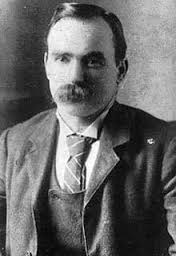
People often pick and choose from revolutionary writings to find what they want and then quote out of context.1 In 1909 Connolly wrote the words Corbyn quoted at the Féile, clearly thinking that the large organised workers’ movement in Britain might bring about a revolution.
And also of the opinion that the revolution there would open the gates to a revolution in Ireland – or vice versa. Those are of course still possible outcomes but it seems to me more likely to occur with the Irish revolution giving the impetus to a British one.
In 1920 Lenin too recommended British revolutionaries to vote for Labour “as a rope supports a hanging man”.
That quotation has been repeated by social-democrats and some Trotskyists out of context and ad nauseam too, right up to the present. Lenin at no time argued that people should support the government of an imperialist state.
I think Lenin was mistaken because the British Labour Party had confirmed the imperialist ideology of its leaders at least six years earlier.
In 1914 most social-democratic parties overturned their earlier agreed declarations against war and supported their own national capitalist classes who were sending hundreds of thousands of working people out to slaughter the working people of other countries.
Connolly in Ireland, John MacClean in Scotland and the Bolsheviks in Russia were among the few who stuck to the flags planted earlier.
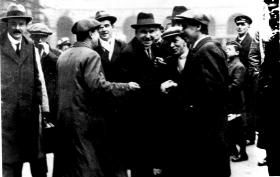
THE BRITISH LABOUR PARTY’S ACTUAL RECORD
The British Labour Party leadership was represented in the WWI War Government and thus colluded in the suppression of the 1916 Rising in Ireland and the execution of 16 leaders, the news of which a number of Labour MP’s cheered in Parliament.
It might have been interesting to hear Corbyn commenting on that and on the subsequent history of the Labour Party. And has British social democracy uprooted “the social system of … the British Empire”? Not in the least, in fact propping it up time and again.
Since 1914 up to the present the party has shown itself, whenever it was not its actual executive, to be the social prop of the imperialist British bourgeoisie. But actually it has often been in government sending troops to suppress national liberation struggles in many parts of the world.
The struggles include those in Vietnam (recruiting Japanese POWs to fight the Viet Minh) so as to hand the country over to French colonialism, which they did. They rearmed Japanese POWs in the Dutch East Indies too in a bloody war against the national movement.
Because of how little-known this war is, I do not apologise from quoting extensively on it from socialist historian John Newsinger.2
Once again, British troops began arriving after Labour had taken office, and found themselves confronting a well-armed nationalist movement that had taken control of most of the country.
Fighting was so fierce that the British turned to the Japanese prisoners-of-war, rearming thousands of them and deploying them against the rebels.
The city of Semarang was taken by Japanese forces, using both tanks and artillery, killing over 2,000 rebel fighters and civilians, and driving the survivors out.
According to one account, ‘Truck loads of Indonesian prisoners with their hands tied behind their backs were driven into the countryside and never seen again.
When the Japanese handed over to the British on 20 October 1945, the British were so impressed that the Japanese commander, a Major Kido, was recommended for the Distinguished Service Order (DSO).
Such an award would, of course, have been political dynamite at a time when British prisoners were being liberated from Japanese camps and would have drawn unwelcome attention to the Labour government’s policy of imperial restoration.
Indeed, both Attlee and Ernest Bevin, the Foreign Secretary, lied to the House of Commons about the extent of the use of Japanese troops. The heaviest fighting took place in the port-city of Surabaya where some 4,000 British troops came under attack towards the end of October.
Over 200 British and Indian soldiers were killed, including their commander, Brigadier Mallaby. Reinforcements were poured into the city and on 9 November a full-scale assault, involving 24,000 troops supported by twenty-four tanks, was launched.
Surabaya was shelled by both land and sea and bombed from the air. On the first day of the assault, over 500 bombs were dropped on the city including 1,500 pounders. Two cruisers and three destroyers joined in pounding the city.
It was, according to one account, ‘one of the largest single engagements fought by British troops since the end of the Second World War’. Only after three weeks of heavy fighting were the nationalist forces driven from the city, suffering some 10,000 casualties in the process.
At the end of the fighting, ‘90 percent of the city’s population were now refugees’. Even today, this major battle is virtually unknown in Britain, although in Indonesia the first day of the British attack, 10 November, is still celebrated as ‘Heroes Day’ … (in) the Indonesian struggle for independence.
Although the Churchill Coalition sent troops and airforce to suppress the Greek Communist resistance after defeat of the Axis troops there, Labour in government continued the policy of restoring the discredited and largely unwanted Greek King against popular resistance.
In Malaya the British banning of strikes and opening fire on unarmed demonstrations of former allies led to armed resistance and war. In Kenya too, treatment of the people led to a war of resistance and British troops committed atrocities in both theatres, including rape and torture.
Later, the UK sent troops to fight in Korea, Cyprus, Aden, Oman, Afghanistan and Iraq and bombed Libya, always with Labour Party support whenever the party was not in the actual executive, i.e in government.
Now, perhaps the author of the article in SF’s publication is weak on international history (clearly the party has never spent any great effort in educating their membership in such areas).
But surely he would be familiar with the events of 1969 in Ireland and of the following three decades there?
Yes, it was a Labour Government that sent troops into the colony in 1969 to crush the struggle for civil rights there, civil rights by the way that were guaranteed by law in every part of Britain.
It was a Labour Government once again that brought in the Prevention (sic) of Terrorism Act in 1974, repressive legislation against the Irish community in Britain which led to intimidation and harassment of thousands of Irish people, raids on homes and deportations.
Under a Labour Government a score of innocent Irish people were framed on extremely serious charges in 1974 and the first antifascist on a demonstration was killed by police – coincidentally of Irish descent too (Kevin Gately, from Leeds, Red Lion Square, London).
In addition to the crimes abroad of British Labour while in government, it supported all the major crimes committed under a Conservative Government, including most definitely those in Ireland.
WHY DO THEY QUOTE THEM?
If social democrats and liberals politicians truly respect those revolutionaries they quote, why do they not follow their teachings? Because in reality, they fear revolution.
But why, in that case, do politicians quote revolutionaries in the first place, even if out of context? It’s because they know that the people love and honour the memory of those revolutionaries and they hope to use them to enlist the people in their reactionary projects.
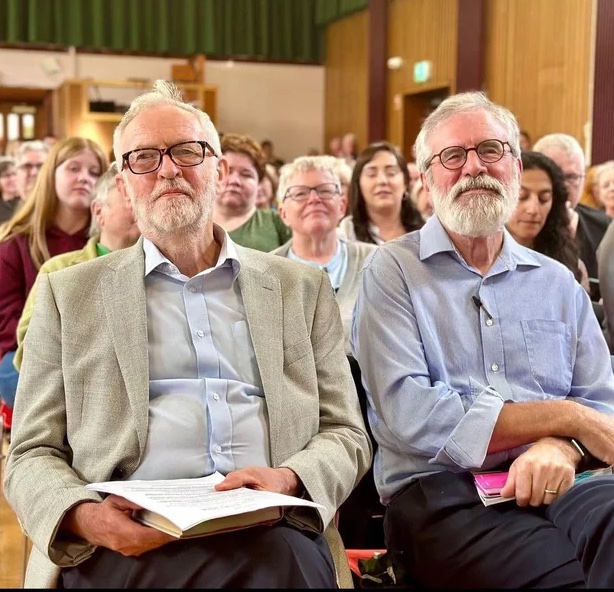
It should not surprise us to see promotion of British social democracy by a party that shares in the administration of a British colony and which is itself dabbling in social democracy — but it is sickening to see them welcoming the use of James Connolly in the course of that.
Connolly was quite clear on his attitude which set it down in song lyrics in Songs of Freedom, published in 1907 in New York3:
Some men, faint-hearted, ever seek
Our program to retouch;
And will insist, whene’er they speak
That we demand too much.
’Tis passing strange, yet I declare
Such statements give me mirth
For our demands most moderate are:
“We only want the Earth.”
“Be moderate,” the trimmers cry
Who dread the tyrants’ thunder;
“You ask too much and people fly
From you aghast in wonder.”
’Tis passing strange, for I declare
Such statements give me mirth
For our demands most moderate are:
“We only want the Earth.”
Our masters all, a godly crew
Whose hearts throb for the poor;
Their sympathies assure us, too
If our demands were fewer.
Most generous souls! But please observe
What they enjoy from birth
Is all we ever had the nerve
To ask, that is, the Earth.
The Labour fakir, full of guile
Base doctrine ever teaches
And whilst he bleeds the rank and file
Tame moderation preaches4.
Yet in his despite we’ll see the day
When with sword in their girths
Workers5 will march in war array
To claim their own, the Earth.
For workers1 long with sighs and tears
To their oppressors knelt;
Yet never yet to aught save fears
Did heart of tyrant melt.
We need not kneel, our cause is high,
Of true hearts there’s no dearth
And our victorious rallying cry
Shall be: ‘We want the Earth!’
End.
FOOTNOTES
1It is even said that “the Devil can quote Scripture”.
2 Newsinger: War, Empire and the Attlee government 1945–1951 65
3No air was indicated for the song; in England I heard it sung to the air of A Nation Once Again, which gives the opportunity for a chorus of “We only want the Earth” etc and of all the airs to which I have heard it sung I believe that one suits it best.
4In my singing, I have reversed the order of ‘preaches’ and ‘teaches’ which to me seems more appropriate, particularly in this era.
5I inserted ‘workers’ rather than ‘labour’ for what should be obvious reasons.
6Ditto.
SOURCES
Jeremy Corbyn returns to West Belfast for Féile35
Newsinger: War, Empire and the Attlee government 1945–1951 65
https://www.marxists.org/archive/connolly/1907/xx/wewnerth.htm
 rebelbreeze