
(Translated to Spanish by unknown source and from there to English by D.Breatnach)
(Reading time: 2 mins.)
An amazing history of cooperation between a Russian woman and her cat to survive the starvation of the Nazi siege of Leningrad Sep 8, 1941 – Jan 27, 1944. History presentation in a Saint Petersburg museum.
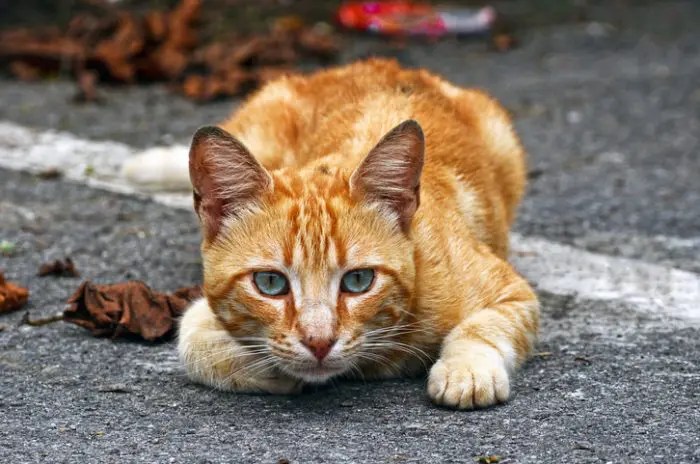
“My grandmother always said that both she and my mother survived the Siege of Leningrad by the Nazis (1941-1944) thanks to their cat Vaska. If it hadn’t been for that cunning red-furred rascal, they would both have starved, as many others did.”
– Granddaughter and daughter of Vaska’s humans.

“Every day, Vaska would go hunting and bring home a mouse or even a big rat. My grandmother gutted the mice and made stew, while with the rats, she managed to make a good goulash.
“The cat always sat next to her (her grandmother) and waited for her turn to eat. During the night, the three of them got under the same blanket and he lulled them to sleep with his purring.
“The hunger was terrible. Vaska was hungry and skinny, like everyone else. All winter my grandmother saved crumbs for the birds, and when spring came she and Vaska would go hunting for them. She would spread the crumbs and then hide with the cat to ambush them.

“Her pounce was always surprisingly accurate and fast. But Vaska was as malnourished as they were, and he no longer had the strength to kill the bird. So, my grandmother would let him just catch it and then she would come to help him. So, between spring and fall, they only ate birds.
“He was aware of the bombing long before they could hear the noise of the planes. When Vaska began to fidget and meow in anguish, my grandmother knew it was time to take her clothes, water, my mother, and definitely Vaska too, and leave home at a run.
“When they had to run to a bomb shelter, being a member of the family, they would also take Vaska and watch him closely so that no one would take him and eat him.”
“At that point in the war, Vaska was very weak, but present in his family, like his story in Russian museums today. Rats abounded because bombing survivors ate cats. Hence, in the middle of the enemy invasion, plagues of rats were also unleashed that further complicated the scenario.
“When the blockade of the city was finally lifted and food came again, and even after the war, my grandmother always saved the best bits for the cat. She would caress him lovingly saying ‘you are our breadwinner’.
“Vaska died in 1949 and my grandmother arranged to bury him in the cemetery. So that no one would trample on his grave, she put a cross on it where she wrote ‘Vasily Bugrov’.
“When her time came, my mother buried my grandmother next to the cat, and later I buried my mother with them. Today, the three lie together under the same tombstone, as in the war, the three together under the same blanket.”
end.
Note: The Siege of Leningrad cost an estimated 800,000 of the city’s inhabitants, one of the statistics that goes to make the 24,000,000 Russian dead of WW2, of which less than half were military deaths.
The decisive turning point of the War was in Russia and all of Eastern Europe was liberated by the Red Army, though today most people in the West would be under the impression that defeating the Nazis was mainly the work of the USA and the UK.
 rebelbreeze