SWISS GOVERNMENT PLANS MASS SLAUGHTER OF WOLVES

Diarmuid Breatnach

(Reading time main text: 4 mins.)

The imagination’s land of the Red Cross, cheese, cuckoo clocks and chocolates plans the massacre of 70% of its wolf packs.1

In reality of course Switzerland is a very regulated country, with a rich financial/ industrial economy and is a major arms producer.

However in 2020 Swiss voters made their desire to protect endangered species clear, when 52% of voters rejected a hunting law that would have made it easier to kill endangered species such as wolves.2

Despite the vote, the Swiss parliament passed a new law in December 2022 that allows the wolf population to be ‘regulated’. Then, just days ago, the government proposed a regulation that will wipe out 19 of the 31 wolf packs remaining in Switzerland!

Eurasian Grey Wolf in snow (Photo sourced: Internet)

WOLF MYTH & REALITY

Childhood and adult fiction is replete with horror stories about wolves (to say nothing of werewolves) attacking humans but, when set against reality, these seem like propaganda. The reality is that it’s not to humans that wolves are generally a danger but to their livestock.

Wolves (Canis lupus) are highly intelligent pack canines and, apart from having donated the dog (Canis lupus famialaris) as a worker and companion for humans, is well aware of its survival boundaries with Earth’s very apex predator – humans (Homo sapiens).

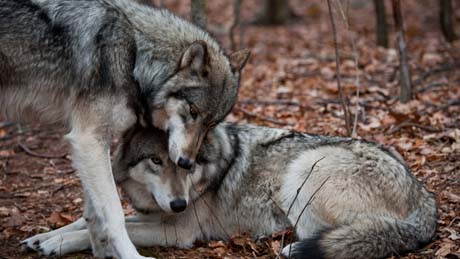
Wolf fondling another; pack members are very affectionate to one another while the alphas maintain boundaries. (Photo source: Internet)

Wolves prey substantially on rodents but must also, for pack survival, prey on larger mammals such as deer, mountain goats and boar. When these are in poor supply or other prey is temptingly easy, such as cattle and sheep, they will take those too.

The traditional human fear of wolves is therefore not one based on self-preservation but on economic priorities. And in the moralistic story of “The Boy Who Cried ‘Wolf’” it is not the human villagers that are attacked by the wolf pack but the community’s sheep.

However, if humans are to continue consuming a diet that will include meat, they will of course need to protect their livestock from wolves and have being doing so even before history was written.

Traditionally the main agent in that protection has been, ironically perhaps, the wolves’ own descendant, the dog – or more specifically, several livestock guardian breeds of dog.

Known livestock guardian dog (LDG) breeds include the Aidi (Atlas Mountain Dog), Carpathian Shepherd, Estrela, Greek Shepherd, Komondor, several breeds of Mastiff and Sardinian Shepherd; a known extinct breed is the Alpine Mastiff (before 5th century BC to 19th century AD).3

Mastín (Mastiff) amidst sheep it guards near Lagunas de Somoza (León, Spain). (Photo sourced: Internet)

Livestock guardian dogs are socialised to the livestock and to their immediate human ‘family’ and will not tolerate the close approach of any potential predator (which often includes even other humans). The primary role is to protect the herd, warn of danger and if necessary, attack.

Where employed in the past, LGDs have been highly effective in protecting their charges, in most cases not even having to fight predators but rather intimidating them. If they have to fight, they are bred for fearlessness and tenacity and their throats also protected by a “wolf-collar”.

Anatolian or Kangol Livestock Guard Dog, with sheep herd it is protecting, Eastern Turkey. (Photo sourced: Internet)

Predators, however courageous, also have strong survival instincts which warn against danger to life or limb (the latter, for a predator in the wild, often in time equalling the first). Unless absolutely desperate they will move on to safer although more difficult-to-catch prey.

For a good LGD however, there is no backing down possible, it is in defence of its own (as a wolf pack might defend its pups). The herder, when present with a firearm, is mainly an additional protection, as well as an alpha member of the dog’s ‘pack’ to obey and protect.

In contemporary times, LGDs have proved effective throughout the world, even in the experimental reintroduction of wolves to the USA.4 So why are they not being more widely employed and, instead, the remaining large predators being exterminated?

Central Asian breed of Livestock Guardian Dog beside its owner (Photo sourced: Internet)

It is no doubt more profitable for big livestock famers to have huge herds roaming freely and when they run out of edible pasture, to move the herd by herding dogs, mechanised herding vehicles or even helicopters. But is it all-around better? And are huge herds environmentally viable?

Apart from other considerations, wolves have been shown to have an environmentally positive effect in a balance between predator, prey and the environment, including vegetation and even water courses, for example in the famous case of the reintroduction of wolves to Yellowstone.5

Deer are pretty to look at but eat young trees and cause damage to reachable branches, while wild goats will eat almost anything, right down to the roots. Wild boar can also be very destructive and, being omnivorous like humans, even prey on ground-nesting birds.

Eurasian Grey Wolf in woodland (Photo sourced: Internet)

All of those invade agricultural crop lands to eat, in the course of which they also trample other crops; wild boar6 are now invading villages and suburbs in a number of towns and cities, overturning large refuse containers for their edible contents.

Female wild boar with litter of piglets in German urban area (Photo cred: Florian Mollers)

Wolves and other predators keep those species down to numbers in better balance with the environment but also of less bother to human settlements. Wolf packs on the other hand do not grow in size beyond the food supply that is fairly safely available.

The human race has made a huge impact on the environment which is sustainable up to a point beyond which, however, we are rapidly passing. We live in a sustainable balance with the environment — or we perish. Perhaps “let the wolf live” can be part of the lesson we need.

End.

FOOTNOTES

1https://theswisstimes.ch/rssfeed/criticism-of-planned-wolf-culling-by-environmental-groups-in-graubunden/

2Including the European Brown Bear, European Lynx and Eagles.

3https://en.wikipedia.org/wiki/Livestock_guardian_dog

4“After the reintroduction of wolves, that were eliminated in the United States in the 1930s, American farmers were losing about a million sheep annually to wolf attacks. 76 farmers took part in the Coppingers program, which introduced European livestock guardian dogs into the US sheep breeding (in their project they used Anatolian Shepherd Dogs). In all farms, where, in the absence of dogs, up to two hundred attacks of wolves per year happened, not a single sheep was lost under the protection of LGDs. At the same time, none of the predators protected by law got killed: the dogs simply did not allow them to approach the herd.” – https://en.wikipedia.org/wiki/Livestock_guardian_dog

5https://www.yellowstonepark.com/things-to-do/wildlife/wolf-reintroduction-changes-ecosystem/

6A wild boar is much more likely to attack a human than is a wolf in Ireland, where the Wolfehound breed was famous, it was a boar that mortally gored Diarmuid of the legendary Fianna after his return from exile. Wild boar also carry diseases that can infect domestic pigs and humans.

SOURCES

Planned Swiss wolf massacre: https://theswisstimes.ch/rssfeed/criticism-of-planned-wolf-culling-by-environmental-groups-in-graubunden/
https://euro.dayfr.com/local/792716.html

Switzerland as arms exporter: https://www.swissinfo.ch/eng/politics/switzerland-contributes-to-global-arms-trade-boom/46565762
https://www.swissinfo.ch/eng/culture/arms-trade–swiss-neutrality-as-business-strategy/48457830
https://www.bloomberg.com/news/articles/2023-03-07/swiss-arms-exports-jump-29-as-industry-laments-neutrality#xj4y7vzkg

Livestock guardian dogs: https://en.wikipedia.org/wiki/Livestock_guardian_dog

Boars as a problem in urban areas: https://www.nationalgeographic.com/animals/article/wild-boars-are-wreaking-havoc-in-europe-spurring-creative-solutions
https://www.nationalgeographic.com/animals/article/hong-kong-urban-dwelling-wild-boars

The Yellowstone Park wolf introduction experiment: https://www.yellowstonepark.com/things-to-do/wildlife/wolf-reintroduction-changes-ecosystem/

“IT WAS FUN WHILE IT LASTED”

Diarmuid Breatnach

The indicator climbed the temperature gauges and the ice caps melted. The seas rose and in many of the more developed societies, the rich and better-off had to relocate from scenic coast sites further inland, having to move again as the seas moved higher still but some, the more cautious and far-seeing among them (not a trait in great supply among their kind), transferred to mountains.

Melting Artic ice threatens the Polar Bear but also raises sea level around the world.
(Photo source: Internet)

The prices of property rose and the construction industry had another boom, which was great for those who had directorships or investments in construction companies or materials. Or in banks, which gave out interest loans like they would be out of fashion the following year (which they well might, some said with a laugh – but a hollow one).

Far away from the Artic, a flooded village, probably in the Indian Subcontinent.
(Photo source: Internet)

In the less-developed parts of the world, all the fishing communities had to move further inland and fishing was harder, with lines and nets getting entangled or shredded on the branches of trees and shrubs that were now submerged. Besides, the waters were polluted with flooded sewers, drains, latrines, dumps ….. and plastic.

Some of the nuclear power stations had been built near coasts and they were flooded. Some had exploded, causing unimaginable disaster. Well, what used to be unimaginable. Vast areas of sea, including all that lived in them, from algae and plankton to the great whales, suffered radioactive contamination.

Wind and wave turbines were swamped too and wrecked by storms. Oh, the storms! The changing climate brought great heat to formerly temperate and cold climes while those that had been hotter grew sometimes cold, sometimes even hotter. Those changes created cyclones, hurricanes, great storms that destroyed so many constructions of all types.

Overall, the greatest impact of all this on the human population of the planet was a huge loss of generated energy. Oil and gas fields began to run out and remaining extraction installations to cease working as they were wrecked by storms, flooded or destroyed by climate protesters.

Power station polluting the air. But without power ….!
(Photo source: Internet)

Electrical energy became scarce. Entertainment companies, which would normally have done well in times of disaster, went bust since fewer people could receive their programs. The Internet was taken over by governments for civil defence. All kinds of sophisticated equipment could no longer work. Radio replaced TV in most homes and mobile phones went out of fashion. Bicycles soon outsold cars.

Human-powered friction generators of many types began to be produced. Batteries of all kinds were in great demand, especially the rechargeable ones. Solar panels reached astronomical prices on the black market, the only place they were available. People were killed over them: sometimes as gangs fought for control over a diminishing supply, sometimes as someone was sold a dud and went looking for the seller for a refund.

Now, a strange thing happened – they began to run out of oil-based material. Hard plastic was still around but leak-proof and waterproof polythene bags were hard to find. So too with oil-based material used in clothing, such as acrylic. Bark could be used for clothing but there weren’t enough trees to keep up with the demand. There was less wool and leather as the sheep and cattle herds diminished. After awhile, that was less of a problem as there were less humans to clothe anyway.

(Photo source: Internet)

Employees of State companies and departments considered essential – by their employers – lived in walled communities protected by watchtowers and armed guards. And the rich lived in there too. Being rich meant a lot less than it did in the good old days but still a lot more than most people had now: meals every day, hot and potable cold water in good supply, good shelter, access to waste disposal, available medical supplies and recreational drugs including alcohol, armed protection and transport for self and small family circle. Security workers of all kinds became highly valued and former gang members formed themselves into security companies. Some police departments became private security firms and so also did some military. Although they didn’t talk about it most of the time, the rich lived in fear that their security compounds, walled villages and high-rise fortresses would be overrun. Or that their security services would stage a takeover, which is why they generally employed two companies at the same time and kept them in competition with one another.

Another fear was that there would be no replenishing of their huge stocks of food and goods when they were all used up, which was going to happen someday. Not enough production was still going on and what there was tended to be exchanged in barter, rather than coin or scrip.

Dainfern, northern suburbs of Johannesburg, South Africa, has a four-metre electrified fence with cameras and vibration sensors protecting more than 1,200 houses. Photograph: Jeffrey Barbee

The poor lived in fear too and not just of starvation or of getting sick without access to medical services but of gangs taking what little they had left or of abductions of self or of family members to supply services of all kinds to gang members. Of wars between gangs. Of being in the wrong gang area when a rival gang staged a takeover.

Huge sections of the human population were wiped out, through loss of essential services, starvation, exposure, dehydration, fire, heat, cold, drowning, epidemics, resource wars with other states or internally. Along with them went pets that did not succeed in becoming feral and cattle, sheep and horses. The pigs went feral pretty successfully, overall as did some chickens. Many, many specialised species or in fragile ecosystems became extinct. Over time, some new species began to evolve.

It is said, though the story might be apocryphal (a word perhaps suitable for an apocalypse), that in one of the compounds of the rich overrun by a gang or insurrectionary group, depending on which version one hears, a former petroleum magnate put on trial was asked why he and his kind had not stopped destroying the climate, even after it became clear to even the most stupid politicians (which can reach a very high level of stupidity) what they were doing to the world.

It is said he related the fable of the frog and the scorpion.

In case you don’t know the story, it goes like this: A scorpion wants to cross a river but knows he can’t swim well enough to do that, so he goes in search of a frog. When he finds him – the frog of course keeping his distance – he asks him to take him on his back across the river. The frog replies that as soon as lets him on his back, the scorpion will sting him and the frog is not ready to die yet.

The scorpion pleads with the frog, who sees that the scorpion really means it. And it would be very handy for a frog to have a dangerous animal like a scorpion in his debt. So he agrees.

The frog hops down to the shallow water and the scorpion gets on the frog’s back. The frog tenses in fear but nothing happens. The frog starts to swim, feeling more and more relaxed. Halfway across the river, the scorpion stings the frog. As the poison courses through his body, the frog speaks to the scorpion: “Why did you do that? Not only did you break your promise and kill me but you will die now too, you will drown.”

“I know,” says the scorpion. “I just couldn’t help it. It’s in my nature.”

It is also said that in another compound overrun by hostile forces, as a couple of drug company executives were being taken out to be shot for crimes against humanity, including climate destruction, one of them turned to the other with a smile.

“Cheer up”, she said, “It was fun while it lasted.”

end.

THE SCENT OF INTRUDERS

Diarmuid Breatnach

 The inhabitants of this land have fought invaders for at least a thousand years, some successfully and some less so.  Many of the invaders were assimilated.  Throughout this time, other invaders have quietly entered and spread throughout the land, mostly without encountering any organised opposition.


Last month and perhaps occasionally since, your nose might have picked up a scent drifting towards you, particularly as evening drew near but also at other times.  The aroma I speak of is one of those scents that is difficult to describe and that actually seems to change from time to time and also according to whether one is right beside it or farther away.  Sometimes it seems musky and very pleasant while at other times is not so welcome.  

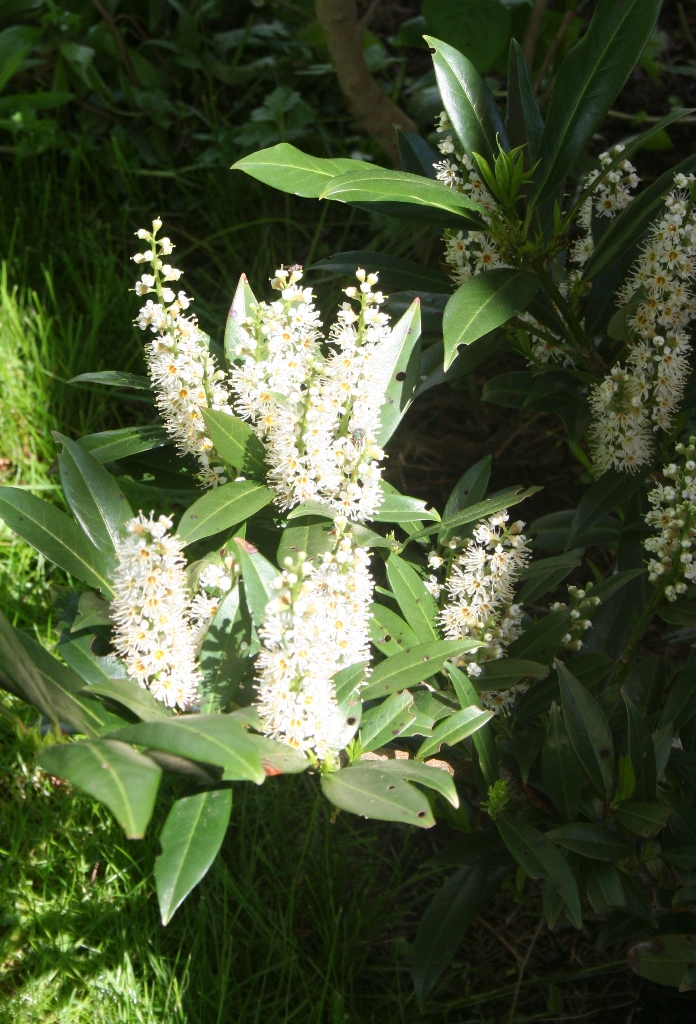
The scent may have been from the blossoms of the Cherry Laurel (Prunus laurocerus), a dense thicket-forming shrub that grows to small tree size with a strong thick trunk covered in a smooth dark grey bark.  It is neither a cherry variant nor a laurel (or bay), which its leaves supposedly resemble, these being thick and dark green but poisonous (containing cyanide).  The blossoms, white flowers clustered on upright spikes, produce blackish fruit in the Autumn about the size of cherries which are also poisonous to humans.  Originally from South-West Asia, it was introduced into Irish gardens as a shrub or hedge plant (uses to which it is still put) but it has “escaped” and established itself in the wild.

Cherry Laurel bush with flowering spikes in early stage

The Cherry Laurel has become very successful and a resultant problem for bio-diversity in Ireland. A quick perusal of the on-line references do not reveal the reason for its success; it tends to be grouped alongside another invasive species, the Rhododendron, which deposits a chemical in the ground surrounding it, thereby preventing other plant species competing with it for light, moisture and nutrients. Like the Cherry Laurel, the Rhododendron is a plant species invasive to Ireland.  Of course, since Ireland was almost entirely covered in ice 20,000 years ago, nearly all of the plant life now naturalised on our island had to have been invasive species originally — including trees, bushes, flowers, grasses, ferns …

Cherry Laurel flowering spikes at late stage

Invasive species are not always harmful to the existing balance (or to humans) but clearly they have to have some means of competing with the existing flora (plant life) or they would have been unable to establish themselves.  They may have better protection against herbivorous animals (undoubtedly the Cherry Laurel has at least that), or against insect or snail attack, or even against fungi (such as the ‘blight’ that attacked the potato a number of times in Ireland in the 1840s).  Or they may be able to occupy a niche not well exploited so far, as one of the Buddleida species has done (literally, one might say), growing out of thin gaps in stone or brick walls or on waste ground, its racemes of mauve or purple flowers attracting butterflies and other insects for pollination and later scattering its seeds on the wind.


The Luftwaffe helped the spread of the plant in Britain; so common did this shrub become on waste ground after the Second World War that it earned the popular name of « Bombsite Plant ». The species in question is Buddleia Davidii and according to The Online Atlas of British and Irish Florait was introduced into cultivation in the 1890s, quickly becoming very popular in gardens. By 1922 it was known to be naturalised in the wild in Merioneth and in Middlesex by 1927; it is shown as locally well established in S. England in the 1962 Atlas and “In recent decades it has spread rapidly throughout lowland Britain and, to a lesser extent, Ireland.” It is certainly ubiquitous in Dublin city and surrounds.

Buddleja Bush in bloom
Buddleia Bush in bloom

Buddleja davidii growing out of a wall
Buddleia davidii growing out of a wall

Buddleia (pronounced “budd-lee-ah) has about 100 species native to all continents except Europe and Australasia but a number of species and cross-breds are cultivated in European gardens, including the escapologist davidii. Although nearly all are shrubs growing to at most 5m (16ft) tall, a few species qualify as trees, the largest reaching 30m (98ft). There are both evergreen and deciduous species, not that unusual among trees and shrubs, as appropriate in tropical and temperate regions respectively. Some of the South American species have evolved long red flowers to attract hummingbirds, rather than insects, as exclusive pollinators.

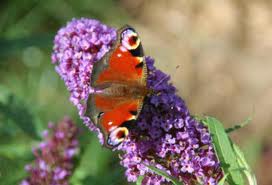
Peacock Butterfly on a Buddleja raceme
Peacock Butterfly on a Buddleia raceme

In Ireland, far from hummingbirds, davidii’s racemes of tiny purple or mauve flowers are a welcome sight as they flower in July, less so as the flowers, having done their work, die and turn brown (though repeated dead-heading can extend flowering until September). The flowers are scented but less so than those of the similar but not closely-related Common Lilac (Syringa vulgaris) which, incidentally, is an aggressive coloniser in parts of Southern Europe and of the USA.  The roots of davidii will do some damage to house walls and chimney stacks if allowed to become established, when pulling them out becomes impossible and the stump would need treating with an appropriate chemical. Checked early, it is easily controllable.

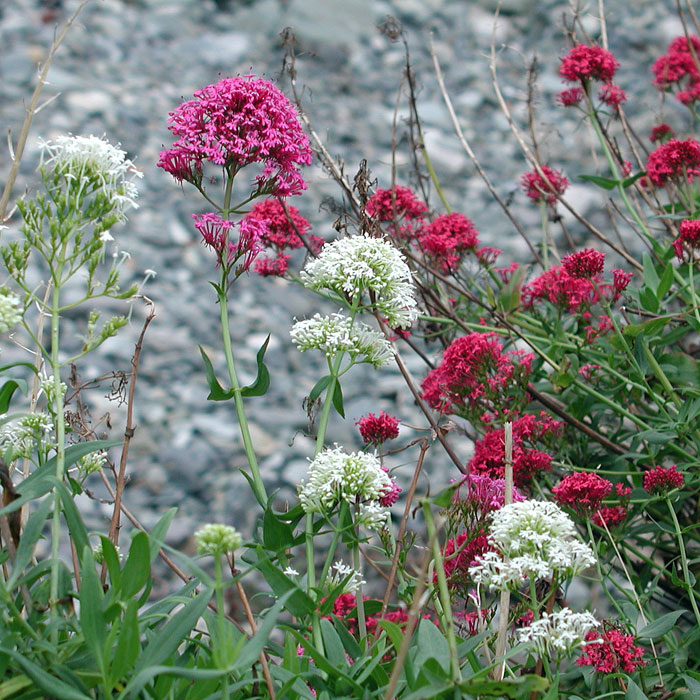
Another successful wall climber in Ireland is the Red Valerian (Centranthus ruber), sometimes known as Jupiter’s Beard. Despite its common name, the flowers are often pink or even white and at times clumps of two or even all three colours may be seen growing alongside one another. This one likes the tops of walls rather than the sides and grows well on dry or stony soil too.

Its seeds are wind-driven too and from anecdotal evidence, it made particular use of the railway cuttings and lines to distribute itself throughout Ireland.

Red Valerian growing on top of a wall

Despite its name, it is not closely related to the true Valerian (Valeriana officinalis), and no medicinal properties have been discovered in Centranthus. The leaves and the root may be eaten but there seems to be no great lobby recommending it as food.  Its scent is rather rank to the human nose.

The three colour variations of Ceranthus Ruber growing closely together on rocky ground

Originally from S.W. Europe and the Mediterranean region, the plant was grown in Britain as early as 1597, according to Online Atlas of British & Irish Flora. Like some cases in human history, when the newcomers were first invited and then became invaders, Red Valerian was first imported to be grown in gardens. By 1763 it was recorded in the wild in Cambridgeshire. Now it is to be found all over Ireland and is generally welcomed. Like some of the invading Vikings, Normans and English, Red Valerian and Buddleja have become part of the Ireland we know today and there seems no need to organise a resistance to them; the Cherry Laurel and the Rhododendron, despite the scent of one and the colour of the other, are a different case altogether.

end


Some on-line sources:

Cherry Laurel

http://www.conservationvolunteers.ie/images/buttons/submenus/news_and_advice/downloads/naa_bpmg_rcl.pdf

Buddleja http://www.brc.ac.uk/plantatlas/index.php?q=plant/unmatched-species-name-392

http://en.wikipedia.org/wiki/Buddleia

Red Valerianhttp://www.brc.ac.uk/plantatlas/index.php?q=plant/centranthus-ruber