EU Vice-President Kallas referred to a number of state leaders meeting in China as ‘autocratic’, accusing them of challenging the ‘rules-based order’ of the Western states. But what is that ‘order’ and what are the ‘rules’ upon which it is based?
Kallas, in the course of her mostly economic briefing on behalf of the EU: While Western leaders gather in diplomacy, an autocratic alliance is seeking a fast track to a new world order. Looking at President Xi standing alongside the leaders of Russia, Iran, and North Korea in Beijing today.
These are not just anti-Western optics; this is a direct challenge to the international system built on rules. And it is not just symbolic: Russia’s war in Ukraine is being sustained by Chinese support. These are realities that Europe needs to confront.1
Leaders of states to which Kallas objected (without North Korea’s), L-R: Vladimir Putin, Xi Jianpeng and Masoud Pezeshkian, leaders respectively of Russia, China and Iran at the Victory of Japan (WWII) parade in Beijing following the recent Shanghai Cooperation Organisation conference. (Photo: CNN)
Who are the ‘western leaders’ to whom Kallas is referring? Presumably they are leaders of the “Western states”, a term usually understood to describe a bloc of the European Union, UK, the United States, Canada, Australia and New Zealand.
A number of the European Union collection of states are imperialist and some of those are generally considered to be the leading members of the whole EU, in particular Germany and France.
Most of the European states also have a recent record of colonialism and some still rule those external colonies in part or wholly, viz: UK, France, Spain.
In addition, some have practised internal colonisation, forcing nations to submit to their integration within and submission to the particular European state; in this regard there should be added Italy and Belgium in addition to the three examples above.2
The principal non-European states of the western alliance are all European settler colonies in origin, all having practised genocide upon the indigenous people, all with a record of racism towards their indigenous and other people and one, the USA, having stocked huge slave plantations.
Given the record above, it is not surprising that these states also have a record of colonial wars and even wars upon their neighbours. In WWI, Germany and Austria fought the UK and its Dominions of Australia, New Zealand and Canada, along with France, Belgium and the USA.
In WWII, Germany and Austria with some allied states went to war with most of the remaining states of Europe and the USA and countries further afield in North Africa and the Middle East.
SINCE WWII, the UK3 has fought 41 external conflicts and a three-decades war internally (against the Resistance in a colonised part of Ireland);4 France fought 34 external conflicts5 and the USA 57.6 The vast majority of these conflicts have been fought in lands outside Europe or the US.
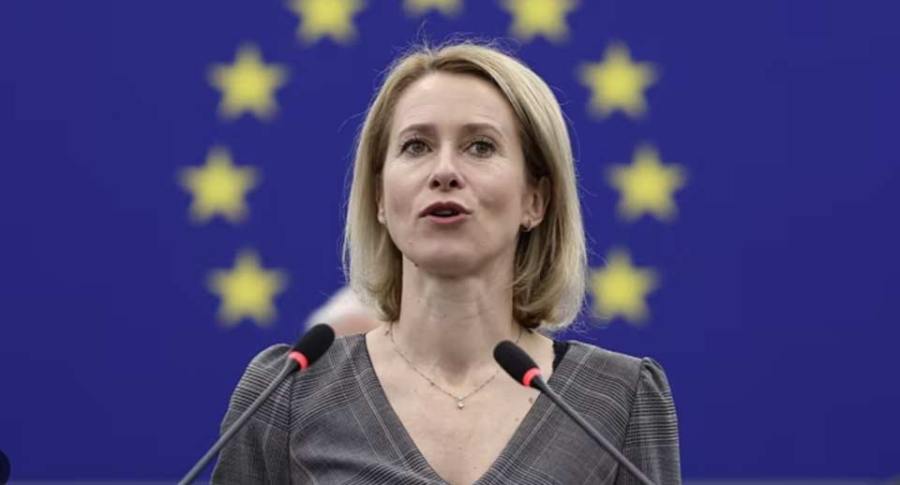
Katja Kallas, Vice-President European Commission, who sanctified Western states in her statement and looking saintly in this photo. (Photo sourced: Internet)
So, on past historical threat record, how do these “autocratic states” compare to the states Kalas complains of? They don’t even come close, of course. Ah, but wait, we are told that they do things by rules – they are part of a “rule-based order”, which those “autocratic states” are not, apparently.
Therules under which the Western states operate for decades have not prevented them supporting – including in many cases with actual arms — a European settler colony carrying out apartheid, constant war crimes and recently genocide against the indigenous people in Palestine.
The rules have allowed these Western states, as distinct from “autocratic states”, to censor news and twist media reporting into Zionist propaganda, to forbid Palestine solidarity demonstrations and beat up participants, categorise solidarity actions as ‘terrorism’ and jail Palestine supporters.
The rules have permitted the state hosting the United Nations building to decide who cannot attend; to regularly veto votes of the majority member states; to ignore decisions of international courts and sanction its officials and to have the UN humanitarian agency de-funded and staff killed.7
In fact, we have been taught that this ‘order’ is based on the following rules: Any member of the Western states club can do what it likes so long as a) the club leader, the USA agrees to it and b) the other members of the club don’t take any real practical adverse action (which they haven’t).
2Arguably Scotland, Wales, Cornwall, Isle of Man and the Six Counties in Ireland are nations or parts thereof colonised and incorporated into its state by England; Brittany, northern Basque Country, Corsica and Pau by France; southern Basque Country, Galicia, Catalan Countries, Andalusia, Asturies by Castille/ Spain; Sicily by Italy …
3The UK includes the nations of Scotland, Wales, Cornwall and part of Ireland, essentially ruled by England and by that understanding the 30 Years War in Ireland was ‘internal’. The Isle of Man is not formally part of the UK but is effectively under its control. France also fought an ‘internal’ war against the Basque national Resistance but that was nothing like the degree of intensity of the British one in the northern Six Counties of Ireland.
“Wars and rumours of wars …”1 The sabres are rattling around Eastern Europe. The mass media in our latitudes largely takes the position of the USA under the guise of democracy; however with some text and the use of a few maps I hope to show that Russia’s position is essentially defensive in this regard and that the USA is the main aggressor. I hope to do that without expressing any support for the Russian regime.
WHAT IS ACTUALLY HAPPENING?
The USA sees Russia as its main opponent or competitor in Europe and has been working since the post-WWII decades to neutralise it, earlier under the guise of stopping the spread of “communism” and defending “democracy”. Since the fall of the USSR system the talk is no longer about defeating “communism” but “defending democracy” continues to used in anti-Russian rhetoric. Russia is no democracy but the notion that the US, the world superpower, the biggest imperialist power on the planet since WWII, cares about democracy should make us laugh. It would perhaps, except that the mass media keeps feeding us the USA’s rhetoric and shaping us to support it in war.
The USA is actually squeezing Russia from two directions — from Europe and from the Middle East. NATO, the North Atlantic Treaty Organisation is a US-led military alliance which now has the membership of most states in the EU, along with the UK and nearly every state of the former USSR to the west of Russia. A look at the map of NATO states will demonstrate that2. Nearly every state in the Middle East is also formally or informally in the sphere of influence of US imperialism3.
“Russia says it wants Western guarantees that Nato will not allow Ukraine and other former Soviet countries to join as members. Moscow has also demanded the alliance halt weapons deployments to Ukraine and roll back its forces from eastern Europe – demands flatly rejected by the West.4”
Map NATO & non-NATO countries in Europe, showing also periodic expansion (Source: The Economist)
So the Russian ruling class is naturally worried and feeling besieged. On or near their European borders they only have Sweden, Finland, Moldova, Belarus and Ukraine which are not formally part of NATO and Ukraine has clearly indicated an interest in that direction. Beyond those last three aforementioned, all the states through central Europe are NATO members right through to the UK: Poland, Slovakia, Hungary and Romania actually bordering on Russia, with – heading generally westward and south-westward– Czech Republic, Croatia, Slovenia, Bulgaria, Albania, Greece, Germany, Netherlands, Belgium, Italy, Spain, Portugal, France and UK. In addition, some of those states have highly-developed military power such as Germany and two of them have nuclear armament of their own — UK and France – while the US has ready-to-launch nuclear missiles on the lands of many of the NATO states — Belgium, Germany, Italy, the Netherlands and Turkey5.
Sweden, Austria and Switzerland may remain nominally neutral but are in general politically aligned with the EU and the USA rather than with Russia, while non-NATO Finland is definitely, for historical and geographical reasons, extremely wary of its Russian neighbour.
The smaller non-NATO states of the former Yugoslavia – Bosnia & Herzegovina, Serbia, Montenegro, Montenegro and Kosovo are in some cases friendly towards Russia (or not overly-friendly towards NATO) but they are completely surrounded by NATO states.
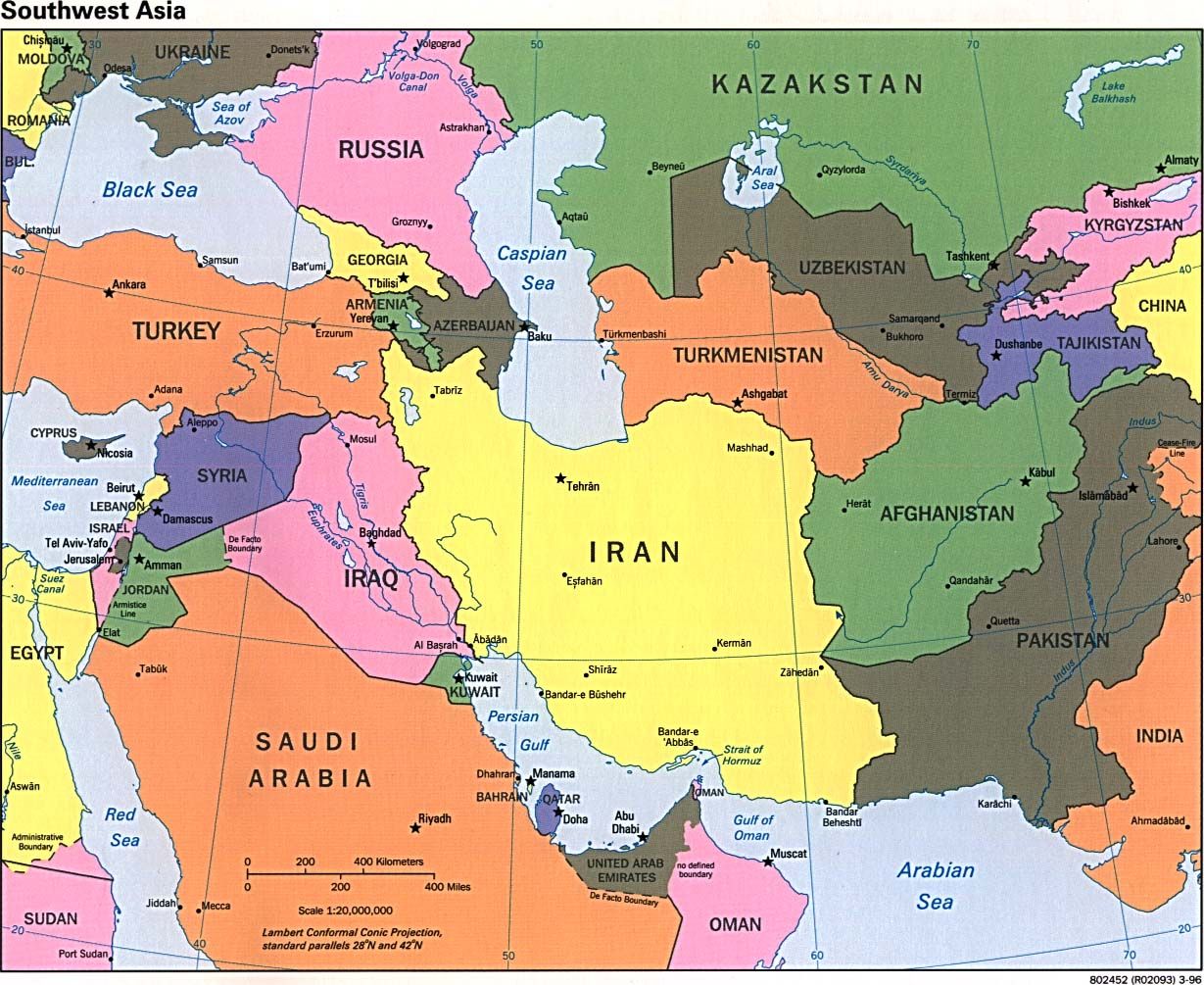
On its borders with the Middle East, Russia is also being squeezed. Turkey has long been a major NATO state in the region and only Georgia is located between it an Russia to the latter’s south-west, with Armenia and Azerbaijan to its south-east. Nearly all of the states in the Middle East are in formal or informal alliance with the West and therefore with the US: Cyprus, Lebanon, Iraq, Israel, Jordan, Egypt, Sudan, Libya, Saudi Arabia, Kuwait, Oman, Bahrain, Qatar and United Arab Emirates. Yemen is embroiled in its own Saudi and West-proxy war, while Syria is threatened by Israel, Turkey and NATO. Only Iran is fairly safe for the moment on that part of Russia’s border, which is why Russia will take its side in any conflict with the West, despite the Russian ruling class’ dislike of and vulnerability in some regions, as in Chechnya, to militant fundamentalist Islam.
Middle East states and Russia (Source: Internet)
Syria is next to Iran which is also why Russia has been supporting the Assad regime and why, during the past week, it has warned Israel about its bombing raids into Syria as the latter attacks Hizbollah bases there. In fact we may see the invasions by western alliances of Iraq and Libya as part of huge US/NATO ‘domino’ plan to attack Syria with Iran next; then the pressure on Azerbaijan and Georgia on Russia’s doorstep. While on the eastern side of Iran, Afghanistan and Pakistan are also allies of the West ….
Further east, there is India which has long been friendly to Russia and in tussles with Pakistan — and China, which is not openly hostile to Russia as a rule but which is not a real friend either, though its competition and contention with the US keeps it friendly enough towards Russia for the moment.
What the Russian ruling class is doing is attempting to bring a halt to its encirclement by NATO at the point of Ukraine. And the US-NATO and EU are issuing a counter-threat – an open one of sanctions and a more veiled one, in the case of US-NATO, of armed action.
This week it appears that some parts of Ukraine have sought to break away from the main part, probably instigated by Russia or at least promised support if they did – which has materialised in Russian diplomatic recognition and in troop movements. This may amount to an annexation or may not but what is clear is that Russia, in the face of what it considers a threat to its existence and NATO intransigence, has decided to take some decisive action.
WHAT IS REPORTED
The western mass media reports the situation painting a picture of big powerful Russia threatening its much smaller neighbour, by threat of invasion seeking to force it into submission to Russia’s regime, in denial of the small nation’s democratic rights. And the democratic West, through NATO, is moving troops to support the Ukraine, warning Russia of consequences.
Russian Tanks and Troops Reportedly entering part of Ukraine (Photo source: The Telegraph)
The picture contains much truth but overall it is a lie. Russia is much bigger than the Ukraine and it is threatening it with troop movements. And NATO is moving troops up to counter-threaten. But to evaluate a situation properly, we need to know its antecedents, what led up to it. We also need to see the situation through the eyes of the participants, whether we agree with them or not. The mass media, apart from a couple of honest analysts tucked away inside a newspaper, far from the headlines, does not supply us with that information.
The Irish Times, one of Ireland’s main daily newspapers, on 12 February reported that “Russia’s military build-up near Ukraine and a surge of Russia’s military activity has fueled fears that Russia could invade the country. Russia denies having any such plans. However a US official has said that the US had picked up intelligence that Russia is looking at Wednesday as a target date for an incursion.”
So on the basis of the quoted paragraph, we were to draw the conclusion that Russia was threatening to invade Ukraine. OK, Russia denied it but then why the military buildup near Ukraine? Finally, the authority voice of the USA, quoting what we are supposed to see as excellent intelligence sources (which we cannot of course question), predicting a probable Russian invasion four days away. So which state are most people in this part of the world likely to believe, the Russians or the US?
Some weeks earlier, on 25th January, another Irish daily newspaper, the Examiner, reported on reactions to a Russian naval fleet exercise in the Atlantic. The Irish Government told the Russians the exercise was not welcome although not illegal6, because the area of the exercise is regarded as international waters. This from the same government that facilitates US military flights via Shannon airport, i.e on its own national territory. And NATO carries out at least one major exercise in European waters annualy, with the UK doing so twice yearly without complaint from the Irish Government.7
The Ukrainian Ambassador to Ireland, Ms Gerasko moved to take advantage of the situation “A plan to hold a major exercise by the Russian navy and air force in the Atlantic off the southwest coast of Ireland is yet another demonstration of the threat that Russia poses for the world,” she said, in a statement to the Irish Examiner.” 8
Attempts were made at the same time to whip up Irish offshore fishermen against the Russians and to whip up the Irish public in defence of “our fishermen”. The latter project failed miserably since the Russian Ambassador to Ireland met and negotiated with the fishermen, leading one of their leaders to comment that the Russians had treated his members better than their own (Irish) government.
We might expect an alternative discourse about the Ukraine crisis from Al Jazeera but its report on the 24th of January, although emphasising US military movements in the area, attached a number of articles which were generally relaying the western line. The Irish Independent carried a much more in-depth explanation, though based on the position of the UK through its premier, Boris Johnson; however it did list the Russian demand that NATO cease pushing towards them and that Russia considered Ukraine joining NATO “an existential threat” while in general still following the general anti-Russian pattern9.
Closing ceremony of Sea Breeze, NATO-Ukraine joint naval exercises in the Black Sea 12 July 2019 (Photo by US Naval Officer)
POSITION OF THE IRISH STATE
An analysis piece in its business section by the Irish State’s national broadcaster, RTÉ, concentrated on the possible economic impact of loss or drastic reduction in gas and oil exports from Russia, either as a direct consequence of conflict or through imposition of sanctions by the West. “Russia produces 11% of global oil supplies and according to David Horgan, managing director of Petrel Resources, any significant loss of Russian energy exports would result in a further spike in prices.”10
Russia is the biggest supplier of gas in the world and the largest to Europe with a third of of its gas pipeline supply to Europe crossing Ukraine. Ireland’s electricity supply is highly dependent on gas for its generating stations so any disruption will impact heavily of prices which “have already gone from $2 to about $30 per million BTU”, according to the Petrel managing director.11
It is clear that while the USA is driving the agenda through its dominance of NATO and the the threat of sanctions on Russia, which the USA regularly insists upon when teaching other countries a lesson, its own economy would suffer little as a result. However, it is a different question for the European states, which would be obliged to bear the weight of economic impact. Mícheál Martin, the Taoiseach (Prime Minister) of the Irish State felt obliged to comment on this possibility but, rather than criticise the USA and NATO’s expansionism, spoke about the need to break from their dependence on Russian energy supplies.
Micheál Martin said the EU is unified in responding “very strongly” to any Russian invasion of Ukraine and stated that in Europe’s view the huge build-up of troops by Russia on the Ukraine border is “not justifiable” in any circumstances. While calling for “diplomacy and de-escalation” he clearly sided with the USA in the conflict as both the Irish ruling class and the EU’s would expect of him.12
Despite many criticisms to the contrary, the policy of the Irish state during WWII was essentially one of neutrality in favour of the Allied forces while the government of the Six Counties was of course wholly aligned with the UK. Nevertheless Irish commercial shipping was sunk by Nazi German action and cost many Irish seamen their lives.
So far the Irish state has remained outside NATO but over the past decade there has been discussion envisaging the creation of an EU rapid deployment force made up of personnel contributed from all member states. It would hardly be surprising if such a move appealed to some within the career personnel in the Irish armed forces, envisaging taking part in wider military action, alongside varied forces, employing advanced weapons and systems and with possibly better promotion prospects. Additionally in recent weeks there has been media discussion of greater funding for those forces.
Ireland – and not only the UK’s colony here – can be dragged into war more easily than we perhaps imagine and also into being targeted for retaliatory action. Indeed, the facilitation of US military personnel and materiel through Ireland’s airport at Shannon, along with CIA transport of secret prisoners (“rendition”) has already exposed the State (and succeeding governments) to accusations of military partisanship.
Contrary to popular belief, the Irish State’s ‘neutrality’ is in general a matter of government policy rather than a requirement of the Constitution or Statute law.13
The principal statute governing the Irish Defence Forces is the Defence Act 1954, which did not oblige members of the Irish Army to serve outside the state (members of the Air Corps and Naval Service are not so excused). A 1960 amendment intended to allow deployment in United Nations Peacekeeping missions requires three forms of authorisation, since the 1990s often described as the “triple lock”:
A UN Security Council Resolution or UN General Assembly Resolution;
A formal decision by the Irish government;
Approval by a resolution of Dáil Éireann (the lower house of the Oireachtas, to which the government is responsible).
From those last two it is clear that the 26 Counties can be put on a war footing by a decision of the Irish Government or even a majority vote in favour in the Dáil. Anyone who believes that the party with most TDs would necessarily vote against such a motion is fooling themselves since the SF party has been at pains to portray itself as a safe pair of hands for Irish capitalism and recently called for greater funding for the armed forces of the Irish state; in addition it has long had an uncritically friendly relationship with the USA, in particular – though not only – with its Democratic Party.
A resolution from the UN Security Council obliging the Irish state to go to war against Russia is impossible and though such from the General Council might be possible, albeit unlikely.14
These provisions were modified in 1993 to allow for UN Chapter VII missions and again in 2006 to allow for regionally organised UN missions.
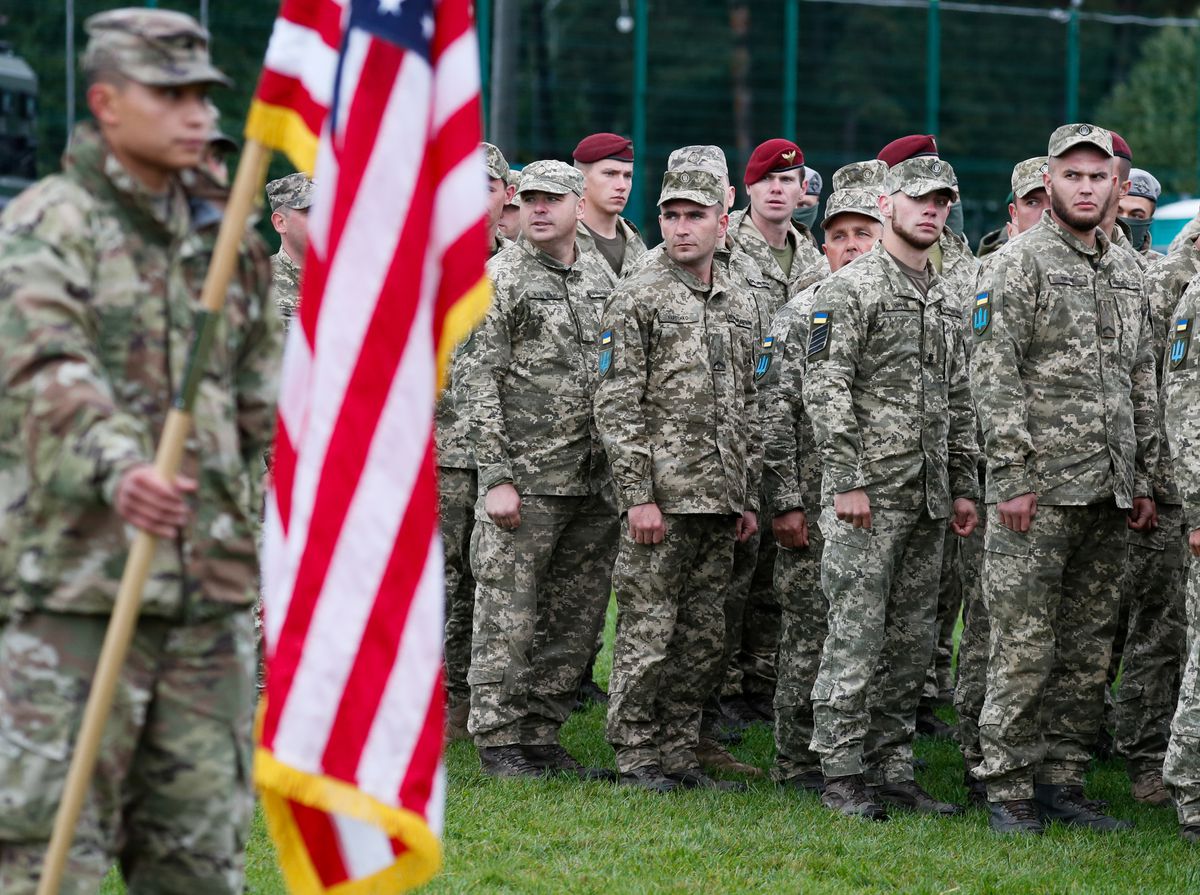
Joint NATO-Ukraine military exercise September 2021 (Photo sourced: Internet)
WHAT WE CAN DO
There seems no middle way — either NATO will back down or Russia will. No doubt the Western powers think it reasonable that Russia be the one to blink but as commented earlier, for the latter NATO creep to their borders is seen as a threat to their very existence. The same people who thought it reasonable for John Kennedy as President of the US to threaten war on the Soviet Union for the location of some missiles on the Caribbean island of Cuba think Russia should accept the advance of NATO to its borders.
In practical terms there seems little we can do in Ireland except struggle to resist the state and colony in which we live being dragged into war – for which we need to mobilise the opposition we can on the street. Sadly the anti-imperialist war movement in Ireland of years ago was allowed to deteriorate — but we should work to rebuild it.
In order to assist in this it is essential that we expose the reality of what is going on in the world. Some will say that because the USA is the main aggressor in this case and the biggest bully, we should support Russia but to do so would be a big mistake. Not long ago, while joining others in anti-fascist solidarity with people in the Donbas region in SE Ukraine, I found us being increasingly nudged towards support for Russia which I did not view as being the same thing at all.
Russia has its own crimes against people and workers and calling for support for it now will cause confusion when in future we will need to condemn it. Our position should be that while neither the USA’s regime or Russia’s is to be supported, the biggest danger of war comes from the USA and therefore it will be the main target of our hostility – besides which it is the power with which the ruling classes of Ireland and the UK are aligned. It is the biggest imperialist power in the world by far along with being the biggest military power in most of the world.
Most Irish people have no wish to be dragged into an armed conflict anywhere where they do not feel threatened. On the other hand our society is conditioned not only by decades of strong cultural influences from the USA, in particular through film but also by media reporting that is biased towards the dominant western European view and that of the USA. In that paradigm, the Russians are the bad guys, the gunfighters in the black hats, while the US and the West in general are on the side of the angels.
With the 1916 Rising in the middle of WWI, Ireland became the first country to carry out an uprising against world war15, against the dominant trend throughout Europe at the time — a tradition worth upholding. As long as imperialism exists, the world will continue to suffer smaller wars and the danger of another major war. It is necessary to overthrow imperialism and we can best contribute towards that aim by coordinating our struggles with the aim of carrying out a revolution in Ireland, thereby depriving imperialism of one of its supporters in Europe.
End.
FOOTNOTES 1“And you will begin to hear of wars and rumors of wars. Behold, do not be alarmed; for it is necessary to take place, but the end is not yet” — Christian New Testament Bible, Matthew, Chapter 24:6.
14Resolutions of the UN Security Council, the only ones binding on all member states, require unanimous agreement by all five Permanent Members: UK, France, USA, Russia and China. Forcing a vote such as this in the UN General Assembly would likely lead to the fracture of the organisation.
15The following year there were two in Russia and in 1918 another in Germany.





 rebelbreeze