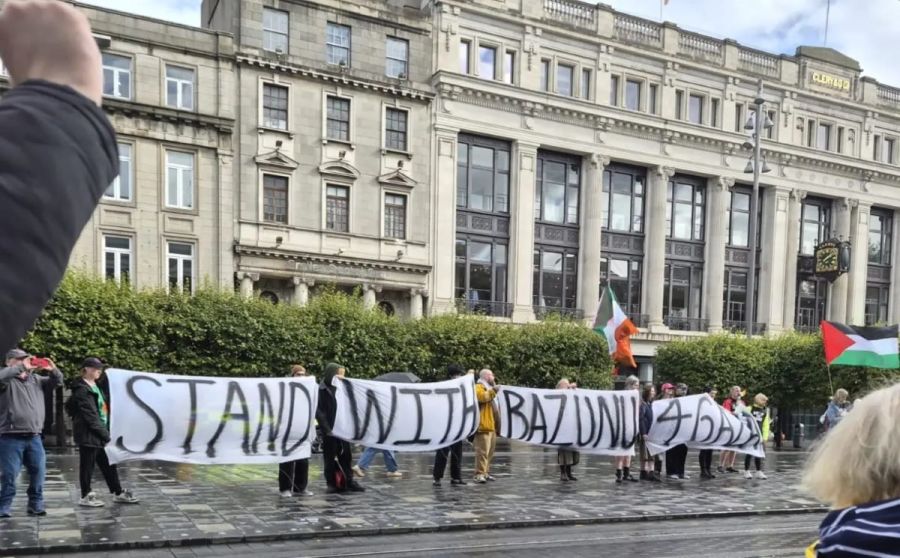
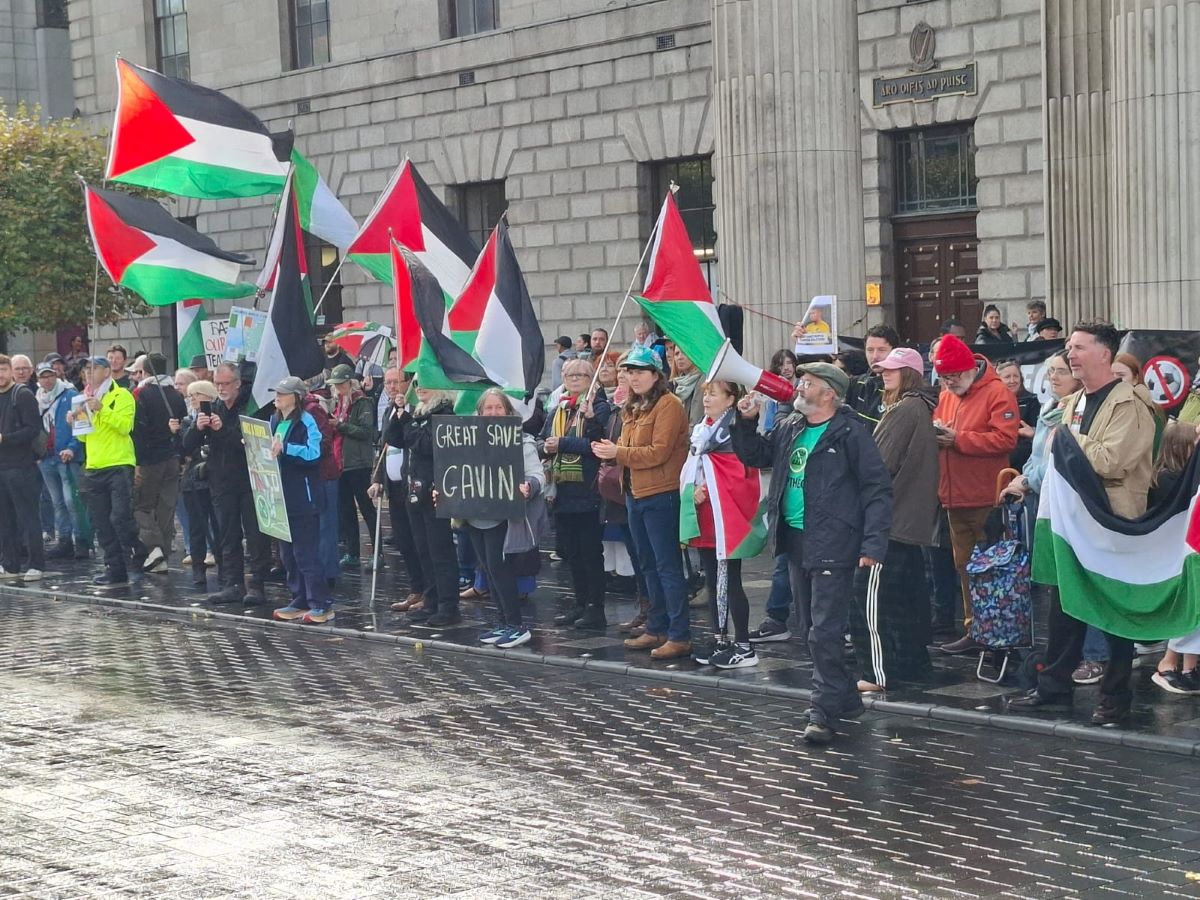
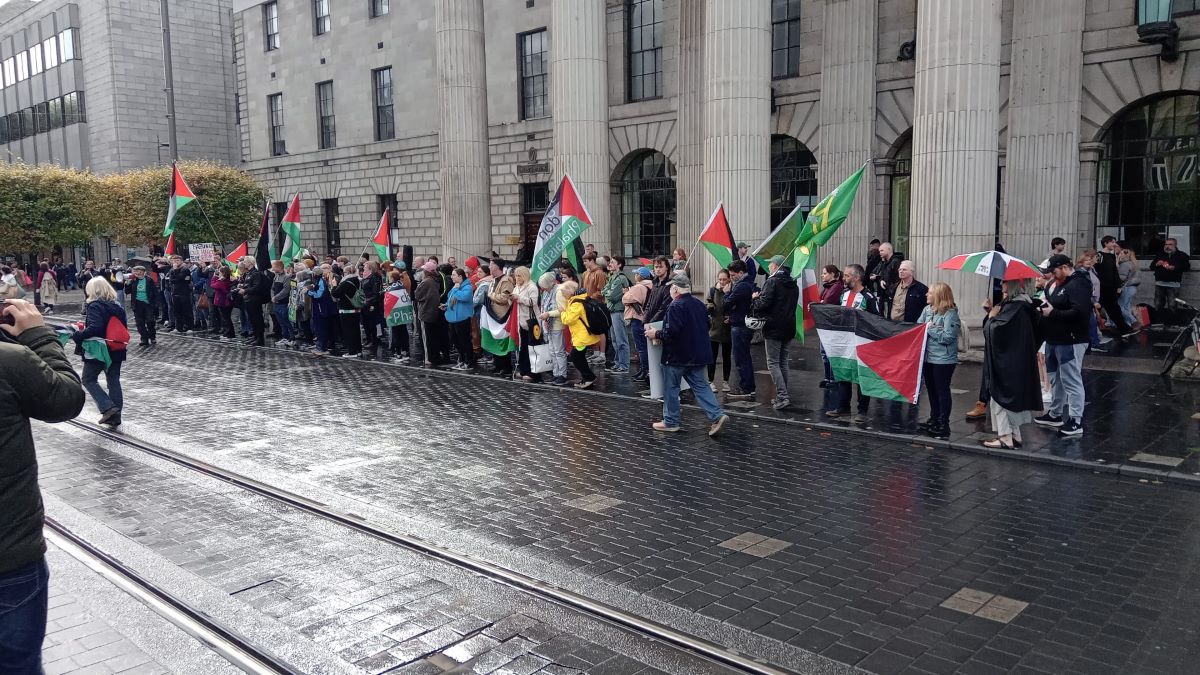
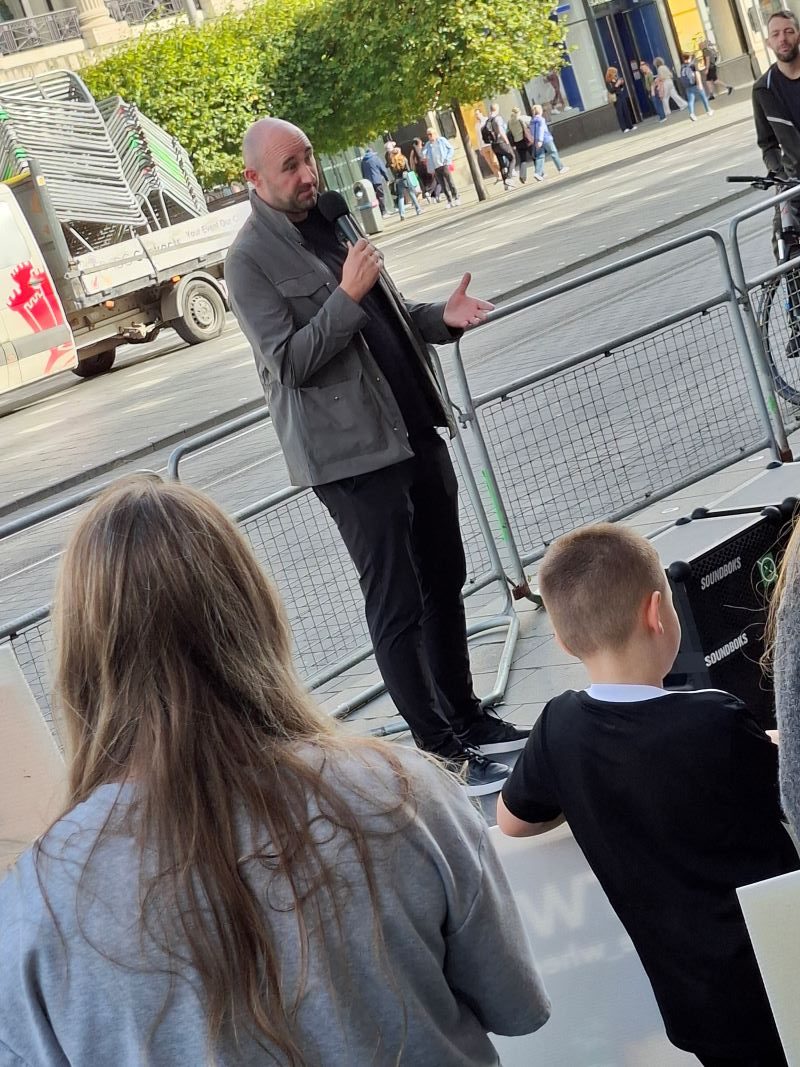
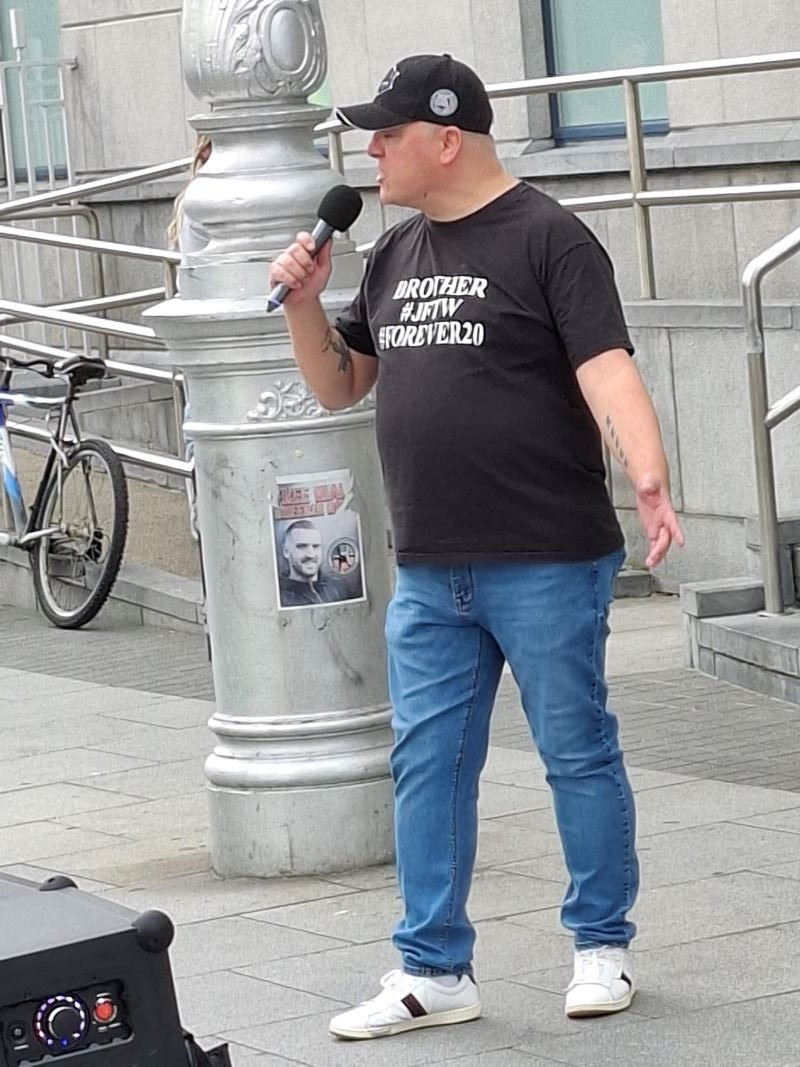
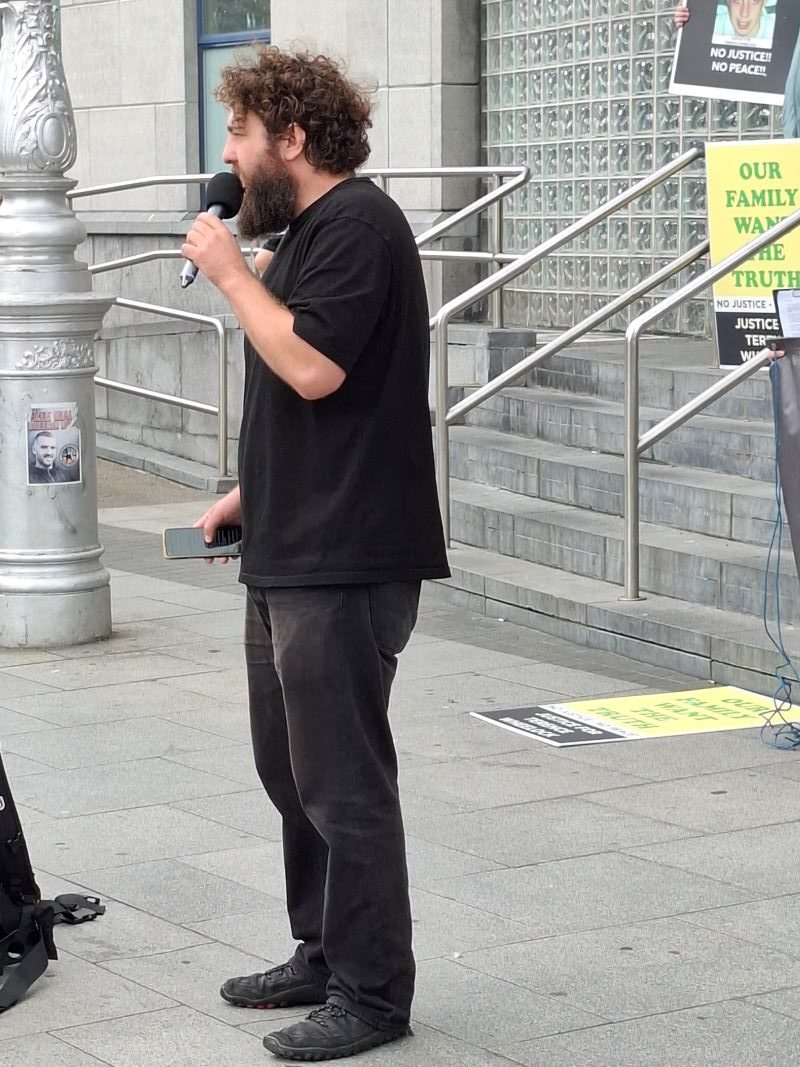
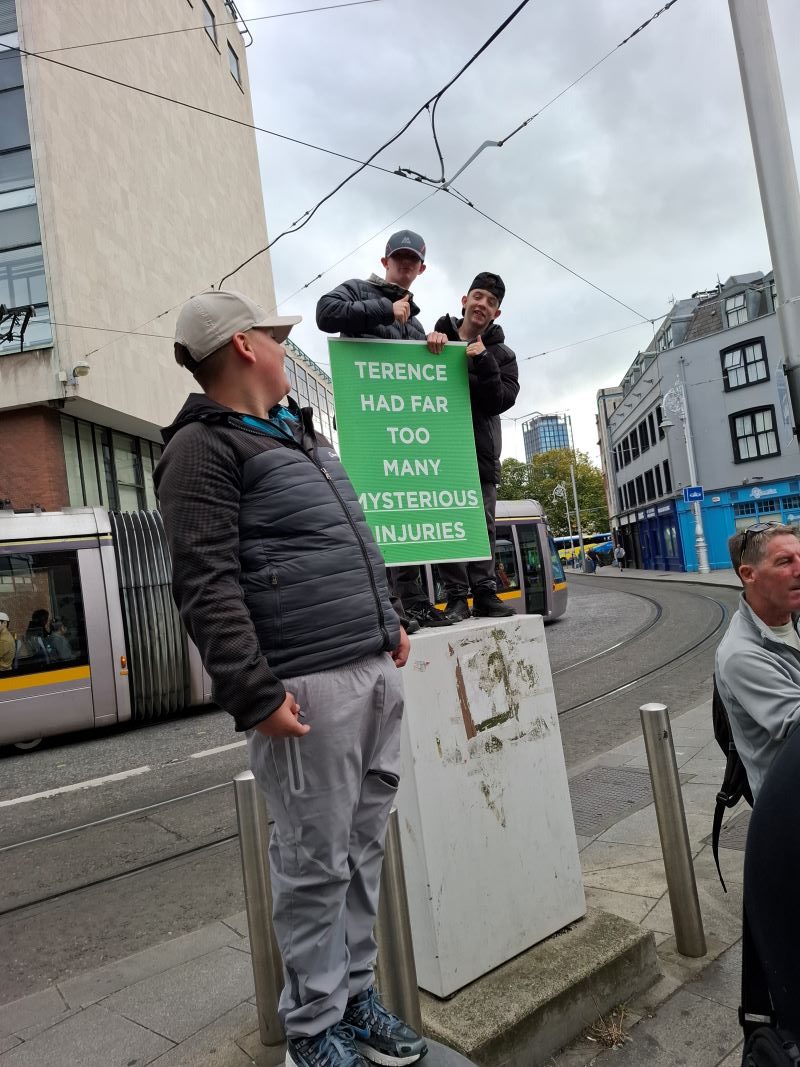
An impromptu demonstration in solidarity with Gavin Bazuno, the Ireland team goalkeeper, attracted many participants on late Sunday afternoon 27 September in Dublin. The call-out had only been posted the previous evening.
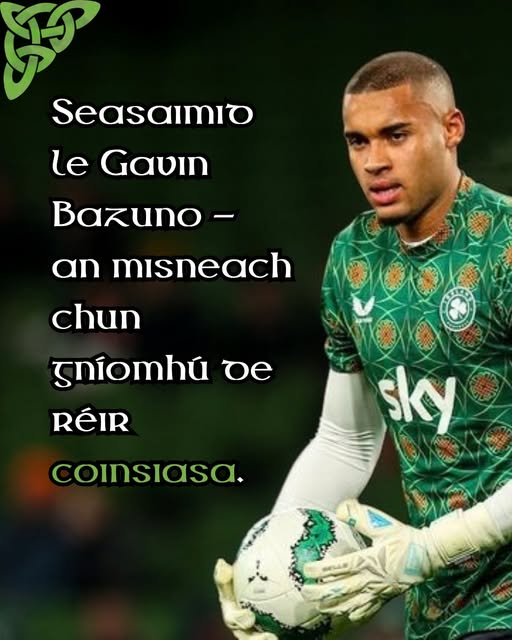
Irish language poster calling to stand with Gavin Bazuno and the courage to act according to conscience.
24 year-old goalkeeper Gavin Bazuno declined to play against the team of the genocidal Israel state, against which the Irish team were drawn in the UEFA Nations competition, despite the controversial decision of the team’s management and the Football Association of Ireland to go ahead.
Responding to the overwhelming majority sentiment in Ireland and of the members of the Association, the FAI executive in November had requested UEFA to exclude the Israeli team from the competition, which UEFA executives refused to do.1
Until September, long after FAI members’ fears were realised and in February the Irish team had been drawn to play ‘Israel’, the UEFA board had also refused to exempt Ireland from being drawn against ‘Iosrael’ (which they have the power to do)2 in future games.
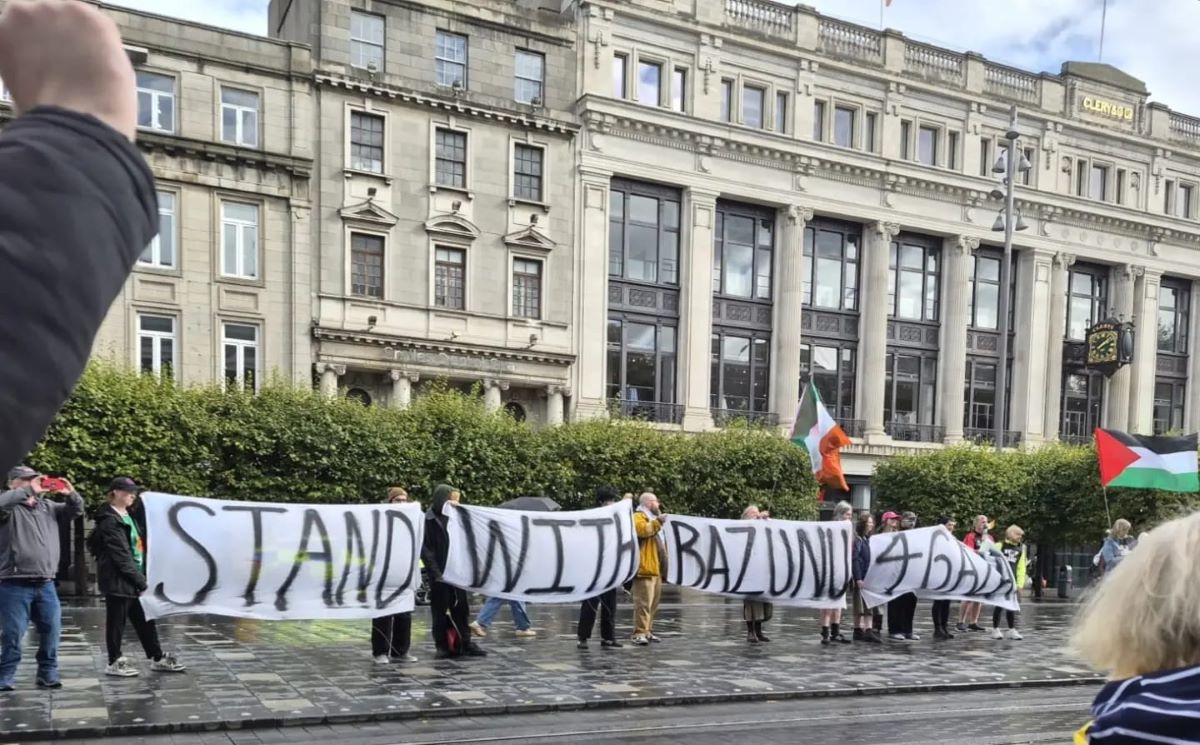
Attendance at the Dublin rally drew from a broad pool without any clear political party or indeed solidarity organisation dominance. Placards were not plentiful but some home-made ones could be seen and indeed the banner calling for solidarity with Bazuno was sprayed on white sheets.
A placard appeared showing an IOF sniper, referencing ‘Israeli’ player Said Abu Sarchi taking the ‘sniper position’ after scoring against Austria, for which he was sent off, to his apparent great surprise (after all, it’s normal in ‘Israel’ to actually shoot, not just mime shooting Palestinians).3
In order to comply with Palestinian society’s request for a boycott of ‘Israel’ to include sports competitions, a number of groups have been specifically campaigning against firstly ‘Israel’ being permitted to enter the competition and secondly for the Irish football team to refuse to play them.
The main ones have been League of Ireland fans, Stop the Game and Ireland Sports for Palestine. Over 160 Irish sports people signed a letter asking the Irish team not to play and Jacinta O’Keefe, registered to compete in the Pondevedra Triathlon withdrew due to ‘Israeli’ athlete participation.
The Show Israel the Red Card banner seemed the only printed one present at the rally, whereas a number of sheets had been spray-painted in order to together spell out Stand with Bazuno 4 Gaza.
A home-made placard read: Nice Save, Gavin! The flags flown among the crowd were mostly Palestinian with some Irish Tricolours and one Starry Plough.
Section of the crowd outside the GPO with one of the megaphone speakers, chant leaders etc. (Photo: D.Breatnach)
There was hardly a Garda uniform in evidence, nor was any stewarding organised or required: the main group occupied the GPO side while a smaller group stood on the central pedestrian reservation. A street person danced a bit in the road but generally withdrew as vehicles approached.
The ad-hoc nature of the rally and absence of any organisation’s control was illustrated by the lack of printed placards or banners, by much of the speeches from people with megaphones and in particular by the slogans chanted.
Specific slogans included: Don’t play the Game! We Support Gavin Bazuno! FAI, you can’t hide – You’re supporting genocide! There’s Only One Bazuno!
But there were also other chants relating to Ireland more generally, such as against British Unionists and their attempted Orange Order march on the Garvaghy Road4 and the slogan referring to both occupation of Ireland and of Palestine: Irish people understand: No peace on stolen land!
The more usual slogans of Palestine solidarity were also chanted: Free, Free: Palestine! From the River to the Sea – Palestine will be free! From the Sea to the River – Palestine will live for ever! In our thousands and our millions – We are all Palestinians!
There is only one solution: Intifada revolution! 1, 2, 3, 4 – Occupation no more! 5, 6, 7, 8 – Israel is a terrorist state! Saoirse – Don Phalaistín!
A recording of Martin Leahy’s Don’t Play was amplified with the crowd joining in on the chorus, which repeats the title of the composition.
The air of Don’t Play has been used earlier for many songs and chants, first recorded in 1864 as the air for Tramp, Tramp, Tramp, a song composed by George Frederick Root to give Union troop captives of the Confederacy hope of liberation in the American Civil war.
Not long after its USA composition, the air was used for the God Save Ireland! song by Irish nationalist MP, journalist and poet T.D. Sullivan in honour of the Manchester Martyrs, the three Fenians who were framed, convicted and hanged in front of a baying crowd in Manchester in 1867.
The title is taken from the words shouted by the three as they were sentenced to hang and the song became very popular, particularly in Ireland where, for decades it was the unofficial national anthem until eventually replaced by Amhrán na bhFiann.5
The home-made banner made from sections of spray-painted white cloth, displayed on the pedestrian reservation, seen from the pavement outside the GPO. (Photo: D.Breatnach)
Wide fallout followed the decision of the FAI that the Irish team would play the fixtures drawn against ‘Israel’. UEFA scheduled the games to take place in Serbia (without any Irish fans) and Hungary. RTÉ€6 declined to accept advertising or to provide commentary on the games.
In the run up to the game, attempting to project the decision to play in a positive light, the Ireland team manager Heimar Hallgrimsson said that rather than playing with genocide, they were ‘playing against Genocide’.This comment drew a tirade of abuse from the ‘Israeli’ Football Association.7
However at a subsequent press conference, Hallgrimsson withdrew the ‘Genocide’ comment, ascribing his use of it to the popular Irish pressure not to sportswash ‘Israel’ and the demand of ‘Don’t play with genocide.’
According to reports, out of the Irish team of 24, eight voted not to play, at a meeting from which it appears that Bazuno was excluded but the rest voted to play. They were then organised to wear armbands mourning the Palestinians killed and to lower their heads during the Zionist anthem.
On the field, the Irish team captain declined to shake hands with the ‘Israeli’ one. The FAI claimed that they had done well apart from their 3-0 win but many felt that to play at all was to lose something more important.
Many of the Bazuno and declining to play Israel at the rally outside the GPO, O’Connell Street, Dublin. (Photo by: Participant)
It may well have been a tactical campaign mistake not to include the players from the outset in the call for boycott of the game, giving them time to realise and prepare for the fact that if the FAI and Irish Government failed to call for the boycott, then it would come down to them.
The call not to target the players for action, even in that way, seems to have been mistaken. All those of sound mental state are responsible for their actions or lack of them. More importantly perhaps, young men and women of principle will be required to build the Irish nation that we need.
And nothing could be worse than genocide.
End.
Note: If you found this article of interest, why not register with Rebel Breeze for free, so that you will be notified by email of subsequent articles. You can de-register any time you wish.
3https://www.instagram.com/p/DdvXWXBG6Y4/ Even more horrible is that he is of Palestinian Arab background. The discourse that it’s a harmless snooker game stance does not warrant entertaining (unless the apologists can show how snooker shots are taken by players of the game while on their knees).
4A road in the nationalist area of West Belfast upon which the British-loyal Orange Order are demanding to be permitted to march
5Original title, The Soldiers’ Song; but for the State, it is the air of the chorus alone that constitutes the ‘National Anthem’.
6Radio Teilifís Éireann, the national broadcaster for television and radio.
Two members of the Irish Parliament1 and four Dublin municipal Councillors2 accompanied Wheelock family members, neighbours and other campaigners in a march to Store Street Garda3 Station, where Terence Wheelock had received fatal injuries.
The event took place on the afternoon of Saturday 12th September and commenced with a rally outside the GPO. Despite the passing of an anti-Trump visit demonstration of reportedly 25,000 a little earlier, tens of supporters were present for the Wheelock protest.
Terence Wheelock was a young man of 20 years from a working-class area in Summerhill, in the north Dublin inner city in 2005. Leaving his home to purchase some paint brushes to decorate his room, he stopped to talk to some youths beside a recently-stolen car.
When a group of Gardaí arrived, the youths scattered, Terence among them, the Gardaí chasing and detaining four youths including Terence, bringing him to Store Street Garda station. When he left that station apparently some hours later, it was in a coma to the Mater Hospital.
He never recovered consciousness and died three-and-a-half months later.
According to the Wheelock family, the Gardaí who came to inform them of the young man’s whereabouts misinformed them of the location, therefore denying their ability to obtain Terence’s clothes or demand crime scene security of Terence’s cell, which was quickly redecorated.
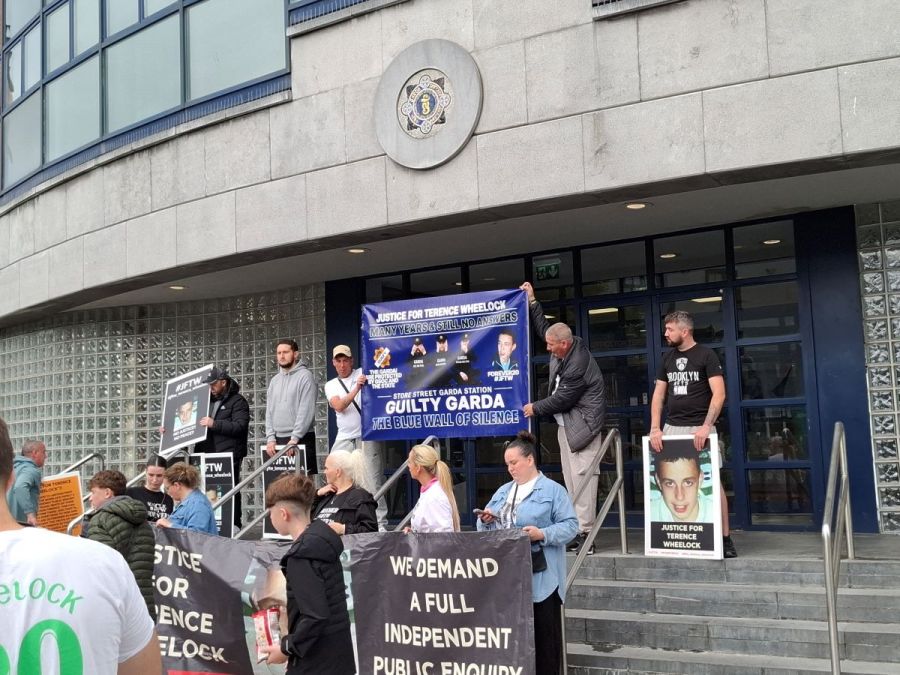
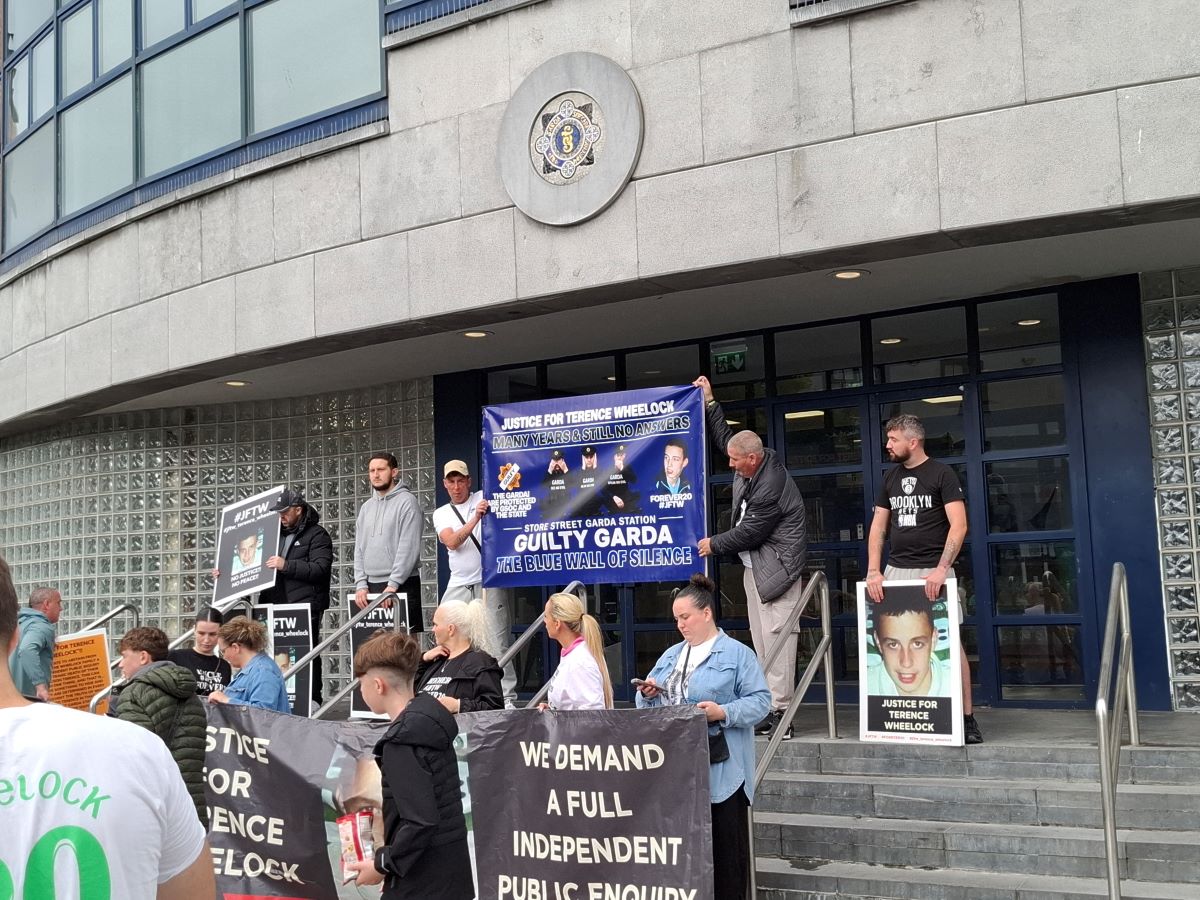
Relatives and supporters of the Terence Wheelock campaign in front of Store Street Garda station a week ago on Saturday. (Photo: D.Breatnach)
OUTSIDE THE GPO ON SATURDAY
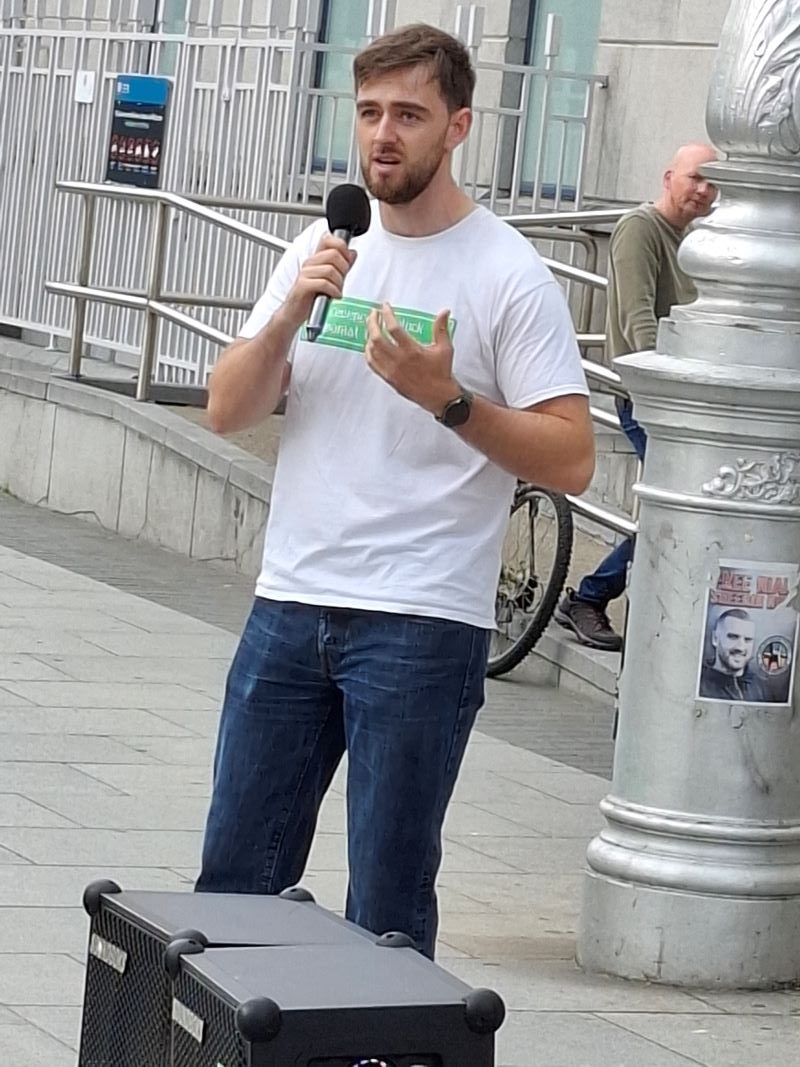
At the rally outside the iconic GPO building in Dublin’s O’Connell Street in the north city centre, one of Terence’s older brothers, Sammy, announced the purpose of the gathering to those present and the many curious passers-by, both resident and visiting.
Sammy took over as coordinator of the campaign for justice regarding Terence from an older brother, Larry, after the latter died of brain cancer in 2019.
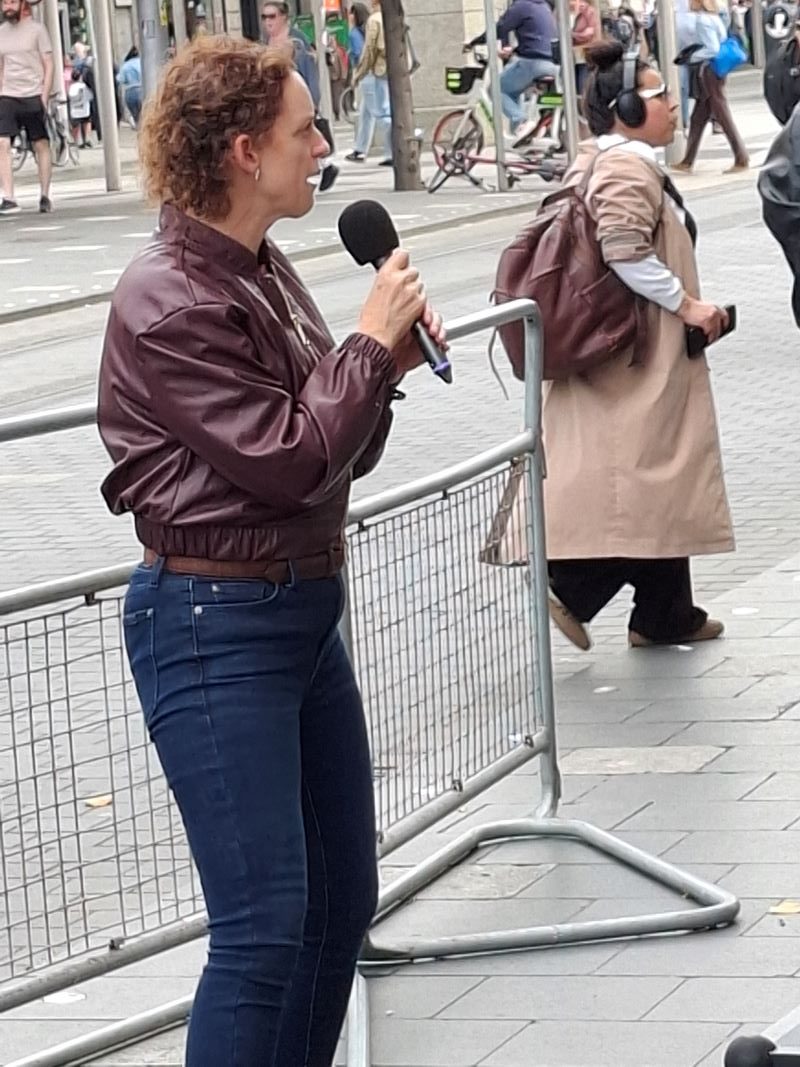
Called first to speak was elected Dublin City Councillor Marie Sherlock, a member of the Labour Party, who commiserated with the Wheelock family on their loss and remarked on their persistence in the campaign over the years, vowing to continue supporting them until justice was achieved.
Marie Sherlock speaking at the rally outside the GPO. (Photo: D.Breatnach)
Less welcome to my ears and probably to at least some others were her words that she would ‘support the Gardaí’ and ‘the Minister for Justice’ in seeking an inquiry into the cause of Terence Wheelock’s death. ‘Support’ for the Gardaí was far from the tone of most campaign demands.
Next to speak was Daniel Ennis, until fairly recently an elected Dublin City Councillor of the Social Democrats party, which he now represents as a TD (elected representative to the Irish Parliament). Ennis spoke mainly as a resident of primarily a working-class area of Dublin city.
Daniel Ennis TD addressing the pre-march rally at the GPO. (Photo: D.Breatnach)
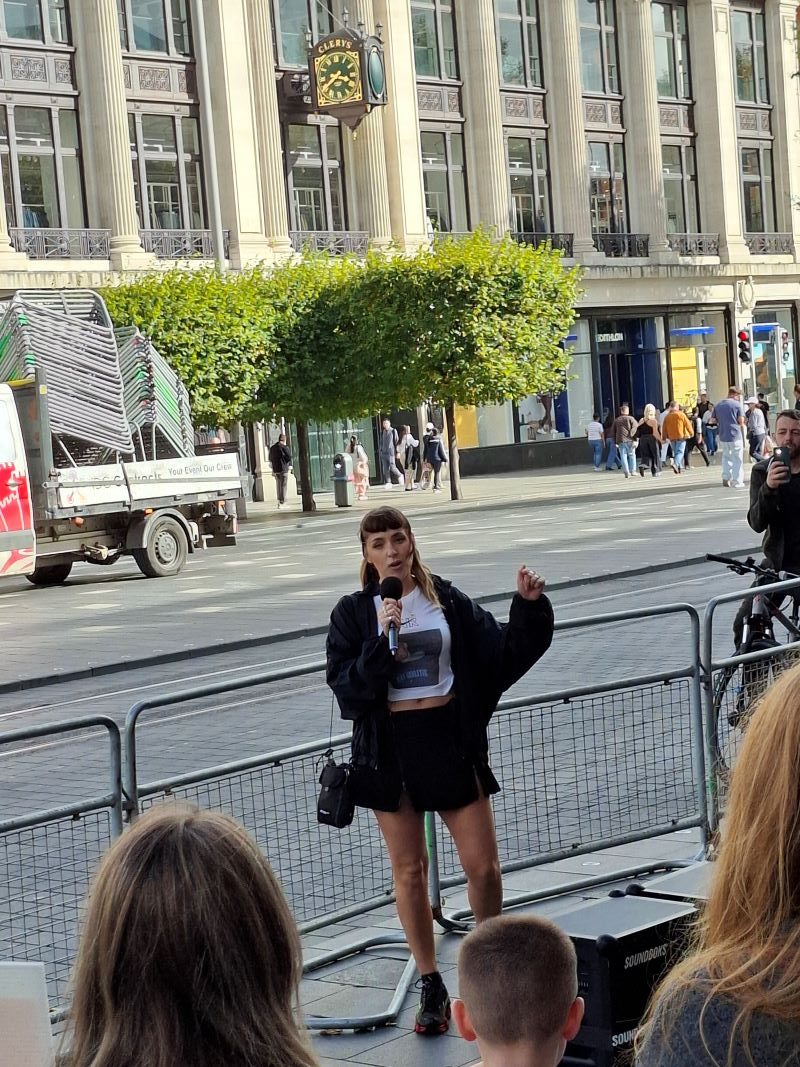
Sammy Wheelock also introduced Gemma Dunleavy, the petit rapper from Sheriff Street background on the north-eastern side of the city centre, who has highlighted the Terence Wheelock case in the past.
Dunleavy performed one of her pieces organised around numbers such as ‘Thirty-seven, the number of photographs taken of injuries on Terence’s body’ and ‘zero, the number of people held accountable for Terence’s death’.
Rapper Gemma Dunleavy outside the GPO performing her piece about the killing of Terence Wheelock. (Photo: D.Breatnach)
After Dunleavy’s performance, Sammy Wheelock announced the intention to march to Store Street Garda station, detention location for two hours of his younger brother Terence in September 2005 before admission to the Mater Hospital in a coma, followed by death three-and-a-half months later.
Sammy also referred to the harassment by Gardaí of the Wheelock family wanting to intimidate them from campaigning.
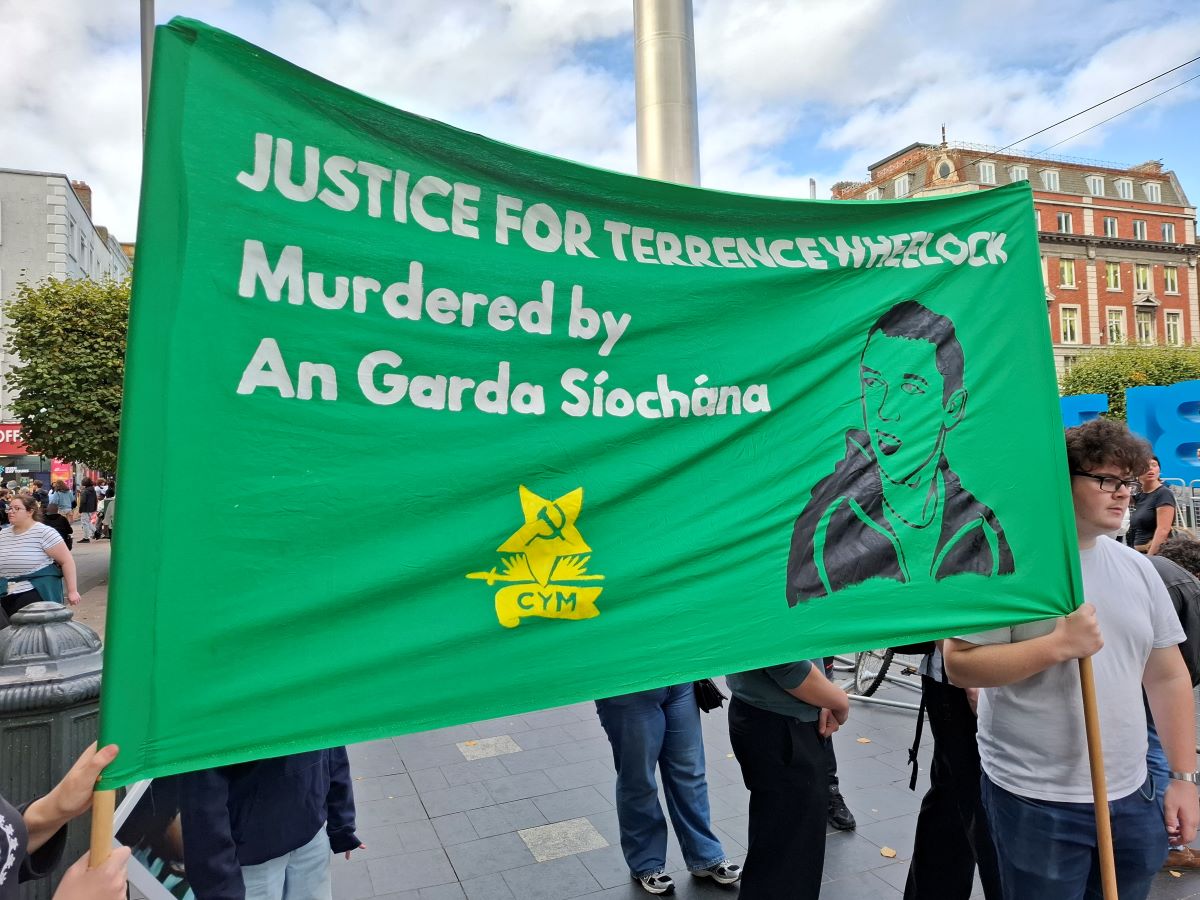
The march, with banners and placards, proceeded along O’Connell Street, the city’s main thoroughfare, chanting call-and-answer: Say his name: Terence Wheelock! For Justice to be imposed, the guilty must be exposed! What do we Demand?Answers! When do we demand them? Now! What do we want? Justice! When do we want it? Now! Guilty: Garda!
Reaching the Liffey river that bisects the city, the march turned left along Eden Quay,4 then left at Butt Bridge, passing Liberty Hall5 and the monument to James Connolly.6 As they neared Store Street, Sammy pronounced it ‘one of the most corrupt Garda stations in Ireland.’
One of the banners, seen here outside the GPO during the pre-march rally. (Photo: D.Breatnach)
OUTSIDE THE GARDA STATION
Family relatives lined the steps of and with their backs to the Garda station, displaying the campaign’s placards and banners while supporters gathered facing them to listen to speakers.
Dublin City councillors Conor Reddy of the People Before Profit party, Madeleine Johannson (non-party) and Janice Boylan of the Sinn Féin party addressed the crowd, along with James O’Toole of Red Media and, for the second time, Daniel Ennis TD (Soc. Dems).
Conor Reddy speaking outside the Garda station (Paul Murphy, TD may be seen behind, caring for his child which is out of shot). (Photo: D.Breatnach)
Reddy, Ennis and O’Brien all related their origins in working-class areas of Dublin and their familiarity with the hostile attitude of the authorities, especially the Gardaí, to the residents of those areas, particularly the youth. Reddy mentioned another family campaign around Garda violence.
James O’Toole referenced ‘the thin blue line’ used to describe the police and their defence of democracy but pointed out that people’s experience of that ‘blue line’ differed remarkably according to upon which side of the line they found themselves.
O’Toole pointed out that although people from working class areas tend to find themselves universally on the ‘wrong’ side of the ‘blue line’, at times, due to taking militant action, people normally on the ‘right’ side of that line can find themselves subjected to Garda violence.
Boylan, speaking briefly, apologised for her absence from the campaign heretofore but promised support for the future. Reddy spoke about the need for youth social provision, justice system diversion programs and drug prevention treatment facilities for young people.
Sammy Wheelock, brother of Terence and chairperson of the campaign, addressing the crowd outside Store St. Garda station. (Photo: D.Breatnach)
Both Sammy and Robert Wheelock, another brother, spoke eloquently from their prepared speeches about the loss of their brother, the effect on their family and in particular on their mother, unable to be present for health reasons but who sent her thanks to those present.
The brothers spoke about the future that Terence never had a chance to experience and the loss also to the daughter he left behind. Both of them also pointed out that although their campaign sought justice in relation to Terence, it implied the need for justice across Irish society.
Sammy called Vera Lynch from Tallaght forward to speak about her own struggle for justice around the killing of her son Stephen Lynch by a hit-and-run driver but the Gardaí, who failed to investigate the crime with any rigour.
Speaking outside the Garda station, Lynch said her son, a father of three, had been knocked down by a car ten years ago and then reversed over but neither multiple phone calls attempting to speak to the investigating Garda nor an email to the Minister of Justice had achieved any result.
Eoghan Ó Ceannabháin in front of Store Street Garda station singing “Summerhill” by Sammy Wheelock. (Photo: D.Breatnach)
Sammy introduced Eoghan Ó Ceannabháin to sing Sammy’s lyrics of Summerhill, his song to the air of Spancil Hill.7 Ó Ceannabháin of the PBP party sang the song well, which was no surprise as he is a talented singer in the traditional sean-nós style, from a musical family from Connemara.
At conclusion of the song, Sammy led the crowd in a few more chants directed at the Gardaí, thanked all for their attendance and promised to keep pushing for an independent inquiry into the killing of Terence Wheelock and for measures to ensure no similar experience for anyone in future.
Some youth supporting the rally outside Store Street Garda station – the next generation of Garda targets? (Photo: D.Breatnach)
FOCAL SCOIR
The State’s defenders tend to hope that the grind of the passing years will sap the energy of campaigners or that they will die of ill-health, trauma or old age before any question arises of acknowledging guilt over the behaviour of those defenders and responsibility of the State itself.
In July this year Osgur Breatnach received from the High Court, after decades campaigning, a Certificate of Miscarriage of Justice for his 1978 Sallins Mail Train robbery conviction on the basis of a ‘confession’ obtained, Breatnach has always maintained, through Garda ‘Heavy Gang’ torture.
End.
Note: If you found this article of interest, why not register with Rebel Breeze for free, so that you will be notified by email of subsequent articles. You can de-register any time you wish.
FOOTNOTES
1Often incorrectly referred to as ‘the Dáil’ from the also incorrect official title of ‘Dáil Éireann’ (‘Parliament of Ireland’); it lost any claim to that title held since 1919 when in 1999 the State sponsored successfully an amendment to the Constitution of the State to abandon its claim to sovereignty over the Six Counties of the British colony. The two TDs included Paul Murphy, who was not one of the speakers.
2Including Ciaran Perry, non-party, who was present but did not address the crowd.
3An Garda Síochána is the official title of the police force of the Irish State, an officer of the force is a Garda (plural: Gardaí).
4Ironically this street was the scene of a fatal (to two workers) police (DMP) attack on a street rally of the Irish Transport and General Workers Union at the beginning of the Dublin Employers’ Lockout to break the ITGWU. Buildings along this street were damaged and partly demolished by British artillery during the repression of the 1916 Rising.
5Liberty Hall was the title of the HQ of the ITGWU which was demolished after artillery destruction in 1916; it is now the title of the successor to that union following a number of amalgamations leading to the creation of SIPTU which is a far cry from the militancy of even the post-1913 ITGWU.
6One of the Signatories of the 1916 Proclamation of Independence, Commander of Dublin in the 1916 Rising, for which he was one of the 16 executed leaders of the 1916 Rising. Also a leading official of the ITGWU during the Lockout and in the union’s recovery. But also a leading revolutionary socialist, anti-imperialist, historian, author and songwriter.
7Written by Sammy as a tribute to his brother Larry who had founded and chaired the campaign in 2005 until his death in 2019 from brain cancer, Sammy donated the song for all proceeds to go to the Irish Cancer Society.
The last person of the 10 Republican prisoners to die in the 1981 Hunger strikes died on August 20th but hunger strikes continued for a while until relatives began instructing the doctors to give the strikers alimentation.
What can be said about those strikes? Clearly, a tremendous sacrifice requiring immense courage and determination in a non-violent protest by national liberation fighters in jail in a struggle against British colonialism.
Certainly we lost individuals of great worth in that struggle. It may be asked whether the gain was worth the sacrifice or whether the prison struggle might have been fought in some other way.
The medieval Irish society practice of fasting as a means of protest may or may not have been original but it was an important part of the people of India’s struggle against English colonial rule. Palestinian prisoners have used mass and individual hunger strikes on a number of occasions.
The effects of the Irish 1981 hunger strikes were many and wide, most probably far beyond the intentions or expectations of the prisoners. The news went around the world, bringing expressions of solidarity from many regions, including actions by parliaments of various states.
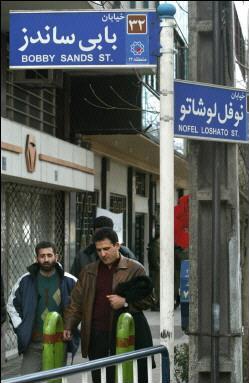
The Islamic Republic of Iran sent delegates to Bobby Sands’ funeral and renamed the street in which stood the British Embassy in Teheran ‘Bobby Sands Street’. The British Embassy to Iran had to give that as their address until they moved their main entrance around the corner.
Bobby Sands Street in Teheran, Islamic Republic of Iran (Photo sourced: Internet)
Hunger strikers stood in parliamentary elections in Ireland on both sides of the British Border, winning some seats and coming very close to winning some others. One result was that the British changed their electoral laws so that convicted prisoners could no longer stand in elections.
In the Irish state there has not been an outright majority government since that year – every single Irish government since then has been a coalition of one kind or another.
In Britain, the hunger strikes made a huge difference amongst the Irish community there. The 1974 Birmingham Pub Bombings massacre had been jumped on by the British Labour Government to pass the Prevention of Terrorism Act 1974 (now the Terrorism Act 2000).
Probably already drafted, it was brought before Parliament and passed within days, giving the police power to hold suspects for seven days without charge, wide-scale powers of stop and search and interrogation, usually without legal representation for the victim.
Within the year a score of people from the community had been framed on serious charges, convicted and jailed: Birmingham Six, Guildford Four, Maguire Seven, Judith Ward. Subsequently many Irish people stayed away from Irish solidarity marches and meetings – just in case.
The hunger strikes of 1981 blew away much of that fear and the Irish community came out in their thousands in an attempt to save the lives of the hunger-strikers — and have never been cowed down to the previous degree since.
The Irish in Britain Representation Group was formed in 1981 after the refusal of the Federation of Irish Societies to even pass a motion of sympathy for the family of Bobby Sands, who had died only days earlier; the IBRG provided radical and resolute leadership for the next 20 years.
One of a number of songs arising from the 1981 hunger strikes was the Ballad of Joe McDonnell, by Derek Warfield. It is a good song in general but what is most excellent is its chorus, where it turns the accusation of terrorism away from the Resistance and back to British Imperialism.
And you dare to call me a terrorist, While you look down your guns! When I think of all the things that you have done: You have plundered many nations, Divided many lands, You terrorised their people, Ruled with an iron hand … And you brought the stain of terror to my land.
And it could just as well apply to US Imperialism, EU imperialism and their NATO military alliance.
I have sung the song many times over the years and did so again recently at the weekly Dubs For Palestine gathering outside Leinster House. And more recently still outside the British Embassy. I changed only a couple of words to provide a more optimistic line at the end.
End.
Note: If you found this article of interest, why not register with Rebel Breeze for free, so that you will be notified by email of subsequent articles. You can de-register any time you wish.
Gearóid Ó Loinsigh (Republished from author’s substack with permission, reformatted for Rebel Breeze)
(Reading time: 8 mins.)
The Jason Arday affair has left few standing, least of all those who think they are not only standing but standing tall.
Lots of people came out of it very badly. Nathan Cofnas is one, as is Jason Arday himself as well as the media, Cambridge University and academia in general and also the Left.
Jason Arday in Cambridge University (Photo arrangement credit: The Herald)
Before the story broke Nathan Cofnas was even by academic standards an obscure figure. He is now a household name, not just in Britain, but globally. He describes himself as a “race realist” something the media and others are treating as something respectable or new.
It is neither. Race Realism and the search to find a biological link to intelligence is not new.
Biological Determinism goes back a long way and enjoyed social and even scientific support in the 19th Century through the work of Francis Galton (Darwin’s cousin), the father of eugenics who unsurprisingly had studied at Cambridge.
It reached ridiculous levels assigning all sorts of non-sensical biological criteria by which to measure intelligence. Farcically at one point the size of certain bones was seen as a biological (racial) sign of intelligence: the ratio of the radius to the humerus to be precise.
This rubbish never went away and resurfaced time and again. The genetic discussion is just a modern version of it, which found its expression in The Bell Curve by Richard Herrnstein and Charles Murray in 1994.[1]
At the time many liberal and left wing scientists demolished the arguments and Stephen Jay Gould even debated Murray, something most on the Left would be now ill-prepared to do after years of cancel culture and “winning” arguments by saying they are offended.
Cofnas has added nothing new to the debate, not even from a right-wing perspective, though as Gould pointed out in his updated edition of The Mismeasure of Man, Murray too had only regurgitated old arguments with lots of charts and stats to accompany them.
Which is something Cofnas also does: style over substance. But he has exposed the shallowness of what is considered intellectually worthy in academia, both in terms of his own contributions and also Arday’s.
I am all in favour of free inquiry at universities and in life in general, but Biological Determinism or its modern synonym Race Realism is nothing short of quackery.
It belongs in the same category as Flat Earth Science or even Creationism, though Cambridge actually has a Faculty of Divinity i.e. quackery. That Cambridge and Ghent took it seriously is a damning indictment of both places.
All education is political, what is taught, what courses are offered, the range of opinions etc. Education is a battleground for ideas, some of which seem obscure and irrelevant but which end up shaping our society, albeit indirectly in some cases.
Given the level of moralistic hysteria doing the rounds on this topic it has been impossible to ask certain sectors to step back and take a look at the facts and then proceed on that basis. Cambridge has belatedly set up an independent review of how it handled the Arday affair and also how it came to appoint him in the first place.[2]
Was racism a factor in what happened to Arday? Almost certainly. The question is to what degree and none of that takes away from the fact the racists had the goods on him. When I say racists I mean the right wingers like Cofnas. Though I could mean the racists who hired him.
It is clear that Cambridge is institutionally racist. It could not be any other way given its history, current links to the arms trade, the low number of black academics etc.
So they hired Arday, as a poster boy, as Jason Okundaye put it “Arday was treated not as a scholar but as a mascot, one who was particularly expedient for an institution that had been regularly embarrassed by its historic record on race”.[3]
They were saying look at what we have done. It is the academic equivalent of “I am not racist, some of my friends are black”. It is clear that Cambridge sought to deflect criticism by hiring someone regardless of whether they met the requirements.
Maybe they thought this offset having “race realists” like Cofnas, or right wingers like Reform UK’s James Orr on the payroll and even inviting people like Murray to give talks at the university.
But Cofnas was not the first academic to question Arday’s record.
Another academic, David Harris, whilst researching a book he was writing on race tried to raise questions the way academics do, gently, politely through the system and was accused of harassment and reported to the police by Arday.
He had been told that he should read Arday’s work for his own research and he did and found some problems with it.[4]
Had his questions received the consideration they deserved, the whole affair might not have played out the way it did and Arday might not have a job, or he may have received some disciplinary sanction, but he might still be alive.
It was the reaction to Harris, a mild-mannered academic who unlike Cofnas has no agenda in the matter, that increased the pressure in the pot and helped set the scene.
There was also the police persecution of Times Higher Education journalist Jack Grove, where the police acted like a private security firm for Arday putting him under investigation for four months.[5]
As a result of the affair, other issues have come to light, or rather have gained wider traction than they otherwise would. Academia is hardly an enthralling newsworthy issue at the best of times.
It has been pointed out that other white people at Cambridge had been found guilty by Cambridge itself of plagiarism and nothing happened to them just mild disciplinary sanctions in the best of cases. One of them even plagiarised his own student!
Cambridge protects its own. Arday, despite being their poster boy was not and when it came time to cut him loose they let him resign, something which seems to have genuinely shocked many on the Left.
It has other problems with sexism. Coming just days before Arday’s suicide the courts found in favour of Professor Wyn Evans, a lecturer in astrophysics, who fought a long battle against Cambridge over the treatment of a female colleague, Dr Tausch-Pebody.
The case revolved around a complaint made against Dr McMahon who had held up the disbursement of funding to her by 37 weeks refusing to sign the appropriate release form and had bizarrely used her IP address and that of other colleagues.
The university used its insurance funds to fight the case, and was nasty about it, with Wyn Evans saying “At one point the university’s barrister accused me of crying crocodile tears about an employee who committed suicide”[6] which is a bit rich given the howls around Arday’s suicide.
Following the tribunal report, other academics posted a picture of Judas on his door and Cambridge announced it was reviewing its HR procedures, following its bullying of this whistleblower.[7]
This judgement came in the midst of the furore surrounding Arday’s appointment clearly showing that Cambridge is not the type of employer which facilitates internal criticism of its decisions.
The Left responded by defending Arday and when backed into an indefensible corner said “Well lots of people plagiarise and embellish their CV”. To be clear he didn’t embellish his CV, he fabricated it.
Embellishing it would mean exaggerating accomplishments, not completely inventing them. But on the plagiarism issue they have also pointed to various academics found guilty of plagiarism who were not sacked. Yes, those academics should be sacked.
Saying white upper class people got away with plagiarism is not a defence, it is an accusation levelled at the academic institution. Unwittingly they have exposed part of the corruption at the heart of academia.
The Left’s proposal was that if whites can commit crimes, or falsify records the solution is to demand equal rights for everyone to do so, rather than say this should be rooted out.
This is partly because the identity politics industry is not controlled by working-class blacks or Asians but by the white, black and Asian middle-class and they have no intention of upsetting the apple cart they are eating from.
However, it is disingenuous to believe that it was all about racism. Arday fell on his sword because he was not qualified for the job and his backstory was the work of a fantasist whose skills would have been better suited to writing sci-fi literature or something.
If it was just racism, why did the racists not manage to force the other black academics at Cambridge out of a job. The racists had a field day with Arday, but only because the patronising racists who employed him overlooked his qualifications and backstory.
Surprisingly, Liverpool John Moore’s university that awarded Arday his PhD has fared better than can be expected, but only because it has received less attention.
But at some point Cambridge will wash their hands entirely of Arday and pass the buck downstream to Liverpool John Moore’s and then perhaps they may not look so well.
This may happen at some point during the review when their defence will most certainly be that Arday and Liverpool John Moore’s conned them.
The media haven’t come out of it well either and I don’t say that because of the pile-on but because as I have pointed out lots of issues arose in the course of the discussion, which the media decided not to pursue.
Like the plagiarism of other academics, like Cofnas’ modern Flat Earth Science type of stuff on intelligence actually getting recognition, none of which was raised, nor will it be, by neither the Left nor the media.
The Left also don’t come out of it well. Their response to the media coverage was to deny the facts of the case. If Arday was treated unfairly by the media, then that argument can’t be made on the basis that he did no wrong. Even some identitarians have argued this.
One of the few left papers in Britain to examine the issue rationally, The Weekly Worker (CPGB) made the point.
He was undoubtedly the tragic victim of an openly racist attack dog and a baying mainstream media.
However, maintaining that Jason Arday was not guilty of plagiarism is worse than useless. We need the truth about him and, more importantly, the whole neoliberal university system.[8]
Instead of asking for that, the Left has now proposed a law limiting media coverage of individuals. The utter stupidity of the Left never ceases to amaze me.
Some of the repression of the Palestinian solidarity movement around the world is being carried out through just the type of measures the Left has called for around hate speech, personal offence etc. You would think they would learn about it coming back to bite them. But no.
Right now Tommy Robinson and other right wing activists are floating in Cypriot swimming pools laughing and thinking about the Left pushing for a law they will be able to use to restrict media coverage of their pool trips and other less than savoury activities.
Even the practicalities of the law have not been thought out. Would it be overall coverage? Could The Sun use up all the media quota, leaving others with no right to comment on an issue? Or will it be per media outlet? When an outlet used up its quota, could it talk about new developments?
The stupidity of it all is beyond comprehension.
Though many of the Left organisations say they stand by Arday, they don’t. They stand by Cambridge, first and foremost, along with its handling of Arday’s appointment and they are standing by academia and its identity politics tokenistic approach to inequality.
Many on the Left actually earn a living from the tokenism and some of the leaders are well ensconced in academia, so they were never going to say much in any case. They are standing by the identity politics industry, academic corruption and their own grifting.
The Arday affair has exposed academia and the Left as having little to really say about inequality or access to university for working-class people of any race, and not much to say about racism either.
Note: If you found this article of interest, why not register with Rebel Breeze for free, so that you will be notified by email of subsequent articles. You can de-register any time you wish.
[1] For an in-depth analysis of the history of Biological Determinism see revised edition of Gould, S.J. (1996) The Mismeasure of Man. W.W. Norton & Co. New York.
The international conflicts around the world are largely explained by imperialism versus liberation struggles or, occasionally, as in two world wars, struggles between the imperialists themselves, as entirely in WWI and very largely in WWII. But not all control is by invasion or occupation.
The idea of an imperial power invading other countries, occupying and dominating them is easy to grasp, it being similar to the behaviour of feudal empires. But even in ancient times, kingdoms could be controlled by a stronger power without occupying them – by intimidation and bribery.
That kind of collaboration is easier and cheaper for the dominant exploiting power to manage and certainly less risky. Conquered populations can remain resistant for generations and rebellions can break out again and again as has been the case par excellence in Ireland.
Also the taxes and rents extracted by feudal empires from subject kingdoms are largely replaced today by high profits on finance invested in the extraction of natural resources from client nations and often in exports to those very nations, often fabricated from their very plundered resources.
And that latter example is where from comes the word ‘comprador’, i.e ‘buyer’; the client economies exported raw resources, made little themselves but bought finished products from the dominant power. “Gombeens”1 is an Irish appellation for native foreign-dependent capitalists.
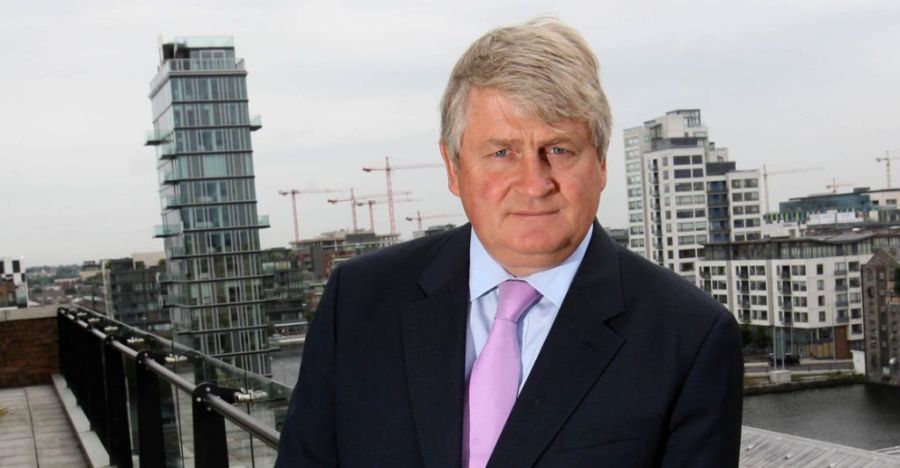
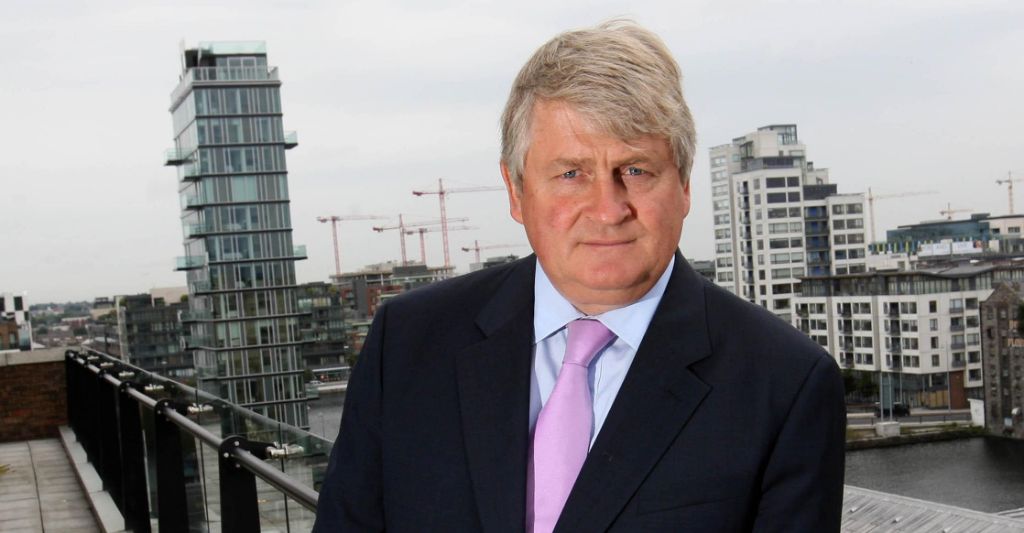
Gombeen Denis O’Brien, owner of many known companies including construction, telecommunication, water infrastructure, fuel and media.
Of course, in a later stage, the dominant power exported not only finance to invest but whole factories, with resulting production declining within the former industrial powers.
Analysing the imperialist capitalist system internally, it becomes less and less productive, increasingly parasitical and dominated by finance capital, whereas the colonies and client states may even become more productive but only in such ways as are required by the imperialists.
Production of their own necessities, even their very food may decline in client states and colonies as they are driven to concentrating on export-orientated cash crops and minerals instead. The ruling classes in such countries are merely economic/political managers for the imperial powers.
They are comprador capitalists, neo-colonials, typically orientated culturally towards the imperial power, often venal, contemptuous of their own nation’s people and their history, contemptuous enough often to flaunt their ill-gotten wealth.2
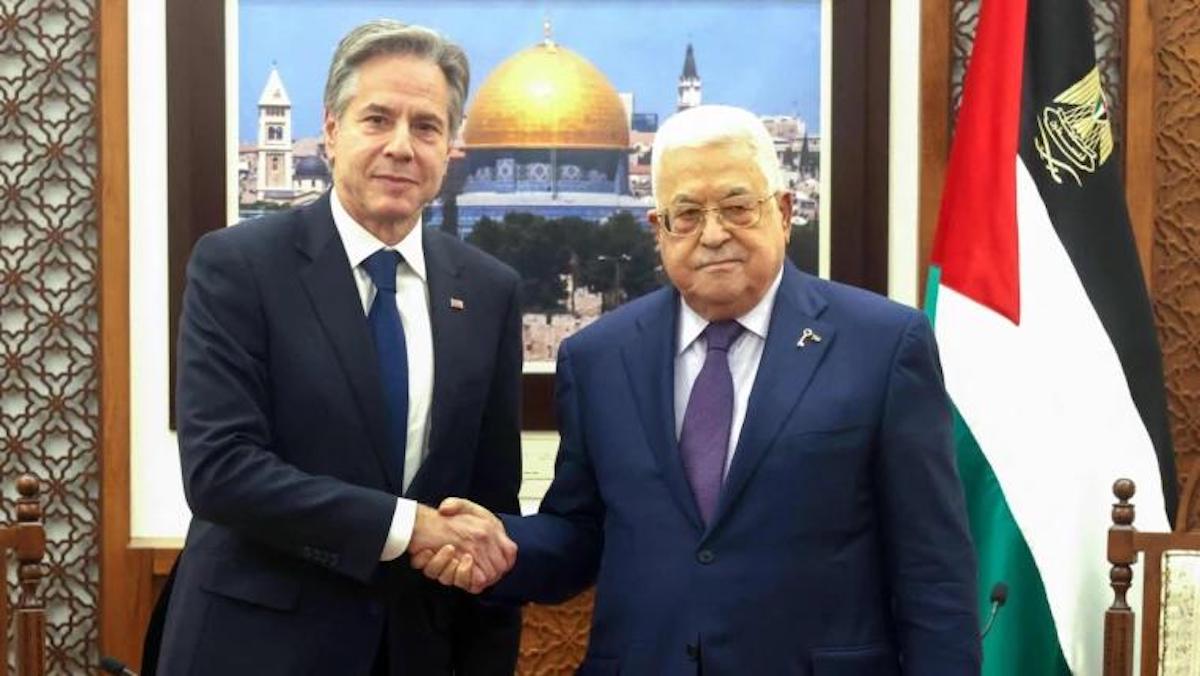
There are many examples of such people and behaviour around the world, some of the more famous being Lavalle (France), Vidkun Quisling (Norway), Mahmoud Abbas (Palestine), Daniel O’Connell and Michael Collins (Ireland); which last brings us nicely to the Gombeens ruling the Irish State.
Anti-Treaty cartoon, 1921, depicts Ireland being coerced by Michael Collins, representing the Free State Army, along with the Catholic Church, in the service of British Imperialism. (Sourced: Internet)
From right of image, Mahmoud Abbas of the Palestinian Authority poses shaking hands with the representative of his US master, Antony Blinken. (Image sourced: Internet)
The Irish State came into existence after centuries of English occupation and resistance after which the colonial power offered more autonomy but partition. The Resistance refused acceptance and the new State defeated the national liberation forces in the ensuing Civil War (see History Appendix).
Ireland is a partitioned nation: one-sixth of its territory (the Six Counties colony) is occupied by the UK, policed by a sectarian colonial police force and garrisoned by British armed forces and is part of the European imperialist military alliance of NATO.
Yet the invaders’ chiefs, including military and monarchy are welcomed by the leaders of the Irish State and the invader’s Royal Air Force patrols skies of the Irish state.3 The State’s police works in close cooperation with the sectarian police force of the colonial administration.4
The Irish economy is comprehensively penetrated by companies of foreign ownership: The State’s carrier Aer Lingus is owned by British Airways. The former state telecommunication networks is owned by Eircom, 64-65% owned by a French company and most of the rest by a US company.
Foreign-owned companies dominate the retail sector, accounting for roughly 30% of employment and over 50% of total turnover and retail gross value. It terms of food products retail the figures are the same with British and German monopolies dominating the rest.5
Most food consumed in Ireland is now imported, a country that two centuries ago could feed a larger population and yet still export some.
Retail banking is ‘highly internationalised’ i.e. dominated by foreign-owned institutions and has been so since the founding of the State, accounting for 24% of sector earnings. International financial services from Ireland is even more foreign-dominated, accounting for +90% of jobs.
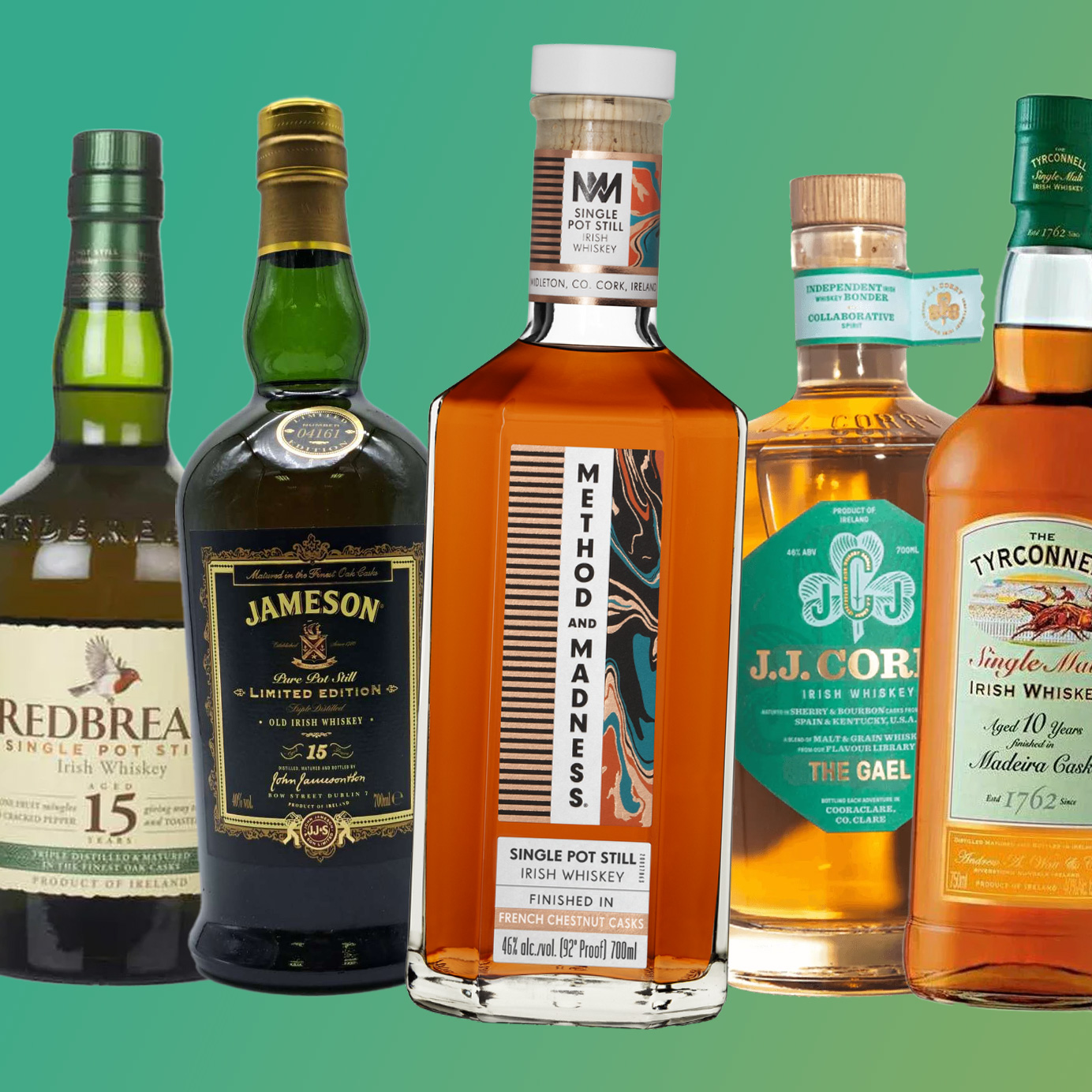
Irish whisky production is divided between a US-based and a French company (which also owns Cork Dry Gin), while Irish beer, stout (including Guinness) and lager are produced by the British company Diageo. In addition, beers and spirits are imported large-scale from abroad.
Some of the money from roads collecting tolls goes to foreign companies, eg. French and Spanish. While the Irish State owns the infrastructure and collects the revenue of Dublin’s LUAS, the day-to-day operation and maintenance are contracted out to German and French companies.
Roughly 21% of hospital beds are in the private (non-state) sector and a significant portion of that private market—alongside specialized diagnostic and sports clinics—is foreign-owned or backed by international private equity and multinational healthcare groups.
According to AI, non-resident institutional and foreign-backed real estate companies buy a significantly higher share (over 50%) of newly built multi-unit apartment developments in urban centres like Dublin and Cork. 6
Approximately 60% to 70% of total assets in the Irish banking and financial system are linked to foreign-owned institutions or cross-border non-resident claims. However, the domestic retail banking market is heavily concentrated among a small number of groups with Irish headquarters.7
Following the exit of major foreign retail players like Ulster Bank and KBC which were active in banking with the Irish state, Irish-headquartered groups like AIB, Bank of Ireland, and PTSB came to take a large share of retail banking in Ireland but these too have foreign connections.8
The colonial history of Ireland and neo-colonial evolution of the Irish State has been deepened by its suppression of forces of national resistance9 and by opening its internal markets, national resources and State networks to foreign penetration.
It is hardly surprising that the national bourgeoisie of Ireland is incapable of asserting sovereignty and independence not only in relation to the UK and the USA but also in the face of the western imperialist alliances of the EU and NATO.
The images of four reformist Irish politicians which City Managers of Dublin City Council erected over the Bank of Ireland building (former Irish Parliament under British rule) in College Green as a riposte to the commemoration of the 1916 Rising. Not only were these politicians not revolutionary, each one failed completely to even win the limited autonomy he set out to win. From top left around the clock: Henry Grattan, Charles Parnell, John Redmondand Daniel O’Connell. (Image sourced: Irish Times)
Contemporary examples of this lack of sovereignty is permitting US military flights through Shannon Airport and, despite overwhelming popular support for Palestine and against ‘Israel’, the Irish state continuing to be the second-largest importer of ‘Israeli’ exports.
Describing the problem is useful to an extent but mainly if we then direct ourselves to resolving the issue. A Gombeen class will never deliver independence or sovereignty – it is incapable of doing so. But it is not incapable of repressing those who actively seek independence and sovereignty.
Perforce, the struggle against imperialism most also strike at neo-colonialism and conversely, the Gombeens must be exposed and overthrown in order to be free of imperialism and colonialism.
End.
Note: If you found this article of interest, why not register with Rebel Breeze for free, so that you will be notified by email of subsequent articles. You can de-register any time you wish.
HISTORICAL APPENDIX (Reading time:2 mins.)
The foreign occupation of Ireland10 promoted the use of the English language and culture and from the reign of Henry VIII onwards this included religion, a branch of Christianity of which the Monarch of the realm was also the Head of the Church.
That was resisted not only by the indigenous Irish and descendants of Vikings but by most of the Anglo-Norman lords’ descendants in Ireland too. Their English-based contemporaries excoriated them for having become the ‘degenerate English’ and ‘more Irish than the Irish themselves’.11
The cultural-political struggle continued with the Irish and Gaelicised Normans being dispossessed and suppressed until a section of the occupying settlers sought to unite people of all cultural backgrounds in Ireland in order to establish an independent Irish Republic.
Following defeat and suppression of the United Irishmen, the native Catholic bourgeoisie began to slowly rise, their main efforts at first being to legalise the Catholic Church as an institution and to abolish the discriminatory Penal Laws against Catholics (i.e. the majority of the indigenous).
While O’Connell and his followers also sought the return of an Irish Parliament,12 they did so as part of the British Empire. Their Repeal Movement leadership totally eschewed the use of force and this led to the ‘Young Irelanders,’ their most progressive component, splitting from them.
Subsequently the native Irish bourgeoisie participated in pressurising the Occupation and the landed aristocracy into giving greater security to the peasantry renting agricultural land. However this struggle too was presented in non-revolutionary terms, as a resolution within the British Empire.
The Parnellites and their political heirs evolved over time into the Redmonites of the Irish Nationalist Party,13 still very much for remaining within the Empire. After the 1916 Rising these were all but wiped out as an electoral force in the 1918 UK General Election.
The party that won the vast majority of Irish seats in that election was a coalition of revolutionary and radical non-revolutionary nationalists of various types, calling itself ‘Sinn Féin’ although it differed from the original party of that name in being avowedly Irish Republican.14
Many of the party’s representatives in the Dáil, the Irish Parliament, strongly endorsed the armed struggle of the newly-created Irish Republican Army.15 But not all, although eight months into the 2nd year of the War of Independence the Dáil formally claimed the IRA as its military wing.16
When the British, in order to stop the armed and political struggle against them offered the new Sinn Féin Government leadership a deal with partial autonomy as one of the British Dominions but with the country partitioned, it split the movement and one part of it attacked the dissenting part.
During the ensuing Civil War, the State forces were armed, supplied and even clothed by the British and executed more Irish Republicans than the British forces had done during the War of Independence. Activists were interned without trial and a number of organisations banned.
In addition, the State police and Army kidnapped, tortured and murdered opponents.17 Although the Sinn Féin party that opposed the Anglo-Irish Agreement split to form Fianna Fáil, the party longest in government, the Irish State that exists today is in an unbroken line of descent from that of 1922.
1From the Irish language Gaimbín, a pejorative description of Irish individuals who took advantage of the poverty and debts of Irish people during and after the Great Starvation of the mid-19th Century to acquire land cheaply.
2Some specific examples are Imelda Marcos’ shoes and Charles Haughey’s purchase of an island. Imelda Marcos, the former First Lady of the Philippines, became globally infamous for owning around 3,000 pairs of shoes, which symbolized lavish wealth and extreme government corruption during her husband’s rule. When protesters and officials raided the presidential palace in 1986, they found her massive collection alongside thousands of other expensive gowns and designer items. Charles Haughey held a number of Government portfolios but was Prime Minister of the Irish state Dec 1979 – Jun 1981; Mar 1982 – Dec 1982; Mar 1987 – Jun 1989; Jun 1989 – Feb 1992.
4Even without being on British payroll: Former Garda Assistant Commissioner Edmund (Ned) Garvey was named as a British intelligence “asset” by British whistleblower and former soldier Fred Holroyd, who claimed he met Garvey at Garda Headquarters in Dublin during the 1970s. Garvey denied being a spy, though official investigations like the Barron Report confirmed a meeting took place without Garvey reporting it to his superiors.
The board features international leadership, including Chairman Akshaya Bhargava and non-executive directors like Pascal Boillat (who brings decades of global operational experience across institutions like Deutsche Bank and Citigroup), alongside international committee members.
Operates extensively across the UK and international markets.
AIB (Allied Irish Banks)
AIB operates subsidiary structures in the UK and maintains broad international institutional shareholding following full state exit.
Board members and corporate teams frequently hold background experience across major global financial hubs in London, New York, and Europe.
PTSB (Permanent TSB)
Following the €1.6 billion acquisition agreement by Austria’s BAWAG Group, continental European banking interests have direct representation and control over the institution’s trajectory.
The board includes directors with heavy international banking backgrounds, such as prior executive experience spanning EMEA, the US, and the UK.
9The Civil War/Counter-revolution 1922-’23 and repression until 1939, Fianna Fáil Government 1939-1945, Irish State repression campaigns mid-1960s, Section 31 Broadcasting Act 1971, re-establishment of the non-jury ‘sentencing tribunal’ of the Special Criminal (sic) Court 1972, use of the ‘Heavy Gang’ 1980s.
10Usually dated from the Anglo-Norman invasion of 1169, although the British did not succeed in totally dominating all parts of Ireland until the beginning of 17th Century.
12 The Irish Parliament under British colonial rule was a thoroughly sectarian one, open only to members of the small minority Anglican community and the failed attempt to enlarge it to all religions in Irish was what had convinced Irish Republicans to form the revolutionary United Irishmen organisation. After the suppression of the latter’s uprising in 1798 the English administration had organised the Parliament abolishing itself and Ireland becoming part of the British Union in 1801.
13Charles Stewart Parnell formed most of the MPs elected in Ireland into a party to participate in the UK Parliament.
14Griffith, founder of the original Sinn Féin had argued for a dual-British-Irish monarchy but agreed to the change.
15Newly-created from former members of the Irish Volunteers of 1916 and Irish Citizen Army and with new recruits.
16August 1919 – the following month the British occupation banned the Dáil.
17In particular in and from Oriel House, located at the corner of Westland Row and Fenian Street.
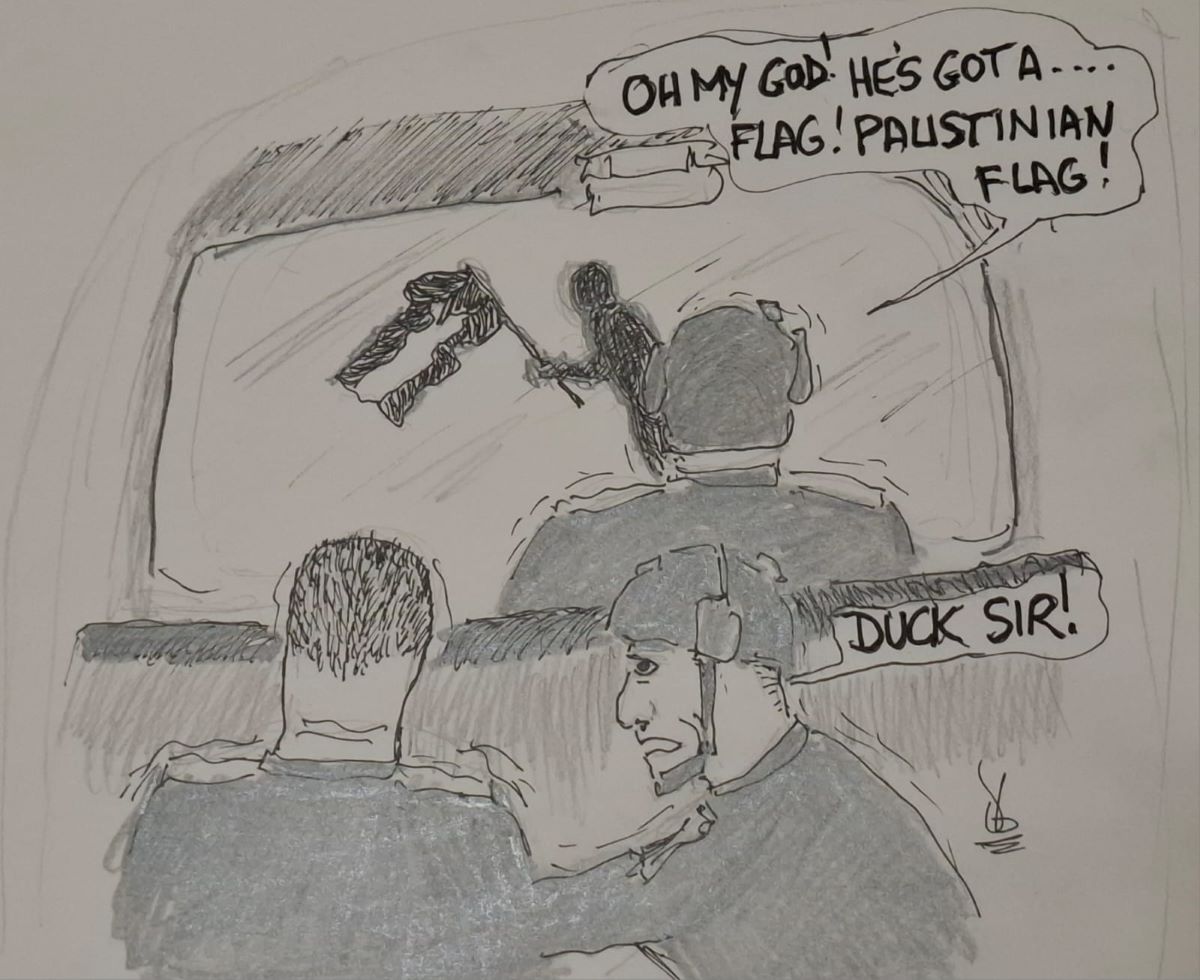
An Irish Palestine solidarity activist momentarily blocked NATO ‘Supreme European Commander’ Alexus Grynkewich’s armed convoy as he left the Dublin US Embassy on Wednesday, escorted by his bodyguards.
The activist was bashed against a wall by Gardaí, arrested and taken to Irishtown Garda station, released on Garda bail to attend court 2nd September.
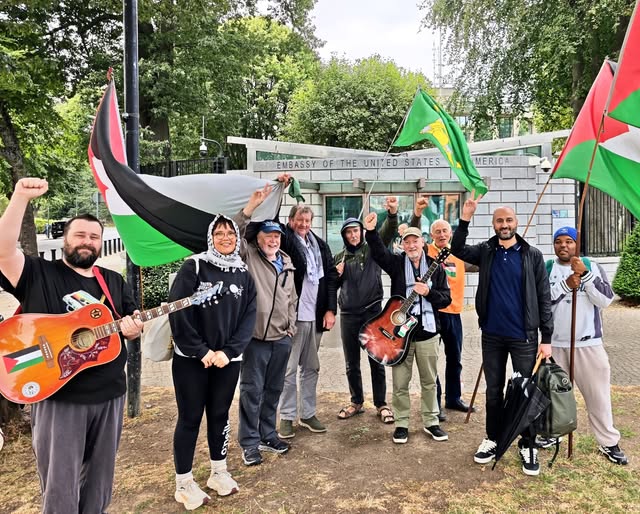
The protest action appears to have been unplanned and came at the end of a weekly event, an hour of displaying flags and singing songs of resistance in front of the US Embassy’s main entrance organised by singer-musician Jimi Cullen which moved from the Israeli Embassy over a year ago.
A recent one of the weekly Wednesday musical protests at the US Embassy organised by Jimi Cullen (on extreme left of photo), this one on 5th September 2025 (Wk 158)
The event began as usual with a handful of people gathering at their usual spot at the triangular junction of Pembroke Road and Elgin Road. It appears that an RTÉ (national broadcaster) team were noted entering the Embassy from the Elgin Road side which alerted the activists to some unusual Embassy activity.
The activists moved down to direct shouts at the Embassy staff and military, shouts such as “US military out of Shannon!”, “US military baby-killers!” and “Free Palestine!”. A car collecting a leaving official was momentarily blocked by an activist who was removed by Gardaí.
Some time later the event was coming to an end with the usual group singing of An Dord Féinne with the chorus “Óró sé do bheatha ‘bhaile” etc and some of the group dispersed. Those who had not yet left however noticed a convoy of Garda and unmarked vehicles arrive.
It was at that point that Alexus Grynkewich, the NATO supremo, emerged from the Embassy building, escorted by his bodyguards and entered one of the vehicles. Before the convoy could take off, the activist ran in front of it, waving a Palestine flag and was grabbed by Gardaí.
After the activist’s detention and removal to Irishtown Garda Station and other activists attended the station, the activist was charged and bailed in his own recognisance and another activist arrived to give him a lift back to where his car was parked near the US Embassy.
Cartoon on the incident by D.Breatnach
NATO & IRELAND
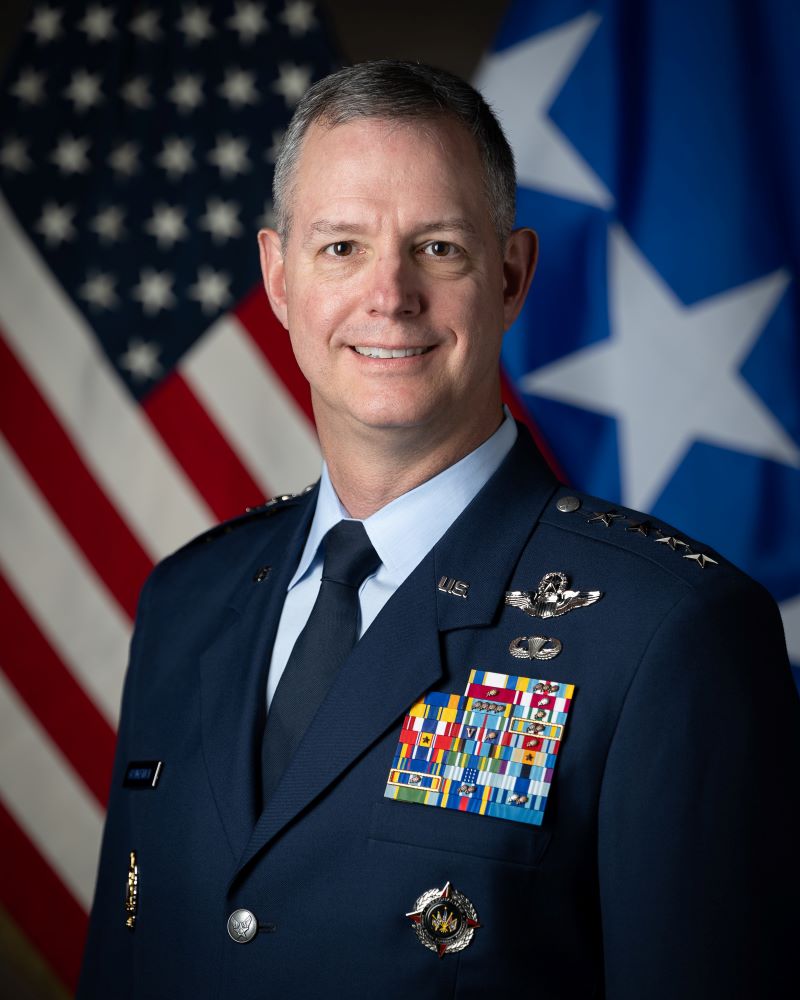
Alexus Grynkewich is no stranger to US Imperialism/ NATO’s wars in the Levant and in Ukraine and his role in Ireland is to push for Ireland to join NATO and continue facilitating US military flights through Shannon. As far as the Gombeen class is concerned he’s pushing an open door.
Not so with the general Irish population, however, who have made it clear on a number of occasions that they wish the Irish State not to be a part of any external military alliance. The campaign to retain the ‘Triple Lock’1to prevent the Government abandoning official neutrality is ongoing.
While the occupied colony of the Six Counties is part of NATO, the Irish State is not. However it was revealed not long ago that the State has given permission to the Royal Air Force to patrol Irish skies and for many years, US military plains have been observed refuelling at Shannon Airport.
General Alexis Grynkewich, Supreme European Commander NATO (US/EU imperialist military alliance). (Photo source: Wikipedia)
In addition, the Ditch online media has logged planes being permitted to fly towards ‘Israel’ through Irish airspace while carrying weapons-grade material. NATO warships dock at Irish harbours a number of times a year.
Ireland’s current Presidency of the EU seems to be accelerating the State’s slide towards foreign militarisation and has already seen restrictions on the right to protest, with Gardaí closing a part of Dame Street to protest one day and moving protesters from in front of Trinity on another day.
A number of organisations have stated an intention to increase their protests against NATO and US imperialism while some regular broad pro-Palestine groups have indicated they will move their regular protests to outside the US Embassy in solidarity with the arrested activist.
Resistance is often met with State repression but in turn that too often generates more resistance. Voices of broad support for the activist have called for assembly outside the US Embassy at 2pm Wednesday 19th proceeding thereafter to the British Embassy to at 3pm where Jimi Cullen has temporarily relocated.
End.
Note: If you found this article of interest, why not register with Rebel Breeze for free, so that you will be notified by email of subsequent articles. You can de-register any time you wish.
FOOTNOTES
1Before more than 12 Irish military may be sent on an external mission, it has to be 1) a formal Government Cabinet decision, 2) with Irish Parliamentary approval and 3) on a UN mission.
Readers will, we’re sure, sympathise with Patrick Quinlan on his resignation from the leadership of the National Party, alleging undemocratic goings-on in the party’s ‘ard-chomhairle’. Undemocratic behaviour in a fascist party! Who’d have thought?
Apparently they voted him, their party leader, off their national committee for asking questions they found awkward and for making criticisms of some things they were doing and about things he thought they should do, which they weren’t.
Quinlan is the party’s only elected public representative, elected to Fingal County Council in 2024.1 Rather than targeting property speculators his election leaflet perpetuated the lie of ‘mass immigration’, that this was ‘fuelling inflation’ and ‘depriving our nation of affordable homes’.
No mention of big landlords. Or bankers. Though his voting record shows opposition to one rent rise plan he did vote in favour of ‘moderate rent increases’ and a time when the purchasing power of incomes is falling. Quinlan is clearly not a supporter of a program of universal rented housing,
But Quinlan, like his party, knows what’s important and will solve most of our problems, apparently and so he has participated in anti-migrant demonstrations and spoke at the pan-racist event in Dublin in April last year perversely linking their trajectory to that of the 1916 Rising.2
FOUNDING OF THE PARTY AND INTERNAL WORKINGS
Quinlan’s letter of resignation and the national committee’s response reveal interesting facets of the party’s internal workings: meetings are online, no minutes of meetings are kept but voting results noted on WhatsApp; the list of members (such as they may be) secret even from their leader.
The fascists who founded the NP did so in 2016, while other people were either preventing the fascist Pegida’s launch in Dublin,3 commemorating the centenary of the 1916 Rising or questioning why it and the subsequent War of Independence had failed to bring about the intended Republic.
Any notion that the racists and fascists might’ve shared those concerns can quickly be put to rest by examining the 1916 Proclamation of Independence, in particular the lines that “The Republic guarantees religious and civil liberty and equal opportunities for all.”4
The NP has had more than its share of splits and internal struggles, from the missing gold bars to the reported value of €400,000 (£344,000) stolen from the party’s vault5 (!) in July 2023 by ‘rivals’ in the NP, to Nazi6 Justin Barrett’s dismissal as leader (denied by Barrett) two weeks later.
Barrett in faux-Nazi officer greatcoat, addressing a small rally of fascists and other racists in Dublin’s Molesworth Street in July 2025. (Photo sourced: Internet)
Despite Barrett’s denials, he was replaced by James Reynolds, a party co-founder with Barrett who apparently made homophobic remarks at the party’s founding conference, defended by Barrett who confirmed the party’s bias to a putative supporter who then walked out of the conference.
However, two years later Reynolds was replaced by Patrick Quinlan.
Homophobia is a frequently visible and audible aspect of fascists and the far-Right generally and in July 2020 the party organised a rally against the appointment of Roderic O’Gorman, an openly gay man, as Irish Minister for Children, pushing the line that gay men are paedophiles.7
EARLY CAMPAIGNING AND OPPOSITION
The NP supported and spoke at a number of protests against requirements to wear face masks during the Covid epidemic, at one of which they also organised an attack by supporters armed with clubs upon unarmed counter-protesters, in which they were assisted by the Garda POU.8
A few months later, a number of NP supporters confronted and jostled an LBGT activist, one of them clubbing her on the head with a wooden batten wrapped in a flag. Despite Gardaí claiming that nothing happened, many recordings on video camera forced an admission.
NP member Michael Quinn pleaded guilty in court and in October 2021 was sentenced to three years prison, the final year suspended.9
The main activity along with most of the far-Right in Ireland has been in opposing immigration to Ireland and in particular opposing Muslims. Immigrants are alleged to get preferential access to resources over Irish people – in particular housing — and of living off state social benefits.
The far-Right also accuse immigrants of attacking women and preying on children. Proving these to be lies through use of statistics does not work since the far-Right are only interested in quoting statistics that seem to prove their theories.
Antifascists have targeted the party’s events a number of times, notably in a charge against their rally outside Leinster House on 10th October 2020, when Barrett told the Gardaí that the NP was on their side10 and begged for a safe escort away from the area (which the Gardaí supplied).
The party’s annual conference in November 2022 in the expensive conference centre in Lough Erne Resort, County Fermanagh (inside the British-occupied colony) was attacked by antifascists resulting in a number of NP requiring hospital treatment.
Just your local friendly fascist leaders (l-r): James Reynolds, Justin Barrett and Patrick Quinlan in days before expulsions, splits and resignations. (Photo source: Internet)
While the fascist movement in Ireland remains tiny and riven by splits, often as a result of career ambition and always due to competing egos, they remain a danger to vulnerable groups and to the democratic forces of resistance, particularly with State support, as currently in the Six Counties.
End.
Note: If you found this article of interest, why not register with Rebel Breeze for free, so that you will be notified by email of subsequent articles. You can de-register any time you wish.
FOOTNOTES
1The only one elected out of nine NP candidates in various areas.
2See reference later to the text of the 1916 Proclamation of Independence.
6Any doubts about the full accuracy of the appellation of ‘Nazi’ to Barrett can quickly be dispelled by reference to some of his utterances and to his dress sense on occasion.
7Fascists and other far-Right activists frequently throw that slur, not only at LBGT people but also in general at antifascists and anti-racists.
8Public Order Unit (what used to be called the ‘Riot Squad’). See also https://the-beacon.ie/2020/10/10/clashes-at-far-right-rally-as-national-party-leader-tells-gardai-you-are-of-us-and-we-are-of-you/ though clearly not a report of someone who was actually there. Witnesses will spot the inaccuracy of “Both groups could be seen attempting to push back the barriers separating them” which is what might have appeared from brief video clips; in fact the NP were pushing the barriers to block the antifascists while the latter were trying to remove or overcome the barriers to close with the NP supporters.
Reproduced with permission of the author; edited to format for Rebel Breeze.
Just 110 years ago on August 3rd 1916 the Irish revolutionary Roger Casement was executed at Pentonville Prison in England, hung by the neck till dead.
However, it was not the only execution of Roger Casement, he has been executed many, many times, by diverse types ranging from the British State to right wing sections of Irish society and the West Brits that populate the Irish media and Dublin’s chattering classes et al.
Of course when I say executed many times, I am not referring to his physical execution, that only happened once, though the British Empire was an expert in cruelty and came as close as you possibly can to multiple physical executions.
One of its favoured methods was for a long time the sentence of Hung, Drawn and Quartered which entailed being hung till nearly dead, brought down, disembowelled whilst still alive and then decapitated: the pinnacle of British civilisation up until 1870.
But I refer to the assassination of his character which still continues to this day.
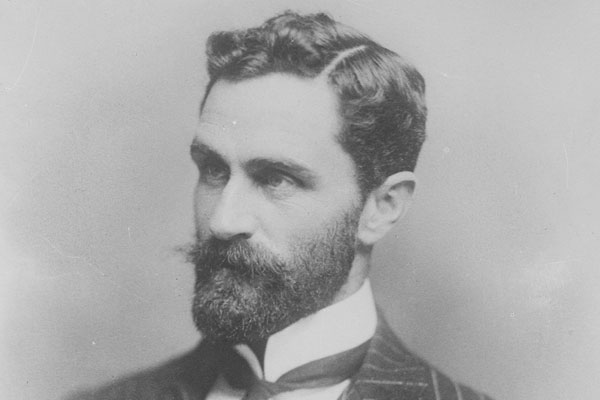
Roger Casement portrait, hanged for his revolutionary work in Pentonville Prison, London, on 3rd August 1916. (Image sourced: Internet)
Casement was a British diplomat for much of his life but his activism in Ireland and his later role in the lead up to the 1916 Rising brought him to the attention of the British authorities that he worked for.
He was an internationally recognised figure praised by all and sundry for his work in Congo and also in Latin America for his work on abuses in the rubber industry.
Executing someone who was ostensibly one of their own was not as easy as executing the other leaders of the Rising and so the rumour mill of the Black Diaries was produced to denigrate his character at the time.
In the 1980s, some Republicans of the Sinn Féin variety reclaimed Casement as a gay icon.
Whether Casement was gay or not would be largely irrelevant to a modern Irish audience, but it was not so at the time. Gay sex was illegal and gays were pursued ruthlessly.
Even Alan Turing who played a key role in Britain’s war against the Nazis by cracking their codes was hounded and prosecuted. Were it not for Turing the course of WWII may well have been very different, but not even that could save him.
Casement who rose up against the British Empire could have expected nothing but the worst from the British. However, alongside the allegation based on the forged Black Diaries that he was gay is also the allegation that he was a pederast.
It is beyond the scope of this article to refute all the fabricated allegations against Casement of which there are many, though Angus Mitchell’s updated biography Casement is thorough in refuting the Black Diaries and the campaign against him.[1]
I was struck by the fact that Casement was under watch from German intelligence during his time there and yet they never recorded any of the behaviour Casement’s enemies ascribed to him, including during his period in Germany.
Why so many attempts to assassinate his character? Well, they needed to do so to justify his execution and have stuck to their murderous guns ever since.
But also, there are many myths about the 1916 leaders that portray them as insular, reactionary irredentist nationalists when in fact they were very open to other cultures and had a broad international perspective not only on culture but also on politics.
Casement’s internationalism, his outward looking view is a matter of public record. His stature as one of the great humanitarians of the 19th and 20th centuries is almost unassailable.
That the rebellion against the British Empire in Dublin could be linked to Casement’s work exposing the atrocities of the Belgian state and royal family or his work in South America in also exposing the atrocities of rubber companies cannot be tolerated.
Not by those who believe in the civilising mission of the White Man’s Burden as the reactionary vile poet Rudyard Kipling put it.
Casement is the only leader of the Rising who is both known internationally, and whose writings are available in various languages. His writings about the Amazon rubber industry are rarely out of print in South America.
The attempts to smear him got more “sophisticated” over the years as concerns about him being gay no longer had the same force and so his work is attacked. He has been accused of racism, being in effect an imperialist, despite all evidence and even part of the problem in the rubber industry.
The Murdoch press in 2010 even stated he was no humanitarian, though that particular press group is given to lying as a matter of course, one of the most infamous cases being the accusations they levelled with gay abandon at the Liverpool fans during the Hillsborough disaster.
But the Murdoch press’ accusations are not any less “serious” than some of the “academic” tripe produced by others.[2]
Casement makes for uncomfortable reading for many. You cannot consider his life, his work and the 1916 Rising without taking into account the international context, international politics and empire in all its nauseous rotten elements.
He inspired other anti-colonial leaders and his speech from the dock was such that it was referenced by independence leaders around the world.[3]
“When languishing as a political prisoner in the 1930s, Jawaharlal Nehru, the first prime minister of India, commented how ‘it seemed to point out exactly how a subject nation should feel.’”[4]
His base in La Chorrera, Putumayo in modern day Colombia[5] still recalls Casement and they refer to Ireland simply as Roger’s Country.[6]
The debates about Casement are not about Casement per se, but rather his politics and what he did and sought to do in relation to the British Empire’s occupation of his homeland. Some of those who denigrate him would be happy for all of Ireland to become part of the British state again.
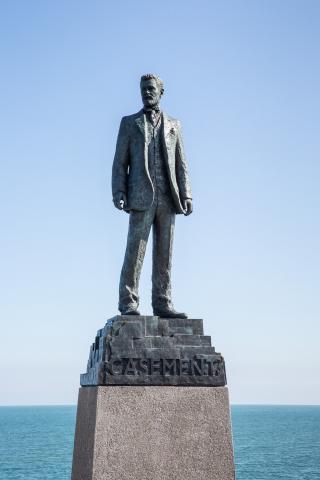
Roger Casement statue on Dún Laoghaire waterfront, erected August 2021. (Photo sourced: Internet)
On one level it does not matter whether he was gay, in the modern Ireland it is hardly an issue, his alleged racism and paedophilia would still be an issue however.
All of these are attempts by a state that cannot come to terms with how one of their own (initially), a man of world renown stature could rise up against their putrid empire.
As we go forward, we have not seen the last of the attempted executions of a man whose fame outlives that of all those who opposed him, argued against him, executed him physically, intellectually and ideologically.
As Angus Mitchell has pointed out about forgeries that they need to be controlled as the British did to a point that we cannot be even sure that the partial release in the 1950s and the later releases are the same documents.
The Black Diaries display the same signature. A consensus that was genuinely secure would not need the regular re-litigation it receives, nor the marshalling of reviews to maintain that consensus.
It would also not require the assurance of the Guardian correspondent that the forgery theory has been discredited when he knows full well that is not the case…
A genuine source needs neither secrecy nor maintenance. The Black Diaries have acquired both – concealed in their handling and defended ever since by a consensus that must be continually reasserted. The endless fascination is not evidence that the mystery is deep.
It is evidence that someone, somewhere, is still doing the work of maintaining the mystery and claiming it as history.[7]
What we can be certain of is that Roger Casement stood up to the empire, he fought against it and that his work is as relevant to modern Ireland and indeed the world as it was then and that is the biggest crime that Casement committed.
One we should be proud of on the 110th anniversary of his execution by the British, that led to multiple executions of his legacy at the hands of the British Establishment, West Brits and other apologists for empire.
Note: If you found this article of interest, why not register with Rebel Breeze for free, so that you will be notified by email of subsequent articles. You can de-register any time you wish.
NOTES
[1] Mitchell, A. (2026) Casement. Haus Publishing. UK.
[4] Mitchell, A. (1916) 16 Lives: Roger Casement. O Brien. Dublin para 21.108
[5] The Putumayo region in which Casement travelled straddled the borders of Colombia, Ecuador and Peru. Land borders have changed since then, particularly after the 1932-34 war. His base was then and still is now in Colombia, some of the other parts are in Ecuador and Peru and others have changed between the countries.
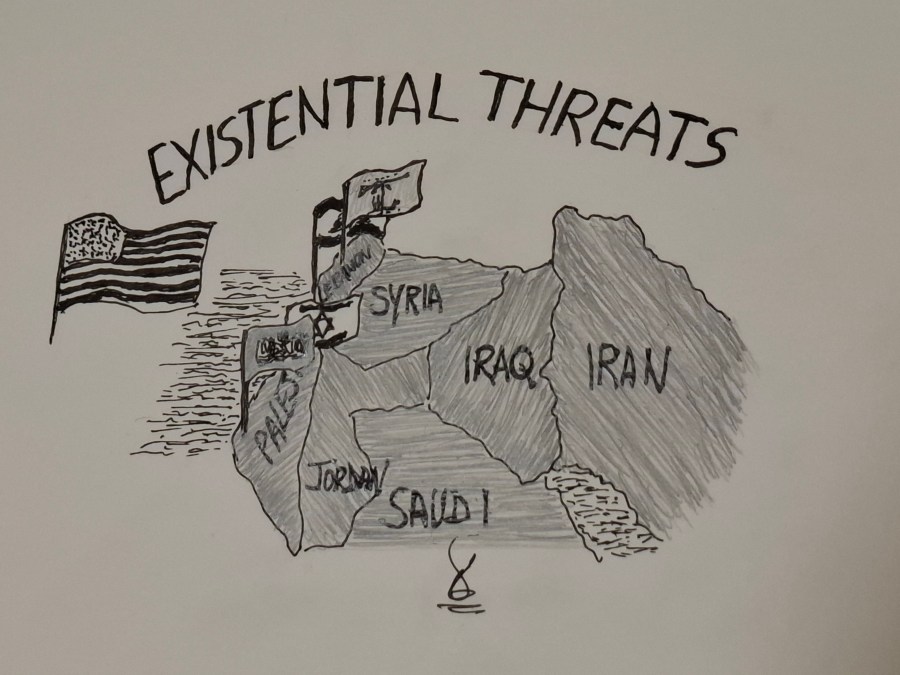
As we face the possible escalation of an extended regional war in West Asia it is worthwhile to consider what’s at stake for some of the various ‘players’.
‘Israel’ constantly claims existential threats to its state but Iran has stated the same with regard to attacks upon it by the US and ‘Israel’. The Resistance in Palestine and in Lebanon have also spoken in those terms with regard to themselves.
It might seem that the US is the only major participant in the wars in Western Asia which is not itself threatened existentially. However, in a sense it too is facing a kind of existential threat, the threat to its continuing existence as a superpower.
Dr. Mohamad Hasan Sweidan, one of the panel of regular news updates on YouTube for The Cradle online media regularly states that in reality, all of the principal actors are indeed fighting a threat to their existence, though the weight of threat being of varying degrees for each.
The ‘Israeli’ state
The Zionist state of ‘Israel’ came into being in 1948 as a Zionist-led European settler project to impose itself on the indigenous Palestinian people of all ethnic groups. Supported by the USA, Zionism gathered force since 1945 to the full-blown terror and ethnic cleansing of the 1948 Nakba.1
Despite claims of recovering ancestral lands, the culture of Ashkenazi colonisers and their languages were European, not West Asian, in keeping with their origin. Citizenship was opened to any Jewish person around the world but not to the Arab Palestinians who had been driven out.
The Zionist state is of course completely dependent on western imperialism for its defence and its very he existence. But ‘Israel’ is not content with that alone and in the logic of all settler colonialism, is constantly fighting wars of expansion with its neighbours.2
The location of this settler colony makes it of important political and military value to western imperialism and in particular to the USA superpower. It is a dagger at the throat of West Asian sovereignty, let alone socialism and in the region is totally free of both those dangers internally.
The settler colony is never secure until it has either wiped out the indigenous people or totally broken their resistance and scattered them. Consequently the indigenous people will resist and if they can, logically, aided by their threatened neighbours, will overthrow the occupation.
Therefore the Zionist State is truthfully facing an existential threat.
The Resistance
The Resistance to imperialism and Zionism in West Asia is wide and multi-faceted but for the purpose of this examination we’ll look at sum of the factions inside Palestine, both Islamic and secular factions as one Resistance; and Hizbollah and political allies in Lebanon as another.
Because of its practices, its origins and attitudes to the cultures of West Asia, ‘Israel’ is viewed by Palestinians and most people of the region as an occupier. It has functioned as a proxy of imperialism, particularly the US variety, in the region since it came into being.
Like settler colonies in general, the Zionist state has been expanding its territory since its inception.
It has also waged war on its neighbours for most of its existence: 1948 against Palestinians and Arab states, 1950s-1960s against the Palestinian Resistance; with France and UK against Egypt (Suez) 1956; 1967 against Egypt, Jordan, Syria; 1973 against Egypt and Syria.
And in 1971-1982 in South Lebanon.3 In September 2024 it attacked Lebanon with assassinations and exploding pagers and in December of that year, invaded Syria4 (though it had regularly bombed it previously) and attacked Iran (during peace negotiation) in February 2026.
The Zionist military carried out a great number of major attacks within Palestine including against the West Bank and Gaza in between what the Zionists call ‘mowing the lawn’, i.e. regular assassinations, raids, arrests and imprisonment of hostages.
The attitude of the ‘Israeli’ occupation to the Palestinian resistance is typified in its attitude to Hamas, the political party elected by significant majority across Palestine in 2006: it totally rejects the people’s choice and attempts to eliminate it in Gaza through economic and military means.
In the West Bank the Occupation’s proxy, the Palestine Authority refused to accede to the popular vote and collaborates with the Occupation, even though the even more extreme elements in ‘Israeli’ government and society despise it, regularly denouncing it and calling for its elimination.
The PA represses criticism by Palestinians in the West Bank, jails critics and fighters, sets them up for ‘Israeli’ jailing and has even murdered Resistance fighters.
‘Israel’ and the US are in concert attempting to use elements of the Lebanese Government against Hizbollah and political parties close to or friendly with them, attempting to turn the Lebanese Army to that purpose. Were they to succeed this would result in another Lebanese civil war.
It is a fact that the state of ‘Israel’ has no formal borders, except where its present territory reaches the borders of Egypt and Jordan.5 The ‘Greater Israel’ concept6 and Zionist aspiration exceeds far beyond even those,7 including Jordan, Lebanon, Syria, Iraq and swathes of Egypt and Saudi Arabia.
Many Israeli political leaders including Ze’ev Jabotinsky,8 Menachem Begin9 and Benjamin Netanyahu, Smotrich and Ben-Gvir10 have openly promoted the ‘Greater Israel’ (sic) concept as an objective and seems to have the support of US foreign policy and the ‘Israeli’ opposition.11
In all ‘peace’ proposals the ‘Israeli’ establishment seeks the ‘disarmament’ of the Lebanese and Palestinian Resistance, while itself remaining the most heavily armed state in the whole of West Asia, the only one with a nuclear weapon and a long history of committing massacres and genocide.
Hizbullah and the Palestine Resistance are therefore indeed facing an existential threat.
Image by D. Breatnach
The USA
The USA is the chief world imperialist power and in order to maintain that position has a number of requirements, among which are that it can direct or at least influence events around most of the world and that its military might is seen as impossible to defend against.
The Warsaw Pact bloc, a former impediment to expansion of US dominance has gone, though the Russian Federation remains. However the rising economic power of China already threatens the world dominance of the US imperialist ruling class.
But it has faced a new threat to its hegemony of West Asia. Although the non-compliant regimes there of Iraq and Syria (and Libya in North Africa) have been overthrown, US influence in Iran12 had been defeated by uprisings and founding of the Islamic Republic of Iran in 1979.
Despite war against the Republic (1980-’88) by then western-supported Saddam Hussein, the Islamic Republic survived and supplied resistance organisations in Lebanon and in Palestine with weapons.
The US failed to subdue Iran with decades of sanctions or to instigate popular or separatist insurrection against the ruling elite during unprovoked attack in February, having to accept the stability of the Republic and to agree to ceasefire terms, losing much of its mythos of invincibility.
Not only were its military installations in West Asia shown to be vulnerable but they became regular targets in retaliation for US strikes against Iran. Client regimes began to wonder whether they could even afford to have such failed protection US military bases on their soil.
The repercussions of that will extend right around the World.
Iran
The Islamic Republic of Iran came into existence in 1979 in a revolution against the Pahlavi monarchy, its repressive Savak secret police and against Iran’s client status of US imperialism (such that the CIA’s head office for the whole of West Asia was located there).
The revolution found the CIA desperately shredding their spy documents (many of which were later painstakingly stuck back together by the Iranian revolutionaries). The revolutionary leadership and its followers were immediately targeted by imperialism, in particular by the USA.
The imperialists instigated Saddam Hussein (at the time their client) to have Iraq invade Iran in a war which lasted eight years during which 188,015 to 217,489 Iranians were killed (about 70 people per day).13 Hussein used gas attacks14 as well as bullets and explosives.
In addition, US imperialism has imposed sanctions on Iran since 1979, which is to say threatened sanctions on any state prepared to sell to or trade with the Islamic Republic and these have had a heavy negative impact on the population, in particular in the area of health treatment.15
In January 2026 the USA manipulated currency trading and the value of the Iranian rial fell. Protest demonstrations took place which Israeli and US intelligence operatives in places turned into armed attacks on police, government buildings and even some place of religious worship.
The Iranian authorities issued figures of 3,117 killed during the disturbances,16 which included civilians and agents acting under foreign direction, without identifying which was which. A significant number of those killed were State employees, including public security and police.
Sources sympathetic to the West have issued a range of fatal casualty numbers, rising to 36,000. It does not seem possible to separate real figures from propaganda, certainly of Western sources and possibly too of the Iranian State.
However the involvement of agents working for foreign powers to destabilise Iran has been established, not only in results of raids by Iranian State security forces but also in statements by US and ‘Israeli’ authorities17 and in admissions of Starlink-linked devices smuggled into Iran.18
Trump admitted that the US had supplied weapons to Iranian Kurdish pro-independence groups at this time also and complained that the Kurds had failed to use them against the US. Probably Baluchistan separatists were similarly urged to rise but did not do so in any numbers.19
The presence of foreign agents in Iran was also evident not only by intelligence possessed by the aggressors during the following war but also by when drones were launched against targets in Iran from within the country.
‘Israel’ accompanied by the USA,on 28 February, during negotiations, assassinated the religious and political supreme leader, Ali Khamenei and others, along with families and launched air strikes across Iran, including killing 124 schoolgirls with their teachers in a ‘double-tap’ strike.
The USA is too far away for a retaliatory strike but their military assets are distributed around the Gulf and Iran’s response struck those hard, US defences proving inadequate in action. Iran also closed the Strait of Hormuz, cutting the flow of essential gas and oil from the region to the West.
The US was forced to negotiate and to agree to Iranian terms in a Memorandum of Understanding for peace talks, most of which the US has yet to carry out in practice and much of which it has violated. But it is difficult to see what final options it has other than compliance.
The intentions of US imperialism to the Islamic Republic of Iran are irremediably hostile, proven in sanctions, assassinations, war, subversion attempts, rhetoric and threats, wishing the Iranian revolutionary regime overthrown and Iran dismembered, i.e. indeed an existential threat to Iran.
CONCLUSION
The mutual existential threats of antagonists do not usually cancel each other out. Rather, one of the antagonists must fall. Liberal solutions of ‘peace’ between them are illusory and chasing such mirages is not only fruitless but diverts attention from the necessary resolution.
In fact, wars where none of the antagonists feel they can afford to give way are complicated and very hard to resolve.
In the short term, for relative peace in Western Asia, both the US imperialists and the Israeli Zionists need to be severely weakened and those who wish for that relative peace must logically wish success to the struggles of the Islamic Republic of Iran and of the Resistance organisations.
In the medium term, the existence of the state of ‘Israel’ needs to cease and the democratic state of Palestine to come into being with US Imperialism weakened further or overthrown.
The ruling class of the strengthened Iran will need to see how they can manage Iran’s new status and the Resistance organisations how they develop and grow their respective nations as independent and sovereign states.
In the longer term, new threats and new conflicts will emerge throughout the world. As long as capitalism exists, parts of it will grow into monopoly capitalism and that in turn will seek to maximise its profits by venturing abroad in competition and/or in coercion.
End.
Note: If you found this article of interest, why not register with Rebel Breeze for free, so that you will be notified by email of subsequent articles. You can de-register any time you wish.
FOOTNOTES& SOURCES
1During the 1948 Nakba (Arabic for “catastrophe”), approximately 750,000 to one million Palestinians were displaced from their homes, and an estimated 10,000 to 15,000 Palestinians were killed.
More than 80% of the Palestinian population living in the territory that became Israel was forced to leave.At least 530 villages and towns were destroyed or depopulated.
The United Nations Relief and Works Agency reports that this initial displacement grew into an ongoing crisis, with nearly 6 million Palestinian refugees registered today. Historians and organizations generally estimate that 10,000 to 15,000 Palestinians were killed. Deaths occurred during combat, in dozens of targeted massacres, and from the general violence of the war.
3From 16 to 18 September 1982, the IOF’s proxy, the Lebanese Forces, one of the main Christian militias in Lebanon, massacred between 1,300 and 3,500 civilians—mostly Palestinians and Lebanese Shias — in the Sabra neighbourhood of Beirut and in the nearby Shatila refugees camp, with the support of the IOF.
4As the Syrian regime collapsed in early December 2024.
14Western media were not interested at the time – Hussein was attacking Iran and was therefore one of ‘the good guys’. Journalists who tried to get western media to cover the wiping out of a Kurdish village Halabja by gas attack in 1982 were getting nowhere. However, many years later, when the Saddam Hussein had switched and started defying the western imperialists, western media suddenly found the story valuable even though years old by then.