PEACE WITHOUT JUSTICE IN PALESTINE

Diarmuid Breatnach

(Reading time: 4 mins.)

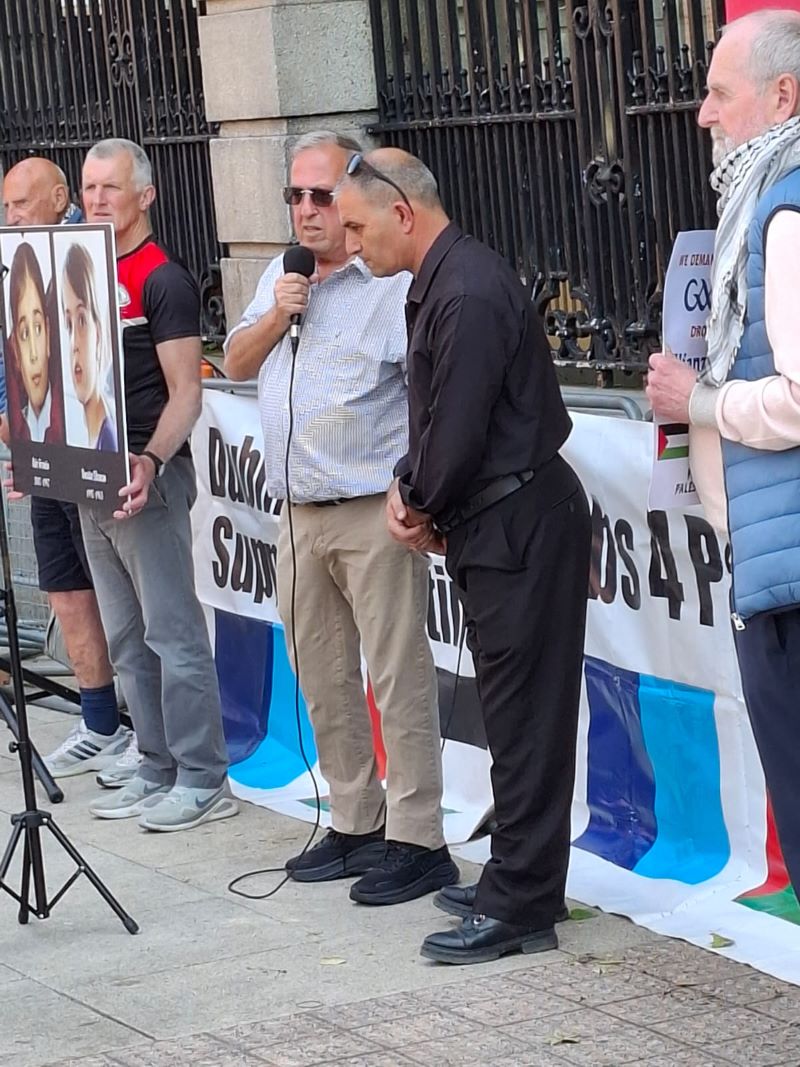
Two famous people addressed a crowd outside Leinster House, home of the Parliament of the Irish State on 25th May. Rami Elhanan, an Israeli graphic designer, and Bassam Aramin, a Palestinian scholar, had forged a remarkable friendship.

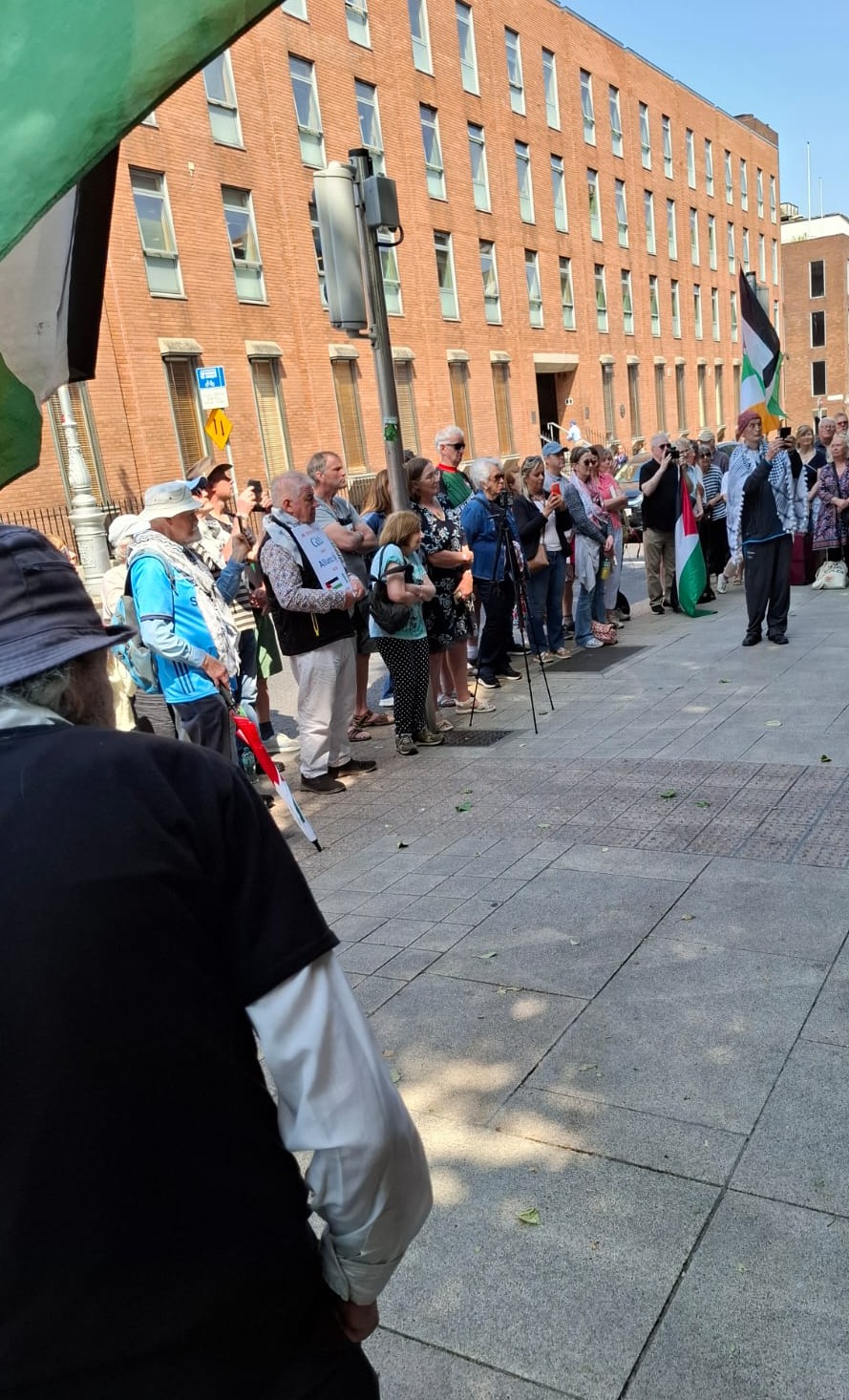
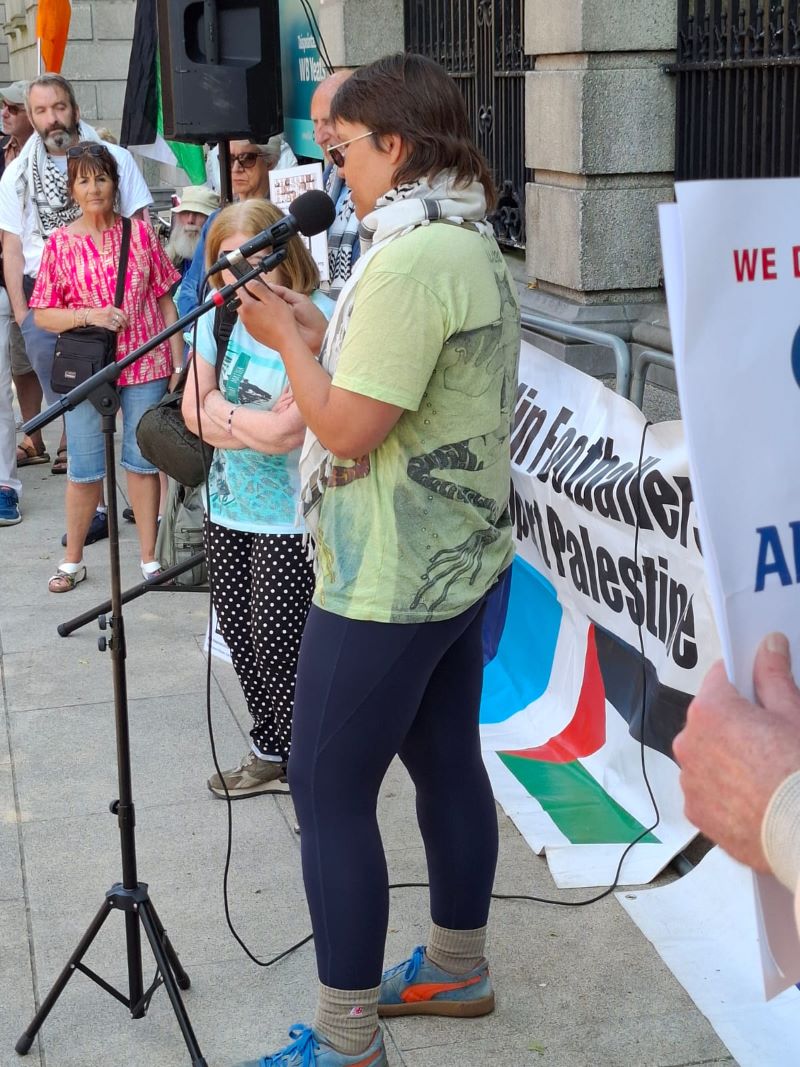
Section of participants in the Dubs for Palestine noontime event outside Leinster House 27 May 2026. (Photo: D.Breatnach)

Bassam Aramin, now a Palestinian scholar, had been sentenced to a 7-year term of imprisonment for throwing a grenade at Israeli soldiers when he was 17 and had lost his daughter later to a plastic bullet fired at short distance by an IOF soldier.

Rami Elhanan, an Israeli graphic designer, had also lost his daughter Smada but to a suicide bomber in 1997. Both men became advocates of peace and dialogue and friends to one another.

Their audience was the weekly Dubs for Palestine gathering outside Leinster House on Wednesdays 12 noon to about 1.00 pm, with speeches, songs and poetry and David Hickey as MC. This week’s was the 113th such weekly gathering and the duo had been invited to speak.

The broad group has of late been concentrating on parting the Gaelic Athletic Association1 from its sponsor and insurance underwriter, the former Nazi and since Zionist-friendly Allianz company, along with now campaigning for the Irish soccer team not to play the ‘Israeli’ team.

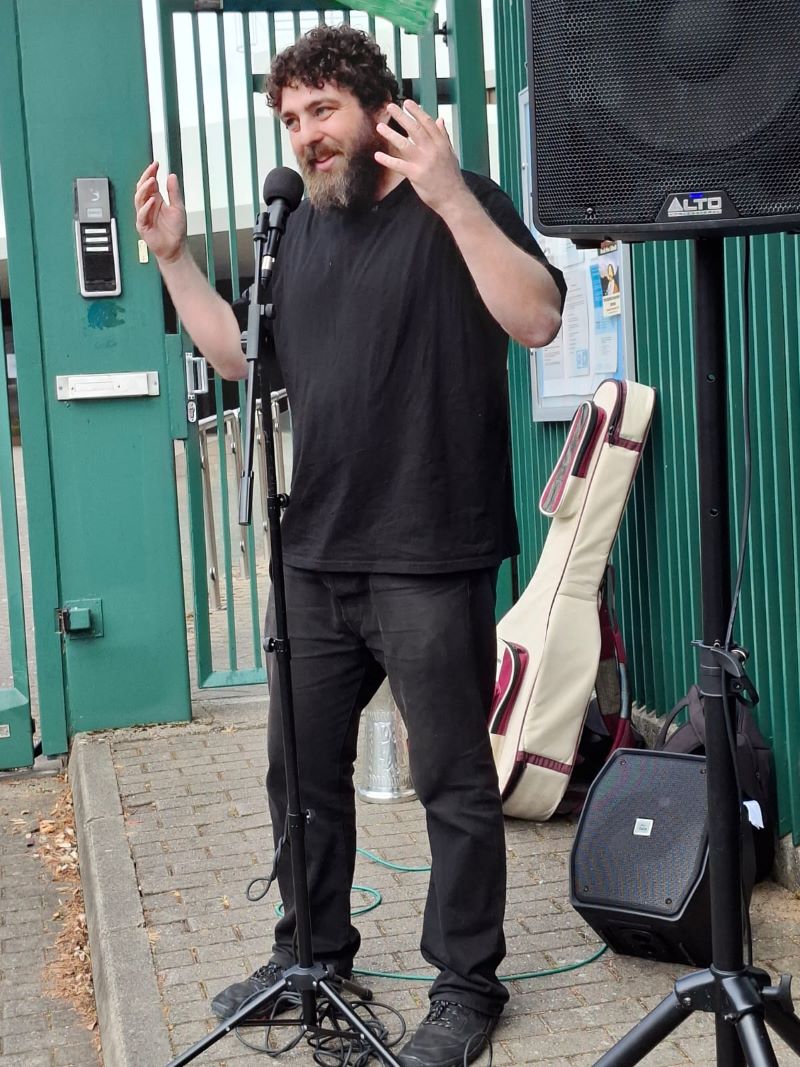
Rami Elhanan (L-R) and Basam Aramin addressing the Dubs for Palestine noontime event outside Leinster House 27 May 2026. (Photo: D.Breatnach)

Rami Elhanan referenced his descent from Holocaust survivors and outlined the different living standards of the Palestinian and Israeli Jewish communities, commenting on the sickness in Israeli society, that they did not want to know what is being done in their name to the Palestinians.

Basam Aramin’s contribution was against the Occupation and claimed that without that, Palestinians and Israelis could live in peace (it was not clear whether he was referring to the ‘Two State’ proposal2). David Hickey, the MC of the group presented them with an Arum Lily each.3

After their speeches had been applauded, they were asked to comment on the recent Leinster House debate and the Government’s refusal to endorse a boycott of Israel. Rami Elhanan replied that boycotts entrenched opposing sides and that continuing to talk was the answer.

Singer and activist Emma Browne, invited next to the microphone, sang Keep the Little Flame Alive, among the lyrics of which Faye, Dolores, Bernadine, Table grapes and gasoline, Homemade rifles, kitchen knives, Kept the little flame alive riposted the previous speakers.

Soon afterwards, Paul Lynch read a poem of a Palestinian father mourning the killing of his child. Poet and activist Dorothy Collin declared that in order to have peace there must be justice first and that we must support the oppressed in whatever way they choose to resist.

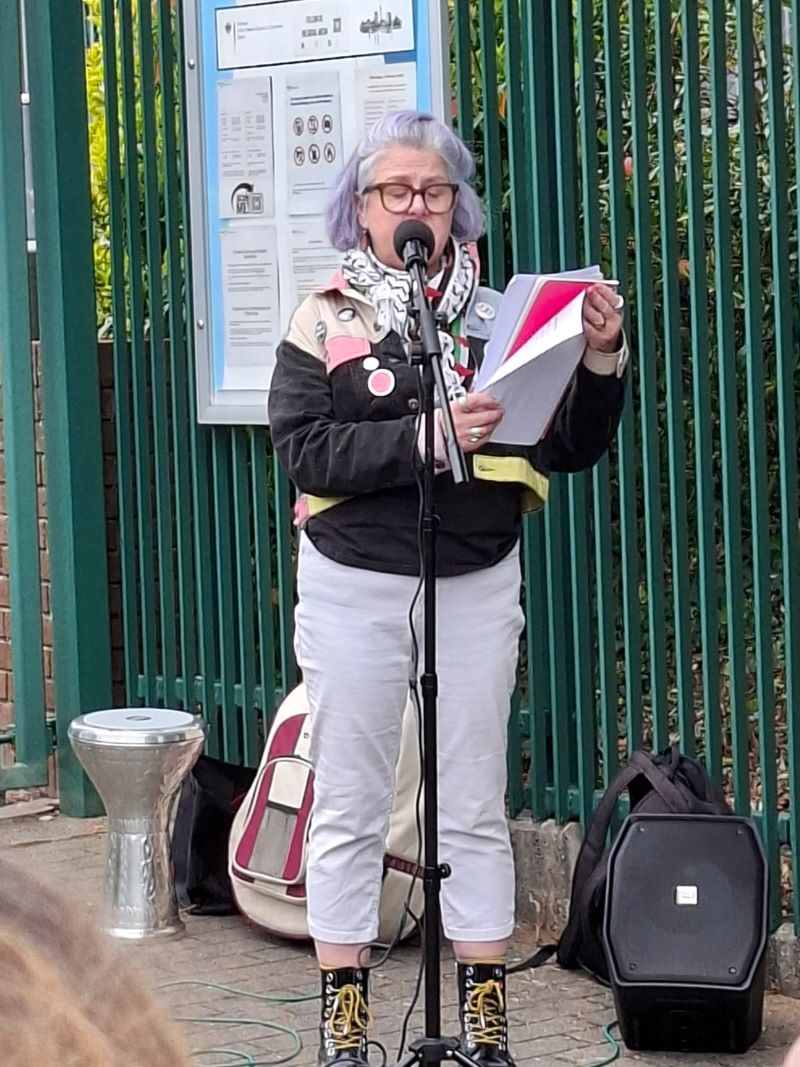
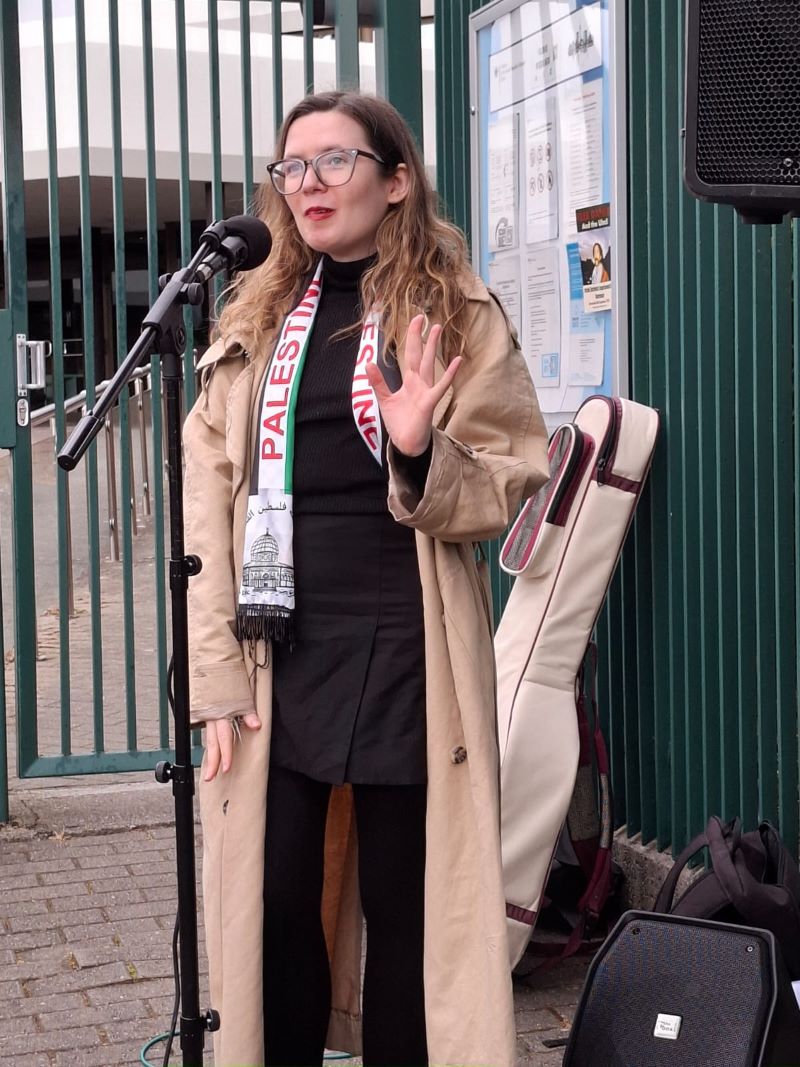
Áine Ruttley reading her poem while addressing the Dubs for Palestine noontime event outside Leinster House 27 May 2026. (Photo: D.Breatnach)

Áine Rutley also upheld our duty of solidarity and the right of the Resistance movement to choose its own methods, as did Jimi Cullen who then performed his own song composition The Freedom Fighter about a fighter from Gaza.
As I was called to the microphone, I commented that my views had already been well expressed in song and speech and that one of the forms of resistance is song, of which we had more than probably any other people in the world and sang An Dord Féinne,4 which is banned in Germany.

A little later the event came to an end with another song from Emma Browne, Never Again Is Now and with group chanting for Palestine, against Allianz and against playing the ‘Israeli’ team.

IN CONCLUSION

It is a popular proposition in certain circles that all social conflicts can be resolved by discussion, by understanding our opponents’ view. It is an attractive idea but flies in the face of history and of contemporary reality.

The interests of Occupied and Occupier are opposed and cannot be reconciled through understanding. The Occupier understands that the Occupied wish to be rid of them. The Occupied do understand that the Occupier wishes to continue appropriating their land and resources.

In this kind of situation one must win and the other lose. Far from understanding leading to peaceful resolution, the more the oppressed understand the nature of their oppressor, the more resolutely they are likely to resist and this is surely true of the Palestinians resisting the Zionist settlers.

The false proposition of resolving irreconcilable interests through discussion is usually of liberal or social-democratic origin when applied to anti-colonial, anti-imperialist and anti-racist struggles and though appearing even-handed, always ends up disempowering the victimised.

The journeys of both these men is extraordinary and interesting but it should not be presented as representative of the Palestinian struggle against Occupation, Theft and Genocide. Each father lost a child but the Palestinian is losing a lot more on top.

Furthermore, a just resolution can only come about through the total defeat of the Zionist forces and the dismantling of their State, so that if we really want that kind of resolution we are called to support the Palestinian side, unequivocally and resolutely.

Of course, in reality there is no question of real peace without justice, for ultimately the oppressed (unless wiped out) will rise in struggle again and again. The proposition of accommodation of opposites by discussion can only undermine or distract the struggle of the oppressed.

We cannot take the story of Bassam Aramin and Rami Elhanan, however remarkable, as even a metaphor for a just resolution nor allow ourselves to be seduced from resistance nor our struggle undermined by it.

End.

Note: If you found this article of interest, why not register with Rebel Breeze for free, so that you will be notified by email of subsequent articles. You can de-register any time you wish.

FOOTNOTES

1The management of the Gaelic games, including hurling and Gaelic football. The GAA has teams in every one of the 32 counties of Ireland, crossing the colonial border and is the biggest community sports association not only in Ireland but also in Europe and perhaps in the world.
2This proposal came out of the Oslo Accords, to give the Palestinians 20% of their land for peace with the Zionist settlers who would own the remaining 80%. Apart from its basic injustice the proposal was never realistic since Zionist settlers continued to construct settlements on additional land. Despite this, supporting that proposal is the formal position of most western imperialist states and the Irish State and of most parliamentary political parties.

3In Ireland these are often viewed as symbolic of the 1916 Easter Rising.

4Also known as Gráinne Mhaol and Óró Sé Do Bheatha ‘Bhaile, an Irish traditional song of some antiquity refashioned into an Irish resistance song by Patrick Pearse, a martyred leader of the 1916 Rising.

SOURCES

https://en.wikipedia.org/wiki/Apeirogon_(novel)

MAN DEAD AFTER BRUTAL RESTRAINT BY ARNOTTS SECURITY

Diarmuid Breatnach

(Reading time: 4 mins.)

A vigil was held today outside Arnotts department store, Dublin at the site of the death of a man yesterday while being restrained by four men, apparently employed as security by the store.
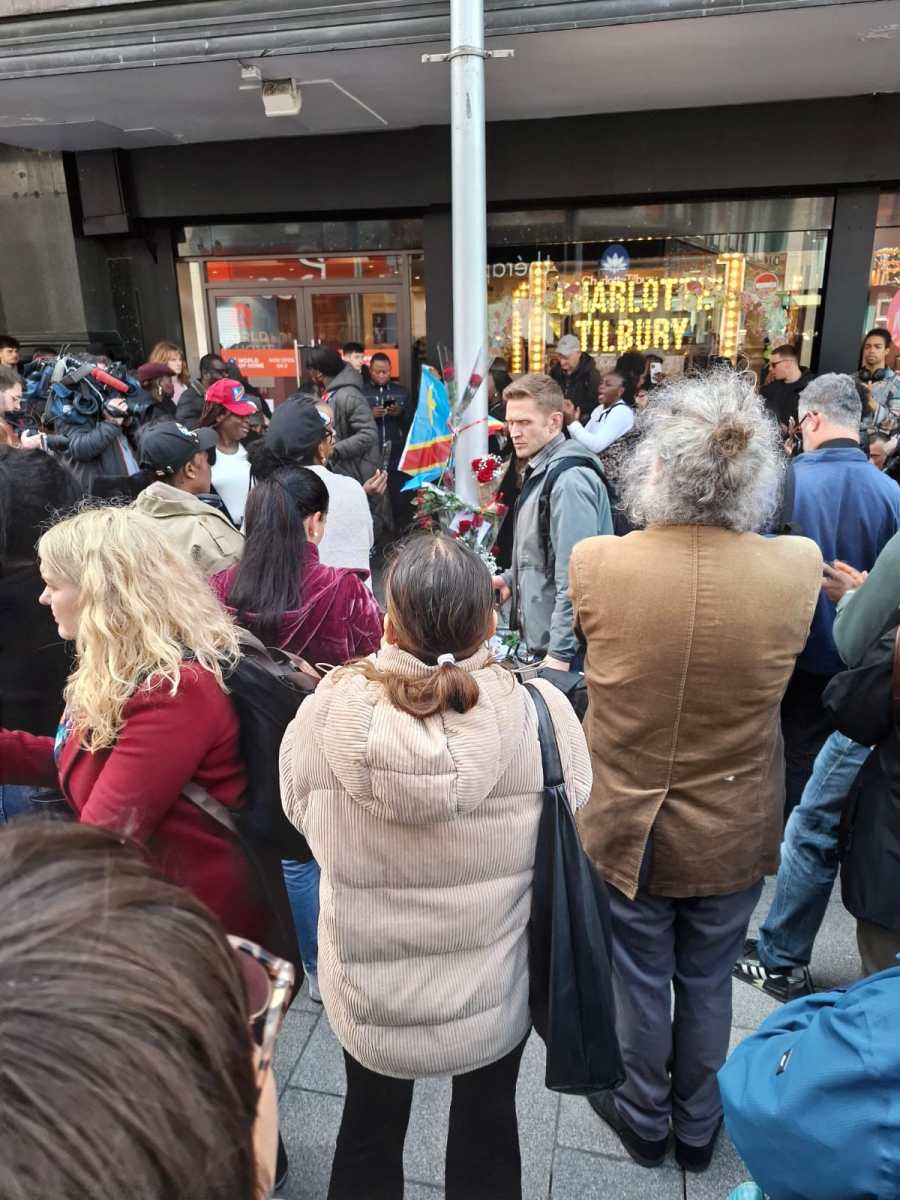
The crowd grew dense in front of Arnotts in Henry Street Dublin as more people arrived to support the vigil about the killing of Yves Sakila. A woman can be seen displaying the flag of the Democratic Republic of the Congo. (Photo: D.Breatnach)
A video of the four security staff restraining a man has now circulated widely. It is brutal. He is being held face down with one operative pressing his head to the ground. Another is placing his knee against the man’s neck and then shoving hard it inwards while the man’s cries are ignored.

The other two, not clearly in view, are presumably restraining at least his legs.

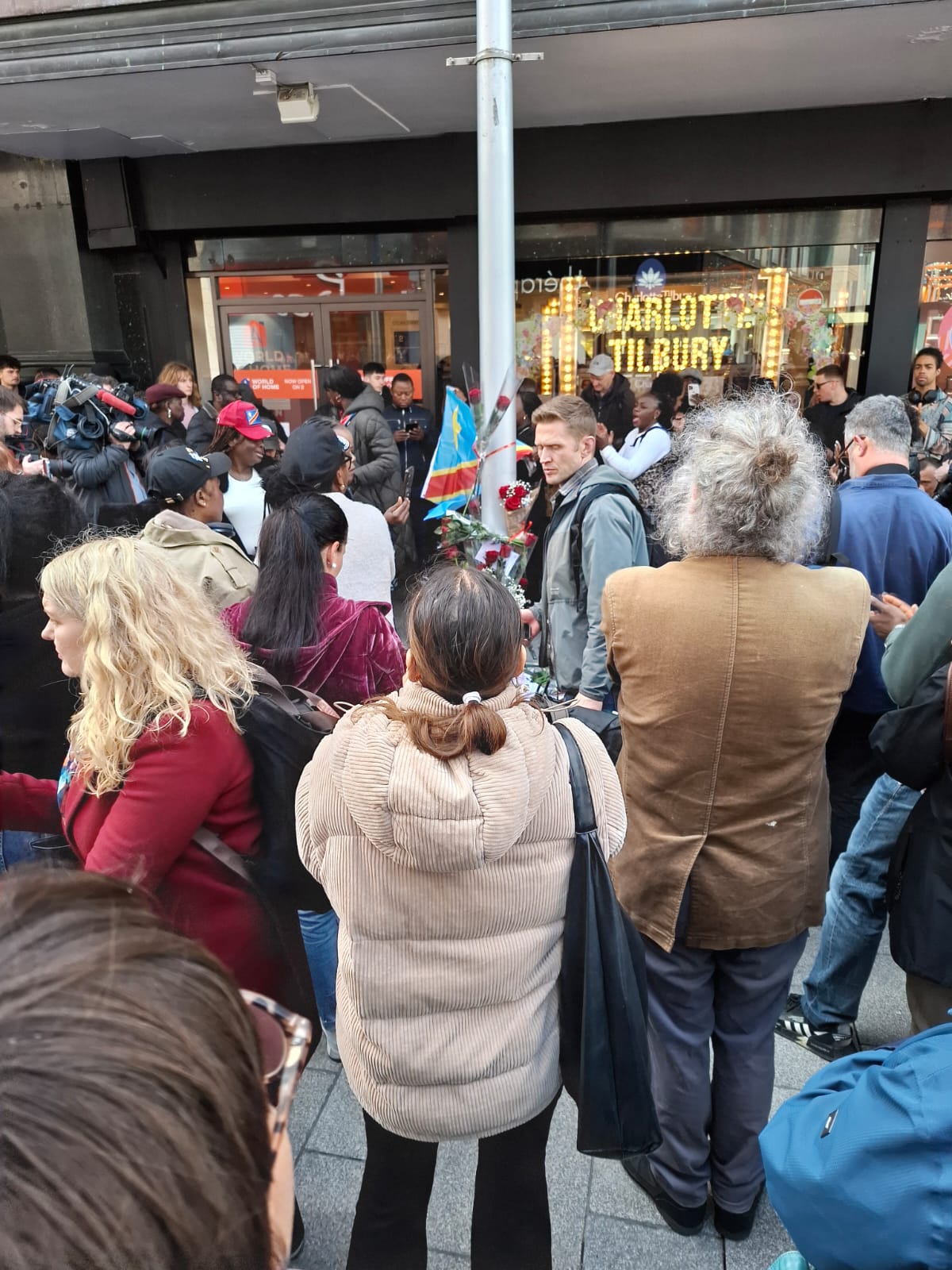
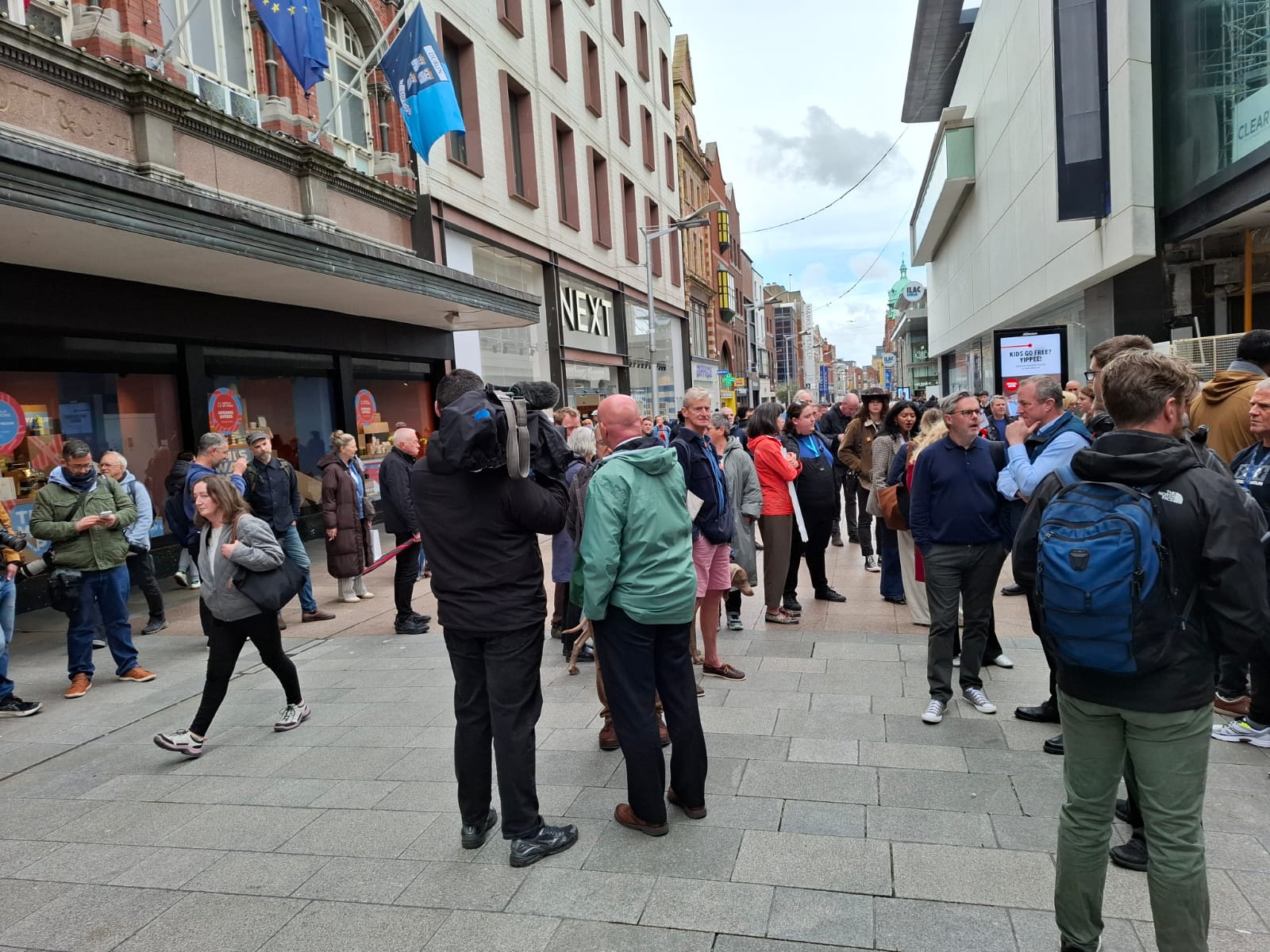
View of the initial crowd in front of Arnotts in Henry Street Dublin to support the vigil about the killing of Yves Sakila. (Photo: D.Breatnach)

According to media reports, the man is alleged to have shoplifted something. That is an unproven allegation but even had it been so, are we to accept the endangering of a life to defend a commercial company from the theft of some article?

Are we to accept the right of a commercial company’s security team to brutally take a suspect down and to restrain him without regard to the safety of his life?

It is possible but not yet certain that attitudes to race played a part in Yves’ treatment. One of the speakers at the vigil today seemed to say that was not so, that it could’ve happened to anyone in the hands of that security team. Perhaps. And perhaps not.

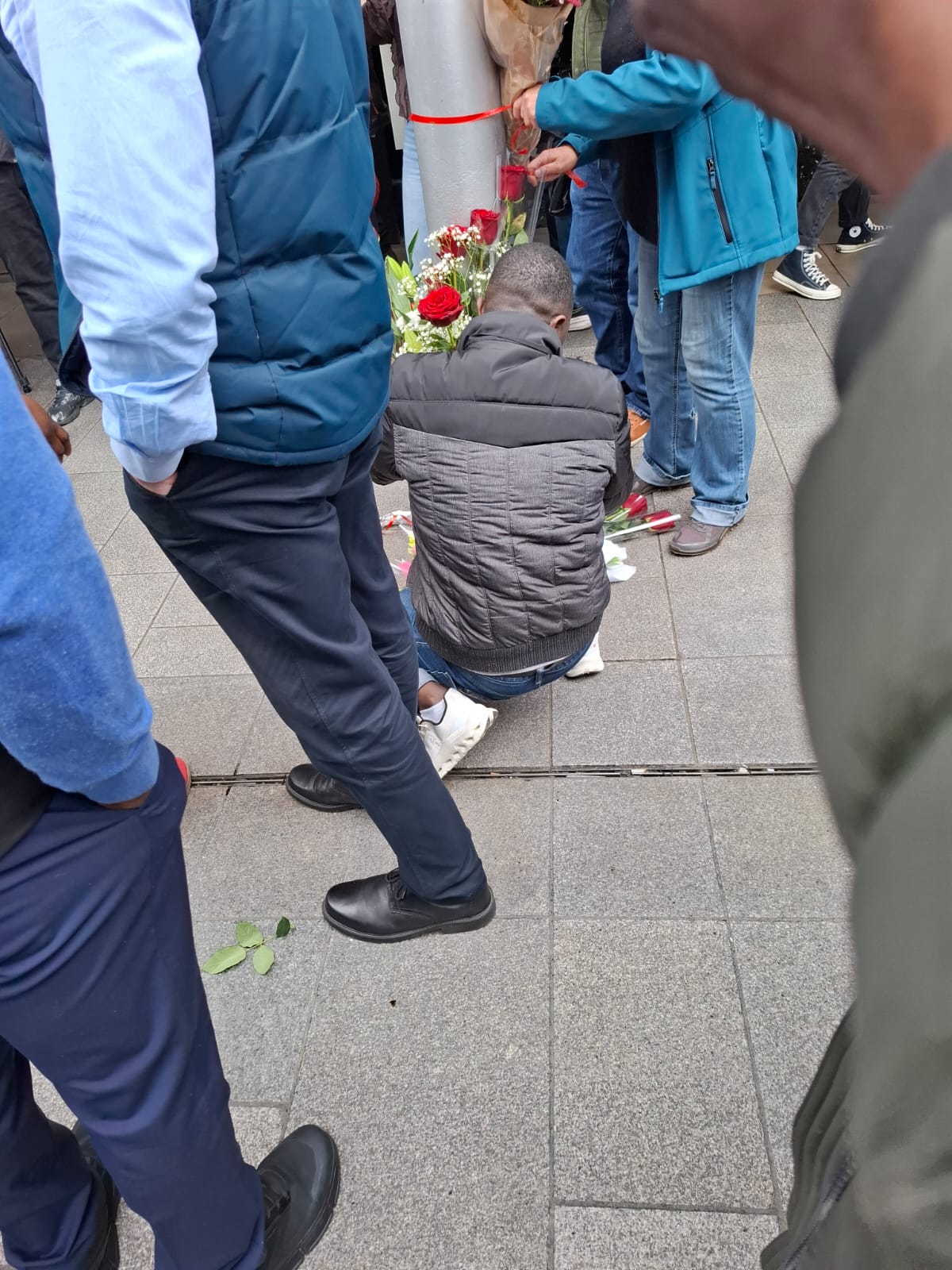
One of the Congolese adjusting flower offerings in mourning for the killing of Yves Sakila in Henry Street in front of Arnotts. (Photo: D.Breatnach)

Just over five years ago George Nchengo, a Nigerian experiencing an episode of mental illness, was shot dead by Gardaí. While brandishing a knife he was in his own family’s garden and of no immediate threat to the Gardaí or anyone else but they were cleared by GSOC investigation.1

The victim’s name is Yves Sakila, of Congolese background, who came to Ireland as a child, where he attended secondary school 22 years ago, according to one of the speakers at the vigil. A number of apparently Congolese spoke, most in English and one in French and were widely applauded.

One of the speakers angrily drew attention to the recently-reported racist comments of Fianna Fáil politician and former Taoiseach (Prime Minister equivalent) Bertie Ahern, who in his anti-immigration comment specifically mentioned people from the Congo.

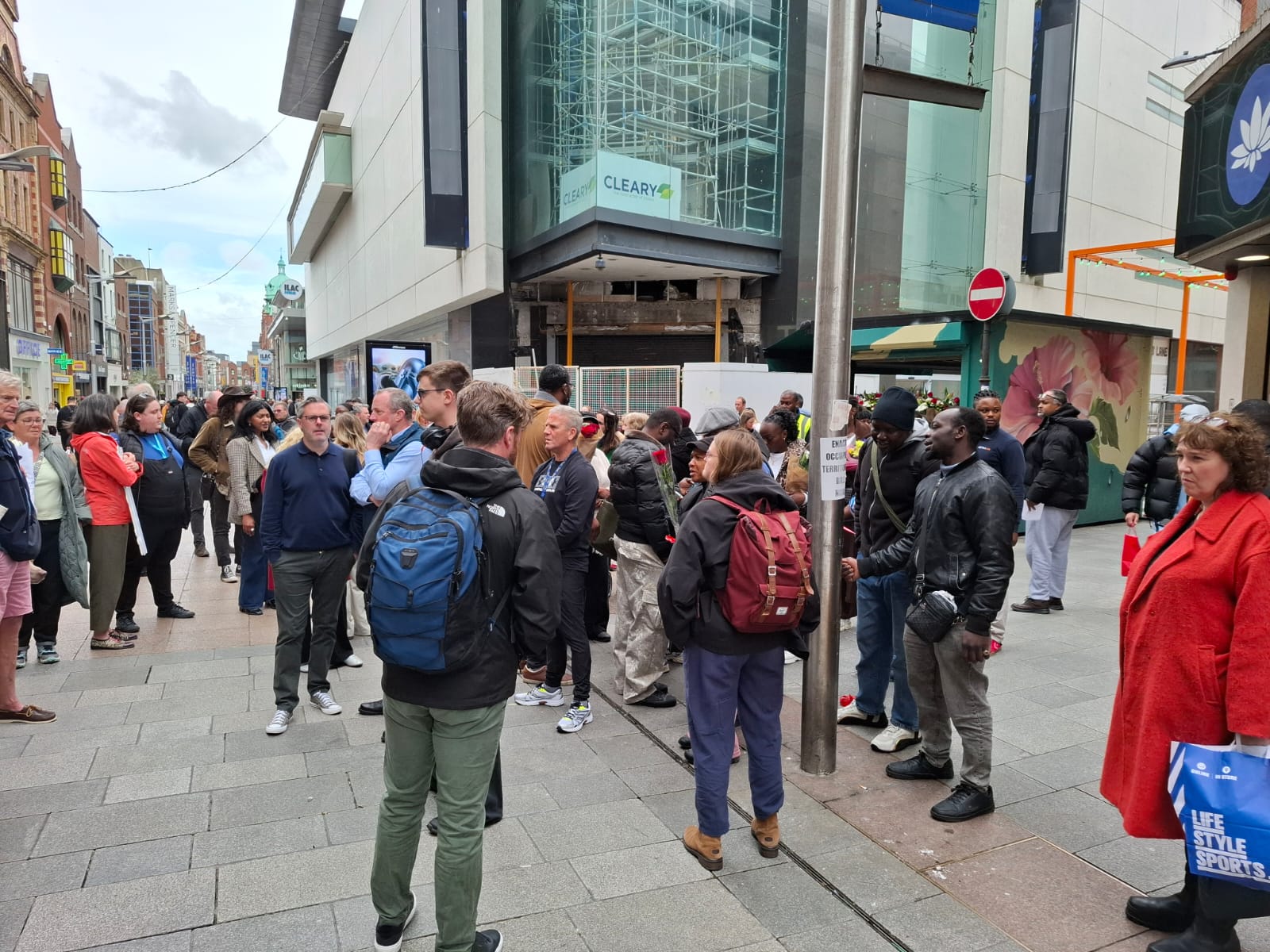
Another view of the initial crowd in front of Arnotts in Henry Street Dublin to support the vigil about the killing of Yves Sakila. (Photo: D.Breatnach)

That is a man who used his Government positions to rip off the Irish people and was judged by the Mahon Tribunal to have lied during at least four sessions of the Tribunal from 2007 to 2008 about the purpose of substantial cash transactions during his time as Minister of Finance.

Gardaí were present at the vigil today but in the background. One Congolese man told the crowd he was an engineer and paid his taxes in Ireland. A few Congolese present were in Dublin Bus jackets, with a white-skinned man in the same uniform talking to them.

The crowd of both black and white-skinned people took up chants of No Violence! and Justice for Yves! Flowers were purchased from a street stall, brought to a nearby spot and attached to a lamppost. A group of African women led a chant in a circling dance around the spot.

One of the Congolese explained to me that the chant is a mourning one and, in reply to my comment about the keeners in our tradition, said that they also have women who come to funerals to perform that service; like ours, there are also stories, songs and laughter amid the mourning.

There were photo and video cameras much in evidence with individuals being interviewed but there was no mention of the vigil in Breaking News this afternoon. RTÉ News issued a reasonably full report while the Independent seemed to be slanting against the victim.2

Earlier today the Irish Network Against Racism (INAR) issued a statement expressing concern and its Director Shane O’Curry was quoted calling for a thorough investigation “in order to ensure minority ethnic community confidence in the criminal justice system.”3

While expressions of concern are welcome, one needs to ask why one should expect the minority ethnic community to have confidence in the Irish criminal justice system. Quite apart from their own experience of it, many in the host community themselves have no confidence at all in it.

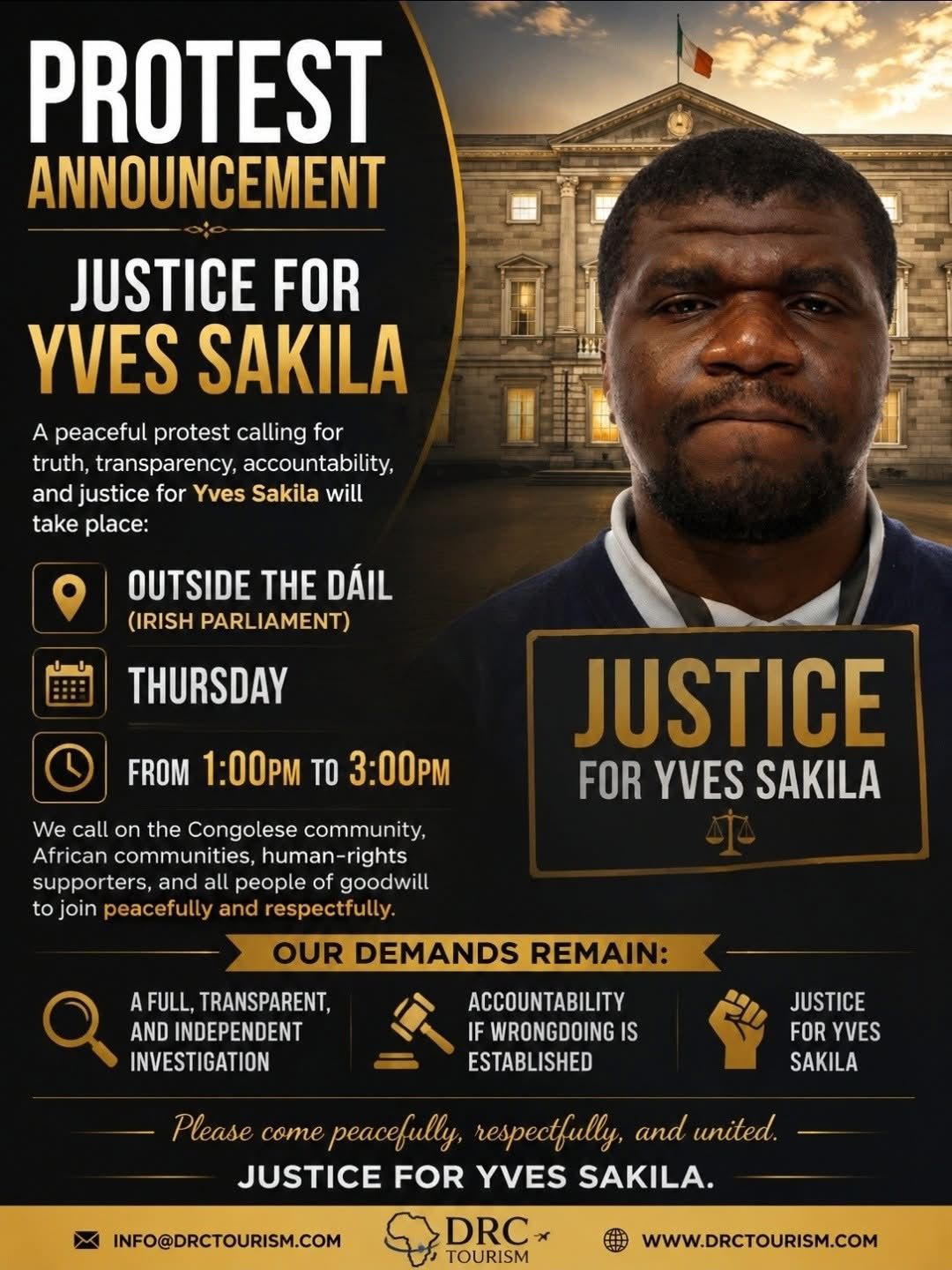
A number of presumably Congolese called for further protests at the spot: Thursday at 1pm and Saturday also at 1pm, Thursday’s at least to be followed by a march to Leinster House, the seat of the Parliament of the Irish State.

IN CONCLUSION

From the video alone there are clear grounds for the charging of the security team with manslaughter.

An early inquiry should be held – not one sitting years down the road4 – to also produce recommendations on appropriate types of restraint by security guards and on what occasions.

But Arnotts, as the responsible employer of the security staff, also has tough questions to answer. According to RTÉ their management expressed regret at the death: at the very least, out of respect, Arnotts should have closed today rather than carrying on business as usual.5

end.

Note: If you found this article of interest, why not register with Rebel Breeze for free, so that you will be notified by email of subsequent articles. You can de-register any time you wish.

FOOTNOTES

1Two years after the event.

2See Additional Sources section.

3https://inar.ie/statement-on-the-death-of-mr-yves-sakila/

4See the two-year-long investigation in the Garda fatal shooting of George Nchenko.

5In the case of a fatality on a building site in England, closing that day out of respect was a minimum demand of the Construction Safety Campaign.

ADDITIONAL SOURCES

https://www.rte.ie/news/2026/0519/1574115-yves-sakila-death

https://www.independent.ie/irish-news/crime/horrible-locals-on-death-of-man-after-alleged-shoplifting-incident-on-dublins-henry-street/a/151795866.html

DUBLIN GERMAN EMBASSY PICKETED IN SOLIDARITY WITH ULM FIVE

Clive Sulish

(Reading time: 3 mins.)

Outside the German Embassy in Dublin speakers denounced the German State’s repression of Palestine solidarity activists and their treatment as terrorists in solitary confinement in dispersed locations, increasing the visiting difficulties for relatives.

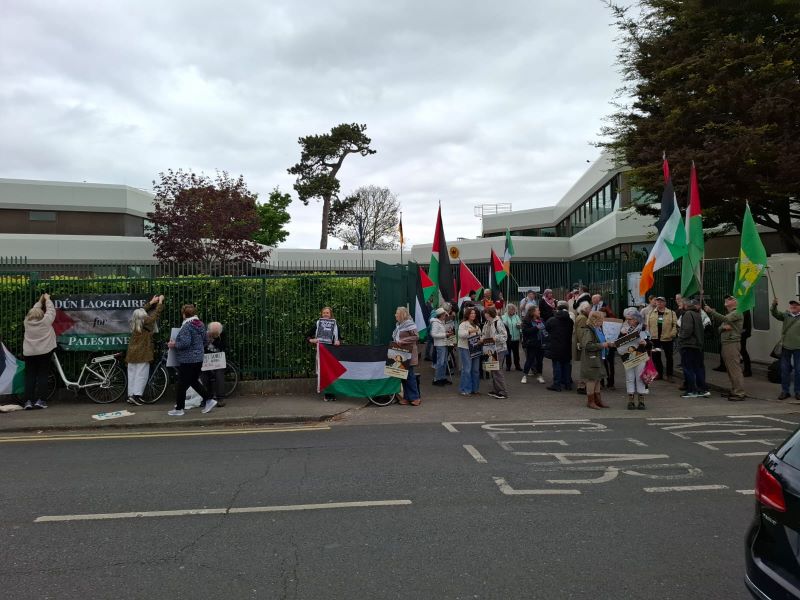
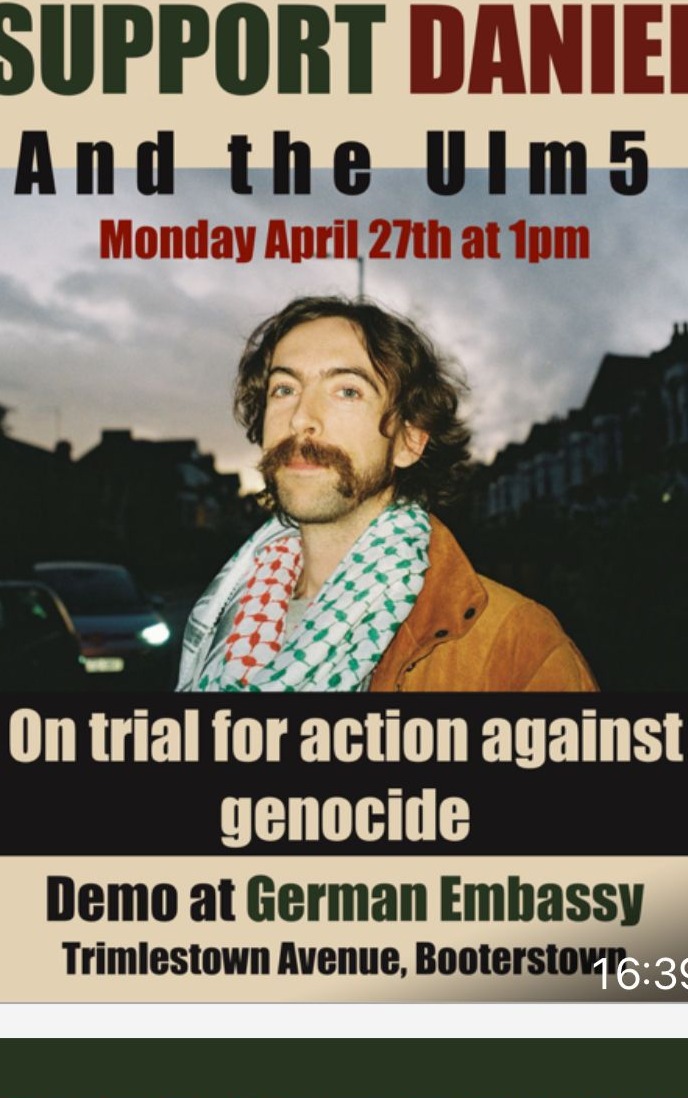
Organised by the broad group Dubs for Palestine, scores of people attended a lunchtime picket of the Embassy on Monday 27th April.1 In addition to the speeches and chants, songs were sung with particular relevance to the occasion and location.

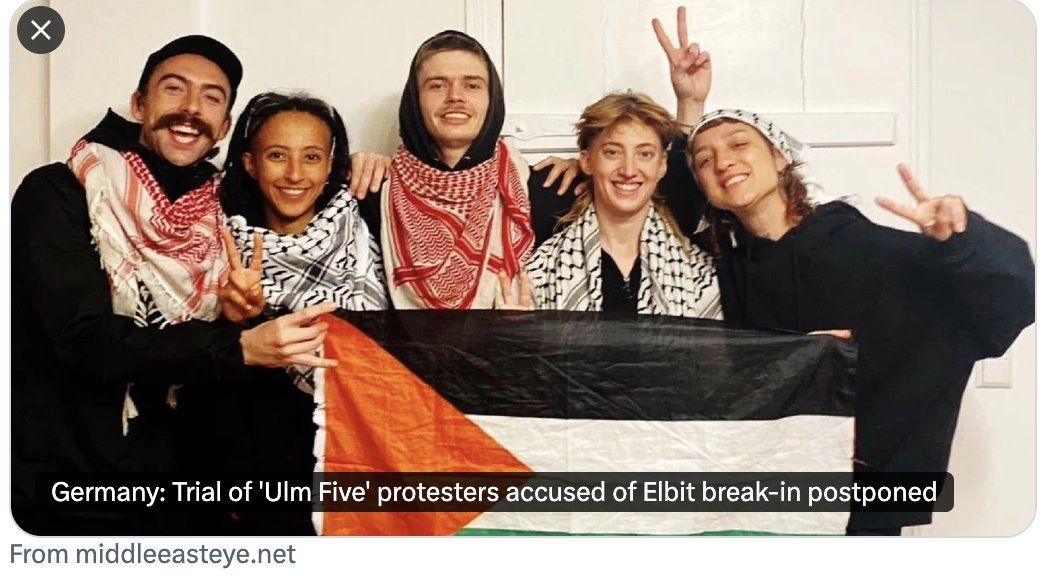
The focus of this rally was in support of a group of five activists that includes a young man formerly of Dún Laoire, Daniel Tatler-Devally and have become known as the Ulm Five. They were alleged to have broken into an Elbit Systems facility in Ulm, Germany and caused damage inside.


Lynn Treacy, of the Devally-Tatler family support grou, speaking outside gates of the German Embassy, Dublin on Ulm Five solidarity rally April 29th.
(Photo: R.Breeze)

Their action was in protest at the Israeli military systems company and its part in the genocide of Palestinians supported by the German state. One of the speakers was Daniel’s father, Conor Devally while Lynn Treacy, a friend of Daniel’s mother spoke on her behalf too.

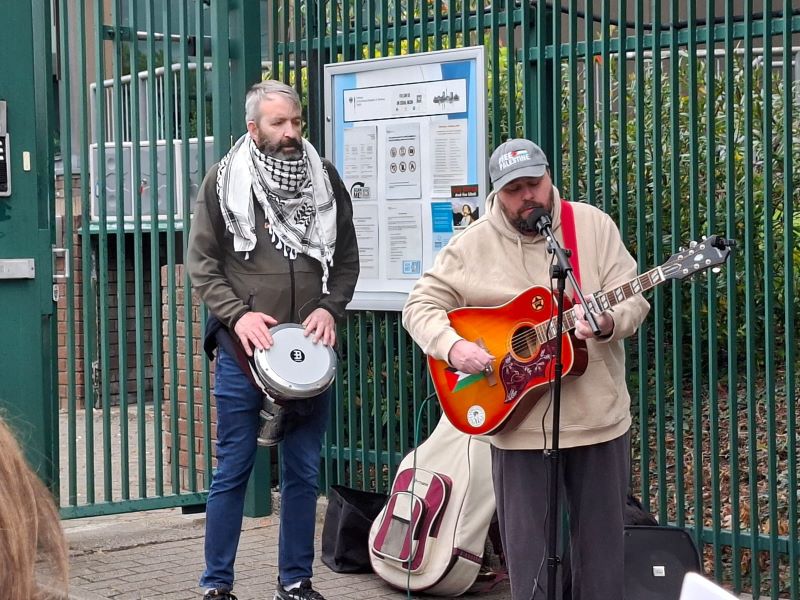
Jimi Cullen, accompanied by Dermot outside gates of German Embassy, Dublin on Ulm Five solidarity rally. (Photo: R.Breeze)

The activists are being treated as terrorists, in seven months of solitary confinement, separated and dispersed throughout different jails long distances apart. Their trial is scheduled for separate days over a period from April to July, also causing relatives and friends great difficulty.

Jimi Cullen singing and playing guitar performed his own We Are All Palestinians, developed from the well-known chant on Palestine solidarity demonstrations, accompanied by Dermot Sheehan on drum.

Two prominent members of People Before Profit spoke, Richard Boyd Barrett TD and Eoghan Ó Ceannabháin, a political and cultural activist and noted singer in the sean-nós style. Raymond Deane, composer and founding member of the IPSC spoke too as did political activist and singer Diarmuid Breatnach.

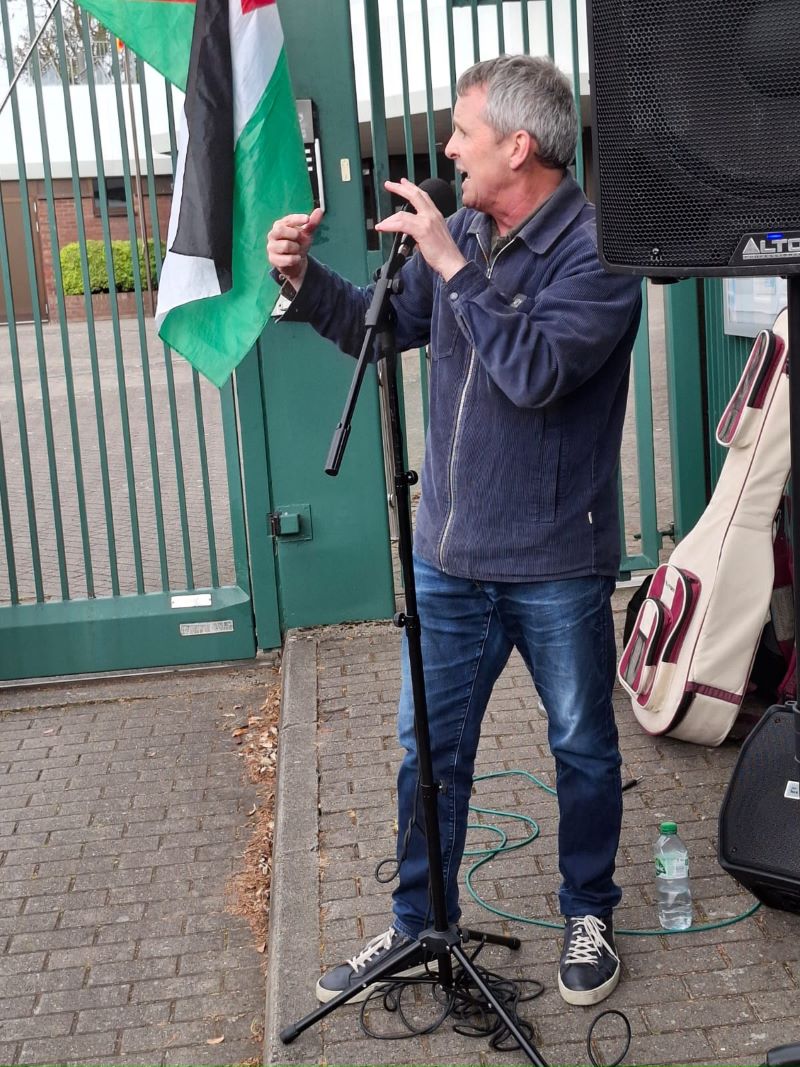
Richard Boyd Barret speaking at Ulm Five solidarity rally at German Embassy April 29th. (Photo: R.Breeze)

Ó Ceannabháin spent some time demolishing the discourse that Germany has an excuse for its repression of pro-Palestine solidarity because of alleged guilt due to its perpetration of the Hollocaust. He pointed to its genocidal history in Namibia and its leadership of EU imperialism.

The PBP member and election candidate for a councillor vacancy in DCC told the rally of Germany’s banning not only some Palestinian solidarity chants2 but also the song known as ‘Óró Sé do Bheatha Abhaile3 which he proceeded to sing, the participants joining the chorus with gusto.

Ó Ceannabháin at Ulm Five solidarity rally at German Embassy April 29th. (Photo: R.Breeze)

Diarmuid Breatnach pointed out that the German working class had a strong history of struggle and at one time led the world in socialist and social-democratic representation, even recording a vote of 4.8 million votes for the Communist Party in the midst of Nazi repression.

Hans Beimler, a communist trade union activist, Breatnach said, escaped from a Nazi concentration camp, went to Spain to fight in the Anti-Fascist War there and was killed. In his honour Breatnach sang two verses of The Peat Bog Soldiers4 followed by the ballad about Beimler.

Breatnach was accompanied on drum by Dermot Sheehan, a regular attendee at the weekly Wednesday Dubs for Palestine event outside Leinster House, seat of the parliament of the Irish State. An anti-Zionist Jewish activist spoke against Israeli Zionism and its support by Germany.

Naoise Dolan speaking at Ulm Five solidarity rally at German Embassy April 29th. (Photo: R.Breeze)

Speaking in German, Irish and English, Naoise Dolan, novelist, supporter of Palestine Action who was captured in piracy action by the IOF on the October 2025 Gaza aid flotilla, also spoke to denounce the attitude and actions of the German Government and Berlin police.

Ken Powell of Dubs for Palestine, who had acted as MC throughout, led the rally in chanting slogans of solidarity with Palestine including calling for the freedom of each of the Ulm Five by name before thanking all for their attendance and concluding the event.

end.

Early view of Ulm Five solidarity rally outside German Embassy April 29th as people are still arriving. (Photo: R.Breeze)

Note: If you found this article of interest, why not register with Rebel Breeze for free, so that you will be notified by email of subsequent articles. You can de-register any time you wish.

FOOTNOTES

1The day the trial began in Germany but however did not proceed due to the presiding judge refusing to allow the Defence lawyers to sit with their clients and the lawyers’ refusal to proceed under those restrictions

https://www.theguardian.com/world/2026/apr/27/pro-palestine-activists-face-trial-attack-israel-arms-factory-germany

2“From the River to the Sea, Palestine will be free,” which they claim is ‘anti-Semitic’; also “Globalise the Intifada.”

3An Dord Féinne is the actual title given by Patrick Pearse in his adaptation of a traditional song in Irish.

4A translation from the German song of the Communists in Nazi concentration camps which was eventually banned by the camp authorities under pain of death.

THE DICEMAN CAMETH

Diarmuid Breatnach

(Reading time: 4 mins.)

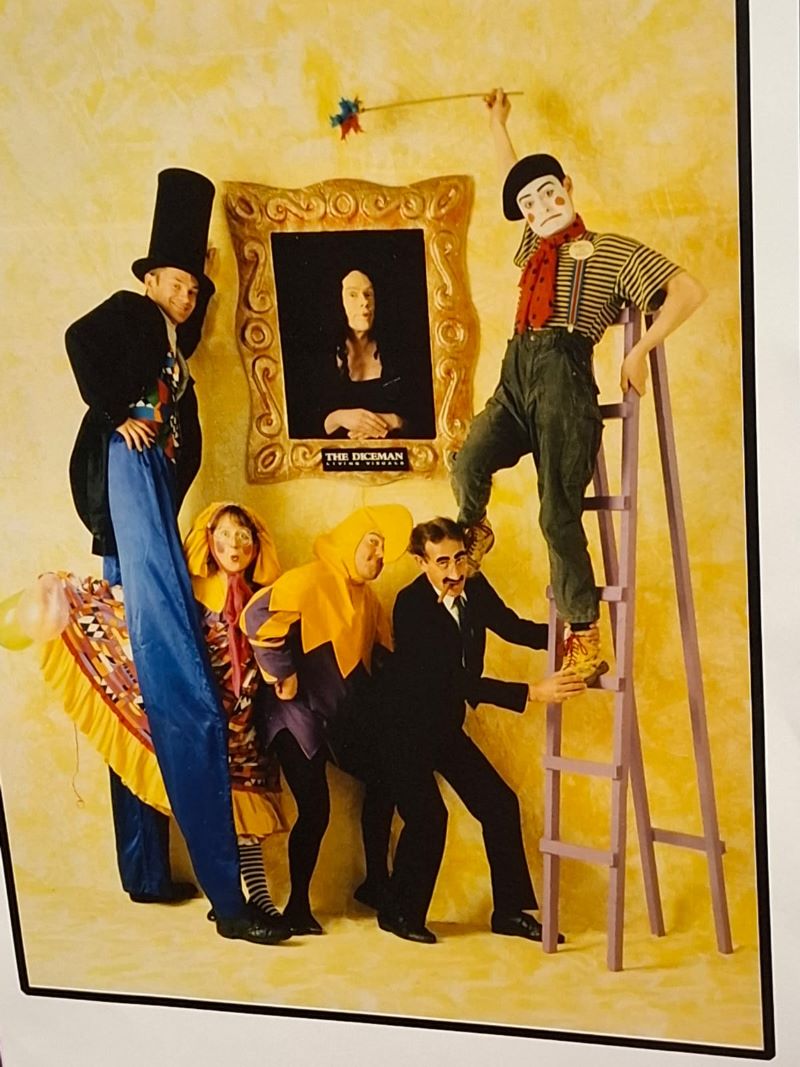
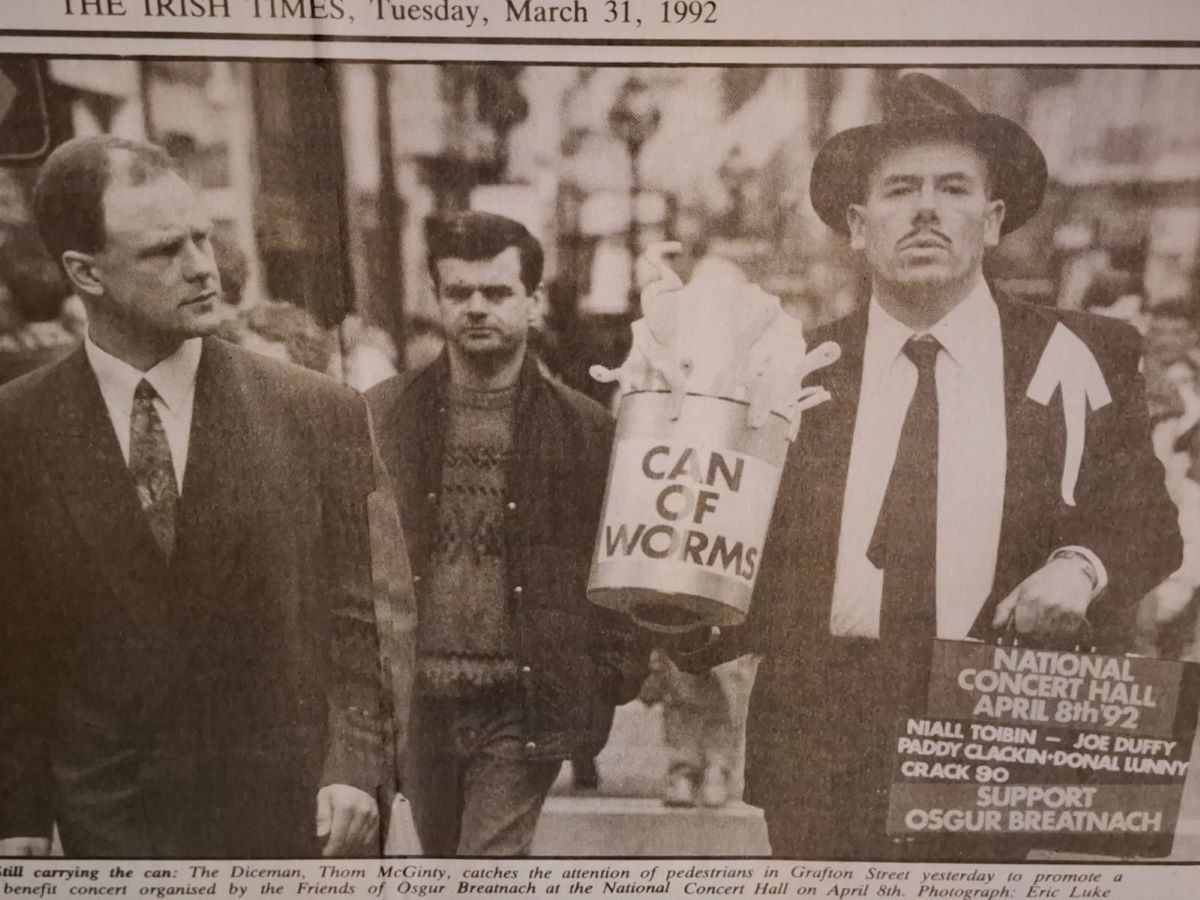
Alerted by a sibling to a short exhibition on the life of the Spice Man (Thom McGinty), a remarkable performance artist and character of Dublin streets particularly associated with Grafton Street, I was fortunate to view it on its final day.

The exhibition was part of the annual Phizzfest’s annual program and was staged in the Bohemians FC room above the Phibsborough shopping centre. The space was a moderately-sized room with a few installations, a film projector, panels of images and text displayed on the walls.

One of the panels at the exhibition.

Sadly the chatter of a number of people made it difficult – for me at least – to understand all the audio accompanying the film footage but some of the images were very interesting, in particular the reaction of Dublin adults and children to the Spice Man’s street performances.

When he spoke it was with a Scottish accent, having been born to a father from Donegal and mother from Wicklow and reared in a village outside Glasgow from where he recalled journeying on holidays to Baltinglass for family reunions.

He came to economically-depressed Ireland in 1976, trying his hand at a number of occupations before he found the one that both gave him success and defined him publicly.

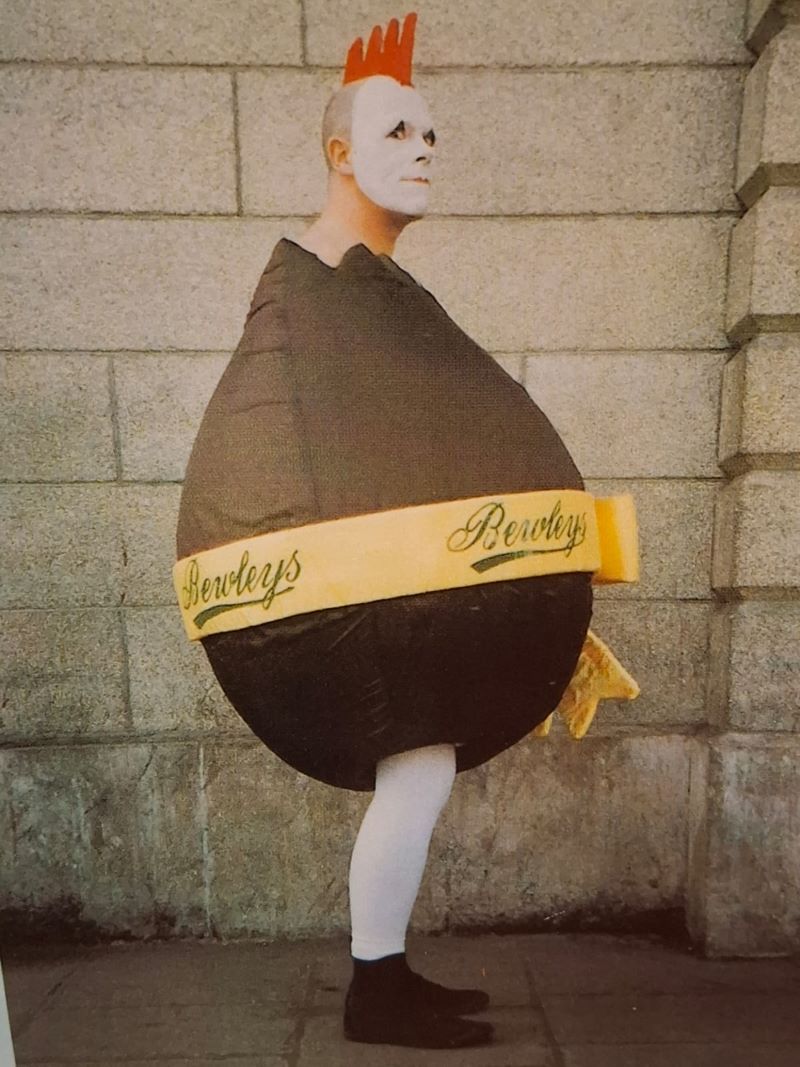
Typically, his performance was silent, his movement stilled or gradual, slow but moving to avoid arrest.1 But his costume and makeup were something else. Though McGinty later initiated performances in social and political protest, his initial ones in Dublin were commercial promotions.

A gaming shop called The Dice Man was the first of these and the one that gave him the nickname by which he became known and found fame. It was one of the commercial promotions, ironically not a political one, that ended with his arrest.

The promoters of a run of The Rocky Horror show in Dublin hired Thom to promote their show which he did, walking the street in ‘horror’ facial makeup, a cerise basque, fishnet stockings and a thong. He was arrested.

McGinty was charged with acts contrary to public decency under Section 5 of the Summary Jurisdiction (Ireland) Amendment Act, 1871, and with breach of the peace. Thom protested that these were his working clothes and he had been contracted to wear them.

According to the arresting gardaí, complaints had been made that Thom’s buttocks were clearly visible, “and the only thing covering his genitals was a G-string.” He was bailed from Store Street Garda Station pending the trial but could not be released until he was given a raincoat to wear.

The Act, which is still on the statute books (according to the exhibition text) had sexual connotations and could be used against gay people. McGinty’s lawyer raised the ramifications of a conviction under this Act and the judge sentenced him to probation without recorded conviction.

The 1991 production of the Rocky Horror Show at the Bord Gáis Theatre could not have asked for better publicity and McGinty personally got exposure (!) internationally and offers of work abroad as a result, from which he always returned to Ireland.

Among social causes which Thom protested with performance was the financial penalty on the Union of Students in Ireland for breach of injunctions by publishing anti-pregnancy choice information in a case pursued by SPUC.2 Another was against restrictions on the sale of condoms.3

Thom’s performances and the causes espoused would have been of interest to me had I been living in Ireland at the time but they touched on my family in Dublin a number of times. Foremost was his support for the wrongly accused, framed and brutalised of the Sallins Mail Train robbery.

One of the panels at the exhibition.

It is nearly 50 years since three socialist Republicans were wrongly convicted and sentenced to nine and twelve years imprisonment. As a result of much campaigning, two of the accused, one of whom is a sibling of mine, were released with convictions revoked after 18 months in Portlaoise jail.

The third accused, who had absconded the day prior to the sentence, returned to Ireland and was immediately jailed, campaigners then switching to obtain his freedom, gained only ‘on humanitarian grounds’ after four years in jail and a hunger strike of 38 days.

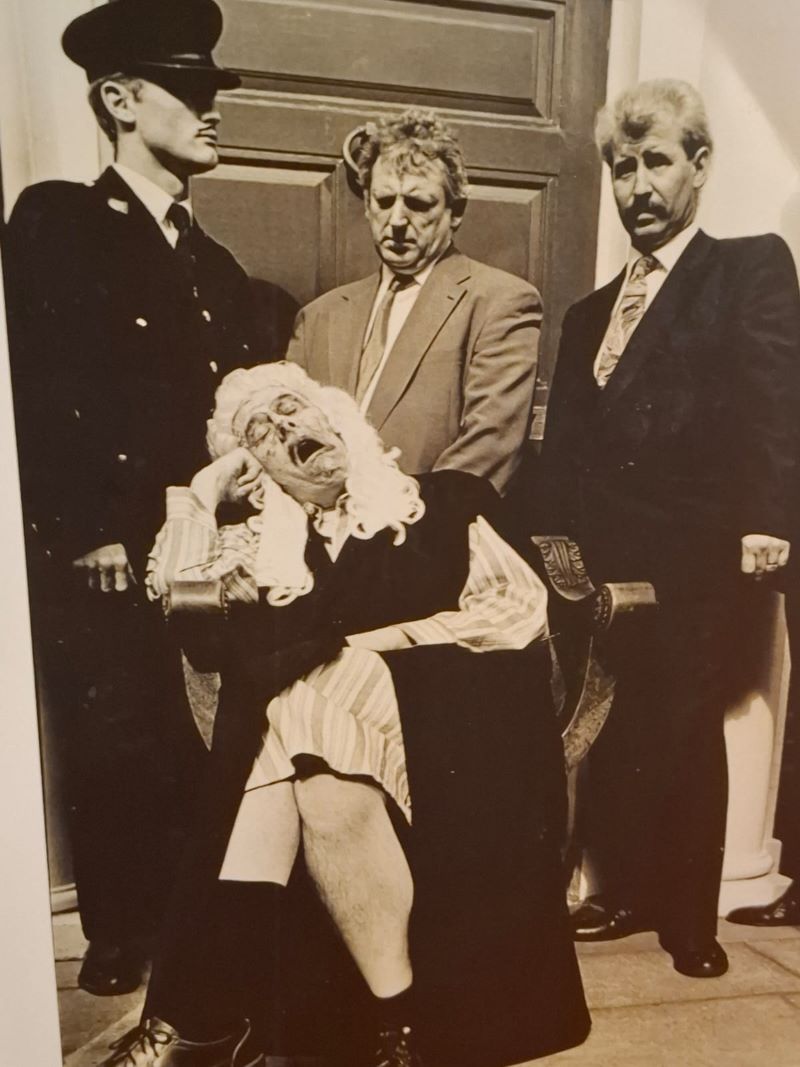
Satirising the ‘sleeping judge’ in one of the Sallins trials (he was clearly seen sleeping but his co-judges and State denied it and then to embarrassment of State, he died days later). In suits, two of the framed, (l-r) Nicky Kelly and Osgur Breatnach. One of the panels at the exhibition.

A recent concert, packed both by audience and performers in the Vicar Street Dublin venue was organised by yet another sibling to promote a campaign for an inquiry into how that travesty of justice could be carried out by state police, Government and judiciary right up to the High Court.4

Thom was a strong supporter of liberal social rights such as the right to prevent pregnancy or birth and for gay and lesbian rights. His defence of framed Irish Socialist Republicans centred on their right to a fair trial and not to be brutalised, as did his support for the Birmingham Six.

One of the panels at the exhibition.

But he was far from being an Irish Republican. Dressed as the Grim Reaper with scythe, Thom also led a delegation of ‘Peace Train’5 people in protest to the offices of Provisional Sinn Féin where, in a twist of fate, it was another sibling of mine who had to receive him and to face the cameras there.

At the time, SF was the political party leading a struggle for Irish reunification and independence from British occupation and, though its leadership and much of the party’ base support was socially conservative, it was not that which focussed the attacks of two states and a statelet6 upon it.

And those armed and judicial attacks were backed by the imperialist and neocolonial-dominated liberal and social-democratic sector of society, the likes of the ‘Peace (sic) Train’ and ‘Peace Women’.7 I would have argued strongly with Thom I’m sure but regret very much his passing.

Thom McGinty (1952-20/21 February 1995)

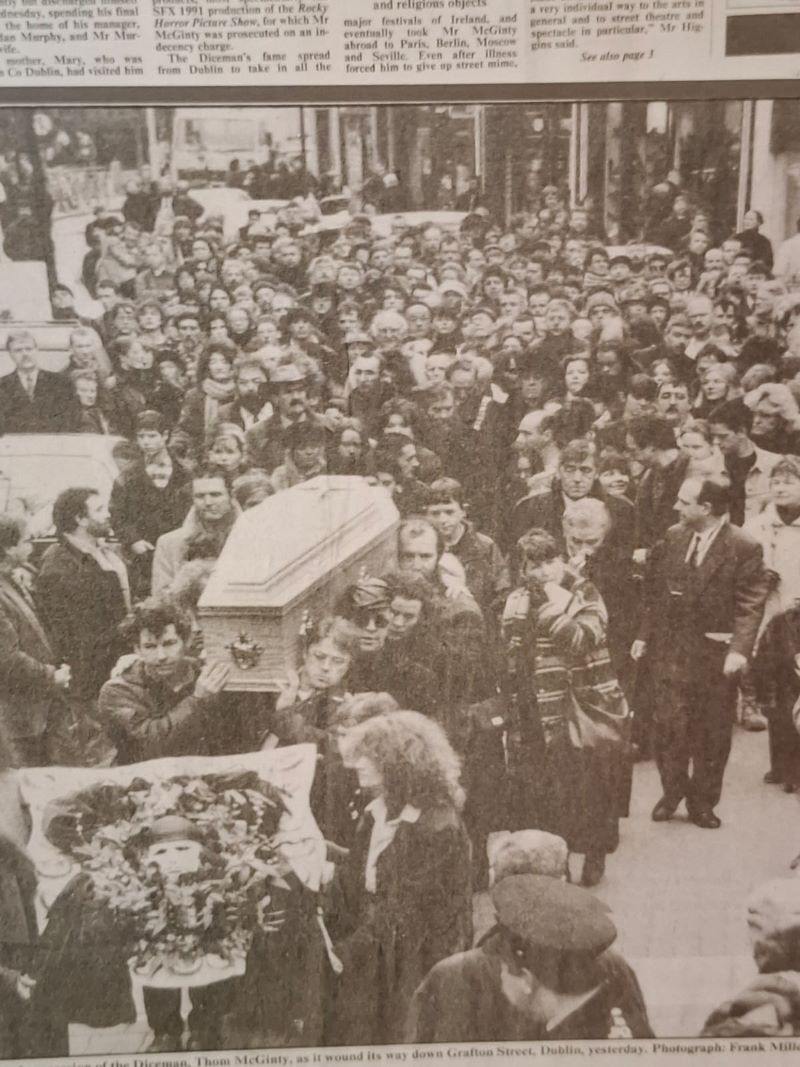
Thom McGinty’s funeral, from one of the panels at the exhibition.

end.

Note: If you found this article of interest, why not register with Rebel Breeze for free, so that you will be notified by email of subsequent articles. You can de-register any time you wish.

FOOTNOTES

SOURCES

Biography Thom McGinty: https://www.thejournal.ie/readme/the-dice-man-5007353-Feb2020/

The Sallins Mail Train frame-up and campaign: https://sallinsinquirynow.ie/

The ‘Peace People’ etc, Mairéad Corrigan/ Maguire: https://en.wikipedia.org/wiki/Mairead_Maguire

1On ‘loitering’ charges.

2Society for the Protection of the Unborn Child. After a long struggle ending pregnancy became legal within the Irish state but regulated under the Health (Regulation of Termination of Pregnancy) Act 2018, allowing for termination on request up to 12 weeks of pregnancy. Following a 2018 referendum, abortion services began on 1 January 2019, providing free access for residents.

3Following campaigning and public defiance of the law, restrictions on the sale of condoms were only finally removed in 1993 in the Irish state.

4https://sallinsinquirynow.ie/

5https://en.wikipedia.org/wiki/Peace_Train_Organisation The issue is not whether bombing the railway line was a useful activity or not but rather that its condemnation took the place of condemning and drawing attention to the British occupation of a colony in Ireland and the brutal repression of resistance to that occupation.

6Although it has the trappings of a state, the Northern Ireland (sic) Assembly is a UK colonial administration.

7

TWO RECENT EVENTS CONNECTED DECADES EARLIER

Diarmuid Breatnach

(Reading time: 3mins.)

A recent arrest in France and concert in Dublin are connected by events in both countries a half-century earlier.1

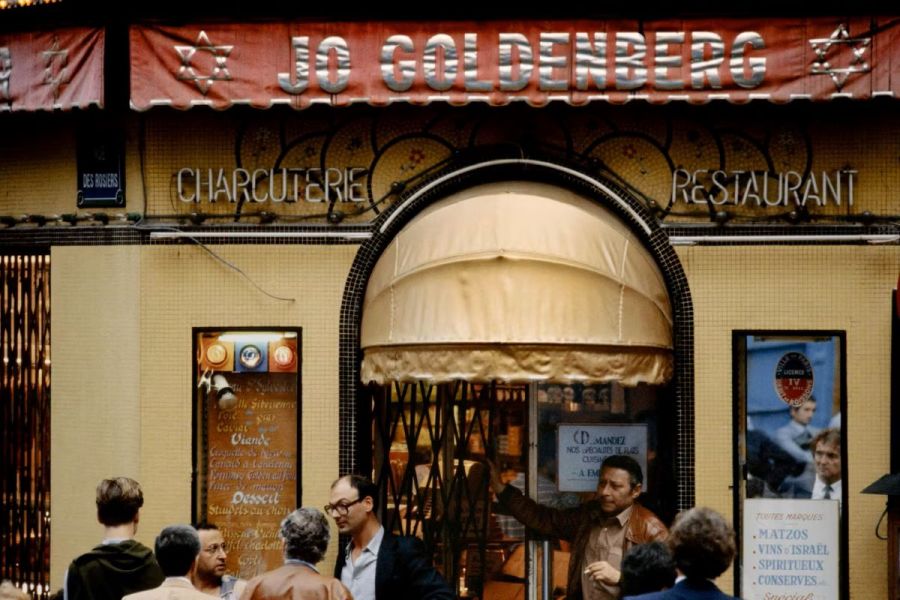
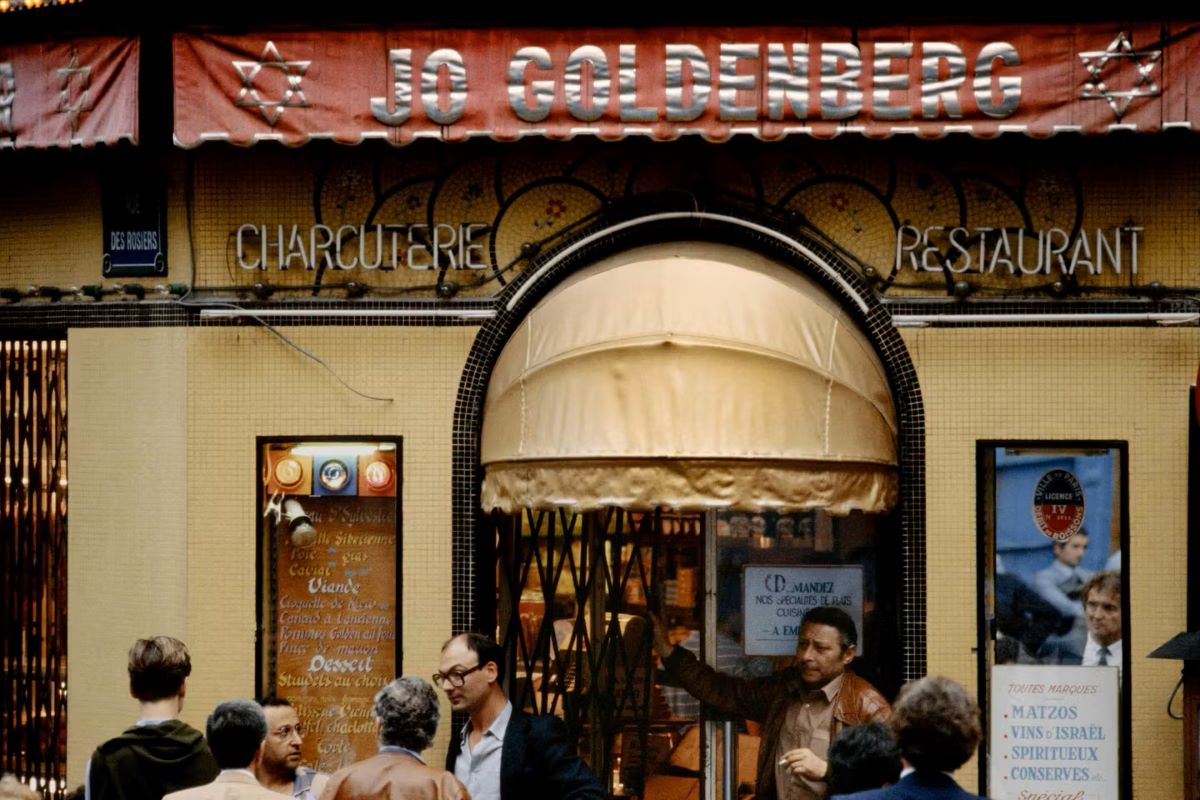
The arrest in question by French police was on 16 April of Mahmoud Khader Abed Adra, for alleged involvement in the 1982 attack on the Jo Goldenberg restaurant in the Marais district of Paris.2

The report of the arrest came less than a week after the Dublin commemoration by concert of another event, also half a century earlier. And strangely, there was a connection between both events.

On 11 April, a concert was held in Vicar Street to commemorate the arrest, torture, framing of three Irish Socialist Republicans and their jailing in 1986.3

Musicians, poets and journalists came together at the event, organised by musician Cormac Breatnach, brother of one of the accused, to commemorate the event and to press for an inquiry into three activists being tortured into making false confessions incriminating themselves.

And into how, despite their retractions and medical evidence of torture, they were then convicted of an event they had not committed. And how the legal system, from the Court of Appeal to the High Court, had all colluded in the injustice.

The trial in Ireland was for the Sallins Mail Train Robbery of 1976. The convicted three were Osgur Breatnach, Nicky Kelly and Brian McNally: Breatnach and Kelly were sentenced in the no-jury Special Criminal Court to 12 years, McNally to nine.

The day before sentence, Nicky Kelly jumped bail but returned nearly two years later when the convictions of Breatnach and McNally were deemed ‘unsafe’ and that their statements had ‘not been made voluntarily’.

However, the State insisted that the time period for registering an appeal had by then been exceeded and it took much campaigning and his own hunger strike before Kelly was finally released, on a Presidential pardon for a crime he had not committed.

A fourth, Mick Plunkett, had stood trial with the three on the same charges but having succeeded in not making a false confession under torture and threats, was finally acquitted. The French connection with the extradition of Mahmoud Khader Abed Adra, is Plunkett’s.

Mick Plunkett4 had decided that, despite his escaping the framing, that the Garda Heavy Gang5 would be out to get him and that a departure to other climes might he healthy. Plunkett settled in France but did not give up his politics.

Photo: Joel Robine/ AFP

The Jo Goldenberg restaurant was subjected to a grenade and firearms attack on 9 August 1982, killing six and injuring 22.

On 28 August that year, Plunkett, Mary Reid and Stephen King (not the novelist) were arrested by a special anti-terrorist unit of the Gendarmerie (perhaps Le Gang Lourd, the Heavy Gang a la Francaise!).

The police claimed that all three were part of a terrorist organisation and that leaflets confirming that had been found in their apartment. And also firearms. All the allegations were vigorously denied by the three Irish activists.

Eventually the case against all three fell apart and they were released with, in time, the Gendarmerie admitting that the evidence against them had been ‘planted’ and the special unit was disbanded.6

One of the acts which the French police had claimed for the organisation of which they had falsely claimed membership of Plunkett, Reid and King was the attack on the Jo Goldberg Restaurant — the same incident for which the French Police have now charged Mahmoud Khader Abed Adra.

The French state got Khader Abed by extradition from Occupied Palestine. The State of Israel does not extradite its citizens anywhere but the Palestinian Authority was willing to do the job for France, which last year had officially recognised ‘the State of Palestine.’

end.

Note: If you found this article of interest, why not register with Rebel Breeze for free, so that you will be notified by email of subsequent articles. You can de-register any time you wish.

Footnotes

1This story was published recently in the Irish language-only weekly An Páipéar (available in newsagents and online).

2https://www.aljazeera.com/news/2026/4/17/france-arrests-suspect-over-1982-attack-on-jewish-restaurant

3https://www.irishexaminer.com/opinion/commentanalysis/arid-41819201.html

4See report on his funeral https://rebelbreeze.com/2022/05/04/death-of-a-retired-warrior/

5https://sallinsinquirynow.ie/heavy-gang-named/

6 https://en.wikipedia.org/wiki/Irish_of_Vincennes

Sources & Further reading

https://www.independent.ie/irish-news/false-arrest-victims-call-on-judge-to-act-against-french-police/26257140.html

Gardaí Threaten Arrests to Remove Solidarity Picketers at Dublin Court

Clive Sulish

(Reading time: 3 mins.)

Participants in a small picket outside a Dublin court on 13 April were threatened with arrest by Gardaí unless they dispersed.

The picketers were supporting two activists facing charges after being pepper-sprayed by Gardaí on the Dublin docks in October last year.

The event in October had been to symbolically blockade Ireland against imports from the Zionist state due to its genocide of Palestinians. Ireland is the second-largest importer of Israeli goods next to the EU and the largest single-state importer of all, exceeding even the USA.

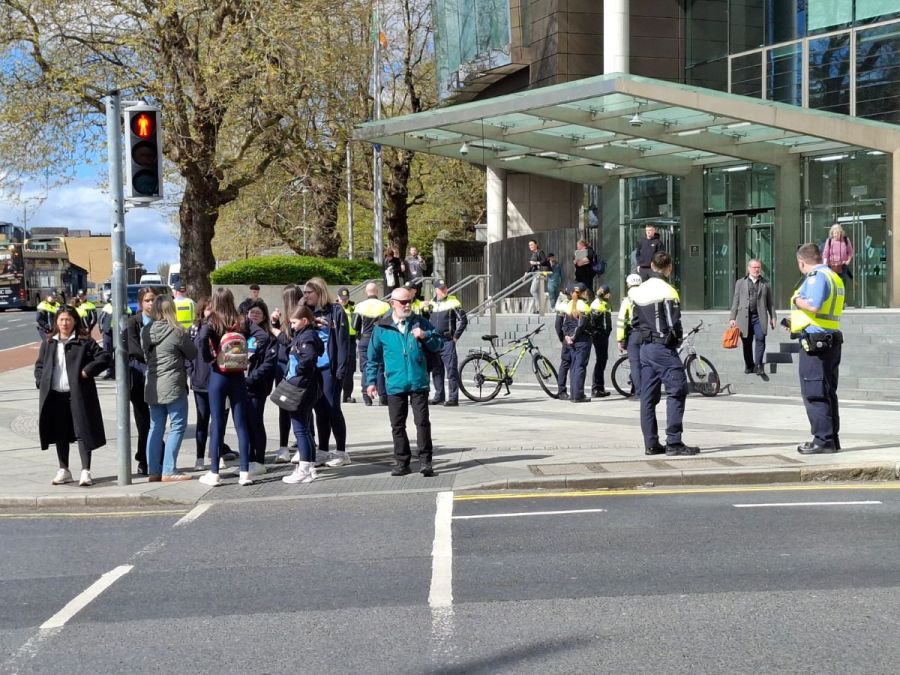
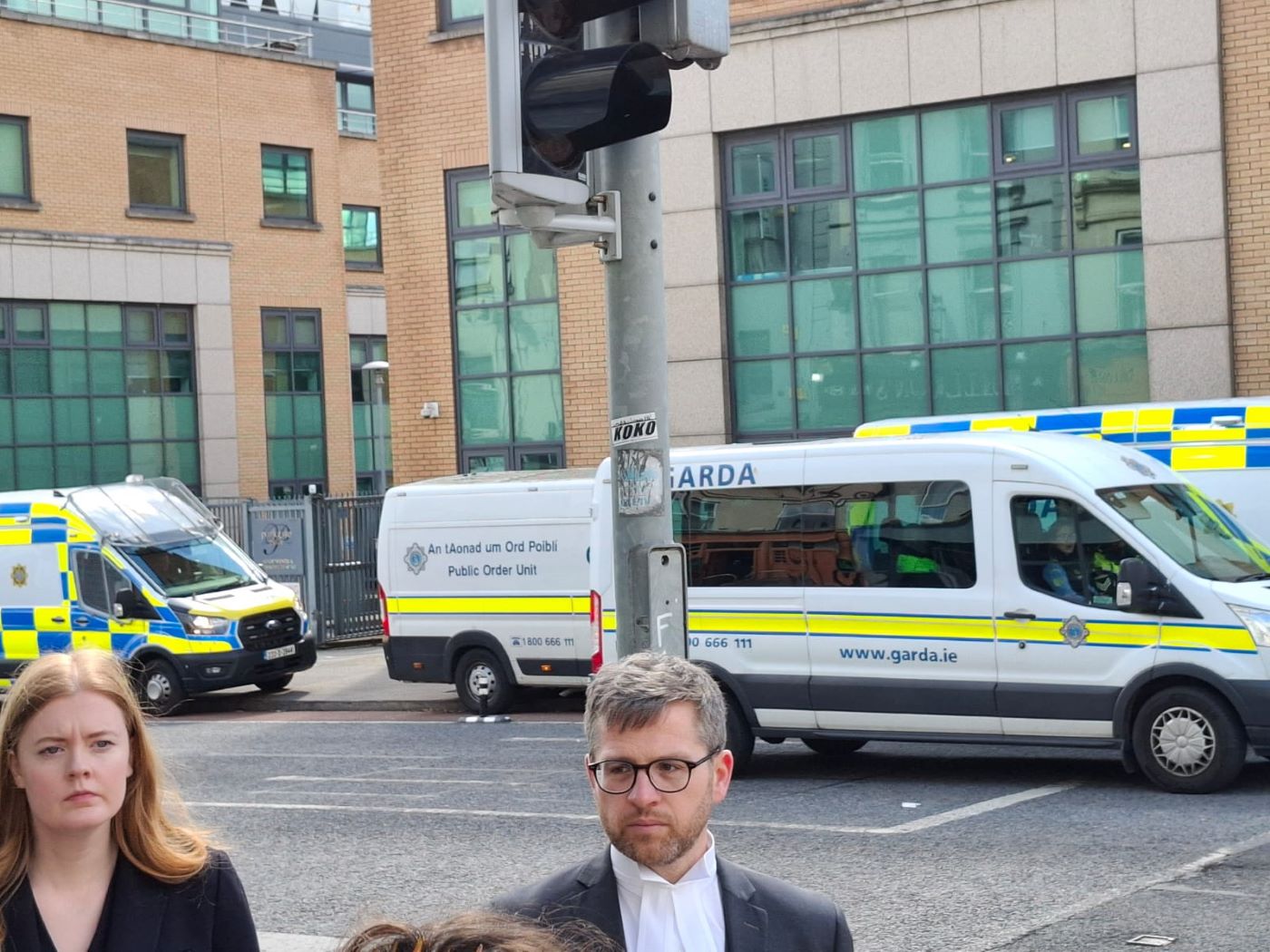
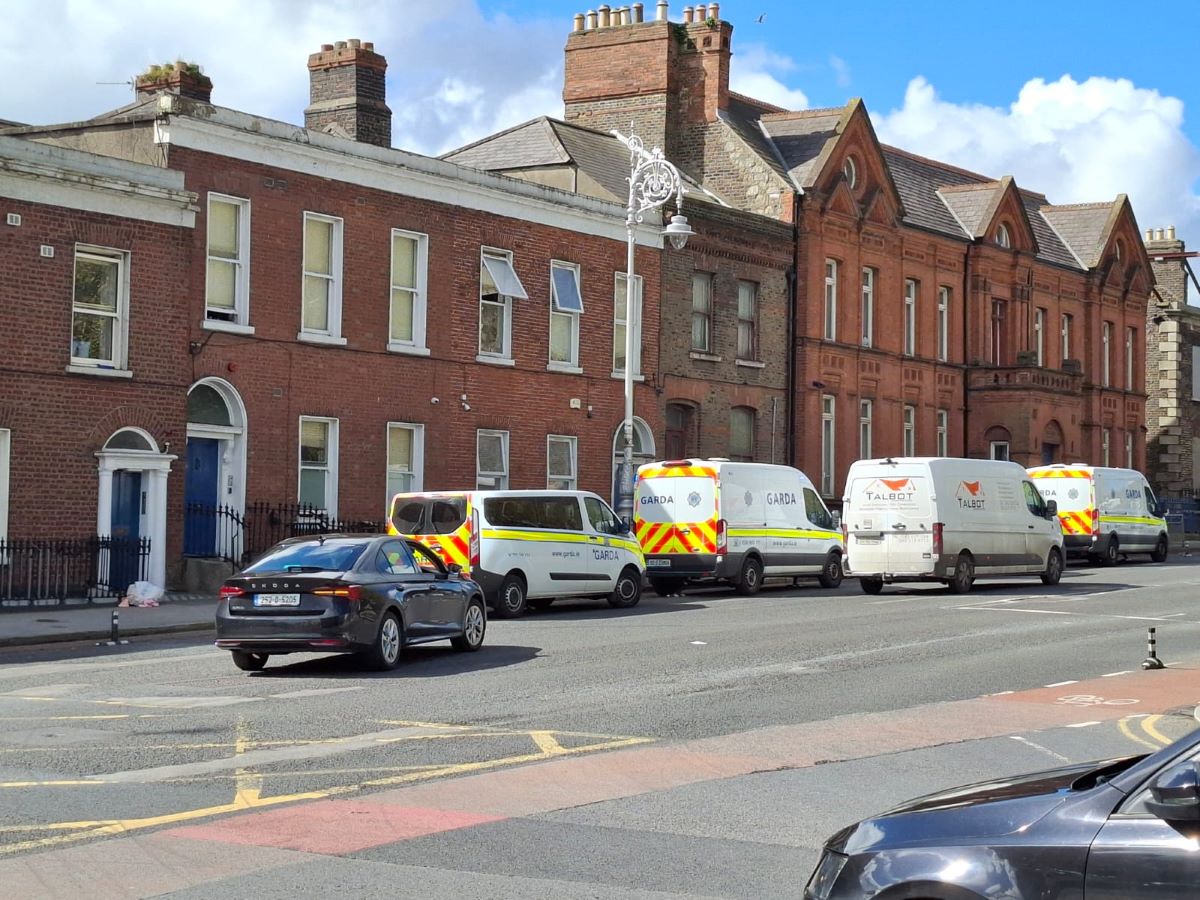
Some of the Garda vehicles attending the Garda repression of picketers. (Photo: R.Breeze)

Pickets outside the Court of Criminal Justice in Dublin have been a regular feature in recent years, not only in support of Palestine solidarity activists but also anti-NATO protesters, housing activists and Irish Republicans (the latter being brought through the no-Jury Special Criminal Court).

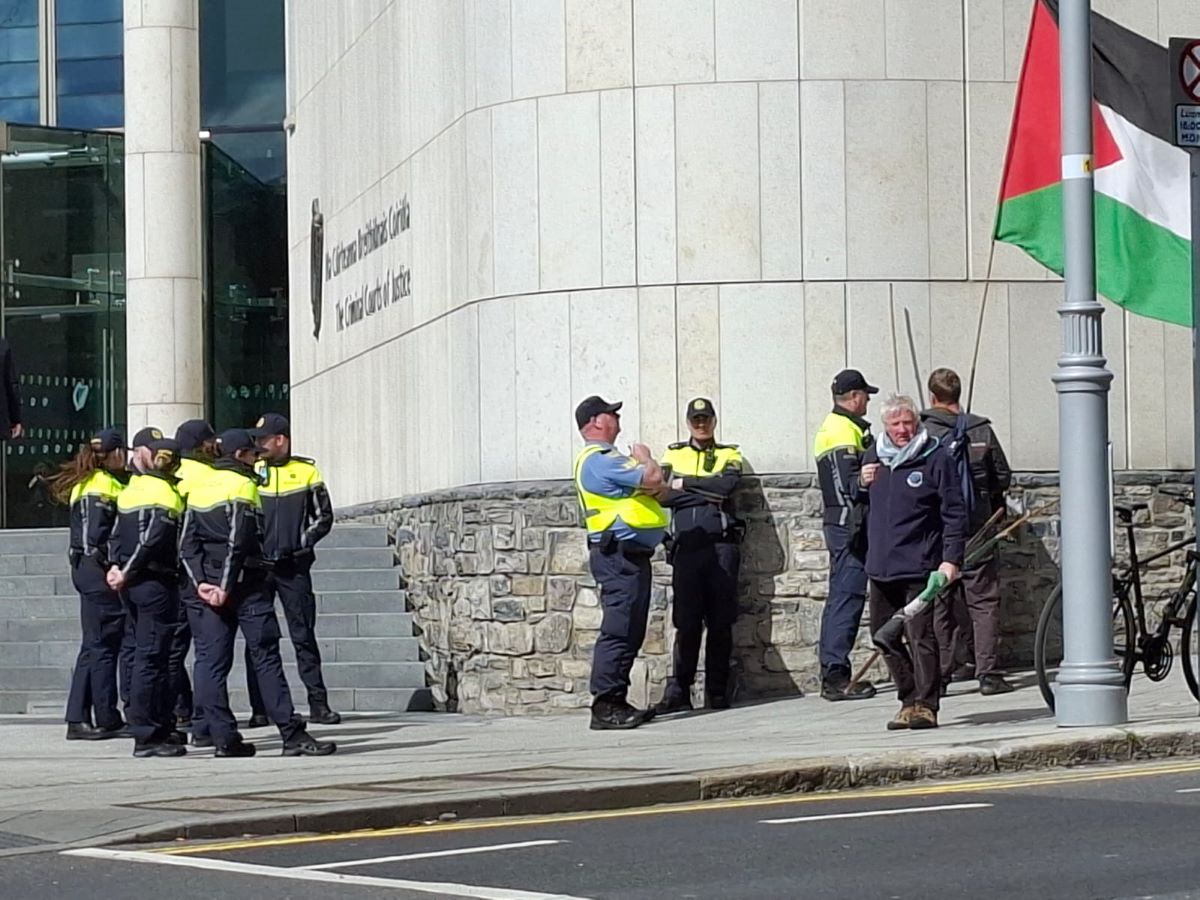
While some attend the actual court case others picket outside with flags, placards and banners. Until the incident being described there has been no recorded trouble from the Gardaí. However on the 13th picketers were approached by at least 15 Gardaí from five Garda vans.

More of the Garda vehicles attending the Garda repression of picketers. (Photo: R.Breeze)

First they went to a lone picketer who was standing with Palestinian flags on the line dividing west from eastbound traffic outside the court. It is not known what words were exchanged between them but they accompanied him to the roadside for some time before detaining him in handcuffs.

The Garda leader then told the picketers immediately outside the court to leave the area and when they asked what law they were accused of breaking refused to reply except to directed them under the Public Order Act to leave or he would arrest them.

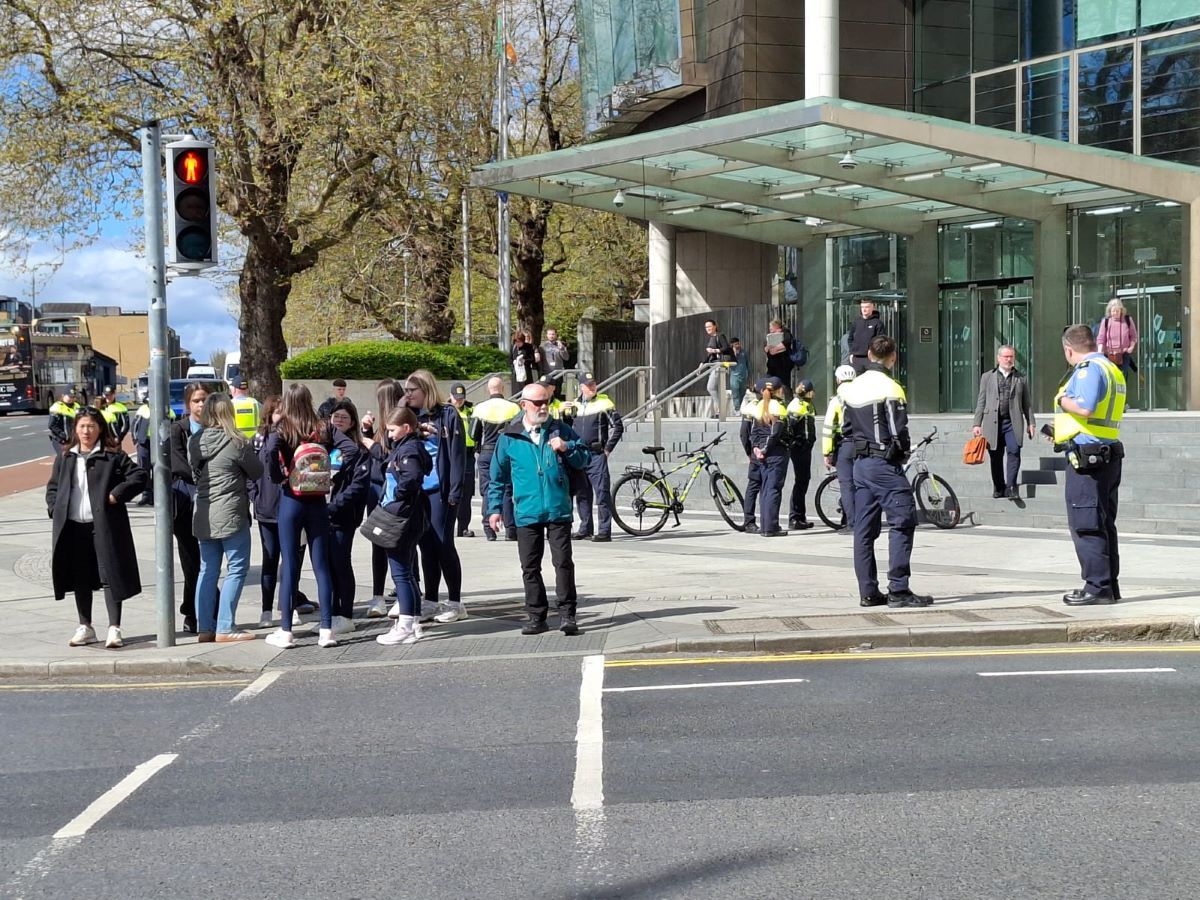
Some of the Garda participating in the repression of picketers, some of whom have already crossed to the other side of the road. (Photo: R.Breeze)

Most of the picketers crossed the road to the north-east side but after the Gardaí departed, slowly drifted back. Gardaí returned, their previous leader visibly angered as he once again told them to leave, adding that should he find them in the area, he would arrest without warning.

Once again most picketers crossed the road away from the Court but shortly thereafter the court adjourned, both activists of the Dublin Port incident emerging along with their supporters who had attended inside and shortly thereafter all dispersed in various directions without incident.

The legal advice is that neither the individual picketer in the road nor the others nearer the court were breaking any law and that the Gardaí, under instructions from somewhere, exceeded their powers, including under the Public Order Act.

Gardaí in front of the Court after repression of picketers. (Photo: R.Breeze)

The picketers viewed the Garda actions as an attack in general on civil liberties, the right to peacefully assemble and demonstrate and in particular on the right to express solidarity with the Palestinian people and to protest Irish State collusion in Israeli State genocide.

A couple of separate incidents occurred prior to the Garda action. In one, a seemingly hysterical man appeared before the solidarity picketers, with two others videoing him while he brandished a tabloid newspaper with a headline alleging a sexual offence by a migrant.

He departed quickly shouting racist sentences. Later another in similar vein approached to within a foot of the picketers asking them where they were from, alleging that sexual assaults were committed only by immigrants and twice made an unsuccessful grab for a Palestinian flag.

The two Palestine activists are due back in court on 11th June and the arrested picketer, it is believed, on the 12th. It has been suggested that legal observers trained by the Irish Council for Civil Rights will be in attendance outside, as they were during the Garda attack last October.

end.

Note: If you found this article of interest, why not register with Rebel Breeze for free, so that you will be notified by email of subsequent articles. You can de-register any time you wish.

Further related reading:

Irishman Among Activists Against Genocide Jailed by the German State

Diarmuid Breatnach

(Reading time: 3 mins.)

An Irishman, Daniel Tatlow-Devally is one of five people who allegedly damaged equipment in the Israeli arms company Elbit in Germany last year. They are charged under anti-terror legislation and kept in solitary confinement in separate jails.

Daniel’s mother complained that for a month friends and relatives were prevented from making any communication with the detained: “They thought we’d disowned them.” By the time the trials are expected to conclude, the five will have spent around around 11 months in custody.1

Two weeks ago Daniel’s father addressed the weekly Dubs for Palestine rally outside Leinster House in Dublin to raise awareness of his son’s situation and to ask for support. A protest at the German Embassy has been organised for Monday 27 April at 1pm.2

In recent years the German state has earned a reputation for repression of freedom of expression of pro-Palestine sentiments or criticism of the Israeli Zionist state, including banning demonstrations, classifying anti-Zionism as ‘anti-Semitism’ and arresting people for wearing the kiffiyeh.

A 2025 report “documents how German authorities systematically curtail freedoms of assembly, expression, academia, and art when it comes to anti-genocide protests and advocacy for Palestinian rights …

… from legal repression, criminalisation, and surveillance to delegitimizing dissent within the educational sector, arts, and media. Such measures …. form a pattern of political persecution that undermines democratic principles and international human rights obligations.

European legal expert Alice Garcia of the European Legal Support Centre (ELSC) cautioned that current practices in Germany are “unequivocally comparable to practices of authoritarian regimes.”

The Civic Space Report 2025 by the European Civic Forum identifies Germany as one of the most repressive EU states in relation to Palestine advocacy, highlighting the systematic misuse of public order laws and excessive use of executive and police power (European Civic Forum, 2025, p. 20).3

Their police have been widely accused of violence towards peaceful demonstrators and a video circulated widely on 28 August 2025 showing a Berlin police officer punching Kitty O’Brien twice in the face, causing her to bleed and the same officer snapped the humerus bone in their arm.4

O’Brien was charged with assault but the circulation of video of the incident caused the police to change the charge to ‘insulting the police’ by calling them “genocide supporters”.

Speaking on RTÉ’s News at One on 5 August, Kitty described their injuries after arriving home from hospital the previous day: “I have a broken nose, a broken humerus bone (with 11 screws holding the bone together), and potentially long-standing radial nerve damage.”5

Last year an independent protest took place outside the Dublin German Embassy about the treatment of Kitty O’Brien, other Palestine solidarity protesters and the German state’s collusion with the genocide of Palestinians by the ‘Israeli’ state, its biggest supplier of arms after the USA.

HISTORICAL GENOCIDE ‘GUILT’ USED TO JUSTIFY GENOCIDE TODAY

Ironically, Germany’s ruling class uses the Nazi history of its state’s genocide of Jews (also Roma, Disabled, Gays & Lesbians, Communists etc) as justification for its support for the Zionist state’s genocide of Palestinians today. But that ‘guilt’ also infected the Left resistance movement.

For many years large sections of the German Left would counter calls for solidarity with struggles of national liberation abroad with their support for anti-nationalismus (anti-nationalism), erroneously identifying that as the source of fascism, rather than just a factor exploited by fascists.

In the mid-19th Century and up until the 1930s, most observers expected Germany to be the first socialist state, so powerful were its communist and social-democratic movements. Even after the Communist Party had been banned by Hitler, it received around 4.8 million votes.

After the defeat of Nazism in the Anti-Fascist War (WWII) the USA recruited not only Nazi scientists but also Nazi intelligence agents for its anti-Soviet campaigns and built NATO as an imperialist military alliance and a specifically anti-communist alliance, with Germany at its heart.

The USA built military bases across Germany and, after the fall of the USSR, began to spread NATO membership in states eastward to encircle Russia.

The German state has hard economic motivation for supporting the Israeli state in addition to any ideological reasons; after the USA, Germany is the biggest arms supplier to the Zionist State6 and approved $7.8 million in arms exports to Israel during the USA and Israel’s strikes on Iran.7

Daniel can be written to:
Daniel Tatlow-Devally,
JVA Ulm,
Frauengraben 4,
89072 Ulm,
An Ghearmáin.

End.

Note: If you found this article of interest, why not register with Rebel Breeze for free, so that you will be notified by email of subsequent articles. You can de-register any time you wish.

Footnotes

1https://www.middleeasteye.net/news/germany-five-activists-held-alleged-elbit-systems-break-in-isolation-families-say

2The German Embassy’s address is 31 Trimleston Road, Booterstown in the south-eastern Dublin suburbs, about 10 minute’s walk from Booterstown train Station on the DART system. By BUS: Rock Road, Bellevue Avenue – Routes serving this stop: 4, 7, 7A, 8. CAR: No parking available on site – on-street parking (Pay & Display, max. 3Hrs).

3https://elsc.support/resource_ext/repression-of-palestine-solidarity-in-germany/

4https://www.rte.ie/news/2025/0905/1532044-irish-activist-berlin/

5Ibid.

6https://www.amnesty.org/en/latest/news/2025/11/germany-arms-transfers-to-israel-reckless-unlawful-and-risks-complicity-in-israels-international-crimes/

7The approvals ran from 28 February to 27 March and were disclosed in responses from the Economy Ministry to queries by The Left party.

Links

https://www.middleeasteye.net/news/germany-five-activists-held-alleged-elbit-systems-break-in-isolation-families-say

The Nazis Never Went Away: Israel, Allianz and Holocaust Companies.

(Reading time: 6 mins.)

Gearóid Ó Loingsigh

(Reprinted from author’s substack on 01/03/2026 and reformatted for WordPress. All graphic images created or chosen by R. Breeze editor)

The English band Chumbawamba recorded a song called The Day The Nazi Died about how the Nazis never really went away.1

The song references the Nazi leader Rudolf Hess, who was not executed following WWII but was instead held a prisoner in Spandau Prison until he took his own life at the age of 93.

The song asks why when we were told that the Nazis had died did they all come out on the day Hess died and points to the boardrooms of companies as maggots getting fat on the decaying flesh of capitalist society.

The band were not wrong. Some of the Nazis and boards of companies that did not go away are now involved in the genocide in Palestine.

Goosestepping as a military parade practice has gone out of fashion in most Western countries, but stomping on the peoples of the world is very much in fashion.

Many companies such as Porsche, Mercedes, Volkswagen and even IG Farben – the manufacturers of the gas used to murder millions in the camps – went unpunished after WWII. Some companies were even compensated for the damage to their factories.

Lots of other German companies passed under the radar.

Hugo Boss was never taken to task for making the Nazis look so sexy in their murderous swagger and Allianz the German insurance company that insured parts of the camps and the ghettos against fire and damage to their installations survived intact.

Apparently, they didn’t specifically insure the ovens or gas chambers, but the camps were a whole unit. Any part insured contributed to all of it running smoothly.

Of course those who died in the gas chambers and were pushed like peat brickettes through the ovens were not covered, just the Nazi property.

Hugo Boss can make no claims to being pressured, he was a member of the Nazi party before Hitler ever took power. He wasn’t betting on which horse won the race, he was the horse in the race.

Allianz likes to present itself as just another company that did business with the Nazis in order to continue functioning and that they had no choice, Krupps makes similar claims about its use of slave labour, saying they had to.

Cartoon by D.Breatnach

That is a dubious claim, when you look at their history. But also morally there is no basis to it. You always have the choice, some Germans lost their lives fighting the Nazis, not losing your money is hardly an excuse.

What companies such as Allianz did is make a cost benefit analysis. They calculated that not doing business with the Nazis would affect their profits, so they insured the camps but not the people pushed through the ovens.

The company claims a certain naivety on its part about what was happening.

But you can only take that at face value if you ignore that the director general of the company the antisemite Dr Kurt Schmitt resigned his post with Allianz in 1933 to become Hitler’s first Reich Minister of Economic Affairs.

He had previously turned down the post when it was offered to him by the Von Papen government before the Nazis took over.

He had to step down for health reasons, but when he recovered he went back to Allianz to administer it. It also claims it made no money from the camps contract.

This does not mean there was no money to be made, it means it wasn’t as profitable a contract as it thought, but it managed to get other contracts from the Nazis.

If you read the company’s website you come away with the distinct impression that they would like us to think they were a victim of the Nazis and we should pity them.

It turns out because they were on the losing side and because the war didn’t go ahead as planned with Hitler steamrollering his way to Moscow, the war was not as profitable as it should have been for insurance companies.

In the following quote it is clear that 1943, following the Nazi defeat at Stalingrad, the tide turned not only in the war but in the accounts ledgers.

After Germany overran Poland in 1939, the business of the insurance sector became characterized by the risks associated with the war.

Doing business in wartime meant obeying the principle of “minimizing new dangers and taking maximum advantage of new business opportunities.”

The repercussions of the war were detrimental to business as a whole and at the end of the war, Allianz was on the brink of ruin. Even so, until 1943 the company had managed to increase its profits by a considerable margin.2

Even today the company whitewashes its record and states in glowing language that:

Kurt Schmitt’s energetic course of expansion in the 1920s had made Allianz the largest insurance company in Germany. In 1933, Schmitt became Minister of Economic Affairs in Adolf Hitler’s government.

In 1935, he resigned from this post as he was unable to implement his political ideas and his health was failing. After his recovery, he returned to Allianz and in 1938 became General Director of Munich Re.3

No, not true, the Nazi stepped down because he had a heart attack, not over disagreements about economic policy and though it is not stated, there is a sleight of hand which leaves you wondering whether he had disagreements over the treatment of Jews.

This antisemite had no such disagreements with the Nazis at all. He was well known to them before they ever took power. He knew who and what they were.

The company’s site is not that detailed about the period and there are lots of sleights of hands in how it presents information. For example, it is mentioned that the company opposed Nazi attempts to nationalise the insurance industry.

But not because they opposed the Nazis, but because it might affect their profit margins.

But not even Allianz can completely deny reality. Their site does acknowledge that it began to come clean about its role following a lawsuit in the US against insurance companies and set up a study into its activities.4

It did it, because it was forced to. Had they really been forced to insure the Nazis against their will they wouldn’t have waited till 1997 to start publicly owning up.

They commissioned Dr Feldman a Jewish historian to look at their history. He quotes Schmitt as talking about the Nazi position on Jews as explained to him by Göring that:

I must honestly say, that I had no reservations about this line, for it cannot objectively be contested that in our public and intellectual life, beginning with the Reichstag, in the press, and also in many scientific faculties, in the legal field and above all in the Berlin banking business, the Jews had too strong and too loud and also an unhealthy influence.5

Feldman goes on to say of this that:

it is important to recognize that the responsibility for the evils that he [Schmitt] and his organization [Allianz] were to experience and perpetrate during the coming years lay to an important extent in the fact that he (and others like him) shared a political culture and an anti-Semitic posture that made the coming and installation of the Third Reich possible.6

Of Schmitt he says that:

Schmitt was rather more enthusiastic and active than his colleagues in pandering to the new order at this time.

Not only was he prominently on display at the aforementioned Hitler birthday festivities, he also catered to the “socialistic” side of the regime while playing the public defender of employer interests with the new rulers as well.7

Now we have come full circle. The people who tried to profit from the Third Reich and the camps are once again involved in a genocide, not only as an insurance company but also as a direct investor.

Allianz has invested USD 960 million in Israeli war bonds, or genocide bonds as they are more accurately known. I

n 50 years’ time, they might hire some Palestinian historian to write the history of collaboration in yet another genocide and their website might just say they had no choice but to maximise profits in line with their legal duty to their shareholders or some such rubbish.

Last time, none of the Allianz board were sent to the gallows. They all did very well out of the war and the company went on to become not just Germany’s largest insurance company but a major player in the global insurance industry.

It is as the Chumbawamba song says:

The world is riddled with maggots; the maggots are getting fat
They’re making a tasty meal of all the bosses and bureaucrats
They’re taking over the boardrooms, and they’re fat and full of pride.

This time, should we ever get a day of reckoning to cite the much abused quote from Karl Marx we should make no excuses for the terror. They should have all their assets confiscated and they should meet their end hanging from a rope.

So if you meet with these historians, I’ll tell you what to say
Tell them that the Nazis never really went away.
They’re out there burning houses down and peddling racist lies
And we’ll never rest again until every Nazi dies.

End.

Note: You may wish to read other articles by Gearóid Ó Loingsigh on his substack https://gearoidloingsigh.substack.com/

Note: If you found this article of interest, why not register with Rebel Breeze for free, so that you will be notified by email of subsequent articles. You can de-register any time you wish.

1 See https://www.youtube.com/watch?v=OLkPwxcIji0

2 See https://www.allianz.com/en/about-us/company/history/allianz-in-the-nazi-era/world-war-ii.html

3 See https://www.allianz.com/en/about-us/company/history/allianz-in-the-nazi-era/humans.html

4 See https://www.allianz.com/en/about-us/company/history/allianz-in-the-nazi-era/insurance-compensation.html#tabpar_6554_1Tab

5 Feldman, G.D (2001) Allianz and the German Insurance Business, 1933-1945. Berkley. University of California Press p.58

6 Ibid., p.59

7 Ibid., p.66

AGENDA ITEM: BOMBING HOSPITALS

Diarmuid Breatnach

(Reading time: 2 mins.)

Written some time ago but never posted: Now, while the IOF once again threatens to bomb a hospital seems like an appropriate time for publication.

(Come for a quick peek into an ‘Israeli’ intelligence agents’ meeting as they get to the agenda item “Bombing Hospitals”. Names have been eliminated for the protection of the guilty)

Chairman: We all agree, whatever international law on conflicts says, that destroying the healthcare system of the enemy is important. However, X has requested a discussion on the current bombing of hospitals in Lebanon. X, over to you.

X: Thank you, Chairman. That was not clever, in my opinion, claiming the Lebanese hospitals have Hezbollah bunkers containing gold and weapons. Now the hospital administrators have brought the media on a tour around them so they can see for themselves that what we said was a lie.

Y: But your people agreed to bombing them – we had to have some reason for that. And anyway, that’s what we did in Gaza – bombed, sniped, invaded every one.

Hospital Bombsight (Cartoon by D.Breatnach)

X: Yes, but in Gaza WE controlled press foreign media access. And WE could make OUR videos, plant weapons etc.

Y: Wait a minute! Your videos showed maintenance shafts that didn’t look anything like Hamas tunnels. And planting weapons for media video? AFTER some media had ALREADY photographed the area WITHOUT weapons?

X: Did it matter? Did any international agency step in to stop what we were doing? Do you see the UN Security Council even bringing us to court in Brussels?

Y: Well then, why are you getting all steamed up about it?

X: Are you really that thick? Don’t put out lies that can and will be checked immediately! Either get some of our agents in Lebanon to plant stuff or … or just bomb the hospitals anyway. Nobody who matters will do anything. But don’t have us caught out lying, again and again!

Y: You’re not making sense. One minute it doesn’t matter what we do, then the next it matters what we say.

X: (Clap, clap). Congratulations. You finally get it!

Y: Don’t you patronise me! Your agency fucked up big time over October 7. Don’t think we’ve forgotten!

Chairman: Gentlemen! Decorum, please! We are all colleagues here …

(We leave the discussion at this point, the sound of raised voices fading behind us …)

end.

Note: If you found this article of interest, why not register with Rebel Breeze for free, so that you will be notified by email of subsequent articles. You can de-register any time you wish.

SOME REFERENCES

BBC team debunks Israeli claim: https://www.bbc.com/news/videos/c9818n8v7d8o

Amnesty calls for war crimes investigation on Israeli attacks on health facilities: https://www.amnesty.org/en/latest/news/2025/03/lebanon-israeli-attacks-on-health-facilities-ambulances-and-paramedics-must-be-investigated-as-war-crimes/

https://www.aljazeera.com/news/2024/11/17/mapping-israeli-attacks-on-lebanons-healthcare-system

https://www.facebook.com/watch/?v=1598748161065029

JUST BECAUSE SHE’S PALESTINIAN DOESN’T MEAN SHE’S RIGHT

Diarmuid Breatnach

(Reading time: 3 mins.)

A lesson today: an important truth was demonstrated to a number of us protesting by visible presence and song outside the US Embassy (at the weekly Wednesday afternoon Palestine solidarity event there organised by Jimi Cullen).

We were accosted by a woman who said she was Palestinian, didn’t agree that we were supporting Palestine and insisted we should be pushing for peace.

‘Peace with Zionism?’ someone asked.

‘What is Zionism – do you know?’ she responded.

‘Yes, it’s a belief that Jewish religion gives them the right to occupy someone else’s land and kick the indigenous out.’

‘No, that’s not what it is!’ (but failed to elucidate for us what she claims it is).

Then: ‘That flag is not for freedom for Palestine! Do you know when it was created?’

We were saying ‘Yes’ when she started running down Hamas (which didn’t even exist when the flag was designed and popularised).

She kept saying: ‘I’m a Palestinian!’ (as though that meant she must be right and also that we had no right to contradict her).

Just in case we were confused about her wider ideology, she began to attack Venezuela under ‘communist rule’ (sic).

Most of those attending on 7th January, some time after our encounter with the person under discussion. (Photo source: J.Cullen)

THE LESSON

Her intervention and her manner were annoying but she underlined an important point in political discourse: Nobody’s nationality, ethnicity or residency status gives them guaranteed possession of the truth, nor the right to assert that other opinions must for that reason be wrong.

In every country there is a variety of people, including social classes and a range of opinions on important political and social questions. It is likely that some will have very progressive ideological positions, some less so but still progressive, some conservative and some others, reactionary.

It is more complicated even that that, for some might be progressive on some issues but conservative or reactionary on others – and vice versa.

Of course we fight for the right of Palestinian voices to be seen in print and heard on mass media, as a question of justice and also as the voices of witnesses, those who have experienced the genocide at first hand, or at close second hand through family and community.

We disagreed with silencing Palestinian voices objecting to the Palestinian Ambassador (she was a Palestinian too!) addressing a Belfast meeting organised by Sinn Féin in February ‘24 not because they had to be correct as Palestinians but because their objection was an important one to be heard.

The Ambassador does not represent Palestine but rather the Palestine Authority, which in turn cannot claim to represent the Palestinian people, if for no other reason than that it has not held elections for its Presidency in twenty years.

In fact there are many other reasons including financial corruption, nepotism, repression of any kind of criticism, collusion with the Zionist Occupation, jailing Resistance fighters and actually killing some. Those critics – even had they not been Palestinian – should have been heard instead of being ejected.

It would have been instructive, educational even, to listen to the condemnation by Palestinians of an official who claimed to represent them. But of course, the Sinn Féin party, like nearly all states and all western political parties of any size, supports the Palestinian Authority and its Embassy.1

In this case, it appears from what they were saying and what we can verify, that the Palestinian critics were correct and we know too that the Ambassador is wrong and in fact illegitimate, both in representation status and also in terms of national sovereignty.

But when people claim possession of the truth and immunity from criticism solely on the basis of where they are from or to what ethnic or other group they belong, we need to oppose that undemocratic cloak very resolutely as they use it to close down debate and education.

It’s not only the person claiming a kind of ethnic certainty we must beware of but often also the one who claims to speak for them, who takes a position as their defender and therefore their spokesperson for the truth. Apart from being patronising, such a position is wrong in principle.

And usually opportunist in essence.

This general principle holds true with regard to individuals or groups from any social or ethnic group or community, whether Palestinian, West Asian, Muslim, Six-County, 32-County, homeless, Traveller, working class, disabled, migrant, Irish speaker … etc.

end.

Note: If you found this article of interest, why not register with Rebel Breeze for free, so that you will be notified by email of subsequent articles. You can de-register any time you wish.

SOURCES

https://en.wikipedia.org/wiki/Corruption_in_Palestine

https://www.omsac.org/post/mahmoud-abbas-and-corruption-in-palestine-the-real-obstacles-to-democracy-and-good-governance

https://www.aljazeera.com/news/2025/1/5/palestinian-authority-suppresses-criticism-of-jenin-operation-in-west-bank

1https://electronicintifada.net/blogs/david-cronin/why-sinn-fein-love-palestinian-authority

https://www.irishnews.com/news/northern-ireland/palestinian-protesters-criticise-sinn-fein-after-being-ejected-from-belfast-rally-ANEZSGBQZFHQZHARJVRANEX5IU/