

Diarmuid Breatnach
(Reading time: 6 mins.)
The collapse of multi-occupation buildings in Dublin’s Fenian Street killed two girls. A day from the anniversary of the tragedy sixty years later, local residents in a working-class block of flats organised a moving and informative commemoration.
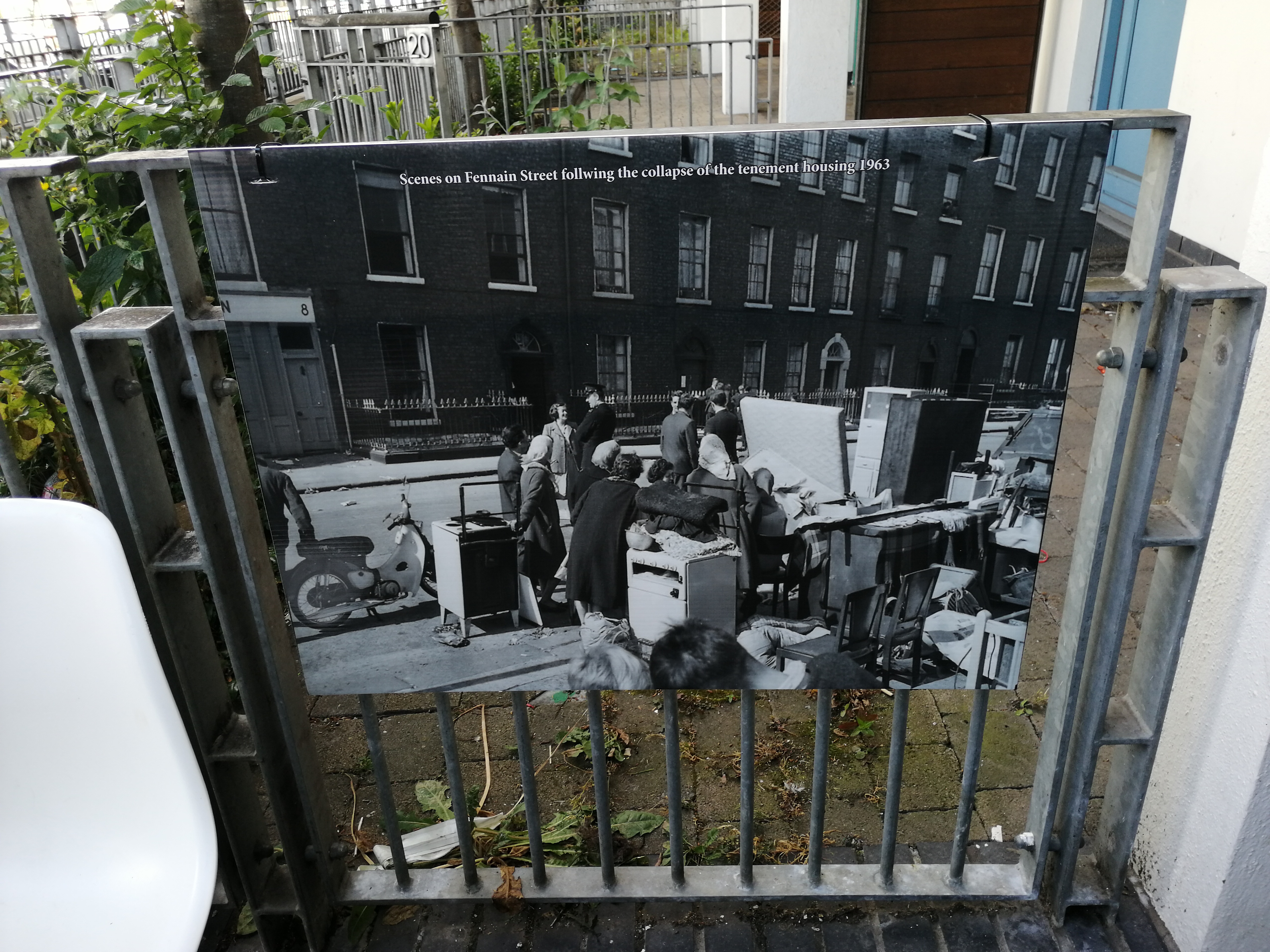
On 12th June 1963, Marion Vardy and Linda Byrne, returning from a shop were killed when the buildings collapsed.
After another two people were killed in a Bolton Street collapse, a galvanised Dublin City Council inspection condemned many other buildings in the city and 155 families were rehoused immediately, though some in Army barracks.
And a number had to camp out for some days in the street. But it was not the first fatal building collapse in Dublin. On 2nd September 1913 (with the epic Lockout struggle only days old), two adjacent buildings had collapsed in Church Street, killing seven people.1
All the buildings in question were privately-owned with working class people paying rent to the owners. Emergency inspections by Dublin City Council inspectors in 1963 resulted in the condemning of 156 Dublin buildings as too dangerous for residence.
For years, other buildings in the Dublin inner city could be seen braced on a side by a massive timber frame.


COMMEMORATIVE EVENT
A display of panels describing the tragedy and panels of photos had been erected around the entrance to St.Andrew’s Court block of flats in Fenian Street, where a crowd had gathered for the well-organised commemoration.
Paul McKeown chaired the event speaking eloquently when he could be heard (there was no public address facility) about the actual tragedy and the context of housing provision for working class people in the inner city.
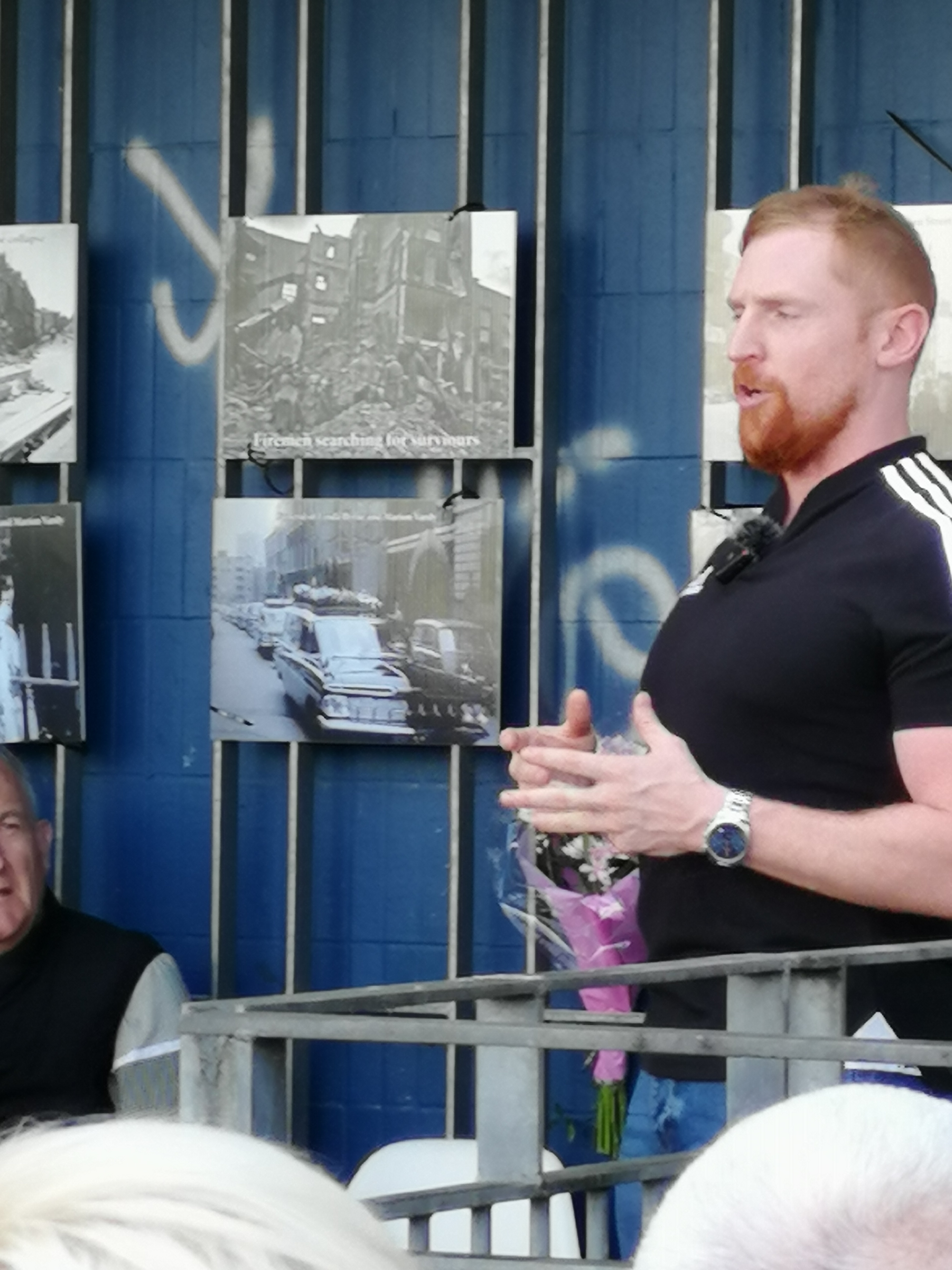
As a Catholic priest had performed the religion’s Last Rites over the bodies of the girls in 1963, McKeown invited a priest to recite some prayers at the event, which he duly did, after which the MC introduced a representative from the Henrietta Street Tenement Experience.2
The Henrietta Street speaker provided interesting snapshots of what past life was like for working people of the inner city in terms of occupation, accommodation and schooling. Some women sewed shirts in a factory while others sold items in street markets, such as Moore Street.3

The floors in the poorest homes had no covering and toilets were very few, their use often shared by a great many residents. Although virtually all children would end schooling at the age of 14, the eldest boy often left years earlier to work, as a newsboy or shop messenger, for example.
Labouring on the nearby docks and carting would be the main employment for the men. No doubt emigration, almost a constant in Irish history, played a part too. Rats and mice were endemic in the buildings.
Though alternative and eventually new housing was found for all, it was to Dublin’s outlying areas, breaking up communities and their ways of life, separating them from services used, employment, etc. Many felt isolated and took the long journey to return to the city centre for social contact.

ATTACK ON NEARBY REFUGEES
The local flats overlook the location in Sandwith Street that in May had seen an attack by fascists on refugees who had been living in tents because the nearby International Protection Office, a State body, had failed to allocate them accommodation while processing their applications.
A few locals might have joined in and certainly some had attended the crowd but the fascists were imported (as indeed were the refugees and subsequently their antifascist defenders). Some locals at least resented the way they were being portrayed in some social media subsequently.

“We’ve had generations of Travellers4 in the flats and migrant people too,” commented one. “We’re more ethnically diverse than Dalkey,” he added. “Middle class people don’t talk to us, they talk down at us,” was another comment.
They claim that they have been neglected for generations by all the government parties but also by small left-wing parties, also by people who were quick to criticise them and to see them in negative stereotypes. “Nobody talks about class prejudice”, commented McKeown.
The inner city working class population has been moved out of much of the city and this area, which was previously seen as the least valuable real estate in Dublin, as McKeown observes, is now attracting property speculators for gentrification.

McKeown feels his people are not wanted in the area and he’s probably right. It’s not just that they are not the typical users of the wine bars and coffee bars of gentrified areas but that their current location would take in big rents after construction of hotels and upper-market flats.
Past the site of the attack on the refugees there is a new block of apartments, two bedrooms for 3,000 euro a month, one bedroom for 2,000. An empty bloc across the road which people say was well-maintained, remains empty since Dublin City Council moved the residents out 5 years ago.
The local residents say that they have been promised that a new block of apartments will be built on the latter site and that all the units will go for “social housing”, presumably meaning for affordable rent.5They want that to be true but are not sure whether they should trust the authorities.
After the speeches of the commemoration people were invited to partake of food and music in the inside square of the flats which contains minimal playground facilities.

The music was provided by a trio including Shay Connolly playing ballads with the food served by local residents, in a relaxed atmosphere. The area at the back of the flats had become a sun-trap and while some soaked it up, I and some others eventually fled the heat.
PAST, PRESENT AND FUTURE
The commemoration of historical events can be of great importance. The event in 1963 forms part not only of an older story but also of the present, which is the lack of decent housing provision for the population of Ireland, in particular for those living in the inner cities.

Working and lower middle class people were wanted in the inner city to work its industries and its shipping port and to service the houses of higher social classes. As industry and port declined and the higher social classes moved out, the need for their work declined.
When their poor areas are seen instead as development prize areas, there is even less demand for the people who have lived in these areas for generations.
One can see this as the inexorable play of impersonal market forces or as the operation of finance and rentier capitalism in a capitalist economy and more, a Gombeen capitalist state where everything is done for the foreign capitalists and as little as possible for the working classes.
From the latter viewpoint, voting different political parties in to government will make no essential difference; what is needed is a fundamental change in the economy which can only be brought about by an organised, conscious and militant working class seizing their rightful inheritance.
End.

FOOTNOTES
1 I recall reading that a number of Dublin City Councillors, including Nationalist ones, were slum landlords.
2 It is open for visits from Wednesdays through to the weekend, I am told.
3 The market and area are subject to a long war between property speculators and conservationists (see smsfd.ie)
4 An Irish indigenous nomadic ethnic group of at least five centuries existence, much discriminated against.
5 “Social housing” is often understood as provision for people unemployed and on state welfare provision. Perhaps “Public housing on affordable rent” is a better description, housing both people working and those on benefits, the rents adjusted to means. This was widely built in the middle of the last century but none has been built in Dublin for decades, all governments insisting that the “private sector” (i.e big landlords, property speculators and vulture funds) can solve the problem while the housing crisis intensifies year after year.
SOURCES & OTHER READING
1963 Collapse: https://www.rte.ie/archives/2023/0531/1386694-fenian-street-homes-collapse/
1913 Collapse: https://www.historyireland.com/the-church-street-disaster-september-1913/
Tenement conditions 1913: https://csu1916.wordpress.com/lockout/dublin-1911/tenements/
2023 DCC failure to enforce standards on landlords: https://www.irishexaminer.com/news/arid-41080388.html
 rebelbreeze