THE GANG, THE BOSS AND THE MICE

Diarmuid Breatnach

Around 6am I awoke, still half in the script and trying to figure a way to win through. But not for long, as I was driven stumbling by the urea imperative – I had to go to the toilet. In the hallway I switched on the light, still thinking about the situation I had been in and, turning into what I thought was the open doorway, immediately stubbed my toe and nearly my nose on the door. After suitable curses, I stood in front of the enamel directing the hose while I thought about the damned situation.

I had debts. And there was a gang …. or gangs … and I was kind of in one of them and the big boss was putting the squeeze on me. Now, in my other life, the waking one, I’ve never really been in a gang, not even in my teens, although that’s not to say I didn’t have anything to do with them. I did – running from them, hiding from them, sometimes fighting and (of course) getting beaten up by them.

My social class set, the lower middle class, didn’t have gangs. The working class had them and curiously, the upper middle class had them too. The Geldoff types (he was from my home town). And since I didn’t usually have money to go to dances and discos, the dangerous times in my hometown were mostly daytime. The Geldoff types hung out in the Bamboo café across the road from Murray’s record shop, where us gangless lower middle class hung out. And the working class had no café or record shop, just their areas – the ‘Noggin, York Road ….

They weren’t anything like the legendary Ringsend or Dolphin’s Barn, but they were tough enough in my book. Ringsend lads came to the Top Hat Ballroom in my hometown once to settle a score and chased the locals all the way up to the ‘Noggin and the Farm, over a mile away. Local folklore had it that as they queued up in Ringsend earlier that evening to get into taxis for the foray, old dockers had handed each youth a docker’s hook.

There were times when walking down the main street in Dún Laoghaire had felt like something out of High Noon or some other western film, when the hero doesn’t want to go out in the street, he knows death is waiting there – but he has to. In his case, it was duty or some kind of fatalism sending him out there. In my case, it was fear of isolation. I didn’t want to end up cut off from my contemporaries – the boys and, yes, especially the girls. Where they hung out, I would have to go. Of course death wasn’t waiting for me, unless it were accidental …. only a beating.

Anyway, I deviate. Which doesn’t make me a deviant, by the way ….. Anyway, back to the script.

One of the things I was being pressured about had to do with promoting the gang leader’s mice. Yes, mice. Don’t ask me – I didn’t write the script.

For some reason the boss’ mice needed to be distributed, to take over everywhere. And one of the places Big Al wanted his mice installed was in a closed down fairground. It was in my area, so of course Big Al thought it was my responsibility to do it.

Big Al, photo taken during one of his philosophical debates

The thing is, that abandoned fairground already had mice, as I tried to tell Big Al. I’d hardly ever actually seen one but you could hear them, rustling, scratching and sometimes squeaking as they fought.

Big Al wasn’t interested. Were they HIS mice?

Well, no ….

Well, didn’t I see the problem?

I nodded. I could see I had a problem and I’d have a worse one if I didn’t do as he wanted.

Big Al’s mice arrived next day delivered by motorbike courier, in a plastic bag. Yeah, I know … but remember — I’m not the script writer.

I took some of the mice out. They were sleek, strong, well-fed, pinky-white mice. I carried the bag to the empty fair ground and let some of them out, to see how they got on. They scurried eagerly down lots of holes and there was suddenly a lot of squeaking underground. Then silence.

After a while, one came back, mauled and bloody. I waited but no others arrived. I put the rest of Al’s mice on the ground so they could avenge their mates. I had no choice, unless I wanted to tell Big Al I had disobeyed his instructions.

Those mice knew what was waiting for them and not a single one went down any hole. They milled around above ground. Then they found an unopened can of beer left by some inebriated street drinker, bit through into it …. and proceeded to get really, really drunk.

Some of Al's mice before they discovered the beer can
Some of Al’s mice before they discovered the beer can

They were still drunk when Big Al dropped by to see how his mouse colonising was progressing.

“What the fuck is going on?” Big Al and his bodyguard were looking in amazement at his carousing, stumbling mice.

I told him what had happened. He shook his head, muttered something, shook his head again, then went off grumbling to get some more mice – maybe Super-mice, or Ninja Mice, or something.

I knew the drunken mice would be history. If a cat or a kestrel didn’t get them …. well, Big Al had a low tolerance for failure. I should have felt sorry for them …. and I kind of did … but also a kind of contempt. The fairground mice had lived a hard life, braving flood and ice, finding what food they could, breeding, tunneling, avoiding alley cats, kestrels …

Big Al’s mice had been fed high-protein diets, reared in secure environments, built up muscle, each probably outweighed the biggest fairground mouse by a couple of ounces. But those scruffy, lean, dirty mice had finished off the advance guard of Al’s mice in minutes. And the rest? Didn’t even have the courage to make a fight of it but went and got drunk instead!

I left them to it. Al would be back and he’d probably want to supervise the operation against the Fairground Mice himself. That was fine with me. I didn’t like the job and I secretly wished the native mice well.

Anyway, I had other problems to deal with. I still had to organise my area for Big Al’s other operations – or else. I didn’t know exactly what the “else” might be and truth to tell, I didn’t even want to think about it.


…………………………………………………………………………………………………………………………………………….

In the end, I couldn’t do it. I could fool myself that I could manage the area for Al in a more decent way than somebody else working for him …. maybe. But I would still have to become too much like Al himself to do it. So, one alternative only – get out, go on the run and hope Big Al or his goons couldn’t find me. I didn’t even know where I was going to go – just out.

In my benighted life, I had one bit of success.

I ducked into a shop and got to use their phone. That’s right, no mobiles – maybe this script was set in the 1980s …. Not that I remember seeing big hair, shoulder pads or baggy trousers …

Anyway, I phoned up the electric phone company and got to speak to the Area Manager about my bill …. yes, the actual Area Manager! I told him I was going out of business and after a little haggling he agreed to accept 20% of the bill in payment and to wipe the slate clean.

Then I phoned my cousin, also my best friend and told him I was getting out. He was disappointed in me. Really, really disappointed. I could imagine him shaking his head.

“What about community organisation, man?” he asked.

“I can’t do it, Mort. Big Al is too much to go up against.”

“I can’t believe it – and you from a long line of trade union organisers.”

That got to me because, in the script, it was true. My Da had been a union organiser most of his life. My Ma too. And one of my Grandas as well. Strikes, union meetings, pickets, marches, police stations and courthouses had been a part of my childhood, almost as much as school throughout the year and the seaside in summer.

In real life, of course, my Da had been many things but never a trade union organiser. Active trade union member, yes – organiser, no. And my Ma – well, maybe if there had been a Housewife’s Union …. she would have probably been the General Secretary.

Anyway, in the script, Mort shamed me. And talked some more. And I argued. And he put forward a plan.

For some reason, this plan, which of course required community organising, needed a public appeal by television. Mort said I should do it. I told him I couldn’t – I’d freeze on camera and anyway I was too closely involved. I begged him to nominate someone else. He thought for a little while.

“Ok, but you have to go with whoever I choose – no backing out.”

“Sure! Thanks!” I gulped, relief flooding me.

His next words ejected that relief right out again.

“Ask your Ma.”

After I recovered from the shock and hung up, I went to see Ma. This was Ma in the script and nothing like the Ma I had in the real life, the one who was born in the Basque Country and spoke English with a German accent, because her Da had been a German.

And this script Ma was easy-going, unruffled …. Still, she took some persuading before she agreed. And while she was getting ready for her TV appearance – having her hair done, rehearsing her appeal, buying new shoes (who was going to see her shoes on TV?!!) — I was down on the street in my area, doing the rounds, talking to shopkeepers, community workers, youth, pensioners ….

Of course, Big Al was going to get to hear what I was doing. But the gamble was that my Ma’s appeal would be broadcast before he could make his move …. and after that, it would be much more difficult for Big Al to demonstrate the full meaning of that “else” with which he had threatened me. And hopefully the community would start to solidify and be able to resist. Doing nasty things to me wouldn’t be that productive any more. And whatever else Big Al was, he was a pragmatist.

Yes, of course, there’s always the unpredictable emotional element ….

I was pondering that when something pulled me half out of the script.

It was around 6am and I was still half in the script and trying to figure a way to win through. But not for long, as I was driven stumbling from my bed by the urea imperative – I had to go to the toilet.

In the hallway I switched on the light, still thinking about the script I had been in and, turning into what I thought was the open doorway, immediately stubbed my toe and nearly my nose on the door. After suitable curses, I did the business in the toilet and thought about the events in the script.

Then I wondered whether I could somehow get hold of the scriptwriter and how I could make him pay for what he put me through.

Had I met him? No, never. How did I know he was male? I don’t know, but for some reason I was sure he was. Which is strange, because nobody in my life had ever fucked with my head the way some women had. But yes, he is male – I’m sure of it. Now, where could he be hanging out ….?

End.

THE FLIGHT OF THE UNDERGROUND QUEEN

Diarmuid Breatnach

                                                          They had been preparing for this for some time. The infants were selected, received special care and food and were raised carefully in the Palace chambers inside the Citadel. They were now adolescents, maturing sexually. As the time approached for their great expedition, the tunnels leading to the departure terminal were widened and cleared of all obstructions. Experts tested the weather conditions daily and, when the majority of these were in agreement, the Queen gave the order to launch.

The adolescents took off then, a great host of them, amidst great excitement. Their pheromones, male and female, filled the air around them and those who could, which was most of them, quickly found a partner and coupled. It was a maiden flight from which the adolescent females would land no longer maidens.  

Those who would land, that is.  For suddenly the air was filled with giant flying monsters with huge eyes and giant whirring wings.  Much more accustomed to flight, these monsters flew among them, gobbling them up.  Some even held rows of their hapless victims in their huge beaks as they flew off to feed them to their young.  Hundreds, perhaps thousands of the little flyers perished in minutes. 

Those who managed to land safely and didn’t end up drowning in a lake or a river, or snapped by denizens of the deep who sprang up at them as they passed overhead, or caught in sticky webs, or who were not stamped carelessly to death by huge walking giants or flattened by roaring, stinking monsters, still had to contend with smaller predators on the ground. The casualty rate was huge but some made it alive – some always did.

The males who made it down to ground safely would all die within a couple of days. Their wings were only intended for their nuptial flight; on the ground, they were nothing more than a nuisance, impeding their progress over and underground.

The females, sexually sated and no longer interested, had left their male partners behind. They bit off their own wings, ate them and, quickly finding some reasonably soft ground, began to dig. Each one dug down as though her life depended on it, which of course it did; and not only her own life – each one was pregnant. Then she blocked the entrance to her tunnel, went back down it, excavated a chamber and began to lay eggs. It was completely dark down there but she had been reared in darkness – she had one day of daylight only, the day she flew.

The young grubs who hatched were all females. She supplied them with some sparse nutrition from herself and cared for them as they grew, shed skin, grew … until they spun a cocoon from which they emerged as very small worker ants. They were infertile workers and tended to their large mother, their Queen; even when they were fully-grown she was still one-and-a-half times their size, although about half the size she had been when she left her old nest. Her most recent meal had been her own wings the day she had flown and mated. If she got past this crucial stage, she would recover her size and weight and lay more and more eggs.  

The workers soon went up the tunnel, unblocked it and spilled out into daylight for the first time in their lives, beginning to forage for food. They found small seeds and, if they were lucky, sweet material such as soft-skinned ripe or rotting fruit. They soon had their surroundings covered with their hive-scent, carried by each and every worker. Sometimes they found insects they could kill but these had to be very small indeed – these workers had been fed on insufficient nutrition and were, compared to the majority of their kind, puny. If they found a food-source worth another visit, they left a specially-scented trail on their way back to their home, to guide theirs sisters back to the prize later. A rich source of food typically would show two streams of traffic between their nest and the food – one emptyjawed heading for the food and the other, with pieces in their jaws, heading away from it and towards the nest.  The food gathered by the workers fed them and their Queen, while she continued laying eggs.  As time went by, more and more workers were born, who would care for the hundreds of eggs their matriarch laid and raise more and more workers.  Extensive tunnel networks were dug.

At some point the workers found aphids and began harvesting their sugary secretions; tending them on the stems of the plants the aphids infested and carrying them down to their citadel but bringing them back up later. The workers would fight to protect the aphids from those who preyed on their ‘herds’.

Successive generations of ant workers grew bigger, until they reached the optimum size of five milimetres (still four millimetres short of the Queen in her prime). A well-established citadel could in time house as many as 40,000 individuals (although between four and seven thousand would be more common) – they, and previous generations, all daughters of the same mother and the product of one mating only. Their Queen, barring unusual disasters, might live to 15 years of age.

Once the citadel is built, it is vulnerable in the ordinary course of things only to parasites, flood, fire and severe surface disturbance. In Ireland, without bears, wild boar and largely without foraging pigs, severe surface disturbance is unlikely away from human construction or ploughing and digging. Fire might not reach underground but the heat generated or the lack of oxygen might kill anyway; flood, of course, would be the biggest threat. If a citadel should be uncovered or invaded by flood waters, some workers will rush to deal with the problem while others rush to save the young, trying to carry eggs, pupae or cocoons away in their jaws to a safe place. Some others will rush to do whatever they can for their Queen. A black ant defends itself by running away if possible and if not, by biting. But intruders to the citadel are swarmed by biting ants. However most human skin is impervious to the bite and this species does not sting.

Black Ant nest under a stone, disturbed. Ant larvae and pupae visible as the workers rush to take them to safety.

One day, perhaps three years from the Queen’s maiden flight, she will decide it is time to send her own children into the wider world.  She will lay eggs and have these emerging grubs fed special food, which will produce males for the first time in her citadel, as well as other fertile females besides herself.  Then, one day in July or in August, she will send them out too, to start new colonies.  

Lasius niger, the Black or Garden Ant, is the most common of the 21 species of ant in Ireland. It is the most common also across Europe and a sub-species, L. neoniger, is known in the USA where however, it is not one of the most numerous ant species. Lasius niger is a very active, hardy and adaptable species, living mostly outdoors under rocks and but rarely inside houses (although it may well enter houses repeatedly if it learns of food within, especially sweet food). In cities, its nests are to be found in parks and gardens but also under street paving stones, the workers emerging to forage from tunnels leading to the joints between the stone. When those joints are surrounded by thin lines or small heaps of bright sand in summer, one knows that the workers are clearing the tunnels for the adolescents’ flights. Another indication is an unusual amount of

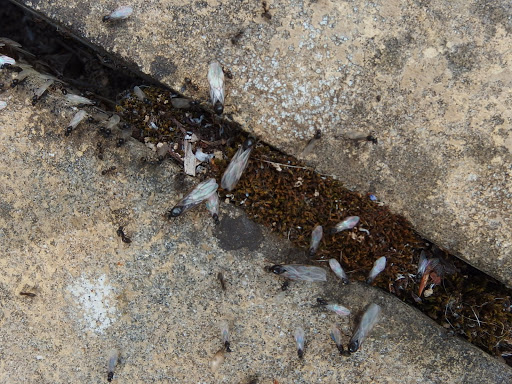
Black ants, emerging from under their nest. The larger winged ones are fertile and, if they survive, future queens. The winged males are much smaller and all are doomed.

seemingly erratic ant activity around a nest, though one would need to be aware of what normal activity looked like, for comparison. The ants may delay, awaiting what they judge to be optimum conditions but someday soon, mid to late afternoon, they will take to the air, to fly, to mate, to die or to live, to start a new population.

End

THE SCENT OF INTRUDERS

Diarmuid Breatnach

 The inhabitants of this land have fought invaders for at least a thousand years, some successfully and some less so.  Many of the invaders were assimilated.  Throughout this time, other invaders have quietly entered and spread throughout the land, mostly without encountering any organised opposition.


Last month and perhaps occasionally since, your nose might have picked up a scent drifting towards you, particularly as evening drew near but also at other times.  The aroma I speak of is one of those scents that is difficult to describe and that actually seems to change from time to time and also according to whether one is right beside it or farther away.  Sometimes it seems musky and very pleasant while at other times is not so welcome.  

The scent may have been from the blossoms of the Cherry Laurel (Prunus laurocerus), a dense thicket-forming shrub that grows to small tree size with a strong thick trunk covered in a smooth dark grey bark.  It is neither a cherry variant nor a laurel (or bay), which its leaves supposedly resemble, these being thick and dark green but poisonous (containing cyanide).  The blossoms, white flowers clustered on upright spikes, produce blackish fruit in the Autumn about the size of cherries which are also poisonous to humans.  Originally from South-West Asia, it was introduced into Irish gardens as a shrub or hedge plant (uses to which it is still put) but it has “escaped” and established itself in the wild.

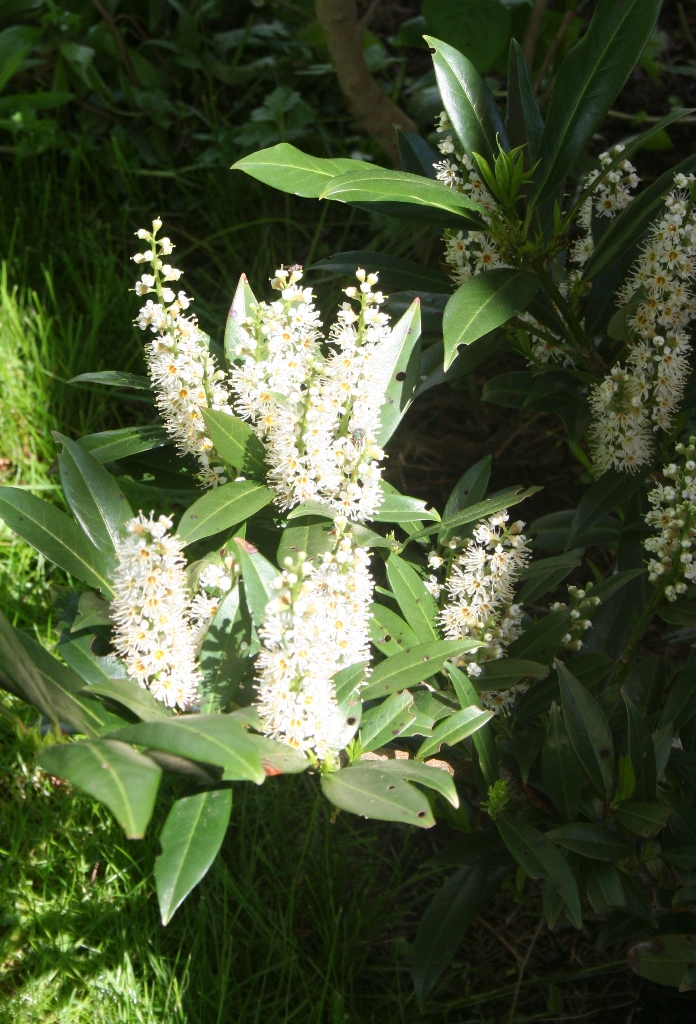
Cherry Laurel bush with flowering spikes in early stage

The Cherry Laurel has become very successful and a resultant problem for bio-diversity in Ireland. A quick perusal of the on-line references do not reveal the reason for its success; it tends to be grouped alongside another invasive species, the Rhododendron, which deposits a chemical in the ground surrounding it, thereby preventing other plant species competing with it for light, moisture and nutrients. Like the Cherry Laurel, the Rhododendron is a plant species invasive to Ireland.  Of course, since Ireland was almost entirely covered in ice 20,000 years ago, nearly all of the plant life now naturalised on our island had to have been invasive species originally — including trees, bushes, flowers, grasses, ferns …

Cherry Laurel flowering spikes at late stage

Invasive species are not always harmful to the existing balance (or to humans) but clearly they have to have some means of competing with the existing flora (plant life) or they would have been unable to establish themselves.  They may have better protection against herbivorous animals (undoubtedly the Cherry Laurel has at least that), or against insect or snail attack, or even against fungi (such as the ‘blight’ that attacked the potato a number of times in Ireland in the 1840s).  Or they may be able to occupy a niche not well exploited so far, as one of the Buddleida species has done (literally, one might say), growing out of thin gaps in stone or brick walls or on waste ground, its racemes of mauve or purple flowers attracting butterflies and other insects for pollination and later scattering its seeds on the wind.


The Luftwaffe helped the spread of the plant in Britain; so common did this shrub become on waste ground after the Second World War that it earned the popular name of « Bombsite Plant ». The species in question is Buddleia Davidii and according to The Online Atlas of British and Irish Florait was introduced into cultivation in the 1890s, quickly becoming very popular in gardens. By 1922 it was known to be naturalised in the wild in Merioneth and in Middlesex by 1927; it is shown as locally well established in S. England in the 1962 Atlas and “In recent decades it has spread rapidly throughout lowland Britain and, to a lesser extent, Ireland.” It is certainly ubiquitous in Dublin city and surrounds.

Buddleja Bush in bloom
Buddleia Bush in bloom
Buddleja davidii growing out of a wall
Buddleia davidii growing out of a wall

Buddleia (pronounced “budd-lee-ah) has about 100 species native to all continents except Europe and Australasia but a number of species and cross-breds are cultivated in European gardens, including the escapologist davidii. Although nearly all are shrubs growing to at most 5m (16ft) tall, a few species qualify as trees, the largest reaching 30m (98ft). There are both evergreen and deciduous species, not that unusual among trees and shrubs, as appropriate in tropical and temperate regions respectively. Some of the South American species have evolved long red flowers to attract hummingbirds, rather than insects, as exclusive pollinators.

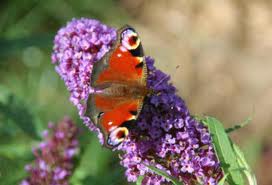
Peacock Butterfly on a Buddleja raceme
Peacock Butterfly on a Buddleia raceme

In Ireland, far from hummingbirds, davidii’s racemes of tiny purple or mauve flowers are a welcome sight as they flower in July, less so as the flowers, having done their work, die and turn brown (though repeated dead-heading can extend flowering until September). The flowers are scented but less so than those of the similar but not closely-related Common Lilac (Syringa vulgaris) which, incidentally, is an aggressive coloniser in parts of Southern Europe and of the USA.  The roots of davidii will do some damage to house walls and chimney stacks if allowed to become established, when pulling them out becomes impossible and the stump would need treating with an appropriate chemical. Checked early, it is easily controllable.

Another successful wall climber in Ireland is the Red Valerian (Centranthus ruber), sometimes known as Jupiter’s Beard. Despite its common name, the flowers are often pink or even white and at times clumps of two or even all three colours may be seen growing alongside one another. This one likes the tops of walls rather than the sides and grows well on dry or stony soil too.

Its seeds are wind-driven too and from anecdotal evidence, it made particular use of the railway cuttings and lines to distribute itself throughout Ireland.

Red Valerian growing on top of a wall

Despite its name, it is not closely related to the true Valerian (Valeriana officinalis), and no medicinal properties have been discovered in Centranthus. The leaves and the root may be eaten but there seems to be no great lobby recommending it as food.  Its scent is rather rank to the human nose.

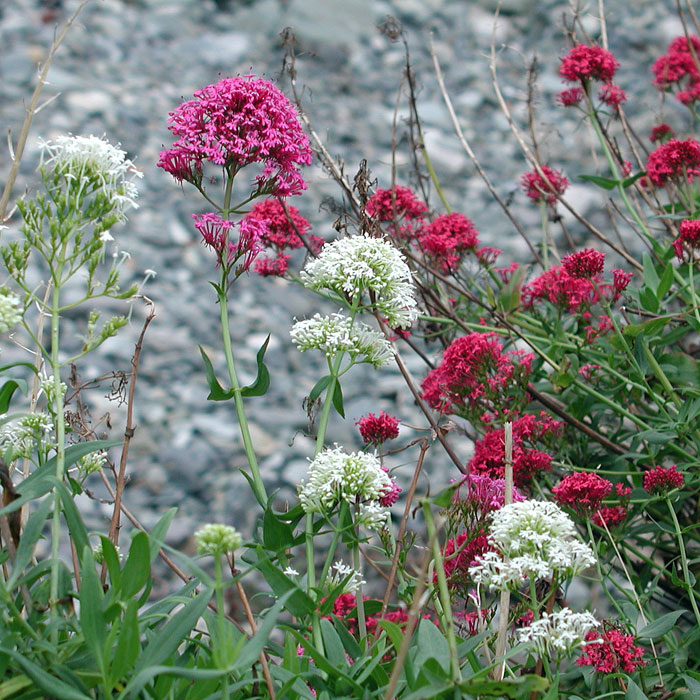
The three colour variations of Ceranthus Ruber growing closely together on rocky ground

Originally from S.W. Europe and the Mediterranean region, the plant was grown in Britain as early as 1597, according to Online Atlas of British & Irish Flora. Like some cases in human history, when the newcomers were first invited and then became invaders, Red Valerian was first imported to be grown in gardens. By 1763 it was recorded in the wild in Cambridgeshire. Now it is to be found all over Ireland and is generally welcomed. Like some of the invading Vikings, Normans and English, Red Valerian and Buddleja have become part of the Ireland we know today and there seems no need to organise a resistance to them; the Cherry Laurel and the Rhododendron, despite the scent of one and the colour of the other, are a different case altogether.

end


Some on-line sources:

Cherry Laurel

http://www.conservationvolunteers.ie/images/buttons/submenus/news_and_advice/downloads/naa_bpmg_rcl.pdf

Buddleja http://www.brc.ac.uk/plantatlas/index.php?q=plant/unmatched-species-name-392

http://en.wikipedia.org/wiki/Buddleia

Red Valerianhttp://www.brc.ac.uk/plantatlas/index.php?q=plant/centranthus-ruber