The St. Patrick’s Day Blood Fest Comes Round Again

Gearóid Ó Loingsigh Feb. 23
NB: Edited by Rebel Breeze for formatting purposes

(Reading time: 5 mins.)

When the genocide in Gaza began, no one thought it would go on for so long.

But it has, and along the road many challenges have come up for governments, social movements, Arab countries and political parties and nearly all of them have been found wanting on the issue.

In Ireland the annual cringe fest that is St. Patrick’s Day in Washington threw up a problem for Sinn Féin last year. Should they go or not go?

Last year the Irish Palestinian Solidarity Campaign issued a call for all political parties, including government parties, not to go.

Sinn Féin broke that call for a boycott and were swiftly pardoned by the IPSC which swiftly invited them to address a Palestinian solidarity rally in Belfast one day before Mary Lou McDonald and Michelle O’Neill First Minister of Northern Ireland set off for the USA.

There they swanned around with Biden, imbibing of whatever liquor was on offer on the day. Supping the devil’s buttermilk as some of their unionist colleagues might put it.

At the time Sinn Féin said it was going, as it was important and that they would raise the issue of Palestine with Biden. One month before flying out to Washington a Sinn Féin spokesperson stated:

We will use every political and diplomatic opportunity and influence that we have to be a voice for Palestine, to demand an end to the occupation of the West Bank and Gaza, for Palestinian statehood and for a permanent ceasefire now.[1]

In the end they did no such thing. In fact, the then Irish Taoiseach (Prime Minister) Leo Varadkar was more forceful than Mary Lou or Michelle who made even more tepid statements and quaffed what was put in front of them and enjoyed the jollies.

They could have been forgiven for thinking that it would be all over by 2025 and this situation would not arise again. Well, we should be gentle on them, many of us underestimated the Israeli bloodlust. But here we are again.

Trump continues with Biden’s genocide and announces his intention to commit two war crimes e.g. the mass expulsion of Palestinians from Gaza, a war crime under Article 49 of the Fourth Geneva Convention and profit from the looting of their assets a further war crime under Article 33 of the same convention.[2]

The SDLP was the first out of the hatches saying it would not go, reaffirming their position of the previous year.

It is ironic that Sinn Féin supporters used to refer to the SDLP as the Stoops, a play on their initials, Stoop Down Low Party, which probably means Sinn Féin (SF) should now be known as the Stoop Further.

As is common with the Stoop Further, they are fond of speaking out both sides of their mouths. They announced that they would not go this year, though not official invite has been issued to them, and at the same time urged the Irish government to go.

A case of wanting to have their cake and eat it too.

Mary Lou McDonald stated Trump’s plan “represents a marked escalation in the very complex conflict situation for the Palestinian people.”[3] Really? Expulsion is an escalation from genocide?

To be very clear, there is a specific genocide convention and genocide is a Crime Against Humanity, under that convention, and is so at all times and in all circumstances.[4] There are no ifs or buts to that.

Expulsion and profiteering are war crimes. In legal terms, they are egregious crimes but less so than genocide. There is no escalation here. Both Biden and Trump have been complicit in the genocide, Trump however has put the blood-soaked icing on the cake with his proposal.

Donald Trump US President in what is no doubt one of his favourite photos (Photo sourced: Internet)

Except it is not his proposal. It has been official US and Israeli policy since 2007.[5] 

In other words, a plan that began under Bush and continued during the eight years of Obama’s presidency when Biden was the Vice-President, Trump’s first presidency and of course Biden’s four demented years as President.

Mary Lou McDonald seeks to draw a line under her support for the US. There is some mythical line in the sand between the Democrats support for murder, genocide, torture and Trump’s.

In refusing to go to the Blood Fest in Washington she stated that Sinn Féin would not be in a position to challenge Trump’s statements at the Blood Fest (she doesn’t describe it as such, to be clear that is my accurate description).

This is surprising as last year, she said that they would challenge Biden on his support for Israel.

Before they went off on their junket last year, two days before the St Patrick’s Blood Fest they issued a tame communiqué asking Biden to play a more “constructive role” in Palestine,[6] whatever that is supposed to mean.

In fact, part of their public rationale for going was that they could influence US government policy. So, what is different now? Have they concluded that their junket last year did not produce the results they hoped for?

Well, they had no expectations that Biden would end US complicity in the genocide and as I already pointed out, when they went their statements were way weaker than the Irish government’s official statements. So, the answer is no.

This year they have said they won’t go, but have said the Taoiseach should go.

We absolutely believe that he needs to go and, furthermore, when there, set out unambiguously the Irish position in respect to all of these matters and to push back directly against any threat or goal for the mass expulsion of Palestinians from the Gaza Strip, the annexation of that land.[7]

If, as last year under Biden, they believed they could influence policy in the same way they now expect the southern Irish government to do, why don’t they go? The answer is one of political expediency.

They have calculated that this time round there is no political cost amongst their reactionary base in the USA to boycotting a Trump event and by calling on the Irish government to go, they continue to signal that they are a “reasonable partner” that the Irish state and Trump can do business with.

Michelle O’Neill stated that she couldn’t go this year because

I couldn’t in all conscience make that trip at this time. I just think that there are times whenever we’ll all reflect, and certainly whenever my grandchildren ask me, what did I do whenever the Palestinian people were suffering, I could say that I stood on the side of humanity.[8]

Except of course, she didn’t. Whilst Biden gladly and gaily supplied Israel with all the military hardware required to carry out a genocide, she did not nothing.

In the waning days of Biden’s support for genocide, on January 4th of this year he notified Congress of an additional US $8 billion arms sale to Israel.[9] Yeah, Michelle can tell her grandchildren what she likes, but she supped with the Devil.

She took part in a genocide through her endorsement of Biden. Her sudden hypocritical distancing from the same policies under Trump is meaningless.

It is not an ethical position; it is not one based on some internationalist concept of solidarity with the oppressed or even a liberal opposition to genocide and war crimes as they have previously shown no such solidarity or real opposition to such acts when Biden was the war criminal in charge.

No matter how low you think Sinn Féin can stoop, they will always surprise you and Stoop Further.

End.

NB: For more articles by Gearóid see https://gearoidloingsigh.substack.com

NOTES

[1] The Irish News (23/02/2024) Protests at east Belfast arms manufacturer as city council’s largest parties accused of ‘vetoing’ PBP Gaza ceasefire motion. John Manley. https://www.irishnews.com/news/northern-ireland/protests-at-east-belfast-arms-manufacturer-as-city-councils-largest-parties-accused-of-vetoing-pbp-gaza-ceasefire-motion-BO4VAMQCYVF37BOSCHVPPNLACY/

[2] The Geneva Conventions can be consulted at https://ihl-databases.icrc.org/en/ihl-treaties

[3] Irish Independent (22/02/2025) Sinn Féin may be boycotting White House for St Patrick’s Day, but Mary Lou McDonald is imploring Taoiseach to attend and confront Trump. Tabitha Monahan and Senan Molony. https://www.independent.ie/irish-news/sinn-fein-may-be-boycotting-white-house-for-st-patricks-day-but-mary-lou-mcdonald-is-imploring-taoiseach-to-attend-and-confront-trump/a52621936.html

[4] To consult the Genocide Convention see https://ihl-databases.icrc.org/en/ihl-treaties/genocide-conv-1948

[5] Jonathan Cook (14/02/2025) Trump didn’t invent the Gaza ethnic cleansing plan. It’s been US policy since 2007.

Jonathan Cook

Trump didn’t invent the Gaza ethnic cleansing plan. It’s been US policy since 2007
ANTI-RACIST IRISH-AMERICAN WAS “THE QUINTESSENTIAL PRIEST”

By Geoffrey Cobb (Reprint from The Irish Echo 23 June 2021)

(Reading time: 2 mins.)

The Rev. Bernard Quinn faced opposition from the Ku Klux Klan on Long Island.

In 1983, African-American priest Fr. Paul Jervis was assigned to the parish of St. Peter Claver in Brooklyn, which had been founded in 1921 by Fr. Bernard Quinn, as Brooklyn’s first black Catholic parish. Speaking with his parishioners, Jervis was amazed to hear the stories of so many older people who still spoke of Quinn with profound reverence, even though he had died 43 years earlier.

Intrigued, Jervis began to research his predecessor and was so taken with Quinn’s life that he decided to write a biography of Quinn calling it: “Quintessential Priest, The Life of Father Bernard J. Quinn.” Jervis’s biography is an inspirational tale of a man whose love for his black congregation defined him and forged a unique community of faith.

Quinn was born in 1888 in Newark, N.J., into a large Irish Catholic family. His father, who was from County Cavan, and his County Offaly mother sent him to parochial school and young Bernard felt such a strong vocation that he entered the seminary in 1906, where he developed a lifelong deep sympathy for the poor and the downtrodden. Ordained in 1912 in Brooklyn, Quinn was assigned to diocesan parishes such as St. Patrick’s in Bay Ridge and St. Gregory the Great in Crown Heights.

SHOCKED BY RACISM IN US ARMY DURING WW1

When World War I erupted, Quinn volunteered to serve as a chaplain for front line troops. Commissioned as a First Lieutenant, Quinn served as chaplain of the 333rd infantry. Serving at the front, he became a victim of mustard gas. Though he recovered, Quinn suffered from the gassing for the rest of his life. In France, Quinn was shocked by the racism in the American army. When a white American Protestant chaplain refused to pray with a dying Black soldier, Quinn intervened and prayed with the dying soldier, but the troubling incident lingered with Quinn.

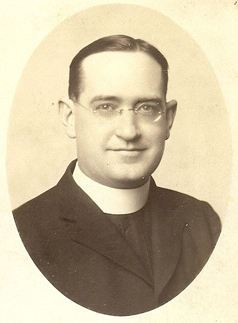
Fr. Bernard J. Quinn, c.1930 (Photo sourced: Wikipedia)

The war ended, but Fr. Quinn remained in France to minister to the wounded soldiers. After a chance reading of “The Story of a Soul, the life of St. Therese of Lisieux,” in the barracks library, Fr. Quinn discovered a spiritual hero. Learning that he was stationed in the vicinity of Alencon, not far from St. Therese childhood home, Quinn obtained permission to visit it and became the first priest to celebrate Mass there before it became a popular shrine. Intense devotion to St. Therese would define Fr. Quinn’s faith for the rest of his life.

BACK TO BROOKLYN FROM THE WAR

Quinn returned to Brooklyn in 1919. While preparing two black women for baptism, he was inspired to create an apostolate to African Americans, but his concern for Blacks was not shared by all Brooklyn’s Catholics, some of whom did not want African Americans praying in their churches. After repeated appeals, Quinn finally received permission from Bishop McDonnell to begin his mission to the Black people of Brooklyn, but finding Black Catholics proved difficult. Quinn went to the streets, asking every African American he met where he could find Catholics.

Finally, Quinn found Mr. Jules de Weever, the leader of the dissolved Colored Catholic Club, which had met from 1915-1916, seeking in vain to establish a church for Black Catholics in Brooklyn. Frustrated by the church’s indifference to their quest, the group disbanded. Quinn revived the CCC and inspired them to persevere in founding Brooklyn’s first Catholic church.

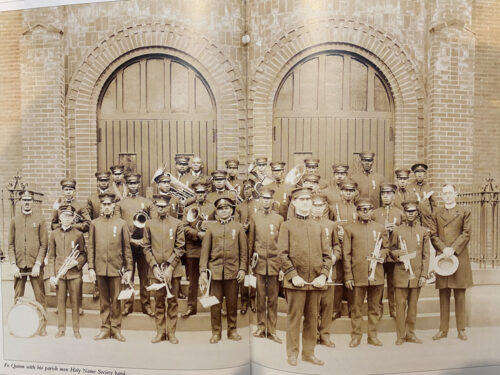
The Holy Name Band and Fr. Quinn (to far right). (Photo sourced: Internet)
The Rev. Bernard Quinn with young parishioners of St. Peter Claver during a religious festival. (Photo sourced: Internet)

Quinn incessantly petitioned the bishops for permission to establish an African-American parish, reminding them that Black Catholics were being excluded from worship at Italian, Irish and German churches, but instead of agreeing, the bishops ignored Quinn’s pleas. Finally, thanks to his perseverance, they authorized the founding of Brooklyn’s first African American Catholic Church, St. Peter Claver Church, in 1921, naming Quinn pastor.

The Irish-American priest now needed a church building and the parish soon found a warehouse for trunks and baggage that had once been a Congregationalist church on the corner of Ormond Street, now Peter Claver Place, and Jefferson Avenue, in the expanding black community of Bedford Stuyvesant. Quinn and the congregation enthusiastically set to work on the herculean task of transforming the warehouse back into a house of worship. The church’s decoration celebrated black faith with murals of early Black saints, and of St. Peter Claver’s work with enslaved Africans in Cartagena, Colombia.

On Christmas Day, 1921, the cornerstone for St. Peter Claver, named for the patron saint of African peoples, was laid. By 1922, the church was ready and blessed by Bishop Thomas Edmund Molloy. Quinn soon proved to be a model pastor and quickly the kindhearted priest endeared himself to his rapidly growing flock. Brooklyn’s Black Catholics were attracted to a church that didn’t just tolerate them, but even welcomed them with open arms. The parish became more than a place to pray, helping the parish’s poor, while also setting up a clinic, a credit union, a parish school, and adult education classes. St. Peter Claver soon became famous for its large children’s choir and its band. Legendary entertainers Lena Horne and Pearl Bailey both started their singing in the church’s choir. Reputedly, it was the first African-American choir ever to sing at the prestigious Brooklyn Academy of Music.

THE LITTLE FLOWER NOVENA BUSTOP

Fr. Quinn began a temporary daily novena, a series of prayers, to his inspiration, St. Thérèse, called the Little Flower Novena, but he never could have imagined the massive reaction the novena received. People begged for the novena to continue and an estimated that 10,000 of all races a week poured into St. Peter Claver’s. Within five years an amazing 2.2 million people had attended the novena, stirring the envy of nearby white Catholic pastors who complained that it drew away their parishioners. The novena was such a hit that the drivers on the bus line near the church would call out “Little Flower Novena stop.” The Brooklyn Daily Eagle soon did a feature article on the amazing success of the novena.

The novena proved to be a huge money maker for the parish, allowing Fr. Quinn to fund some of the parish projects he envisioned including a $300,000 school building, a convent, a recreation center and a Long Island orphanage that would ignite the bitter flames of racism. In 1929, Msgr. Quinn founded the Brooklyn Diocese’s first orphanage for Black children in a farmhouse in Wading River, Long Island, which at the time was still part of the diocese. A cross was burned in front of the Quinn family home in Mineola, but the priest defied the threat. Outraged racist locals contacted the Ku Klux Klan, which was very active on Long Island in the 20s and 30s, and the orphanage burned in an act of arson. The orphanage was rebuilt but burned again in the same year.

THE KLAN AND RACISM IN THE CHURCH

Undeterred, Father Quinn rebuilt the orphanage yet again, this time in stone and brick. The Brooklyn Eagle announced this with a headline, “New Fireproof Orphanage Will Defy Incendiary.” The KKK gave up, and the orphanage, called the Little Flower Orphanage, in honor of St. Thérèse, was dedicated as the Little Flower House of Providence Oct. 26, 1930. Today that organization survives as the Little Flower Children and Family Services of New York, offering adoptions and other social services in Brooklyn, Queens and Long Island.

Quinn became an outspoken defender of Brooklyn’s Blacks against the pervasive racism of his day. He denounced institutionalized racism and invited the Urban League, an African American advocacy group, to speak at his church. Some Brooklyn Catholic clergy spoke out against Quinn’s embrace of Black Catholics. In 1929, Msgr. John L. Bedford wrote in his Brooklyn parish newsletter that “Negroes should be excluded from this Roman Catholic Church if they become numerous.” Quinn vehemently defended his flock writing in the Brooklyn Tablet, “It seems to me that no church can exclude anyone and still keep its Christian ideals. The Constitution guarantees the freedom of religion and this, plus the fact that church property is tax exempt, ought to mean that anyone can go anyplace to worship.”

St. Peter Claver Church, Brooklyn, New York. (Photo sourced: Internet)

The strain of his herculean labors took a physical toll on Quinn. In the spring of 1940, Msgr. Quinn went into nearby St. Mary’s Hospital for surgery for an abdominal problem. He never came back to St. Peter Claver’s, dying on April 7. Brooklyn’s Black Catholics were in shock. They had lost a dear friend and their most vocal advocate. Eight thousand grieving mourners attended his funeral at St. Peter Claver, which was reported in all the New York papers including the New York Times.

In 1992, a movement to canonize Msgr. Quinn received the blessing of the Catholic Church and the long and difficult path to Quinn’s canonization has started. Decades before the founding of the Black Lives Matter movement, Fr. Quinn dedicated his life to serving Brooklyn’s Black Catholics and his life remains a shining example of the power of love to defeat hatred and bigotry.

End.

Author and teacher Geoffrey Cobb will lead a walking tour on Saturday, Aug. 7, of sites associated with the Tipperary-born Paddy “Battle Axe” Gleason, who was the last mayor of Long Island City before its 1898 incorporation into New York City. The event is sponsored by the New York Irish Center, 10-40 Jackson Ave. “Rebel Breeze” will shortly publish an article about the same Gleason by Geoffrey Cobb.