
Clive Sulish
(Reading time:2 mins.)
As the Irish State holds the Presidency of the European Union now and for six months hence, ministers of EU governments met in Dublin yesterday and today, the latter giving rise to an anti-war and pro-neutrality picket near Dublin Castle.
Since the Irish State’s incumbency of the EU Presidency the Irish State has forbidden demonstrations from Dame Street/ Gt. George’s Street junction to Lord Edward1 Street, along with the display of flags along that stretch.
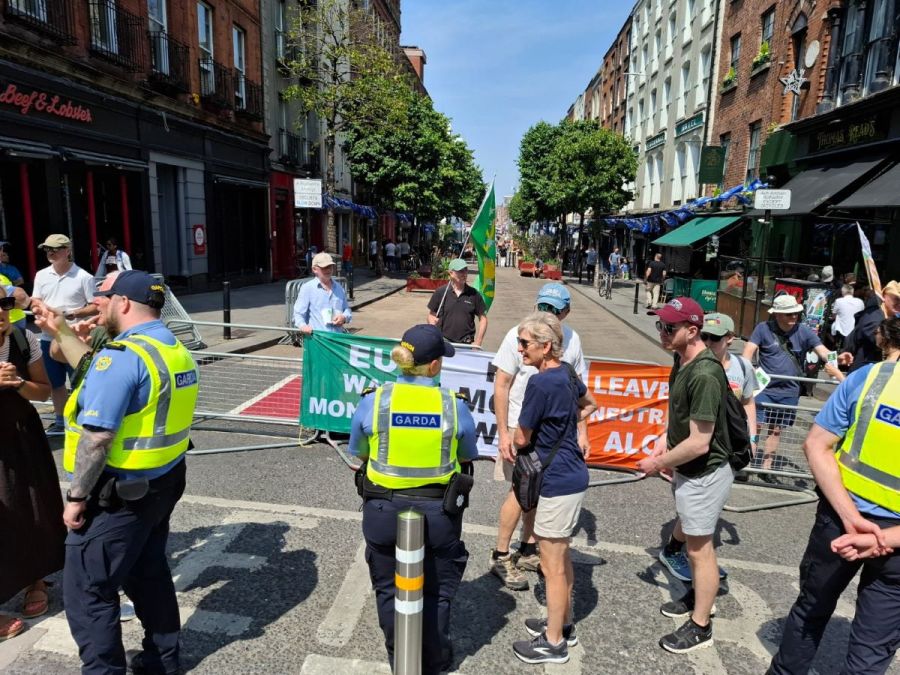
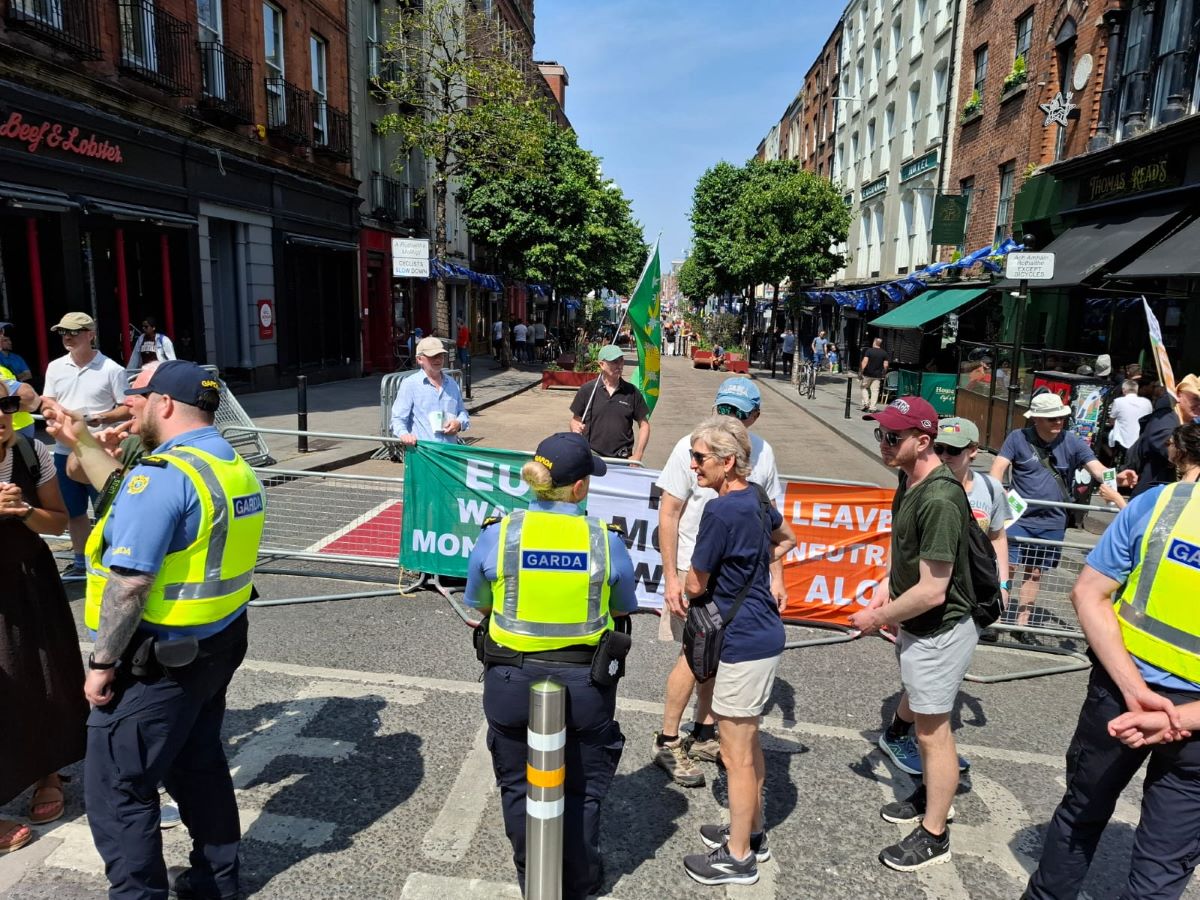
Demonstrators in favour of the retention of the Irish State’s formal neutrality took up position at the south end of Parliament Street, directly facing City Hall. The Gardaí closed most of the street entrance and had crowd barriers erected across it, which the protesters then lined with their banner.
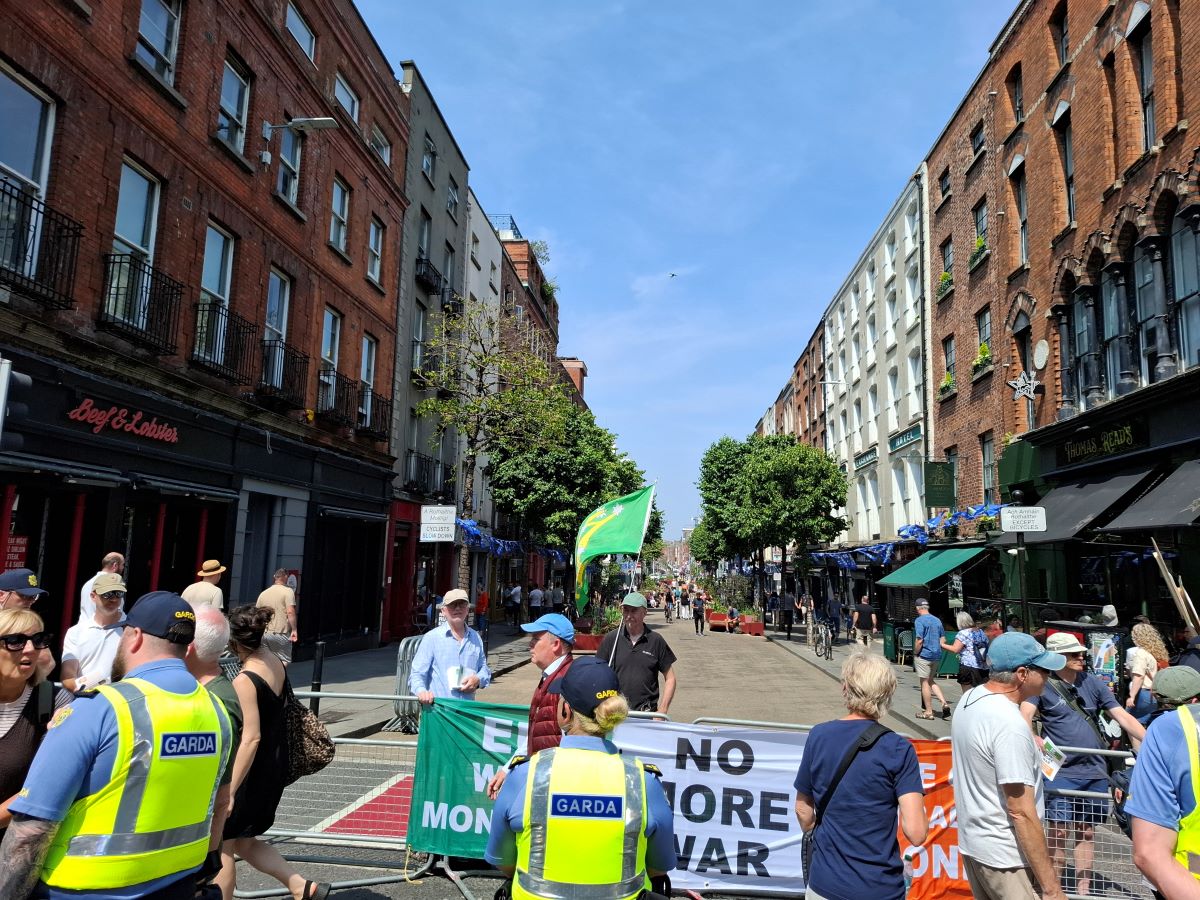
The letters on the Green, White and Orange banner read EU WAR MONGERS. NO MORE WAR. LEAVE OUR NEUTRALITY ALONE. Leaflets with the same colours on one side were distributed while the reverse expanded on the main slogan, in particular calling for retention of the Triple Lock.2
Some passing vehicles sounded their horns in solidarity.
The city was busy with pedestrian tourists and others enjoying the sun. The heat bore down on the demonstrators facing into the sun and on the backs of the Gardaí facing them and the demonstrators (some of whom had already picketed the Hatch St. EU office), packed up after an hour.
One flag alone flew over the protesters, the Starry Plough, flag of the Irish Citizen Army, the workers’ militia formed to defend the strikers and locked out workers in Dublin in 1913 and which later took part in the 1916 Rising, their leader, James Connolly,3 being overall Commander.
Coincidentally perhaps, City Hall was garrisoned by the Irish Citizen Army during the Rising and a steel plaque on its wall records the names of the Volunteers who fought there and in nearby buildings – half of which are women’s names (the ICA recruited women as well as men).
End.
Note: If you found this article of interest, why not register with Rebel Breeze for free, so that you will be notified by email of subsequent articles. You can de-register any time you wish.
FOOTNOTES
1Named after Edward Fitzgerald (1763-4 May 1798), one of the leaders of the United Irishmen, the revolutionary Irish Republican organisation. Often incorrectly referred to as ‘Lord Edward’, he had renounced his title, his sister later saying of him that the only title he aspired to was that of ‘Paddy’. Edward Fitzgerald went into hiding from British occupation forces but remained in the Liberties area, where his hiding place was discovered and he was wounded and arrested, having killed one of his would-be captors and injuring another. He died in jail reportedly of neglect by the authorities of his wounds.
2A provision that no more than 12 Irish State armed forces personnel may be sent on active service anywhere outside the State unless on UN mandate, a decision of the Government and a majority decision of the Irish Parliament. The suspicion is widespread in Irish society that the Irish ruling class wishes to dispense with the ‘Triple Lock’ or even to ignore it in order to commit the Irish State to NATO (or an EU armed force).
3Trade union leader, historian, journalist, revolutionary socialist, one of seven signatories of the 1916 Proclamation of Independence. Born Edinburgh (1868), executed by British firing squad on 12 May 1916.
SOURCES

