Covert Crusade: Washington’s $600m digital war on Iran

For over a decade, the US State Department’s NERD fund has covertly funnelled hundreds of millions into regime-change efforts in Iran, disguising digital warfare and opposition funding as ‘democracy promotion’ – but a sudden funding freeze has thrown these operations into chaos.

Kit Klarenberg FEB 21, 2025
(Reprinted with kind permission of author from https://thecradle.co/articles/covert-crusade-washingtons-600m-digital-war-on-iran)

(Reading time: 6 mins.)

Earlier this month, The Cradle exposed how in 2023, the US State Department’s shadowy Near East Regional Democracy (NERD) fund earmarked $55 million to stoke unrest in Iran during the following year’s elections. 

This was part of a wider US campaign of interference designed to disrupt and destabilize the Islamic Republic.

As that investigation noted, details on where this money goes – and who benefits – are strictly confidential as a matter of policy. Still, there are clues in the public domain pointing to at least some recipients.

(Image credit: The Cradle)

Regime change by another name 

As a US Congressional Research Service report records, due to hostile US–Iran relations, and Tehran’s well-founded view of NERD “as a means of financing regime change,” its programs rely on “third-country training” as well as “online training and media content.” 

The report further confirms that despite NERD being Washington’s primary “foreign assistance channel” for projects targeting Iran, “activities, grantees, [and] beneficiaries” are not advertised “due to the security risks posed by the Iranian government.”

It continues: 

“NERD was created in 2009 as a ‘line item for Iran democracy’ but was not (and is still not) technically Iran-specific … For 2024, the Biden Administration requested $65 million for NERD … to ‘foster a vibrant civil society, increase the free flow of information, and promote the exercise of human rights,’ including at least $16.75 million for internet freedom.”

What was unstated in the report is that NERD represents a simple rebranding of the Iran Democracy Fund, created by former president George W. Bush in 2006 with the explicit goal of toppling the Islamic Republic. 

The initiative was ostensibly shut down under Barack Obama three years later, eliciting bitter condemnation from much of the western media, neoconservative pundits, and lawmakers.

However, as the BBC acknowledged at the time, the move was in fact “welcomed by Iranian human rights and pro-democracy activists”:

“These US funds are going to people who have very little to do with the real struggle for democracy in Iran and our civil society activists never received such funds,” a Tehran-based human rights lawyer told the British state broadcaster.

“The end to this program will have no impact on our activities whatsoever.”

Internet interference 

In reality, the program never ended – it was merely repackaged. White House officials maintained the fiction that NERD was focused on democratization rather than regime change, a claim undermined by a June 2011 New York Times exposé. 

That investigation revealed the Obama administration’s so-called “Internet Freedom” initiative aimed to “deploy ‘shadow’ internet and mobile phone systems dissidents can use to communicate outside the reach of governments in countries like Iran, Syria, and Libya.”

In other words, Washington sought to build a covert legion of regime change operatives in Tehran, and provide them with the technology to coordinate in secret. It is clear from the Congressional report’s marked reference to “internet freedom” that these machinations continue today. 

Moreover, as a 2020 report by the DC-based Project on Middle East Democracy noted, organizations genuinely committed to advancing Iranian rights still steer well clear of NERD. An anonymous NGO worker described its “style” as “aggressive.”

Another implied NERD is engaged in deeply dirty work:

“We choose not to apply for NERD grants because we do not want to get pulled into [anything] crazy.” 

Non-Iranian’

The same year, the Financial Times (FT) reported how NERD efforts had become turbocharged under US President Donald Trump’s administration, explicitly to facilitate and encourage “anti-Tehran protests.”

This included “providing apps, servers, and other technology to help people communicate, visit banned websites, install anti-tracking software,” and more in the Islamic Republic, in order to offer “Iranians more options on how they communicate with each other and the outside world.” 

Curiously, while portraying Iran as a digital prison, the FT admitted that major western social networks remain accessible in the country, and Iranians can easily view western media.

As usual, recipients of NERD funds remained unnamed – except for Psiphon, a VPN provider long-associated with discredited exiled Iranian opposition figures and, by then, controlled by the Open Technology Fund (OTF).

The FT estimated that just three million Iranians used Psiphon, less than four percent of the population.

OTF was an “Internet Freedom” product – one of its board members has openly admitted the Fund’s agenda is “regime change.” 

Fast forward to September 2024; as former US president Joe Biden’s administration was seeking increased funds for NERD – mere months after the $55 million invested the previous year failed to produce desired mass unrest and upheaval around that year’s elections in Iran – a White House meeting was convened with major tech giants, encouraging them to offer more “digital bandwidth” for OTF-bankrolled apps and tools.

As fund chief Laura Cunningham explained, a “sizeable chunk” of OTF’s budget was taken up by the cost of hosting all the network traffic generated by its vast array of digital destabilization apps, which included Signal and Tor

While OTF sought to support “additional users” of these products, it lacked resources to keep up with “surging demand.” What came of this meeting, which was attended by representatives of Amazon, Cloudflare, Google, and Microsoft, is not clear.

Yet, if further “digital bandwidth” was granted to OTF, it is clear the Trump administration’s “pause” in overseas aid funding has thrown all NERD’s meddling efforts in Iran into total – and potentially permanent – disarray. 

A 27 January report in the Saudi-funded, anti-Islamic Republic Iran International quoted numerous anonymous beneficiaries of US financing bemoaning how grantees, including foreign-run Persian-language media outlets and organizations documenting purported “abuses” to keep the Islamic Republic “accountable,” had been abruptly shuttered.

An anonymous “human rights activist” told the outlet Washington’s freeze on aid spending “(will) impose restrictions on projects that address human rights violations or investigate governmental and military corruption which have impacted Iran’s economy and social conditions in favor of foreign terrorist activities and money laundering.” 

They said “several non-Iranian American institutions [emphasis added] have been using these funds to investigate corruption and money laundering.” Now though, “these organizations will be forced to halt their activities.”

Severe implications’

US-supplied Virtual Private Network (VPN) services also loomed large among the malign resources impacted by the aid “pause.” A nameless “activist” told Iran International that 20 million Iranians used such tools “to bypass Tehran’s internet curbs.” 

The outlet further quoted an article published by Human Rights Activists in Iran, a US-funded NGO not based in the Islamic Republic, but Virginia, near the CIA’s Langley headquarters: “In today’s Iran, the internet has no meaning without VPNs.”

Such dire warnings were echoed by Ahmad Ahmadian, head of California-based tech firm Holistic Resilience, which “aims to advance internet freedom and privacy by developing and researching censorship circumvention.” 

An Iranian expat and alumni of Tehran University, Ahmadian warned major US tech firms “may not be willing or able to continue their support for providing anti-censorship tools” without government support.

Such remarks highlight how these supposedly popular resources lack grassroots backing or financing, being wholly dependent on Washington’s sponsorship to operate:

“The leadership of the US government has been crucial in urging big tech companies to provide public services. Without the encouragement of the US government, these companies wouldn’t take the initiative on their own.”

Other unnamed activists further warned Iran International, “the consequences of Trump’s executive order will not remain limited to internet censorship circumvention tools.”

They believe that if NERD’s activities “do not receive an exemption within the next month” – by the end of February – “they will either collapse entirely or be deeply curtailed.” 

One declared, “the impact of this freeze might not be immediately noticeable, but its severe implications will become evident over time.”

Meanwhile, “internet experts” cautioned that “even if US aid starts again” after the 90-day pause, “the damage is irreversible since many people … might never fully return to using US-backed secure services.” 

As The Cradle noted on 11 February, Washington’s forced withdrawal from meddling in Iran could create fresh opportunities for genuine diplomatic engagement between the two long-time adversaries.

But another possibility looms: after spending $600 million over a decade with little success, the US may simply be preparing to test out new, potentially more malign regime-change strategies.

End.

SCRAPPING CARRIERS SINKS BRITISH WORLD POLICEMAN PLAN

Kit Klarenberg (republished with author’s kind permission from Al Mayadeen)

(Reading time: 6 mins.)

On November 15th, The Times published a remarkable report, revealing serious “questions” are being asked about the viability of Britain’s two flagship aircraft carriers, at the highest levels of London’s defence establishment.

Such perspectives would have been unreportable mere months ago. Yet, subsequent reporting seemingly confirms the vessels are for the chop.

Should that come to pass, it will represent an absolutely crushing, historic defeat for the Royal Navy – and the US Empire in turn – without a single shot fired.

The HMS Queen Elizabeth and HMS Prince of Wales first set sail in 2017 and 2019 respectively, after 20 years in development.

HMS Queen Elizabeth and HMS Prince of Wales in dock and at anchor.

The former arrived at the Royal Navy’s historic Portsmouth base with considerable fanfare, a Ministry of Defence press release boasting that the carrier would be deployed “in every ocean around the world over the next five decades.”

The pair were and remain the biggest and most expensive ships built in British history, costing close to $8 billion combined. Ongoing operational costs are likewise vast.

Fast forward to today however, and British ministers and military chiefs are, per The Times, “under immense pressure to make billions of pounds’ worth of savings,” with major “casualties” certain.

Resultantly, senior Ministry of Defence and Treasury officials are considering scrapping at least one of the carriers, if not both.

The reason is simple – “in most war games, the carriers get sunk,” and are “particularly vulnerable to missiles.” As such, the pair are now widely perceived as the “Royal Navy’s weak link.” 

Matthew Savill of British state-tied Royal United Services Institute told The Times that missile technology is developing “at such a pace” that carriers are rapidly becoming easy for Britain’s adversaries to “locate and track”, then neutralise.

“In particular,” he cautioned, China is increasing the range of its ballistic and supersonic anti-ship missiles.

Meanwhile, Beijing’s “hypersonic glide vehicle”, the DF-17, “can evade existing missile defence systems,” its “range, speed and manoeuvrability” making it a “formidable weapon” neither Britain nor the US can adequately counter.

Savill advocated “cutting one or both of the carriers,” as this “would free up people and running costs and those could be reinvested in the running costs of the rest of the fleet and easing the stresses on personnel”.

Nonetheless, he warned that scrapping the carriers would be a “big deal for a navy that has designed itself around those carriers…and that the £6.2 billion paid for them would be a sunk cost.”

That the Royal Navy has “designed itself” around the two carriers is an understatement.

For just one to set sail, it must be supported by a strike group consisting of two Type 45 destroyers for air defence, two Type 23 frigates for anti-submarine warfare, a submarine, a fleet tanker and a support ship.

British aircraft carrier as part of allegedly “strike force” but in reality sailing with its necessary escorts. (Photo sourced: Internet)

This “full-fat protective approach”, Savill lamented, means “most of the deployable Royal Navy” must accompany a single carrier at any given time:

‘You can protect the carriers, but then the Navy has put all of its eggs in a particularly large and expensive basket.’

‘National Embarrassment’

March 2021 saw the publication of a long-awaited report, Global Britain in a Competitive Age – “a comprehensive articulation” of London’s “national security and international policy,” intended to “[shape] the open international order of the future.”

The two aircraft carriers loomed large in its contents. One passage referred to how HMS Queen Elizabeth would soon lead Britain’s “most ambitious global deployment for two decades, visiting the Mediterranean, the Middle East and the Indo-Pacific”:

She will demonstrate our interoperability with allies and partners – in particular the US – and our ability to project cutting-edge military power in support of NATO and international maritime security.

Her deployment will also help the government to deepen our diplomatic and prosperity links with allies and partners worldwide.”

Such bombast directly echoed the bold wording of a July 1998 strategic defence review, initiated a year earlier by then-prime minister Tony Blair.

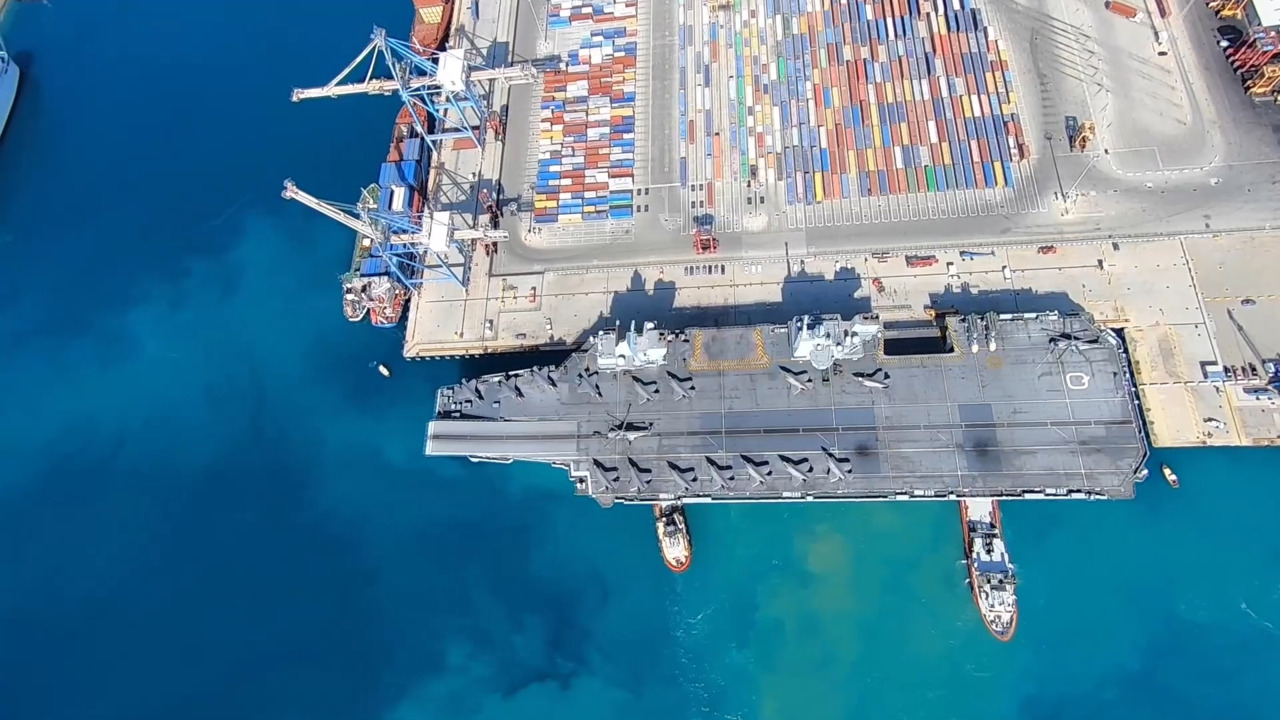
As world naval policeman: HMS Queen Elizabeth aircraft carrier docked in Cyprus (where the UK has two military bases)

Its findings kickstarted London’s quest to acquire world-leading aircraft carriers, which culminated with the birth of HMS Queen Elizabeth and HMS Prince of Wales.

Britain’s explicit objective, directly inspired by the US Empire’s dependence on carriers to belligerently project its diplomatic, economic, military and political interests abroad, was to recover London’s role as world police officer, and audaciously assert herself overseas: 

In the post-Cold War world, we must be prepared to go to the crisis, rather than have the crisis come to us. So we plan to buy two new larger aircraft carriers to project power more flexibly around the world…

This will give us a fully independent ability to deploy a powerful combat force to potential trouble spots without waiting for basing agreements on other countries’ territory. We will…be poised in international waters and most effectively back up diplomacy with the threat of force.”

Blair’s reverie appeared to finally come to pass in May 2021, when HMS Queen Elizabeth set off on a grand tour of the world’s oceans, escorted by a vast carrier strike group.

Over the next six months, the vessel engaged in a large number of widely-publicised exercises with foreign navies, including NATO allies, and docked in dozens of countries. Press coverage was universally fawning.

Yet, in November, as the excursion was nearing its end, an F-35 fighter launched from the carrier unceremoniously crashed

The F-35’s myriad issues were by that point well-established. The jet, which has cost US taxpayers close to $2 trillion, entered into active service in 2006 while still under development. It quickly gained a reputation for hazardous unreliability.

In 2015, a Pentagon report acknowledged its severe structural issues, limited service life and low flight-time capacity.

Two years later, the Department of Defense quietly admitted the US Joint Program Office had been secretly recategorising F-35 failure incidents to make the plane appear safe to fly. 

Despite this, the HMS Queen Elizabeth and HMS Prince of Wales were specifically designed to transport the F-35, to the exclusion of all other fighter jets.

However, Britain has all along struggled to source usable F-35s, which produces the ludicrous situation of the two carriers almost invariably patrolling seas with few if any fighters aboard at all, therefore invalidating their entire raison d’être.

In November 2023, the Daily Telegraph dubbed these regular “jet-less” forays a “national embarrassment”.

‘Carrier Gap’

An even graver embarrassment, rarely discussed with any seriousness by the British media, is that the two aircraft carriers have been plagued with endless technical and mechanical issues as long as they’ve been in service.

Flooding, mid-operation breakdowns, onboard fires, and engine leaks are routine. Both vessels have spent
 considerably more time docked and under repair than at sea over their brief lifetimes. In 2020, an entire HMS Prince of Wales crew accommodation block collapsed, for reasons unclear.

As the elite US foreign policy journal National Interest acknowledged in March 2024, “the Royal Navy remains unable to adequately defend or operate” its two carriers “independently” – code for the Empire being consistently compelled to deploy its own naval and air assets to support the pair.

This is quite some failure, given British officials originally intended for the vessels to not only lead NATO exercises and deployments, but “slot into” US navy operations wherever and whenever necessary.

The Empire’s inability to outsource its hegemonic duties to Britain has created a critical “carrier gap”.

Despite maintaining an 11-strong fleet, Washington cannot deploy the vessels to every global flashpoint at once, grievously undermining her power and influence at a time of tremendous upheaval worldwide.

In a bitter irony, by encouraging and facilitating London’s emulation of its own flawed and outdated reliance on aircraft carriers, the US has inadvertently birthed yet another needy imperial dependent, further draining its already fatally overstretched military resources. 

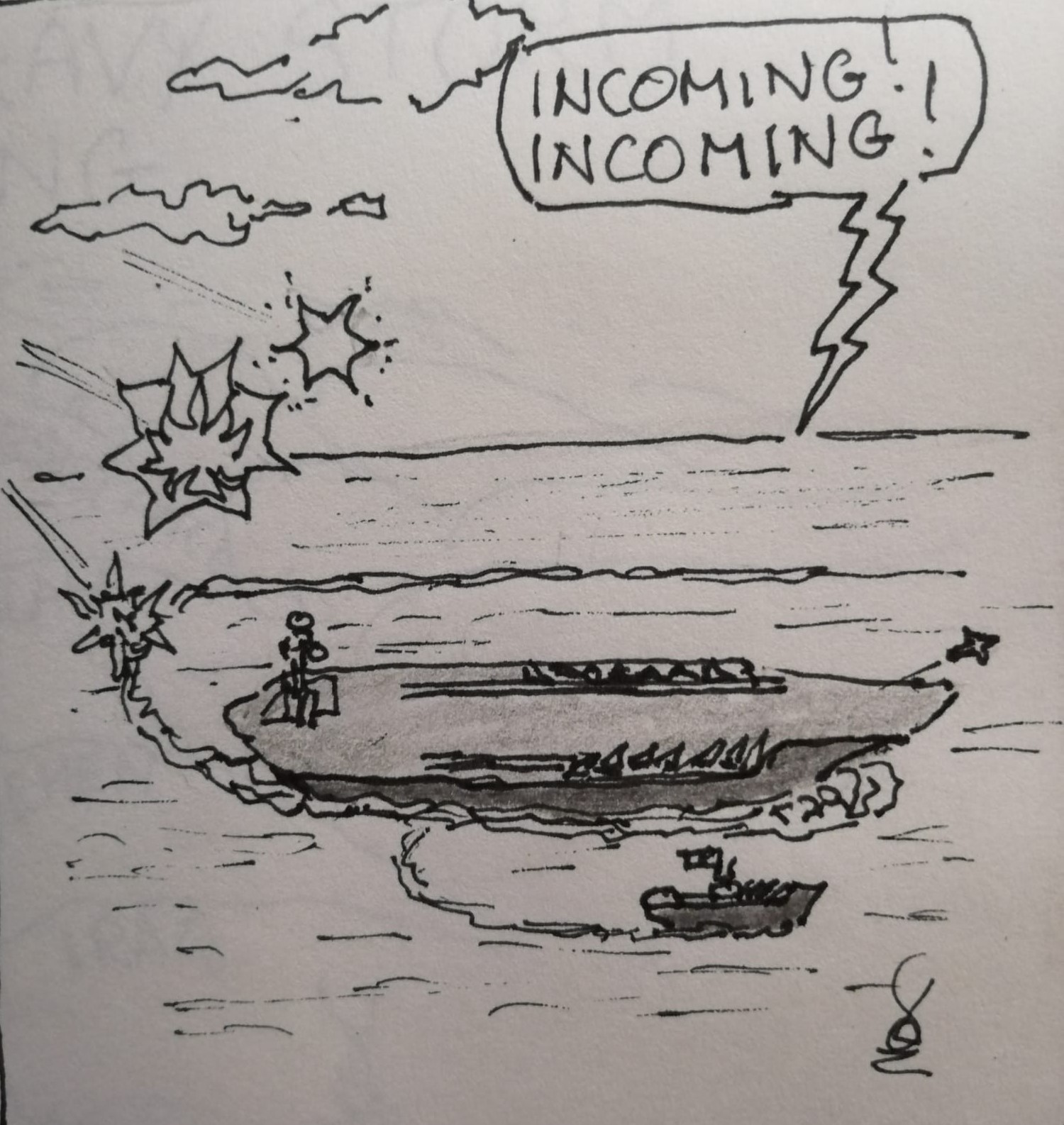
Frame 2 of a DB cartoon depicting US Navy aircraft carrier sailing to teach Ansar Allah (‘Houthis’) a lesson but instead getting chased out of the Arabian Sea by Yemeni missiles in June this year. (Image source: DB cartoons)

Several Royal Navy destroyers were originally part of abortive US-led Operation Prosperity Guardian, launched in late 2023 to smash Ansar Allah’s righteous anti-genocide Red Sea blockade.

Almost immediately, it became apparent the British lacked any ability to fire on land targets, therefore rendering their participation completely useless.

Subsequently, photos emerged of areas on Britain’s ships where land attack cruise missiles should’ve been situated. Instead, the spaces were occupied by humble treadmills, for use as on-board gyms.

It transpired that the appropriate weapons hadn’t been purchased, due to a lack of funds – the money having of course been spent instead on constructing barely operable aircraft carriers, which now face summary defenestration.

By investing incalculable time, energy, and money in pursuing the mythological greatness associated with carrier capability, Britain – just like the US Empire – now finds itself unable to meet modern warfare’s most basic challenges.

Meanwhile, its adversaries near and far have remorselessly innovated, equipping themselves for 21st century battle.

Days after The Times portended the impending death of London’s aircraft carriers, mainstream media became awash with reports of savage cutbacks in Britain’s military capabilities, in advance of a new strategic defence review.

Potentially a huge pile of scrap or to be dumped on an ally …

Five Royal Navy warships, all of which had lain disused due to staffing issues and structural decay for some time, were among the first announced “casualties”. What if anything will replace these losses isn’t certain, although it likely won’t be an aircraft carrier.

End.

Source: https://english.almayadeen.net/articles/analysis/collapsing-empire–rip-royal-navy