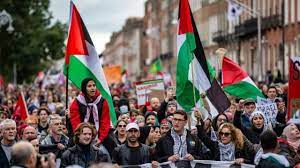
Diarmuid Breatnach
(Reading time: 8 mins.)
Demonstrations, like many organised activities, require a certain discipline: time and place set, conduct along the way, speakers and time allocated, dispersing afterwards. But just as discipline helps avoid dangers, its imposition also bring dangers.
I’ve been one of the organisers, or a steward on a number of public events over the years but more often a participant without any particular role.
Once, in London as a steward I was called “a State agent” as I moved to prevent a couple of people leading others out of an Irish demonstration to attack some British fascists and Loyalists who were chanting against us.
For us, the main objective was to hold an Irish solidarity demonstration in London from its start to its finish without giving the London Metropolitan Police and Special Branch the opportunity to disrupt it.1 Attacking fascist jeerers was secondary to our objective on that occasion.
And if those guys really wanted to attack fascists, they should have been travelling parallel to the march (as the Red Action group often did, for example) instead of inside the march body. Then they could have attacked the fascists without any disruption of the march.
I have also been a party on a broad antifascist mobilisation to a refusal to organisers’ direction to march away from the fascists, instead heading towards them with others.2 In those cases the organisers were, in effect, colluding with the State.
PALESTINE SOLIDARITY IN IRELAND
The main organisation for Palestine solidarity in Ireland for decades has been and continues to be the Ireland Palestine Solidarity Campaign. Its steering group or executive committee is entirely unpaid and works with energy and determination over the years and at times more intensively.
Those intensive times have been with us again since last month in the horrific genocidal Zionist bombing of Gaza and the murderous ground attacks in the West Bank and the IPSC activists have organised large – sometimes huge – marches of solidarity in Dublin every week.
These have been combined with other events such as rallies, concerts and public meetings in the city and marches, rallies and pickets elsewhere to the south, the west and the north of the country.
No organisation however is perfect or right all the time and there are a number of areas and occasions that deserve constructive criticism for improvement.
I do believe that the cancelation of a Palestine solidarity march scheduled for 25th November was a serious error tactically and strategically.

In terms of strategy we must strive as far as is possible not to give ground in the public arena to fascists and other racists since as we vacate ground, they step forward to occupy it. To move the rallying point from the Garden of Remembrance3 made sense but the cancellation not at all.
Tactically, the absence of a Palestine solidarity march that weekend broke the momentum of large public Palestinian solidarity events occurring at least weekly throughout the capital city.4
WHICH SLOGAN?
The IPSC now calls for the expulsion of the Israeli Ambassador but earlier on in October it refrained from doing so. That was a mistake but what was worse was the attempt to influence others also not to do so, for example with regard to speakers from their platform.
During that period the presence of non-stop chant-leaders shouting the approved slogans, one after another, particularly near groups who might chant for the expulsion of the Ambassador seemed more than a coincidence.
It is good to hear now the ubiquitous “Israeli Ambassador – Out, out, out!” from the IPSC slogan-callers and, though perhaps not the IPSC’s choice, may the one stating that “There is only one solution – Intifada revolution!” be accepted in toleration.
WHICH FLAGS?
At the recent much-diminished Palestine solidarity march in Dublin5 – the first since the cancellation – I witnessed a man and woman acting for the IPSC organisers, they said, approaching a person with a PLFP6 flag, to ask not to fly any flag other than the Palestinian national one.
They were polite and not in any way intimidating; their manner was not the problem but the content of their message was.

There are issues where the IPSC should be giving a lead and are of course doing so but just as there are some where they should but are not, this is one where they seem to be attempting to impose a discipline and uniformity that is both unnecessary and unhealthy.
There are organisations that send sacks of their group’s flags and placards to demonstrations to be carried by random participants, swamping the event to make it appear as though their organisation is bigger and more prevalent than is the case, a practice I detest.
It is not as though people are flooding the demonstration with PFLP flags or, indeed, Irish Tricolours and Starry Ploughs, though it seemed that they were not as worried about the latter two.
There are people who support different organisations in Palestine and why should it be a problem for them to fly the flag of the organisation of their choice?
Why should it be a problem for people to realise that there are many Palestinian organisations of struggle in opposition to the one of collusion?
In a demonstration for Irish independence would we demand that only the Tricolour7 could be flown? Or for Catalan independence, only accepting the display of the Senyera?8
WHAT KIND OF PALESTINIAN STATE?
The IPSC is formally neutral on the issue of what kind of Palestinian state to which to aspire, which in some respects is fair enough since that is a matter for the people there to choose. But it is not OK to be neutral on whether the ‘two-state solution’ (sic) is acceptable, never mind viable.
Yes, we know that the imperialists of the EU, USA and UK support that ‘solution’. We know that their allies do, including the Irish Government. We also know that the collaborationist Palestinian organisation9 and most Arab states’ leaders also support that arrangement.
BUT
The two-state solution is one where the settler-occupier gets to keep what he robbed and murdered to get while the indigenous receives less than 40% of her original land and the worst of it, with the least water and, furthermore, under the constant guns of the robbers and murderers.
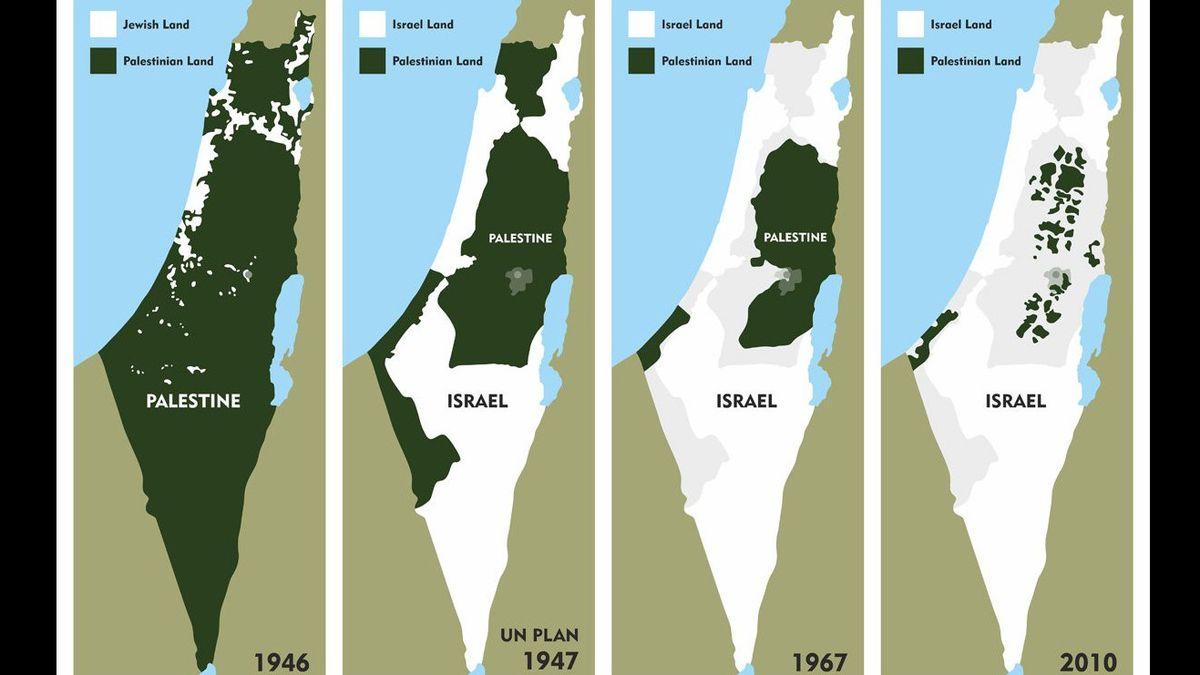
MOST PALESTINIANS POLLED IN PALESTINE REJECT IT.10 And you can guarantee, without polling, that the vast majority of the exiled Palestinian refugees reject it too, since it would close for ever any hope for a return to Palestine for most of them.
The IPSC supports the slogan “From the River to the Sea, Palestine will be free!” This is, one might say, an implicit rejection of the two-state proposal since it must mean a free Palestine from the River Jordan to the Mediterranean and Red Seas. But how many understand that?
In a world where imperialism is the main support of the European Zionist colonial (and genocidal) project, it is essential that the mass of people understand for what it is that the Palestinians are fighting and what we support, as distinct from what the imperialists want to foist upon them.
PALESTINIAN POLITICAL PRISONERS
In the struggle for independence and for social justice, right across the world, many people are taken by those in power and put in jail. Solidarity with those prisoners, objections to their conditions and demands for their release have been an important part of those struggles.
This has been well-illustrated in Irish history too and in Britain, the First International (Workingmen’s Association) founded by Marx, Engels and others campaigned in solidarity with the Fenians incarcerated in English jails.
The “blanket protests” and in particular the hunger strikes in colonial jails in Ireland a little over 40 years ago drew huge attention and wide support not only in Ireland but across the world.
All the Palestinian prisoners in Israeli jails are there as a result of the European Zionist occupation of Palestine and the natural resistance of the indigenous people.
When Hamas recently obtained the release of 180 prisoners from Israeli jails, most were women and children. Furthermore, many had not even been convicted in the Israeli military courts but were held in “administrative detention”, in effect, interned without trial.

Though the IPSC has highlighted the number of children in Israeli jails and those in administrative detention, it does not have a position of overall solidarity with the rest of the 100,000 Palestinian prisoners nor in calling for their blanket release.
The organisation has however covered the release of prisoners in the recent exchange and shared reports of the brutality inflicted upon many, particularly after the Hamas offensive on 7th October. One must hope that this process will be extended to solidarity with all the Palestinian prisoners.
Solidarity with political prisoners does not necessarily imply support for their previous actions or for their organisations; what it does is to recognise that all liberation struggles produce martyrs and prisoners due to the repression of resistance to colonialism and occupation.
The existence of the prisoners is a direct result of the colonial occupation and if we oppose that occupation we should stand in solidarity with the prisoners, agitate around their conditions and demand their freedom, along with the departure of the colonists.
IN CONCLUSION
All organisations and movements need to instil some discipline around their activities. All also commit errors from time to time and it is crucial to learn from those in order to improve their effectiveness and to bring nearer the objectives for which they strive.
In their attempt to mediate between the different pressures upon them it is necessary to distinguish between what the dominant system wants or would like and what the movement’s supporters wish, between what is most welcome and what is most necessary.
The IPSC is an important and valuable organisation in Ireland doing crucial work in the area of solidarity with the Palestinians and, in doing so, contributing to an atmosphere of internationalist solidarity which is essential for the advance of humanity.
While I have not for some years been part of its Dublin organisation I will of course continue to support its marches, rallies and pickets as I have been doing for decades, both in promotion and in attendance.
End.
FOOTNOTES
1The police used attacks by fascists and resistance to them on Irish solidarity marches as opportunities to disrupt the march and to arrest march participants.
2The Communist Party of Great Britain despite the history of many of its members in the 1930s, did not wish to physically attack fascists from the late 1960s and tried to steer demonstrations away from direct confrontation, often leading them away from where the fascists were gathered.
3That place is less than 100 metres from the scene of the attack on the children and the march began there the participants would have to pass by the site.
4It also left exposed to attack any small group that went ahead with Palestine solidarity or anti-racism pickets, as some did, in the city centre.
52nd December 2023.
6Popular Front for the Liberation of Palestine.
7There is nothing wrong with the Tricolour but some Republicans and socialists prefer the Starry Plough, signifying a more socialist republicanism and also a separation from the State, which has appropriated the Tricolour.
8The original flag of Catalan independence, red stripes on a yellow field — but on Catalan demonstrations the Estelada Blava, including a blue triangle surrounding a white star, for left Republicans, is much more common and the Vermella, with a red star on yellow instead of the white one on blue is quite common also, especially among revolutionary socialists.
9The Al Fatah-dominated PLO from which a number of Palestinian resistance organisations are excluded. They also dominate the Palestinian Authority which has not held elections since Hamas won them in 2008.
10https://www.washingtoninstitute.org/policy-analysis/new-polling-and-legacy-oslo-accords
SOURCES
Cancellation of march: https://www.irishexaminer.com/news/arid-41276554.html
Polls on two-state ‘solution’: https://www.washingtoninstitute.org/policy-analysis/new-polling-and-legacy-oslo-accords
Israeli Palestinian prisoners: https://www.aljazeera.com/news/2023/11/24/who-were-the-palestinian-prisoners-israel-released-on-friday
 rebelbreeze