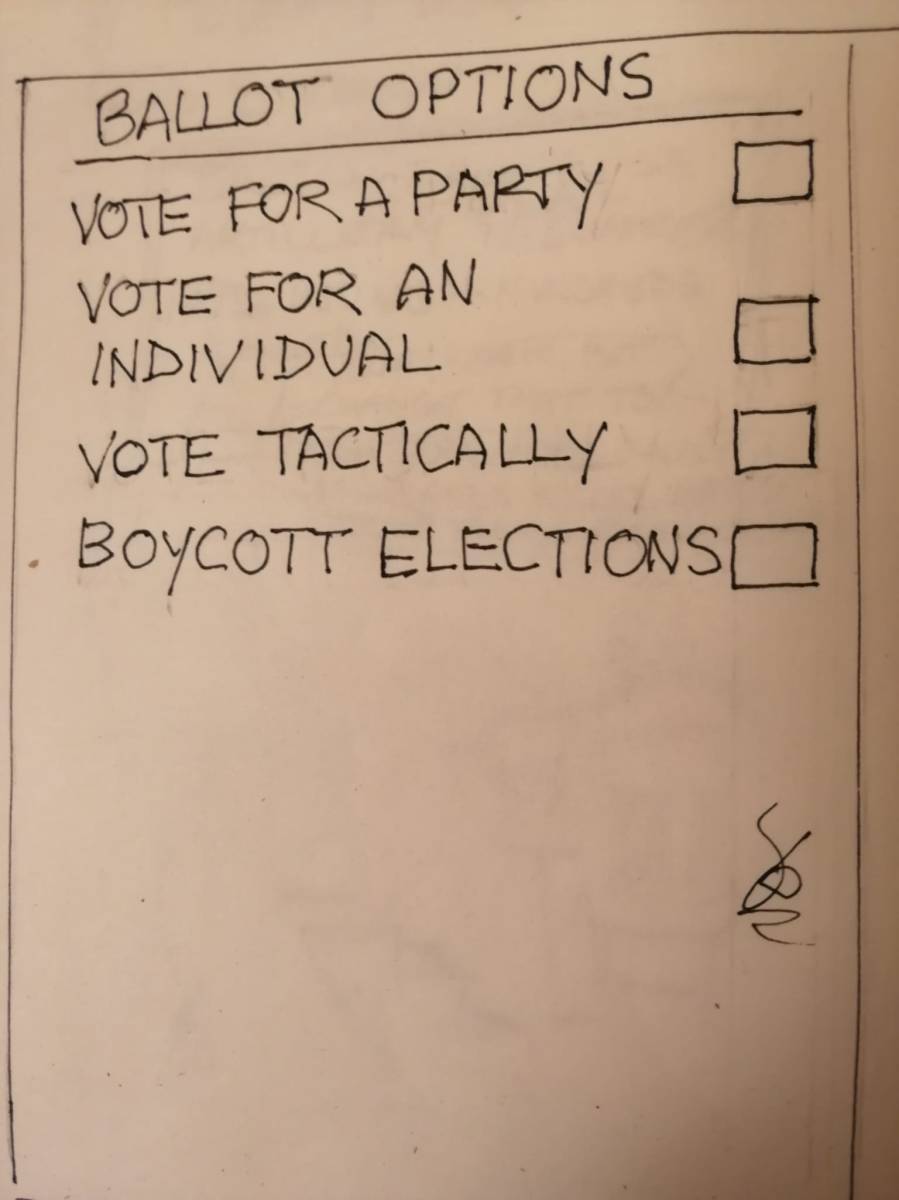
Diarmuid Breatnach
(Reading time: 7 mins.)
The elections for a government in the 26-County state are only days away now and, while many are advocating a vote for this or that party or candidate, some are opposed to voting at all.
ARGUMENTS AGAINST VOTING
An amusing take on abstention advises: Don’t vote – it only encourages them! Anarchists have long been opposed to voting in national elections and I recall a poster in Britain exhorting people to Vote for Guy Fawkes – the only man ever to enter Parliament with honest intentions. 1
Revolutionary marxists have also often called for a boycott of elections.
The position that they hold in common is that changing this or that party in government does not change the system and that it is that which is in need of change; as Connolly2 famously declared capitalist governments to be “committees of the rich to manage the affairs of the capitalist class.”
However, it is possible to hold that opinion but yet to vote – and even to advocate voting – in some circumstances. However among some Irish Republican circles there has been a trend maintaining that voting in these elections is a recognition or acceptance of their alleged legitimacy.
A massive spoiling of ballot papers is often advocated by those who wish to ensure that the boycott may not be interpreted as apathy among the electorate. The number of spoiled ballot papers is supposed to be recorded and the papers available for inspection.
ARGUMENTS FOR
Those arguing in favour of voting in elections come at the question from a variety of points, including that voting is a democratic right for which our ancestors fought; that if we fail to vote we have no right to complain about government actions (or inaction).
They may maintain that not voting for some parties is equivalent to voting in favour of their opponents; or that voting a particular party into power can be used to overturn undesired legislation or conversely to promote desired legislation or to put them in power so that they may be exposed.3
The reformists and social democrats (often presenting themselves as revolutionaries) advocate for reforming or at least controlling capitalism under a Left Government. Despite the impracticability of the latter in many historical experiments, the hopeful and deluded keep advocating it.
Then of course, there is the ‘Lesser Evil’ argument, which is probably the most seductive; we witnessed that during the Harris-Trump USA Presidency competition. The Greens in Europe even appealed to Stein of the USA Greens, running against Harris on an anti-Genocide ticket, to desist.4
The claim that we might as well use our votes to elect a ‘lesser evil’ government is seductive precisely when we feel that no other option is available, combined with fear of worse economic and social conditions to be imposed upon us by the ‘worse evil’ party or candidate.
To follow the ‘lesser evil’ road is not only to perpetuate the system in one form or another but also fail to recognise our potential strength as the producers of all wealth; to fail to strengthen our energies to break firstly the mental chains, then the physical ones; to make fundamental choices.
THE TACTICAL VARIANT
Some argue that although in general national elections don’t change the system, they can be used at times to effect a tactical change: show rejection of a specific government position or individual.
They sometimes argue in favour of voting to put a specific individual or group of individuals into parliament for tactical reasons.
Can it be of use to have a few individuals in the Irish parliament who will attack the government and ruling class in speeches? Or to put specific issues forward on which to expose the ruling elite? Or to ask questions to gather government information? I am sure that it can and has been at times.
Can it be useful to have a handful of individuals elected to the Irish parliament who are prepared to seek entry to prisons to talk to political prisoners? Or who will head an investigation into some kinds of abuses and publish the results? Such can be and has been of use at times.
The important thing is to ensure that the message we give is that useful though such people and positions may be at times, they are not the solution, which can only be the overthrow of the system and the establishment of a socialist system with power in the hands of the working people.
ELECTIONS IN A CAPITALIST DEMOCRACY
What are known as ‘democracies’ are states concentrated across ‘Western’ regions, i.e western Europe and its former colonies of the USA, Canada, Australia and New Zealand, with varying degrees of effect upon states on the African and Asian continents, along with ‘Latin America’.5
These are without exception, regardless of variety, systems of governing their working people without having to resort to wide-scale constant repression and suppression. For that project, the illusion of choice is essential, hence the regular elections and different political parties.
But the illusion of any fundamental choice is failing. Increasingly, governments in many European ‘democracies’ are becoming coalitions between a number of political parties and in Ireland, the main Government-Opposition parties for decades have exposed the reality by governing together.6
The effect of such exposure of the lack of real choice is impacting upon the consciousness of the populations concerned so that progressively less of them are willing to participate in the charade. In Ireland now more than one-third of the population do not vote.
This situation is of great concern to the ruling classes and to their intellectuals who are busy trying to devise schemes to offset the drift such as advocating voting from home, spectacles such as televised confrontations between competitors and ‘Citizenship’ programs in schools.
Clearly revolutionaries should not assist in any attempt to justify the system or to perpetuate the illusion of elections in capitalist ‘democracy’ being anything else than a periodic choice for slaves between the overseers employed by their masters.
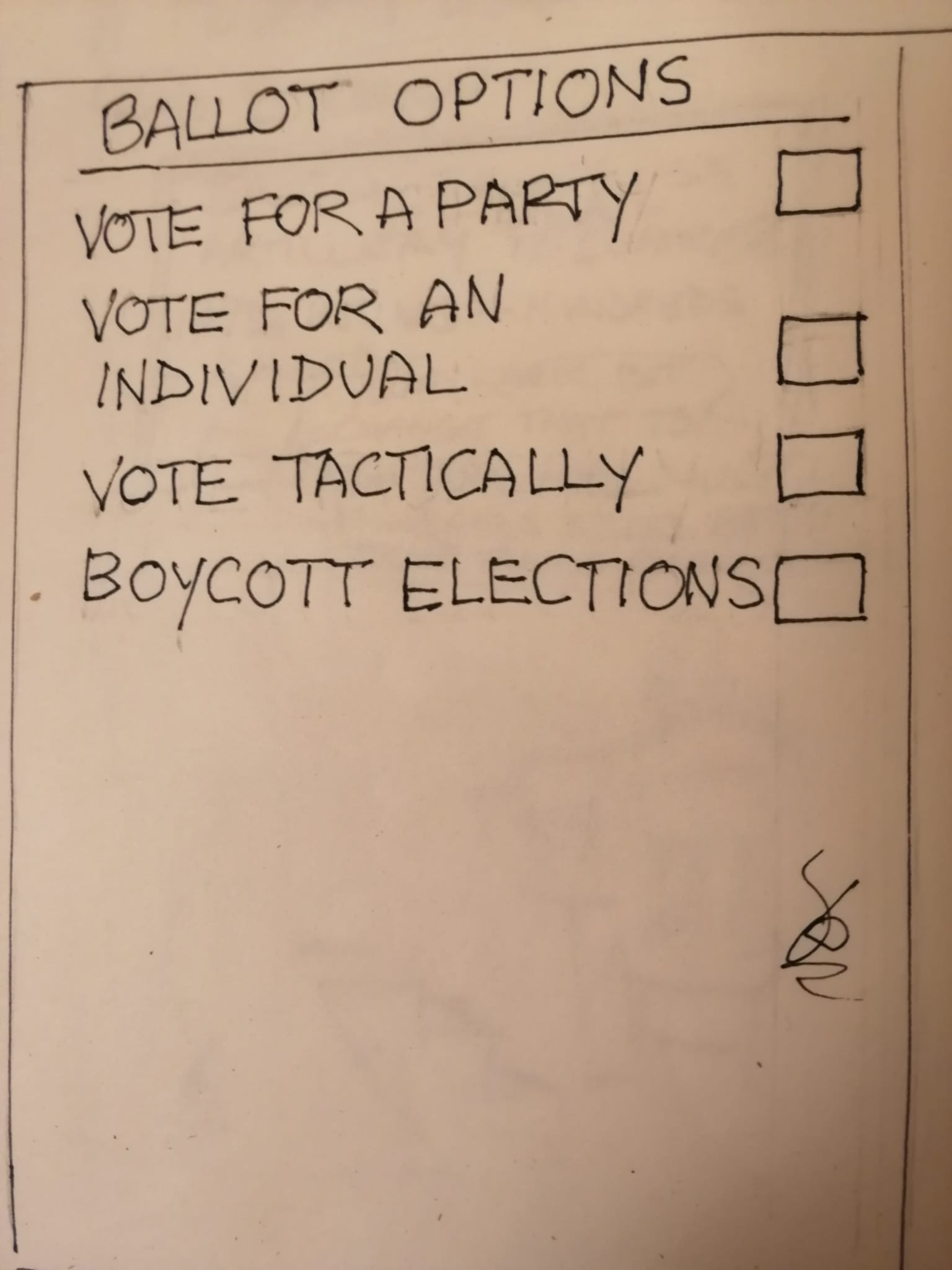
DOES IT MATTER ANYWAY?
The nub of the question as to whether to vote boils down to what we hope to achieve and its prospects. If there were a massive abstention from the polls then of course that would be seen as a huge vote of no confidence in the parties standing and perhaps in the system itself – but from what perspective?
From the Right? From the Left? From apathy? In any case at the moment that looks like a moot question since there’s a likelihood of a turnout of around 60% of the registered voters.7
Will abstention make people more politically aware or conversely will participation in the elections turn people away from the possibilities of organising on the ground and ultimately of revolution? Perhaps for some – but overall, I think not many in either case, not on a longer-term basis.
From a revolutionary point of view, does it matter whether people vote or not? Or even sometimes who they vote for? Surely what matters is organising and supporting the movement for fundamental progressive change? Can that be done by people who vote as well as by those who don’t?
I’d say that is at least as likely.
During capitalist state elections the best we can do, I think, is to point out the inadequacy of the choices presented to us and to advocate stronger and more militant organisation as an alternative to the calls to vote for one party or another.
Whatever party or individual gets elected to Leinster House, the principal struggles remain: for a free united independent Ireland, for a socialist system, against the imperialist world system, against environmental destruction. It is on that we need to concentrate.
The newly-elected management committee of the capitalist class should be savaged mercilessly for its inevitably broken promises and its continuing attacks upon the economic and social conditions of the working people, and on Irish national neutrality.
Most of all, we need to improve our organising, strengthen our ranks and find ways to strike blows against the system to win victories in our march towards the overthrow of the neo-liberal and neo-colonial Gombeen ruling class and its foreign masters.
End.
1While amusing as a caption, given that Guido Fawkes plotted to blow up the English Parliament on 5th November 1605, upholding Guido Fawkes as some kind of historical hero is problematic, as he was a militant Catholic and the date of capture, Guy Fawkes’ Day, was a regular occasion for the exhibition of anti-Catholic prejudice even into the 20th Century in Protestant Britain, which more often than not, manifested itself as anti-Irish racism.
2James Connolly (1868-1916), revolutionary socialist activist, theoretician, journalist, writer and trade unionist, leading participant in the 1916 Irish Rising for which he was sentenced to death and shot by British firing squad.
3Lenin famously advocated voting the British Labour Party into government for the first time to ensure their exposure, supporting them “as a rope supports a hanging man”, advice misused by social democrats and others on the electoral Left and about which revolutionaries have argued ever since.
4https://www.theguardian.com/us-news/2024/nov/01/european-greens-ask-jill-stein-to-stand-down-and-endorse-kamala-harris
5And of Eastern Europe.
6Throughout the existence of the Irish State, the Fianna Fáil party has been the longest in government, with Fine Gael second, both socially conservative parties with strong loyal electoral bases. However now they are governing in coalition, along with the Greens. It is worth noting that there has not been a government of absolute majority by any party in the Irish state since 1981, when Irish Republicans stood as H-Block (e.g. hunger strike) candidates and two were elected with another having a near miss.
7Despite a trend of dropping percentages of the potential voters actually participating, in 2020 the turnout was a little over 62%.
 rebelbreeze