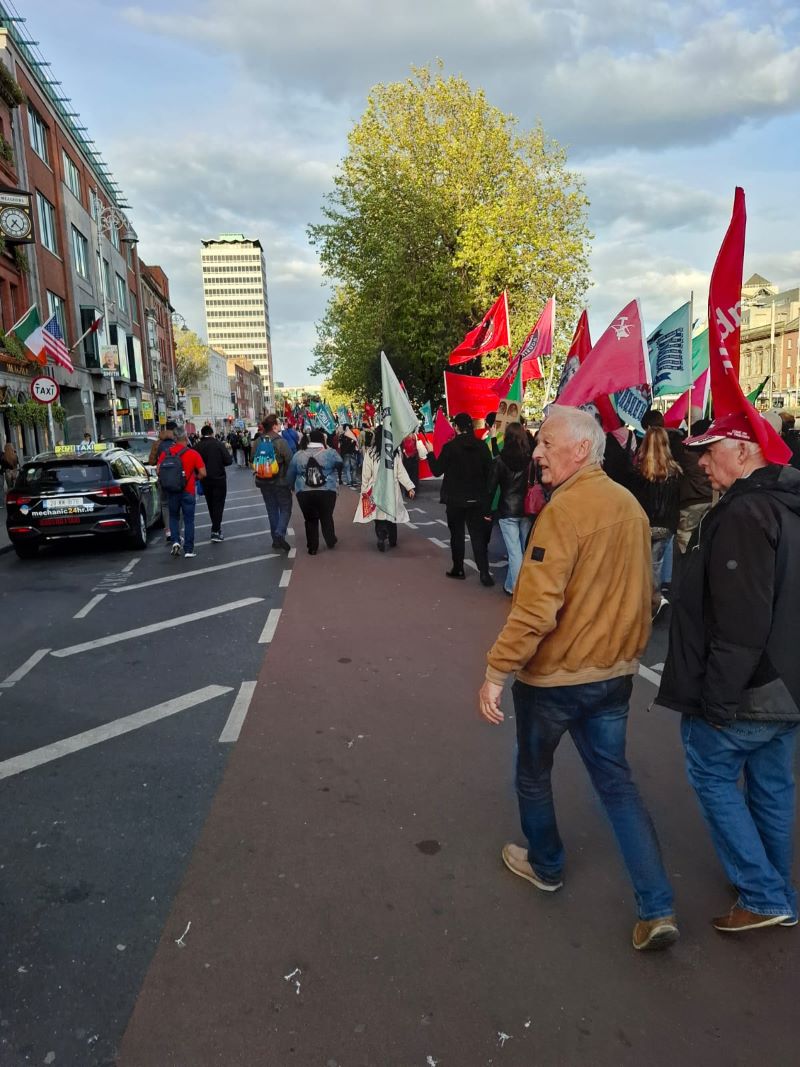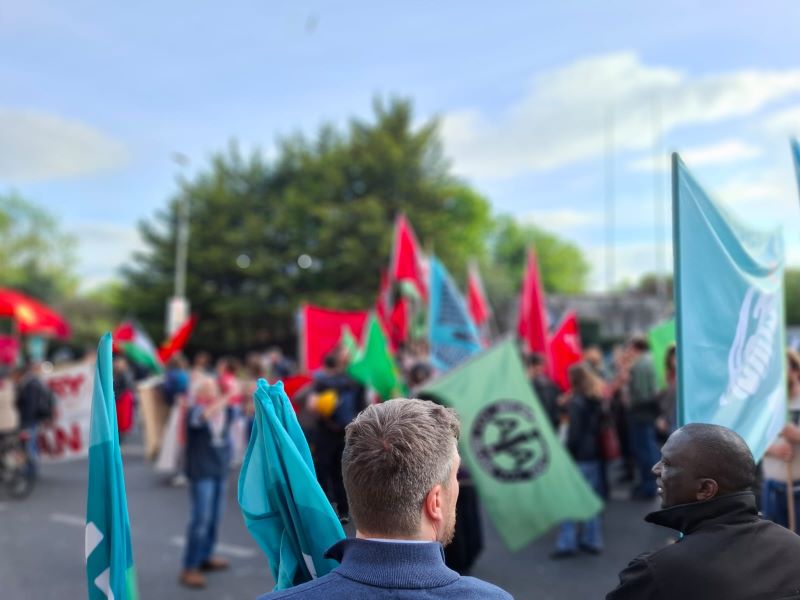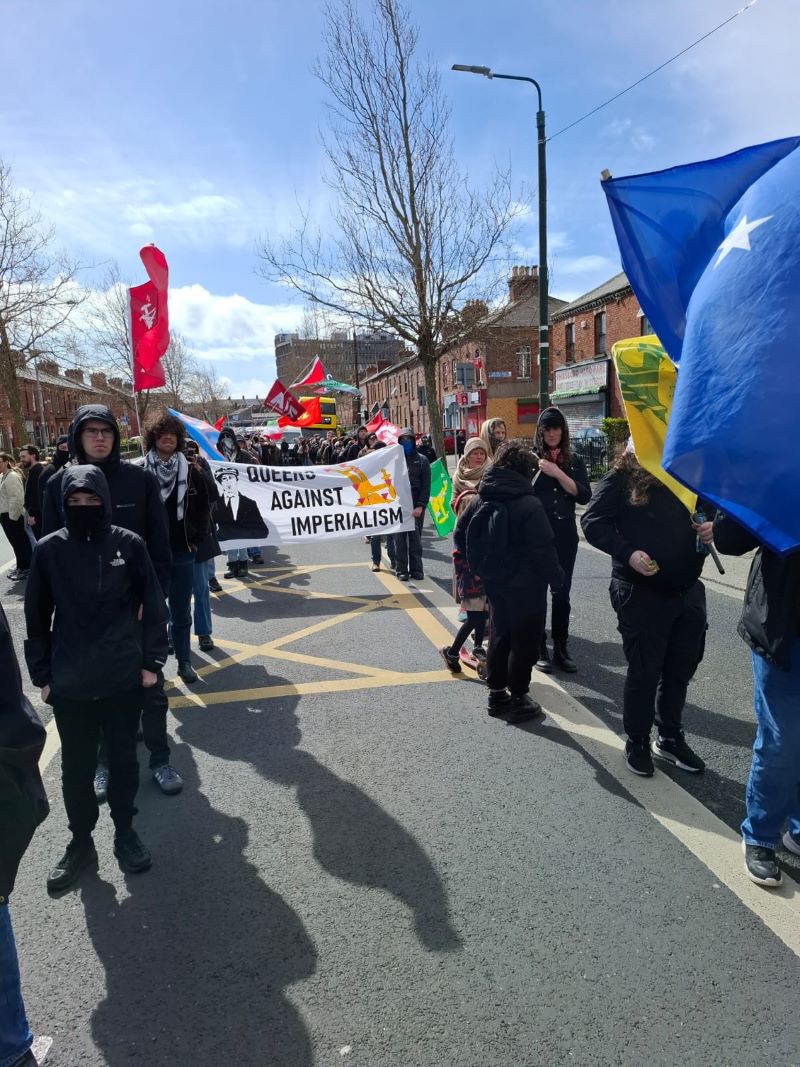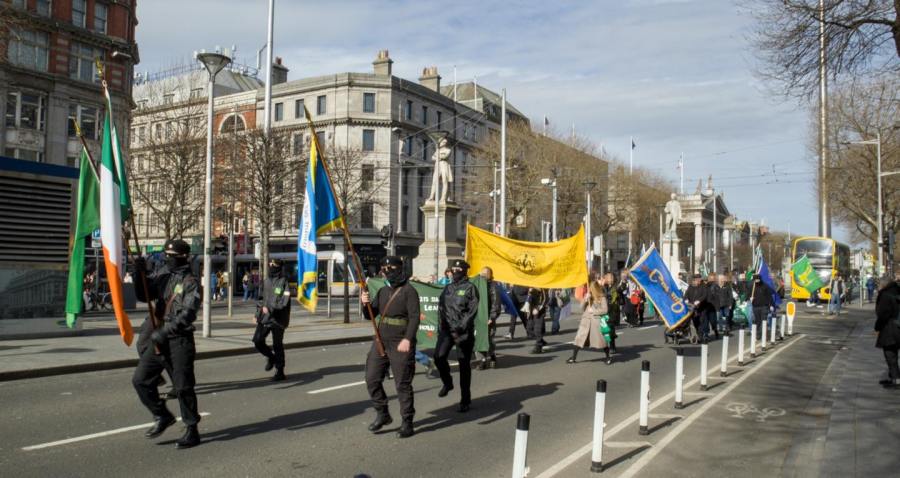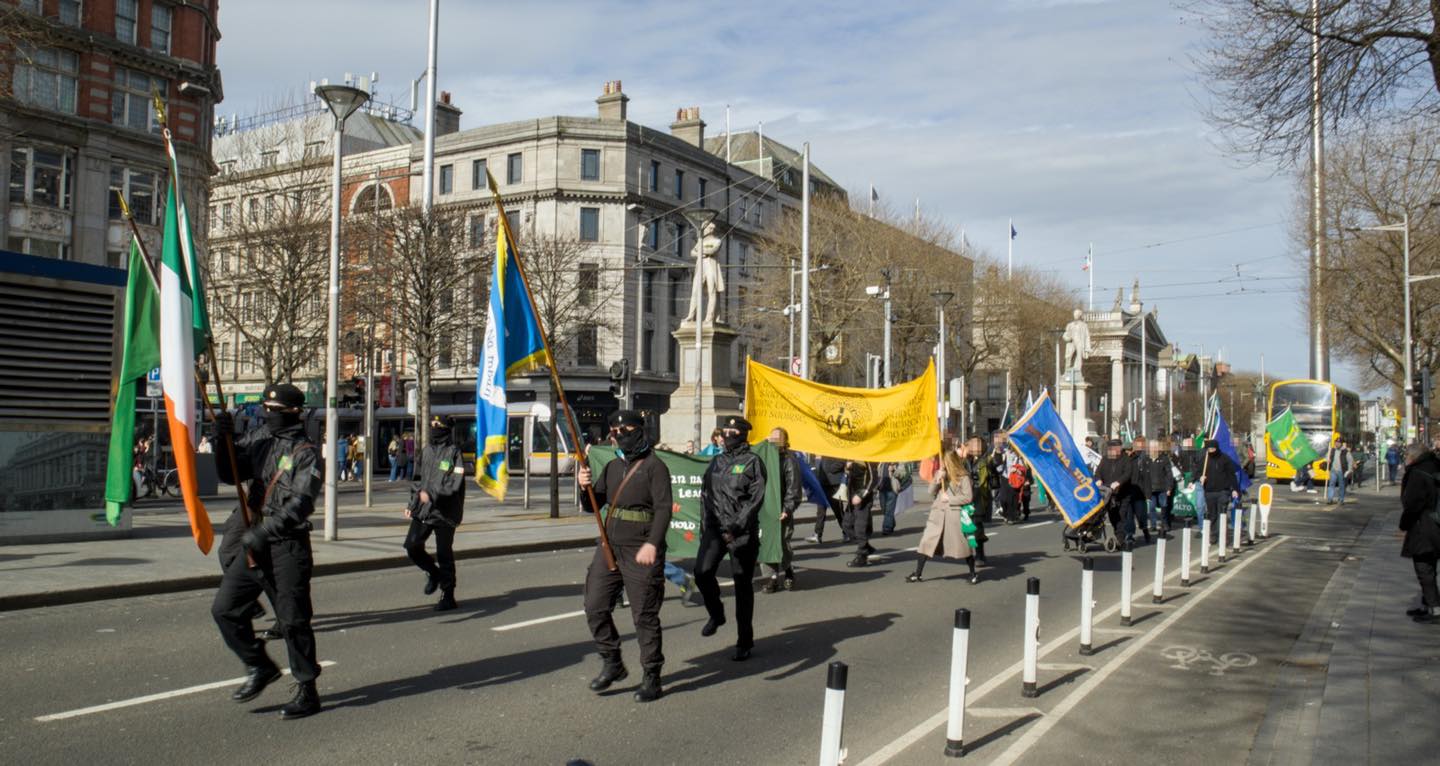
Composed of Socialist Republican, Communist and Anarchist contingents, along with independent activists of various tendencies, a broad Revolutionary Bloc marched among other groups and individuals in the annual May Day march in Dublin on May 1st.
Eden Quay, as the march turns off O’Connell Street, heading for Beresford Square, by the tall Liberty Hall building in the left background. (Photo: R.Breeze)
At intervals the banners of the Communist Party of Ireland, the Independent Workers’ Union and flags of the Anti-Imperialist Action contingents could be seen and a number of flags denoting specific groups or campaigns were on show but the Bloc was mainly identifiable by its slogans.
Led in call-and-answer almost non-stop from departure point at the Garden of Remembrance to Beresford Place in front of Liberty Hall,1 slogans called on workers to strike work and fight, to oust imperialist states and NATO from Ireland, for resistance unity, revolution and a socialist republic.
Section of the Revolutionary Bloc, centre image. (Photo: R.Breeze)
It was notable that an Irish Tricolour and a number of Starry Plough flags were visible among the Bloc and indeed one of the chants was against the appropriation of the Tricolour by ‘traitors’. They also called for funding for education and not for big corporations and for a hotel-free city centre.
At least one of the flags was of the Revolutionary Housing League and the march passed an empty building appropriated three years earlier by the RHL who were then evicted by a Garda force of 100 with helicopter and armed unit as backup. The building remains empty to this day.
People in Dublin stopped in the early Friday evening to watch and in the northern reach of O’Connell Street an elderly man stepped off the pavement to march along with the Bloc, though in silence while further along, two teenage girls in school uniform joined the Bloc also.
The Priory Market, Tallaght, Dublin prior to opening (Photo: Supplied by supporter)
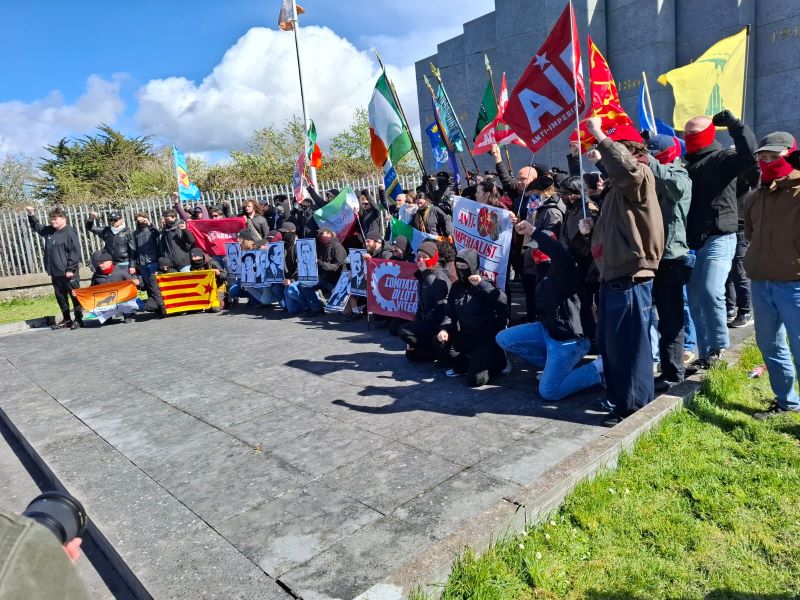
Led by a long piper, the various contingents marched into Beresford Place, where a stage had been set up in front of the SIPTU2 headquarters building but most of the Revolutionary Bloc marched past to congregate for a group photo around the nearby monument to James Connolly.
Using the Bloc’s megaphone, one of the group then sang the Be Moderate song (also known as We Only Want the Earth) composed by James Connolly3 and, as the singer informed his listeners, published in the Songs of Freedom songbook by Connolly in New York in 1907.
As most of the Bloc dispersed, speeches were being made from the nearby stage and a group of mostly younger people from Turkey were assembling at the Connolly Monument also for a group photo.
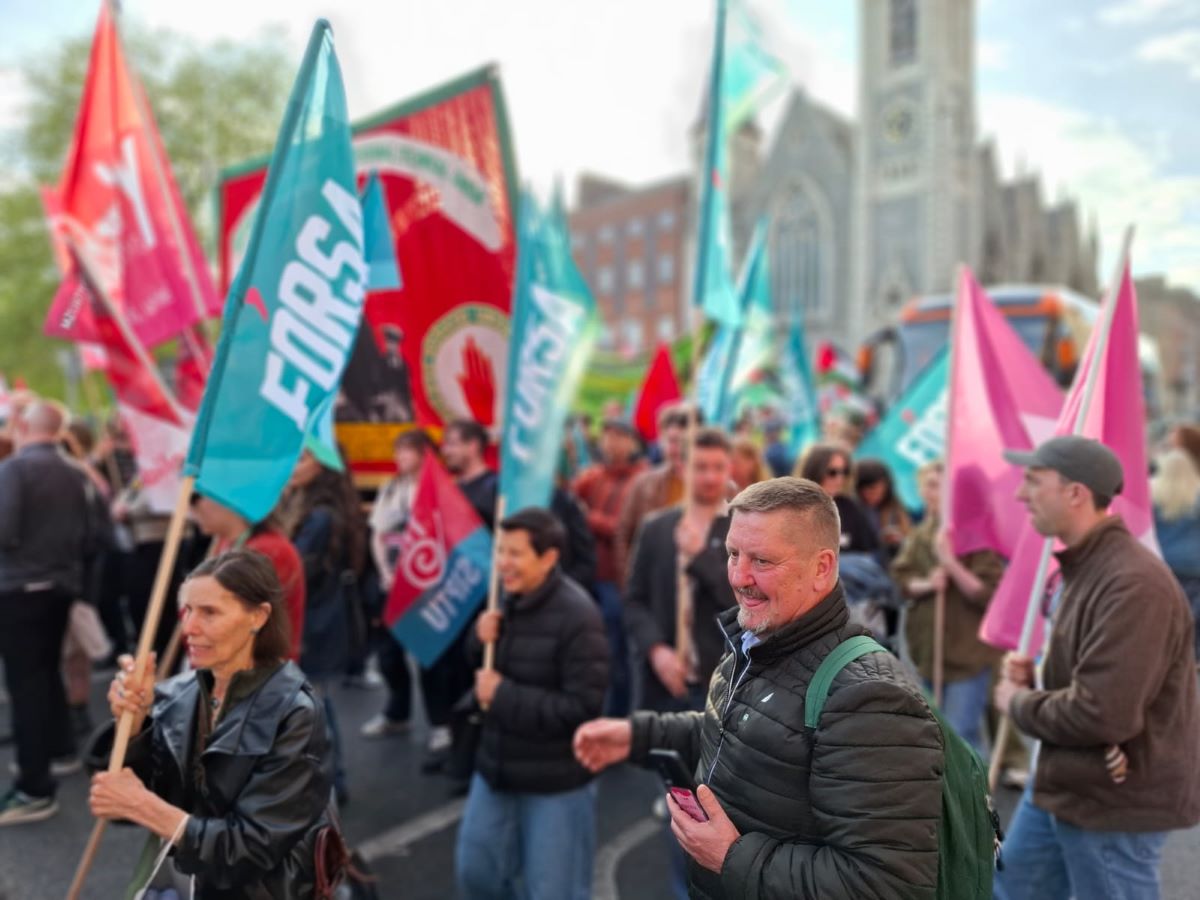
The May Day march and rally in Dublin is traditionally organised by the Dublin Council of Trade Unions. However the participation of union banners was low in numbers and those present mostly of the FÓRSA union.
Section of the march showing FORSA union flags being carried. (Photo: R.Breeze)
Distinct from other European states, the foremost struggle in Ireland for centuries has been on the national question which has entailed less development in the forces devoted to socialism, so that in general May Day does not bring out the numbers one can see in the capitals of the EU and UK.
However, Ireland’s long history of resistance to colonial occupation has entailed a greater history of insurrection than most European states and it has also produced a remarkable number of leaders of labour struggles among the Irish diaspora in Britain, the USA and Australia.
End.
Note: If you found this article of interest, why not register with Rebel Breeze for free, so that you will be notified by email of subsequent articles. You can de-register any time you wish.
FOOTNOTES
1A highly-visible very tall building on the site of the original Liberty Hall, HQ of the IT&GWU, now of SIPTU.
2One of the largest (possibly the largest) trade unions in Ireland, formed by amalgamation of other unions on the base of the Irish Transport and General Workers union, of which James Connolly had been an officer and for a period, its overall leader.
3James Connolly ( – 12 May 1916), born and raised in the Cowgate area of Edinburgh, revolutionary socialist activist-theoretician and Irish Republican, author, journalist, historian, union organiser, executed by the British occupation along with another 15 prominent insurrectionists of the East Rising.
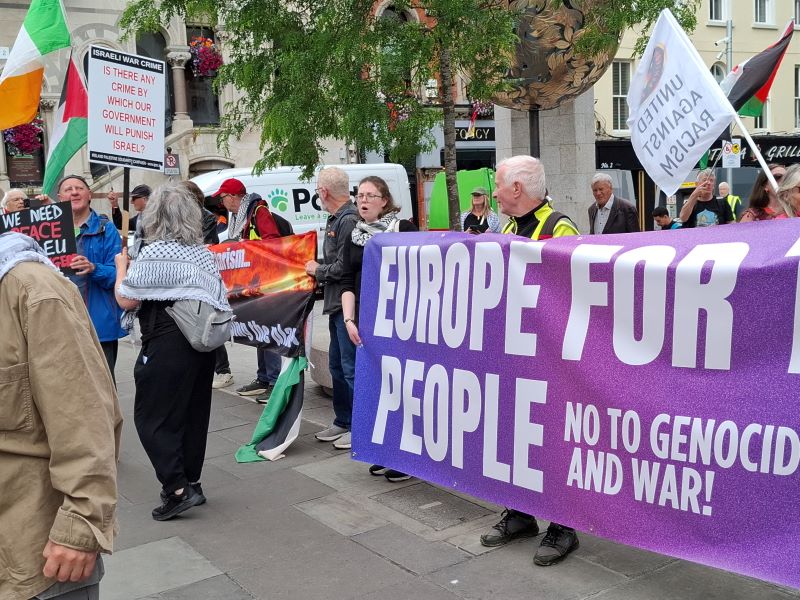
Last Saturday (26th April) in Dublin a march took place in support of Irish neutrality and in opposition to Irish Government attempts to remove an obstacle to joining some future imperialist military alliance.
The march was organised by the Irish Anti-War Movement, an organisation that flickers into life on occasion as desired by the leaders of the People Before Profit organisation, although some of its activists are not members of PBP. And not all marching by any means were members of either.
I have a regular commitment on Saturdays elsewhere until 1.30 and it’s at least 1.45 by the time I’m free. I caught up with the march as it began to wheel around Trinity College. At its destination1 I looked around to see how many flags were representative of the Irish nation.
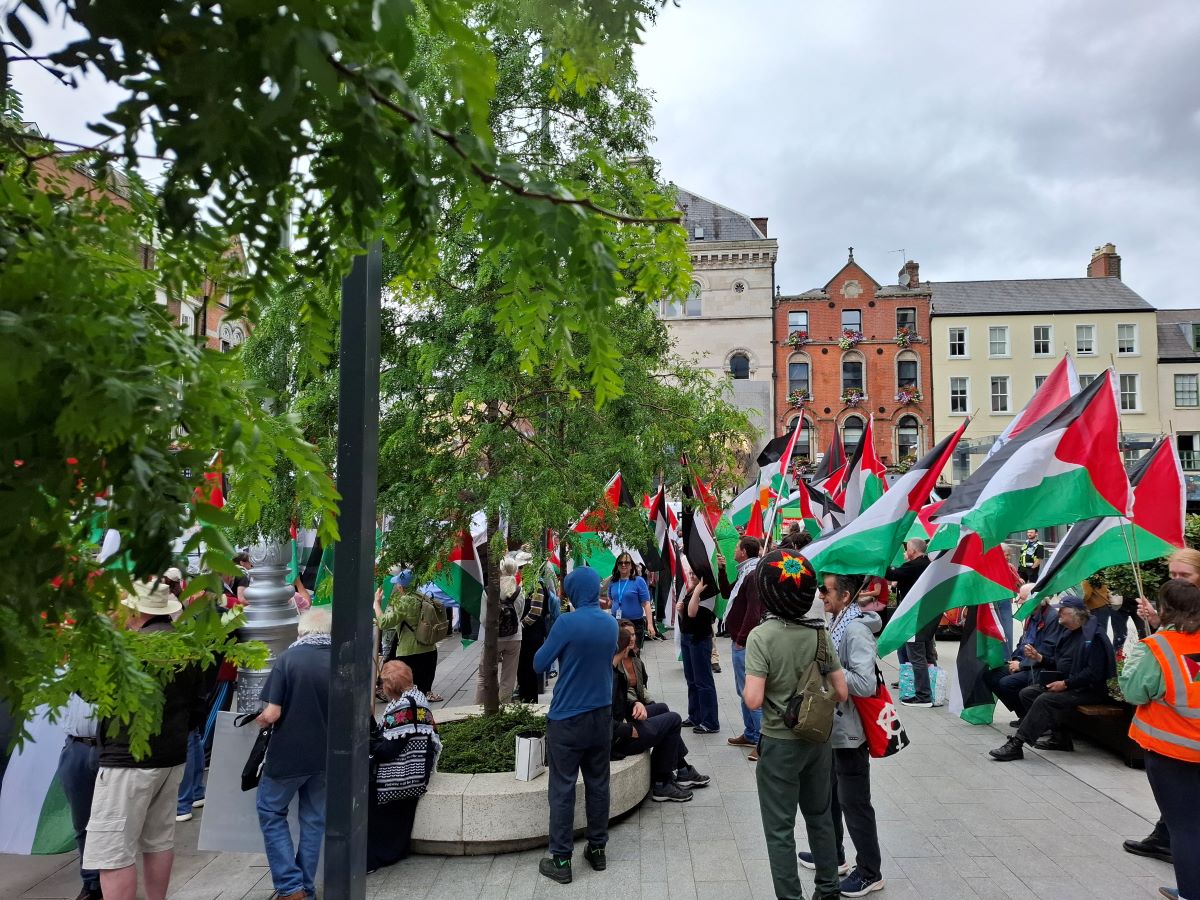
I counted three Irish Tricolours and one other which was also combined with a Palestinian flag. I was carrying a Starry Plough flag (the original version of gold design on a green background).2 A total of four Irish national flags in a march of several hundred amidst lots of Palestinian flags.
The stupidity is almost beyond belief. The march was not organised primarily to express solidarity with Palestine but to call for Irish neutrality and for remaining outside NATO. However, one-sixth of the nation is inside NATO without even the pretence of democratic agreement.
The other five-sixths are what constitutes the Irish State, the one upon which the march was focused, to save the Triple Lock,3 to prevent the Gombeen Government from driving us into NATO or some other military alliance. But apparently to be done without symbolising the Irish nation.
Again, the stupidity stretches credulity. We have passed through a number of years in which the Far-Right and outright fascists, in order to disguise themselves as Irish nationalists, have appropriated primarily the Tricolour but also the Irish Republic flag which was created in 1916.
A situation was permitted to arise whereby to see many Irish Tricolours being carried was to suspect a far-Right event — and usually to have that suspicion confirmed as accurate. This occurred because the broad anti-fascist anti-racist movement in general allowed it to happen.4
The fault is primarily that of the Irish socialist Left and their dislike or distrust of nationalism and their association of the Tricolour with the Irish State. They fail to recognise it as a democratic, anti-colonial, anti-imperialist republican symbol of national sovereignty and resistance.
The design was presented to the Young Ireland movement by revolutionary women in Paris in 1848, the ‘Year of Revolutions’ in Europe. Its colours represent national revolutionary unity (White) between the indigenous Irish (Green) and the descendants of colonial settlers (Orange).
Unlike its presence among racist and homophobic gatherings, the Tricolour was completely appropriate for a march in support of Irish neutrality. But somehow this did not occur to the organisers of the march nor, apparently, to most of the participants.
There would be no need to exclude flags representing the socialist or anarchist movements nor indeed of struggles in other countries but on this march they should have been outnumbered by Irish Tricolour and Starry Plough flags.
The Republican movement, for all its faults, would not have failed in this representation. Sins of omission in politics can be as bad as those of commission and the almost absence of Tricolours on this march epitomises how badly some of the movement in defence of neutrality is being led.
The general absence of the Republican movement from this march, whatever their reasons, is to my mind another part of this problem.
End.
Note: If you found this article of interest, why not register with Rebel Breeze for free, so that you will be notified by email of subsequent articles. You can de-register any time you wish.
1Molesworth Street, facing Leinster House, home of the parliament of the Irish State.
2Essentially the original design of the flag of the Irish Citizen Army, a workers’ defence militia during the 1913 Lockout which also fought in the 1916 Rising.
3A measure which does not permit the State to send more than 12 personnel abroad on a military mission unless with 1) a government decision, 2) a majority vote in the Irish Parliament and 3) a UN mandate. Recently leaders of the Coalition Goverment parties have been saying that a vote in the Parliament would not be necessary.
4This is not alone the fault of the PBP but also of the anarchists who did fight the fascists but also of the Republicans who, some notable attacks on the National Party aside, largely ignored the fascist and far-Right protests.
A call for unity of Irish Republicans in action to win Irish freedom and independence was made at a 1916 Rising commemoration in Dublin on Sunday, an event organised by the Anti-Imperialist Action Ireland organisation.
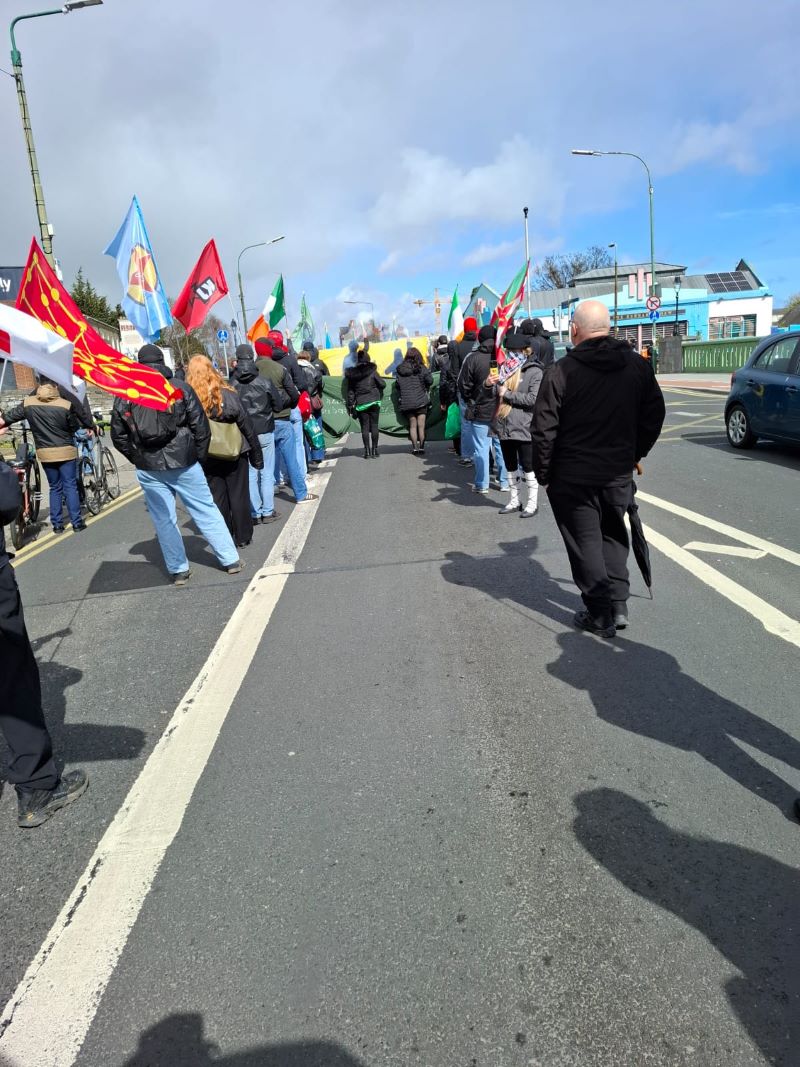
Section of the marchers looking back towards Phibsborough as they approach Cross Guns Bridge from Phibsborough. (Photo: R.Breeze)
A relatively large number of people participated, including a number of delegations from organisations of struggle in the Spanish, Turkish, German and Italian states. Young people were particularly well represented.
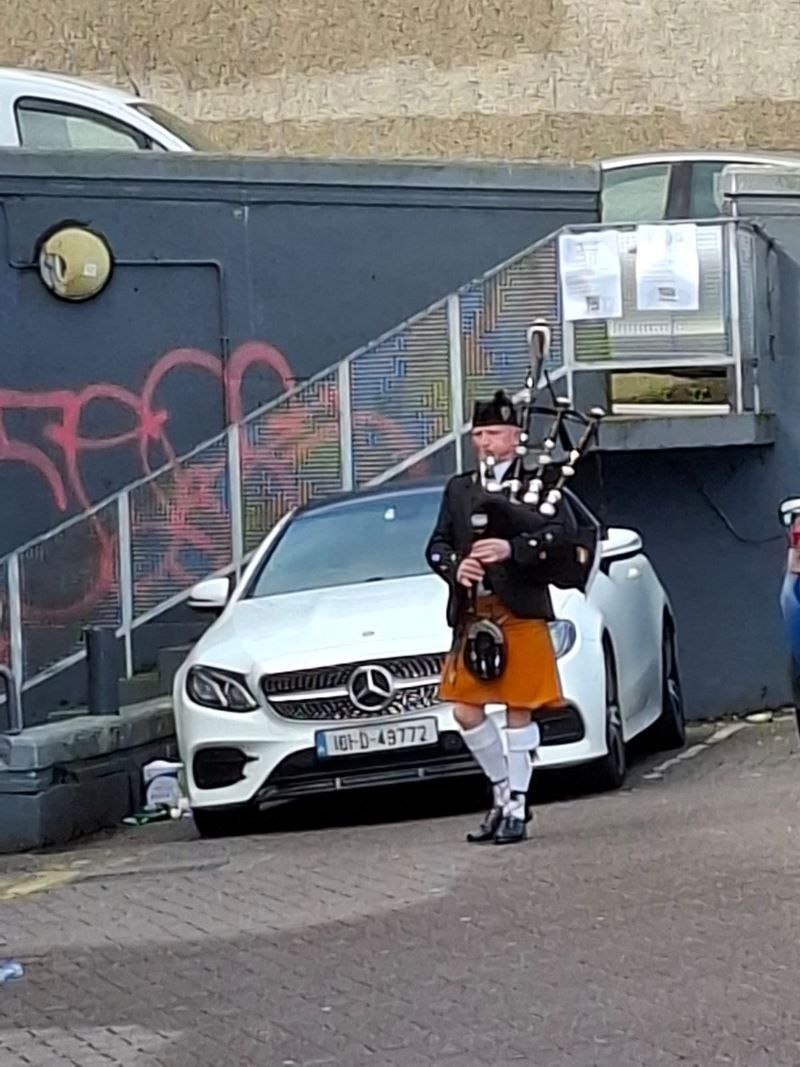
Participants met outside the Phibsborough shopping area on Dublin’s northside from which they were led by a lone piper, a colour party and a number of banners. Among them flew various flags of national and social struggle in Ireland, the Basque Country, Catalunya, Palestine, Turkey …
The lone piper in Phibsborough exercising his lungs and warming pipes and bag as he prepares to lead the procession towards Glasnevin. (Photo: R.Breeze)
The orders to the colour party, as is traditional, were all given in Irish.1 At Cross Guns Bridge, the march halted and, in what has become a tradition for the AIA, flares were lit in memory of the presence of Irish Volunteers there in 1916 and the murder of a civilian by British soldiers.
Proceeding along Finglas Road to the interest of passers-by and the odd ‘beep’ of solidarity from a passing vehicle, the march turned left outside the gates of the older Glasnevin Cemetery to cross over the railway pedestrian bridge to the St. Paul’s section of the Cemetery.
Section of the marchers approaching Cross Guns Bridge from Phibsborough, halting as flares are lit in memoriam. (Photo: R.Breeze)
Winding their way on a path through the headstones, what was now one thick column approached the monument to six Irish Republican armed uprisings, commissioned by the National Graves Association, where a representative of the AIA greeted them.
From the Monument, the AIA representative introduced the reason for the commemoration and listed in honour the Irish Republican Brotherhood, Irish Volunteers, Irish Citizen Army, Cumann na mBan and Na Fianna Éireann, different organisations that fought together in the Rising.2
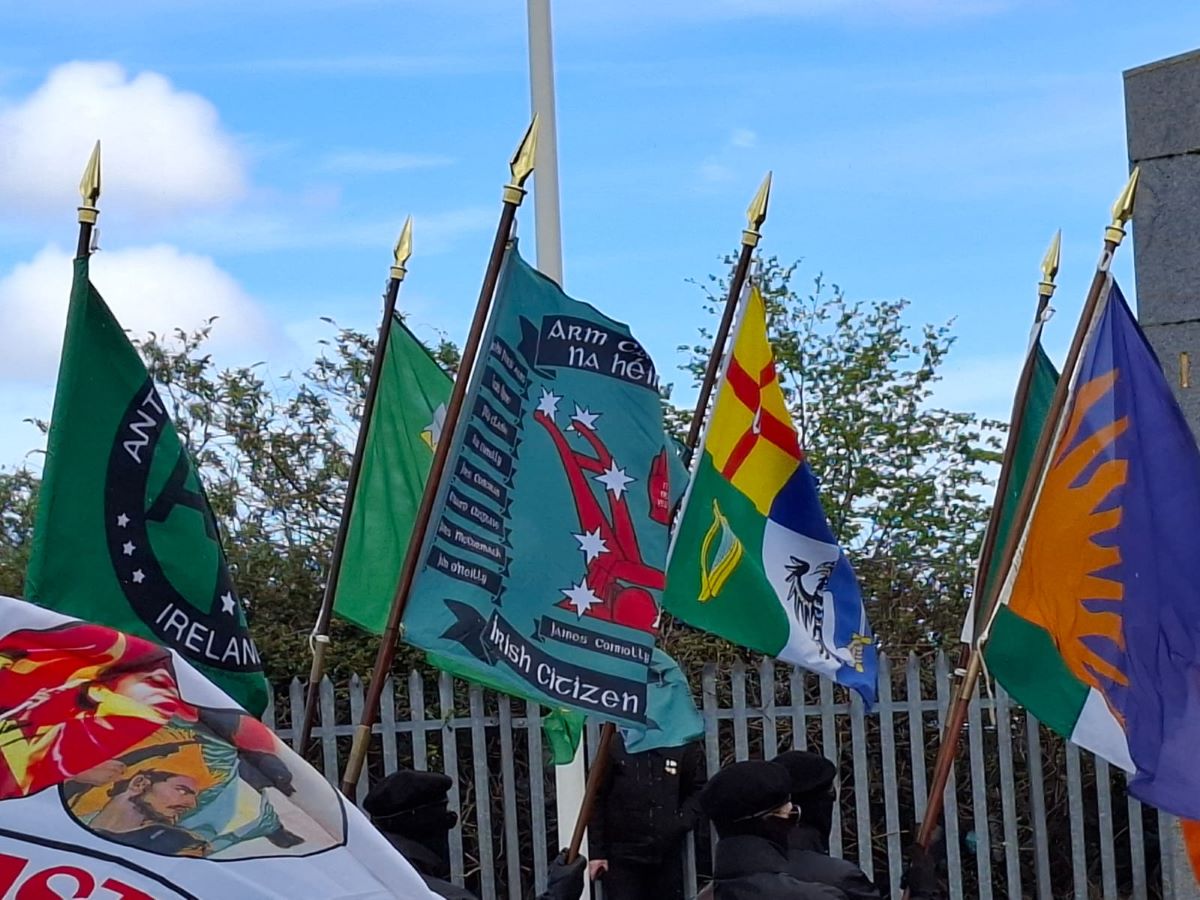
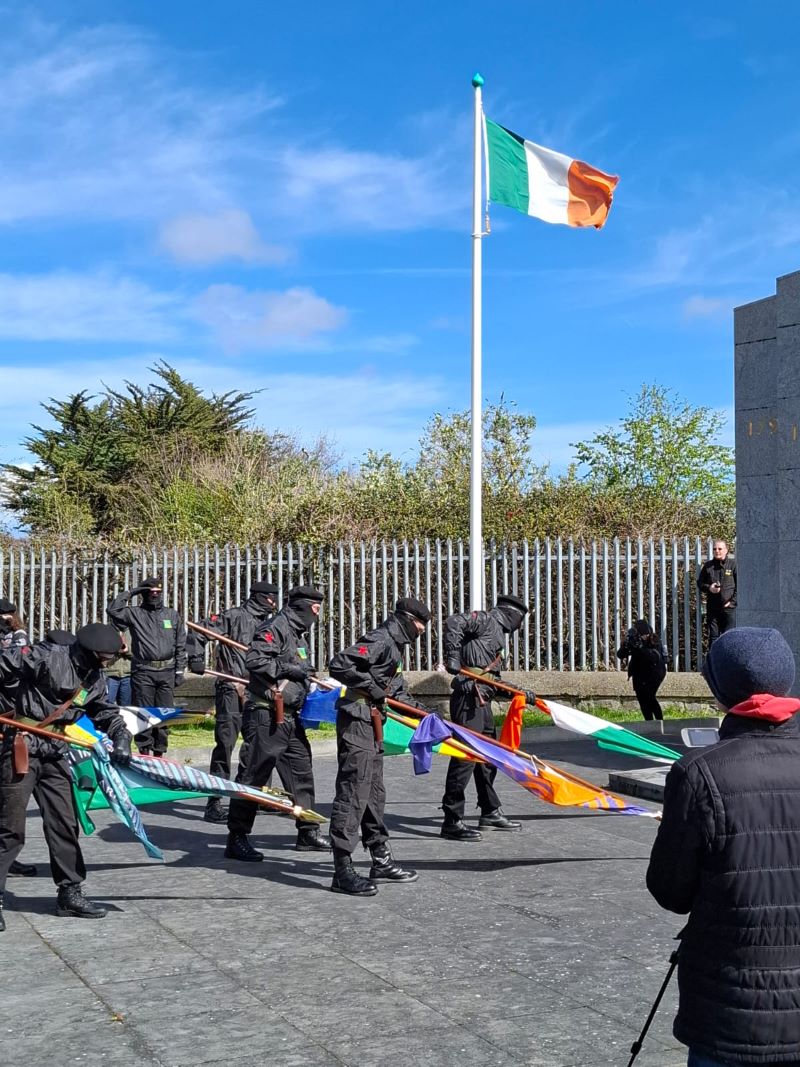
Central: Flags of the colour party, from left to right: Flag of AIA, Irish Citizen Army (mostly concealed), a version of Irish Citizen Army, emblems of the four provinces of Ireland, the Tricolour (mostly concealed), the Gal Gréine (Sunburst). The flag intervening from the left is of some participants in the Anti-Imperialist Front, a different organisation. (Photo: R.Breeze)
He called for delegates of different organisations to meet to decide a basis for unity, following which, going on to note that the AIA has long been prepared to work alongside others for shared objectives, he announced floral wreaths to be laid on behalf of the CPI and IDR.3
After the laying of those wreaths, another man was called to read the text of the 1916 Proclamation.
The keynote speaker, a veteran Irish Republican and former political prisoner, was then introduced. He began by reminding his audience of Irish Republican armed uprisings before 1916 going back to 1798 and forward up to the war in the occupied Six Counties.
The main speaker, veteran Irish Republican and ex-political prisoner, delivering the oration for the commemorative event. (Photo: R.Breeze)
The speaker made a number of points regarding the text of the 1916 Proclamation, the declarations of which remain to be fulfilled, in its address placing women on an equal standing with men, ‘cherishing the children of the nation equally’ and guaranteeing ‘civil and religious freedom to all.’
Drawing on the example of those of varying ideological positions who in the 1916 Rising united to “fight against the largest world empire in history”, the ex-prisoner called on Irish Republicans to find the means to unite in action today against imperialism and colonialism.
The speaker also highlighted that the objective of the Rising had been an independent democratic republic which is still to be achieved and that Republicans need to honestly confront the failures which, despite strong resistance, have weakened the struggle to date.
The piper played a slow air as the flags of the colour party were lowered and a few minutes’ silence observed – a traditional Irish Republican honouring of its martyrs in struggle. Announcing the end of the event the MC then called for the piper to play Amhrán na bhFiann4 to conclude.
A moment in the lowering of the colour party’s flags during the moments’ silence in honour and remembrance of fallen martyrs. (Photo: R.Breeze)
COMMENT
The attendance at this year’s event was numerous and encouraging, even discounting the numbers from abroad. The latter has been a feature of AIA commemorations for some years but has also grown visibly in numbers and in countries of origin.
In previous 1916 commemorations of the AIA, songs had been performed by singers but that feature was missing this year. Another missing feature was a part-address in the Irish language, au contraire to the main speaker’s call for the restoration of Irish as the nation’s spoken language.
In common with a great many commemorations by varied organisations at this spot, there was no mention of the independent National Graves Association, for whose work and the monument itself much thanks are due.
A large section of the participants chose to have their photo taken in a group with the monument behind them, their flags, banners and the portraits of the Seven Signatories of the Proclamation to the fore. (Photo: R.Breeze)
The call for unity in struggle is a common one in the Socialist and Republican movement though less verified in practice across their organisations. That said, on many occasions the AIA has put the desire into practice in joint action with other organisations and independent activists.
It is certain that without general unity in action across the resistance movement in Ireland, neither independence nor revolutionary change in society can be achieved.
In the city centre, at the GPO,5 site of the HQ of the Rising in 1916, the State held its own commemoration, with admittance to the area close to the podium by ticket only. According to reports, the speeches of the Taoiseach6 of the Coalition Government were received in silence.
This was in contrast to the speech of the new Uachtarán or President, a native Irish speaker and of broadly left-nationalist political outlook, which was enthusiastically applauded.
End.
Note: If you found this article of interest, why not register with Rebel Breeze for free, so that you will be notified by email of subsequent articles. You can de-register any time you wish.
FOOTNOTES
1However, no other instructions were given in the language, not even ‘dhá líne’ (i.e two lines) when the marchers were being instructed by stewards to separate into two columns.
2Omitted, as it often is, was the participation of the Hibernian Rifles unit, who though not part of the planned Rising joined it and acquitted themselves well in the GPO Garrison and in support of the City Hall Garrison.
3Communist Party of Ireland and Independent Dublin Republicans.
4This air and its lyrics are widely considered the National Anthem of Ireland but for the State, it is only the air of the chorus that is their National Anthem. Composed shortly before the Rising by Peadar Kearney and Patrick Heeney in English, it was sung during the Rising and widely adopted by the Republican movement afterwards. The lyrics were translated to Irish by Liam Ó Rinn in 1923 and, unusually, that version became dominant.
5The General Post Office, an imposing building in Dublin’s main thoroughfare,1 for which recently the Irish Government announced plans to remove the An Post (postal service) to develop in part as a shopping centre.
6Equivalent to Prime Minister. The Government is a coalition of formerly hostile parties Fine Gael and Fianna Fáil, from oppositional sides of the Irish Civil War (1922-1923) and supported by the Green Party and some Independents.
The recognised date known as International Working Women’s Day is March 8th and it was commemorated on that date with a march and revolutionary words and symbolism organised by Irish Socialist Republicans in Dublin.
The marchers gathered outside Wynn’s Hotel in Lower Abbey Street, to mark the founding there of the revolutionary Republican military women’s organisation, Cumann na mBan, on 2 April 1914. The organisation, with its own officers, was possibly the first of its kind for women in the world.1
From there the march set off into O’Connell Street, then marching southward to cross the Liffey into D’Olier Street before turning left into Townsend Street, continuing to the statue of Constance Markievicz where the colour party’s flags were lowered in respect.
The march near the start in O’Connell St (photo credit: An Pobal Abú FB page)
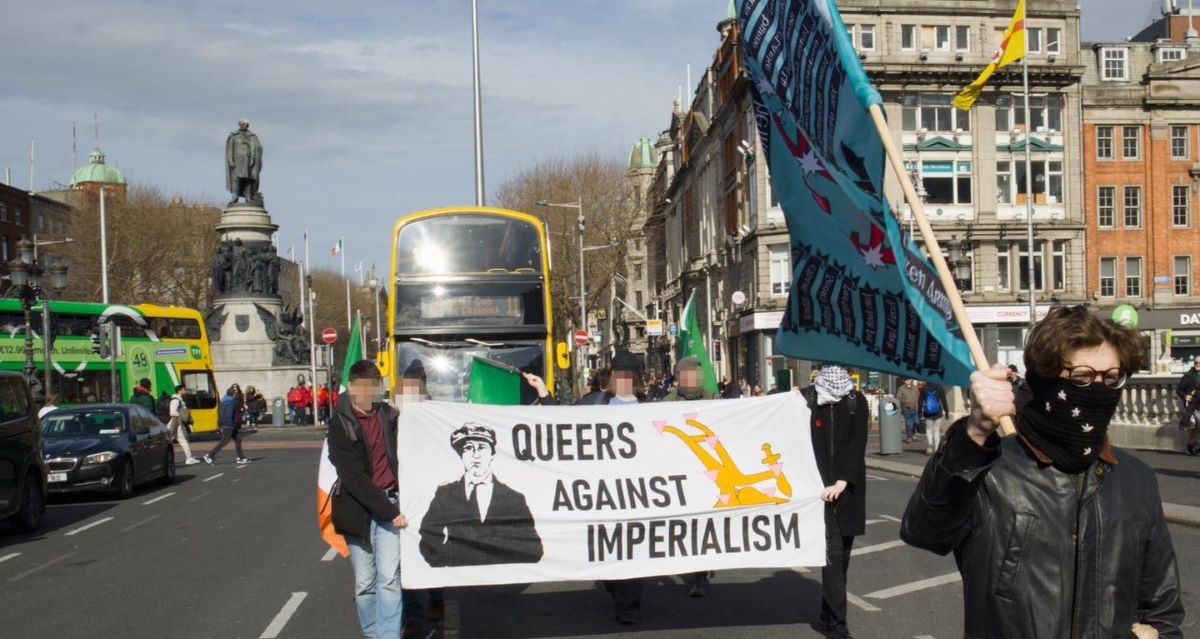
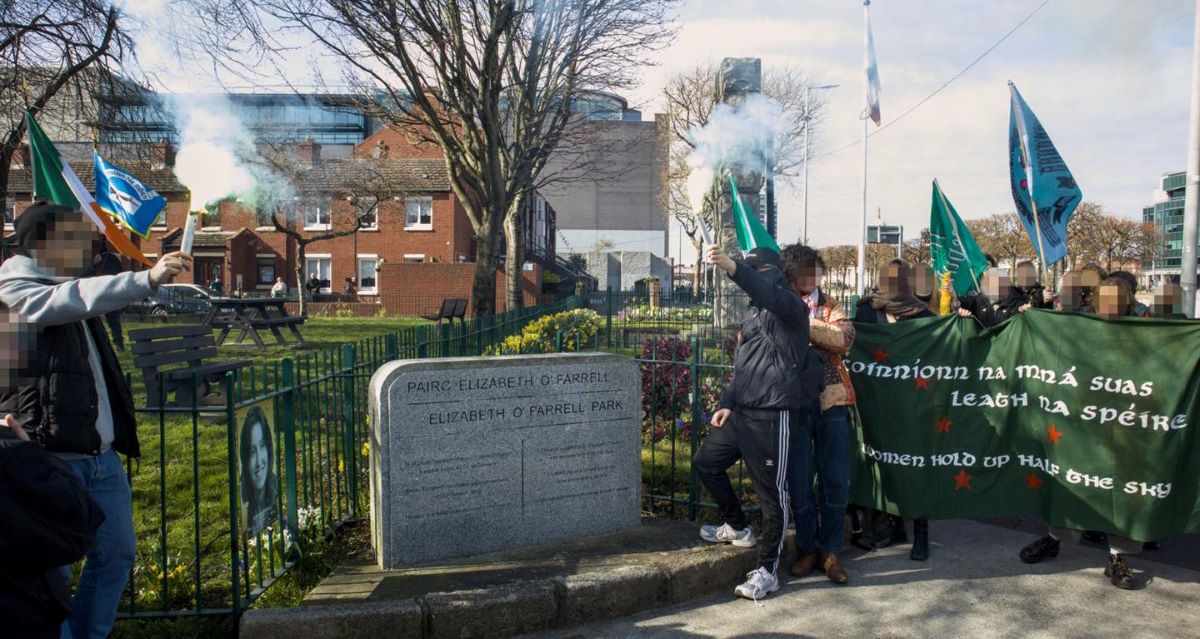
Throughout, chants of “Ní Saoirse go Saoirse na mBan”2 and “Britain out of Ireland” reverberated through the streets of Dublin as banners displayed the slogans “coinníonn na mná suas leath na spéire / women hold up half the sky” and “Queers Against Imperialism”.
Markievicz was an active member of Iníní na hÉireann, the Irish Citizen Army and of Cumann na mBan. She was part of the command of the Stephens Green/ College of Surgeons garrison in 1916 and elected MP on an abstentionist ticket in 1918 and Minister of Labour in the First Dáil in 1919.
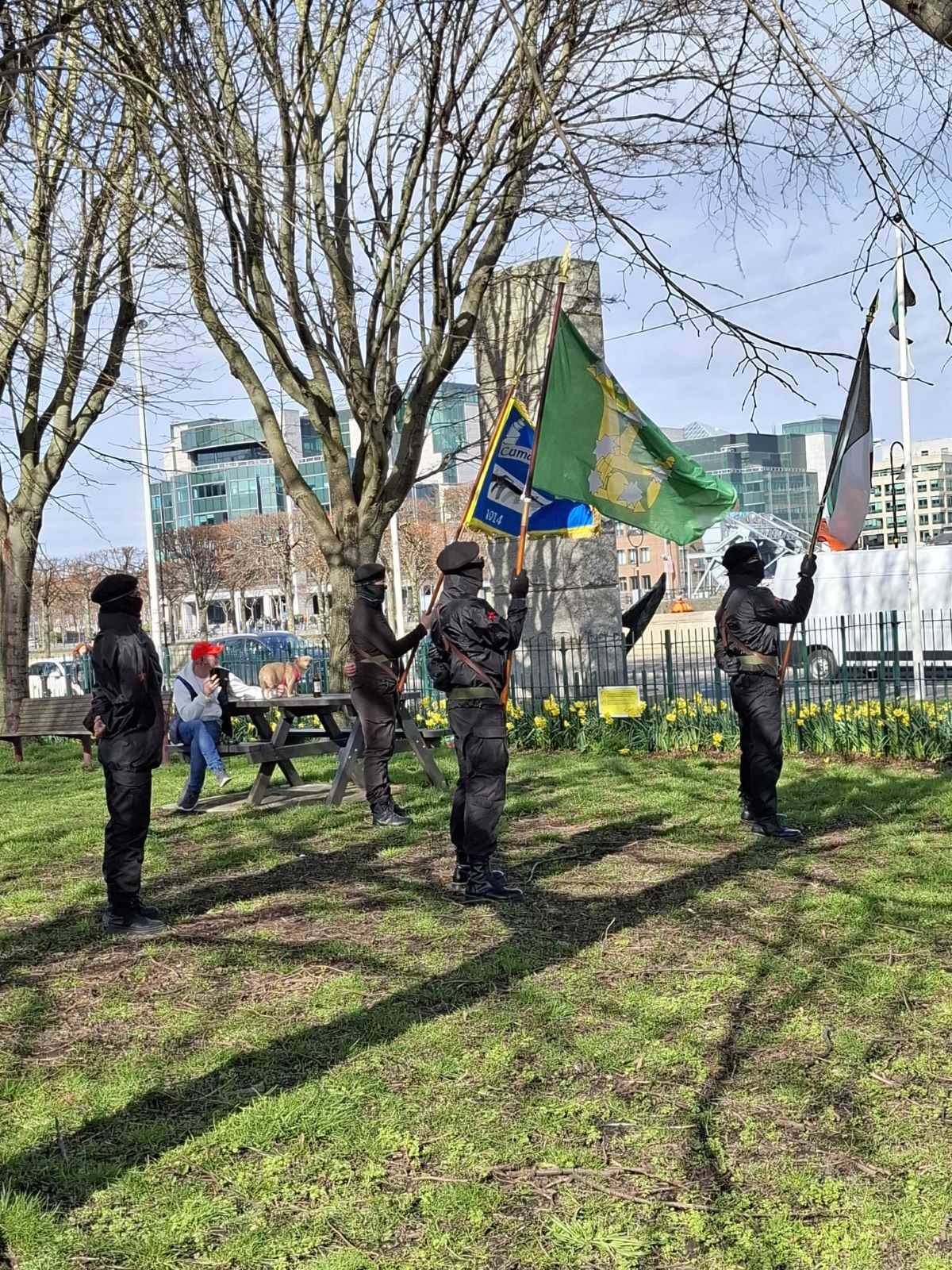
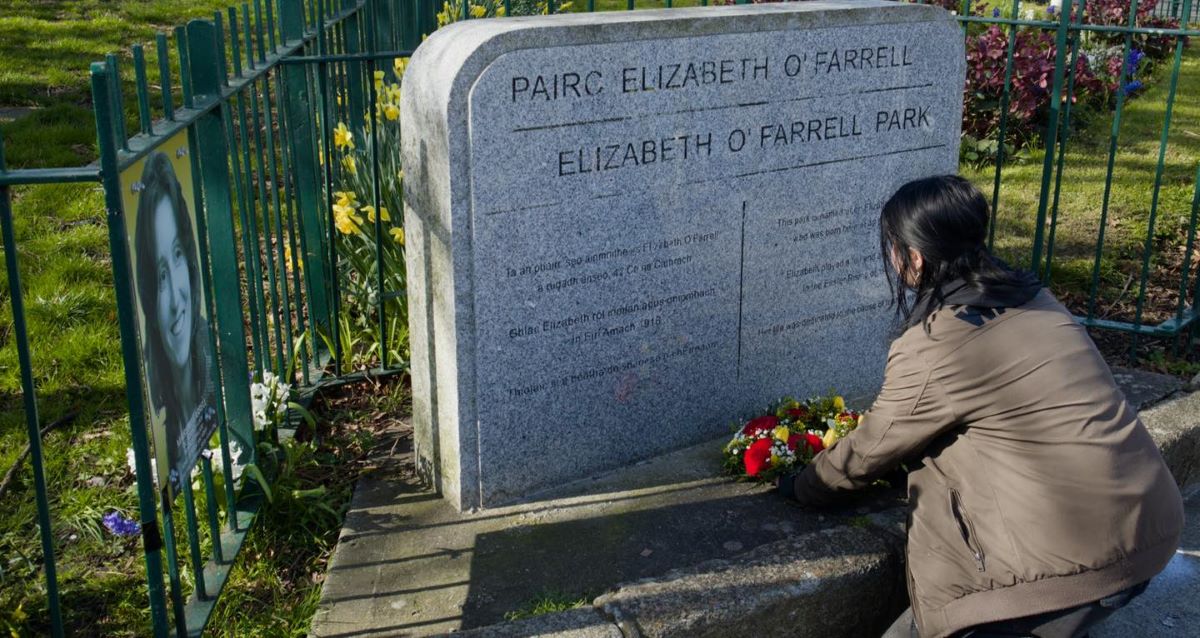
Continuing along Townsend Street and ending at Elizabeth O’Farrell park where a commemoration was held outside in honour of the role of women in the struggle for national liberation while the colour party took up position inside the park.
(Photo credit: An Pobal Abú FB page)
A woman read a speech on behalf of the AIA, tracing founding of International Women’s Day from when women in Russia in 1917 had led strikes and marches against the Tsar and WW1, later becoming known as the February Revolution, leading later to the October Socialist Revolution.
The speaker went on to speak of the role of women in the Republican struggle, from Cumann na mBan, the Irish Citizen Army and Armagh Gaol Republican prisoners, followed by a woman reading the 1916 Proclamation of Independence and the burning of two green flares.
(photo credit: An Pobal Abú FB page)
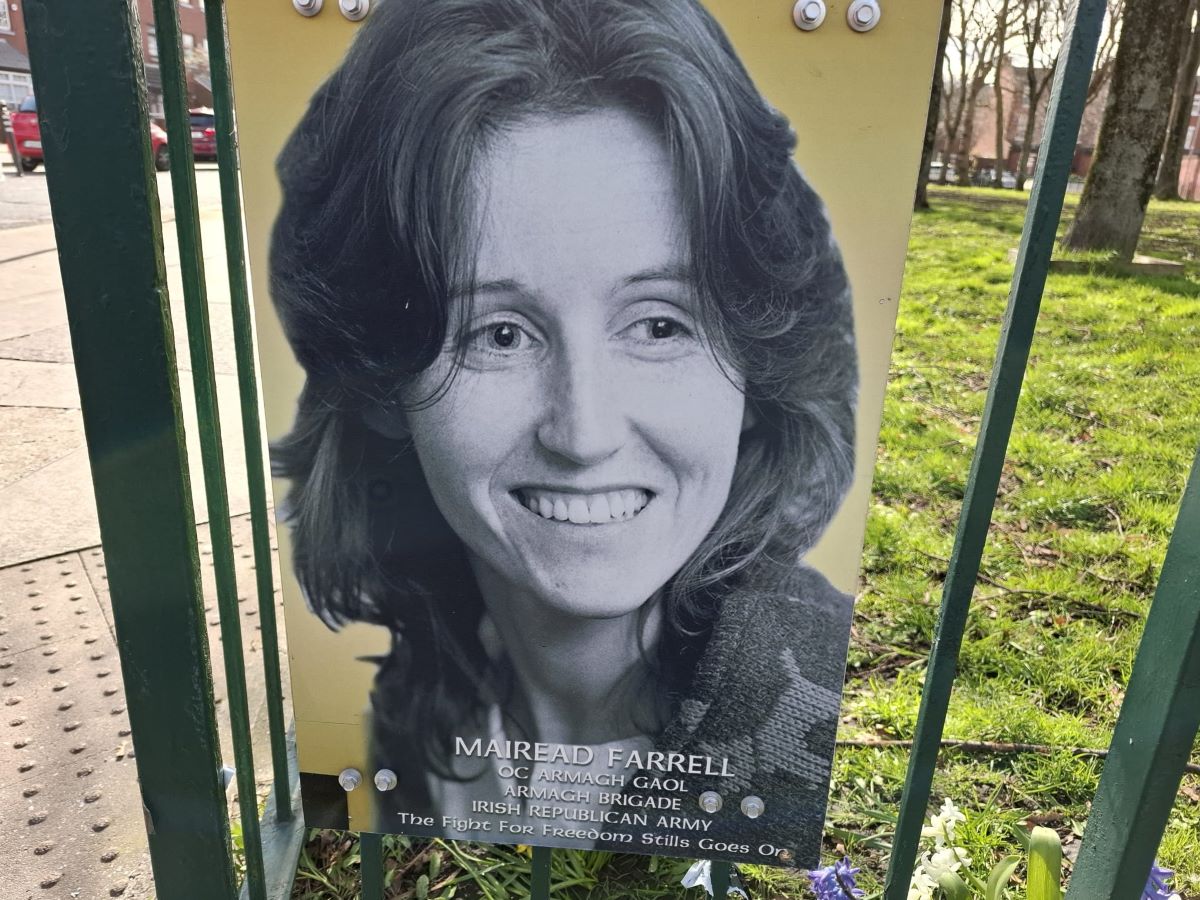
A new plaque of the Socialist Republican Mairéad Farrell was unveiled with the laying also of a commemorative wreath during a minute’s silence observed for all revolutionary women and gender oppressed people who gave their lives for national liberation and anti-imperialist struggle.
The Colour Party in Elizabeth O’Farrell Park (Photo: R.Breeze)
At the same time the colour party lowered their flags in respect, during which the command calls in Irish rang out in the area through the silence.
The area in which the Elizabeth O’Farrell and her life-long friend Julia Grenan3 grew up is a south Dublin docklands still largely working class area. It was in a yard in Lombard Street nearby, actually within sight of the park, that the IRB (Fenians) was founded on March 17th 1858.
Laying of the wreath (photo credit: An Pobal Abú FB page)
Elizabeth O’Farrell and Julia Grenan both participated in the 1916 Rising and, along with Winifred Carney, refused to join the earlier evacuation from the burning GPO building on the Friday, later participating in the final evacuation which ended in the central terrace in Moore Street.
When the leadership took the decision to surrender, O’Farrell went out to negotiate under a white flag even though a man had been killed under such a flag earlier in the very street. In 1922, along with almost the entirety of Cumann na mBan and the ICA, she rejected the Anglo-Irish Agreement.
(Photo: R.Breeze)
Many women were interned by the nascent neo-colonial Irish Government.
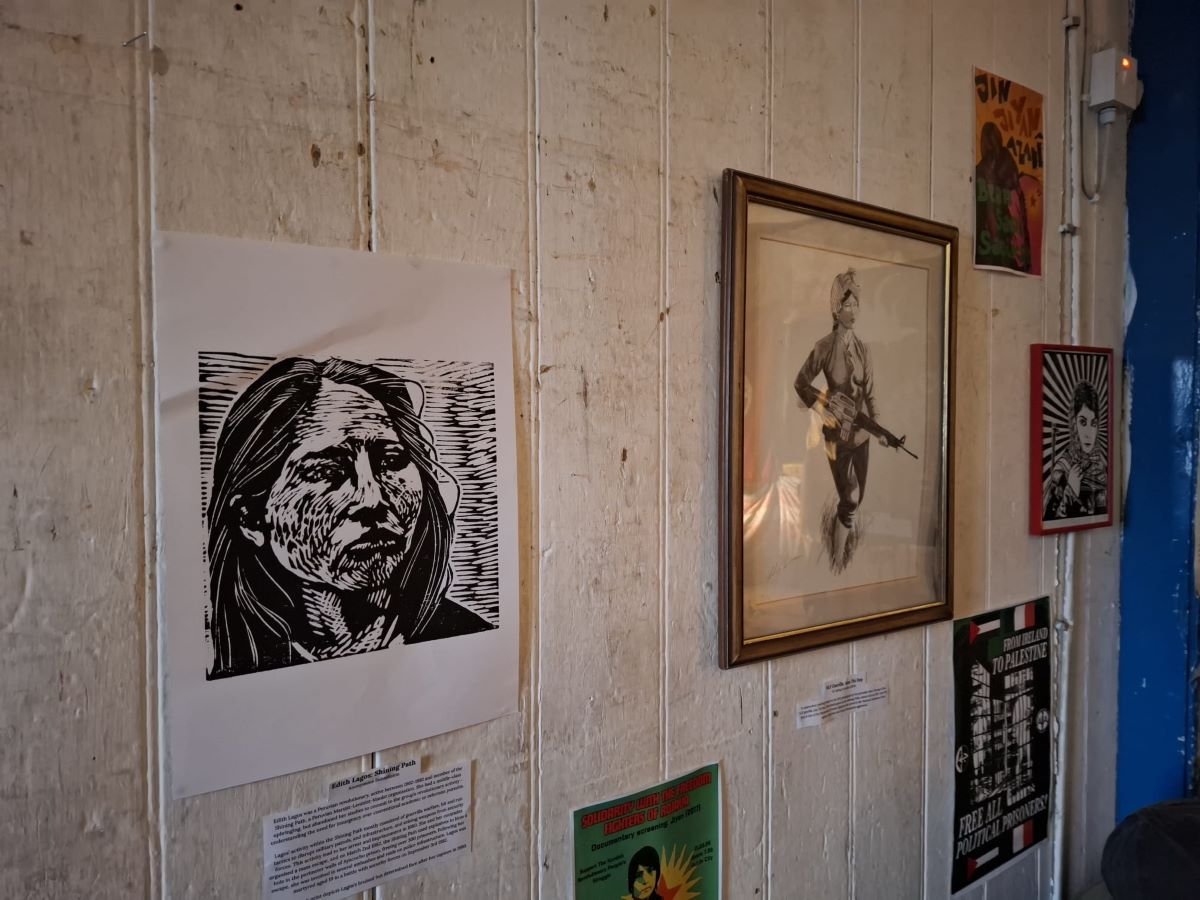
After the Elizabeth O’Farrell Park event, people gathered again at a recently-occupied social centre in Dublin, to view an exhibition of images in honour of the day and to watch an English-subtitled French-language film about women and the Omani Resistance, followed by a music session.4
Part of exhibition for International Working Women’s Day in the social centre (Photo: R.Breeze)
End.
Note: If you found this article of interest, why not register with Rebel Breeze for free, so that you will be notified by email of subsequent articles. You can de-register any time you wish.
Footnotes
1In its early years the organisation worked mainly as an auxiliary to the Irish Volunteers but asserted greater independence at a later stage. It coincided in time with the women in the Irish Citizen Army who shared equal status with male members and indeed in the case of some of them, such as Markievicz and Lynn, actually commanded men. Wynne’s Hotel was also where the decision to found the Irish Volunteers had been taken in 1913.
2Translated as ‘There can be no freedom until women are free.’
3And life partner, many have speculated – certainly they lived together until the end.
4The Hour of Liberation Has Arrived by Heiny Srour
There is an unfortunate trend in the socialist movement in Ireland to underplay or even to completely ignore the continuing colonial occupation of Ireland, while at the same time raising the other evils of imperialism and capitalism.
This harmful trend is epitomised by an article from Paul Murphy in the current issue of the ecosocialist Rupture magazine1 (of RISE, a network of the People Before Profit political party) – without conscious irony entitled THE MAIN ENEMY IS AT HOME – TODAY.
In the piece under discussion, Murphy discusses the blocs forming up in contention and for world war, with the US leading the western bloc and China-Russia the Eastern,2 with the ruling classes of the EU and Ireland lined up with the USA, though the Irish State is not yet a part of NATO.
Rupture Magazine generic image
This is a correct analysis by Murphy and he is right to call for defence of the Triple Lock3 as far as we can in order to prevent or at least impede the Irish ruling class from dragging the population of the Irish state into imperialist war.
Invoking the threat of NATO as a war-making alliance and danger to the limited neutrality of the Irish state is of course absolutely correct. But how can the actual NATO membership of the Occupied Six Counties be ignored in that analysis? Yet Murphy does so, completely.
Murphy is neither blind nor stupid and one must suspect that he does not mention Britain’s Irish colony because his former and current parties both fear to mix their ‘class politics’ with any kind of Irish nationalism – even anti-colonialism – or to find common cause with Irish Republicans.
Those parties took a sudden interest in the potential politics of a united Ireland only when discussion of that possibility was being thrown around in the media and by some political actors.4 But before and afterwards, they ignored them (except on occasion to castigate Irish Republicans).
The ‘enemy at home’ is indeed, as Murphy states, Irish capitalism – however not also British colonialism? But it cannot be ignored that Irish capitalism is subservient to British colonialism, US and EU imperialism. Well, can’t be ignored by revolutionaries that is, whether Marxist or not.
Ireland as treated in the Rupture analysis – but something’s missing! (Image sourced: Internet)
It was through analysis of the subservience of the Irish capitalist class that Connolly wrote that “Only the Irish working class remains as the only incorruptible inheritors of the fight for freedom in Ireland”5 – and that was even before the bourgeois counter-revolution/ Civil War of 1922-’23.
Murphy, PBP and the Socialist Party are all fond of quoting James Connolly but only selectively and never on the question of overthrowing British rule in Ireland.6
A TIMELY WARNING
Before ending let us note that Paul Murphy’s words are not those of some green novitiate; aside from being a TD,7 he is a long-standing member of the Irish Trotskyist movement, formerly a leading member of the Irish Socialist Party before he left it to join PBP-Solidarity.8
Furthermore he has been active at times in street events and was one of the Jobstown Five who were arrested in early-morning raids by the Gardaí and tried but found ‘not guilty’ on charges of ‘kidnapping’ Joan Burton, Tánaiste9 of the Fine Gael-Labour Party coalition government.10
We are entitled to assume, given his prominence and the article’s publication, that Murphy’s political position outlined here is one with which PBP-Solidarity and Rise find no serious disagreement, to the disgrace of any party claiming to be Marxist and revolutionary in Ireland.
Furthermore, their position gives activists timely warning once again that although we may well join with PBP on certain issues, including opposition to US imperialism, they will not be found to the serious side against British colonialism in Ireland or in any fully-committed struggle against NATO.
While upholding principles of a broad front, in any struggle we need to be fairly sure of which forces will stand with us to the end and which may drop us, perhaps even at the worst and most dangerous moment.
End.
Note: If you found this article of interest, why not register with Rebel Breeze for free, so that you will be notified by email of subsequent articles. You can de-register any time you wish.
2In the course of which Murphy states that Russia is an imperialist country but neglects to show any evidence of that. Capitalist and undemocratic does not equal imperialist, which Marxists today understand as the export of finance capital to extract super-profits from under-developed lands through exploitation of the labour there and plunder of their natural resources.
3Ireland’s “Triple Lock” is a policy requiring UN mandate, Government approval, and Parliamentary approval before more than 12 Irish troops may be deployed in overseas support operations.
4Though never taken seriously by some, including myself. I commented that British colonialism/imperialism had many opportunities to end their colonial rule in Ireland and on each occasion had dug their heels in harder, most recently by fighting a vicious war of three decades. In addition, if it were ever even half-considered, it is the British who would decide what the proper majority percentage would be, after which it would need to be agreed in Westminster and then approved by the British Monarch.
6Sadly it is also true that many Irish Republicans quote Connolly only in the reverse, i.e. only about Ireland’s national liberation struggle.
7Teachta Dála, elected member of the lower house of the parliament of the Irish State.
8People Before Profit is now what used to be called the Socialist Workers’ Party, an iteration of a British-based Trotskyist party, as is the Irish Socialist Party similarly of the British-based Socialist Party.
9The Tánaiste is equivalent to Deputy Prime Minister in the UK and many other parliamentary systems.
The Save Moore Street from Demolition campaign group gratefully accepted an invitation to participate in the Comrade Corner on Sunday 3rd January in order to spread the word about the campaign and to make further contacts.
The Comrade Corner is part of the Libertine Market Crawl that takes place on the first Sunday of each month 12-5pm and is spread through a number of pubs, mostly in the Liberties area of north Dublin city: The 4th Corner, Dudley’s, Lucky’s, Molly’s Barand Peadar Brown’s.
Front of the Peadar Brown’s pub building, Clanbrassil Street. (Photo: R. Breeze)
The Comrade Corner’s section of the monthly market take place upstairs in the Peadar Brown’s pub, open to campaigning and community groups to book a table to promote their campaign or group on which they had campaign leaflets, a QR to sign on line and campaign badges.
The latter represented a grotesque on the roof of No.55 Moore Street, missing wingtips shot off by a British bullet during the battle there in 1916.
Two of a number of visitors tothe Comrade Corner engaging with the Save Moore Street From Demolition campaign stall at which campaign activist Orla Dunne is seated. (Photo: R. Breeze)
“Over the 12 years of our group’s existence campaigning on the street we have engaged in outreach work often enough,” said one of the two staffing their table in Peadar Brown’s, “including taking our banner to protest marches, giving talks, interviews and conducting history tours.”
The group has been campaigning with a weekly Saturday table for conservation and against demolition in Moore Street since September 2014. “We want to see a busy street market with small independent shops, not chain stores,” said Orla Dunne, also staffing their table in Peadar Brown’s.”
One of the team staffing the Darragh Ó Faoláin stall in Comrade Corner. (Photo: R. Breeze)
“And the history of the 1916 Battleground properly commemorated,” she went on to say, alluding to the fact that of the Seven Signatories of the Proclamation, no less than five spent their last hours of freedom in the Moore Street houses before taking the painful decision to surrender.
Those were Patrick Pearse, James Connolly, Tom Clarke, Seán Mac Diarmada and Joseph Plunkett, all shot by firing squad, along with Willie Pearse, also late of Moore Street as were another ten prominent figures, including Roger Casement, though hanged in Pentonville Jail somewhat later.
The team staffing the Statue of Pearse by the GPO campaign stall in Comrade Corner. (Photo: R. Breeze)
The GPO Garrison had left the burning building on the Friday of Easter Week and, heading to relocate at the Williams and Woods factory, got only as far as Moore Street before they came under intense machine-gun and rifle fire from the encircling British forces in Parnell Street.
Pausing to take a breath and plan their next moves, around 300 men and women occupied the whole central terrace (Nos.12-25), tunnelling through the walls, along with some other buildings. The leader of a failed charge on the British barricade died in a lane now named O’Rahilly Parade.
As he lay dying he wrote a farewell letter to his wife and children, the magnified script reproduced on an impressive monument in the lane-way.
The current Hammerson plan includes at least seven years of construction on the site (with no food stalls possible meanwhile), a new street cut through the 1916 Terrace to O’Connell Street, a hotel in Moore Lane and a Metro entrance in O’Rahilly Parade additional to the O’Connell Street one.
INSIDE PEADAR BROWN’S
The Peadar Brown’s stall in Comrade Corner. (Photo: R. Breeze)
People drifted into the upstairs room in twos and threes, stopping at some or all of the stalls to examine the literature or merchandise on display and to chat to some of the groups. In addition to SMSFD’s, Peadar Brown’s had their own merchandise of badges and T-shirts.
Also selling merchandise within that range was a revolutionary anti-fascist stall, while another table was held by a group campaigning for the erection of a monument to Patrick Pearse in O’Connell Street, near to the GPO where he was located in 1916 before evacuation to Moore Street.
T-shirts merchandise near the Darragh Ó Faoláin Stall in Comrade Corner. (Photo: R. Breeze)
It was notable that the latter group also directed people to the SMSFD group’s table. Many of the visitors had origins outside Ireland, a sector for which perhaps this kind of event would be more usual. How did the SMSFD team feel their table had done for their hours there?
“We did alright,” said Dunne, “though it wasn’t very busy today.” “If we had boosted our online petition signatures alone, which we did, it would have been worth it,” said Breatnach. “Besides, I always wanted to see the famous Pub,” added Dunne, smiling.
Mural on the side of the Peadar Brown’s building. (Photo: R. Breeze)
Much artwork of an Irish Republican nature decorates the inside of the pub downstairs, including a mural along the wall behind the small stage area. The Irish Tricolour, Starry Plough and ‘Irish Republic’ flags hang from the exterior along with anti-racist posters in the outside drinking area.
Last year officials in Dublin City Council sought unsuccessfully to have Peadar Dunne’s remove the large Palestine flag painted on the side of their building. It has a reputation not only as an Irish Republican pub but also of decidedly internationalist solidarity and antifascist character.
Also last year, some fascist and far-Right elements threatened the pub with a demonstration which failed to materialise, to counter which antifascists had packed the pub to overflowing. The far-Right’s anger was aroused by the banning of a musician for allegedly uttering racist comments.
The Peadar Brown’s T-Shirt rack by their stall in Comrade Corner. (Photo: R. Breeze)
End.
Note: If you found this article of interest, why not register with Rebel Breeze for free, so that you will be notified by email of subsequent articles. You can de-register any time you wish.
A campaign for conservation of the ancient Moore Street Dublin inner-city street market area and 1916 Battleground, in its 11th year of Saturdays on the actual street is seeking to reach 2000 on-line signatures for the group’s petition this year.
The site was formerly under threat of construction of a giant ‘shopping mall’ from the ILAC to O’Connell Street. However ‘shopping malls’ are not making so much money nowadays so the new plan is largely a ‘shopping area’ with an hotel and a new road from the ILAC to O’Connell Street.
Picket/ lobby of Dublin City Council in 2014, petition stretch and posters organised by the Save Moore Street From Demolition Group, founded a couple of months earlier to prevent Dublin City Council City Manager giving property speculator Joe O’Reilly Nos. 24-25 in exchange for Nos.14-17, which would have allowed him to demolish from No.25-No.18. The campaign was successful in preventing that as councillors voted against the swap. (Photo: SMSFD archives)
Moore Street is of course already ‘a shopping area’ but what that means to property speculators is a street of chain stores, something like the Grafton and Henry Streets. Such streets are busy during shopping hours but largely deserted at night and anathema to the living social city centre.
Independent small shops and street stalls characterise a street market, typically with some cafes, a bakery and restaurant. But the agent of Hammerson, the speculator company, has closed down a bakery and a number of successful restaurants and cafés on the street.
On the Friday of Easter Week, 300 or so of the GPO garrison evacuated the burning building and occupied the central terrace in Moore Street to gain a respite, setting up their new HQ there and a field hospital caring for their wounded and for a wounded soldier of the British Army.
The new intended street would cut right through the historic 1916 terrace, the footprint and path traversed by much of the 300 or so GPO Garrison in 1916 as they evacuated their burning former HQ and prepared to relocate to William & Woods site in nearby King’s Inn Street.
Moore Street, according to campaigners, is of great Irish cultural and historical importance but is also of international historical stature: surrender site of the first anti-colonial uprising of the 20th Century and of the first rising against World War and last location in freedom of five of its leaders.
Those five, Connolly, Pearse, Clarke, Mac Diarmada and Plunkett, were also five of the Seven Signatories of the 1916 Proclamation, a document of huge symbolic significance in history and still often referenced in contemporary discourse.
Campaigners point to the presence in the street of the Irish Citizen Army, which they claim as “the first workers’ army” and of its leader, Connolly along with three of the first women’s republican military organisation, Cumann na mBan: Elizabeth O’Farrell, Julia Grenan and Winifred Carney.
The Irish Citizen Army recruited women too, including appointing some of them as officers in command of male Volunteers, another first in world history.
Signed petition sheets sellotaped edge to edge in January 2016, stretched along Moore Street as the 6-day occupation of the endangered buildings came to an end and shortly before the 6-week blockade began. (Photo: SMSFD archive)
SUCCESSES AND DEFEATS
The campaign has had some previous successes, including four buildings being declared a historical monument in 2007, refusal of land-swap in 2014 (see photo), a six-week blockade of the site and a High Court declaration in 2016 of the whole area being a national historical monument.
However, the campaign insists the historical monument is all 16 buildings in the terrace, not just four. And the High Court decision was successfully appealed in February 2017 by the Minister of Heritage on the grounds that a Judge did not have the power to declare a national monument.
The campaigners, now in their 11th year of Saturdays on the street, say that they stopped counting hard copy petition signatures once they passed 380,000. But last year they started an electronic petition in which they aimed for 1,000 by year’s end — and exceeded their target.
Women Christmas shopping crowding around the petition table to sign hard copy and on-line petition last Saturday. (Photo from weekly SMSFDalbum 20 December 2025.)
This year they’ve aimed to reach 2,000 but, with nearly another 300 needed with a week to go before the end of 2025, reaching their target seems very unlikely.
The campaign group supporters say that they have held the line so long because of the support of hundreds of thousands, not only of indigenous Irish but also of settled migrants (the latter being the mainstay of the traditional fresh fruit and vegetable stalls) and want the signatures to reflect all that.
“At this stage, the strongest help we can get from ordinary people is to sign the on-line petition and to get their contacts to do so too,” said one of the campaigners on the street recently. “On-line signatures are identifiable to one person, verifiable and the total can be checked on line.”
“The authorities will remember that people took direct action in the past to halt demolition, as in the occupation and blockade of 2016 but thousands of online petition signatures are an indication that the activists represent much more than themselves alone”.
The Save Moore Street From Demolition campaigners are on the street every Saturday from 11.30am-1.30pm and their online petition is on https://my.uplift.ie/petitions/save-moore-street The group has Instagram and Facebook pages also.
end.
Note: If you found this article of interest, why not register with Rebel Breeze for free, so that you will be notified by email of subsequent articles. You can de-register any time you wish.
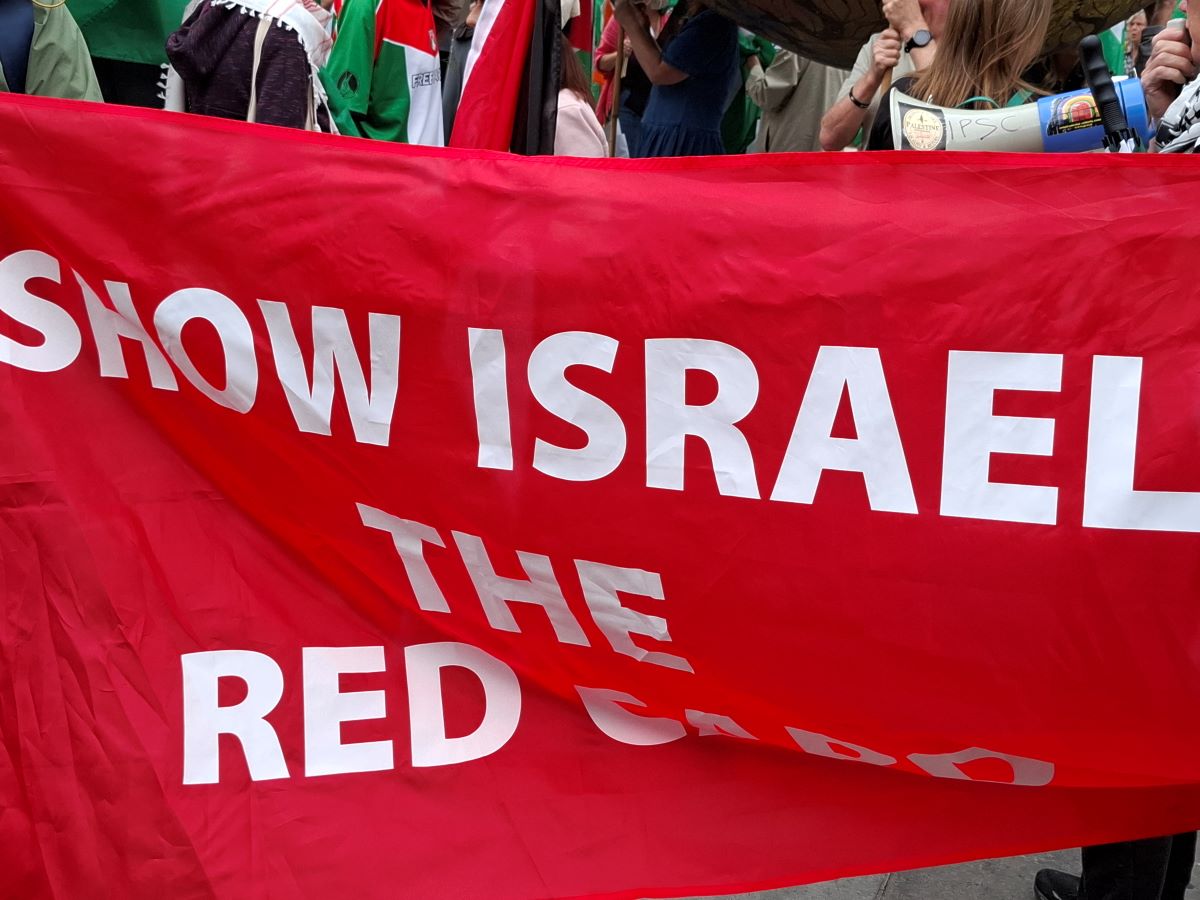
The week before last in Ireland we were led through motions of Palestine solidarity actions once more, motions without practical effect, first by the Irish trade unions, followed the following day by the Ireland Palestine Solidarity Campaign.
Seen on the IPSC National march (Photo by: Participant)
On Friday, the unions announced a ‘stand out for Palestine’ day – well, not a day exactly, more like a lunch break. It was not a strike, not even a work stoppage, rather some dedicated employees surrendering their lunch break to stand with Palestinian flags etc in front of their workplaces.
Not even a work stoppage of one day, half-day, or even an hour. The union leaderships, in most cases, organised nothing, leaving it up to their members to get together and to sacrifice their lunch breaks.
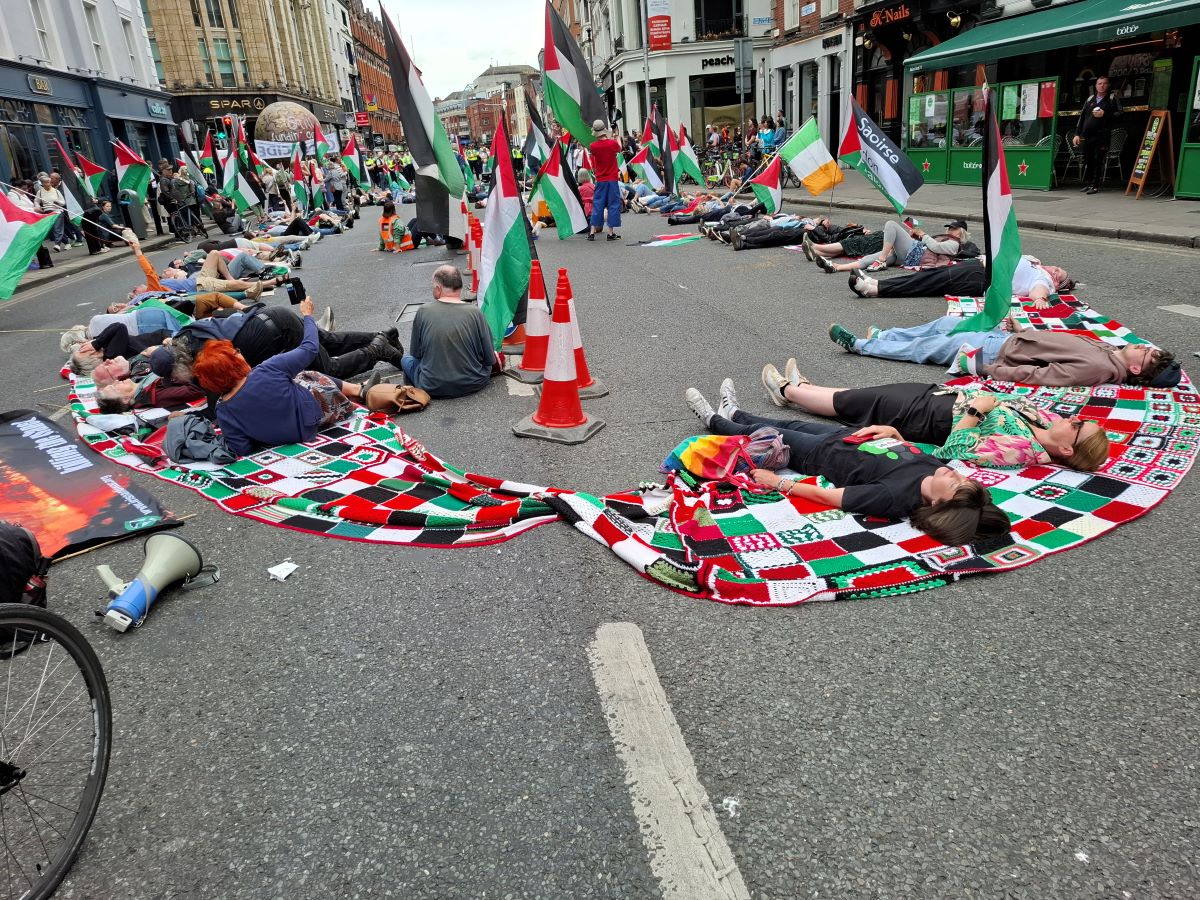
More of us went through the motions again on Saturday 29 November. From the Garden of Remembrance, down O’Connell Street, across the river, around by Trinity College, up Dawson Street and into Molesworth Street, facing Leinster House.
Seen on the IPSC National march (Photo by: Participant)
The Ireland Palestine Solidarity Campaign organised this ‘National Demonstration’ as it does roughly every month. It is supposed, presumably, to impress the Government with its numbers and pressure them to end their collusion with the ongoing genocide of Palestinians.
It has not done so — nor did it in any month or any year in the life of the IPSC, the longest-active Palestine solidarity organisation in Ireland. Nor have the monthly marches brought about any change in Irish Government collusion since the genocide of Gaza began in October 2023.
That is not the fault of the IPSC. What they are to be blamed for is not recognising that and adjusting appropriately to actions of greater pressure. Or, perhaps they recognised it indeed but nevertheless refused to change towards any effective pressurising methods.
The IPSC was for a long time near the ‘middle of the road’ but it has moved further into that position as the genocidal actions of the Zionist colony became worse and as awareness of Israeli crimes spread and grew in Ireland (which it did in part thanks indeed to the work of the IPSC).
Section of the IPSC National march (Photo by: Participant)
Solidarity work however is not about education in the abstract, raising awareness without using that awareness to bring about change. I am sure the IPSC leadership is aware of that and would wish much change but they do not adapt their actions, rather continuing with the monthly motions.
Probably they do not increase the pressure out of fear of losing their influence with the political class. Which would perhaps be well and good if the political class were delivering on ending collusion with the genocidal state – but they are not, nor is there any indication that they will.
Ireland remains the biggest single importer of Israeli products next to the USA and the biggest in the EU. The Irish Government permits military consignments to fly to Israel through ‘neutral’ Irish airspace and USA aircraft and military personnel to stopover and refuel at Shannon Airport.
Seen on the IPSC National march as passing O’Connell monument (Photo by: Participant)
Occupying the ground near the middle is only a good thing if it can be used to support action for change; it is a hindrance if the act of being there comes to be more important than the end objective: an end to genocide and the Occupation, with freedom and independence for Palestine.
The IPSC could use its mass base to blockade Dublin Port, through which Israeli products come into the country. It could also blockade other major stocking and distribution points.
The IPSC could organise mass days of action against retail and tech outlets handling Israeli exports and mobilise pickets in support of retail workers refusing to handle Israeli products, such as a Tesco worker currently facing disciplinary procedures (i.e punishment) for that very ‘crime’.
The worker in question, employed by Tesco in Newcastle, Co. Down is a member of the IWW and also of USDAW, main union for retail workers in the UK (as in the colony) but while the word is that his union is defending them, it is not seeking to extend and widen the boycott.
Defending a worker’s right not to act against their conscience is an individual and personal issue.1 It is understood that the motivation of this worker is one of solidarity with the Palestinian people and against genocide, which is what the trade unions need to be promoting and mobilising.
Union leaderships become bureaucracies with buildings and paid officials, employing administrative staff, growing more and more cautious and afraid of State action (particularly against their funds), moving further away from the ethos that first led to the unions’ creation.
Organised workers in Italy have shown the potential in dock strikes and mass mobilisations but again it was not the mainstream unions that led the action. Canadian provincial trade union Federations have marked all ‘Israel’ goods and services as ‘hot’2 and not to be handled.
Union membership in Ireland has declined as union leadership collusion with management and government escalated from the 1980s and resistance actions decreased; an increase in militant action is likely to boost recruitment but in any case organising resistance is the supposed role of trade unions.
Questions around solidarity with Palestine bring many other underlying issues to the fore: media partiality, government collusion, imperialist and colonialist influence, effective means of applying pressure, appropriate leadership, resistance to oppression, solidarity with prisoners.
We have been taught lessons of great importance – but at a terrible cost; we owe it to the Palestinians and to ourselves to apply them.
End.
Note: If you found this article of interest, why not register with Rebel Breeze for free, so that you will benotified by email of subsequent articles. You can de-register any time you wish.
From The Cradle news updates on Telegram 6 December 2025:
Ontario’s largest labor federation backs ‘hot cargo’ boycott of Israeli goods
The Ontario Federation of Labour has become the fourth provincial labor federation in Canada to adopt a “hot cargo” resolution against Israeli goods and services.
The move designates all trade ties with Israel as products and services workers will refuse to handle due to their connection to exploitation and oppression. The OFL’s decision follows growing momentum across the country as labor groups escalate solidarity actions.
The New Brunswick Federation of Labour first set the precedent in May when it voted to stop handling weapons destined for Israel. Similar resolutions soon followed in Nova Scotia and Newfoundland and Labrador, culminating in Ontario’s endorsement last week.
Together, these federations represent a significant portion of Canada’s organized labor movement.
The OFL’s stance signals a widening labor-led boycott effort, reinforcing a broader push within Canadian unions to apply economic pressure and support calls for accountability over Israel’s war crimes.
1Individual ‘conscience’ can object to many things we consider necessary, for example to give contraception methods information, or about pregnancy termination, to deal politely with migrants, to serving people in the national language, to sending children to integrated education or even to any school, etc. etc.
2‘Blacked’ was a common term for such cases in the recent past, as was ‘tainted’ further back still (á la Larkin and Connolly) – see Appendix.
Last week saw the anniversary of the creation of the Irish Citizen Army, a militia formed initially to defend the workers from attacks of the Dublin Metropolitan Police on behalf of the Dublin capitalists but that went on to fight in the 1916 Rising.
The ICA was born in the struggle of the consortium of Dublin employers, led by big capitalist and Irish nationalist William Martin Murphy, to smash the militant and successful Irish Transport & General Workers Union in Dublin, where the union had its headquarters, in August 1913.
The workers were presented with a declaration to sign that they would not support the ITGWU but no union in Dublin at the time, whatever they thought of the targeted union and its founder,1 could sign such a declaration. As workers began to be sacked, others came out in solidarity strikes.
Dublin entered an extended struggle between the organised capitalists and the organised workers. In such a struggle of course, the organised capitalists had on their side the magistrates, the hierarchy of the various churches, the mass media2 – and the Dublin Metropolitan Police.
Anti-WW1 banner across Liberty Hall, HQ of the Irish Transport & General Workers’ Union in October 1914, with the Irish Citizen Army parading outside.
The DMP, a British colonial police force for Dublin would have needed no specific instructions to attack demonstrations of the ITGWU, their instincts as guardians of colonial ‘law and order’ sufficing but in addition, the attitude of the media would have outlined their ‘duty’.
And after representation from W.M. Murphy to Dublin Castle, the HQ of British control, the ‘duty’ of the DMP was outlined and they were reinforced by a number of the colonial gendarmerie,3 the Royal Irish Constabulary.4
On the evening of 30th August a mass meeting of the ITGWU in Beresford Place, outside the union’s headquarters, Liberty Hall, was attacked by a baton-wielding force of the DMP, leaving two workers mortally wounded5 with resulting running battles towards city working class areas.6
The following day, the DMP again viciously attacked crowds in O’Connell Street in front of Clery’s from which Larkin attempted to address the crowd in a meeting banned by the city magistrate.7
Not long after, a marching music band leading a strikers’ parade was also attacked by the DMP with musical instruments damaged and members injured and the leadership of the union decided that a counter-strategy was required for self-defence and possibly the very survival of the union.
The Lawrence O’Toole Pipe Band’s website lays claims to having been the victims of this attack while other history talks and articles have claimed that the ITGWU’s Fintan Lawlor Pipe Band was the one attacked. It is not impossible that the DMP attacked both.
On 19th November 1913 the Irish Citizen Army was born8 following a suggestion by Seán O’Casey and a call by Jim Larkin as a workers’ defence militia. After Larkin left Ireland for the USA in 1914, James Connolly took over leadership of the ICA and wielded it into a revolutionary force.
I recall attending a book launch or talk about the ICA in which it was described as “the first workers’ army in the world” but searching for that quotation I now find it refuted by AI online and replaced by “first working-class army”.9 I cannot agree with the latter.
Most armies, especially nowadays, are “working class” in that this most numerous social class will contribute the vast majority of its rank-and-file. In the past, the peasantry and landless labourers would have been the majority.
Despite the overwhelming worker membership of the ICA, its most important distinction was not in the social class of its membership. Nor was it totally working class, containing as it did some notable members of middle-commercial and one of a landowning classes.10
What made the Irish Citizen Army very different from other armies and qualified it, I maintain, for the title of “workers’ army” were the intentions and ideological perspective of its founders, the conditions of its birth, ethos of its members and – most of all – its declared purpose.
The ICA was founded with the express intention and necessity of defending a worker’s organisation which was resisting an attempt by the capitalist employers to break that organisation. The struggle was led by declared openly-socialist leaders who gave the call for the ICA’s founding.
In every respect, I maintain, even without a specifically socialist constitution, this was a workers’ army, formed by workers, in a workers’ struggle in defence of their organisation and of the right to organise, defending their previously-won improvements and their dignity.
And the lack of evidence of any such precursor qualifies the Irish Citizen Army as “the first workers’ army in the world.”
However, none of the preceding makes it a socialist organisation, in my opinion. A socialist organisation would have as one of its principal objectives the attainment (whether by reformist or revolutionary methods) of a socialist organisation of society.
As to Lenin having allegedly called the ICA “the first Red Army in the world”, I have searched for the original reference without success, finding only it quoted by speakers, writers, organisations and authors – but never with a reference of where and when Lenin supposedly said it.
I strongly suspect that Lenin never said that. But even if he had, the ICA’s constitution does not support it, being rather of a democratic nationalist and anti-colonial character.11
Socialist Republicans today approve of the Irish Citizen Army throughout the 1913-1916 period. But it is not unknown for them to go further and to characterise it as socialist republican in nature and orientation. I don’t see evidence of this in either the ICA’s constitution or in its membership.
Though certainly Irish nationalist in intention, the word ‘Republic’ is not mentioned anywhere in the constitution. One might argue that it was understood but I can’t see the evidence for that either. Some contemporary prominent Irish nationalists were not even wedded to the idea of a Republic.
The 1919-1921 IRA was not a socialist organisation. Nor was the monarchist Sinn Féin party, even after its founder Griffiths permitted its reformation as Republican in order for the disparate nationalist movement to contest the UK’s 1918 General Election on an abstentionist manifesto.
The political leadership of the Republican movement split over the British offer of dominion status with partition as against a unitary Republic. Churchill was quite adamant that the new Irish State could not be a Republic and it was not declared so until the 1937 Constitution.
Certainly the founders of the ICA were socialist Republicans but in the absence of its constitution being of a kind, for the organisation to qualify as such it must be shown to have been also the widely-embraced ethos of its membership.
Even if imagining that the membership of the ICA, like its founders and a number of its officers, were Irish Republicans, it is still a greater step to assert that they were socialist Republicans, in the sense of intending the socialist organisation of society and elimination of capitalism.12
Irish Citizen Army on the roof of Liberty Hall during a flag-raising activity. (Photo sourced from Internet)
TODAY AND TOMORROW
Whereas these historical questions may fuel debate, no debate should be needed regarding the right of workers to organise to defend and improve their conditions, nor to change the dominant political shape and allegiance of their country, nor to defend their organisation from the police.
Indeed, not only can we take those rights as legitimate and necessary to exercise but it also becomes clear that at some point we will, as workers, as socialists and/ or as Republicans, need such an army. The ruling class has its physical force organisations in the Gardaí and the Irish Army.
The history of ruling classes bears testament to the fact they never relinquish power without using violence against challenges from the rising social forces; even such social and political rights as we have were won through hard struggle, sacrifice and indeed martyrdom.
Commemorative postcard 1916, showing severe British shelling damage to the original Liberty Hall building, Beresford Place, Dublin.
The Far-Right has also given ample proof of their readiness to employ violence against the vulnerable sections of our class and against also those they consider opposed to them ideologically; the history of fascism too warns us of the need to organise our defence.
In that respect too let me briefly comment on the false “ICA” recently proclaimed in a video which, while claiming a 32-County outlook and repeating that Britain has no right in Ireland, filled the rest of their video with racist anti-migrant rhetoric, conspiracy theory and lies.
Of course they contain nothing of the workers’ solidarity ethos of the ranks of the real ICA, not to mention the anti-fascist, anti-racist internationalist and socialist outlook of the ICA’s leadership.
The ICA developed as a force for physical defence of workers’ rights on the streets, which is where the DMP and RIC attacked them. It was some years later, in the course of inter-imperialist World War I that the ICA fought in an armed rising alongside other democratic national forces.
Some, usually only among Irish Republicans, have striven also to organise a fighting force. Typically they concentrated on gaining arms and planning armed actions. Isolated from the masses, they were easily infiltrated by State agents, resulting in activists going to jail.
Captain White & Irish Citizen Army on parade on their grounds at Croydon House, Fairview, N. Dublin City. (Sourced: Internet)
While needed, I believe a workers’ defence force should, in current circumstances, concentrate on street defence-and-offence fighting tactics, also that it should be based on the broad democratic political front, on unity in action against imperialism, colonialism, fascism and Loyalism.
Defence on a broad front basis can and should educate the whole resistance movement, in its disparate ideological influences, as it may be that similar recruits in the Irish Citizen Army were educated and trained under the leadership of revolutionary socialists and republicans.
End.
Note: If you found this article of interest, why not register with Rebel Breeze for free, so that you will be notified by email of subsequent articles. You can de-register any time you wish.
1913 – A Policeman’s Lot and Murphy’s Law. Talk given at Garda Historical Society at Store Street Station, August 29th 2013 and Dublin Castle at Police Memorabilia Exhibition, November 16th, 2013 (speaker’s name not listed). https://1913committee.ie/blog/?p=1800
1Jim Larkin, a migrant and union organiser from Liverpool, had formed the ITGWU as a split from the British-based National Union of Dock Labourers after serious clashes with the latter’s General Secretary, ?????? Sexton (also an Irish nationalist). Larkin was very popular with the ITGWU’s members but much less so with other union leaders around Dublin.
2Not least the editorial and management boards of the Irish Independent, owned by William Martin Murphy, leader of the union-busting consortium.
3An armed police force under central State control, like the Guardia Civil (Spain), Carabinieri (Italy) and similar in France and Turkey.
5James Nolan and John Byrne, which Wikipedia has for years erroneously recorded as killed the subsequent day in another DMP riot in O’Connell Street, known as Bloody Sunday (1913).
6South-eastwards along Townsend Street towards Ringsend and Northwards towards Corporation Street in the Montgomery (Monto) Street area. There the residents defended the strikers and attacked the police, an example of class solidarity for which they paid soon afterwhen a DMP force paid them a visit, smashing household furniture and ornaments and beating John McDonagh. Paralysed from the waist down and in bed, McDonagh was unable to effectively defend himself and when his wife attempted to do so, she also was beaten and McDonagh died shortly afterwards in Jervis Street Hospital. (see Police Retaliation [sic] in APoliceman’s Lot and Murphy’s Lawhttps://1913committee.ie/blog/?p=1800)
7See a number of entries, including Wikipedia on Bloody Sunday Dublin 1913. Though some of those claim the deaths of James Nolan and Patrick Byrne were caused then, in fact it was the previous day that they received their fatal wounds from the police. Unmentioned in most is the case of Fianna Éireann youth Patsy O’Connor, knocked unconscious as he gave first aid to another victim of the police. Patsy O’Connor suffered repeated headaches thereafter and died on 15th June 1915 at the age of 18. https://1913committee.ie/blog/?p=2293
10I state this qualification despite Connolly’s remark in Workers’ Republic, 30 October 1915: Hitherto the workers of Ireland have fought as parts of the armies led by their masters, never as a member of any army officered, trained and inspired by men of their own class. Now, with arms in their hands, they propose to steer their own course, to carve their own future.
Constance Markievicz and Katherine Lynn were officers in the ICA but neither were born into the working class.
12I am not unaware that a significant number of individuals and organisations claiming to be Irish socialist Republicans currently spend hardly any time at all discussing the socialist organisation of society.
Dutch and German warships docked in Dublin’s Liffey Port were met by anti-NATO protesters late Saturday afternoon with banners, an Irish Tricolour and Starry Plough flags and shouts through a loudhailer with passing traffic beeping in solidarity.
The huge Dutch naval landing platform Johann De Witt was immediately visible on the north Liffey quay just on the seaward side of the Tom Clarke Bridge and the protesters took their stand there in front of the security gates, visible to airport and south and northbound Dublin traffic.
German NATO frigate FGS Hamburg entering Dublin Bay, bound for the Port security gate. (Photo cred: Afloat)
The Dutch ship was flying Holland and NATO flags. Among the slogans the protesters periodically chanted were: No NATO troops in Ireland! NATO, NATO, NATO: Out, out, out! From Belfast to Killarney – We don’t want your NATO Army! NATO imperialism – Out of Ireland!
Anti-Nato stickers being affixed to the Dublin Port security gate. (Photo: R.Breeze)
The chants grew louder as military personnel (in street clothes) approached or emerged from the security gates behind the protesters but there was no physical confrontation from either side. No Gardaí attended either, unlike the protest at Ireland’s NATO HQ in April this year.
On that occasion Gardaí pepper-sprayed the peaceful protesters and broke the ankle of one of their number, in addition to arresting them. Some of the arrested were bailed and are due to appear in court in Dublin on 23rd February 2026.
Anti-Nato protesters, the Dutch NATO naval ship clearly visible in background. (Photo: R.Breeze)
NATO was originally claimed to be a western European military defensive force against the Soviet Bloc. However, after the Bloc’s collapse, NATO continued to expand until it has now an additional 17 member states (and the threat of Ukraine joining led to the current war with Russia).
The individual western member states, for example the US, UK, France have been waging imperialist wars for decades. But the NATO military alliance’s forces also fought imperialist wars in a number of countries: Bosnia, Kossovo, Afghanistan and Libya.
Anti-Nato protesters. (Photo: R.Breeze)
The protest on Saturday was organised at very short notice by Action for Palestine Ireland and Anti-Imperialist Action Ireland. Many passing vehicles, both private, company and taxi sounded their horns in support and also gave a thumbs-up or clenched fist salute.
Clearly the protest context was not only a lack of welcome for a member of the western imperialist military alliance but also fears that the Irish ruling class wants to join that alliance too and is currently trying to remove the ‘Triple Lock’ impeding its move in that direction.
End.
Note: If you found this article of interest, why not register with Rebel Breeze for free, so that you will be notified by email of subsequent articles. You can de-register any time you wish.
Anti-Nato protesters on Saturday, the Dutch NATO naval ship clearly visible in background. (Photo: R.Breeze)