Diarmuid Breatnach
(Reading time: 5 mins.)
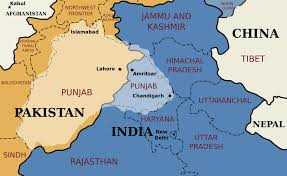
The states of India and Pakistan seem to be approaching war, never a good thing but particularly worrying when both states have nuclear weapons. The British Raj ran both territories as one colony but separated them from one another in 1947.1
Since then there have been a number of conflicts between them including war and it will be no surprise to any politically-educated person that Imperialism has had a hand in that. But they may be surprised to find that so also did the Irish State.
Ireland of course had a strong connection with the anti-colonial movement in what might be called the Indian sub-continent at least from the time of the Fenians and much more so during the War of Independence, for example with the McSwineys in correspondence with the Ghandi family.2
I found the reference to the Irish State’s involvement in a 2nd-hand copy of This Great Little Nation (1999) by Gene Kerrigan and Pat Brennan, about scandals of corruption and injustice in Ireland which I am reading, a few scandals at a time.
It is always interesting reading, at times highly amusing but largely depressing, even for one who holds that this is a neo-colonial state.
I reproduce the relevant article here verbatim and in full (but reformatted for WordPress publication).
It is difficult, looking back from this distance, to comprehend that Ireland once had an independent policy on international affairs.
Those dour, pompous, conservative old men – of whom De Valera was the most visible – sincerely saw themselves as founders of a state, as statesmen, as the equals of the leaders of the great powers.
While aware of the realities of Ireland’s economic dependence on British markets, they sought to take an independent line. As leaders of a former colony, they had particular sympathies with the Third World.
The trimming of that dependence, and the gradual falling into line with the new world order, began in the early 1960s.
The USA was taking over the role previously filled by Britain and the other European colonisers, now exhausted by the Second World War. The USA, confident, triumphant, had a young, assertive President, John Kennedy.
In 1962 India was taking a particular line in its long-running dispute with Pakistan over the former state of Kashmir. Ireland’s representative in the United Nations, Frederic Boland, had discussed the matter with India’s foreign minister, Krisna Menon and had agreed to back the Indian position.
In June, John Kennedy phoned the Irish Ambassador to the US, Thomas Kiernan, and asked him to help change Ireland’s position on Kashmir. He wanted Ireland to propose a motion pushing the US line.
“We can’t put it forward ourselves, without it being knocked, and we want Ireland to put it forward”, Kennedy said, according to Kiernan. “If we can get you to come along we’ll get others.”
In the same phone call, Kennedy said that his friend and aide Kenny O’Donnell had “mentioned something to me. I’ll look after that.” Kevin Boland balked at proposing the US line. He already had a deal with Krisna Menon. “He’ll be wild,” he said.
“We have a certain friendship with India from the old days, and so on, and we can’t do it.” Ambassador Kiernan went over Boland’s head, to the Fianna Fáil Minister for External Affairs, Frank Aiken. And Aiken immediately directed that the US line be followed.
“When he heard the request came from Kennedy he agreed without demur, no difficulty whatever”, Kiernan remembered. “We introduced the resolution, it was put through.”
So far, no scandal. Just some top-level and effective lobbying by Kennedy, the kind of thing that happens every day in foreign affairs. But was that something that Kenneth O’Donnell mentioned to John Kennedy, about which the president said “I’ll look after that”?
Ireland had for some time been trying to get into the US sugar market. To do that it needed to be included in a number of countries allowed to sell a sugar quota to the US. Ambassador Kiernan lobbied the president’s friend Kenny O’Donnell, and O’Donnell mentioned it to Kennedy.
Nothing happened for quite some time, until Kennedy mentioned it obliquely in his phone call to Kiernan. In his book, JFK and his Irish Heritage, Arthur Mitchell reports that “a new bill suddenly appeared, specifically including Ireland.”
Ambassador Kiernan said, “We, for the first time, got into the US sugar market. The Wall Street Journal said that it was hard to understand how it happened, but somebody with a large smile in Washington seemed to have been responsible.” We sold our independence for a few tons of sugar.
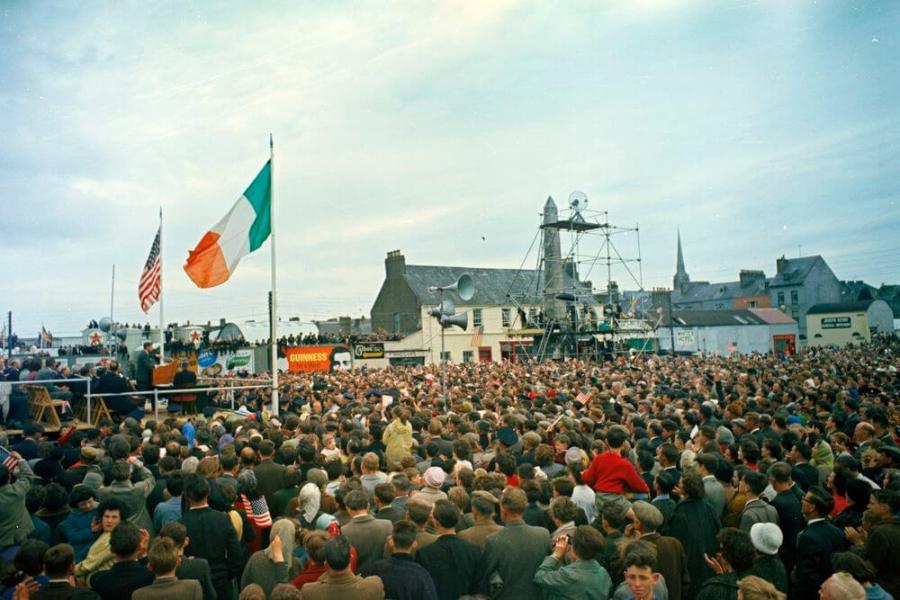
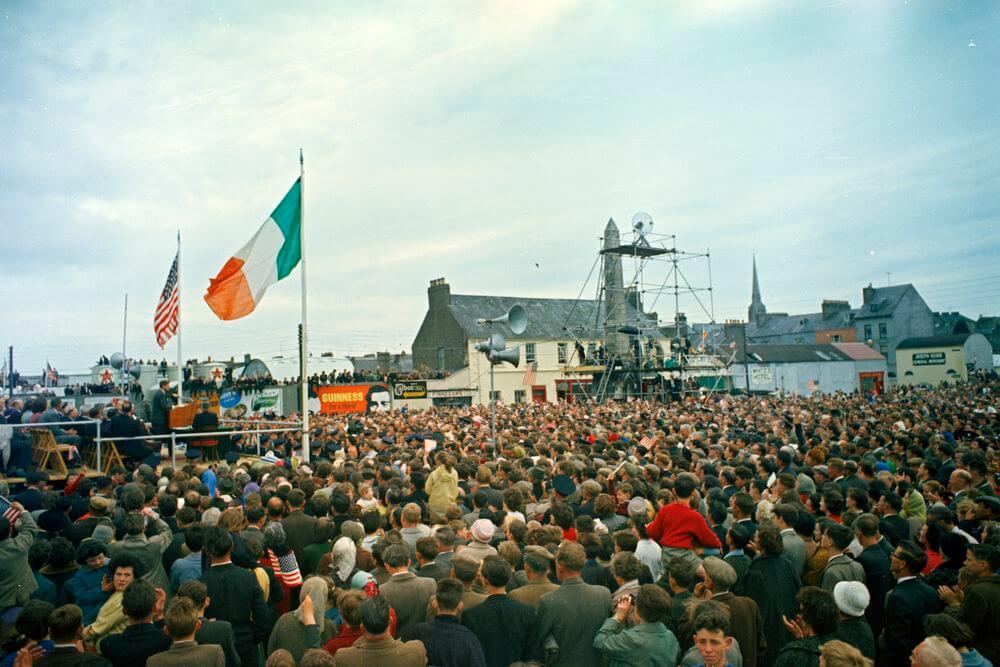
The following year, Kennedy visited Ireland. The young master, taking over responsibility from the tired old colonialists of Europe, was touring his estate.
Four years later, when an RTÉ current affairs crew was about to depart Ireland to do a first-hand report on Vietnam war, Frank Aiken intervened and the RTÉ Authority were told to call off the trip, which they did.
Independent reporting of the war would probably be critical; this would annoy the Americans; and that wasn’t allowed. The cancellation, said the government, “was in the best interests of the nation.” Not to mention the sugar business.
COMMENT
It’s interesting to identify the exact moment (or something like it) at which the Gombeen State switched from being England’s to being the United States’ bitch. Of course, there’s been a period of EU imperialism subservience and there’s always England, again3 … The bitch can switch.
By some kind of coincidence, considering the story earlier, India is a major sugar-producing country too. But … the Irish state was exporting sugar?!!
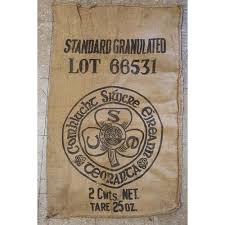
Ireland once had its own sugar industry going back to the mid-19th Century and the Irish State, building on that, nationalised it in 1930. In 1976, according to a study, the company was employing more than 10,000 people full-time, in fields, refineries, factories and in sales teams overseas.4
A further 15,000 people found employment in industries using the sugar as a raw material, industries that sprung up in the wake of the sugar factories and which, by 1976, were themselves earning the nation £20 million annually in foreign currency5.
Sugar quotas were imposed by the EEC and the State began successively to reduce the industry in Ireland, finally privatising it in 1991 by selling to Greencore, who closed the last factory down in 2006.6 We were still consuming high amounts of sugar but now importing it all.
We used to import it from the USA, and so the earlier story comes around to its starting point once more. More recently France, Netherlands, UK and Belgium have taken over supplying us.7
We imported sugars and sugar confectionery to US$536.42 Million during 2024, according to the United Nations COMTRADE database on international trade.8
Sugar is used directly as a sweetener for the table but also in the making of confectionery and it is an important component in the fermentation process of drinking alcohol. Beet pulp waste can be a valuable animal feed and production, refinement, packaging and transport all provide employment.
Nowadays, ethanol fuel and bio-degradable plastics could also be produced from beet9 which would be great for Ireland, along with the more traditional benefits. But that requires an independence-conscious planned State economy — so looks like it will remain just a nice idea.
End.
SOURCES
Terrorist bombing in Kashmir and current Pakistan-India tensions: https://edition.cnn.com/2025/04/24/india/pahalgam-india-pakistan-attack-explainer-intl-hnk/index.html
Sugar production Ireland: https://www.farmersjournal.ie/food/news/despite-its-difficult-past-is-there-a-place-for-future-irish-sugar-production-805519
Fuel and biodegradable plastics from sugar beet: https://www.nature.com/articles/d42473-023-00018-7
1200,000 to 2 million killed in the communal violence that followed, 12 to 20 million displaced. (Wikipedia).
2With the Ghandi political dynasty (not Mahatma Ghandi) in particular when Terence McSwiney was on his long hunger strike in Brixton Jail in 1920.
3Political leader of the Blueshirt section of the Gombeen class expressed leanings in that direction during an interview https://www.breakingnews.ie/ireland/varadkar-says-us-is-no-longer-reliable-political-and-economic-partner-to-europe-1756771.htm
4https://www.independent.ie/regionals/a-history-of-the-irish-sugar-industry/27038406.html
5Ibid.
6There were allegations that the financial justifications for closure were faulty and in 2010 the European Union Court of Auditors found that the Mallow plant in particular did not need to close. https://www.farmersjournal.ie/food/news/despite-its-difficult-past-is-there-a-place-for-future-irish-sugar-production-805519
7https://trendeconomy.com/data/h2/Ireland/1701
8https://tradingeconomics.com/ireland/imports/sugars-sugar-confectionery
9https://www.nature.com/articles/d42473-023-00018-7 and https://www.ebsco.com/research-starters/agriculture-and-agribusiness/sugar-beet-ethanol
 rebelbreeze