The last person of the 10 Republican prisoners to die in the 1981 Hunger strikes died on August 20th but hunger strikes continued for a while until relatives began instructing the doctors to give the strikers alimentation.
What can be said about those strikes? Clearly, a tremendous sacrifice requiring immense courage and determination in a non-violent protest by national liberation fighters in jail in a struggle against British colonialism.
Certainly we lost individuals of great worth in that struggle. It may be asked whether the gain was worth the sacrifice or whether the prison struggle might have been fought in some other way.
The medieval Irish society practice of fasting as a means of protest may or may not have been original but it was an important part of the people of India’s struggle against English colonial rule. Palestinian prisoners have used mass and individual hunger strikes on a number of occasions.
The effects of the Irish 1981 hunger strikes were many and wide, most probably far beyond the intentions or expectations of the prisoners. The news went around the world, bringing expressions of solidarity from many regions, including actions by parliaments of various states.
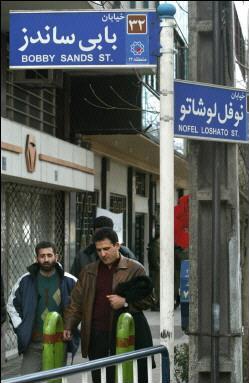
The Islamic Republic of Iran sent delegates to Bobby Sands’ funeral and renamed the street in which stood the British Embassy in Teheran ‘Bobby Sands Street’. The British Embassy to Iran had to give that as their address until they moved their main entrance around the corner.
Bobby Sands Street in Teheran, Islamic Republic of Iran (Photo sourced: Internet)
Hunger strikers stood in parliamentary elections in Ireland on both sides of the British Border, winning some seats and coming very close to winning some others. One result was that the British changed their electoral laws so that convicted prisoners could no longer stand in elections.
In the Irish state there has not been an outright majority government since that year – every single Irish government since then has been a coalition of one kind or another.
In Britain, the hunger strikes made a huge difference amongst the Irish community there. The 1974 Birmingham Pub Bombings massacre had been jumped on by the British Labour Government to pass the Prevention of Terrorism Act 1974 (now the Terrorism Act 2000).
Probably already drafted, it was brought before Parliament and passed within days, giving the police power to hold suspects for seven days without charge, wide-scale powers of stop and search and interrogation, usually without legal representation for the victim.
Within the year a score of people from the community had been framed on serious charges, convicted and jailed: Birmingham Six, Guildford Four, Maguire Seven, Judith Ward. Subsequently many Irish people stayed away from Irish solidarity marches and meetings – just in case.
The hunger strikes of 1981 blew away much of that fear and the Irish community came out in their thousands in an attempt to save the lives of the hunger-strikers — and have never been cowed down to the previous degree since.
The Irish in Britain Representation Group was formed in 1981 after the refusal of the Federation of Irish Societies to even pass a motion of sympathy for the family of Bobby Sands, who had died only days earlier; the IBRG provided radical and resolute leadership for the next 20 years.
One of a number of songs arising from the 1981 hunger strikes was the Ballad of Joe McDonnell, by Derek Warfield. It is a good song in general but what is most excellent is its chorus, where it turns the accusation of terrorism away from the Resistance and back to British Imperialism.
And you dare to call me a terrorist, While you look down your guns! When I think of all the things that you have done: You have plundered many nations, Divided many lands, You terrorised their people, Ruled with an iron hand … And you brought the stain of terror to my land.
And it could just as well apply to US Imperialism, EU imperialism and their NATO military alliance.
I have sung the song many times over the years and did so again recently at the weekly Dubs For Palestine gathering outside Leinster House. And more recently still outside the British Embassy. I changed only a couple of words to provide a more optimistic line at the end.
End.
Note: If you found this article of interest, why not register with Rebel Breeze for free, so that you will be notified by email of subsequent articles. You can de-register any time you wish.
It is well known that many Irish patriotic songs contain a figure metaphorically representing Ireland, usually a woman, very often young and beautiful though sometimes elderly.1 But unusually, in one such song the metaphor is a species of cow.
A woman is understandable, of course, after all the land and the nation are of feminine gender in Irish.2 But a cow? Well, perhaps, however strange, it reflects the values of a largely pastoral society as Ireland’s was during the early centuries of its invasion and gradual conquering by England?
Perhaps – but there is a strange modern story there too, of which more later.
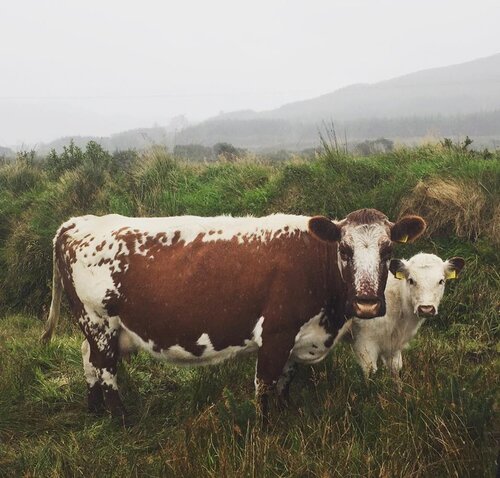
Droimeann cattle, cow and probably calf (Source: Internet)
THE SONG
The song in question is An Droimeann Donn Dílis,3 thought to date from the early 1700s (i.e. early 18th Century). In the first of three short verses that have come down to us, the singer addresses the cow, asking where s/he goes at night and where remains during the day.
The Droimeann replies that s/he is in the woods with her/his boy (herder) but that he left her/him in tears. She seems to go on to speak in completely unbovine terms of lacking a domain, wines, music, educated company, drinking only water while her/his enemies enjoy whisky and wine.
The speaker has become a person. Were s/he free to do so and gain sight of the Crown, s/he says, s/he would thrash the English as one might an old shoe, through hill, through cliffs and dark foggy glens and that’s how s/he would woo or please his/her fair young Droimeann (i.e Ireland).
It is not difficult to decipher the meaning. The man4 has been deprived of his lifestyle and patrimony, physical and cultural, social interaction and is now living in primitive conditions, in hiding even in the woods. Who was he and what was his position? Who dislodged him?
The details of the song indicates he was victim of one of the English campaigns of occupation of Ireland and dispossession of the native Irish, while its assumed timing places it in the aftermath of the Williamite War (1689-1691) and the final defeat of the remains of the Gaelic Order.5
But it could just as easily refer to Oliver Cromwell’s military and land confiscation campaign of 1649-16536 for the English Parliament, or to English Queen Elizabeth I’s Plantation of Munster in 1586, confiscating roughly 300,000 to 500,000 acres of land to bring in English settlers.7
And in relation to the latter, there seems to be a Munster connection in the song also, of which more later also.
The Gaelic Order is often described as a ‘pre-feudal’ social and political organisation of Irish society, with a political and social elite in ownership of sections of land for their clan, along with the herds upon them, but an ownership that implied management, dispensation and allocation.8
The ‘freemen’9 were allocated cattle by the elite, to whom they were obliged to repay in kine and dairy products and to render military service when required. The ‘freemen’ in turn took on others to help manage the herds and milking, making cheeses etc.
Rule and social order was not arbitrary but was regulated not only by custom but by the codified Brehon Laws and in more ancient and pre-Christian times in Ireland interpreted by a branch of the Druidic Order.
The removal of the Gaelic Order elite by death, imprisonment, banishment or exile meant the removal of Irish society’s political and cultural leadership, for it was they who organised the economy, made alliances, gave leadership and also patronised poets, musicians and scholars.
The human narrator in An Droimeann Donn Dílis is well aware of the source of his ills (the English conquest) and of the need to defeat it in arms throughout Ireland.
A Dhruimfhionn Donn Dílis, a shíoda na mbó Cá ngabhann tú san oíche, is cá mbíonn tú sa ló? Ó bím-se ar na coillte is mo bhuachaill im’ chomhair Agus d’fhág sé siúd mise ag sileadh na ndeor.
Níl fearann, níl tígheas agam, níl fíonta na ceol; Níl flathaibh im’ choimhdeacht, níl saoithe ná sló; Ach ag síor-ól an uisce go minic sa ló, Agus beathuisce is fíonta ag mo naimhde ar bord.
Dá bhfaighinn-se cead aighnis nó radharc ar an gcoróin, Sasanaigh do leidhbfinn mar a leidhbfinn sean-bhróg Tré chnocaibh, tré fhaillte, tré ghleannta dubh-cheo, Agus siúd mar a bhréagfainn-se mo Dhroimfhionn Donn Óg.
… AND THE COW
But what of the cow? It turns out that the adoption of an Droimeann as a metaphor for Ireland is much more appropriate than we might have imagined, for it is an ancient native Irish breed, though that was not formally recognised until 8 January 2020 following DNA profiling.
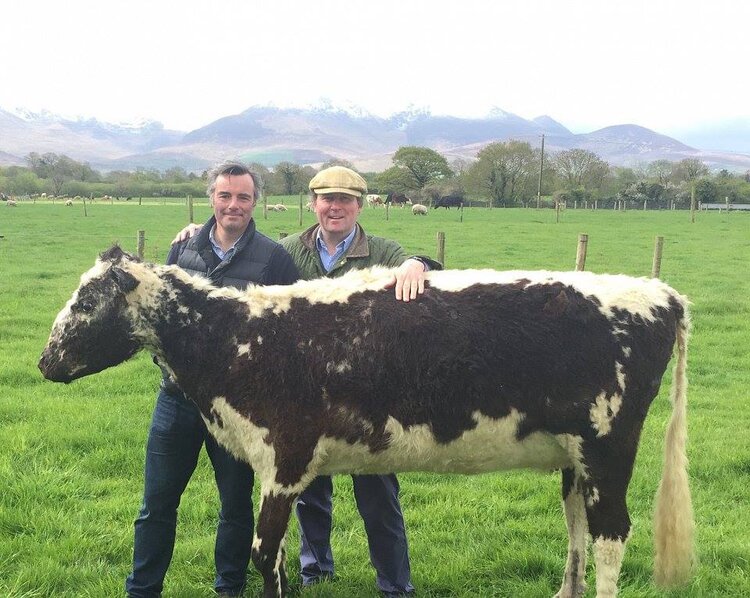
A Droimeann with men beside it to indicate its height. (Source: Irish Rare Breeds)
The tests showed that it was genetically distinct from other breeds, whether Irish or imported. “Animals may be black, red or roan, but most have a white stripe along the back. In 2020, there were 243 breeding females and 23 breeding males registered.”10
The ‘white stripe’ is indicated in its name, Droimeann, i.e Drom Fhionn: “Fair/ Light-coloured back.” And there are many references to the breed in surviving ancient literature. Today the pronunciation varies from ‘drimunn’ to ‘dromeen’ (approximately).
As for the Munster connection, the breed is particularly associated with the south-west of Ireland. It produces both meat and milk and, being a native breed, it is hardy and thrives on poor quality forage even in winter when most other breeds in Ireland require food brought to them.
Droimeann cattle are know for maturing early and being prolific breeders.
I do not know how the song survived the centuries unless it was orally, in the main, which testifies to the power of its imagery and the retention of the Irish language in the Irish population, the majority of which did not become English-speaking until some time between 1850 and 1870.11
And even then, persisted in being retained as a first language in the Gaeltacht12 areas (despite their continual shrinking) for the following two centuries and undergoing ‘revival’ at least three times during that period. We may be witnessing currently her fourth revival period.
End.
Note: If you found this article of interest, why not register with Rebel Breeze for free, so that you will be notified by email of subsequent articles. You can de-register any time you wish.
Footnotes
1The use of young woman to represent Ireland could of course be used to disguise a patriotic song as one about romantic love but also meant that the latter could morph into patriotic song, with perhaps the addition of some lines or verses. We may consider however that there is more than convenience at play here in this interchangeability, some emotional attachment to the land in the poet and presumably among their supportive audience.
2And in a great many parts of the world represented by a goddess. The very name Éire (and Éire-land = Ireland) is thought to derive from a goddess Éiriú, while the goddess Banba (sometimes her sister) also represents Ireland, with her (sometimes sister) Fódla. In poetry and song Ireland has also been represented by female figures Róisín Dubh (in a love song), Caitlín Ní hUallacháin (in a patriotic play) and Gráinne (in myth, legend and song).
3Also spelled Druimfhionn in Irish – The Faithful Brown Droimeann.
5The Gaelic Order describes an Irish-speaking society of custom and law enduring centuries prior to the English invasion and also in consecutively smaller regions of Ireland for a little over five centuries afterwards.
6Though the native Irish could go ‘to Hell or to Connaught’ accurately reflects the policy it is uncertain whether Cromwell or his officers actually said those words.
8Clan leaders, petty kings and even ‘High Kings’ were elected, albeit from and by an elite group.
9‘Freemen’ is not a very accurate term, since women could own land under the Gaelic Order and, upon marriage, retained that ownership and, if divorcing, removed what they owned with them.
10The Droimeann Cattle Society was established on 11 September 2016 at a meeting of breeders and others interested in the preservation of the breed. A Droimeann Cattle Herdbook was launched on 22 August 2018. To be eligible for inclusion in the herdbook, all animals will have to be genetically tested, and newborn calves will need to be tested before being eligible for inclusion. By January 2020 there were 243 breeding females and 23 breeding males included in the herdbook.
11The Irish elite after a century of occupation were perforce English-speaking (but most bilingual with Irish too), since the legal system was in French first, then in English. In 1366 the ruling class of England, considering themselves English after three centuries of Norman conquest of Anglo-Saxon England, called their Norman-Irish relatives, ‘the degenerate English’ who had ‘become more Irish than the Irish themselves’ and enacted the Statutes of Kilkenny to halt and reverse their integration into Irish society. By comparison, the Norman English rulers and nobility considered themselves English by 1366, though their culture and language had evolved from a mix of French and Anglo-Saxon roots. King Edward III, who ruled in 1366, spoke English, promoted it in law courts, and identified fully as an English monarch engaged in the Hundred Years’ War against France. The Irish did not become mainly English-speaking until over two centuries of occupation and only then by the incremental use of wars and English-speaking plantations.
12Areas of Ireland where Irish is the first language of the home may be found in, Cos. Meath (Rath Chairn and Baile Ghib), Galway (Conemara), Mayo (various pockets), Donegal (various), Waterford (Rinn), Cork (various), Kerry (Dingle and Iveragh Peninsulas). In addition some families in other areas raise their children with Irish being the language between at least one parent and the children.
The international conflicts around the world are largely explained by imperialism versus liberation struggles or, occasionally, as in two world wars, struggles between the imperialists themselves, as entirely in WWI and very largely in WWII. But not all control is by invasion or occupation.
The idea of an imperial power invading other countries, occupying and dominating them is easy to grasp, it being similar to the behaviour of feudal empires. But even in ancient times, kingdoms could be controlled by a stronger power without occupying them – by intimidation and bribery.
That kind of collaboration is easier and cheaper for the dominant exploiting power to manage and certainly less risky. Conquered populations can remain resistant for generations and rebellions can break out again and again as has been the case par excellence in Ireland.
Also the taxes and rents extracted by feudal empires from subject kingdoms are largely replaced today by high profits on finance invested in the extraction of natural resources from client nations and often in exports to those very nations, often fabricated from their very plundered resources.
And that latter example is where from comes the word ‘comprador’, i.e ‘buyer’; the client economies exported raw resources, made little themselves but bought finished products from the dominant power. “Gombeens”1 is an Irish appellation for native foreign-dependent capitalists.
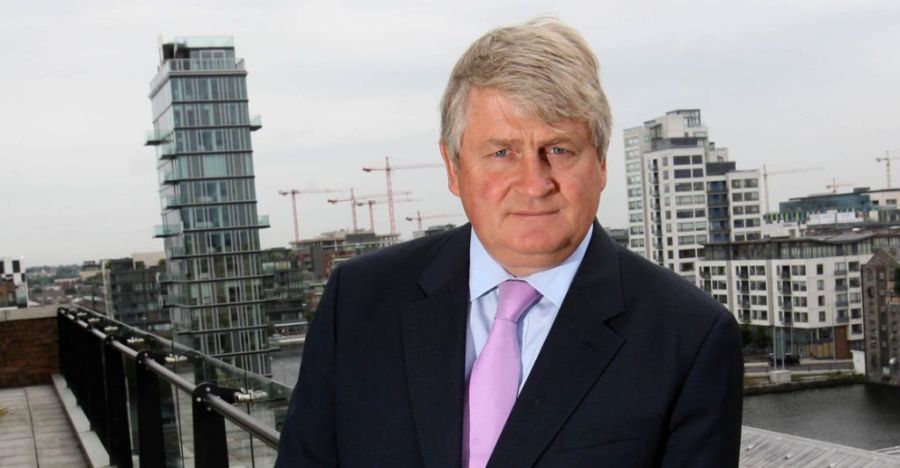
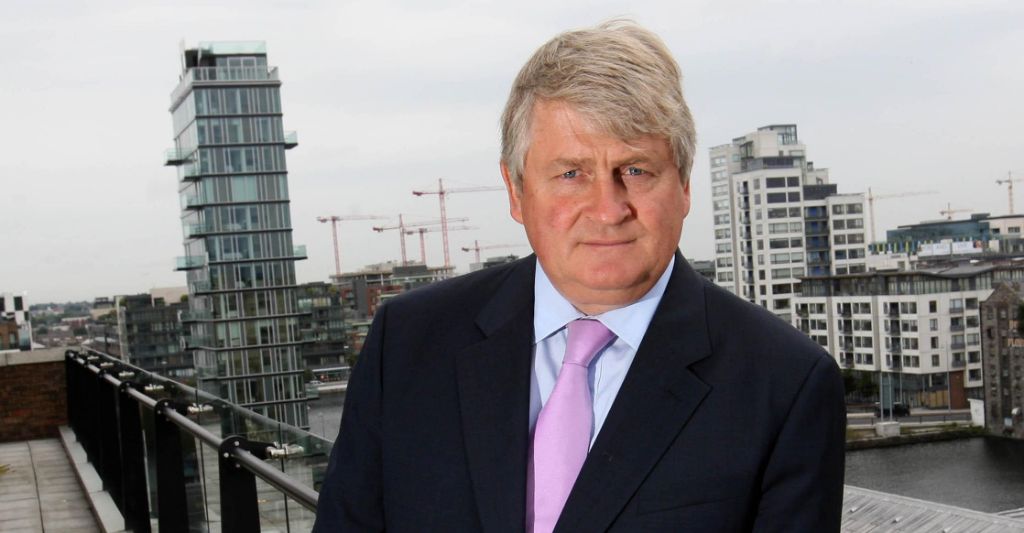
Gombeen Denis O’Brien, owner of many known companies including construction, telecommunication, water infrastructure, fuel and media.
Of course, in a later stage, the dominant power exported not only finance to invest but whole factories, with resulting production declining within the former industrial powers.
Analysing the imperialist capitalist system internally, it becomes less and less productive, increasingly parasitical and dominated by finance capital, whereas the colonies and client states may even become more productive but only in such ways as are required by the imperialists.
Production of their own necessities, even their very food may decline in client states and colonies as they are driven to concentrating on export-orientated cash crops and minerals instead. The ruling classes in such countries are merely economic/political managers for the imperial powers.
They are comprador capitalists, neo-colonials, typically orientated culturally towards the imperial power, often venal, contemptuous of their own nation’s people and their history, contemptuous enough often to flaunt their ill-gotten wealth.2
There are many examples of such people and behaviour around the world, some of the more famous being Lavalle (France), Vidkun Quisling (Norway), Mahmoud Abbas (Palestine), Daniel O’Connell and Michael Collins (Ireland); which last brings us nicely to the Gombeens ruling the Irish State.
Anti-Treaty cartoon, 1921, depicts Ireland being coerced by Michael Collins, representing the Free State Army, along with the Catholic Church, in the service of British Imperialism. (Sourced: Internet)
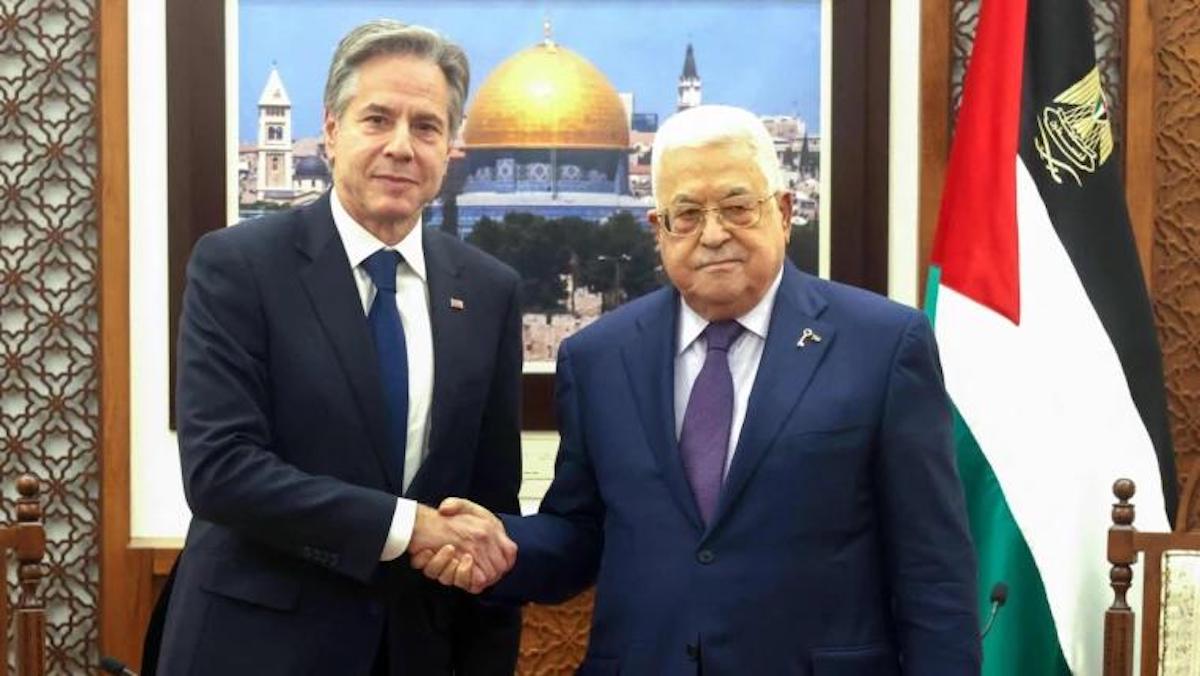
From right of image, Mahmoud Abbas of the Palestinian Authority poses shaking hands with the representative of his US master, Antony Blinken. (Image sourced: Internet)
The Irish State came into existence after centuries of English occupation and resistance after which the colonial power offered more autonomy but partition. The Resistance refused acceptance and the new State defeated the national liberation forces in the ensuing Civil War (see History Appendix).
Ireland is a partitioned nation: one-sixth of its territory (the Six Counties colony) is occupied by the UK, policed by a sectarian colonial police force and garrisoned by British armed forces and is part of the European imperialist military alliance of NATO.
Yet the invaders’ chiefs, including military and monarchy are welcomed by the leaders of the Irish State and the invader’s Royal Air Force patrols skies of the Irish state.3 The State’s police works in close cooperation with the sectarian police force of the colonial administration.4
The Irish economy is comprehensively penetrated by companies of foreign ownership: The State’s carrier Aer Lingus is owned by British Airways. The former state telecommunication networks is owned by Eircom, 64-65% owned by a French company and most of the rest by a US company.
Foreign-owned companies dominate the retail sector, accounting for roughly 30% of employment and over 50% of total turnover and retail gross value. It terms of food products retail the figures are the same with British and German monopolies dominating the rest.5
Most food consumed in Ireland is now imported, a country that two centuries ago could feed a larger population and yet still export some.
Retail banking is ‘highly internationalised’ i.e. dominated by foreign-owned institutions and has been so since the founding of the State, accounting for 24% of sector earnings. International financial services from Ireland is even more foreign-dominated, accounting for +90% of jobs.
Irish whisky production is divided between a US-based and a French company (which also owns Cork Dry Gin), while Irish beer, stout (including Guinness) and lager are produced by the British company Diageo. In addition, beers and spirits are imported large-scale from abroad.
Some of the money from roads collecting tolls goes to foreign companies, eg. French and Spanish. While the Irish State owns the infrastructure and collects the revenue of Dublin’s LUAS, the day-to-day operation and maintenance are contracted out to German and French companies.
Roughly 21% of hospital beds are in the private (non-state) sector and a significant portion of that private market—alongside specialized diagnostic and sports clinics—is foreign-owned or backed by international private equity and multinational healthcare groups.
According to AI, non-resident institutional and foreign-backed real estate companies buy a significantly higher share (over 50%) of newly built multi-unit apartment developments in urban centres like Dublin and Cork. 6
Approximately 60% to 70% of total assets in the Irish banking and financial system are linked to foreign-owned institutions or cross-border non-resident claims. However, the domestic retail banking market is heavily concentrated among a small number of groups with Irish headquarters.7
Following the exit of major foreign retail players like Ulster Bank and KBC which were active in banking with the Irish state, Irish-headquartered groups like AIB, Bank of Ireland, and PTSB came to take a large share of retail banking in Ireland but these too have foreign connections.8
The colonial history of Ireland and neo-colonial evolution of the Irish State has been deepened by its suppression of forces of national resistance9 and by opening its internal markets, national resources and State networks to foreign penetration.
It is hardly surprising that the national bourgeoisie of Ireland is incapable of asserting sovereignty and independence not only in relation to the UK and the USA but also in the face of the western imperialist alliances of the EU and NATO.
The images of four reformist Irish politicians which City Managers of Dublin City Council erected over the Bank of Ireland building (former Irish Parliament under British rule) in College Green as a riposte to the commemoration of the 1916 Rising. Not only were these politicians not revolutionary, each one failed completely to even win the limited autonomy he set out to win. From top left around the clock: Henry Grattan, Charles Parnell, John Redmondand Daniel O’Connell. (Image sourced: Irish Times)
Contemporary examples of this lack of sovereignty is permitting US military flights through Shannon Airport and, despite overwhelming popular support for Palestine and against ‘Israel’, the Irish state continuing to be the second-largest importer of ‘Israeli’ exports.
Describing the problem is useful to an extent but mainly if we then direct ourselves to resolving the issue. A Gombeen class will never deliver independence or sovereignty – it is incapable of doing so. But it is not incapable of repressing those who actively seek independence and sovereignty.
Perforce, the struggle against imperialism most also strike at neo-colonialism and conversely, the Gombeens must be exposed and overthrown in order to be free of imperialism and colonialism.
End.
Note: If you found this article of interest, why not register with Rebel Breeze for free, so that you will be notified by email of subsequent articles. You can de-register any time you wish.
HISTORICAL APPENDIX (Reading time:2 mins.)
The foreign occupation of Ireland10 promoted the use of the English language and culture and from the reign of Henry VIII onwards this included religion, a branch of Christianity of which the Monarch of the realm was also the Head of the Church.
That was resisted not only by the indigenous Irish and descendants of Vikings but by most of the Anglo-Norman lords’ descendants in Ireland too. Their English-based contemporaries excoriated them for having become the ‘degenerate English’ and ‘more Irish than the Irish themselves’.11
The cultural-political struggle continued with the Irish and Gaelicised Normans being dispossessed and suppressed until a section of the occupying settlers sought to unite people of all cultural backgrounds in Ireland in order to establish an independent Irish Republic.
Following defeat and suppression of the United Irishmen, the native Catholic bourgeoisie began to slowly rise, their main efforts at first being to legalise the Catholic Church as an institution and to abolish the discriminatory Penal Laws against Catholics (i.e. the majority of the indigenous).
While O’Connell and his followers also sought the return of an Irish Parliament,12 they did so as part of the British Empire. Their Repeal Movement leadership totally eschewed the use of force and this led to the ‘Young Irelanders,’ their most progressive component, splitting from them.
Subsequently the native Irish bourgeoisie participated in pressurising the Occupation and the landed aristocracy into giving greater security to the peasantry renting agricultural land. However this struggle too was presented in non-revolutionary terms, as a resolution within the British Empire.
The Parnellites and their political heirs evolved over time into the Redmonites of the Irish Nationalist Party,13 still very much for remaining within the Empire. After the 1916 Rising these were all but wiped out as an electoral force in the 1918 UK General Election.
The party that won the vast majority of Irish seats in that election was a coalition of revolutionary and radical non-revolutionary nationalists of various types, calling itself ‘Sinn Féin’ although it differed from the original party of that name in being avowedly Irish Republican.14
Many of the party’s representatives in the Dáil, the Irish Parliament, strongly endorsed the armed struggle of the newly-created Irish Republican Army.15 But not all, although eight months into the 2nd year of the War of Independence the Dáil formally claimed the IRA as its military wing.16
When the British, in order to stop the armed and political struggle against them offered the new Sinn Féin Government leadership a deal with partial autonomy as one of the British Dominions but with the country partitioned, it split the movement and one part of it attacked the dissenting part.
During the ensuing Civil War, the State forces were armed, supplied and even clothed by the British and executed more Irish Republicans than the British forces had done during the War of Independence. Activists were interned without trial and a number of organisations banned.
In addition, the State police and Army kidnapped, tortured and murdered opponents.17 Although the Sinn Féin party that opposed the Anglo-Irish Agreement split to form Fianna Fáil, the party longest in government, the Irish State that exists today is in an unbroken line of descent from that of 1922.
1From the Irish language Gaimbín, a pejorative description of Irish individuals who took advantage of the poverty and debts of Irish people during and after the Great Starvation of the mid-19th Century to acquire land cheaply.
2Some specific examples are Imelda Marcos’ shoes and Charles Haughey’s purchase of an island. Imelda Marcos, the former First Lady of the Philippines, became globally infamous for owning around 3,000 pairs of shoes, which symbolized lavish wealth and extreme government corruption during her husband’s rule. When protesters and officials raided the presidential palace in 1986, they found her massive collection alongside thousands of other expensive gowns and designer items. Charles Haughey held a number of Government portfolios but was Prime Minister of the Irish state Dec 1979 – Jun 1981; Mar 1982 – Dec 1982; Mar 1987 – Jun 1989; Jun 1989 – Feb 1992.
4Even without being on British payroll: Former Garda Assistant Commissioner Edmund (Ned) Garvey was named as a British intelligence “asset” by British whistleblower and former soldier Fred Holroyd, who claimed he met Garvey at Garda Headquarters in Dublin during the 1970s. Garvey denied being a spy, though official investigations like the Barron Report confirmed a meeting took place without Garvey reporting it to his superiors.
The board features international leadership, including Chairman Akshaya Bhargava and non-executive directors like Pascal Boillat (who brings decades of global operational experience across institutions like Deutsche Bank and Citigroup), alongside international committee members.
Operates extensively across the UK and international markets.
AIB (Allied Irish Banks)
AIB operates subsidiary structures in the UK and maintains broad international institutional shareholding following full state exit.
Board members and corporate teams frequently hold background experience across major global financial hubs in London, New York, and Europe.
PTSB (Permanent TSB)
Following the €1.6 billion acquisition agreement by Austria’s BAWAG Group, continental European banking interests have direct representation and control over the institution’s trajectory.
The board includes directors with heavy international banking backgrounds, such as prior executive experience spanning EMEA, the US, and the UK.
9The Civil War/Counter-revolution 1922-’23 and repression until 1939, Fianna Fáil Government 1939-1945, Irish State repression campaigns mid-1960s, Section 31 Broadcasting Act 1971, re-establishment of the non-jury ‘sentencing tribunal’ of the Special Criminal (sic) Court 1972, use of the ‘Heavy Gang’ 1980s.
10Usually dated from the Anglo-Norman invasion of 1169, although the British did not succeed in totally dominating all parts of Ireland until the beginning of 17th Century.
12 The Irish Parliament under British colonial rule was a thoroughly sectarian one, open only to members of the small minority Anglican community and the failed attempt to enlarge it to all religions in Irish was what had convinced Irish Republicans to form the revolutionary United Irishmen organisation. After the suppression of the latter’s uprising in 1798 the English administration had organised the Parliament abolishing itself and Ireland becoming part of the British Union in 1801.
13Charles Stewart Parnell formed most of the MPs elected in Ireland into a party to participate in the UK Parliament.
14Griffith, founder of the original Sinn Féin had argued for a dual-British-Irish monarchy but agreed to the change.
15Newly-created from former members of the Irish Volunteers of 1916 and Irish Citizen Army and with new recruits.
16August 1919 – the following month the British occupation banned the Dáil.
17In particular in and from Oriel House, located at the corner of Westland Row and Fenian Street.
Readers will, we’re sure, sympathise with Patrick Quinlan on his resignation from the leadership of the National Party, alleging undemocratic goings-on in the party’s ‘ard-chomhairle’. Undemocratic behaviour in a fascist party! Who’d have thought?
Apparently they voted him, their party leader, off their national committee for asking questions they found awkward and for making criticisms of some things they were doing and about things he thought they should do, which they weren’t.
Quinlan is the party’s only elected public representative, elected to Fingal County Council in 2024.1 Rather than targeting property speculators his election leaflet perpetuated the lie of ‘mass immigration’, that this was ‘fuelling inflation’ and ‘depriving our nation of affordable homes’.
No mention of big landlords. Or bankers. Though his voting record shows opposition to one rent rise plan he did vote in favour of ‘moderate rent increases’ and a time when the purchasing power of incomes is falling. Quinlan is clearly not a supporter of a program of universal rented housing,
But Quinlan, like his party, knows what’s important and will solve most of our problems, apparently and so he has participated in anti-migrant demonstrations and spoke at the pan-racist event in Dublin in April last year perversely linking their trajectory to that of the 1916 Rising.2
FOUNDING OF THE PARTY AND INTERNAL WORKINGS
Quinlan’s letter of resignation and the national committee’s response reveal interesting facets of the party’s internal workings: meetings are online, no minutes of meetings are kept but voting results noted on WhatsApp; the list of members (such as they may be) secret even from their leader.
The fascists who founded the NP did so in 2016, while other people were either preventing the fascist Pegida’s launch in Dublin,3 commemorating the centenary of the 1916 Rising or questioning why it and the subsequent War of Independence had failed to bring about the intended Republic.
Any notion that the racists and fascists might’ve shared those concerns can quickly be put to rest by examining the 1916 Proclamation of Independence, in particular the lines that “The Republic guarantees religious and civil liberty and equal opportunities for all.”4
The NP has had more than its share of splits and internal struggles, from the missing gold bars to the reported value of €400,000 (£344,000) stolen from the party’s vault5 (!) in July 2023 by ‘rivals’ in the NP, to Nazi6 Justin Barrett’s dismissal as leader (denied by Barrett) two weeks later.
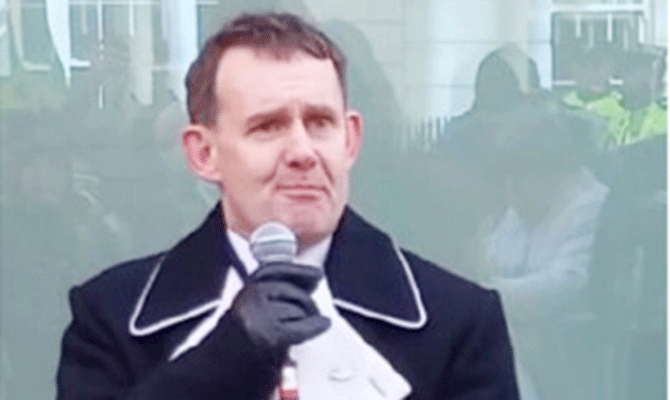
Barrett in faux-Nazi officer greatcoat, addressing a small rally of fascists and other racists in Dublin’s Molesworth Street in July 2025. (Photo sourced: Internet)
Despite Barrett’s denials, he was replaced by James Reynolds, a party co-founder with Barrett who apparently made homophobic remarks at the party’s founding conference, defended by Barrett who confirmed the party’s bias to a putative supporter who then walked out of the conference.
However, two years later Reynolds was replaced by Patrick Quinlan.
Homophobia is a frequently visible and audible aspect of fascists and the far-Right generally and in July 2020 the party organised a rally against the appointment of Roderic O’Gorman, an openly gay man, as Irish Minister for Children, pushing the line that gay men are paedophiles.7
EARLY CAMPAIGNING AND OPPOSITION
The NP supported and spoke at a number of protests against requirements to wear face masks during the Covid epidemic, at one of which they also organised an attack by supporters armed with clubs upon unarmed counter-protesters, in which they were assisted by the Garda POU.8
A few months later, a number of NP supporters confronted and jostled an LBGT activist, one of them clubbing her on the head with a wooden batten wrapped in a flag. Despite Gardaí claiming that nothing happened, many recordings on video camera forced an admission.
NP member Michael Quinn pleaded guilty in court and in October 2021 was sentenced to three years prison, the final year suspended.9
The main activity along with most of the far-Right in Ireland has been in opposing immigration to Ireland and in particular opposing Muslims. Immigrants are alleged to get preferential access to resources over Irish people – in particular housing — and of living off state social benefits.
The far-Right also accuse immigrants of attacking women and preying on children. Proving these to be lies through use of statistics does not work since the far-Right are only interested in quoting statistics that seem to prove their theories.
Antifascists have targeted the party’s events a number of times, notably in a charge against their rally outside Leinster House on 10th October 2020, when Barrett told the Gardaí that the NP was on their side10 and begged for a safe escort away from the area (which the Gardaí supplied).
The party’s annual conference in November 2022 in the expensive conference centre in Lough Erne Resort, County Fermanagh (inside the British-occupied colony) was attacked by antifascists resulting in a number of NP requiring hospital treatment.
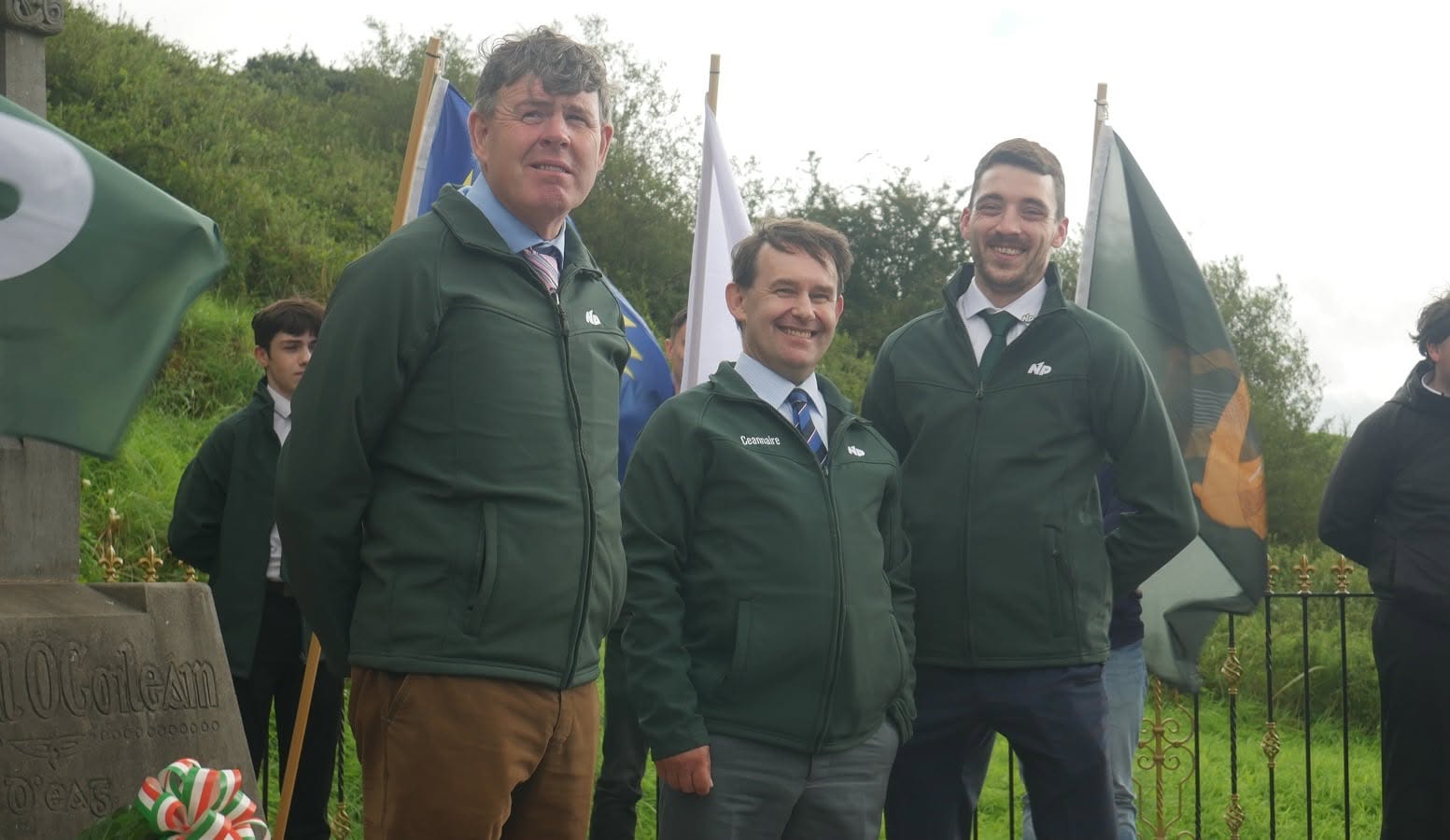
Just your local friendly fascist leaders (l-r): James Reynolds, Justin Barrett and Patrick Quinlan in days before expulsions, splits and resignations. (Photo source: Internet)
While the fascist movement in Ireland remains tiny and riven by splits, often as a result of career ambition and always due to competing egos, they remain a danger to vulnerable groups and to the democratic forces of resistance, particularly with State support, as currently in the Six Counties.
End.
Note: If you found this article of interest, why not register with Rebel Breeze for free, so that you will be notified by email of subsequent articles. You can de-register any time you wish.
FOOTNOTES
1The only one elected out of nine NP candidates in various areas.
2See reference later to the text of the 1916 Proclamation of Independence.
6Any doubts about the full accuracy of the appellation of ‘Nazi’ to Barrett can quickly be dispelled by reference to some of his utterances and to his dress sense on occasion.
7Fascists and other far-Right activists frequently throw that slur, not only at LBGT people but also in general at antifascists and anti-racists.
8Public Order Unit (what used to be called the ‘Riot Squad’). See also https://the-beacon.ie/2020/10/10/clashes-at-far-right-rally-as-national-party-leader-tells-gardai-you-are-of-us-and-we-are-of-you/ though clearly not a report of someone who was actually there. Witnesses will spot the inaccuracy of “Both groups could be seen attempting to push back the barriers separating them” which is what might have appeared from brief video clips; in fact the NP were pushing the barriers to block the antifascists while the latter were trying to remove or overcome the barriers to close with the NP supporters.
As the Irish State holds the Presidency of the European Union now and for six months hence, ministers of EU governments met in Dublin yesterday and today, the latter giving rise to an anti-war and pro-neutrality picket near Dublin Castle.
Since the Irish State’s incumbency of the EU Presidency the Irish State has forbidden demonstrations from Dame Street/ Gt. George’s Street junction to Lord Edward1 Street, along with the display of flags along that stretch.
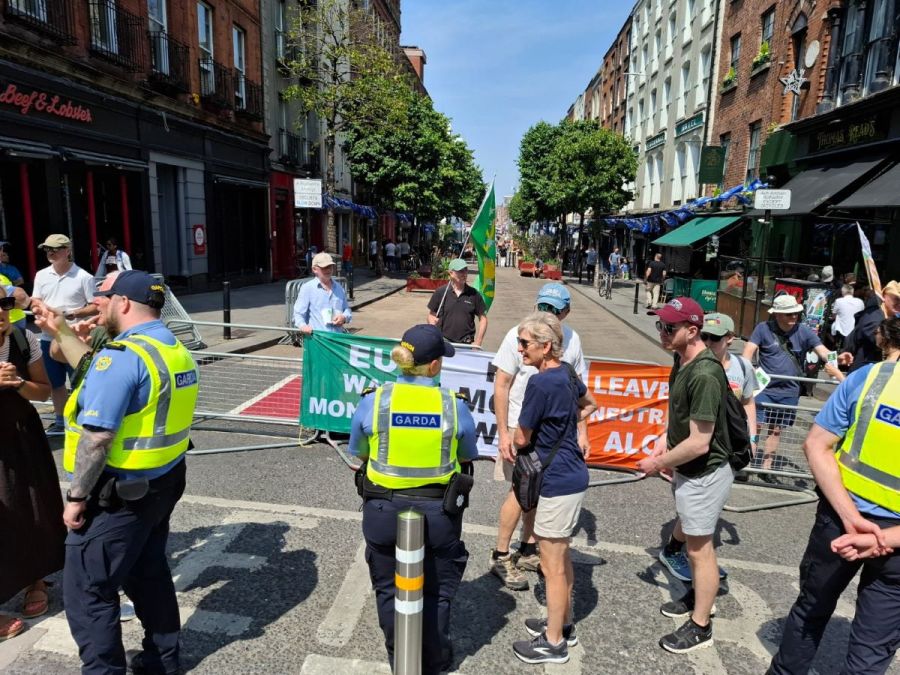
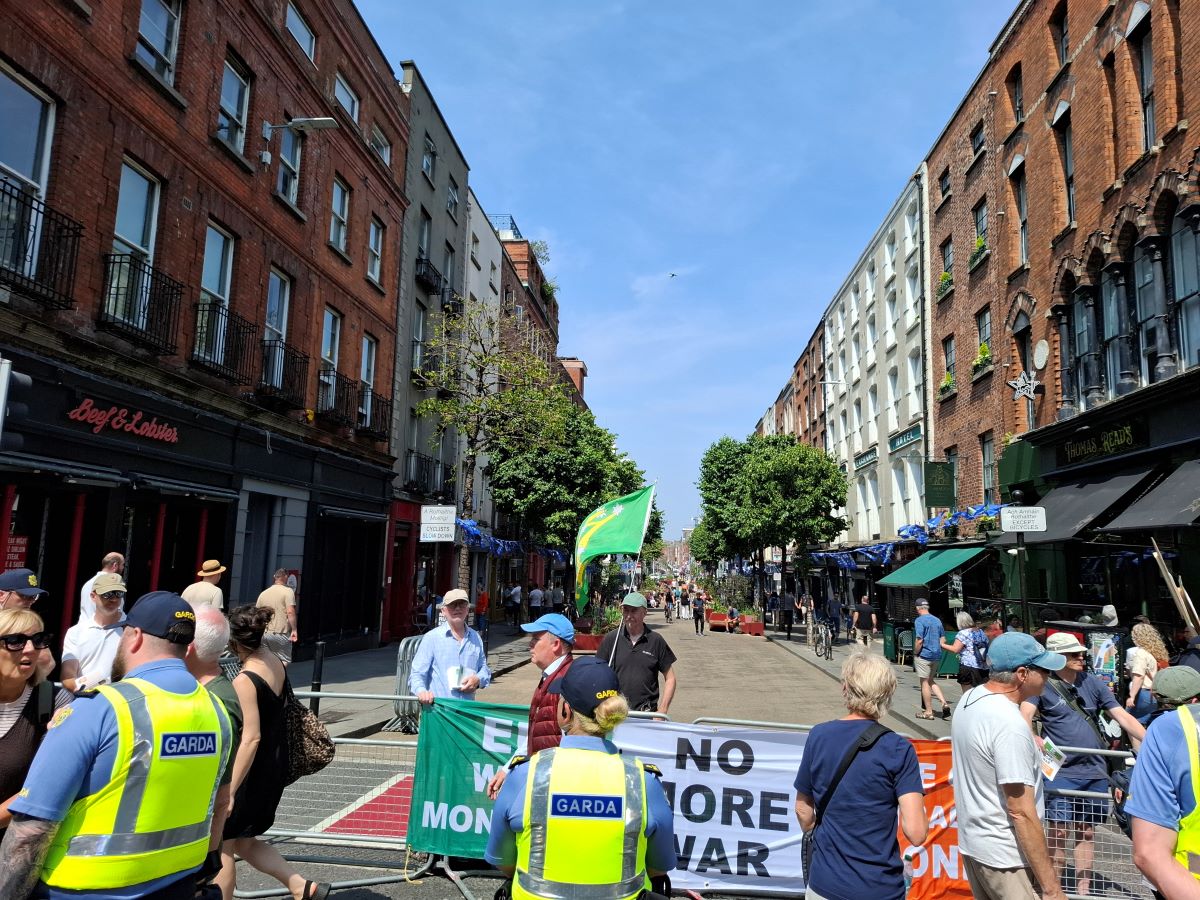
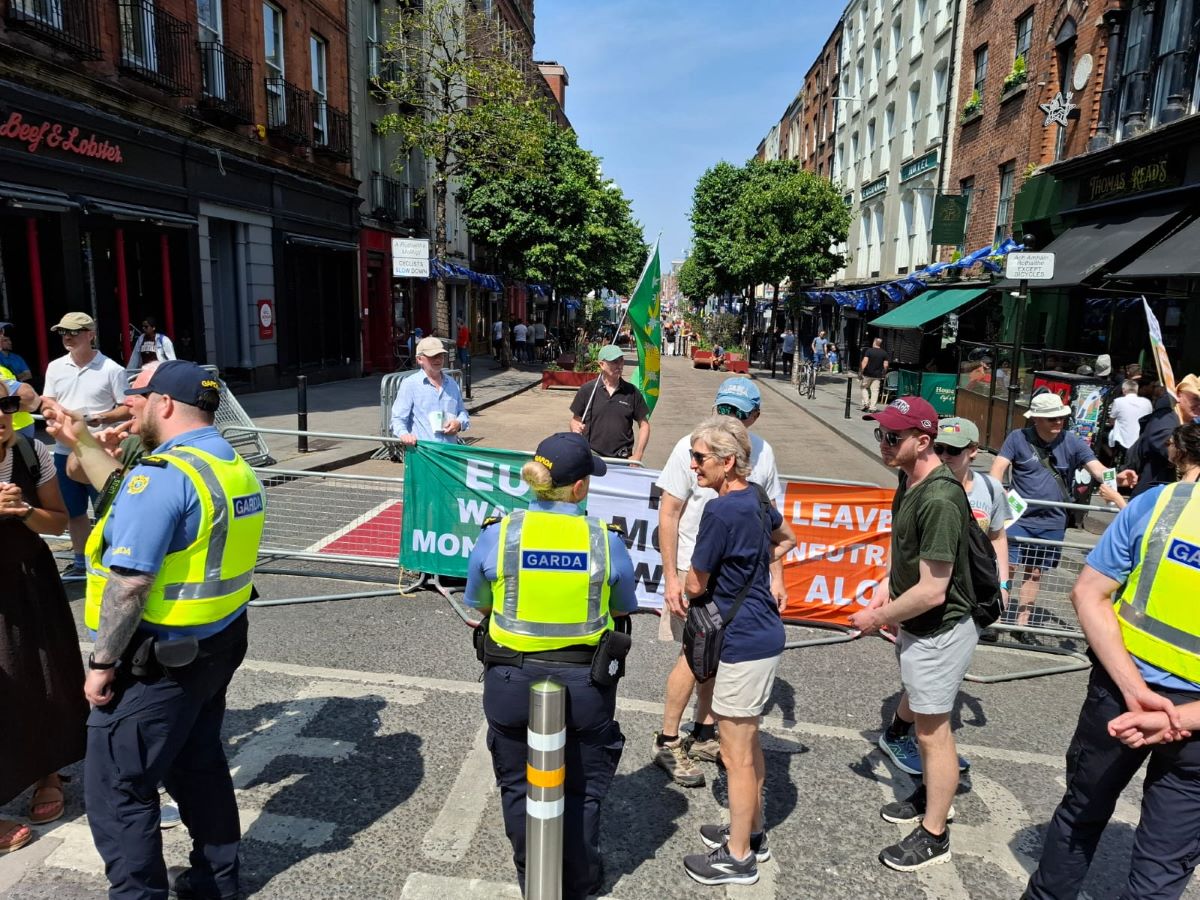
Demonstrators in favour of the retention of the Irish State’s formal neutrality took up position at the south end of Parliament Street, directly facing City Hall. The Gardaí closed most of the street entrance and had crowd barriers erected across it, which the protesters then lined with their banner.
View of some of the protesters and banner, also of the Starry Plough flag (centre photo) and pedestrianised Parliament Street leading to the river. City Hall is behind the photographer and Dublin Castle behind that again. (Photo: Rebel Breeze)
The letters on the Green, White and Orange banner read EU WAR MONGERS. NO MORE WAR. LEAVE OUR NEUTRALITY ALONE. Leaflets with the same colours on one side were distributed while the reverse expanded on the main slogan, in particular calling for retention of the Triple Lock.2
Some passing vehicles sounded their horns in solidarity.
The city was busy with pedestrian tourists and others enjoying the sun. The heat bore down on the demonstrators facing into the sun and on the backs of the Gardaí facing them and the demonstrators (some of whom had already picketed the Hatch St. EU office), packed up after an hour.
One flag alone flew over the protesters, the Starry Plough, flag of the Irish Citizen Army, the workers’ militia formed to defend the strikers and locked out workers in Dublin in 1913 and which later took part in the 1916 Rising, their leader, James Connolly,3 being overall Commander.
View of some of the protesters and banner, also of the Starry Plough flag (centre photo) and pedestrianised Parliament Street. City Hall is behind the photographer and Dublin Castle behind that again. (Photo: Rebel Breeze)
Coincidentally perhaps, City Hall was garrisoned by the Irish Citizen Army during the Rising and a steel plaque on its wall records the names of the Volunteers who fought there and in nearby buildings – half of which are women’s names (the ICA recruited women as well as men).
End.
Note: If you found this article of interest, why not register with Rebel Breeze for free, so that you will be notified by email of subsequent articles. You can de-register any time you wish.
FOOTNOTES
1Named after Edward Fitzgerald (1763-4 May 1798), one of the leaders of the United Irishmen, the revolutionary Irish Republican organisation. Often incorrectly referred to as ‘Lord Edward’, he had renounced his title, his sister later saying of him that the only title he aspired to was that of ‘Paddy’. Edward Fitzgerald went into hiding from British occupation forces but remained in the Liberties area, where his hiding place was discovered and he was wounded and arrested, having killed one of his would-be captors and injuring another. He died in jail reportedly of neglect by the authorities of his wounds.
2A provision that no more than 12 Irish State armed forces personnel may be sent on active service anywhere outside the State unless on UN mandate, a decision of the Government and a majority decision of the Irish Parliament. The suspicion is widespread in Irish society that the Irish ruling class wishes to dispense with the ‘Triple Lock’ or even to ignore it in order to commit the Irish State to NATO (or an EU armed force).
3Trade union leader, historian, journalist, revolutionary socialist, one of seven signatories of the 1916 Proclamation of Independence. Born Edinburgh (1868), executed by British firing squad on 12 May 1916.
If it turns out that the fire destruction of homes in Greenisland, Carrigfergus was caused by Loyalist bonfire embers,1 there may be renewed calls to ban the construction of such bonfires in the cause of safety.
Or even to prevent the deaths of people from Loyalist bonfire tower construction.2
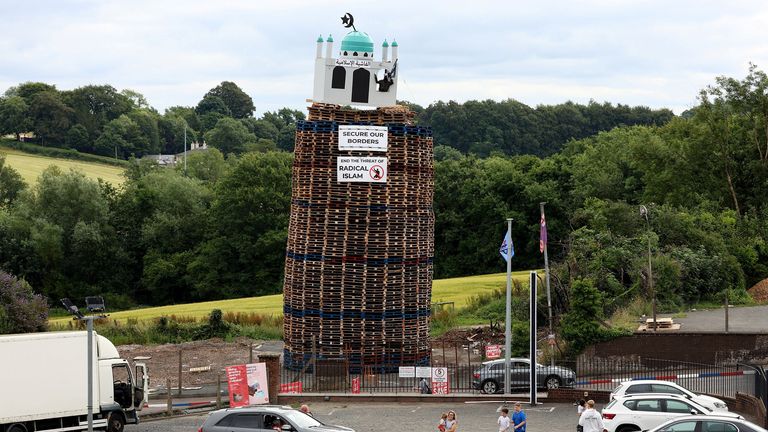
If so, such calls will miss the main point, which is that Ulster Loyalist bonfires are an expression of sectarianism and racism. It is Ulster Loyalism itself which is toxic and more lethal than any mismanaged fire. That is what is expressed in burning Irish Tricolours, Palestinian flags, images of Irish individuals, representations of migrants and of Islam.
A Loyalist bonfire with Irish Tricolour and Palestinian flags to be burned along with images of the popular rap group Kneecap and an attempt at some message aimed at them in Irish. The rejection of SDLP and Alliance colonial political parties is clear, while that of Sinn Féin is taken for granted. (Photo: Niall Carson/ PA Wire).
The record of Ulster Loyalism is as the communal enforcers of settler colonialism upon the indigenous Irish. When the United Irishmen, mostly led by Protestants, were organising in unity with Irish Catholics for Irish independence, the Orange Order was founded in 1795.
At that time it was not controlling the indigenous Irish that was of greatest concern to the British ruling class as much as the Republican Protestants, in particular the Republicans among the Presbyterians and the Orange Order targeted them too with propaganda and intimidation.
Once the threat of Protestant Republican rebellion was contained through intimidation, repression and emigration, the Orange Order concentrated on the majority mostly Catholic indigenous Irish, with general repression and periodic pogroms, continuing after Partition of Ireland in 1922.
The colonial Statelet institutionalised in law and practice discrimination against Catholics, enlisting the help and support of the majority of the Protestant working class, with the result of the worst housing and generally lowest wages in the UK – for workers of both communities.
The Loyalists mobilised against the Civil Rights campaign in the Six Counties, a campaign led by liberal Protestants as well as Catholics. During three decades of war that followed, Loyalist militias with British colonial army and police help, carried out bombings and sectarian murders.3
At this time of year people concerned for their safety or just peace of mind temporarily leave areas near to those under Loyalist control and not only in the Six Counties colony but in parts of Scotland too.
A REACTIONARY FESTIVAL
Unionist and liberal propaganda tell us that some of the bonfires are just good community fun, without flags, politician faces, migrant boat or mosque replicas on top. But the historical excuse for the marking of the 12th of July is the victory of William of Orange’s forces at the Boyne in 1690.
The Unionists celebrate this chiefly because they perceive it as a victory of Protestant forces over Catholic but also because it facilitated the destruction of the remnants of the Gaelic Order, breaking the power of Irish resistance in Ulster and completed the British conquest of Ireland.
Even without a single representation of person, country or religion on top of the bonfires, their very nature and what they intend to celebrate is reactionary, sectarian and colonial.
Most Ulster Protestants are probably unaware that although William was a Protestant and James II a Catholic, from whom Irish Catholics hoped to gain relief from repression, the Battle of the Boyne was actually part of the Nine Years War with William fighting for the League of Augsburg.
And one of the supporters of that League was none other than Pope Innocent XI because of what he and the League saw as the threat of King Luis XIV of France. The News of William’s victory at the Boyne was celebrated with high mass in a number of Catholic countries.
This year’s Loyalist Bonfire in Moygashel, Co. Armagh, with a representation of a Mosque to be burned on top and a placard calling for ‘secure borders’ against emigration. (Photo sourced: Sky News)
Loyalism has gone on to extend its hatred of Catholicism to Islam, of indigenous Irish to migrants from other lands, for example in the recent riots in Belfast.4
‘ONE MILLION PROTESTANTS IN A UNITED IRELAND’
We are frequently counselled to tolerate Ulster Loyalism, told that we must make Loyalists welcome into a united Ireland, that we need to accept their culture on equal level with others and are also subtly threatened with the potential violence of ‘One million Protestants’ if not accommodated.
The culture of Loyalism is toxic. It is intolerant, racist, homophobic, sectarian and violent. Might as well ask black people or native Americans to accept the Ku Klux Klan – after all, the KKK too have a community culture and they live in the USA along with everyone else.
A united 32-County Ireland should of course accept everyone as citizens. That is not at all to say that it should tolerate religious sectarianism, racism or homophobia. On the contrary it should oppose those evils through education and if necessary through application of the law.5
As for the implied threat of “one million Protestants”, that is to assume that all are sectarian Loyalists or at least that such are in leadership over the rest. Not all those reared in Six Counties Protestantism are Loyalists nor in fact even necessarily Unionists.
Removing the military, ideological and structural support for Unionism and Loyalism and also the control exercised by Loyalists on sections of communities will reduce Unionism and its most virulent expression, Loyalism, to a much smaller core who will have to make their choice.
Adjust to get on with your fellow citizens, or leave.
End.
Note: If you found this article of interest, why not register with Rebel Breeze for free, so that you will be notified by email of subsequent articles. You can de-register any time you wish.
3According to Wikipedia, Loyalist paramilitaries killed 1,027 people during the 30 Years War, approximately 30% of all conflict-related deaths. 911 according to https://cain.ulster.ac.uk/issues/violence/sutton.htm (a biased source) including 33 in the no-warning Dublin and Monaghan Bombings of 1974.
On 25th March 2026 the Irish State’s UN representative declined to vote in favour of the UN Declaration of the Trafficking of Enslaved Africans and Racialized Chattel Enslavement of Africans as the Gravest Crime against Humanity.1
The voting patterns reveal much about the world and the position within it that is occupied by the Irish state. The total voting membership present was 193, out of which 123 voted YES, i.e. in favour of the resolution. But where was the Irish State? It abstained, along with 51 other states.2
The Western Powers, its chief the United States and including Australia, Canada and all western Europe, including of course all EU states, abstained.
But most of the eastern Europeanstates also abstained: Albania, Armenia, Bosnia & Herzegovina, Bulgaria, Croatia, Czechia, Estonia, Georgia, Hungary, Latvia, Montenegro, North Macedonia, Poland, Republic of Moldova, Romania, Slovakia, Slovenia and Ukraine.
Voting YES in Eastern Europe were Azerbaijan, Belarus and the Russian Federation,
In Africa, including North Africa, all states voted YES for the motion.
In East Asia, China, Mongolia, North Korea and South Korea voted YES but Japan followed the Western Powers in abstaining (Taiwan is not a UN member state).
In S.E. Asia only Cambodia abstained, the rest of the states in the region voting YES.
In Central Asia, all UN member states voted YES.
In Western Asia (previously termed ‘the Middle East’), only Oman abstained, all other states in the region voting YES, i.e. in favour of the resolution.
In the Western Pacific only Palau and in the Southern Pacific, only Fiji abstained (along with Australia and New Zealand, as noted earlier, as medium powers within the Western Bloc).
In Latin America, only Paraguay abstained and as we’ll see, Argentina voted No to the motion. All other Latin American countries vote in favour.
Yes, Argentina actually voted against the motion, one of only three states voting NO, the other two being the United States and Israel.
The Irish state’s excuse for their abstention included3 “ … concerns regarding certain legal references and assertions that are either inaccurate or inconsistent with international law.”
While the Minister’s response seems to indicate concern over terminology and legality, the Irish representative’s abstention coincided with the whole of the EU, as the Minister indicated but also with most European states and with the Western Powers.
Or in line with the ‘Global North’, in other words. And against the votes of the overwhelming majority of the states of the ‘Global South’. Ireland is geographically located in Western Europe but as a neo-colony (and direct colony in the Six Counties), Ireland belongs much more to the Global South.
In declining to join the vote for the Declaration, the representatives of the Irish State not only aligned themselves with the Western Powers and took a shameful stand in modern times but also went against the history of the Irish people and even of the Irish bourgeoisie itself.
In one of the two recorded writings of 5C St. Patrick, he wrote fiercely denouncing Coroticus, the British Celtic leader who was raiding Ireland and taking slaves.4
Cromwell in 1649 after his sack of Drogheda had Irish men and women sent as slaves to English colonies in Virginia and Barbados.
Yes, I say SLAVES. Although later Irish people were transported to the British colonies as contracted indentured servants, bound to their master for up to 10 years, the notion that Cromwell managed some kind of servant recruiting service among surviving captives in 1649 is ludicrous.5
Irish patriotic songs are full of hostile references to symbolic slavery, for example The Soldiers’ Song: No more our ancient sire land/ Shall shelter the despot or the slave and Who Fears to Speak of ‘98: He’s all a knave or half a slave/ Who slights his country thus …
Many Irish Republicans of the late 18th Century including the United Irishmen abhorred slavery and boycotted sugar because it was harvested by slave labour from sugar cane on colonial plantations.
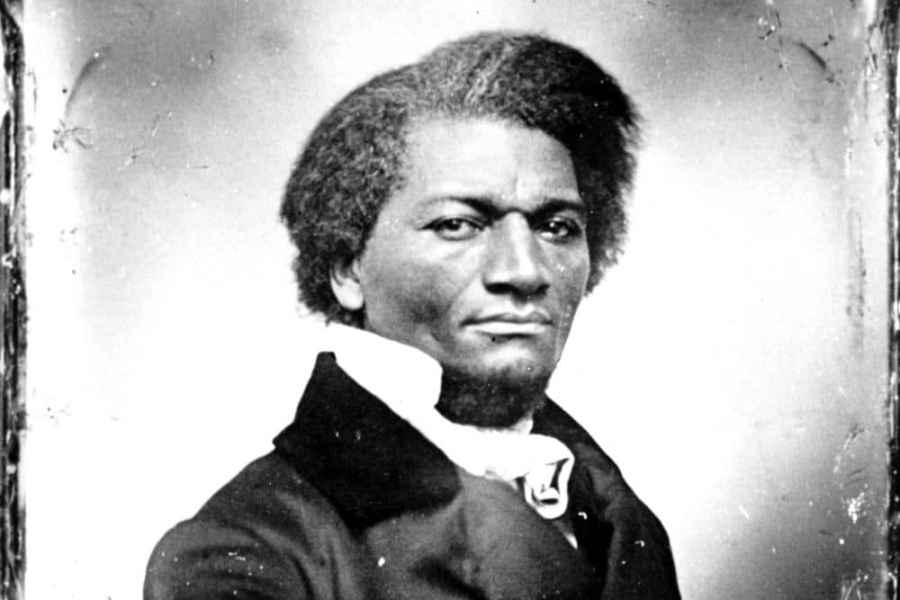
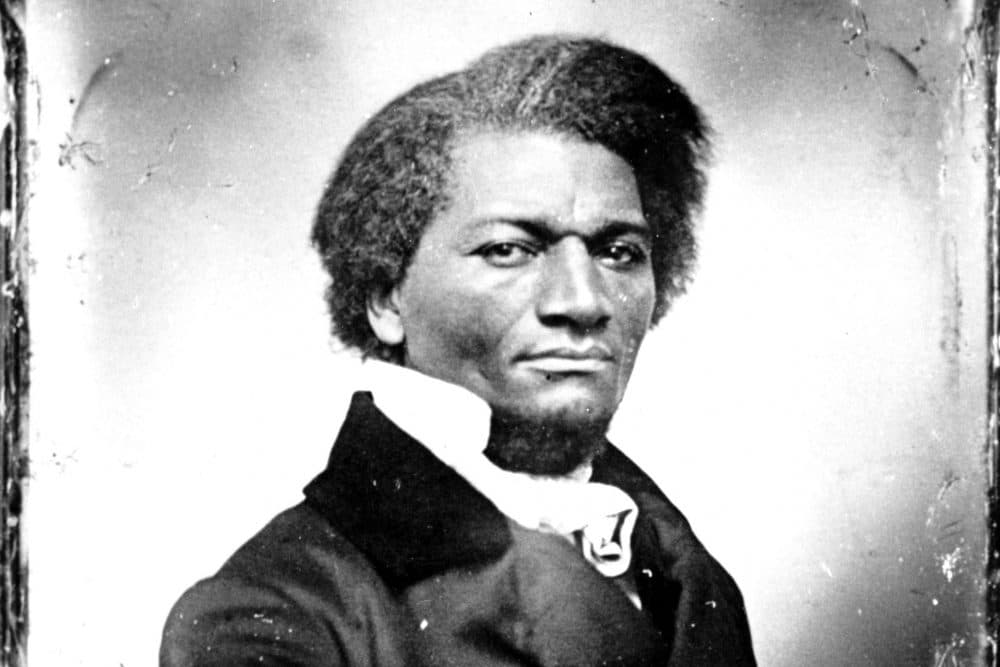
Daniel O’Connell (1775–1847), better known for campaigning for an end to the anti-Catholic laws of the English occupation, was nevertheless a tireless campaigner against chattel slavery. Escaped slave and campaigner Frederick Douglass recorded hearing him mentioned by Irish labourers in the US.
Douglas came to Ireland to escape slave-catchers, staying from 31 August 1845 to January 1846, being welcomed into upper class private houses across Ireland and to address meetings and congregations. In Dublin, Douglass attended a Repeal Association meeting to hear O’Connell speak.
Frederick Douglass (Photo sourced: Internet)
At the meeting at Conciliation Hall on September 29, 1845, learning that the famous abolitionist was in the crowd, O’Connell invited Douglass to join him on stage and to address the audience, which experience made a deep impression upon Douglass’ life.
Although Irish migrants enlisted in the US Army and fought in wars of conquest, in the US-Mexican War (1846-1848) a significant number had deserted to form the St. Patrick’s Battalion and fought on the Mexican side against the USA.
Mexico had abolished slavery in 1829 while many states in the US still upheld it, including Texas which the US had conquered earlier from Mexico.
The Young Irelanders received the Irish Tricolour from women activists of the 1848 French revolution in Paris. They supported the Second French Republic and its Abolition of slavery.
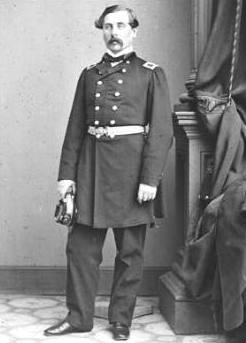
Although John Mitchell, one of the Young Irelanders’ leaders, espoused the Confederacy other Young Ireland leaders supported the Union in the American Civil War (1861-1865), including Thomas Meagher as Captain in the 69th New York Militia, later as Brigadier-General in the Union Army.
Thomas Francis Meagher as Union Army officer and Governor of Montana. (Photo sourced: Internet)
The vast majority of Irish young males who survived emigration to the US from 1845 to 1866 fought in the Union Army in the American Civil War, which is to say on the anti-slavery side.The Fenians in the USA too, as an organisation, mostly fought on the Union side.
The Irish capitalist bourgeoisie, now the neo-colonial Gombeen class, has degraded so much, sunk so far that it cannot even stand by its own weakly progressive strands, never mind by the principles of the earlier Irish Republican bourgeoisie or those of the democratic populace today.
end.
Note: If you found this article of interest, why not register with Rebel Breeze for free, so that you will be notified by email of subsequent articles. You can de-register any time you wish.
APPENDIX
First modern abolition of slavery
Vermont Republic (later a State in the USA) 1777
Second
Republic of France 1794 but reinstated briefly by Napoleon 1802
Third
Haiti Revolution and Independence (1791), 1804.
Fourth
Mexican Republic, 1810-1829
Fifth
UK 1833/ 34 (but the UK undermined the US Union during the American Civil War by building warships for the Confederacy, contraband smuggling and raids from Canada. See also: https://en.wikipedia.org/wiki/Trent_Affair)
5Unlike the case of the imported black slaves, their slave status continuing on to their children if occurred at all, would have been rare unless of course the children were visibly part-African.
SOURCES
2026-03-25 UN General Assembly Resolution on the Declaration of the Trafficking of Enslaved Africans and Racialized Chattel Enslavement of Africans as the Gravest Crime Against Humanity: https://digitallibrary.un.org/record/4106660
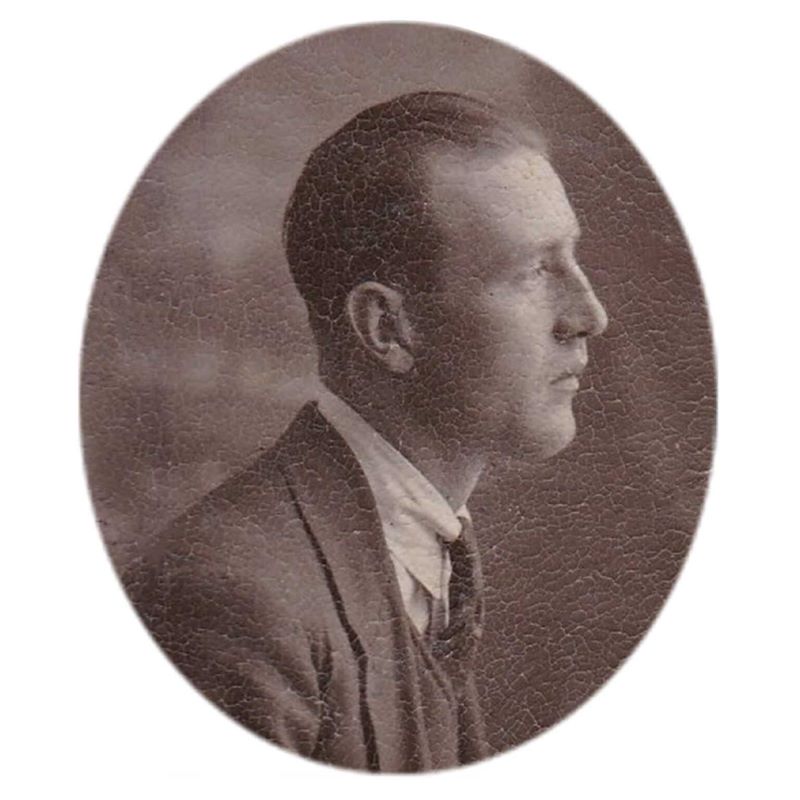
It was an Irish Argentinian who erected the “Irish Republic” flag over Dublin’s General Post Office during the 1916 Easter rising: Eamon Bulfin, born in Buenos Aires on 22 September 1892.
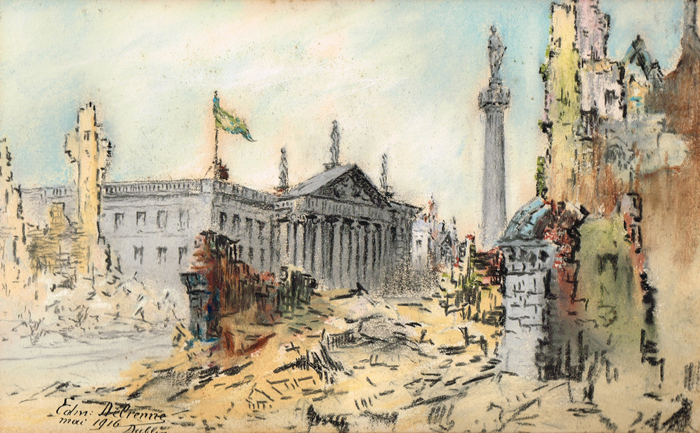
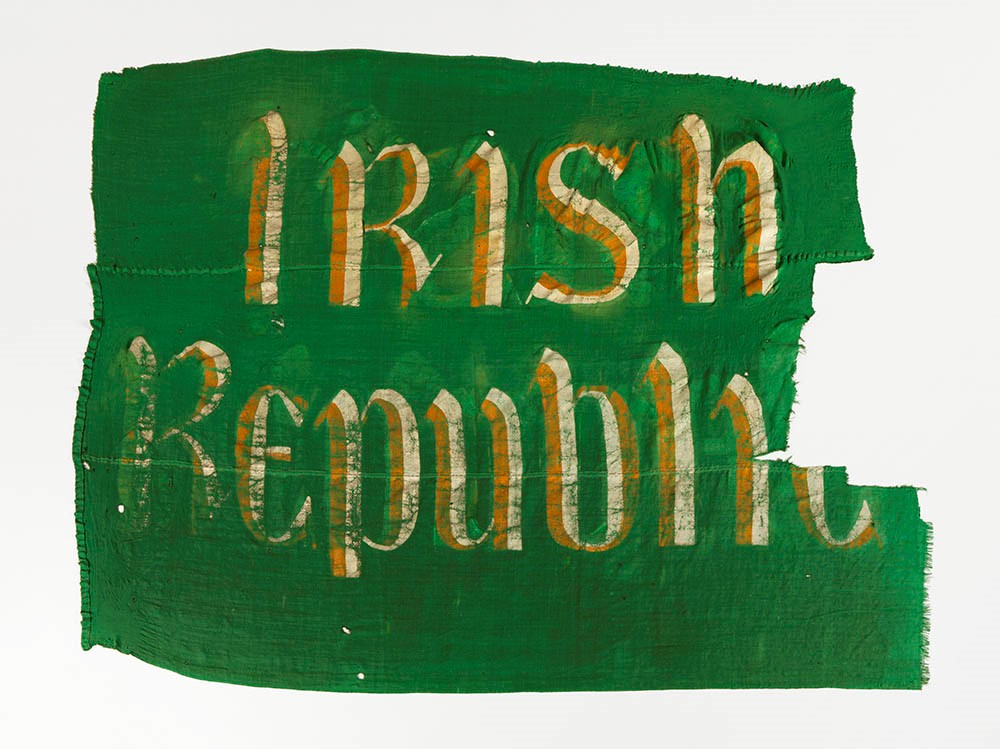
The flag in question was painted by Theobald Wolfe Tone Fitzgerald in the home of Constance Markievicz (1868-1927)1 with the words “Irish Republic” in gold or yellow, edged with white on material of a green curtain or bed-covering.
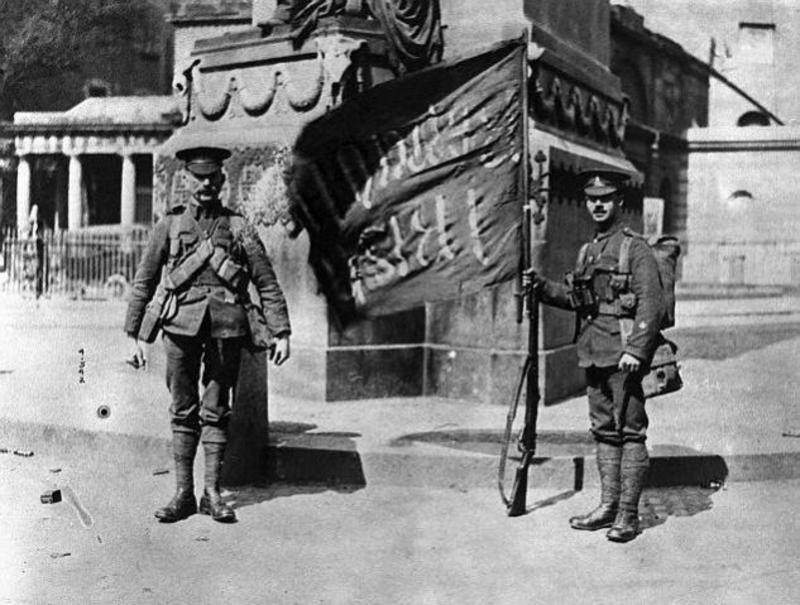
This was the flag later triumphantly displayed upside down by the British in front of the Parnell Monument (of which photographs may be found by search of the Internet).
Eamon BulfinColourised photo of Constance Markievicz in Irish Citizen Army uniform. The ‘Irish Republic’ flag was painted on material in her house and delivered by her to the GPO. The words declared to the world that the national liberation forces were fighting for an independent Republic. (Photo sourced: Internet)
Eamon was the son of William Bulfin (1864-1910) from Birr, King’s County (now Co. Offaly), who emigrated to Argentina at the age of 20 and was a writer and journalist who became editor and proprietor of ‘The Southern Cross’ newspaper. William also helped finance Pádraig Pearse’s Scoil Éanna (St. Enda’s School) which opened in September, 1908.
Bulfin returned to Ireland in 1909 with his wife, Anne O’Rourke, and their children Eamon and Catalina. William’s death in 1910 was a blow to his friend Arthur Griffith and the efforts to launch a Sinn Féin2 daily newspaper.
Eamon was enrolled in St Thomas Aquinas College, Newbridge, before attending St Enda’s School (Scoil Éanna) in Cullenswood, Rathmines, from September 1908 at the age of 17.
He impressed the headmaster and school founder, Patrick Pearse, who noted his aptitude for Irish, French and English,3 though also that he was weak at mathematics.
Bulfin enthusiastically engaged with the ethos of the school, acting in dramas, contributing short stories to the school review, An Macaomh, and captaining the St Enda’s football team in 1909–10.
He was enrolled as a student at St Enda’s until 1910 but remained as a boarder at its new location in Rathfarnham; he became close to the Pearse family. Eamon enrolled in the National University of Ireland in 1911 to study for a science degree.
While at university Bulfin won both Sigerson and Fitzgibbon cups (in football and hurling respectively) on a number of occasions, captaining the National University of Ireland (NUI) football team that won the Sigerson Cup in 1915.
In his 20th year Eamon joined the Irish Republican Brotherhood, being sworn in by Arthur O’Connor and, a year later, in 1913 joined E Company, Fourth Battalion (Rathfarnham) of the newly-formed Irish Volunteers
By 1915 he was involved in organising the volunteers in Dublin and Co. Meath, and in manufacturing munitions and explosives in St Enda’s, which activities continued up to the Easter rising, just prior to which he helped Kathleen Lynn transport these weapons to Liberty Hall.
Bulfin was promoted to the headquarters staff of the volunteers and, mobilised for the 1916 Rising, was under Pearse’s personal command and stationed at the GPO, where he hoisted the “Irish Republic” flag on the roof at the corner with Princes Street.
1916 Artwork in pastels by Edmond Delrenne, a Belgian refugee who had arrived in Ireland in 1914, he drew and coloured the ‘Irish Republic’ flag on the GPO (centre picture). The painting also shows Nelson’s Column, which was blown up in 1966. (Artwork source: Whyte’s)
After the surrender in Moore Street, Eamon Bulfin, as with nearly 100 insurgents was sentenced to death by British military court martial but most sentences (excepting the 15 shot by firing squads in the following days)4 were commuted to periods of prison incarceration in England and Wales.
On March 21, 1917, Eamon Bulfin was deported from jail under Britain’s Aliens Restriction Act of 1914.
The Argentine Government did not want to anger the British Empire, with whom they were already having problems, not the least with their long-standing argument over the sovereignty of Las Malvinas/Falklands.They therefore arrested Eamon Bulfin when he arrived in Buenos Aires and sentenced him to jail for leaving Argentina for the purpose of ‘deserting from military service’.
As Eamon had been a schoolboy when he and his family left for Ireland, the charge was an excuse for the authorities but suspicion of being a communist, which the British gave for his deportation might have been the real reason.
He was conscripted into the Argentine military and served in the army before transferring to the navy, being released after ten months as his mother was a widow, which qualified him for an exemption from military service.
One of two photos of the ‘Irish Republic’ flag being displayed upside down by British soldiers, symbolising the defeat of those who flew it. The site is the base of Parnell’s Monument in Parnell Street with the Rotunda in the background. (Source: Internet)
When Eamon Bulfin was released in 1919, the General Election in Ireland had resulted in an overwhelming victory for Sinn Féin5 which, in accordance with their manifesto, made a Unilateral Declaration of Independence declaring Ireland a republic and set up a parliament in Dublin.
The President of the Irish Republic, Eamon de Valéra wrote to Bulfin in May appointing him the official representative to Argentina. As Irish Consul, Bulfin was to “inaugurate direct trade between Ireland and the Argentine Republic… to co-ordinate Irish opinion in the Argentine, and to bring it into the Irish demand for a republic.”6
Bulfin began work, establishing close contacts with Argentine government officials, Irish Argentine leaders and he launched an Irish Fund to help the cause.
In 1920, during the county council elections, Eamon Bulfin was nominated in his absence for a seat on King’s County Council. He was not only elected but appointed Chairman of the council.
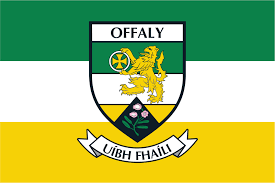
One of the first things the new Council did was to agree that the county’s name be returned to the region’s ancient Irish form of Co. Uí Fáille (anglicised as Offaly). Meetings were conducted with the Chairman’s seat in the council chamber left empty and with a Tricolour draped across it.
In 1922 Eamon Bulfin was finally allowed to return to Ireland where he set up home in his father’s native Derrinlough, Birr, Co. Offaly. He took the Anti-Treaty side in the Civil War and handed over 600 Stg from fund-raising in Argentina.
However the killing of Michael Collins affected him deeply and he stayed out of the Republican forces, telling them that he had refused an officer’s post in the Free State’s National (sic) Army.
On 16 February 1927 Eamon married Nora Brick (Nóra Ní Bríc) of Tralee, a former member of Cumann na mBan, in an Irish language ceremony in Drumcondra, Dublin (his occupation was recorded as a farmer). They had four children: Edward, Jeanne, Blanaid and Michael.
Eamon Bulfin died of a cerebral haemorrhage in the Meath Hospital, Dublin, on 24 December 1968, and was buried in Eglish Cemetery, Co. Offaly.
Remnant of the ‘Irish Republic’ flag in the National Museum of Ireland (Photo: NMI)
His sister, Catalina, also born in Buenos Aires in 1901, had become secretary to Austin Stack (1880-1929). Stack was elected to the Dáil (32-County Irish Parliament) in 1918 and became Minister for Home Affairs from 1920-22.Stack accompanied de Valéra to London for the initial Truce talks but became a leading opponent of the terms agreed by Collins.
Catalina Bulfin married Seán MacBride (1904-1988), born in Paris and his first language French. Sean was the son of John MacBride, executed by the British in 1916 and of Maude Gonne.
Seán McBride is the only Nobel Peace Laureate to have also won the Lenin Prize; he was former IRA Chief of Staff (1936-1937), Irish Minister for External Affairs (1948–‘52) and Secretary of the International Commission of Jurists.
MacBride was a founder member of Amnesty International and Assistant General Secretary of the United Nations. He survived Catalina MacBride by 12 years after she died in 1976, her remains being buried in Glasnevin Cemetery, Dublin. Some descendant of Eamon Bulfin live in Offaly to this day.
2The Sinn Féin party at the time was an Irish nationalist one advocating a dual monarchy, Irish and British.
3And no doubt Spanish too, having been reared in Argentina, a language acquisition that probably helped with the acquisition of Irish and French, which have a great number of similarities in structure.
4And the sixteenth execution was of Roger Casement, by hanging in London.
5Then a reformed and much-expanded party with a Republican constitution.
6 Kennedy, Michael and Joseph Morrison Skelly (eds). Irish Foreign Policy: 1919-1966 From Independence to Internationalism. Four Courts Press: England 2000, p.45. (Quoted in the Wikipedia entry on Eamon Bulfin)
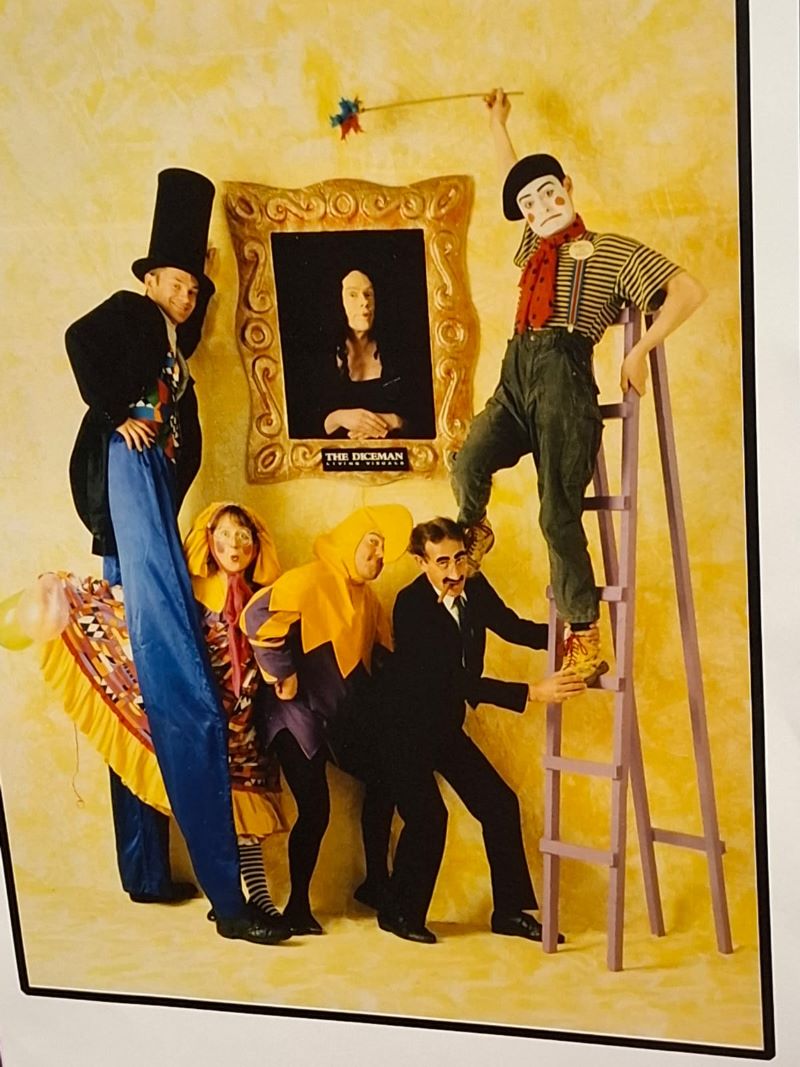
Alerted by a sibling to a short exhibition on the life of the Spice Man (Thom McGinty), a remarkable performance artist and character of Dublin streets particularly associated with Grafton Street, I was fortunate to view it on its final day.
The exhibition was part of the annual Phizzfest’s annual program and was staged in the Bohemians FC room above the Phibsborough shopping centre. The space was a moderately-sized room with a few installations, a film projector, panels of images and text displayed on the walls.
One of the panels at the exhibition.
Sadly the chatter of a number of people made it difficult – for me at least – to understand all the audio accompanying the film footage but some of the images were very interesting, in particular the reaction of Dublin adults and children to the Spice Man’s street performances.
When he spoke it was with a Scottish accent, having been born to a father from Donegal and mother from Wicklow and reared in a village outside Glasgow from where he recalled journeying on holidays to Baltinglass for family reunions.
He came to economically-depressed Ireland in 1976, trying his hand at a number of occupations before he found the one that both gave him success and defined him publicly.
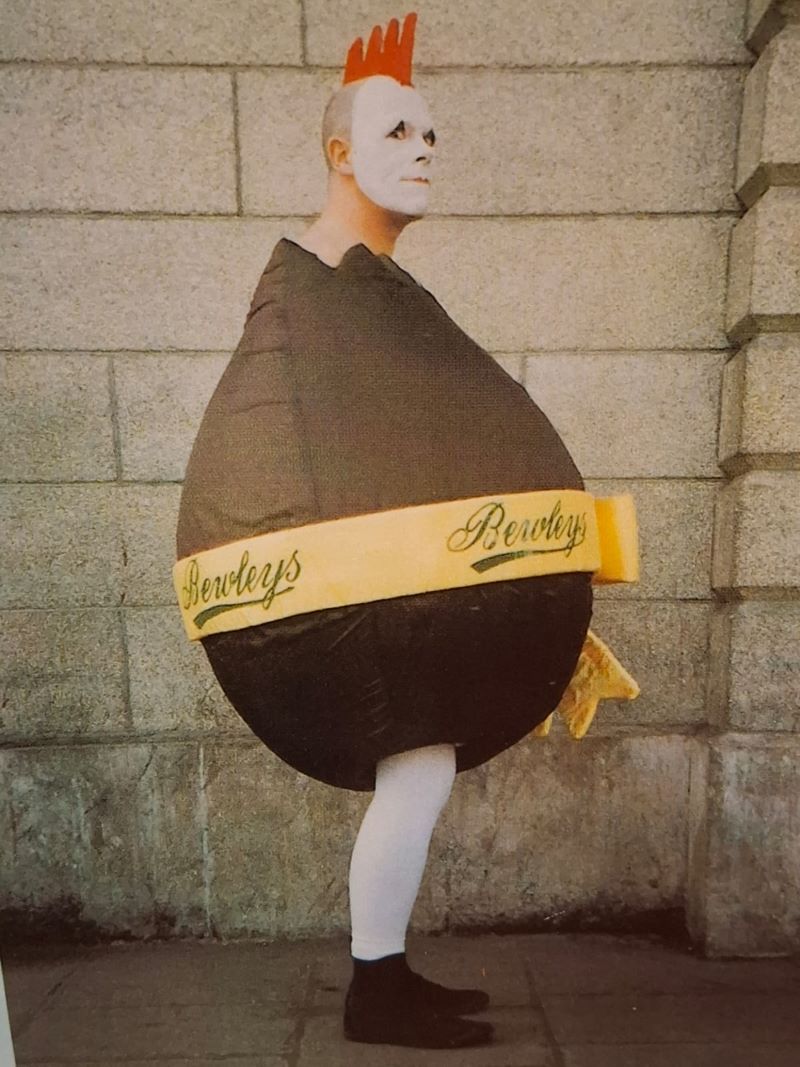
Typically, his performance was silent, his movement stilled or gradual, slow but moving to avoid arrest.1 But his costume and makeup were something else. Though McGinty later initiated performances in social and political protest, his initial ones in Dublin were commercial promotions.
A gaming shop called The Dice Man was the first of these and the one that gave him the nickname by which he became known and found fame. It was one of the commercial promotions, ironically not a political one, that ended with his arrest.
The promoters of a run of The Rocky Horror show in Dublin hired Thom to promote their show which he did, walking the street in ‘horror’ facial makeup, a cerise basque, fishnet stockings and a thong. He was arrested.
McGinty was charged with acts contrary to public decency under Section 5 of the Summary Jurisdiction (Ireland) Amendment Act, 1871, and with breach of the peace. Thom protested that these were his working clothes and he had been contracted to wear them.
According to the arresting gardaí, complaints had been made that Thom’s buttocks were clearly visible, “and the only thing covering his genitals was a G-string.” He was bailed from Store Street Garda Station pending the trial but could not be released until he was given a raincoat to wear.
The Act, which is still on the statute books (according to the exhibition text) had sexual connotations and could be used against gay people. McGinty’s lawyer raised the ramifications of a conviction under this Act and the judge sentenced him to probation without recorded conviction.
The 1991 production of the Rocky Horror Show at the Bord Gáis Theatre could not have asked for better publicity and McGinty personally got exposure (!) internationally and offers of work abroad as a result, from which he always returned to Ireland.
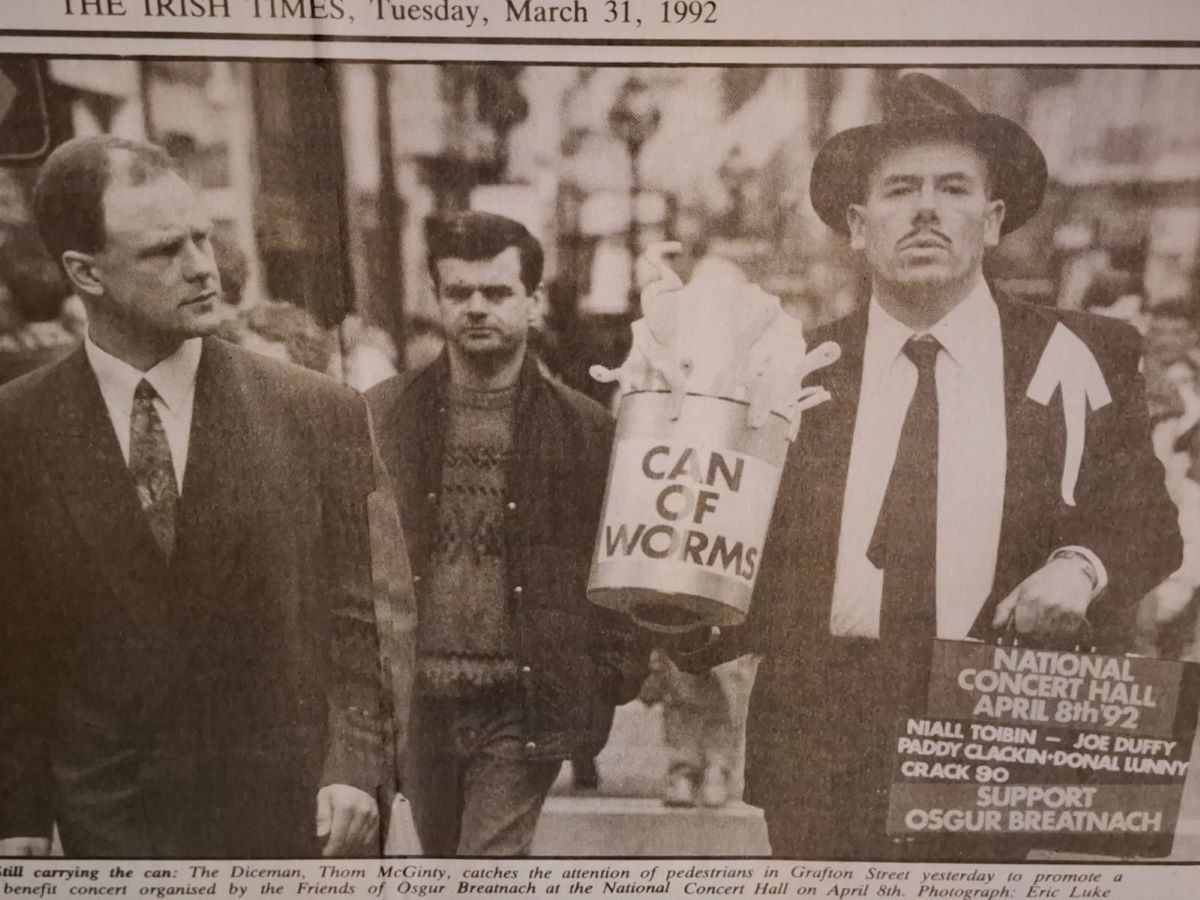
Among social causes which Thom protested with performance was the financial penalty on the Union of Students in Ireland for breach of injunctions by publishing anti-pregnancy choice information in a case pursued by SPUC.2 Another was against restrictions on the sale of condoms.3
Thom’s performances and the causes espoused would have been of interest to me had I been living in Ireland at the time but they touched on my family in Dublin a number of times. Foremost was his support for the wrongly accused, framed and brutalised of the Sallins Mail Train robbery.
One of the panels at the exhibition.
It is nearly 50 years since three socialist Republicans were wrongly convicted and sentenced to nine and twelve years imprisonment. As a result of much campaigning, two of the accused, one of whom is a sibling of mine, were released with convictions revoked after 18 months in Portlaoise jail.
The third accused, who had absconded the day prior to the sentence, returned to Ireland and was immediately jailed, campaigners then switching to obtain his freedom, gained only ‘on humanitarian grounds’ after four years in jail and a hunger strike of 38 days.
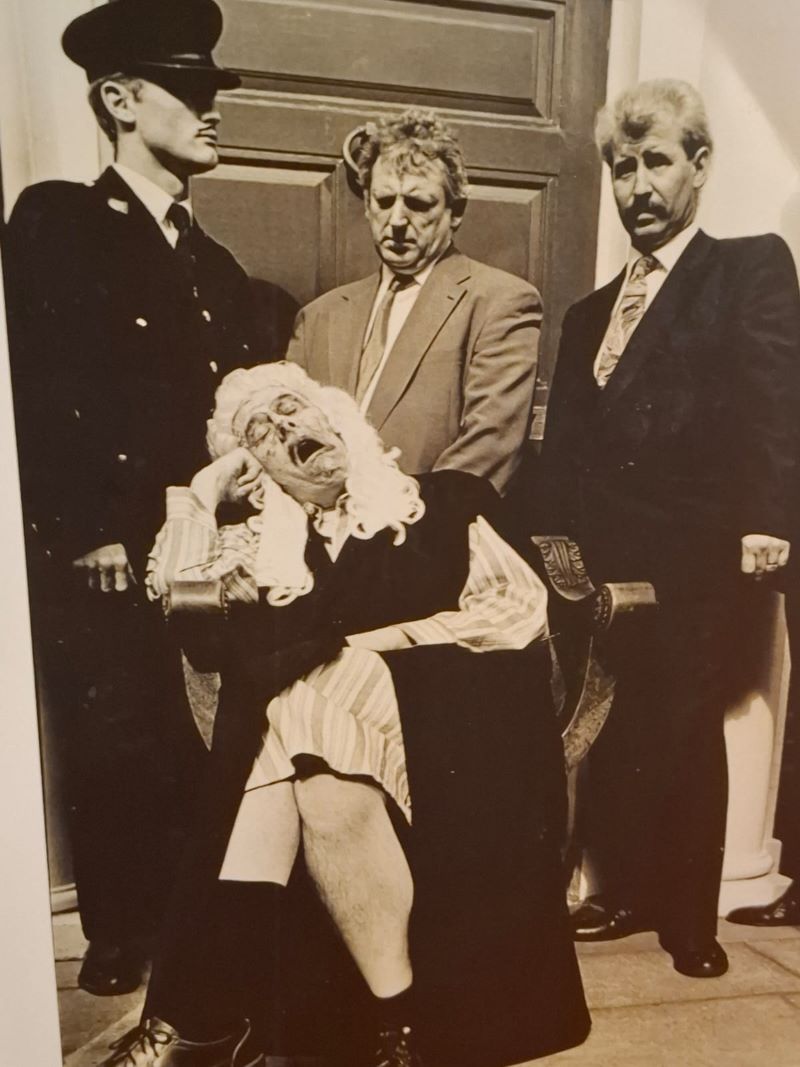
Satirising the ‘sleeping judge’ in one of the Sallins trials (he was clearly seen sleeping but his co-judges and State denied it and then to embarrassment of State, he died days later). In suits, two of the framed, (l-r) Nicky Kelly and Osgur Breatnach.One of the panels at the exhibition.
A recent concert, packed both by audience and performers in the Vicar Street Dublin venue was organised by yet another sibling to promote a campaign for an inquiry into how that travesty of justice could be carried out by state police, Government and judiciary right up to the High Court.4
Thom was a strong supporter of liberal social rights such as the right to prevent pregnancy or birth and for gay and lesbian rights. His defence of framed Irish Socialist Republicans centred on their right to a fair trial and not to be brutalised, as did his support for the Birmingham Six.
One of the panels at the exhibition.
But he was far from being an Irish Republican. Dressed as the Grim Reaper with scythe, Thom also led a delegation of ‘Peace Train’5 people in protest to the offices of Provisional Sinn Féin where, in a twist of fate, it was another sibling of mine who had to receive him and to face the cameras there.
At the time, SF was the political party leading a struggle for Irish reunification and independence from British occupation and, though its leadership and much of the party’ base support was socially conservative, it was not that which focussed the attacks of two states and a statelet6 upon it.
And those armed and judicial attacks were backed by the imperialist and neocolonial-dominated liberal and social-democratic sector of society, the likes of the ‘Peace (sic) Train’ and ‘Peace Women’.7 I would have argued strongly with Thom I’m sure but regret very much his passing.
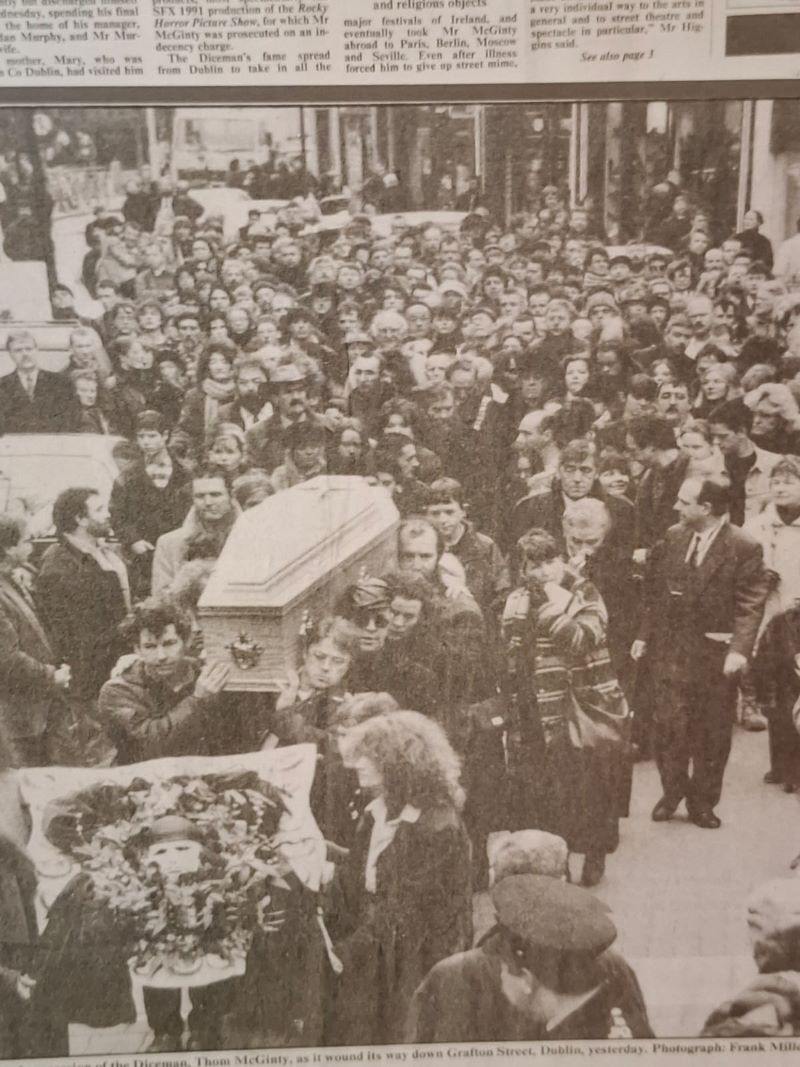
Thom McGinty (1952-20/21 February 1995)
Thom McGinty’s funeral, from one of the panels at the exhibition.
end.
Note: If you found this article of interest, why not register with Rebel Breeze for free, so that you will be notified by email of subsequent articles. You can de-register any time you wish.
2Society for the Protection of the Unborn Child. After a long struggle ending pregnancy became legal within the Irish state but regulated under the Health (Regulation of Termination of Pregnancy) Act 2018, allowing for termination on request up to 12 weeks of pregnancy. Following a 2018 referendum, abortion services began on 1 January 2019, providing free access for residents.
3Following campaigning and public defiance of the law, restrictions on the sale of condoms were only finally removed in 1993 in the Irish state.
5https://en.wikipedia.org/wiki/Peace_Train_Organisation The issue is not whether bombing the railway line was a useful activity or not but rather that its condemnation took the place of condemning and drawing attention to the British occupation of a colony in Ireland and the brutal repression of resistance to that occupation.
6Although it has the trappings of a state, the Northern Ireland (sic) Assembly is a UK colonial administration.
A recent arrest in France and concert in Dublin are connected by events in both countries a half-century earlier.1
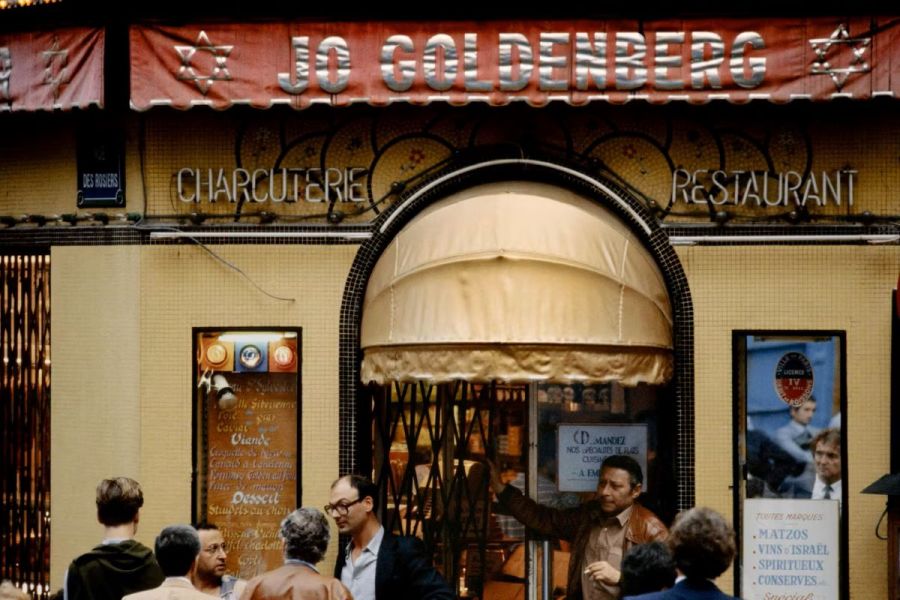
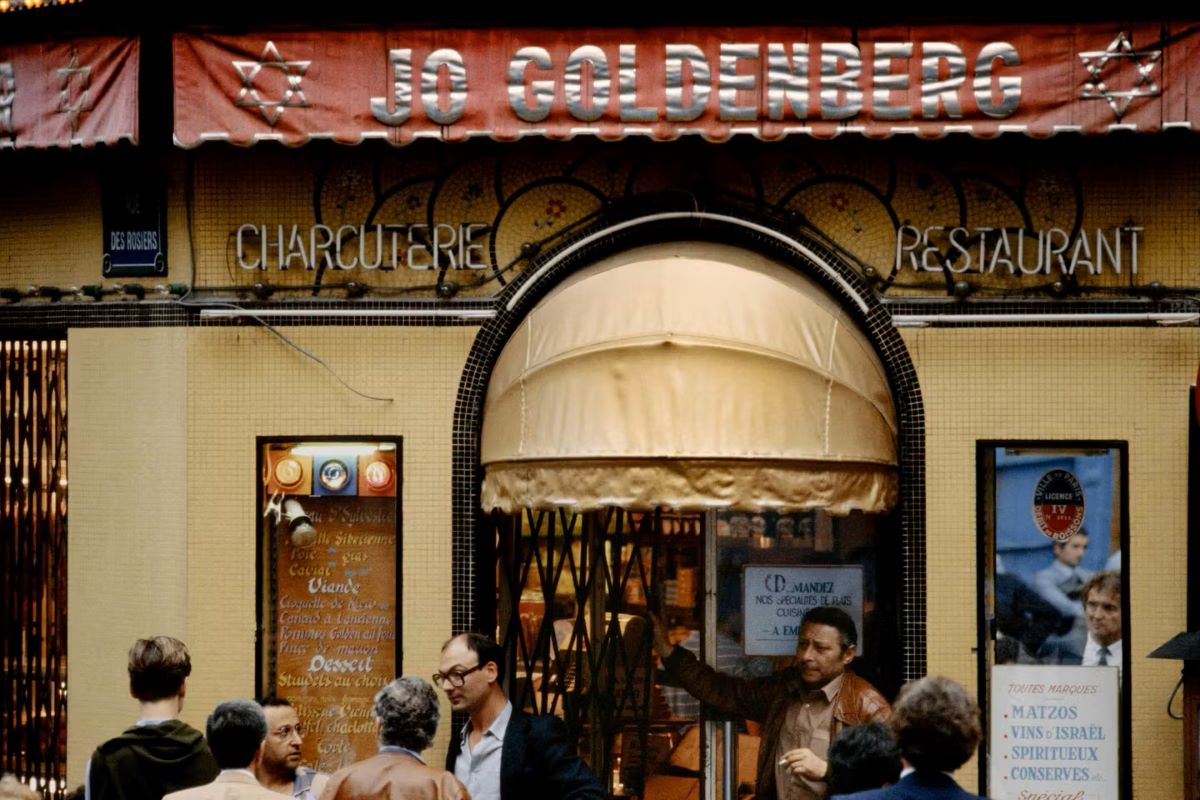
The arrest in question by French police was on 16 April of Mahmoud Khader Abed Adra, for alleged involvement in the 1982 attack on the Jo Goldenberg restaurant in the Marais district of Paris.2
The report of the arrest came less than a week after the Dublin commemoration by concert of another event, also half a century earlier. And strangely, there was a connection between both events.
On 11 April, a concert was held in Vicar Street to commemorate the arrest, torture, framing of three Irish Socialist Republicans and their jailing in 1986.3
Musicians, poets and journalists came together at the event, organised by musician Cormac Breatnach, brother of one of the accused, to commemorate the event and to press for an inquiry into three activists being tortured into making false confessions incriminating themselves.
And into how, despite their retractions and medical evidence of torture, they were then convicted of an event they had not committed. And how the legal system, from the Court of Appeal to the High Court, had all colluded in the injustice.
The trial in Ireland was for the Sallins Mail Train Robbery of 1976. The convicted three were Osgur Breatnach, Nicky Kelly and Brian McNally: Breatnach and Kelly were sentenced in the no-jury Special Criminal Court to 12 years, McNally to nine.
The day before sentence, Nicky Kelly jumped bail but returned nearly two years later when the convictions of Breatnach and McNally were deemed ‘unsafe’ and that their statements had ‘not been made voluntarily’.
However, the State insisted that the time period for registering an appeal had by then been exceeded and it took much campaigning and his own hunger strike before Kelly was finally released, on a Presidential pardon for a crime he had not committed.
A fourth, Mick Plunkett, had stood trial with the three on the same charges but having succeeded in not making a false confession under torture and threats, was finally acquitted. The French connection with the extradition of Mahmoud Khader Abed Adra, is Plunkett’s.
Mick Plunkett4 had decided that, despite his escaping the framing, that the Garda Heavy Gang5 would be out to get him and that a departure to other climes might he healthy. Plunkett settled in France but did not give up his politics.
Photo: Joel Robine/ AFP
The Jo Goldenberg restaurant was subjected to a grenade and firearms attack on 9 August 1982, killing six and injuring 22.
On 28 August that year, Plunkett, Mary Reid and Stephen King (not the novelist) were arrested by a special anti-terrorist unit of the Gendarmerie (perhaps Le Gang Lourd, the Heavy Gang a la Francaise!).
The police claimed that all three were part of a terrorist organisation and that leaflets confirming that had been found in their apartment. And also firearms. All the allegations were vigorously denied by the three Irish activists.
Eventually the case against all three fell apart and they were released with, in time, the Gendarmerie admitting that the evidence against them had been ‘planted’ and the special unit was disbanded.6
One of the acts which the French police had claimed for the organisation of which they had falsely claimed membership of Plunkett, Reid and King was the attack on the Jo Goldberg Restaurant — the same incident for which the French Police have now charged Mahmoud Khader Abed Adra.
The French state got Khader Abed by extradition from Occupied Palestine. The State of Israel does not extradite its citizens anywhere but the Palestinian Authority was willing to do the job for France, which last year had officially recognised ‘the State of Palestine.’
end.
Note: If you found this article of interest, why not register with Rebel Breeze for free, so that you will be notified by email of subsequent articles. You can de-register any time you wish.
Footnotes
1This story was published recently in the Irish language-only weekly An Páipéar (available in newsagents and online).