Composed of Socialist Republican, Communist and Anarchist contingents, along with independent activists of various tendencies, a broad Revolutionary Bloc marched among other groups and individuals in the annual May Day march in Dublin on May 1st.
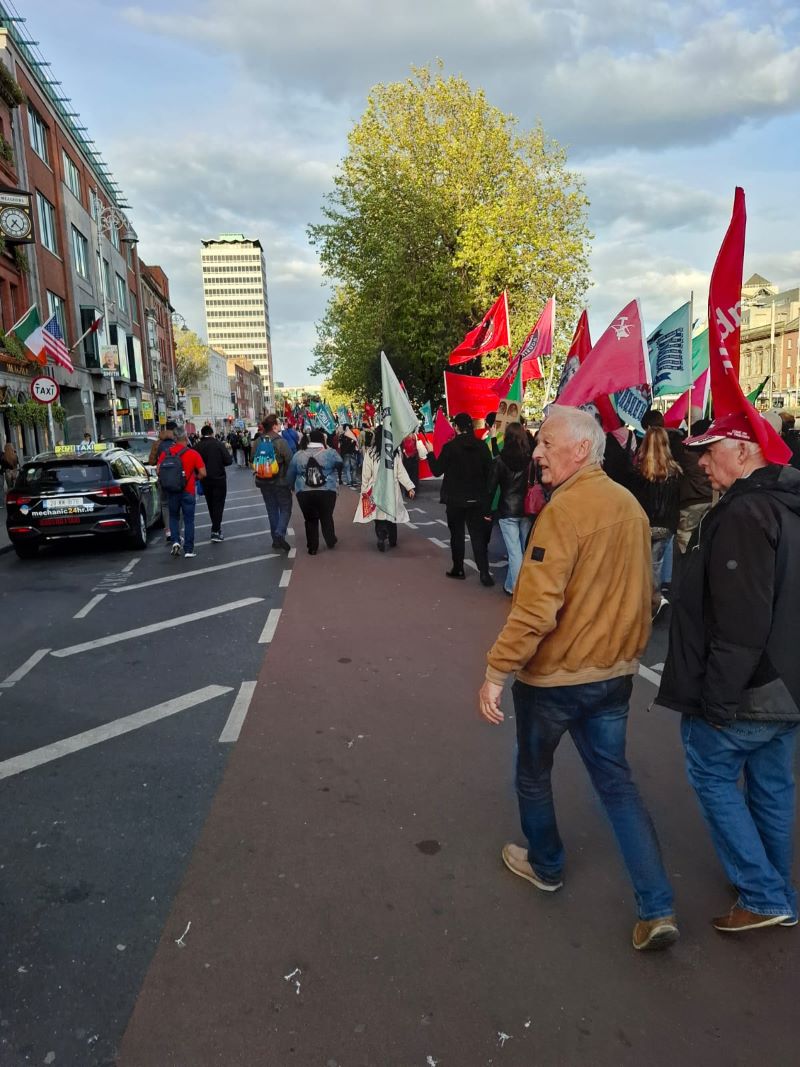
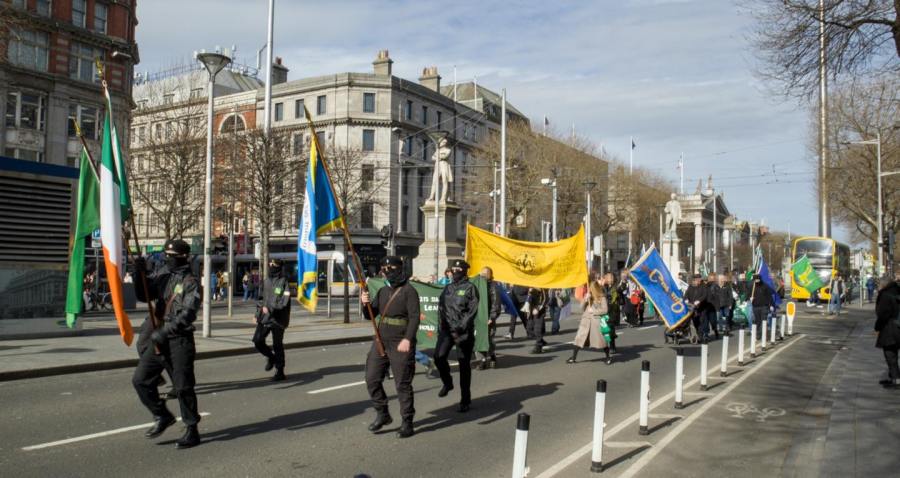
Eden Quay, as the march turns off O’Connell Street, heading for Beresford Square, by the tall Liberty Hall building in the left background. (Photo: R.Breeze)
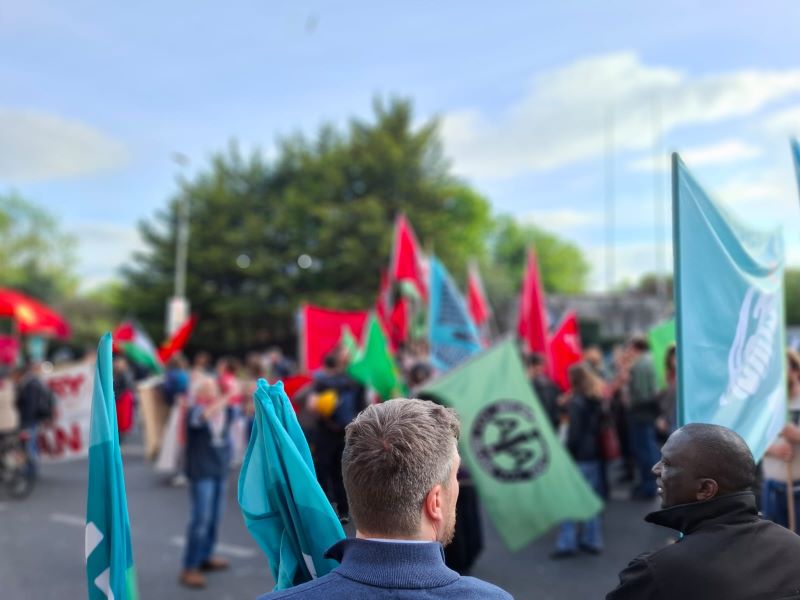
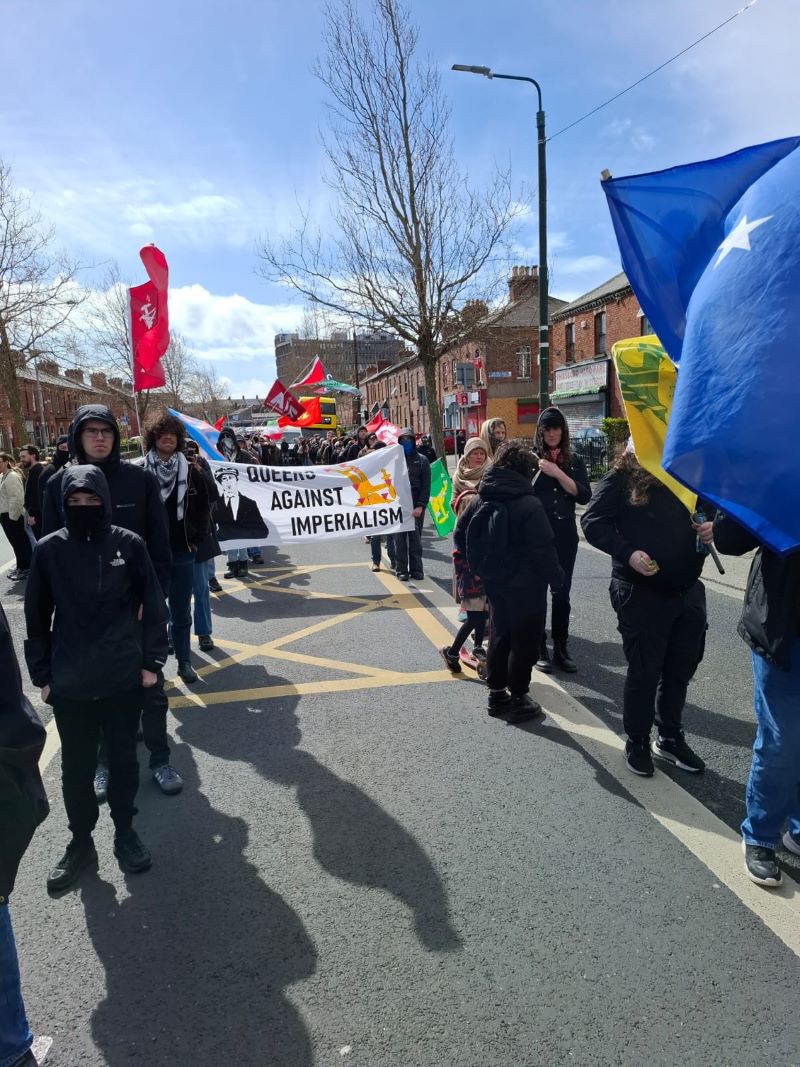
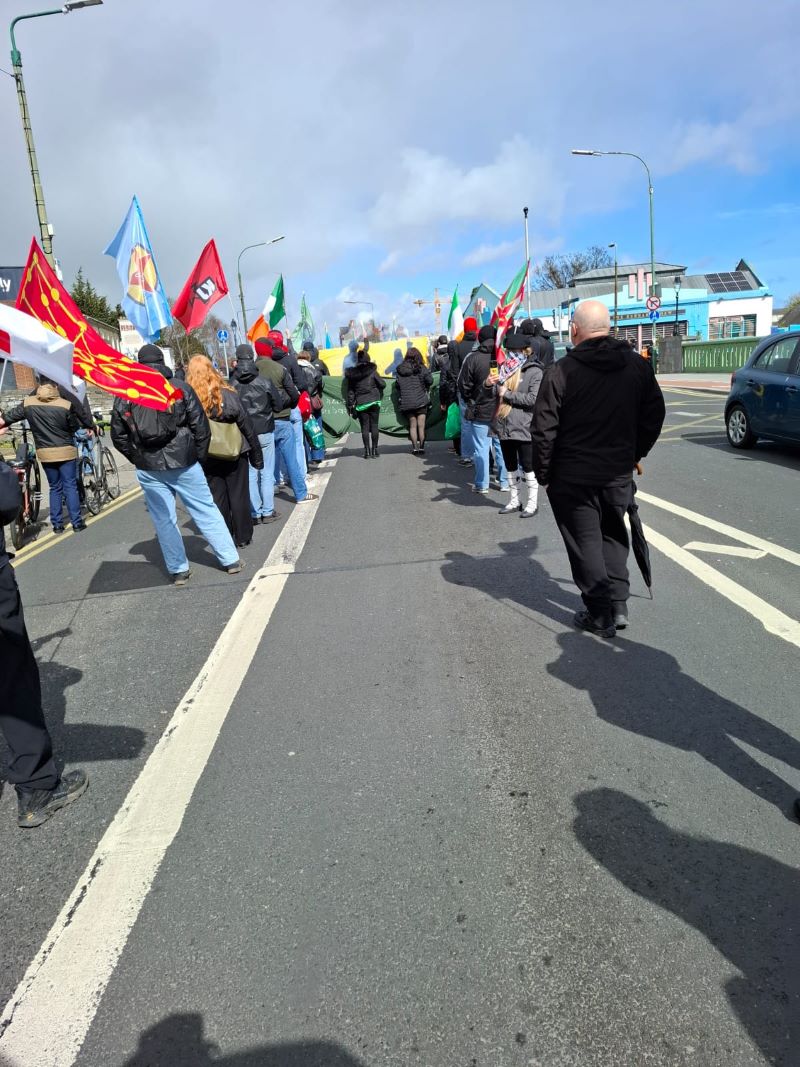
At intervals the banners of the Communist Party of Ireland, the Independent Workers’ Union and flags of the Anti-Imperialist Action contingents could be seen and a number of flags denoting specific groups or campaigns were on show but the Bloc was mainly identifiable by its slogans.
Led in call-and-answer almost non-stop from departure point at the Garden of Remembrance to Beresford Place in front of Liberty Hall,1 slogans called on workers to strike work and fight, to oust imperialist states and NATO from Ireland, for resistance unity, revolution and a socialist republic.
Section of the Revolutionary Bloc, centre image. (Photo: R.Breeze)
It was notable that an Irish Tricolour and a number of Starry Plough flags were visible among the Bloc and indeed one of the chants was against the appropriation of the Tricolour by ‘traitors’. They also called for funding for education and not for big corporations and for a hotel-free city centre.
At least one of the flags was of the Revolutionary Housing League and the march passed an empty building appropriated three years earlier by the RHL who were then evicted by a Garda force of 100 with helicopter and armed unit as backup. The building remains empty to this day.
People in Dublin stopped in the early Friday evening to watch and in the northern reach of O’Connell Street an elderly man stepped off the pavement to march along with the Bloc, though in silence while further along, two teenage girls in school uniform joined the Bloc also.
The Priory Market, Tallaght, Dublin prior to opening (Photo: Supplied by supporter)
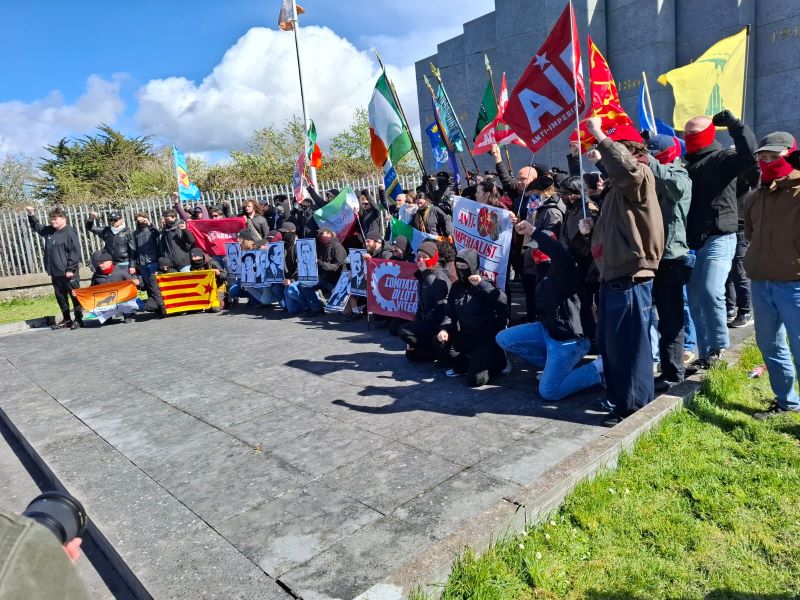
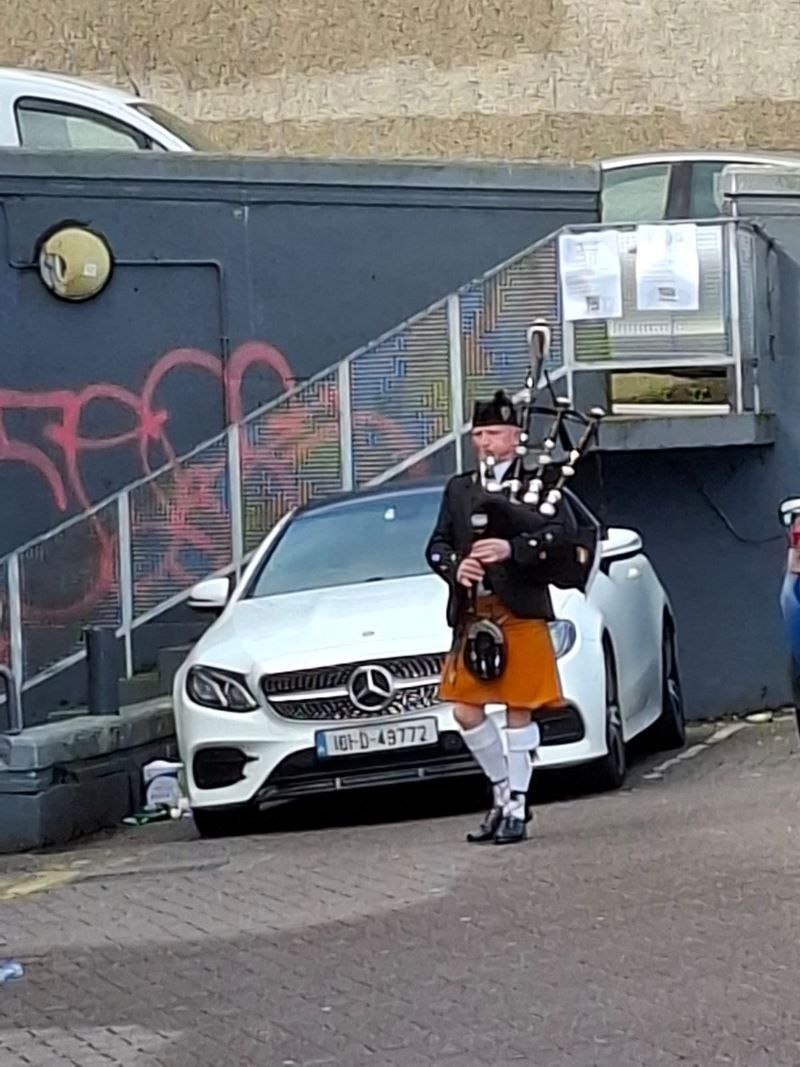
Led by a long piper, the various contingents marched into Beresford Place, where a stage had been set up in front of the SIPTU2 headquarters building but most of the Revolutionary Bloc marched past to congregate for a group photo around the nearby monument to James Connolly.
Using the Bloc’s megaphone, one of the group then sang the Be Moderate song (also known as We Only Want the Earth) composed by James Connolly3 and, as the singer informed his listeners, published in the Songs of Freedom songbook by Connolly in New York in 1907.
As most of the Bloc dispersed, speeches were being made from the nearby stage and a group of mostly younger people from Turkey were assembling at the Connolly Monument also for a group photo.
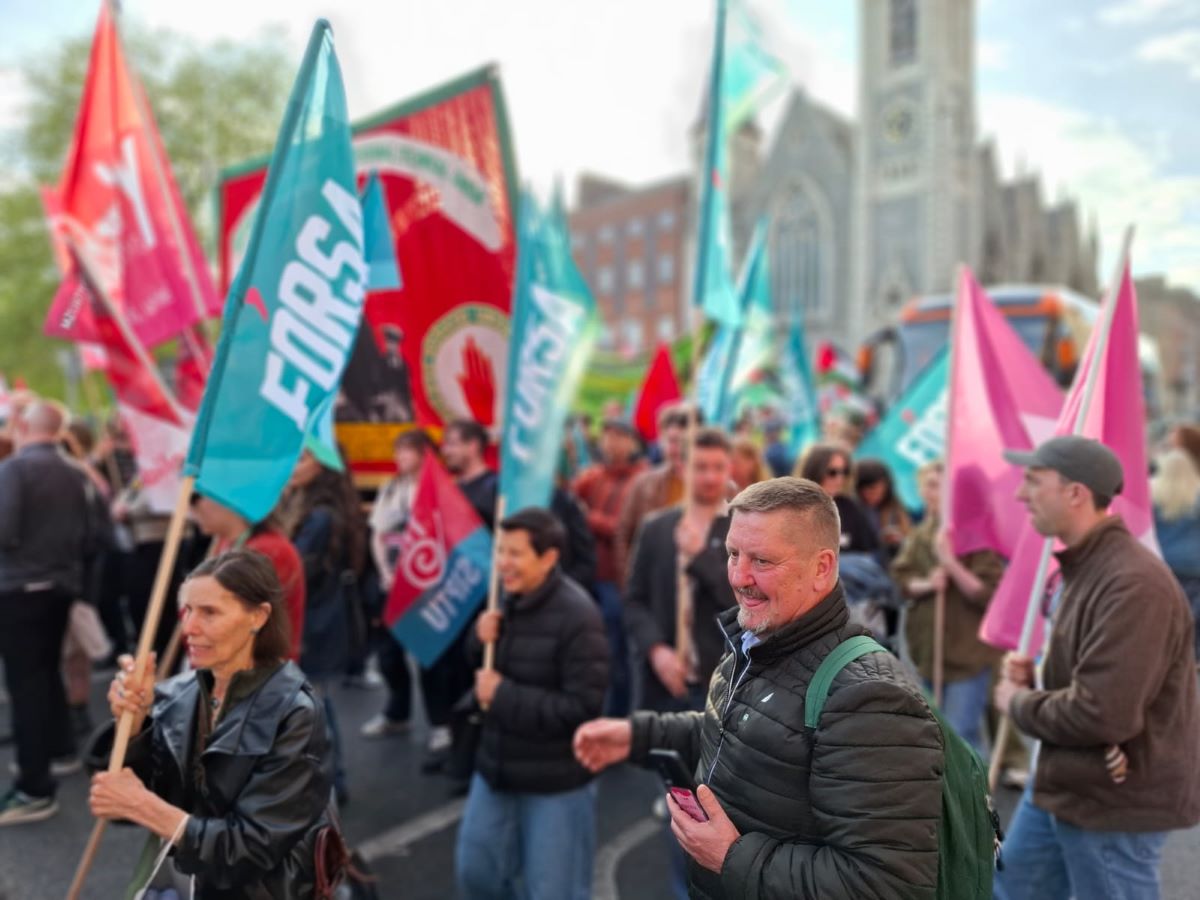
The May Day march and rally in Dublin is traditionally organised by the Dublin Council of Trade Unions. However the participation of union banners was low in numbers and those present mostly of the FÓRSA union.
Section of the march showing FORSA union flags being carried. (Photo: R.Breeze)
Distinct from other European states, the foremost struggle in Ireland for centuries has been on the national question which has entailed less development in the forces devoted to socialism, so that in general May Day does not bring out the numbers one can see in the capitals of the EU and UK.
However, Ireland’s long history of resistance to colonial occupation has entailed a greater history of insurrection than most European states and it has also produced a remarkable number of leaders of labour struggles among the Irish diaspora in Britain, the USA and Australia.
End.
Note: If you found this article of interest, why not register with Rebel Breeze for free, so that you will be notified by email of subsequent articles. You can de-register any time you wish.
FOOTNOTES
1A highly-visible very tall building on the site of the original Liberty Hall, HQ of the IT&GWU, now of SIPTU.
2One of the largest (possibly the largest) trade unions in Ireland, formed by amalgamation of other unions on the base of the Irish Transport and General Workers union, of which James Connolly had been an officer and for a period, its overall leader.
3James Connolly (5 June 1868 – 12 May 1916), born and raised in the Cowgate area of Edinburgh, revolutionary socialist activist-theoretician and Irish Republican, author, journalist, historian, union organiser, executed by the British occupation along with another 15 prominent insurrectionists of the Easter Rising.
A call for unity of Irish Republicans in action to win Irish freedom and independence was made at a 1916 Rising commemoration in Dublin on Sunday, an event organised by the Anti-Imperialist Action Ireland organisation.
Section of the marchers looking back towards Phibsborough as they approach Cross Guns Bridge from Phibsborough. (Photo: R.Breeze)
A relatively large number of people participated, including a number of delegations from organisations of struggle in the Spanish, Turkish, German and Italian states. Young people were particularly well represented.
Participants met outside the Phibsborough shopping area on Dublin’s northside from which they were led by a lone piper, a colour party and a number of banners. Among them flew various flags of national and social struggle in Ireland, the Basque Country, Catalunya, Palestine, Turkey …
The lone piper in Phibsborough exercising his lungs and warming pipes and bag as he prepares to lead the procession towards Glasnevin. (Photo: R.Breeze)
The orders to the colour party, as is traditional, were all given in Irish.1 At Cross Guns Bridge, the march halted and, in what has become a tradition for the AIA, flares were lit in memory of the presence of Irish Volunteers there in 1916 and the murder of a civilian by British soldiers.
Proceeding along Finglas Road to the interest of passers-by and the odd ‘beep’ of solidarity from a passing vehicle, the march turned left outside the gates of the older Glasnevin Cemetery to cross over the railway pedestrian bridge to the St. Paul’s section of the Cemetery.
Section of the marchers approaching Cross Guns Bridge from Phibsborough, halting as flares are lit in memoriam. (Photo: R.Breeze)
Winding their way on a path through the headstones, what was now one thick column approached the monument to six Irish Republican armed uprisings, commissioned by the National Graves Association, where a representative of the AIA greeted them.
From the Monument, the AIA representative introduced the reason for the commemoration and listed in honour the Irish Republican Brotherhood, Irish Volunteers, Irish Citizen Army, Cumann na mBan and Na Fianna Éireann, different organisations that fought together in the Rising.2
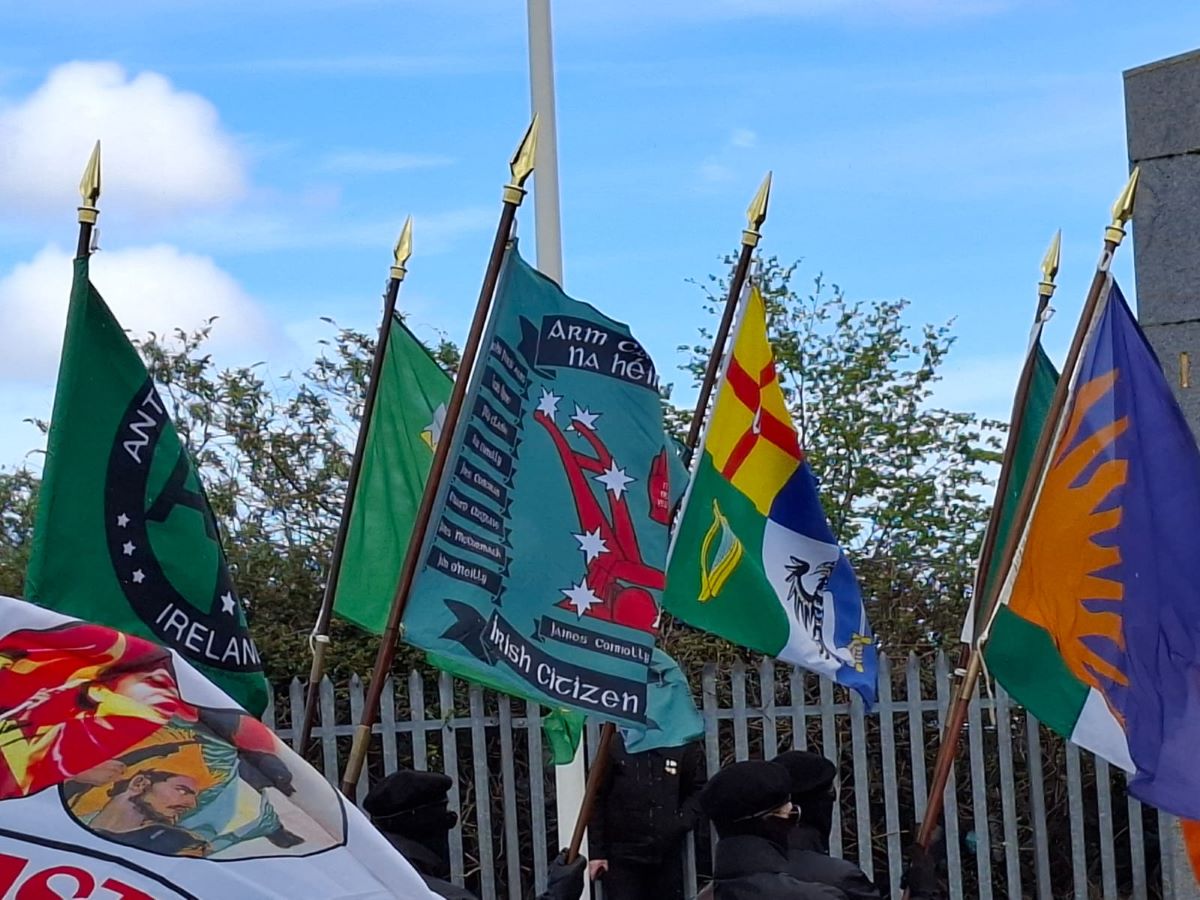
Central: Flags of the colour party, from left to right: Flag of AIA, Irish Citizen Army (mostly concealed), a version of Irish Citizen Army, emblems of the four provinces of Ireland, the Tricolour (mostly concealed), the Gal Gréine (Sunburst). The flag intervening from the left is of some participants in the Anti-Imperialist Front, a different organisation. (Photo: R.Breeze)
He called for delegates of different organisations to meet to decide a basis for unity, following which, going on to note that the AIA has long been prepared to work alongside others for shared objectives, he announced floral wreaths to be laid on behalf of the CPI and IDR.3
After the laying of those wreaths, another man was called to read the text of the 1916 Proclamation.
The keynote speaker, a veteran Irish Republican and former political prisoner, was then introduced. He began by reminding his audience of Irish Republican armed uprisings before 1916 going back to 1798 and forward up to the war in the occupied Six Counties.
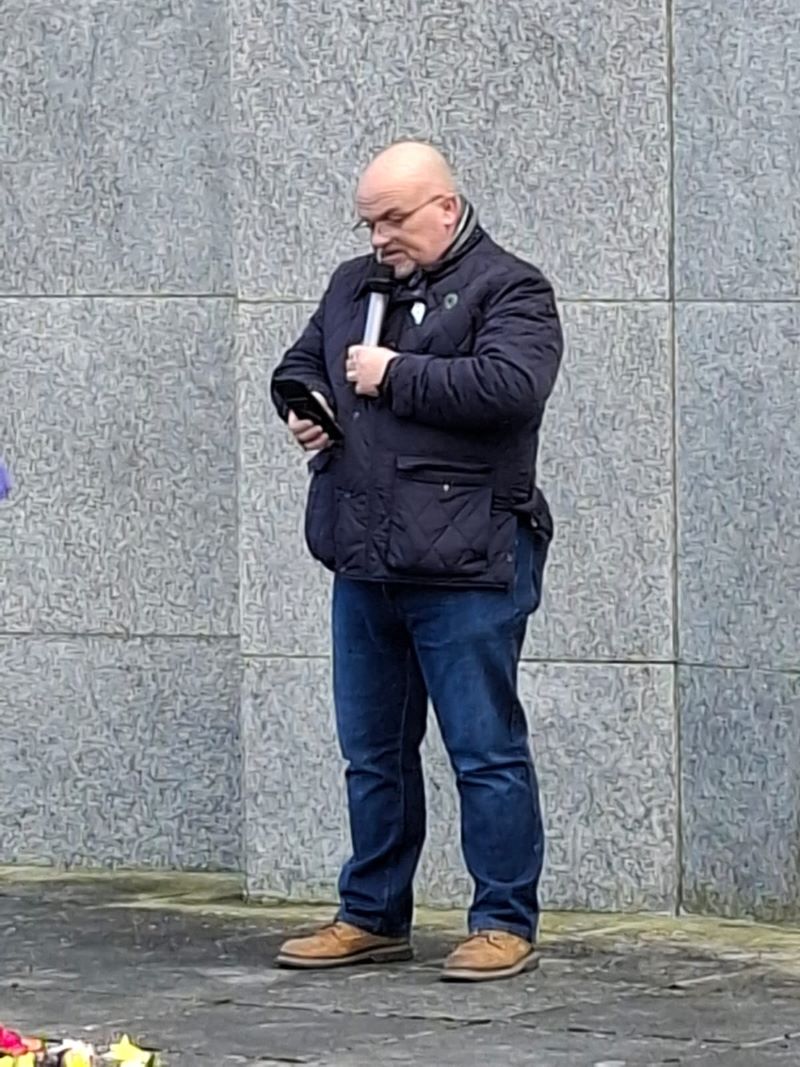
The main speaker, veteran Irish Republican and ex-political prisoner, delivering the oration for the commemorative event. (Photo: R.Breeze)
The speaker made a number of points regarding the text of the 1916 Proclamation, the declarations of which remain to be fulfilled, in its address placing women on an equal standing with men, ‘cherishing the children of the nation equally’ and guaranteeing ‘civil and religious freedom to all.’
Drawing on the example of those of varying ideological positions who in the 1916 Rising united to “fight against the largest world empire in history”, the ex-prisoner called on Irish Republicans to find the means to unite in action today against imperialism and colonialism.
The speaker also highlighted that the objective of the Rising had been an independent democratic republic which is still to be achieved and that Republicans need to honestly confront the failures which, despite strong resistance, have weakened the struggle to date.
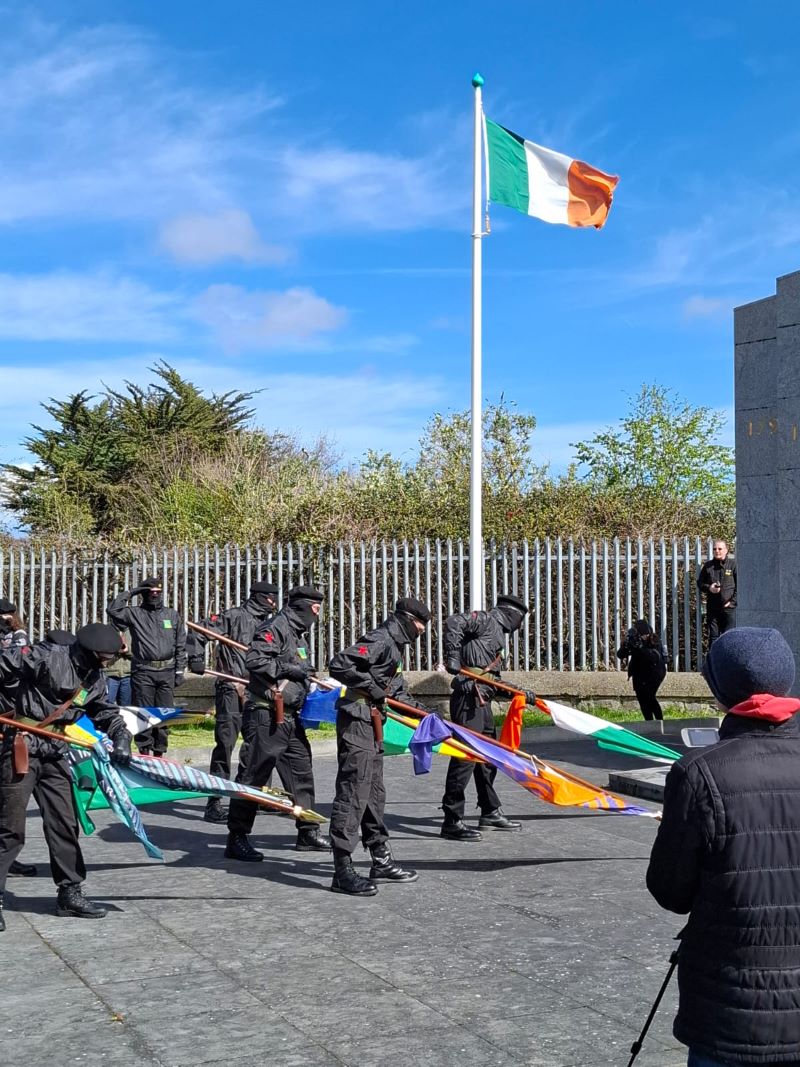
The piper played a slow air as the flags of the colour party were lowered and a few minutes’ silence observed – a traditional Irish Republican honouring of its martyrs in struggle. Announcing the end of the event the MC then called for the piper to play Amhrán na bhFiann4 to conclude.
A moment in the lowering of the colour party’s flags during the moments’ silence in honour and remembrance of fallen martyrs. (Photo: R.Breeze)
COMMENT
The attendance at this year’s event was numerous and encouraging, even discounting the numbers from abroad. The latter has been a feature of AIA commemorations for some years but has also grown visibly in numbers and in countries of origin.
In previous 1916 commemorations of the AIA, songs had been performed by singers but that feature was missing this year. Another missing feature was a part-address in the Irish language, au contraire to the main speaker’s call for the restoration of Irish as the nation’s spoken language.
In common with a great many commemorations by varied organisations at this spot, there was no mention of the independent National Graves Association, for whose work and the monument itself much thanks are due.
A large section of the participants chose to have their photo taken in a group with the monument behind them, their flags, banners and the portraits of the Seven Signatories of the Proclamation to the fore. (Photo: R.Breeze)
The call for unity in struggle is a common one in the Socialist and Republican movement though less verified in practice across their organisations. That said, on many occasions the AIA has put the desire into practice in joint action with other organisations and independent activists.
It is certain that without general unity in action across the resistance movement in Ireland, neither independence nor revolutionary change in society can be achieved.
In the city centre, at the GPO,5 site of the HQ of the Rising in 1916, the State held its own commemoration, with admittance to the area close to the podium by ticket only. According to reports, the speeches of the Taoiseach6 of the Coalition Government were received in silence.
This was in contrast to the speech of the new Uachtarán or President, a native Irish speaker and of broadly left-nationalist political outlook, which was enthusiastically applauded.
End.
Note: If you found this article of interest, why not register with Rebel Breeze for free, so that you will be notified by email of subsequent articles. You can de-register any time you wish.
FOOTNOTES
1However, no other instructions were given in the language, not even ‘dhá líne’ (i.e two lines) when the marchers were being instructed by stewards to separate into two columns.
2Omitted, as it often is, was the participation of the Hibernian Rifles unit, who though not part of the planned Rising joined it and acquitted themselves well in the GPO Garrison and in support of the City Hall Garrison.
3Communist Party of Ireland and Independent Dublin Republicans.
4This air and its lyrics are widely considered the National Anthem of Ireland but for the State, it is only the air of the chorus that is their National Anthem. Composed shortly before the Rising by Peadar Kearney and Patrick Heeney in English, it was sung during the Rising and widely adopted by the Republican movement afterwards. The lyrics were translated to Irish by Liam Ó Rinn in 1923 and, unusually, that version became dominant.
5The General Post Office, an imposing building in Dublin’s main thoroughfare,1 for which recently the Irish Government announced plans to remove the An Post (postal service) to develop in part as a shopping centre.
6Equivalent to Prime Minister. The Government is a coalition of formerly hostile parties Fine Gael and Fianna Fáil, from oppositional sides of the Irish Civil War (1922-1923) and supported by the Green Party and some Independents.
The recognised date known as International Working Women’s Day is March 8th and it was commemorated on that date with a march and revolutionary words and symbolism organised by Irish Socialist Republicans in Dublin.
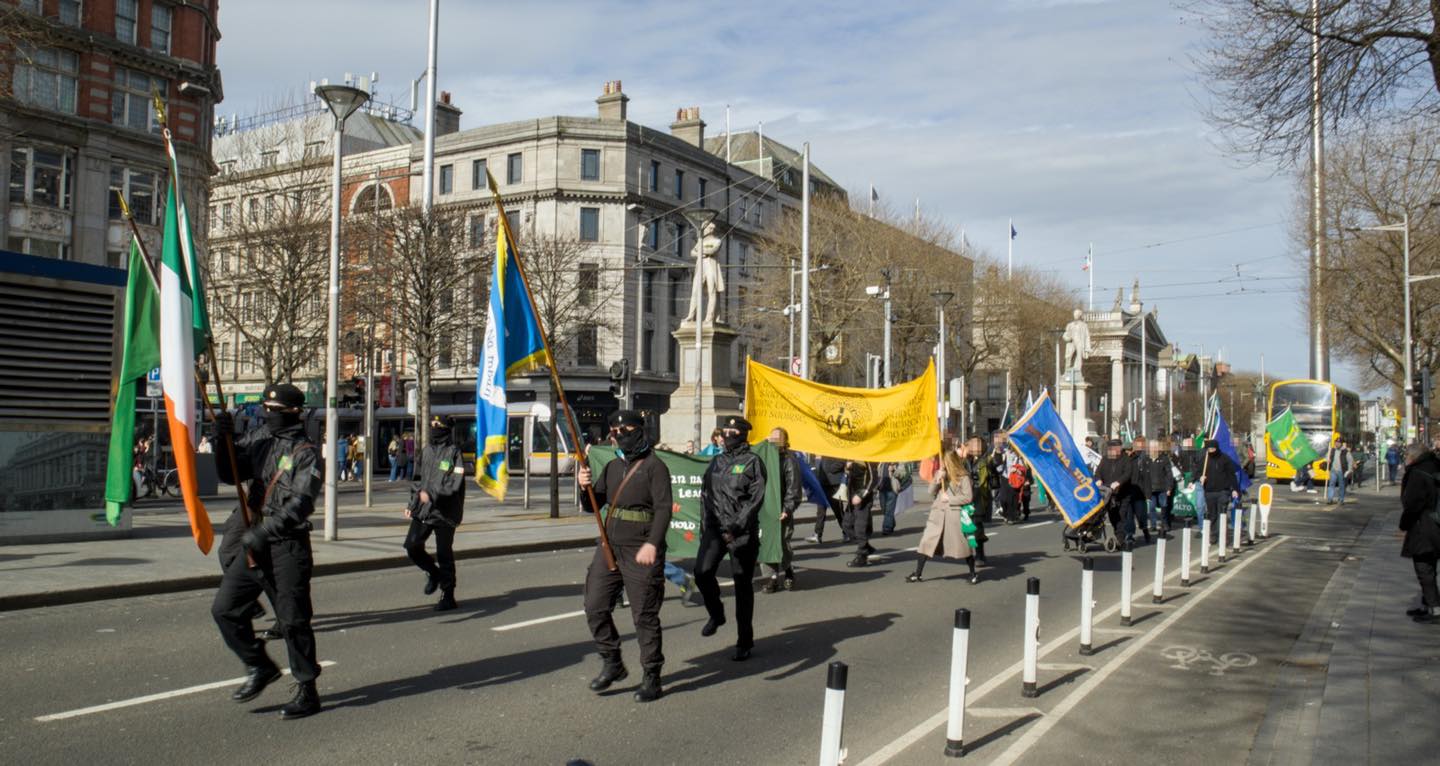
The marchers gathered outside Wynn’s Hotel in Lower Abbey Street, to mark the founding there of the revolutionary Republican military women’s organisation, Cumann na mBan, on 2 April 1914. The organisation, with its own officers, was possibly the first of its kind for women in the world.1
From there the march set off into O’Connell Street, then marching southward to cross the Liffey into D’Olier Street before turning left into Townsend Street, continuing to the statue of Constance Markievicz where the colour party’s flags were lowered in respect.
The march near the start in O’Connell St (photo credit: An Pobal Abú FB page)
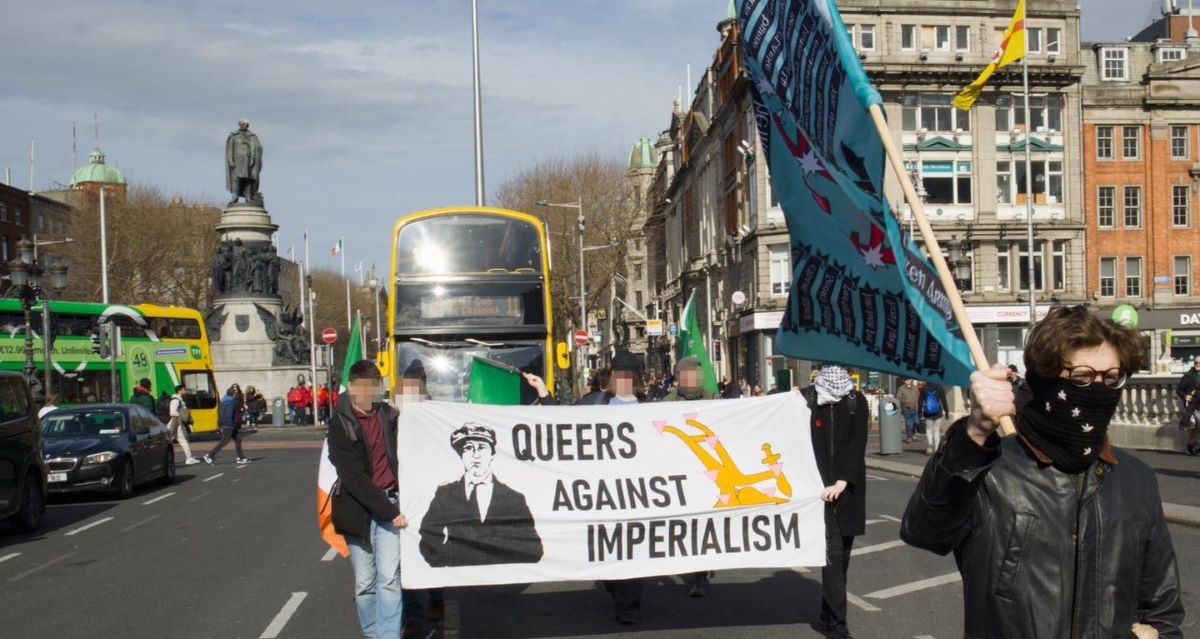
Throughout, chants of “Ní Saoirse go Saoirse na mBan”2 and “Britain out of Ireland” reverberated through the streets of Dublin as banners displayed the slogans “coinníonn na mná suas leath na spéire / women hold up half the sky” and “Queers Against Imperialism”.
Markievicz was an active member of Iníní na hÉireann, the Irish Citizen Army and of Cumann na mBan. She was part of the command of the Stephens Green/ College of Surgeons garrison in 1916 and elected MP on an abstentionist ticket in 1918 and Minister of Labour in the First Dáil in 1919.
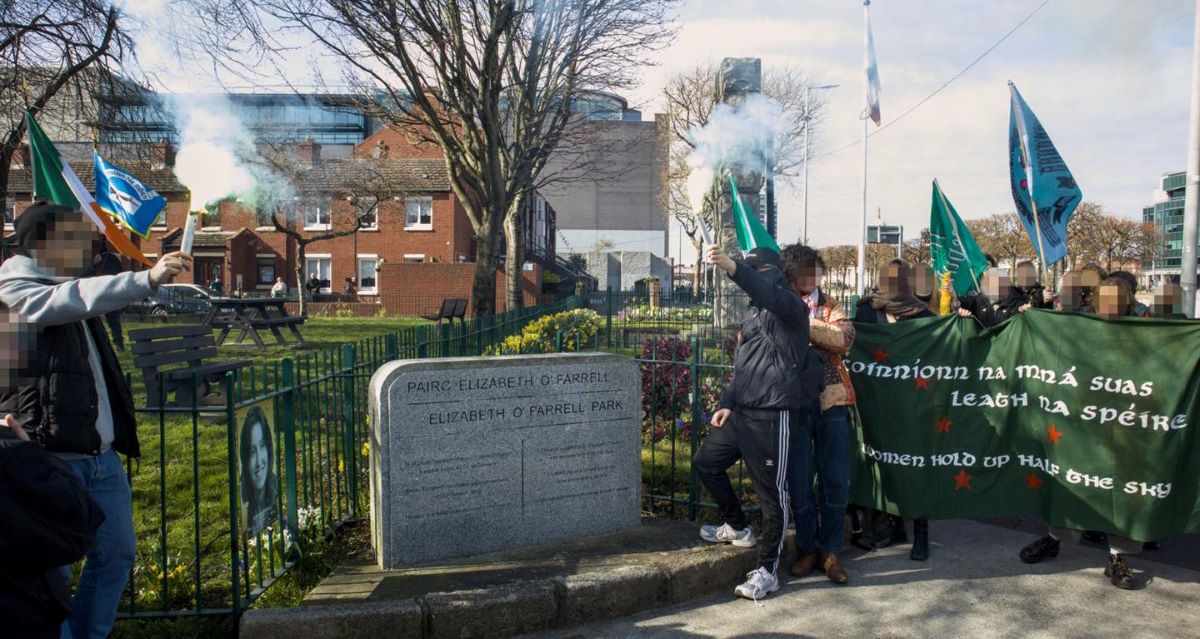
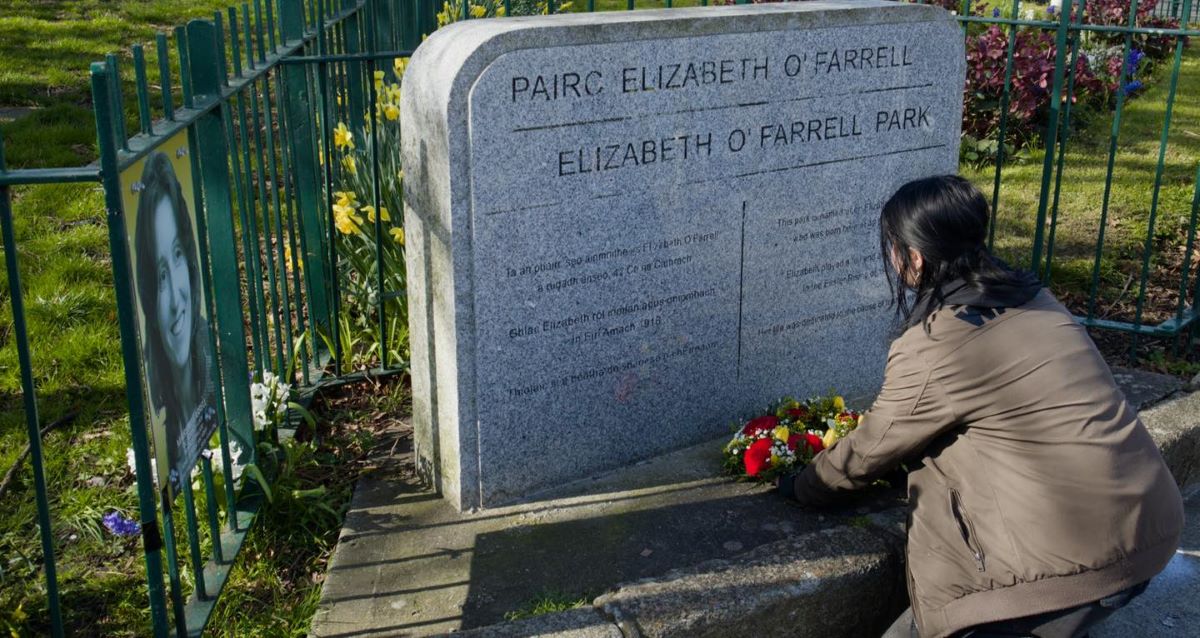
Continuing along Townsend Street and ending at Elizabeth O’Farrell park where a commemoration was held outside in honour of the role of women in the struggle for national liberation while the colour party took up position inside the park.
(Photo credit: An Pobal Abú FB page)
A woman read a speech on behalf of the AIA, tracing founding of International Women’s Day from when women in Russia in 1917 had led strikes and marches against the Tsar and WW1, later becoming known as the February Revolution, leading later to the October Socialist Revolution.
The speaker went on to speak of the role of women in the Republican struggle, from Cumann na mBan, the Irish Citizen Army and Armagh Gaol Republican prisoners, followed by a woman reading the 1916 Proclamation of Independence and the burning of two green flares.
(photo credit: An Pobal Abú FB page)
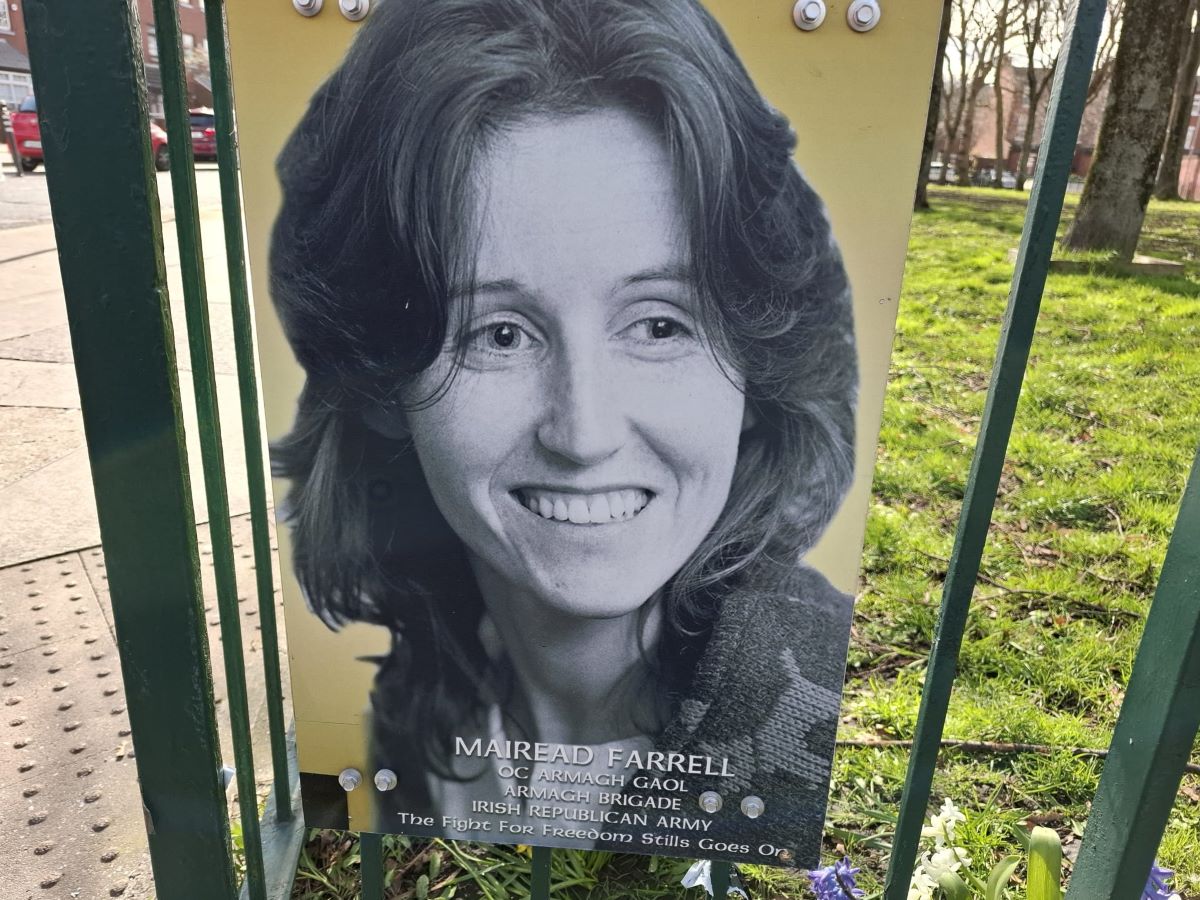
A new plaque of the Socialist Republican Mairéad Farrell was unveiled with the laying also of a commemorative wreath during a minute’s silence observed for all revolutionary women and gender oppressed people who gave their lives for national liberation and anti-imperialist struggle.
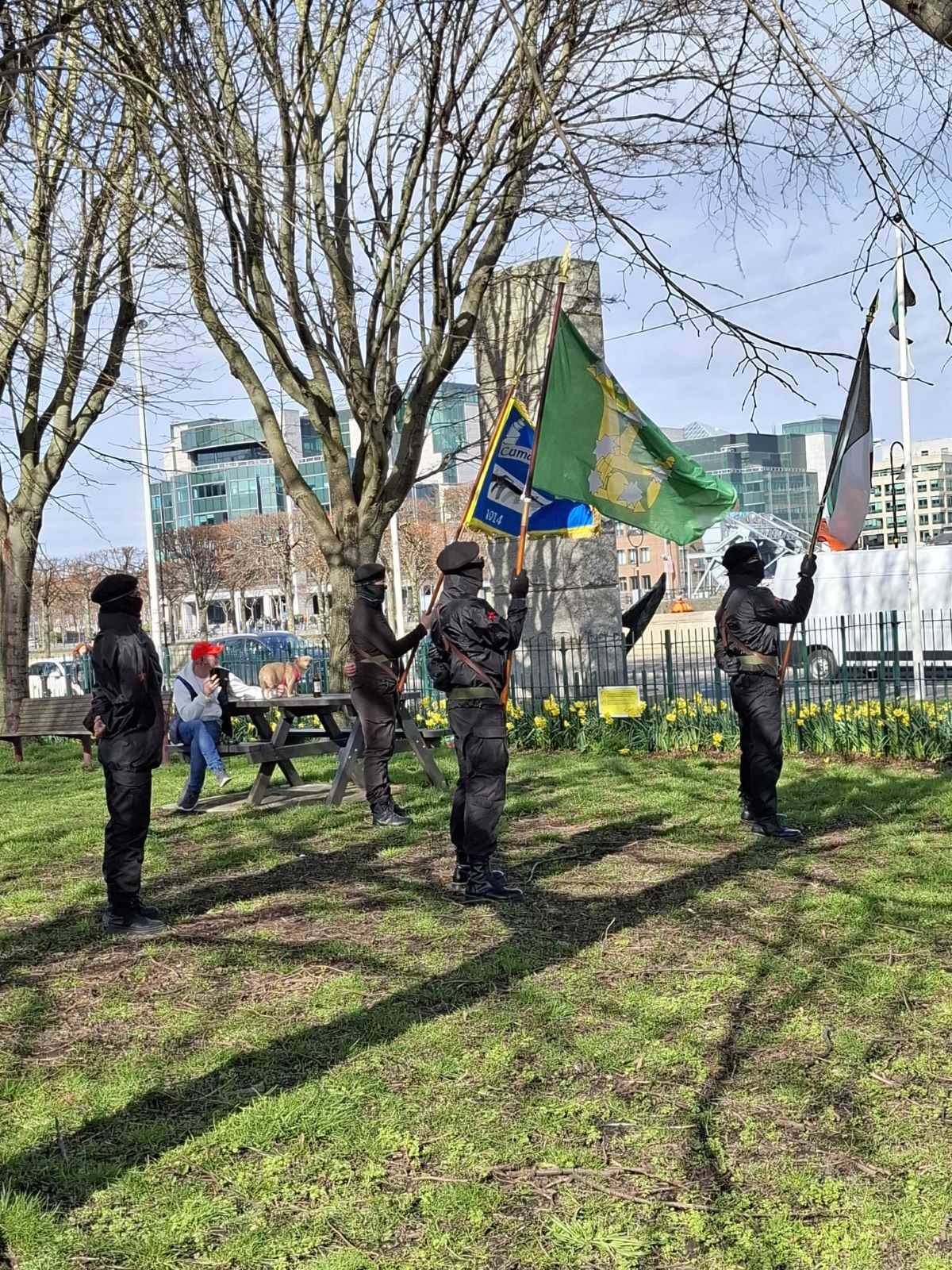
The Colour Party in Elizabeth O’Farrell Park (Photo: R.Breeze)
At the same time the colour party lowered their flags in respect, during which the command calls in Irish rang out in the area through the silence.
The area in which the Elizabeth O’Farrell and her life-long friend Julia Grenan3 grew up is a south Dublin docklands still largely working class area. It was in a yard in Lombard Street nearby, actually within sight of the park, that the IRB (Fenians) was founded on March 17th 1858.
Laying of the wreath (photo credit: An Pobal Abú FB page)
Elizabeth O’Farrell and Julia Grenan both participated in the 1916 Rising and, along with Winifred Carney, refused to join the earlier evacuation from the burning GPO building on the Friday, later participating in the final evacuation which ended in the central terrace in Moore Street.
When the leadership took the decision to surrender, O’Farrell went out to negotiate under a white flag even though a man had been killed under such a flag earlier in the very street. In 1922, along with almost the entirety of Cumann na mBan and the ICA, she rejected the Anglo-Irish Agreement.
(Photo: R.Breeze)
Many women were interned by the nascent neo-colonial Irish Government.
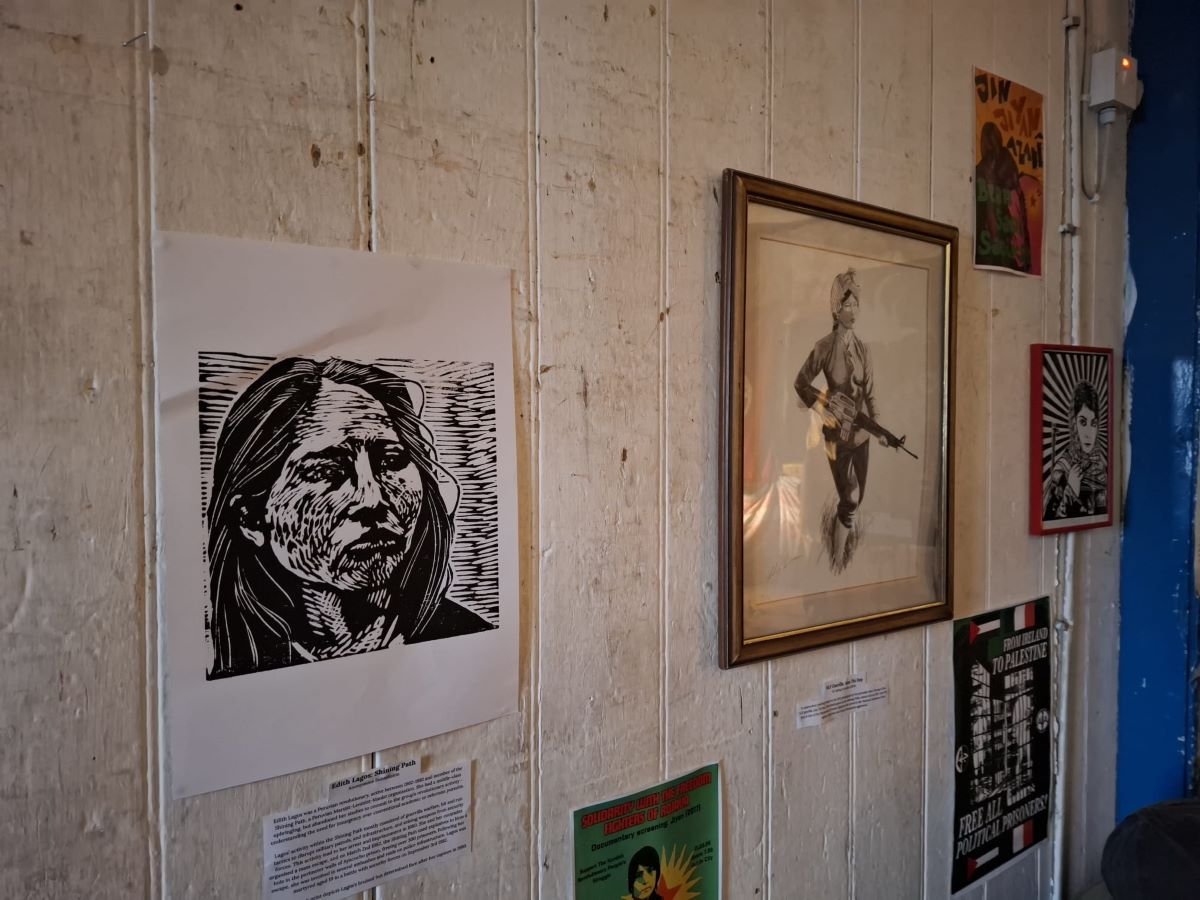
After the Elizabeth O’Farrell Park event, people gathered again at a recently-occupied social centre in Dublin, to view an exhibition of images in honour of the day and to watch an English-subtitled French-language film about women and the Omani Resistance, followed by a music session.4
Part of exhibition for International Working Women’s Day in the social centre (Photo: R.Breeze)
End.
Note: If you found this article of interest, why not register with Rebel Breeze for free, so that you will be notified by email of subsequent articles. You can de-register any time you wish.
Footnotes
1In its early years the organisation worked mainly as an auxiliary to the Irish Volunteers but asserted greater independence at a later stage. It coincided in time with the women in the Irish Citizen Army who shared equal status with male members and indeed in the case of some of them, such as Markievicz and Lynn, actually commanded men. Wynne’s Hotel was also where the decision to found the Irish Volunteers had been taken in 1913.
2Translated as ‘There can be no freedom until women are free.’
3And life partner, many have speculated – certainly they lived together until the end.
4The Hour of Liberation Has Arrived by Heiny Srour
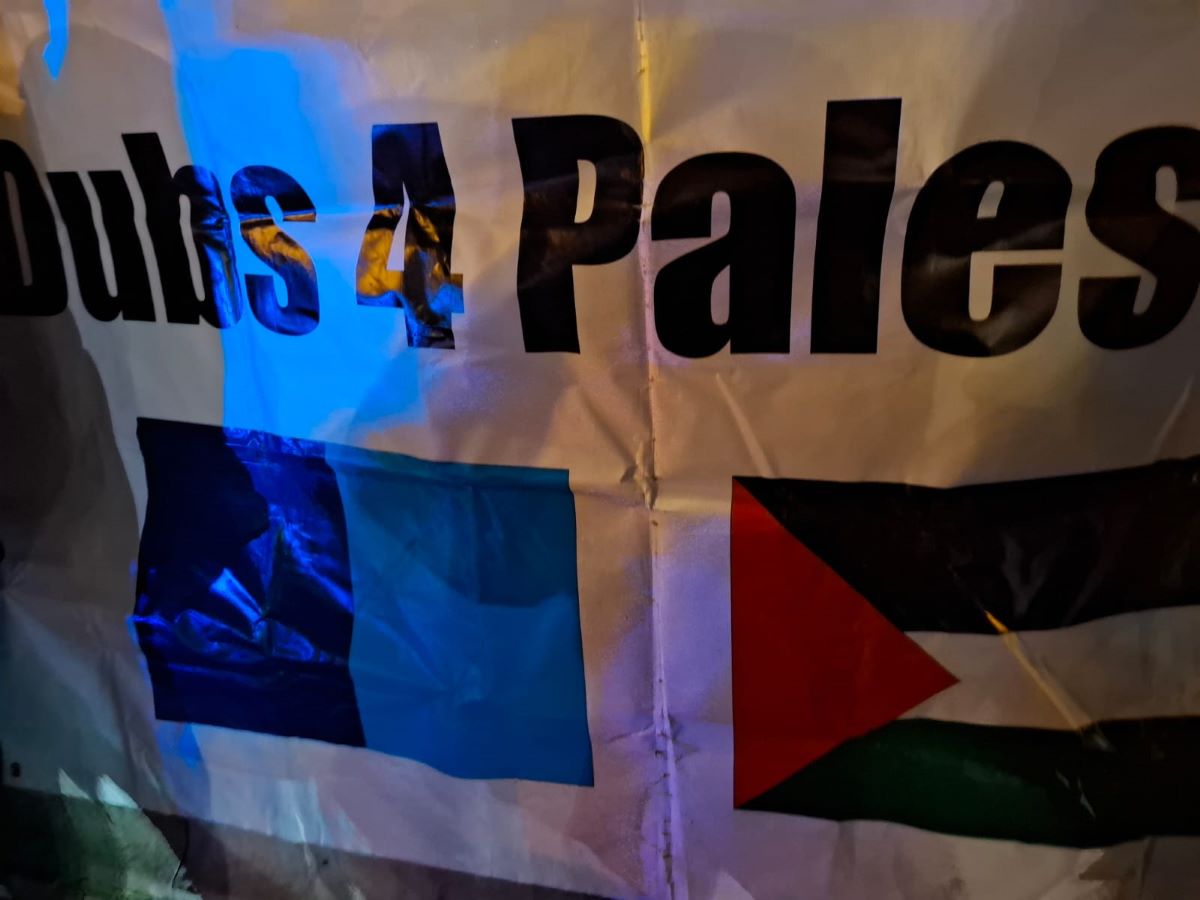
Through three events on Saturday, New Year’s Eve in the city centre, Dublin sent a solidarity message to the Palestinian people and also to the solidarity activists on hunger strike in British jails, referencing also those of the Irish Resistance in 1981.
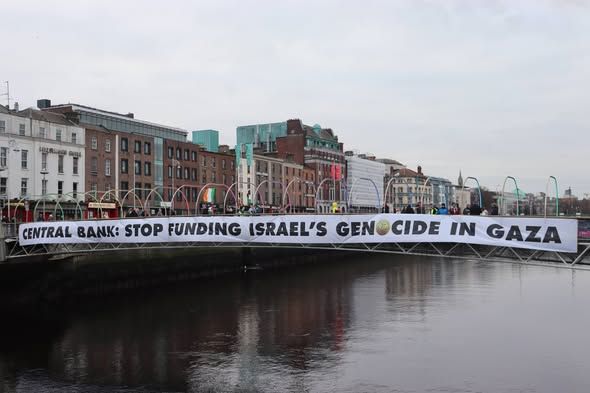
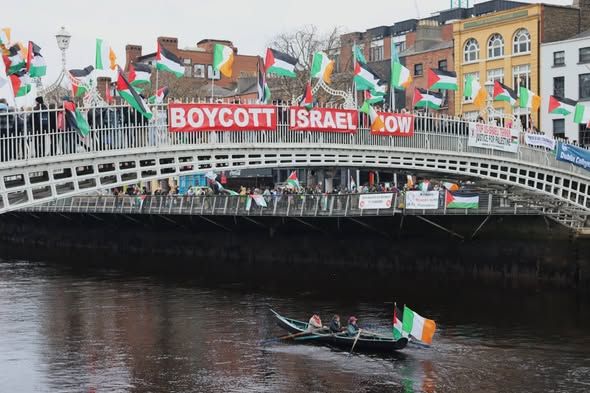
The Millennium Bridge on New Year’s Eve. (Photo: IPSC)
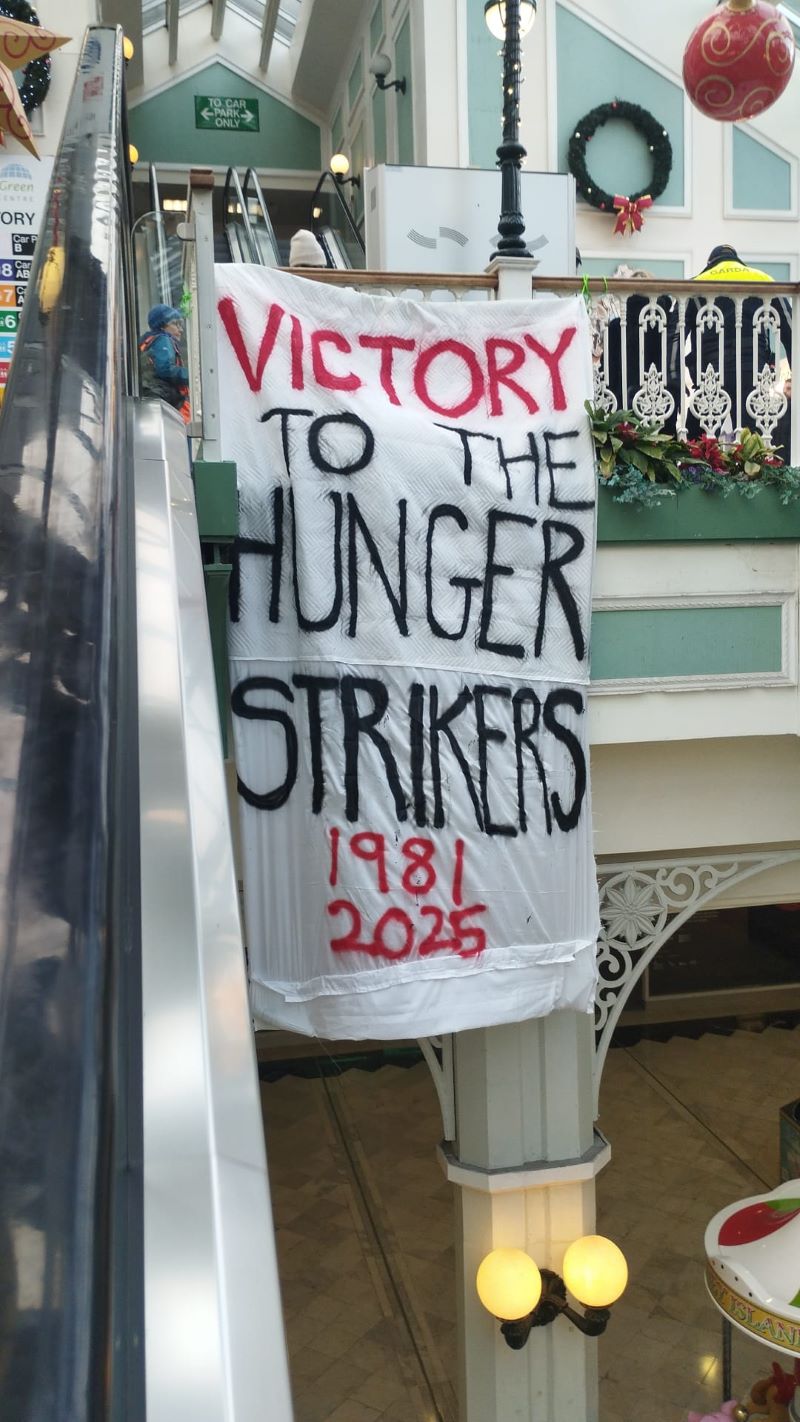
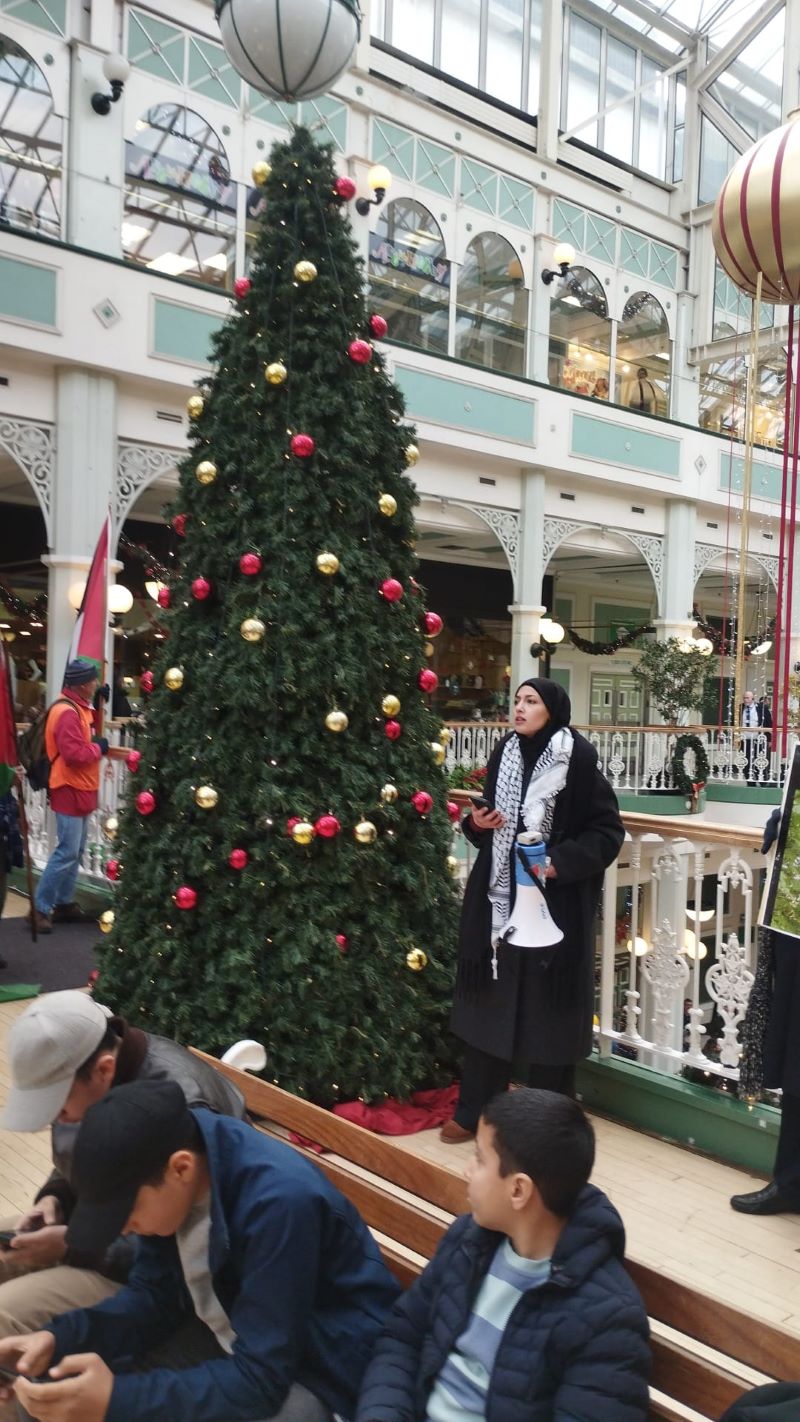
Chronologically first was a protest in the Starbucks café1 in Stephen’s Green Shopping Centre obliging the management to close for hours and a balcony walkway banner drop calling for solidarity with the Elbit accused on hunger strike, referencing also the Irish hunger-strikes of 1981.2
I had not read the poster carefully and arrived at the Starbucks at the north end of Grafton Street, where there were a few other confused people also. By the time I made my way up to the southern end of Grafton Street, the protest there was about to leave and I was about to head elsewhere.
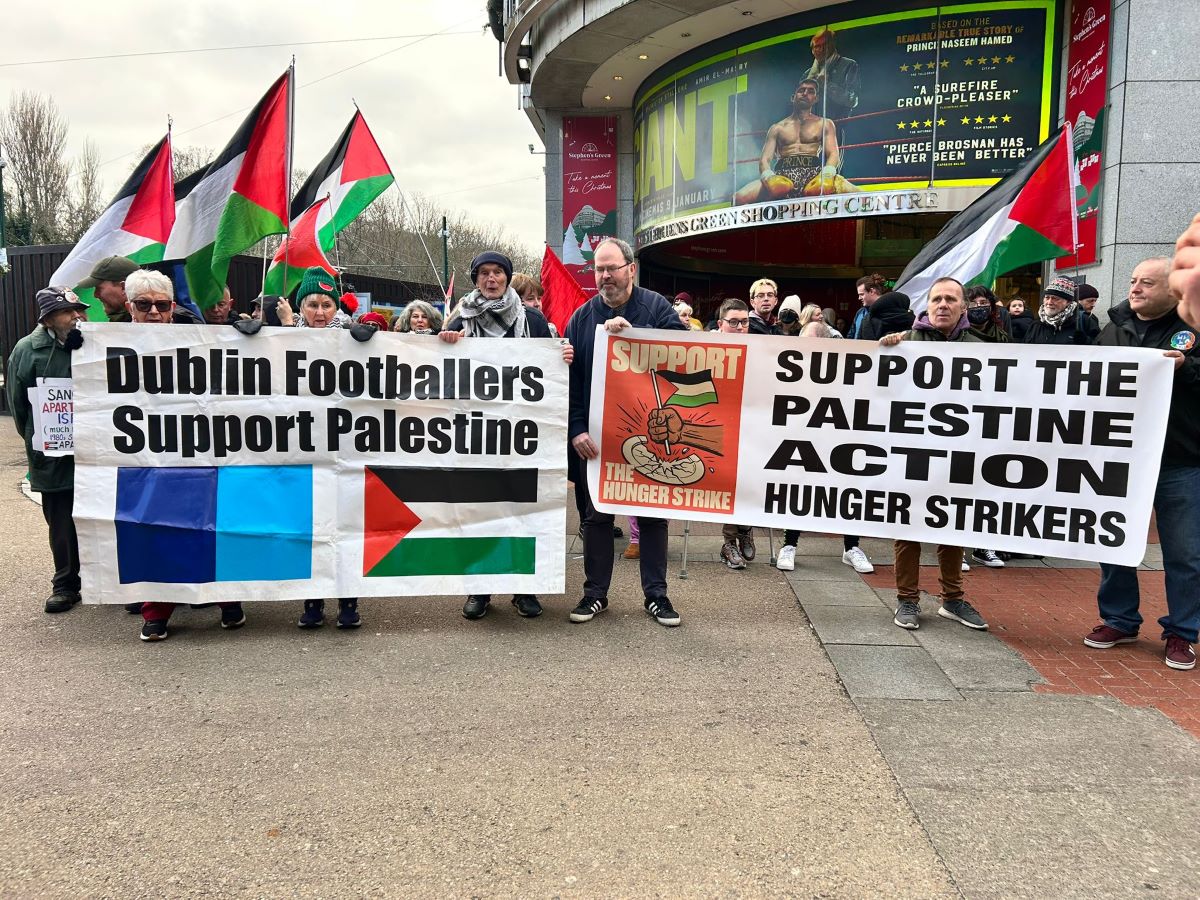
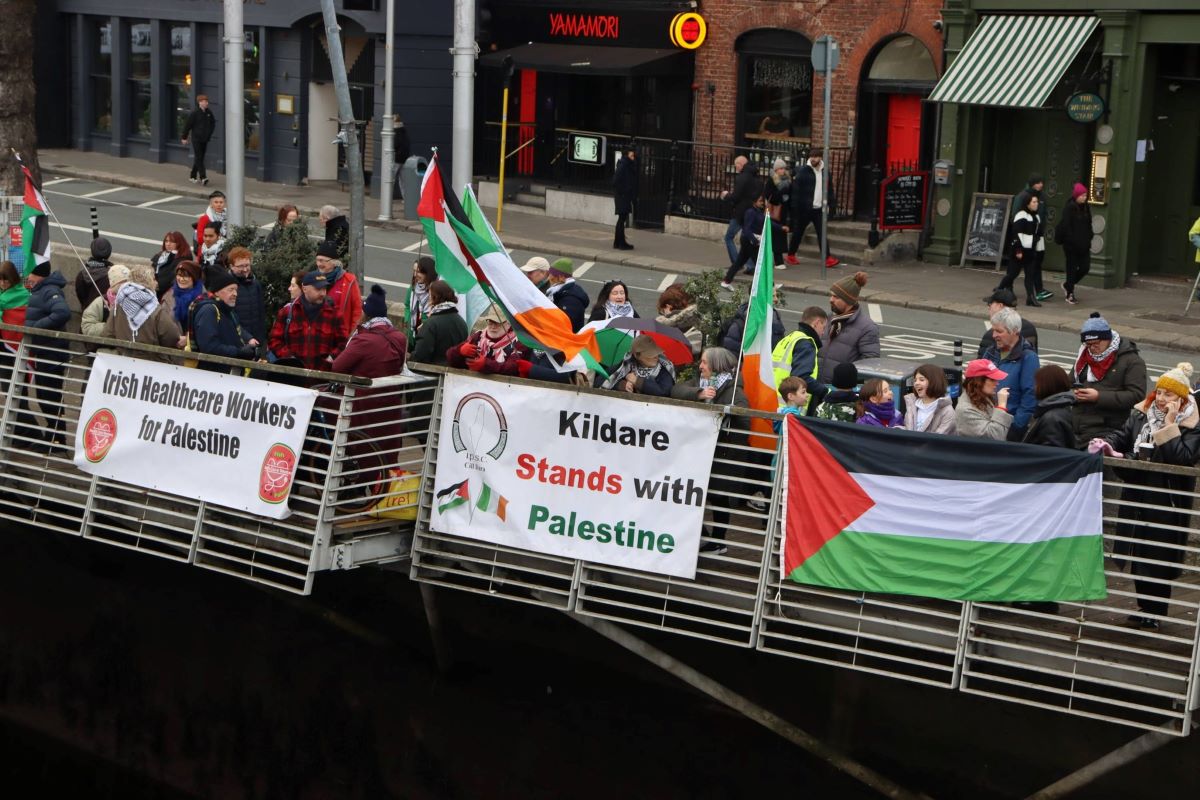
Two main banners present at protest outside the Stephen’s Green Centre on New Year’s Eve, after closing down the Starbucks café inside. (Photo: Bas)
The solidarity crowd continued to demonstrate in the shopping centre’s main doorway before marching away, then went into the Zara3 big shop and demonstrated there awhile before heading on to MacDonald’s in Grafton Street where the Gardaí began to let their nasty side show a little.
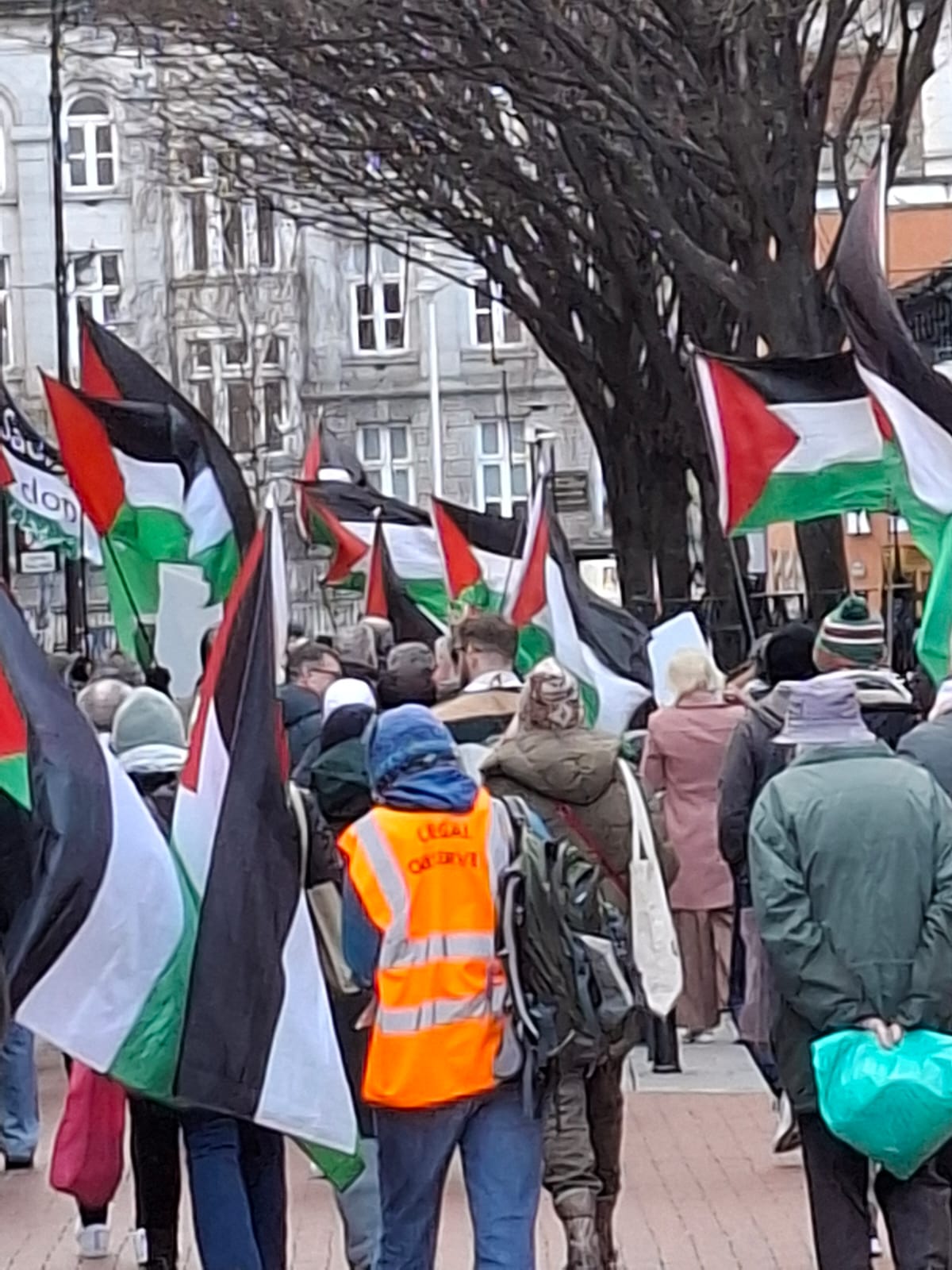
Palestine solidarity protesters leaving the Stephen’s Green Centre on New Year’s Eve, heading down to Zara to protest there (Photo: D.Breatnach)
Then another Starbucks, this one on Dame Street got a Palestine solidarity visit before the demonstrators went on to the iconic pedestrian Ha’penny Bridge, where the Ireland Palestine Solidarity Campaign holds a Palestine solidarity protest every New Year’s Eve.
Closeup of banner-drop inside the Stephen’s Green Centre on New Year’s Eve, during protest after closing down the Starbucks café inside. (Photo: G.O.L)
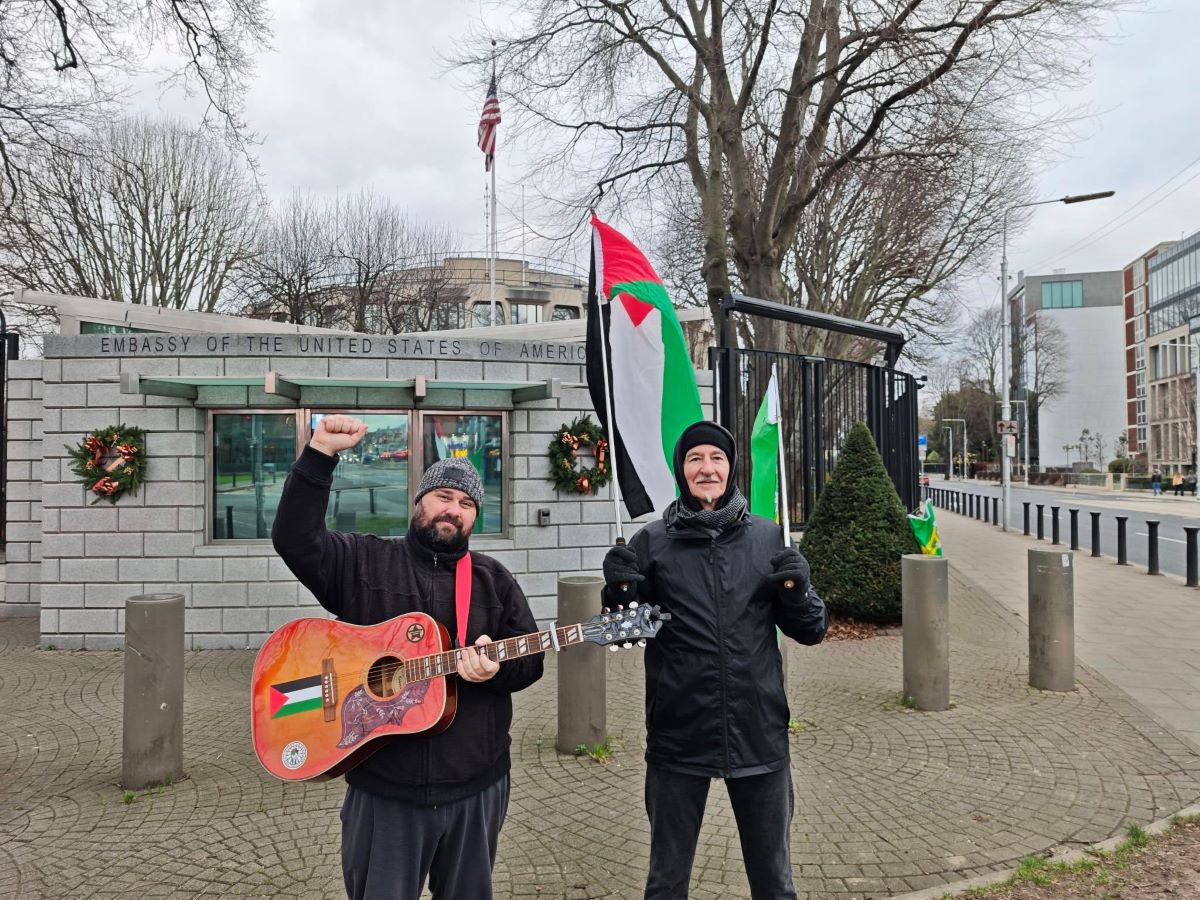
There the demonstrators thronged the Ha’penny and Millennium Bridges and spilled out along the quays. I was elsewherefor the first time in years as it was a Wednesday and therefore Jimi Cullen’s weekly protest with songs at the US Embassy in Ballsbridge, this one to be his 97th straight.
As usual there were police on guard there and one in uniform approached myself and Jimi as we were talking and asked Jimi how long the event would be, how many attending etc. Then she suggested I removed my bike which was leaning against a bollard.
Conducting the protest inside the Stephen’s Green Centre on New Year’s Eve which obliged management to close down for some hours the Starbucks café inside. (Photo: G.O.L)
I told her I was happy with where it was, thank you. Then she said that it might fall on someone (but not, of course, if across the road!), then that someone might steal it, all of which was nonsense of course then said: ‘I am asking you to remove it’ to which I replied ‘And I am declining.’
She was getting quite angry but decided to walk it off. I have attended supporting Jimi’s protest perhaps a score of times and in the early days had a similar approach from a Special Branch4 officer who accused me of causing ‘a security risk’ to the Embassy’s ‘curtilage’ (on a public footpath)!
The Ha’penny Bridge on New Year’s Eve. (Photo: IPSC)
Some police just like to throw their weight around even with regard to things that have nothing to do with the law or causing harm to anyone and over which they have no legal power.
Anyway we unfurled the flags, Jimi had a placard displayed, got out his guitar and we sang through week 97 to frequent waves, clapping, thumbs up, clenched fists, shouts and horn blowing of appreciation and solidarity from passing motorists, pedestrians and cyclists.
Section of northern quays/ Boardwalk on New Year’s Eve, during protest after closing down the Starbucks café inside. (Photo: IPSC)
Jimi began this weekly protest outside the Israeli Embassy but when they left Ireland he moved up the road to the nearby US Embassy, representative of the world leader in terrorism and biggest supporter, politically, financially and militarily of the world’s leading genocider entity.
Usually there are more supporters present. Jimi has a fine stock of protest and solidarity songs, some of which he composed himself and performs them well. Today we did mostly Irish songs of struggle but also one from the black civil rights struggle and Jimi’s own about Palestine.
Jimi Cullen and myself at Jimi’s weekly event outside the US Embassy on New Year’s Eve. (Photo: J.Cullen)
We had a number of Palestinian flags there but also two Starry Plough flags and there were some Irish Tricolours to be seen on the other protests among the many Palestinian ones. It is from our own struggle that we stand in solidarity with Palestine.
End.
Note: If you found this article of interest, why not register with Rebel Breeze for free, so that you will be notified by email of subsequent articles. You can de-register any time you wish.
2Ten Irish Republican prisoners, seven IRA and three INLA died on hunger-strike in a British jail in 1981 in a struggle against criminalisation and for political status
A campaign for conservation of the ancient Moore Street Dublin inner-city street market area and 1916 Battleground, in its 11th year of Saturdays on the actual street is seeking to reach 2000 on-line signatures for the group’s petition this year.
The site was formerly under threat of construction of a giant ‘shopping mall’ from the ILAC to O’Connell Street. However ‘shopping malls’ are not making so much money nowadays so the new plan is largely a ‘shopping area’ with an hotel and a new road from the ILAC to O’Connell Street.
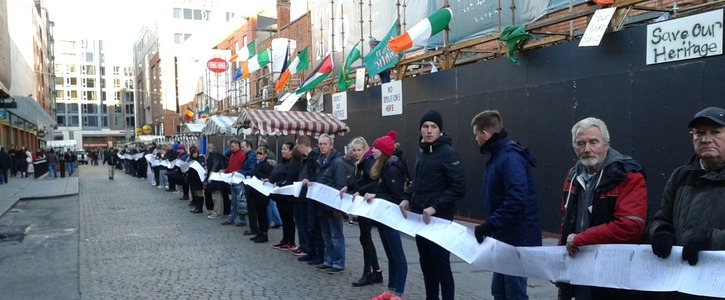
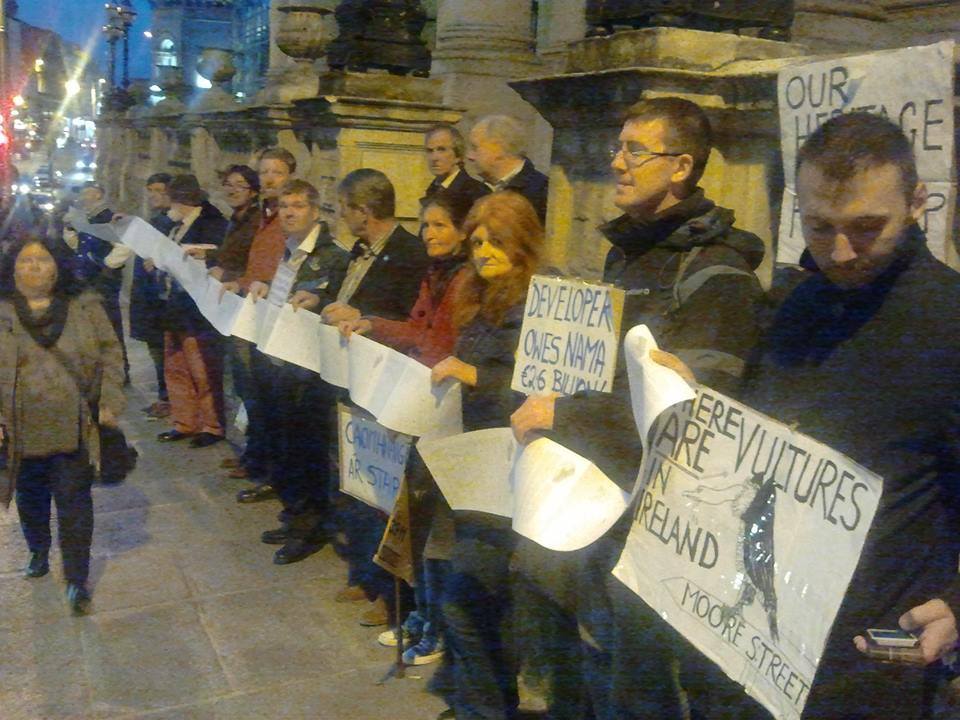
Picket/ lobby of Dublin City Council in 2014, petition stretch and posters organised by the Save Moore Street From Demolition Group, founded a couple of months earlier to prevent Dublin City Council City Manager giving property speculator Joe O’Reilly Nos. 24-25 in exchange for Nos.14-17, which would have allowed him to demolish from No.25-No.18. The campaign was successful in preventing that as councillors voted against the swap. (Photo: SMSFD archives)
Moore Street is of course already ‘a shopping area’ but what that means to property speculators is a street of chain stores, something like the Grafton and Henry Streets. Such streets are busy during shopping hours but largely deserted at night and anathema to the living social city centre.
Independent small shops and street stalls characterise a street market, typically with some cafes, a bakery and restaurant. But the agent of Hammerson, the speculator company, has closed down a bakery and a number of successful restaurants and cafés on the street.
On the Friday of Easter Week, 300 or so of the GPO garrison evacuated the burning building and occupied the central terrace in Moore Street to gain a respite, setting up their new HQ there and a field hospital caring for their wounded and for a wounded soldier of the British Army.
The new intended street would cut right through the historic 1916 terrace, the footprint and path traversed by much of the 300 or so GPO Garrison in 1916 as they evacuated their burning former HQ and prepared to relocate to William & Woods site in nearby King’s Inn Street.
Moore Street, according to campaigners, is of great Irish cultural and historical importance but is also of international historical stature: surrender site of the first anti-colonial uprising of the 20th Century and of the first rising against World War and last location in freedom of five of its leaders.
Those five, Connolly, Pearse, Clarke, Mac Diarmada and Plunkett, were also five of the Seven Signatories of the 1916 Proclamation, a document of huge symbolic significance in history and still often referenced in contemporary discourse.
Campaigners point to the presence in the street of the Irish Citizen Army, which they claim as “the first workers’ army” and of its leader, Connolly along with three of the first women’s republican military organisation, Cumann na mBan: Elizabeth O’Farrell, Julia Grenan and Winifred Carney.
The Irish Citizen Army recruited women too, including appointing some of them as officers in command of male Volunteers, another first in world history.
Signed petition sheets sellotaped edge to edge in January 2016, stretched along Moore Street as the 6-day occupation of the endangered buildings came to an end and shortly before the 6-week blockade began. (Photo: SMSFD archive)
SUCCESSES AND DEFEATS
The campaign has had some previous successes, including four buildings being declared a historical monument in 2007, refusal of land-swap in 2014 (see photo), a six-week blockade of the site and a High Court declaration in 2016 of the whole area being a national historical monument.
However, the campaign insists the historical monument is all 16 buildings in the terrace, not just four. And the High Court decision was successfully appealed in February 2017 by the Minister of Heritage on the grounds that a Judge did not have the power to declare a national monument.
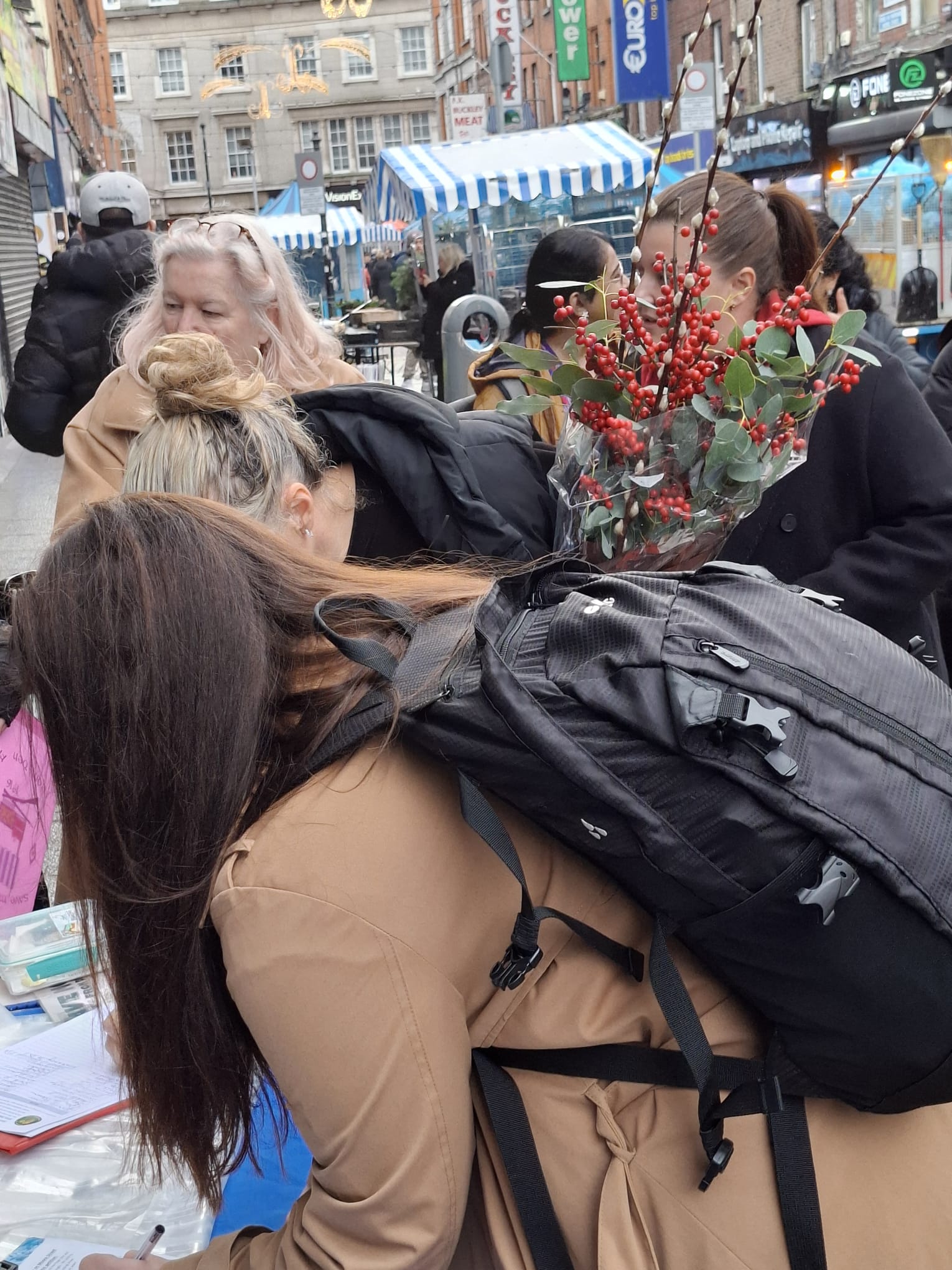
The campaigners, now in their 11th year of Saturdays on the street, say that they stopped counting hard copy petition signatures once they passed 380,000. But last year they started an electronic petition in which they aimed for 1,000 by year’s end — and exceeded their target.
Women Christmas shopping crowding around the petition table to sign hard copy and on-line petition last Saturday. (Photo from weekly SMSFDalbum 20 December 2025.)
This year they’ve aimed to reach 2,000 but, with nearly another 300 needed with a week to go before the end of 2025, reaching their target seems very unlikely.
The campaign group supporters say that they have held the line so long because of the support of hundreds of thousands, not only of indigenous Irish but also of settled migrants (the latter being the mainstay of the traditional fresh fruit and vegetable stalls) and want the signatures to reflect all that.
“At this stage, the strongest help we can get from ordinary people is to sign the on-line petition and to get their contacts to do so too,” said one of the campaigners on the street recently. “On-line signatures are identifiable to one person, verifiable and the total can be checked on line.”
“The authorities will remember that people took direct action in the past to halt demolition, as in the occupation and blockade of 2016 but thousands of online petition signatures are an indication that the activists represent much more than themselves alone”.
The Save Moore Street From Demolition campaigners are on the street every Saturday from 11.30am-1.30pm and their online petition is on https://my.uplift.ie/petitions/save-moore-street The group has Instagram and Facebook pages also.
end.
Note: If you found this article of interest, why not register with Rebel Breeze for free, so that you will be notified by email of subsequent articles. You can de-register any time you wish.
There were lively scenes today outside Dublin’s British Embassy in solidarity with the hunger strikers in British jails awaiting trial on charges arising out of Palestine Action’s operations against the Israeli arms company, Elbit Systems UK.
Two of the six hunger strikers are in their 50th days without food and approaching the point where fatal seizures are possible or suffering irreversible damage to body systems. Their demands are release on bail, a fair trial, de-proscription of Palestine Action and the closure of Elbit Systems.
Early shot of hunger-striker solidarity protesters outside the British Embassy compound today. (Photo: R.Breeze)
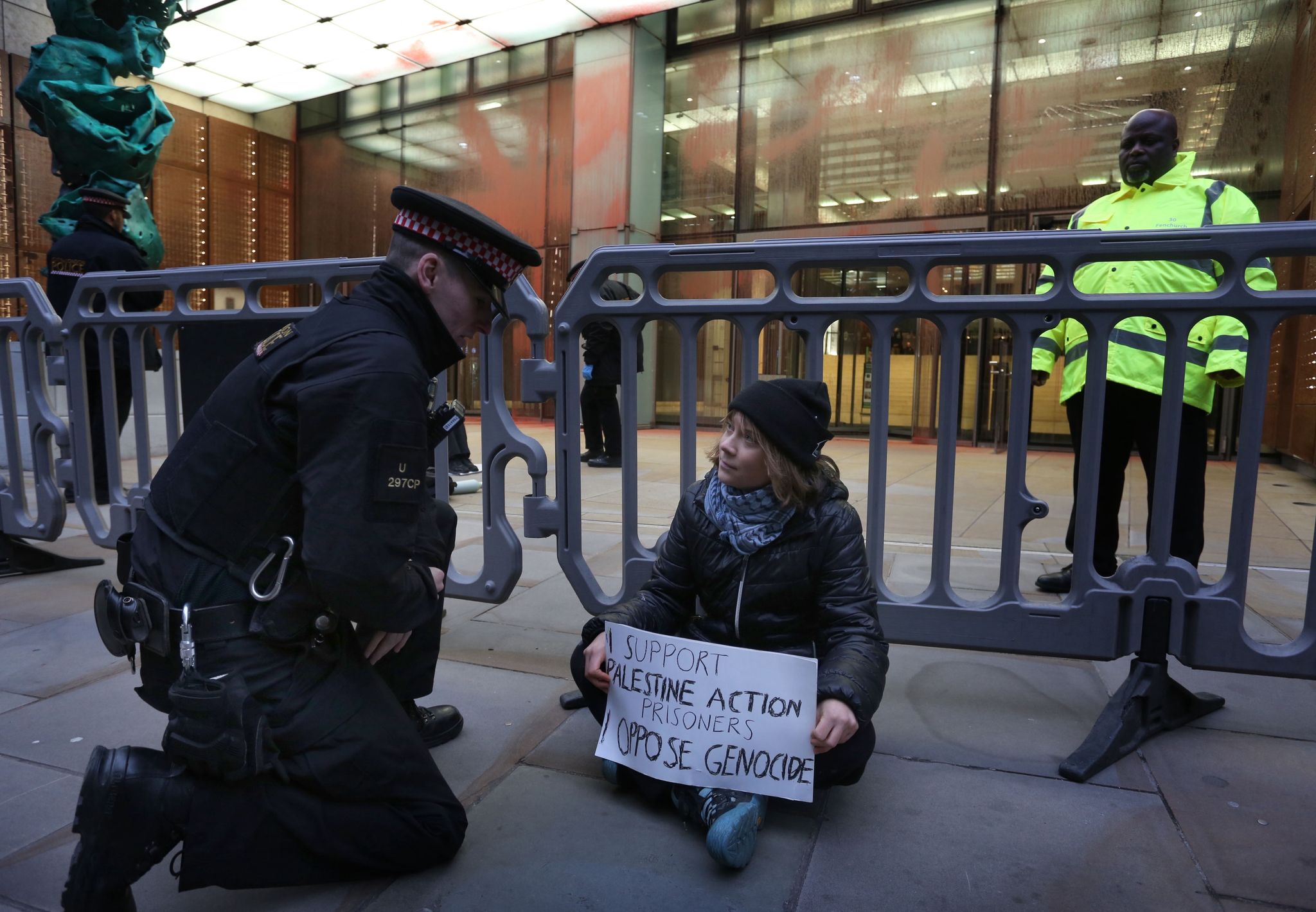
There have been daily solidarity protests in Britain, including those led by the Irish Brigade1 in London amid general mass media silence but the arrest of Greta Thurnberg today on ‘terrorism’ charges may bring a focus on the hunger-strikes for a change.
Today also The National newspaper revealed that Barclay’s had asked the British Government to ban Palestine Action and already the question is being asked: How is it that was not admitted by the Government when Huda Ammori took the Palestine Action banning to judicial review?
(Greta Thurnberg about to be arrested earlier in Central London). Photo source: Internet)
The rally today, like that outside the British Embassy last week, was organised by the Peadar O’Donnell Socialist Republican Forum, while another solidarity rally in Dublin last week but on College Green, in the City Centre, was organised Communities for Palestine.
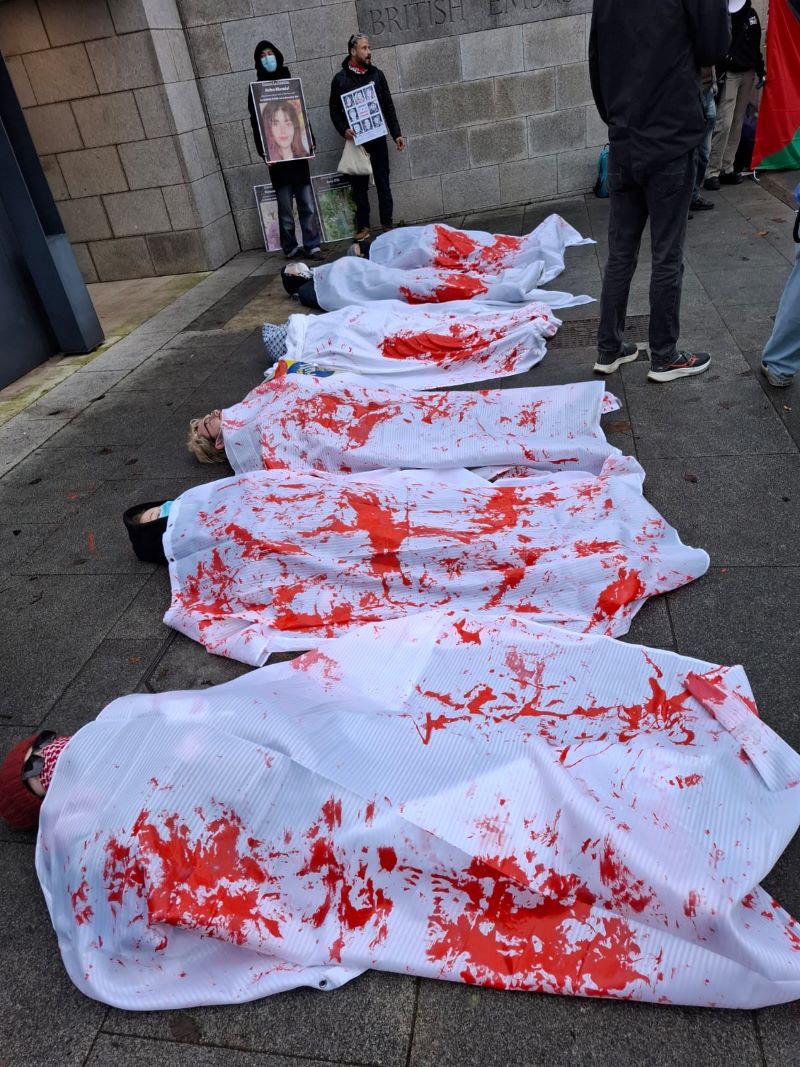
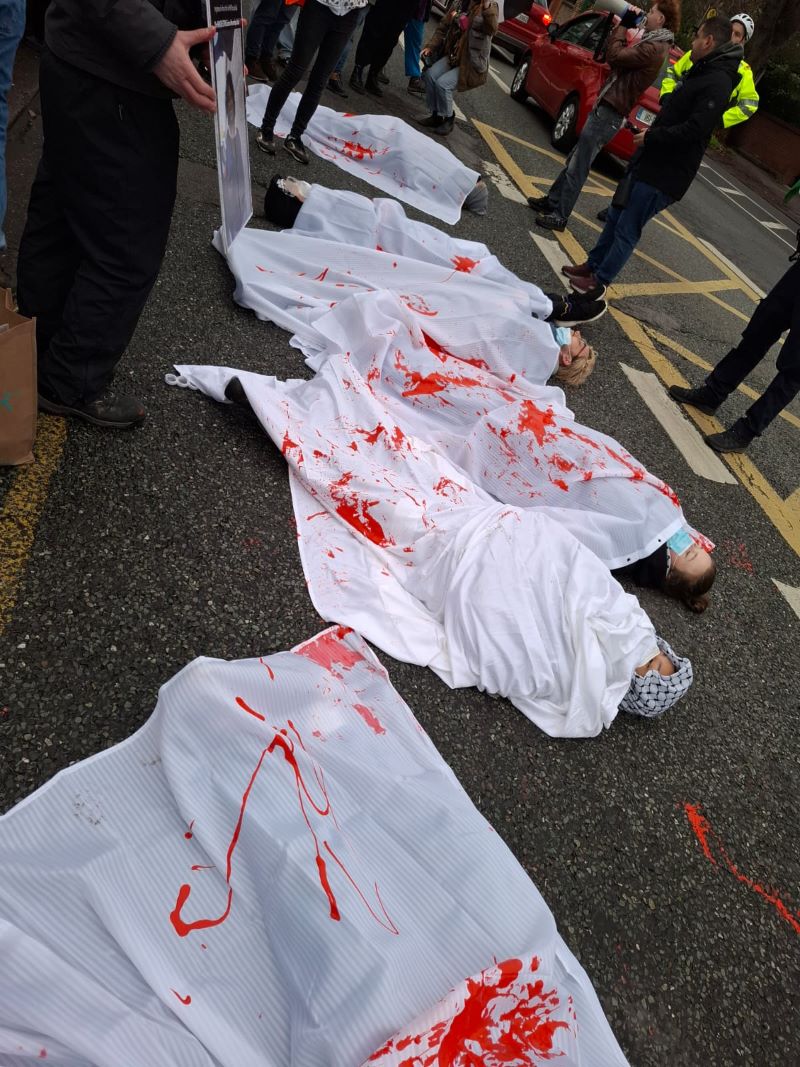
The ‘corpses’ in the road outside the British Embassy compound today. (Photo: R.Breeze)
The chants led outside the Embassy today included the usual ones heard on Palestine solidarity marches, including those referencing the Intifada, the occupation of Ireland and the Irish-language Saoirse don Phalaistín! But there were also new ones and additions to older slogans.
A new Four, Five and Six was added to a previous only One, Two and Three: One – We are the people; Two – We won’t be silenced; Three – Stop the bombing now, now, now! Four – Free our people; Five – Free our land; Six – Kick Zionism out, out, out!
Some other changed and new chants included: One, Two, Three, Four– Support the Filton 24! Five, Six, Seven, Eight – Israel is a terrorist state. We are all Palestine Action! Victory to the hunger-strikers! Brick by brick, wall by wall – all the colonies will fall!
Slogans also castigated British Government collusion in the Israeli genocide, Irish state collusion through militarisation of Shannon Airport and Gardaí collusion through their defence of the British Embassy.
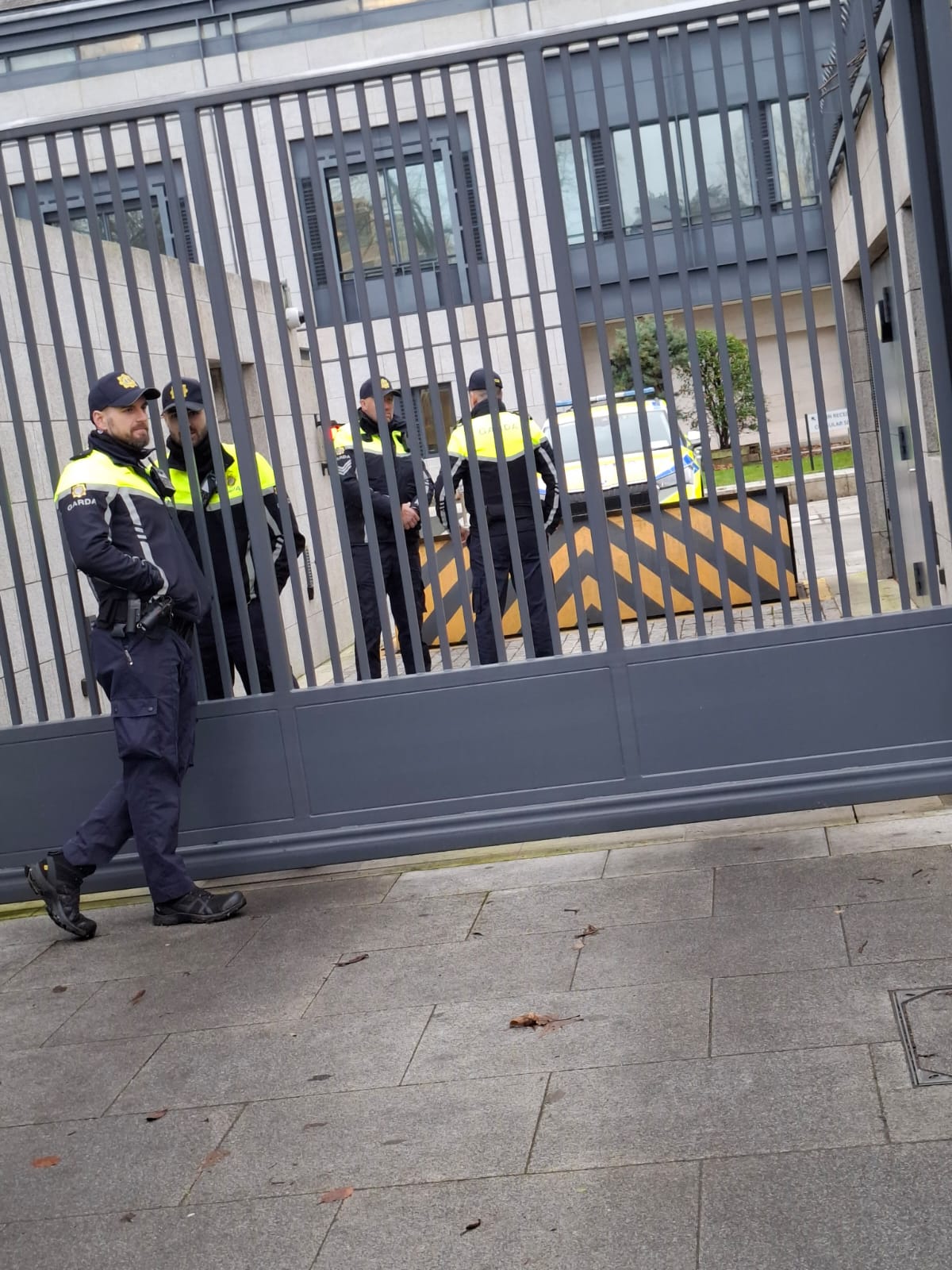
Numbers of Gardaí and one of their vehicles actually inside the British Embassy compound today. (Photo: R.Breeze)
On two occasions the MC asked demonstrators to line both sides of the road outside the Embassy, which is one of the main Dublin routes from and towards the South. Passing traffic frequently sounded their horns in solidarity, passengers often signing thumbs-up or with clenched fist.
But at one point, most of the demonstrators occupied the road, blocking traffic in each direction. The Gardaí moved quickly to break this up and were soon violently shoving demonstrators off the road, one in particular screaming with wild eyes so that he was twice seen restrained by colleagues.2
However part of the northbound road remained occupied in front of the Embassy entrance and at this point a new group of protesters arrived and, unpacking white curtain material, began to squirt red paint on it, then to lie down in the road under the material like massacre victims.
A number of speeches were made during the event and later a man called the crowd to remember also the 1981 hunger strikes in Ireland, for which he sang the Joe McDonnell3 Ballad, with its wonderful chorus lines: You dare to call me a ‘terrorist,’ while you look down your guns!4
Another man recounted the story told by Bobby Sands5 of the caged lark which would not sing for its captor and how that bird came to represent Sands himself, before reciting a poem of an Irish migrant in London in anguish as Bobby Sands lay dying.
The ‘corpses’ were moved from the road to immediately in front of the British Embassy compound today. (Photo: R.Breeze)
The current hunger-strikes are sometimes referenced as “the first coordinated hunger strikes in Britain” since those of the Irish Republicans in 1981. Of course, those strikes were not in Britain but in occupied Ireland and therefore currently part of the United Kingdom.
There are important differences of course. The Irish Republican hunger strikers were convicted, albeit by special non-jury courts, of armed resistance to British occupation; the current hunger strikers have not yet even been tried and none of the charges against them include armed action.
And the motivation of the Palestine Action accused is purely internationalist solidarity against a regime committing daily massacres in a programmed genocide.
Nevertheless, the British ruling class may yet come to regret the day they permitted anti-Zionism to become so strongly linked to anti-British colonialism, and anti-genocide internationalism so closely linked to the memory of Irish colonial resistance.
End.
Note: If you found this article of interest, why not register with Rebel Breeze for free, so that you will be notified by email of subsequent articles. You can de-register any time you wish.
FOOTNOTES
1An ad-hoc broad Palestine solidarity organisation composed of Irish migrants and diaspora in London.
2This may possibly be the same Garda who was seen wildly striking with his baton and pepper-spraying peaceful participants at a Palestine solidarity march to Dublin Port some weeks ago.
4And you dare to call me a terrorist, while you look down your guns! When I think of all the things that you have done: You have plundered many nations, divided many lands, You have terrorised their people, ruled with an iron hand – And you brought the stain of terror, to my land.
5Bobby Sands relinquished his elected post of Officer Commanding the Republican male prisoners in Long Kesh in order to lead the hunger strikes of 1981. On 5th May he was the first of the Ten to die.
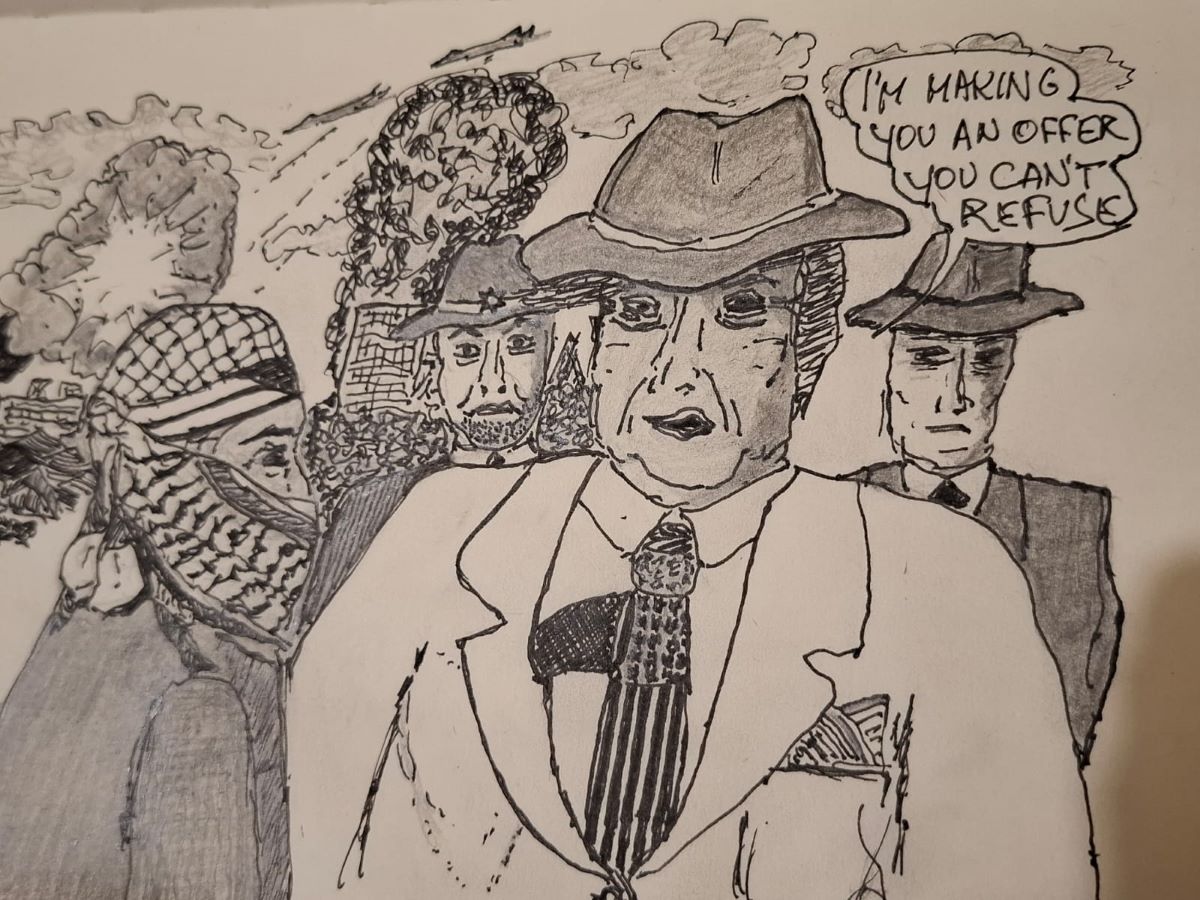
It was great to see the Irish pacification process being referenced with regard to the Trump plan for Gaza1 because that is exactly what the latter is: a plan to pacify the Resistance while ensuring it gets none of what it fought for.2
In other words, exactly like the Irish pacification process.
(Cartoon by D.Breatnach)
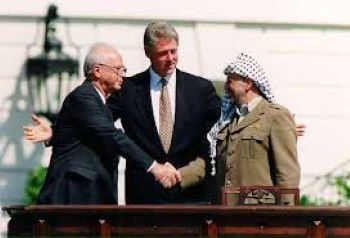
Hamas and Palestine Islamic Jihad grew out of previous Palestinian pacification processes. The Madrid Conference (1991) and the Oslo Agreement (1993) were imperialist/ Zionist attempts to pacify the wide-scale militant Palestinian resistance period of the First Intifada.3
Fatah at that time was the leading group in numbers and influence in the Palestine Liberation Organisation (from which Islamic groups were excluded) but also in Palestinian society in general. But Fatah had agreed to recognise ‘Israel’ and also the two-state solution (sic).
In the Oslo Agreement, furthermore, the question of the return to their homeland of the refugees was left aside. It appears that the Fatah leadership had lost faith in the eventual victory of their people’s struggle and had decided to get what they could by using the struggle to bargain.
The Oslo Agreement: US Imperialism’s President Clinton oversees Yitzak Rabin, Premier of Zionist state of ‘Israel’ shaking hands with Yasser Arafat of Fatah, then leader of the PLO.
What Fatah got was Palestinian Authority control in the first elections (1996), with internal control over/ management of the Palestinian population of the West Bank and Gaza, but not of the Palestinians in Jerusalem (captured by ‘Israel’ in 1967): a far cry from a free Palestine.4
In the Algiers conference of 1988 Fatah had won majority agreement to recognise ‘Israel’ and to accept the two-state solution5 (sic), i.e. embodying a Palestinian state on 20% of Palestinian land, under the eyes and guns of their Zionist neighbour).
Fatah’s rule became known for corruption and nepotism, which then had to be protected and defended from the Palestinian masses, leading to authoritarian, repressive and often arbitrary rule. And repression of the Resistance, along with direct collusion with the ‘Israeli’ State.
Continuing ‘Israeli’ repression and settlement expansion in turn led to the Second Intifada; Fatah lost to Hamas in the Palestinian parliamentary elections of 2006 followed by defeat of Fatah’s attempted coup in Gaza in 2007 (but the West Bank remaining under unelected Fatah control).
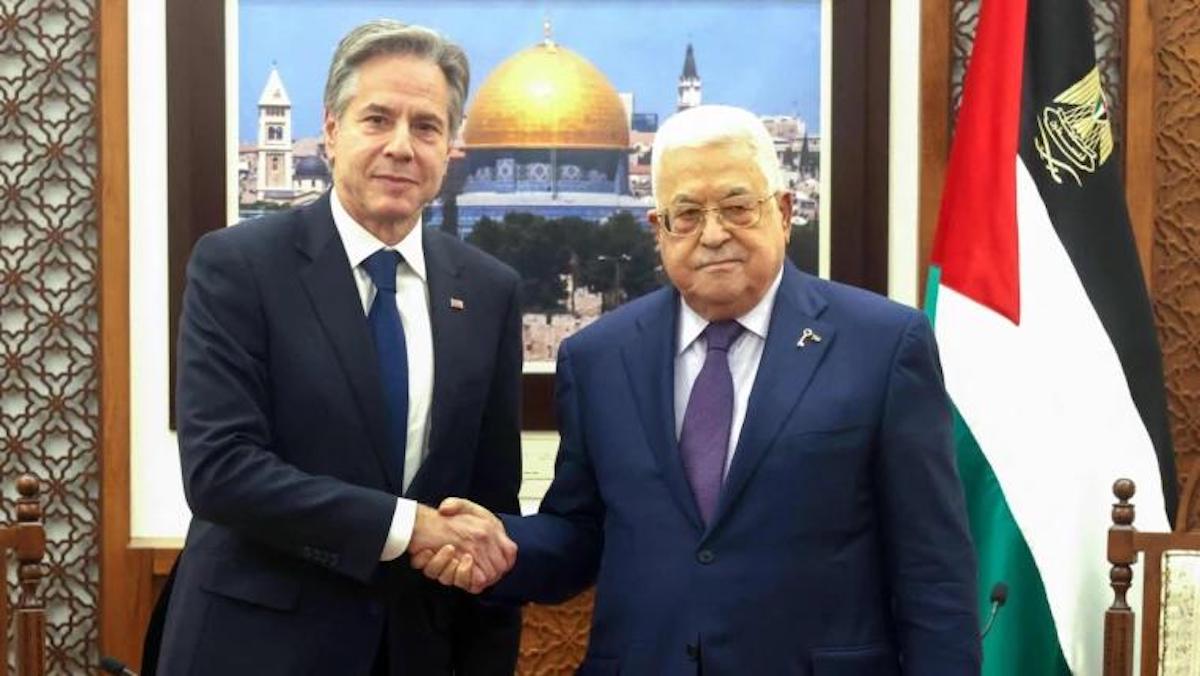
Mahmoud Abbas of Fatah has refused to announce elections since, sitting in unelected control of the PA’s office in the West Bank, collecting the various international grants, presiding over corruption,6 repressing Palestinian resistance of deed or word and colluding with the ‘Israeli’ Occupation.
US Imperialism’s then Secretary of State Anthony Blinken and the PA’s Mahmoud Abbas in Palestine, soon after the start of the accelerated Zionist genocide in Gaza, December 2023
BUT WHAT ABOUT THE IRISH CONNECTION?
Starting with Palestine and South Africa in 1991, an imperialist pacification process spread to Ireland, Basque Country, Kurdish Turkey, Colombia, India, Philippines, Sri Lanka. With some variations the drive has been the same: to give up revolution and join the system.
One of the features of this process was the apparent need of a recognised leader to sell it to the resistance support base and to front it for the world: Arafat (Palestine), Mandela (S. Africa), Adams/McGuinness (Ireland), Ocalan (Turkish Kurdistan), Otegi (Basque Country).
The Provisional IRA was by far the major organisation in the Irish Republican resistance; it gave up armed struggle in return for vague promises and the release of its prisoners under licence.7 Another organisation complied also even as new ‘dissident’ fighters were being jailed.
Nearly 30 years after the signing of the Good Friday Agreement, Ireland is no nearer the Provisional IRA’s declared aims Irish reunification, independence and sovereignty. The Sinn Féin party helps run the colony8 and is attempting to become part of the neo-colony’s government.
Sinn Féin representatives Tina Black (Mayor of Belfast) and Michelle O’Neill, First Minister of the British colony, laying a wreath at the British War Memorial in Belfast, July 2022 (Cred: Liam McBurney/ PA Wire)
Neither the Spanish, French nor Turkish states were interested in other than crushing the Basque and Kurdish resistance and the corresponding movements disabled themselves without getting anything in exchange other than continued repression.9
The resistance movements in parts of India and Philippines continue to resist but in Sri Lanka was wiped out.10
One feature of the spread was the contagion-like way in which leaders of one infected resistance sought to entice others to follow suit: S. Africa and Palestine to Ireland; S. Africa and Ireland to Basque Country; Ireland to Colombia (where only the FARC but not the ELN accepted it).
In only one iteration of the pacification processes was there a partial achievement of the stated aims of the resistance: South Africa got national enfranchisement but the economy remained under imperialist extractive control and its working people under repression.11
In the course of giving up armed struggle, allegedly just changing the methods, the leaders gave up what they had fought for, the very reason for which they had first come into the struggle. Of course, they could still shout the slogans, just not make them real in any way.
The Irish version (and the Basque one) decommissioned their weapons, which makes it very relevant to the Trump Plan for the Palestinian Resistance, particularly Hamas and PIJ. No resistance movement should even discuss giving up their weapons until the defeat of the enemy.
(Image sourced: Internet)
It will be interesting to see what positions the former parties of Irish and Basque resistance, Sinn Féin and EH Bildu12 and their supporters take on this US/ ‘Israeli’ plan for the Palestinian Resistance.
One of the features of the pacification process was the apparent need of a recognised leader to sell it to the resistance support base and to front it to the world: Arafat (Palestine), Mandela (S. Africa), Adams/McGuinness (Ireland), Ocalan (Turkish Kurdistan), Otegi (Basque Country).
Who will the imperialists find to play this role in Palestine?13
End.
NB: If you found this article of interest, why not register with Rebel Breeze for free, so that you will benotified by email of subsequent articles. You can de-register any time you wish.
4“This mirrors Israel’s post-Oslo approach to the occupied West Bank in pacifying the population through economic incentives, avoiding political concessions, and entrenching structural dependence. This model, often dubbed “economic peace,” has transformed the Palestinian Authority (PA) into a subcontractor of occupation – flush with foreign funds, but powerless to deliver sovereignty.” https://thecradle.co/articles-id/34757
7Those released under licence could be returned to jail (and a number were) at the decision of the Secretary of State for Northern Ireland without trial, hearing or details of why the individual was considered to be ‘a threat to public safety.’
8Its representative, Michelle O’Neill, is currently First Minister of the colony’s government. In the Irish State, the party has 33 TDs (MPs), only two behind the party with next largest representation, Fianna Fáil. They Party has abandoned its opposition to the repressive legislation of the State, welcomed British Royal visits to both parts of Ireland, supports recruitment to the colonial gendarmerie and its leader refused to rule out coalition with the neo-colonial political parties of membership of the British Commonwealth. https://www.thejournal.ie/mar-lou-mcdonald-commonwealth-4561600-Mar2019/
9The Basque leadership abandoned armed struggle unilaterally at the time without gaining even the end of dispersal of their jailed fighters throughout the state. The Turkish Kurdish PKK tried to make progress through political electoral means only under continuing repression. But their Syrian version of armed Kurdish forces got a new lease of life with the vulnerability of the Assad regime in Syria but ended up as a NATO proxy in the latter’s war for regime change. The PKK in Turkey very recently agreed to disarm while their Syrian part remains in difficult relationship with the new (formerly ISIS) regime in Syria and some other ISIS elements under Turkish influence.
11See The Marikana Massacre of striking miners by the ANC Government’s police.
12Both parties support the Two-State proposal for Palestine.
13Some liberal and social-democratic sections seem to have fixed on Marwan Marghouti in this role, which of course is no reason not to support his release on human rights grounds. https://www.youtube.com/watch?v=q6IgjlHaaIs
Leaders of two main neo-colonial Irish political parties are reported vehemently opposing a proposal by Dublin City Council to rename one of the city’s parks. That’s almost enough to make most decent people want to support the proposed name change.
The current name is Herzog Park, situated in Rathgar and the controversy is around a proposed removal of ‘Herzog Park’ and change to ‘Hind Rajab Park’.
Of course, the far-Right ‘patriots’ who are so much against the Irish Government won’t be supporting the name-changing or supporting local democracy – not to mention humanitarianism or international solidarity (except in the case of solidarity with US or British-based fascists).
The Herzog in question was Chaim Herzog, 6th President of the State of ‘Israel’1, raised in Ireland after his father, Yitzhak Halevi Herzog, moved from his birthplace in the Russian Empire to England and then to Dublin, where he was Chief Rabbi of the Jewish faith in Ireland (1921-1936).
Both Herzogs, father and son, were part of the founding of the Israeli State in 1948 of which Yitzham Halevi’s great-grandson, Isaac Herzog is President currently.2
Chaim Herzog (like his father and son) was a Zionist, which is to say he was part of a European movement that believed those of the Jewish faith should have a state of their own for which they were entitled to occupy a land, despite any indigenous people, upon which to establish that state.3
He was also a member of the Haganah, the Zionist murder gang that carried out the ethnic cleansing of the Nakba before going on to form the IOF; and he was later military Governor of the West Bank.
Hind Rajab was a Palestinian girl of five years who was killed by the armed forces of the Zionist State of Israel while fleeing Gaza on 29 January 2024. She appears to have been the last survivor of a gradual killing of her uncle, aunt and four cousins including 15-year old Layal Hamadeh.
The distress call came first from Hind’s cousin Layal, begging for help and explaining that they had been targeted by the Israeli Occupation Forces and that the adults were dead but the call terminated amid screams. Gazan emergency services phoned them and Hind told them Layal was dead.
The sequence suggests that the IOF were monitoring movement in the car or perhaps even the calls, as after they had shelled the other occupants, they shot Layal and finally Hind. Not content with that, they also killed the heroic Palestinian ambulance crew4 who lost their lives in rescue attempt.
Placard held at Monday night’s protest lobby of Dublin City Council (Photo: D.Breatnach)
The Park got its current baptism in 1995 which is hard to excuse. Of course the Zionazis were not as reviled 30 years ago as they are now but the facts of their general racism, apartheid and repression of Palestinians were clear – we were no long the Israelophiles we had been formerly.5
BUT WHO ARE TODAY’S REAL NAZIS?
Foremost unofficial ambassador for Zionism in Ireland Alan Shatter, former Fine Gael’s Minister for Justice & Equality and Minister of Defence from 2011 to 2014, of course entered the fray and, commenting on the proposed name-changing, accused Dublin City Council of nazism.6
Shatter’s statement and his sporadic public interventions in support of the genocidal state would provide good ammunition for anyone campaigning against the principle of free speech. How does the Israeli State he defends itself compare to Nazism, his hurled attack on Dublin City Council?
The Nazis carried out ethnic cleansing and genocide against Jews and Roma and mass murders of Communists, Socialists, Gays and Lesbians, Jehovah’s Witnesses and physically and mentally Disabled people.
The State of ‘Israel’ is carrying out daily ethnic cleansing and genocide against Palestinians.
The Nazis attacked and invaded other countries, starting with those near their State in Germany.
The State of ‘Israel’ has attacked 12 countries, starting with those near its base in Palestine, including its 1956 bombing of Egypt in the French-British war against the nationalisation of the Suez Canal.
The Nazis carried out collective punishment against civilians in areas where Nazi forces were attacked.
The IOF for years demolished the family home of anyone who took armed action against them, even after they had killed the alleged individual. Worse, they have collectively punished the whole population of Gaza, allegedly due to the 7th October Resistance operation.7
The State of ‘Israel’ is carrying out collective punishment against Palestinians in Gaza and the West Bank by bombing and shelling, house and infrastructure demolition, also against Palestinians and other people by similar bombings in Lebanon, Syria, Yemen and Iran.
There are four main differences between the crimes of the Nazis and the State of ‘Israel’:
The Nazi extermination campaign was more ordered and faster, included trains to extermination camps with ovens for disposing of the bodies of the victims.
The Zionazis, after the mass expulsions of 1948, carried out a more gradual process of appropriation and genocide until the last two years in Gaza and they don’t have ovens to burn the corpses of their victims, leaving most of them to rot under bombed-out rubble.
The other huge difference between the two is that eventually the rest of the Western powers united against the Nazis, while today they are all united in actively supporting the Zionist genocide.
And of course, although the Nazis kept their actual genocide secret from the vast majority of the German and Austrian populations, for fear they would not support it, the leaders of ‘Israel’ boast of their actions and intentions and opinion polls show the majority of ‘Israelis’ agree with them.
PURPOSE OF PROPOSED CHANGE OF PARK’S NAME
It is hard to imagine decent people being opposed to dropping the Herzog dedication in the park’s name, as that Zionist’s connection with Ireland, though a historical fact, is not one in which we should take pride.
Banner of an Irish sport association in solidarity with Palestine at Dublin City Hall protest lobby. (Photo: D.Breatnach)
If we wanted to honour a representative of Irish Jewry (rather than of Irish Zionism) there were a number of worthwhile candidates, such as antifascist and anti-Zionist Irish Jews Max8 and Maurice Levitas9 or Irish Republican Jews Estella Solomon (Cumann na mBan) and her brother Bethel.10
More than one proposal has been put forward to replace Herzog’s name on the park, the other being Terence Wheelock’s.11
I support the Wheelock family’s campaign for Gardai to be held accountable for the fatal injury to Terence Wheelock in Garda custody in 2005. I have attended protests and covered some of the campaign in articles on the Rebel Breeze blog and I would support a memorial park in his name.
At 24-hours’ notice a rally in support of the Hind Rajab name change was called for Dublin City Hall at 6pm Monday 1 December 2025. Speaking after a number of elected councillors, Abubakker Abed pointed out that whatever about the replacement, a Zionist should not be honoured here.
View of Monday night’s protest lobby of Dublin City Hall. (Photo: D.Breatnach)
Abed is a prominent Gaza journalist for the Electronic Intifada media and recent Palestinian refugee studying in Ireland. A number of Jewish people spoke also, David Landy pointing out that the Jewish community in Ireland is split between supporters of Israel and anti-Zionists.
A speaker from the Bronx, New York, also a Jew, recalled how Chaim Herzog had bragged about the demolition of a row of Palestinian houses in the West Bank, calling them ‘toilets’ and remarked how likening people to dirt or animals reminded him of the Nazis’ portrayal of the Jews.
Banner of an Irish sport association in solidarity with Palestine at Dublin City Hall protest lobby. (Photo: D.Breatnach)
However, in the Hind Rajab naming proposal there is not only the removal of a dedication to a Zionist but also in a sense its replacement by its opposite, the remembrance of a murdered child, with her family victims of Zionism and, in a sense of all Palestinian victims of ongoing genocide.
If you support the proposal for both those purposes, as I do, you may want to sign the petition: https://c.org/kBvN64BhWv.
End.
Note: If you found this article of interest, you may wish to register with Rebel Breeze for free, so that you will be notified by email of subsequent articles. You can de-register any time you wish.
2Much in the news at the moment because of the controversial application by Benjamin Netanyahu, for a pardon – without admitting guilt – to charges of corruption and bribery.
10I learned of the Solomon siblings only yesterday, through a post by Dave Gibney on Facebook. https://www.facebook.com/dgibney100 A number of others were listed by David Landy, speaking outside City Hall during the rally on Monday night.
Last week saw the anniversary of the creation of the Irish Citizen Army, a militia formed initially to defend the workers from attacks of the Dublin Metropolitan Police on behalf of the Dublin capitalists but that went on to fight in the 1916 Rising.
The ICA was born in the struggle of the consortium of Dublin employers, led by big capitalist and Irish nationalist William Martin Murphy, to smash the militant and successful Irish Transport & General Workers Union in Dublin, where the union had its headquarters, in August 1913.
The workers were presented with a declaration to sign that they would not support the ITGWU but no union in Dublin at the time, whatever they thought of the targeted union and its founder,1 could sign such a declaration. As workers began to be sacked, others came out in solidarity strikes.
Dublin entered an extended struggle between the organised capitalists and the organised workers. In such a struggle of course, the organised capitalists had on their side the magistrates, the hierarchy of the various churches, the mass media2 – and the Dublin Metropolitan Police.
Anti-WW1 banner across Liberty Hall, HQ of the Irish Transport & General Workers’ Union in October 1914, with the Irish Citizen Army parading outside.
The DMP, a British colonial police force for Dublin would have needed no specific instructions to attack demonstrations of the ITGWU, their instincts as guardians of colonial ‘law and order’ sufficing but in addition, the attitude of the media would have outlined their ‘duty’.
And after representation from W.M. Murphy to Dublin Castle, the HQ of British control, the ‘duty’ of the DMP was outlined and they were reinforced by a number of the colonial gendarmerie,3 the Royal Irish Constabulary.4
On the evening of 30th August a mass meeting of the ITGWU in Beresford Place, outside the union’s headquarters, Liberty Hall, was attacked by a baton-wielding force of the DMP, leaving two workers mortally wounded5 with resulting running battles towards city working class areas.6
The following day, the DMP again viciously attacked crowds in O’Connell Street in front of Clery’s from which Larkin attempted to address the crowd in a meeting banned by the city magistrate.7
Not long after, a marching music band leading a strikers’ parade was also attacked by the DMP with musical instruments damaged and members injured and the leadership of the union decided that a counter-strategy was required for self-defence and possibly the very survival of the union.
The Lawrence O’Toole Pipe Band’s website lays claims to having been the victims of this attack while other history talks and articles have claimed that the ITGWU’s Fintan Lawlor Pipe Band was the one attacked. It is not impossible that the DMP attacked both.
On 19th November 1913 the Irish Citizen Army was born8 following a suggestion by Seán O’Casey and a call by Jim Larkin as a workers’ defence militia. After Larkin left Ireland for the USA in 1914, James Connolly took over leadership of the ICA and wielded it into a revolutionary force.
I recall attending a book launch or talk about the ICA in which it was described as “the first workers’ army in the world” but searching for that quotation I now find it refuted by AI online and replaced by “first working-class army”.9 I cannot agree with the latter.
Most armies, especially nowadays, are “working class” in that this most numerous social class will contribute the vast majority of its rank-and-file. In the past, the peasantry and landless labourers would have been the majority.
Despite the overwhelming worker membership of the ICA, its most important distinction was not in the social class of its membership. Nor was it totally working class, containing as it did some notable members of middle-commercial and one of a landowning classes.10
What made the Irish Citizen Army very different from other armies and qualified it, I maintain, for the title of “workers’ army” were the intentions and ideological perspective of its founders, the conditions of its birth, ethos of its members and – most of all – its declared purpose.
The ICA was founded with the express intention and necessity of defending a worker’s organisation which was resisting an attempt by the capitalist employers to break that organisation. The struggle was led by declared openly-socialist leaders who gave the call for the ICA’s founding.
In every respect, I maintain, even without a specifically socialist constitution, this was a workers’ army, formed by workers, in a workers’ struggle in defence of their organisation and of the right to organise, defending their previously-won improvements and their dignity.
And the lack of evidence of any such precursor qualifies the Irish Citizen Army as “the first workers’ army in the world.”
However, none of the preceding makes it a socialist organisation, in my opinion. A socialist organisation would have as one of its principal objectives the attainment (whether by reformist or revolutionary methods) of a socialist organisation of society.
As to Lenin having allegedly called the ICA “the first Red Army in the world”, I have searched for the original reference without success, finding only it quoted by speakers, writers, organisations and authors – but never with a reference of where and when Lenin supposedly said it.
I strongly suspect that Lenin never said that. But even if he had, the ICA’s constitution does not support it, being rather of a democratic nationalist and anti-colonial character.11
Socialist Republicans today approve of the Irish Citizen Army throughout the 1913-1916 period. But it is not unknown for them to go further and to characterise it as socialist republican in nature and orientation. I don’t see evidence of this in either the ICA’s constitution or in its membership.
Though certainly Irish nationalist in intention, the word ‘Republic’ is not mentioned anywhere in the constitution. One might argue that it was understood but I can’t see the evidence for that either. Some contemporary prominent Irish nationalists were not even wedded to the idea of a Republic.
The 1919-1921 IRA was not a socialist organisation. Nor was the monarchist Sinn Féin party, even after its founder Griffiths permitted its reformation as Republican in order for the disparate nationalist movement to contest the UK’s 1918 General Election on an abstentionist manifesto.
The political leadership of the Republican movement split over the British offer of dominion status with partition as against a unitary Republic. Churchill was quite adamant that the new Irish State could not be a Republic and it was not declared so until the 1937 Constitution.
Certainly the founders of the ICA were socialist Republicans but in the absence of its constitution being of a kind, for the organisation to qualify as such it must be shown to have been also the widely-embraced ethos of its membership.
Even if imagining that the membership of the ICA, like its founders and a number of its officers, were Irish Republicans, it is still a greater step to assert that they were socialist Republicans, in the sense of intending the socialist organisation of society and elimination of capitalism.12
Irish Citizen Army on the roof of Liberty Hall during a flag-raising activity. (Photo sourced from Internet)
TODAY AND TOMORROW
Whereas these historical questions may fuel debate, no debate should be needed regarding the right of workers to organise to defend and improve their conditions, nor to change the dominant political shape and allegiance of their country, nor to defend their organisation from the police.
Indeed, not only can we take those rights as legitimate and necessary to exercise but it also becomes clear that at some point we will, as workers, as socialists and/ or as Republicans, need such an army. The ruling class has its physical force organisations in the Gardaí and the Irish Army.
The history of ruling classes bears testament to the fact they never relinquish power without using violence against challenges from the rising social forces; even such social and political rights as we have were won through hard struggle, sacrifice and indeed martyrdom.
Commemorative postcard 1916, showing severe British shelling damage to the original Liberty Hall building, Beresford Place, Dublin.
The Far-Right has also given ample proof of their readiness to employ violence against the vulnerable sections of our class and against also those they consider opposed to them ideologically; the history of fascism too warns us of the need to organise our defence.
In that respect too let me briefly comment on the false “ICA” recently proclaimed in a video which, while claiming a 32-County outlook and repeating that Britain has no right in Ireland, filled the rest of their video with racist anti-migrant rhetoric, conspiracy theory and lies.
Of course they contain nothing of the workers’ solidarity ethos of the ranks of the real ICA, not to mention the anti-fascist, anti-racist internationalist and socialist outlook of the ICA’s leadership.
The ICA developed as a force for physical defence of workers’ rights on the streets, which is where the DMP and RIC attacked them. It was some years later, in the course of inter-imperialist World War I that the ICA fought in an armed rising alongside other democratic national forces.
Some, usually only among Irish Republicans, have striven also to organise a fighting force. Typically they concentrated on gaining arms and planning armed actions. Isolated from the masses, they were easily infiltrated by State agents, resulting in activists going to jail.
Captain White & Irish Citizen Army on parade on their grounds at Croydon House, Fairview, N. Dublin City. (Sourced: Internet)
While needed, I believe a workers’ defence force should, in current circumstances, concentrate on street defence-and-offence fighting tactics, also that it should be based on the broad democratic political front, on unity in action against imperialism, colonialism, fascism and Loyalism.
Defence on a broad front basis can and should educate the whole resistance movement, in its disparate ideological influences, as it may be that similar recruits in the Irish Citizen Army were educated and trained under the leadership of revolutionary socialists and republicans.
End.
Note: If you found this article of interest, why not register with Rebel Breeze for free, so that you will be notified by email of subsequent articles. You can de-register any time you wish.
1913 – A Policeman’s Lot and Murphy’s Law. Talk given at Garda Historical Society at Store Street Station, August 29th 2013 and Dublin Castle at Police Memorabilia Exhibition, November 16th, 2013 (speaker’s name not listed). https://1913committee.ie/blog/?p=1800
1Jim Larkin, a migrant and union organiser from Liverpool, had formed the ITGWU as a split from the British-based National Union of Dock Labourers after serious clashes with the latter’s General Secretary, ?????? Sexton (also an Irish nationalist). Larkin was very popular with the ITGWU’s members but much less so with other union leaders around Dublin.
2Not least the editorial and management boards of the Irish Independent, owned by William Martin Murphy, leader of the union-busting consortium.
3An armed police force under central State control, like the Guardia Civil (Spain), Carabinieri (Italy) and similar in France and Turkey.
5James Nolan and John Byrne, which Wikipedia has for years erroneously recorded as killed the subsequent day in another DMP riot in O’Connell Street, known as Bloody Sunday (1913).
6South-eastwards along Townsend Street towards Ringsend and Northwards towards Corporation Street in the Montgomery (Monto) Street area. There the residents defended the strikers and attacked the police, an example of class solidarity for which they paid soon afterwhen a DMP force paid them a visit, smashing household furniture and ornaments and beating John McDonagh. Paralysed from the waist down and in bed, McDonagh was unable to effectively defend himself and when his wife attempted to do so, she also was beaten and McDonagh died shortly afterwards in Jervis Street Hospital. (see Police Retaliation [sic] in APoliceman’s Lot and Murphy’s Lawhttps://1913committee.ie/blog/?p=1800)
7See a number of entries, including Wikipedia on Bloody Sunday Dublin 1913. Though some of those claim the deaths of James Nolan and Patrick Byrne were caused then, in fact it was the previous day that they received their fatal wounds from the police. Unmentioned in most is the case of Fianna Éireann youth Patsy O’Connor, knocked unconscious as he gave first aid to another victim of the police. Patsy O’Connor suffered repeated headaches thereafter and died on 15th June 1915 at the age of 18. https://1913committee.ie/blog/?p=2293
10I state this qualification despite Connolly’s remark in Workers’ Republic, 30 October 1915: Hitherto the workers of Ireland have fought as parts of the armies led by their masters, never as a member of any army officered, trained and inspired by men of their own class. Now, with arms in their hands, they propose to steer their own course, to carve their own future.
Constance Markievicz and Katherine Lynn were officers in the ICA but neither were born into the working class.
12I am not unaware that a significant number of individuals and organisations claiming to be Irish socialist Republicans currently spend hardly any time at all discussing the socialist organisation of society.
If it is true that language at least influences the way we think, then surely it behoves us to pay more attention to our choice of words. But not only because of the influence of our words on others but indeed on us as we utter them.
Take the word ‘Ireland’ – surely a neutral one describing a geographical entity? But if we query “the population of Ireland” on line and receive a reply that the figure is 5.83 million, whereas we know it to be over 7 million, we experience at least puzzlement at the disparity in figures.
Of course, what has has occurred is that “Ireland” is being considered in political terms and the Six County colony’s population is being omitted. The reply may qualify that it is referring to “the Republic of Ireland” (as when commenting on the FAI’s football selection internationally).
But this does not really make everything alright semantically (i.e. in meaning) either. True, the Irish State holds regular elections and does not acknowledge a monarch, so it generally fulfils the description of ‘a Republic’. But that is not a historically or politically-neutral term in Ireland.
The word has a long history in Ireland as applied to the nation and was always imagined as referencing the whole geographical entity. The most influential use of the word in documentary form was probably the 1916 Proclamation, which did not in the least anticipate partition.
Even the 1937 Constitution, which formally baptised the Irish State a ‘Republic’, claimed sovereignty over the entire 32 Counties, a position that stood until the removal of Articles 2 and 3 from the Constitution by the current State in 1999.
The Football Association of Ireland is actually only the Association of the sport for the 26 Counties state and the use of “R.o.I” on the screen to refer to the State’s team during games is, as explained, deeply problematic. However the Irish Rugby Team is indeed an all-Ireland one.
As is the largest sports association of Ireland, the Gaelic Athletic Association. And also Tennis Ireland, Cricket Ireland, Table Tennis Ireland, and both Badminton Ireland and the Irish Judo Association organise on a four-province basis.1
If we call the entity the ‘Irish State’ instead we would be correct. And we could call its territory ‘the Irish state’, with a lower-case ‘s’ to distinguish between the political construction and the territory over which, in constitutional and legal terms, it holds power.
Or we could call it the ‘26 Counties.’ Or, seemingly becoming increasingly popular in some quarters: ‘the Free State’.2 But what about the entity’s parliament? That’s ‘the Dáil’, right?
That’s how we hear it described and, as “Dáil” is an equivalent of ‘parliament’ in Irish, that’s ok, right? No, not at all really; its full title is actually “Dáil Éireann” and we’ve already established that not even by Constitutional lip service does this parliament govern the whole nation.
The first time we had an all-Ireland parliament, open to election across the whole of the nation and open also to participation of all elected candidates was in January 1919 but it was banned in September by the occupying British authority, thenceforth operating under conditions of secrecy.
Then in January 1922, the pro-Treaty majority in the Dáil supported the British Treaty, including Partition, ending Dáil Éireann. There has not been a Dáil Éireann since. The most accurate brief description of the current institution is “Leinster House”.3
Is this the home of Dáil Éireann? Leinster House, west-facing side. (Image: Wikipedia).
Well, does it matter what we call them – we know what they are, right?
If it’s true that the words we use to describe things influence how we think about them, then it matters quite a lot. And how we describe them may also influence how others think about them, which also matters a great deal.
If we want to imply by the words we use that this state is independent and covers the whole nation – and that its parliament administers the whole nation – well then, there’s no need to change our words. Especially if we think that the extent of Irish sovereignty is fine or sufficient.
But if we don’t think along those lines then perhaps we need to examine our terminology more carefully and, where appropriate, amend it.
End.
Note: If you found this article of interest, why not register with Rebel Breeze for free, so that you will be notified by email of subsequent articles. You can de-register any time you wish.
FOOTNOTES
1Interestingly, I note that the Irish Ten-Pin Bowling Association (ITBA) is in the process of becoming a 32-county association.
2This was the official title of the State following its adoption of the terms of the Anglo-Irish Treaty.
3The building is actually formally called “Leinster House” since it was the city resident of the Duke of Leinster, of the Cambro-Norman invader dynasty of FitzGeralds and FitzMaurices. The Duke was Lord Deputy and at times Chief Justice of Ireland under the English Occupation.