Diarmuid Breatnach
(Reading time:4 mins.)
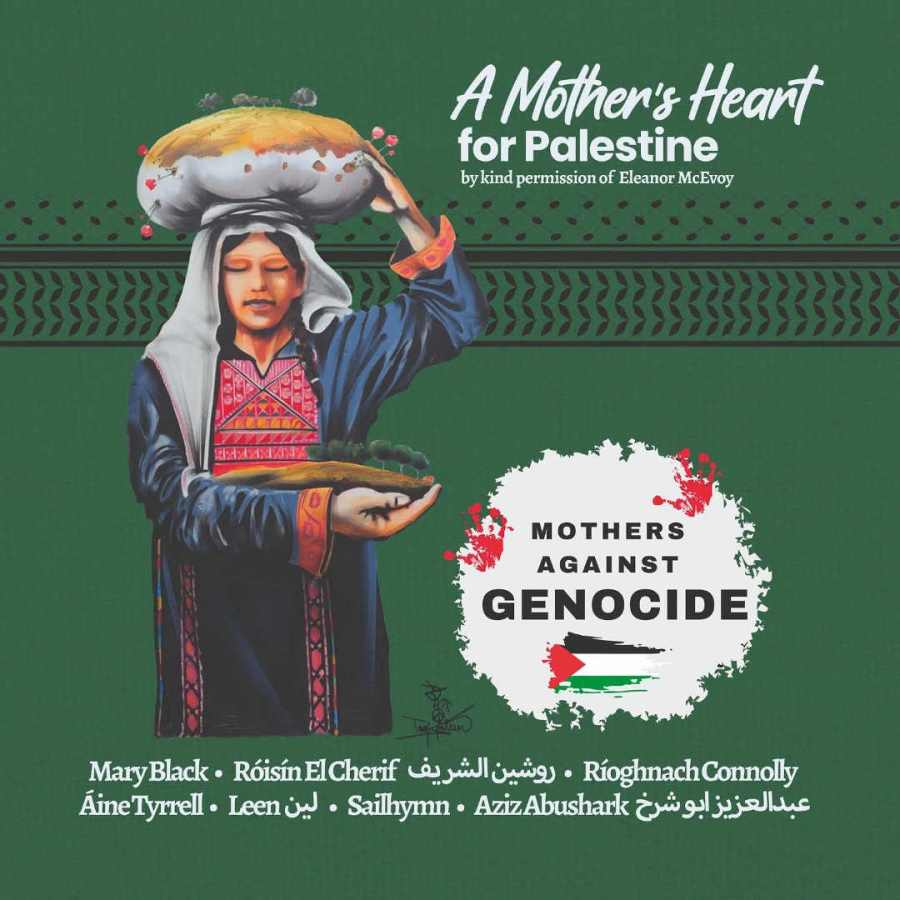
On August 1st singer Mary Black released A Mother’s Heart for Palestine, a soundtrack and video.1 The title and music built on the 1992 track by Mary Black and Eleanor McEvoy, A Woman’s Heart (title of album also).2
The voices are beautiful and the adaptations of the Arab women particularly so. Or at least, they affected me even more deeply.
Like actions by Mothers Against Genocide,3 the recording seeks to transverse borders in the mind, to represent Palestinians as humans, as human as ourselves, through the image of the mother, which almost all of us have had and which many women are or have been.
It is worth thinking about this a bit further. The image of the mother is a powerful one in all cultures for at least biological evolutionary reasons. The future of the human species depends on productive motherhood and in all cultures, in that capacity at least, pregnant women are protected.
The image is also overlain by personal affect, of ourselves nurtured (in most cases) by a mother or ourselves as a mother, nurturing in turn.
The image of the mother is also manipulated by all degrees of the Right, whether to uphold clerical control, to counter assertion of reproductive rights, or to deny the right of lesbian (and gay) sexuality. And ‘to protect ‘our women’’ from imagined migrant assault (or indeed intermarriage).
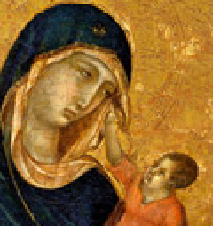
In Christian religious iconography, the Mother as Madonna is particularly prevalent and she is always passive, whether depicted serene or suffering.
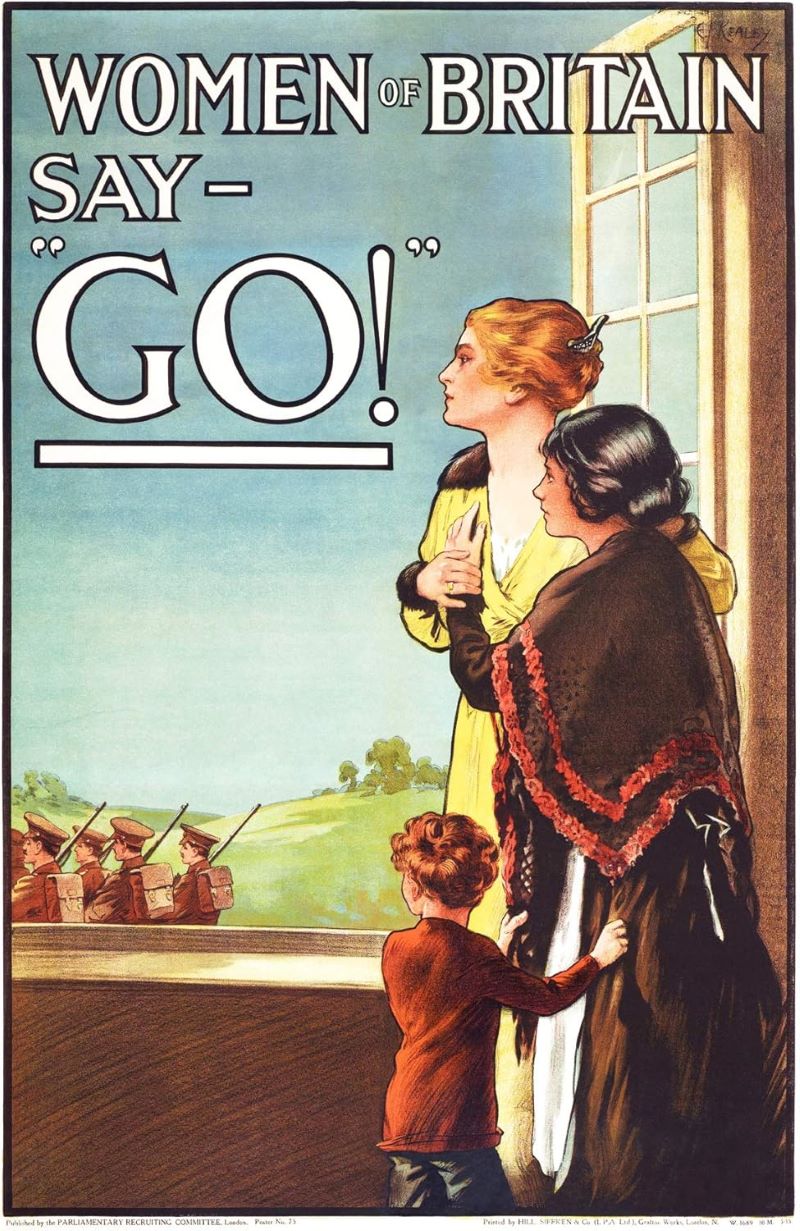
The mother image is also employed by imperialists to send us to war and was crudely used for example in the UK (of which Ireland was then a part) in a WWI poster depicting a mother and child telling the man to go and fight (for them, of course – not for the imperialists, mar dhea!).

But in nearly all cases it is a passive representation of womanhood and is combined in the Mothers Heart video with images of sorrow – naturally, about all the children killed or starving, soon to die — which is also a passive emotion.
Many of the visual representations of Palestinian women are in domestic roles assigned to women around the world: food preparation, washing and drying clothes and of course child care.
Mothers are uniquely women but women are also more than mothers. Slightly more than one-half the human race, they are also workers,4 cultural producers, thinkers, leaders — and fighters. Even in revolutionary iconography we rarely see the woman, never mind mother, represented armed.
This is despite the 1970s images of a Mozambican or Vietnamese woman carrying a gun and a child. Or the famous staged INLA photo of a skirted woman in the Six Counties aiming an automatic rifle. Such images are very much exceptions to the rule.5


The music video shows Palestinian women, among their domestic roles, lamenting, speaking on mobile phones, presumably worried about relatives, carrying belongings, on the move, displaced. The lyrics also are of lament.
As complete counterpoint in the Arab world we have only one image that I know of, which is Leila Khaled with an automatic rifle, because her society too insists on a largely passive role for women, even though their position in that society otherwise seems very influential.
The women shown in the video accompanying the music and lyrics are apparently Arab, Arab-Irish and mostly Irish. On the Palestine solidarity marches here my impression is that born women are the majority over born males and many have taken militant action, for which some are facing prosecution.
Women, in particular Arab women, often lead these marches, calling out the chants for others to respond.
Newsreels show Palestinian and other Arab women abroad marching, shouting slogans, clenched fists in the air. I have seen them denouncing ‘Israeli’ soldiers for invasion and occupation, for mistreatment of children, for demolition of houses, one slapping an armed Israeli soldier in the face.
In our own history (as distinct from mythology and legend) we had few female figures of armed action and Pearse mythologised Gráinne Ní Mháille6 in song to epitomise resistance when he had her represent the nation. But compare that to his poem The Mother!
In recent years Markievicz, Skinnider7 and to a degree Farrell8 have part-emerged from history’s shadows bearing weapons but there is still a long way to go in changing the image of women (through all their biological phases) in the struggle.
This song for all that it affects me emotionally does not do that nor is it expected to and, more to the point, I fear will be used to reinforce passivity in the assigned role of women in struggles — fortitude and solidarity in suffering no doubt, but passivity none the less.
It seems to me that social democrats and liberals perpetuate the mother aspect of the woman manipulatively in order to promote pacifism and much as I appreciate this cultural production, it will be used in that way.
While enjoying cultural productions visually, in sound or in print, we need also to be aware of the social packages they carry and their effects upon us, intended or otherwise.
End.
FOOTNOTES
2https://en.wikipedia.org/wiki/A_Woman%27s_Heart_(compilation_album)
3Whose official stamp is also on the video.
4Industrial, agricultural, municipal, health services, technical and scientific services.
5There was some coverage of armed Kurdish women in Syria fighting ISIS (I wrote about some myself) but it is now clear that was in the context of NATO coordination in the war to overthrow the non-western aligned regime.
6A 17th Century female chief of the Uí Máille clan in Mayo who led attacks on her enemies by land and sea. Pearse adapted the ancient bride-welcoming song to bid her welcome with armed warriors to reclaim her land and disperse the English occupiers.
7Both Markievicz (nee Gore-Booth) and Skinnider were members of the Irish Citizen Army and both carried and fired weapons in the 1916 Rising.
8Though unarmed, she was part of an Active Service Unit of the IRA when she and her two comrades were gunned down in the British colony of Gibraltar on 6th March 1988.
SOURCE
2https://en.wikipedia.org/wiki/A_Woman%27s_Heart_(compilation_album)
3Whose official stamp is also on the video.
4Industrial, agricultural, municipal, health services, technical and scientific services.
5There was some coverage of armed Kurdish women in Syria fighting ISIS (I wrote about some myself) but it is now clear that was in the context of NATO coordination in the war to overthrow the non-western aligned regime.
6A 17th Century female chief of the Uí Máille clan in Mayo who led attacks on her enemies by land and sea. Pearse adapted the ancient bride-welcoming song to bid her welcome with armed warriors to reclaim her land and disperse the English occupiers.
7Both Markievicz (nee Gore-Booth) and Skinnider were members of the Irish Citizen Army and both carried and fired weapons in the 1916 Rising.
8Though unarmed, she was part of an Active Service Unit of the IRA when she and her two comrades were gunned down in the British colony of Gibraltar on 6th March 1988.
 rebelbreeze
Pingback: Η ΚΑΡΔΙΑ ΜΙΑΣ ΜΗΤΕΡΑΣ – A MOTHER’S HEART – A Review. – Αέναη κίνηση-moto Perpetuo