
Diarmuid Breatnach
(Reading time: 4 mins.)
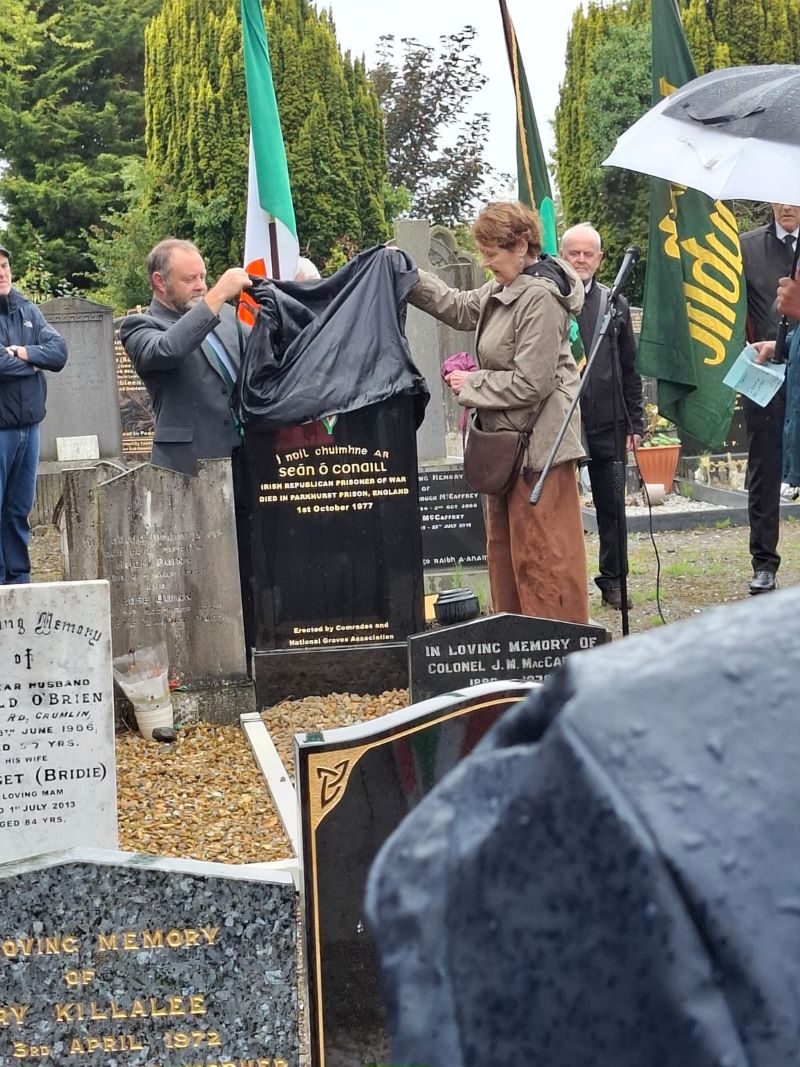
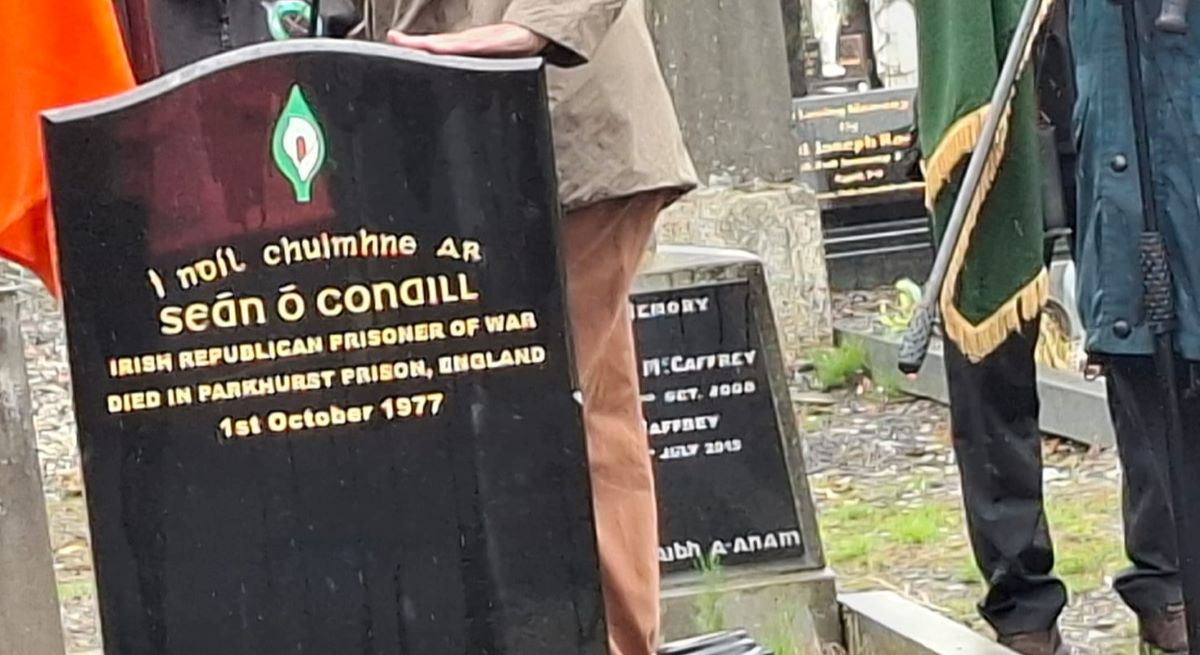
The grave of Irish Republican political prisoner Vol. Seán Ó Conaill received a headstone on Sunday (7th August) due to the efforts of the National Graves Association – nearly 50 years after his death in British custody.
Seán was born and brought up of Irish background in Birmingham and became interested in Irish history. After Bloody Sunday (1972) he tried to join the IRA but was not accepted and subsequently acted independently, assassinating a British Army Lieut. Colonel.
Tracked by British police, he wounded two of the group sent to arrest him, was captured and beaten up. His treatment in jail was bad also but after sentencing was accepted by the Irish Republican prisoners in British jails and, in time, sworn into the Provisional Irish Republican Army.
After his death his body was transferred for burial in Glasnevin. It seems that the NGA understood that his family wished to erect a headstone but for whatever reason the grave lay without one until last week.
The National Graves Association went ahead with commissioning a gravestone which they unveiled on Sunday in the St. Paul’s section of Glasnevin Cemetery1 with a colour party, speakers, music and a goodly attendance, though drenched during the ceremony.
The occasion was supported by members of Sinn Féin and Republican organisations in addition to independent Republicans and anti-imperialists. Seán Whelan, Chairperson of the NGA chaired the event and after some opening remarks introduced the speakers.

SPEAKERS
Jacqui Kaye of the former Prisoners’ Aid Committee2 was introduced to speak and told her audience that Ó Conaill was diagnosed with terminal cancer and requested a visit from Kaye, permission for which was initially refused by the Home Office3 but granted after intervention by Lord Longford.
The visit was permitted for 10 minutes only for Parkhurst Jail but then changed to a hospice though when Kaye arrived it was to be told that he had just died there, leaving her with the suspicion that he had actually died in Parkhurst but that the Home Office did not wish that on their record.4

Former Republican prisoner (21 years in British jails) Noel Gibson laid a wreath on behalf of the NGA and Paddy Lennon read The Rhythm of Time by hunger strike martyr Vol. Bobby Sands, after which a recording of uileann pipes filled the cemetery air with its haunting lament.
Liam Ó Culbáird of the NGA presented the main oration of the event, recounting details of Ó Conaill’s life and time in jail, information gathered from a number of sources, including that despite complaining of chest and stomach pains he did not receive medical investigation in jail.
It was only after coughing up blood that Ó Conaill received a medical visit, after which he was diagnosed with terminal cancer. His marriage had become estranged possibly as a result of his incarceration but official interference in personal relations of political prisoners was also known.5

The speaker alluded to the practice of “ghosting” political prisoners, i.e. moving them to a different jail without notice, often as a scheduled visit by a family member was imminent, which occurred to Ó Conaill’s mother arriving at Wakefield Prison to be told he had been moved to Parkhurst Jail.6
Such practices imposed an additional punishment not only on the prisoner but in particular on family members7 who had often travelled long distances into sometimes hostile territory and had also the additional expense of paying for overnight accommodation.
The media at the time of his arrest had portrayed Ó Conaill as of unbalanced mind but his comrades in jail found him completely rational and dedicated to the cause. He began to learn Irish and encouraged the other Republican prisoners to expand their use of the language.
Commenting on Ó Conaill’s failure to be recruited by the IRA prior to his armed action, Ó Culbáird commented that disagreements between General Headquarters of the IRA and Volunteers were not unknown and related a GHQ approach to Brendan Behan after his release from jail.
Behan was informed that he had been been found guilty by GHQ court-martial8 in his absence and sentenced to be shot. Behan replied that since his court-martial had been in his absence, so equally could his execution and promptly departed!
Ó Culbáird commented also on the number of groups that had operated independently of the IRA’s GHQ and remarked upon the number of different groups that had participated in the 1916 Rising,9 all with their reasons for separate existence but all united in the struggle for independence.
The speaker ended his oration by pointing out in Irish and in English that Ó Conaill was an Irish Republican soldier who gave his life in the struggle for Irish freedom.
CONCLUDING
Bringing the ceremony to an end, Seán Whelan thanked the speakers for their contribution and audience for their attendance and added some words about the NGA, pointing out its political independence and refusal to accept donation from any governmental or other organisation.

Whelan also added that whereas the NGA acknowledges the right of anyone to commemorate their dead, their organisation prioritises the dead who participated in the Irish struggle for independence but also cannot agree to share their commemoration with those who fought against them.
He remarked that he did not know of any other country where that would be done. Whelan then called for attention to the playing of a recording of the the National Anthem.
End.
FOOTNOTES
1i.e the large section on the opposite side of the road from the main Glasnevin gates, also where stands the NGA memorial to the six uprisings mentioned in Pearse’s famous speech.
2The PAC was initially formed by Official Sinn Féin but within two years had left the Officials and operated independently.
3Irish Republican prisoners in British jails were listed as high-security Category A and were not permitted visitors other than immediate family.
4She was not permitted to see his body.
5Letters to the prisoner might be delayed or not delivered, whereas letters from the prisoner might be held back.
6262 miles distant.
7Though not mentioned in the oration, this was also a practice of the Spanish prison system against Basque political prisoners, in which case letters and parcels arriving for the prisoner, rather than be forwarded to the prisoner’s new location, would be returned to sender with a note that the prisoner was no longer at the posted address.
8Presumably for his solo unauthorised action in carrying a bomb to England.
9Irish Republican Brotherhood, Irish Volunteers, Cumann na nBan, Irish Citizen Army, Na Fianna Éireann, Hibernian Rifles. Some individuals not a member of any of those organisation also participated.
SOURCES
 rebelbreeze