CALL FOR UNITY IN ACTION AT 1916 RISING COMMEMORATION

Clive Sulish

(Reading time: 3 mins.)

A call for unity of Irish Republicans in action to win Irish freedom and independence was made at a 1916 Rising commemoration in Dublin on Sunday, an event organised by the Anti-Imperialist Action Ireland organisation.
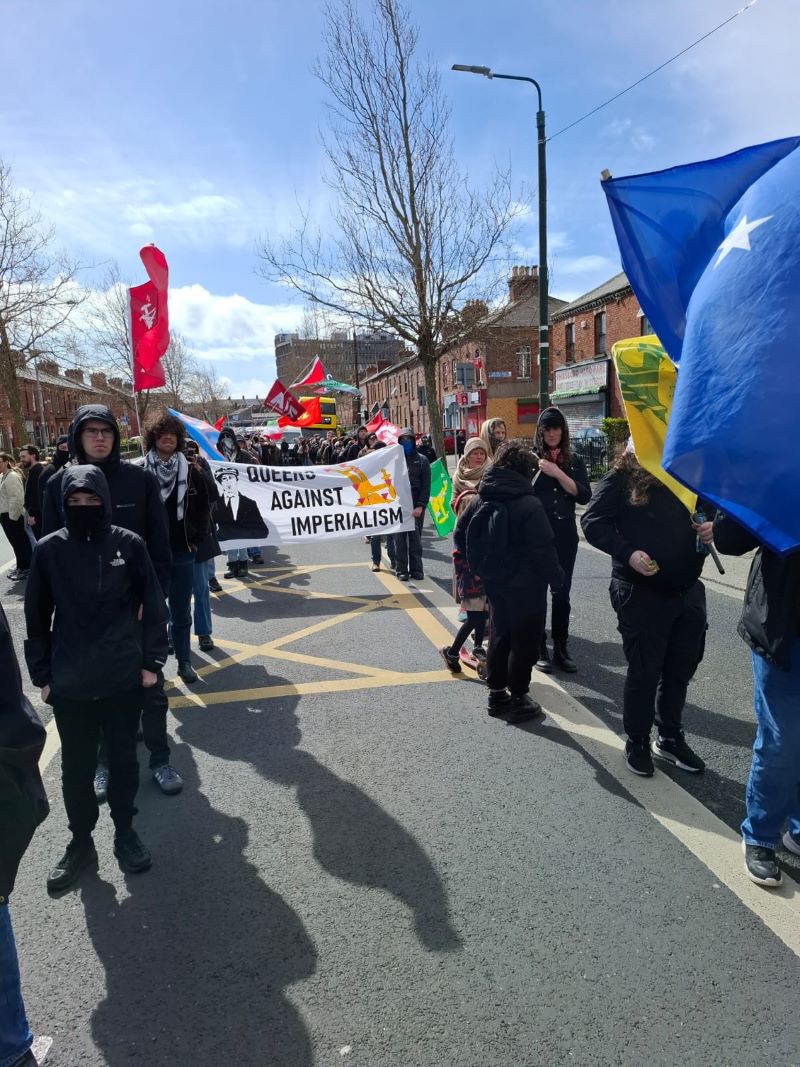
Section of the marchers looking back towards Phibsborough as they approach
Cross Guns Bridge from Phibsborough. (Photo: R.Breeze)

A relatively large number of people participated, including a number of delegations from organisations of struggle in the Spanish, Turkish, German and Italian states. Young people were particularly well represented.

Participants met outside the Phibsborough shopping area on Dublin’s northside from which they were led by a lone piper, a colour party and a number of banners. Among them flew various flags of national and social struggle in Ireland, the Basque Country, Catalunya, Palestine, Turkey …
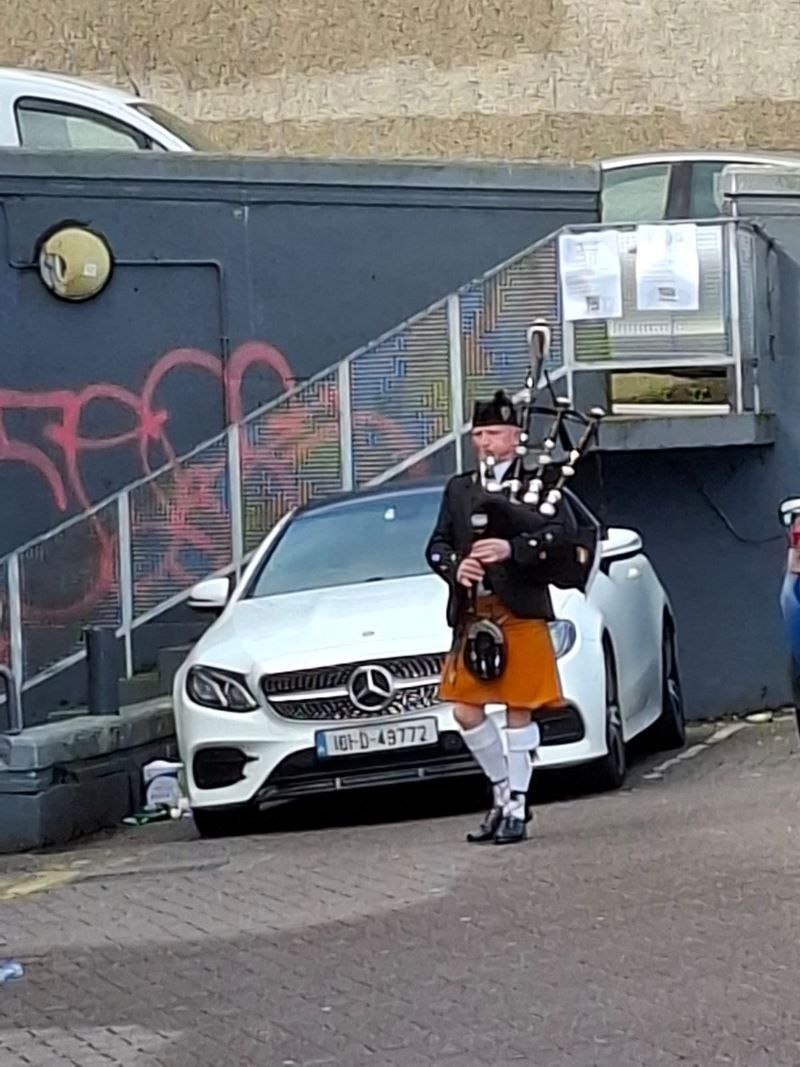
The lone piper in Phibsborough exercising his lungs and warming pipes and bag as he prepares to lead the procession towards Glasnevin. (Photo: R.Breeze)

The orders to the colour party, as is traditional, were all given in Irish.1 At Cross Guns Bridge, the march halted and, in what has become a tradition for the AIA, flares were lit in memory of the presence of Irish Volunteers there in 1916 and the murder of a civilian by British soldiers.

Proceeding along Finglas Road to the interest of passers-by and the odd ‘beep’ of solidarity from a passing vehicle, the march turned left outside the gates of the older Glasnevin Cemetery to cross over the railway pedestrian bridge to the St. Paul’s section of the Cemetery.
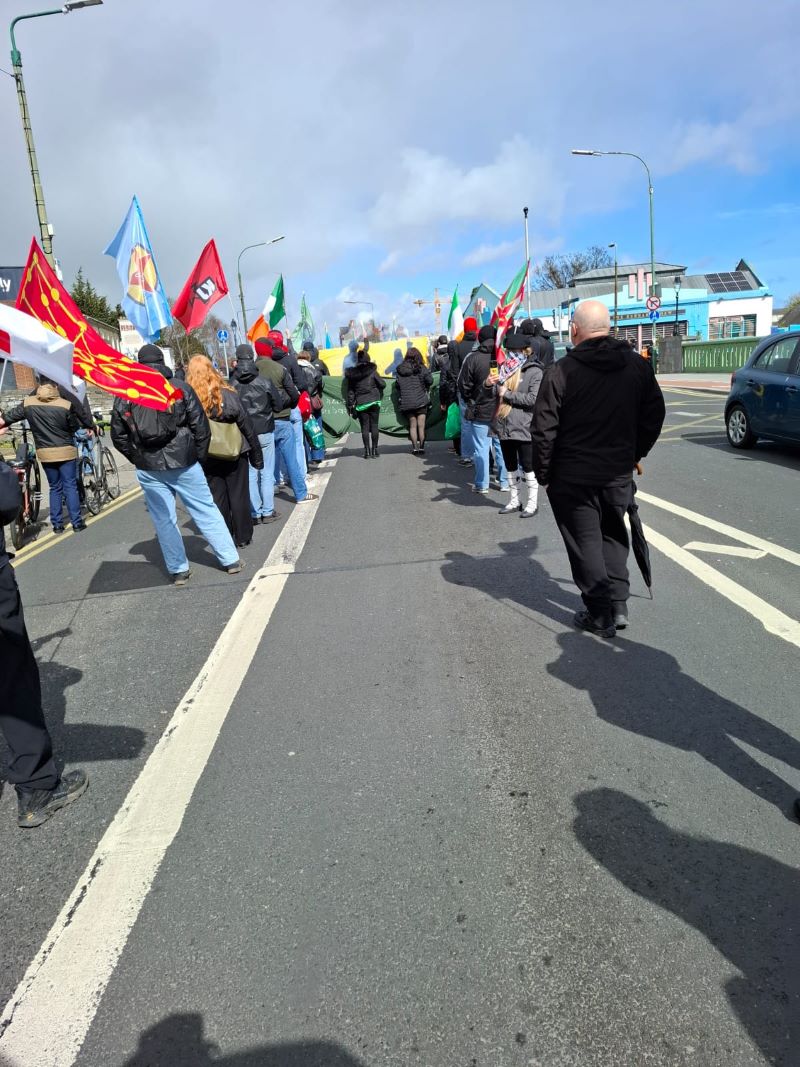
Section of the marchers approaching Cross Guns Bridge from Phibsborough, halting as flares are lit in memoriam. (Photo: R.Breeze)

Winding their way on a path through the headstones, what was now one thick column approached the monument to six Irish Republican armed uprisings, commissioned by the National Graves Association, where a representative of the AIA greeted them.

From the Monument, the AIA representative introduced the reason for the commemoration and listed in honour the Irish Republican Brotherhood, Irish Volunteers, Irish Citizen Army, Cumann na mBan and Na Fianna Éireann, different organisations that fought together in the Rising.2
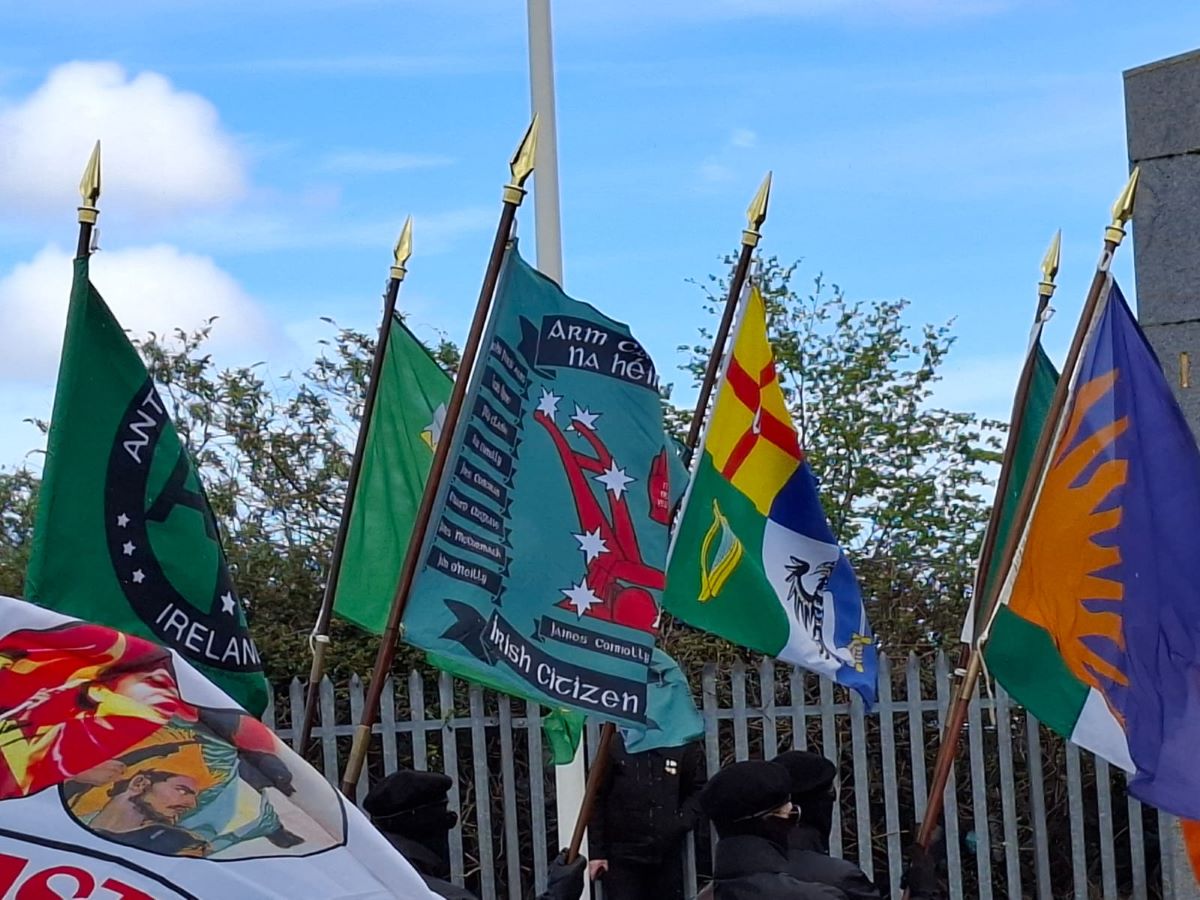
Central: Flags of the colour party, from left to right: Flag of AIA, Irish Citizen Army (mostly concealed), a version of Irish Citizen Army, emblems of the four provinces of Ireland, the Tricolour (mostly concealed), the Gal Gréine (Sunburst).
The flag intervening from the left is of some participants in the Anti-Imperialist Front, a different organisation. (Photo: R.Breeze)

He called for delegates of different organisations to meet to decide a basis for unity, following which, going on to note that the AIA has long been prepared to work alongside others for shared objectives, he announced floral wreaths to be laid on behalf of the CPI and IDR.3

After the laying of those wreaths, another man was called to read the text of the 1916 Proclamation.

The keynote speaker, a veteran Irish Republican and former political prisoner, was then introduced. He began by reminding his audience of Irish Republican armed uprisings before 1916 going back to 1798 and forward up to the war in the occupied Six Counties.
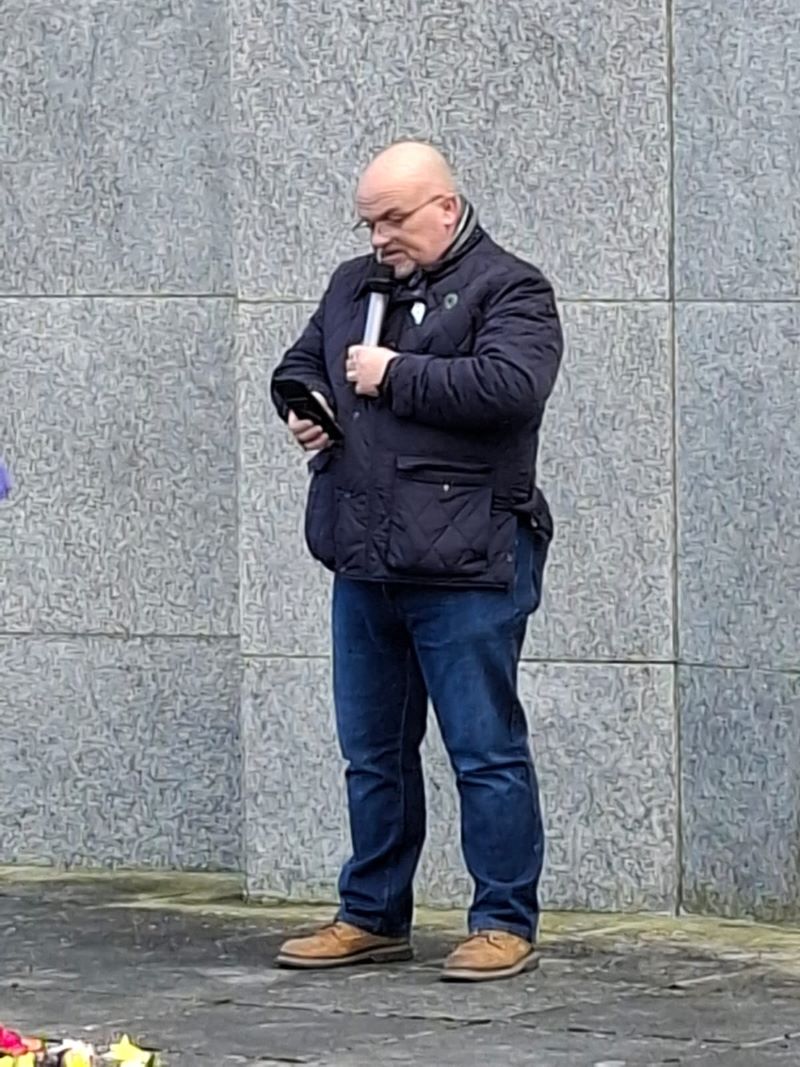
The main speaker, veteran Irish Republican and ex-political prisoner, delivering the oration for the commemorative event. (Photo: R.Breeze)

The speaker made a number of points regarding the text of the 1916 Proclamation, the declarations of which remain to be fulfilled, in its address placing women on an equal standing with men, ‘cherishing the children of the nation equally’ and guaranteeing ‘civil and religious freedom to all.’

Drawing on the example of those of varying ideological positions who in the 1916 Rising united to “fight against the largest world empire in history”, the ex-prisoner called on Irish Republicans to find the means to unite in action today against imperialism and colonialism.

The speaker also highlighted that the objective of the Rising had been an independent democratic republic which is still to be achieved and that Republicans need to honestly confront the failures which, despite strong resistance, have weakened the struggle to date.

The piper played a slow air as the flags of the colour party were lowered and a few minutes’ silence observed – a traditional Irish Republican honouring of its martyrs in struggle. Announcing the end of the event the MC then called for the piper to play Amhrán na bhFiann4 to conclude.
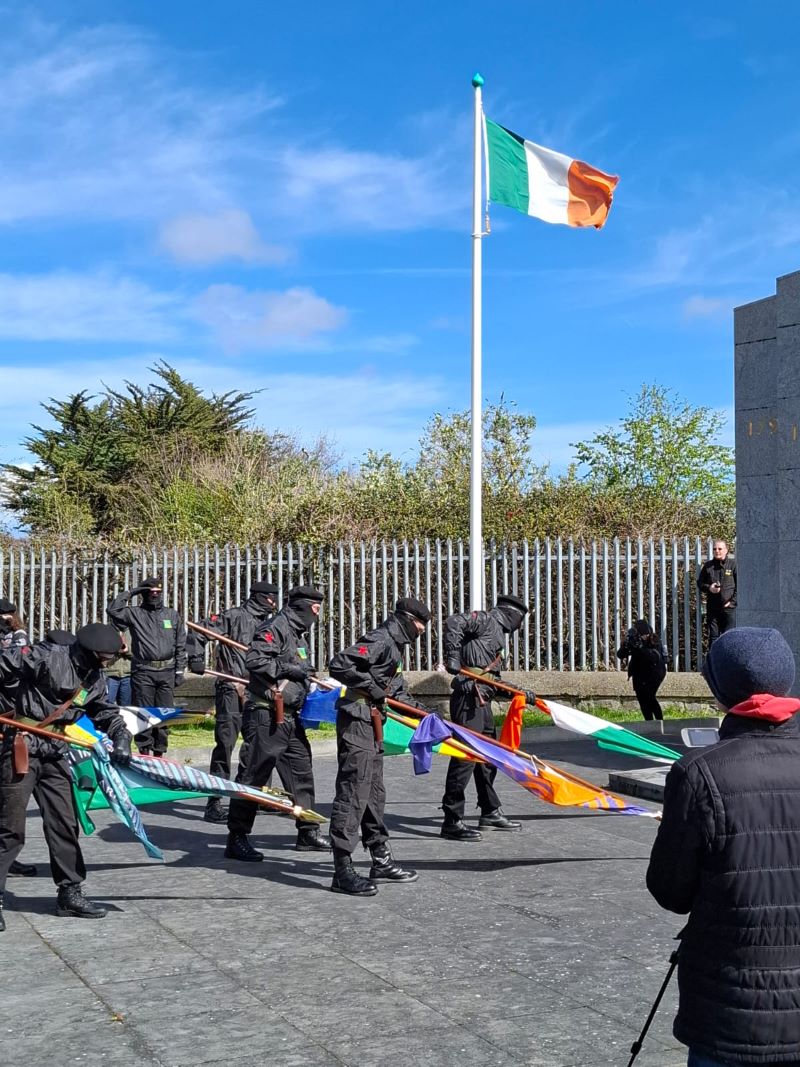
A moment in the lowering of the colour party’s flags during the moments’ silence in honour and remembrance of fallen martyrs. (Photo: R.Breeze)

COMMENT

The attendance at this year’s event was numerous and encouraging, even discounting the numbers from abroad. The latter has been a feature of AIA commemorations for some years but has also grown visibly in numbers and in countries of origin.

In previous 1916 commemorations of the AIA, songs had been performed by singers but that feature was missing this year. Another missing feature was a part-address in the Irish language, au contraire to the main speaker’s call for the restoration of Irish as the nation’s spoken language.

In common with a great many commemorations by varied organisations at this spot, there was no mention of the independent National Graves Association, for whose work and the monument itself much thanks are due.
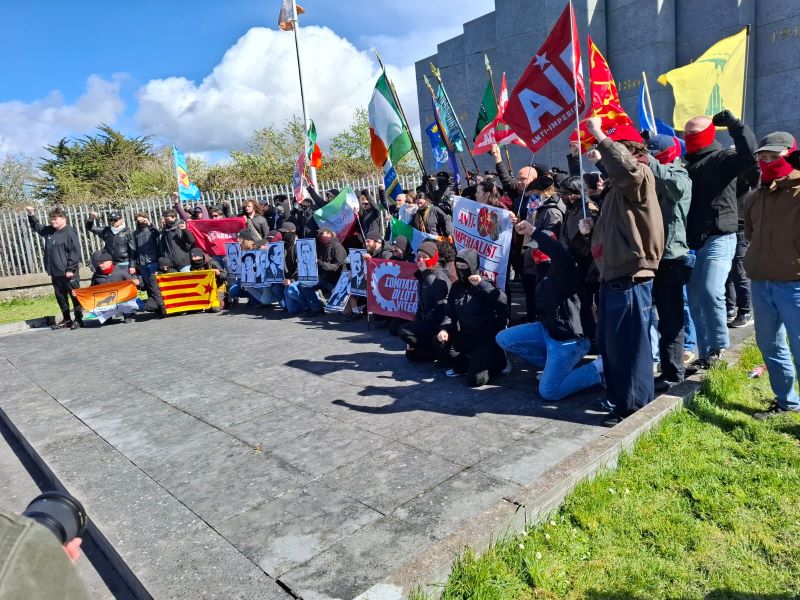
A large section of the participants chose to have their photo taken in a group with the monument behind them, their flags, banners and the portraits of the Seven Signatories of the Proclamation to the fore. (Photo: R.Breeze)

The call for unity in struggle is a common one in the Socialist and Republican movement though less verified in practice across their organisations. That said, on many occasions the AIA has put the desire into practice in joint action with other organisations and independent activists.

It is certain that without general unity in action across the resistance movement in Ireland, neither independence nor revolutionary change in society can be achieved.

In the city centre, at the GPO,5 site of the HQ of the Rising in 1916, the State held its own commemoration, with admittance to the area close to the podium by ticket only. According to reports, the speeches of the Taoiseach6 of the Coalition Government were received in silence.

This was in contrast to the speech of the new Uachtarán or President, a native Irish speaker and of broadly left-nationalist political outlook, which was enthusiastically applauded.

End.

Note: If you found this article of interest, why not register with Rebel Breeze for free, so that you will be notified by email of subsequent articles. You can de-register any time you wish.

FOOTNOTES

1However, no other instructions were given in the language, not even ‘dhá líne’ (i.e two lines) when the marchers were being instructed by stewards to separate into two columns.

2Omitted, as it often is, was the participation of the Hibernian Rifles unit, who though not part of the planned Rising joined it and acquitted themselves well in the GPO Garrison and in support of the City Hall Garrison.

3Communist Party of Ireland and Independent Dublin Republicans.

4This air and its lyrics are widely considered the National Anthem of Ireland but for the State, it is only the air of the chorus that is their National Anthem. Composed shortly before the Rising by Peadar Kearney and Patrick Heeney in English, it was sung during the Rising and widely adopted by the Republican movement afterwards. The lyrics were translated to Irish by Liam Ó Rinn in 1923 and, unusually, that version became dominant.

5The General Post Office, an imposing building in Dublin’s main thoroughfare,1 for which recently the Irish Government announced plans to remove the An Post (postal service) to develop in part as a shopping centre.

6Equivalent to Prime Minister. The Government is a coalition of formerly hostile parties Fine Gael and Fianna Fáil, from oppositional sides of the Irish Civil War (1922-1923) and supported by the Green Party and some Independents.

USEFUL LINKS

Anti-Imperialist Action Ireland: https://www.facebook.com/p/An-Phoblacht-Ab%C3%BA-61551946386300/

The National Graves Association: https://www.nga.ie/
https://www.facebook.com/NationalGravesAssociation/

FIVE DECADES WAITING FOR A HEADSTONE – VOL. SEÁN Ó CONAILL HONOURED IN GLASNEVIN

Diarmuid Breatnach

(Reading time: 4 mins.)

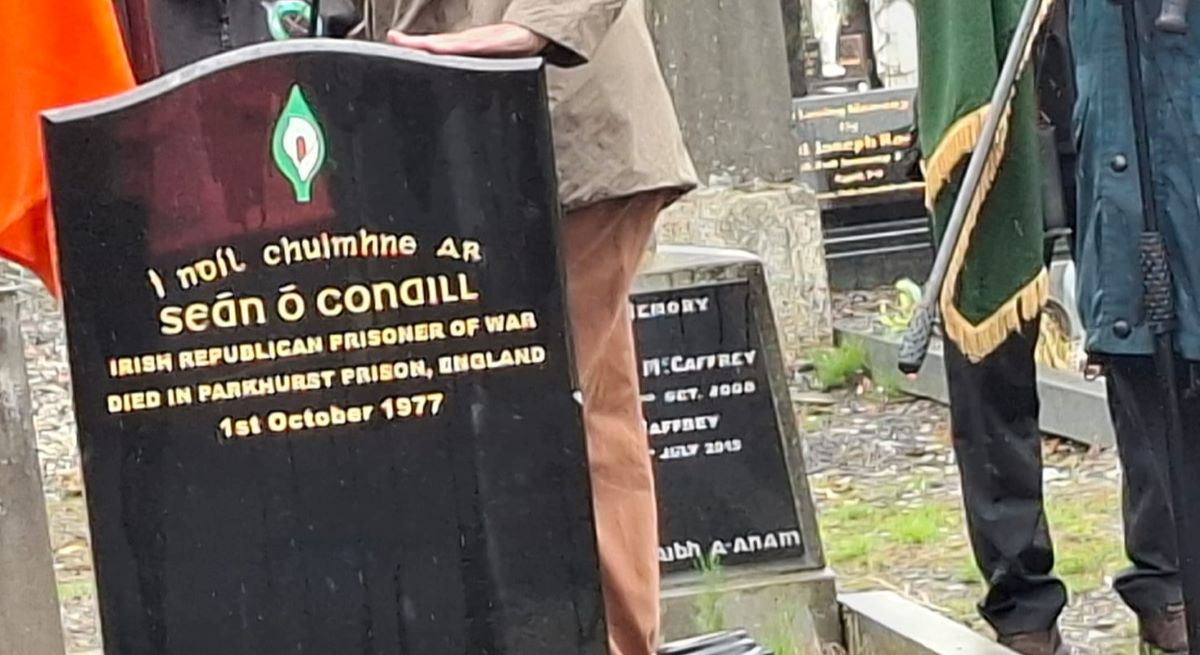
The grave of Irish Republican political prisoner Vol. Seán Ó Conaill received a headstone on Sunday (7th August) due to the efforts of the National Graves Association – nearly 50 years after his death in British custody.

Seán was born and brought up of Irish background in Birmingham and became interested in Irish history. After Bloody Sunday (1972) he tried to join the IRA but was not accepted and subsequently acted independently, assassinating a British Army Lieut. Colonel.

Tracked by British police, he wounded two of the group sent to arrest him, was captured and beaten up. His treatment in jail was bad also but after sentencing was accepted by the Irish Republican prisoners in British jails and, in time, sworn into the Provisional Irish Republican Army.

After his death his body was transferred for burial in Glasnevin. It seems that the NGA understood that his family wished to erect a headstone but for whatever reason the grave lay without one until last week.

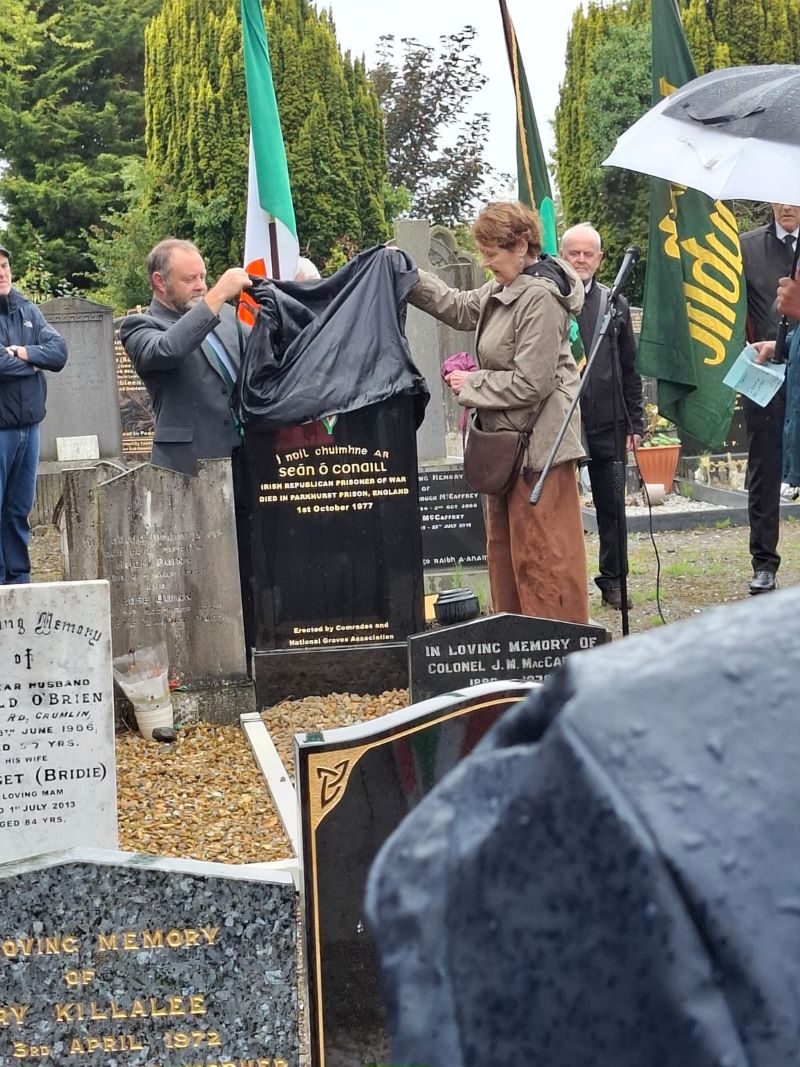
The National Graves Association went ahead with commissioning a gravestone which they unveiled on Sunday in the St. Paul’s section of Glasnevin Cemetery1 with a colour party, speakers, music and a goodly attendance, though drenched during the ceremony.

The occasion was supported by members of Sinn Féin and Republican organisations in addition to independent Republicans and anti-imperialists. Seán Whelan, Chairperson of the NGA chaired the event and after some opening remarks introduced the speakers.

Section of the attendance at the event. (Photo: D. Breatnach)

SPEAKERS

Jacqui Kaye of the former Prisoners’ Aid Committee2 was introduced to speak and told her audience that Ó Conaill was diagnosed with terminal cancer and requested a visit from Kaye, permission for which was initially refused by the Home Office3 but granted after intervention by Lord Longford.

The visit was permitted for 10 minutes only for Parkhurst Jail but then changed to a hospice though when Kaye arrived it was to be told that he had just died there, leaving her with the suspicion that he had actually died in Parkhurst but that the Home Office did not wish that on their record.4

Jacqui Kaye, formerly of the Prisoners Aid Committee (no longer in existence), speaking at the event during a particularly heavy shower. (Photo: D. Breatnach)

Former Republican prisoner (21 years in British jails) Noel Gibson laid a wreath on behalf of the NGA and Paddy Lennon read The Rhythm of Time by hunger strike martyr Vol. Bobby Sands, after which a recording of uileann pipes filled the cemetery air with its haunting lament.

Liam Ó Culbáird of the NGA presented the main oration of the event, recounting details of Ó Conaill’s life and time in jail, information gathered from a number of sources, including that despite complaining of chest and stomach pains he did not receive medical investigation in jail.

It was only after coughing up blood that Ó Conaill received a medical visit, after which he was diagnosed with terminal cancer. His marriage had become estranged possibly as a result of his incarceration but official interference in personal relations of political prisoners was also known.5

Liam Ó Culbáird, giving the oration at the unveiling on Sunday. (Photo: D. Breatnach)

The speaker alluded to the practice of “ghosting” political prisoners, i.e. moving them to a different jail without notice, often as a scheduled visit by a family member was imminent, which occurred to Ó Conaill’s mother arriving at Wakefield Prison to be told he had been moved to Parkhurst Jail.6

Such practices imposed an additional punishment not only on the prisoner but in particular on family members7 who had often travelled long distances into sometimes hostile territory and had also the additional expense of paying for overnight accommodation.

The media at the time of his arrest had portrayed Ó Conaill as of unbalanced mind but his comrades in jail found him completely rational and dedicated to the cause. He began to learn Irish and encouraged the other Republican prisoners to expand their use of the language.

Liam Ó Cúlbáird and Jacqui Kay unveil the headstone to Vol. Seán Ó Conaill on Sunday. (Photo: D. Breatnach)

Commenting on Ó Conaill’s failure to be recruited by the IRA prior to his armed action, Ó Culbáird commented that disagreements between General Headquarters of the IRA and Volunteers were not unknown and related a GHQ approach to Brendan Behan after his release from jail.

Behan was informed that he had been been found guilty by GHQ court-martial8 in his absence and sentenced to be shot. Behan replied that since his court-martial had been in his absence, so equally could his execution and promptly departed!

Ó Culbáird commented also on the number of groups that had operated independently of the IRA’s GHQ and remarked upon the number of different groups that had participated in the 1916 Rising,9 all with their reasons for separate existence but all united in the struggle for independence.

The speaker ended his oration by pointing out in Irish and in English that Ó Conaill was an Irish Republican soldier who gave his life in the struggle for Irish freedom.

CONCLUDING

Bringing the ceremony to an end, Seán Whelan thanked the speakers for their contribution and audience for their attendance and added some words about the NGA, pointing out its political independence and refusal to accept donation from any governmental or other organisation.

Chairperson of the NGA, Seán Whelan, presiding over the unveiling on Sunday. (Photo: D. Breatnach)

Whelan also added that whereas the NGA acknowledges the right of anyone to commemorate their dead, their organisation prioritises the dead who participated in the Irish struggle for independence but also cannot agree to share their commemoration with those who fought against them.

He remarked that he did not know of any other country where that would be done. Whelan then called for attention to the playing of a recording of the the National Anthem.

End.

(Photo: D. Breatnach)

FOOTNOTES

1i.e the large section on the opposite side of the road from the main Glasnevin gates, also where stands the NGA memorial to the six uprisings mentioned in Pearse’s famous speech.

2The PAC was initially formed by Official Sinn Féin but within two years had left the Officials and operated independently.

3Irish Republican prisoners in British jails were listed as high-security Category A and were not permitted visitors other than immediate family.

4She was not permitted to see his body.

5Letters to the prisoner might be delayed or not delivered, whereas letters from the prisoner might be held back.

6262 miles distant.

7Though not mentioned in the oration, this was also a practice of the Spanish prison system against Basque political prisoners, in which case letters and parcels arriving for the prisoner, rather than be forwarded to the prisoner’s new location, would be returned to sender with a note that the prisoner was no longer at the posted address.

8Presumably for his solo unauthorised action in carrying a bomb to England.

9Irish Republican Brotherhood, Irish Volunteers, Cumann na nBan, Irish Citizen Army, Na Fianna Éireann, Hibernian Rifles. Some individuals not a member of any of those organisation also participated.

SOURCES

https://www.facebook.com/NationalGravesAssociation

https://www.nga.ie/index.php