Diarmuid Breatnach
(Reading time: 5 mins.)
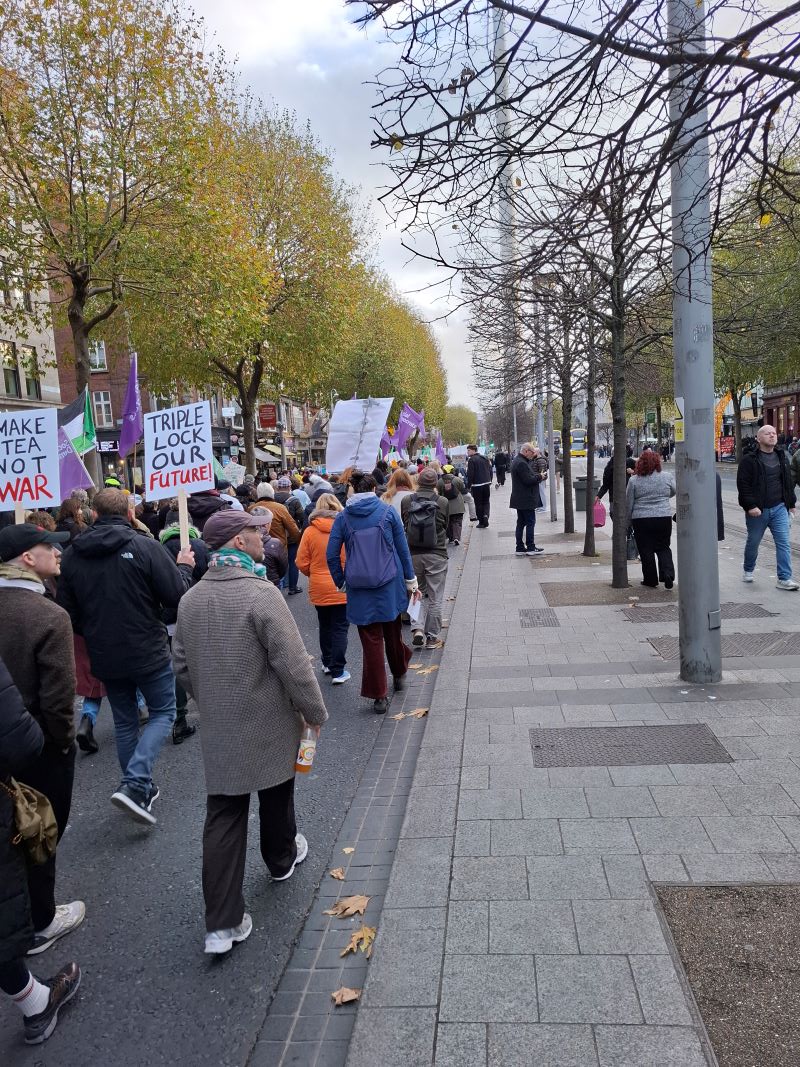
Ireland’s capital city saw thousands marching in defence of Irish neutrality. The marchers on Saturday 21st called for defence of Irish neutrality and for the retention of the Triple Lock, which the Irish Government is in the process of elimination.
The march had been organised by the Irish Neutrality League,1 a coalition of TDs (members of parliament) from People Before Profit, Sinn Féin, Social Democrats parties and independents.
BACKGROUND
The term ‘Triple Lock’ does not appear in any legislation but is part of the legal framework around the Defence Act 1960 and lays out the requirements before more than a dozen Irish State soldiers could be sent abroad on a military mission.
These are that they had to be part of a UN-mandated mission, the Irish Cabinet approved the mission and Irish Parliament passed a resolution approving the mission.2
After a majority voted ‘No’ in the first Irish referendum on the Nice Treaty, the Irish Government persuaded a majority in a second referendum to approve the Treaty in 2002 on a promise that the Triple Lock was a safeguard against Irish armed forces joining the military operations of others.
The Irish Coalition Government on 18th November this year used their majority of eight votes, which includes independents, to vote to abolish the Triple Lock against cross-party opposition.
FLAGS AND SLOGANS
A number of media reported that Irish and Palestinian flags had been flown on the march. It is hard to believe that those reporters were actually there because Palestinian flags on the march were rare, for a change outnumbered by the Irish Tricolour and even Starry Plough and ‘Irish Republic’ flags.
And rightly so, unlike recent marches on Irish neutrality which have had hardly an Irish flag present. The pink flags of the People Before Profit party and purple of the Social Democrat party were also visible in their sections on the march, which was understandable.
But would it have hurt them to fly Irish flags too? One suspects it would indeed have been painful to the PBP cadres, who are generally opposed to all nationalism, including the Irish version and have no great record on defending national sovereignty in general.
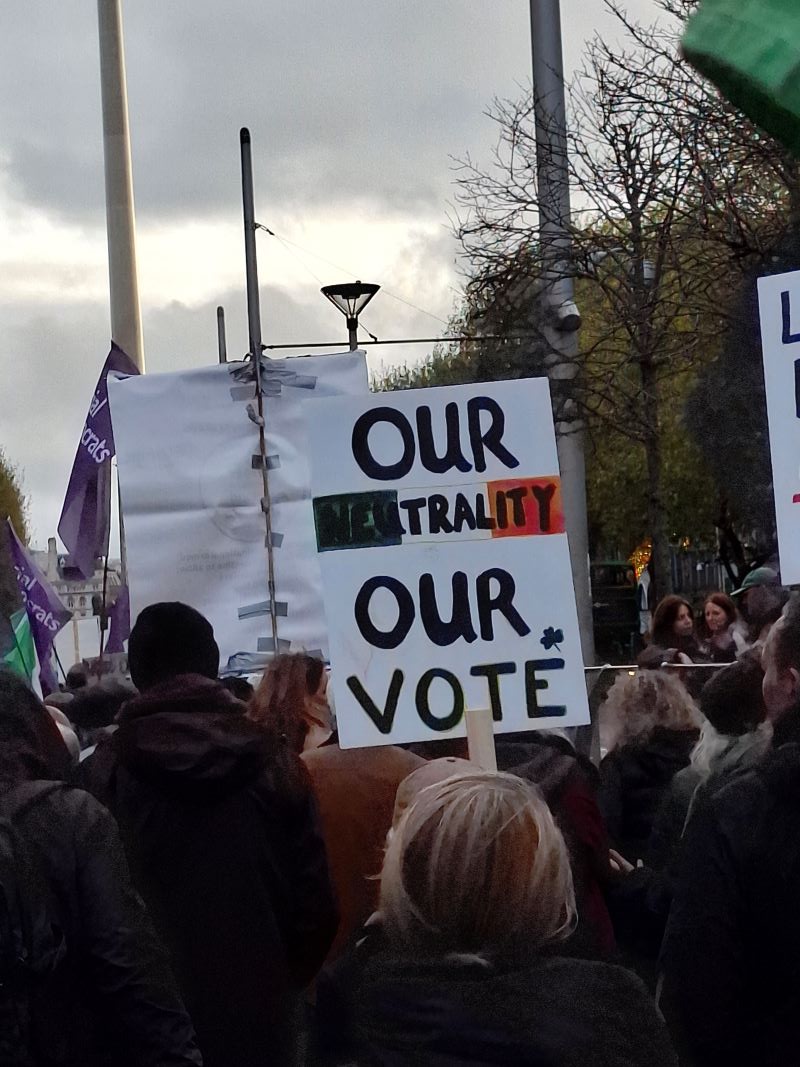
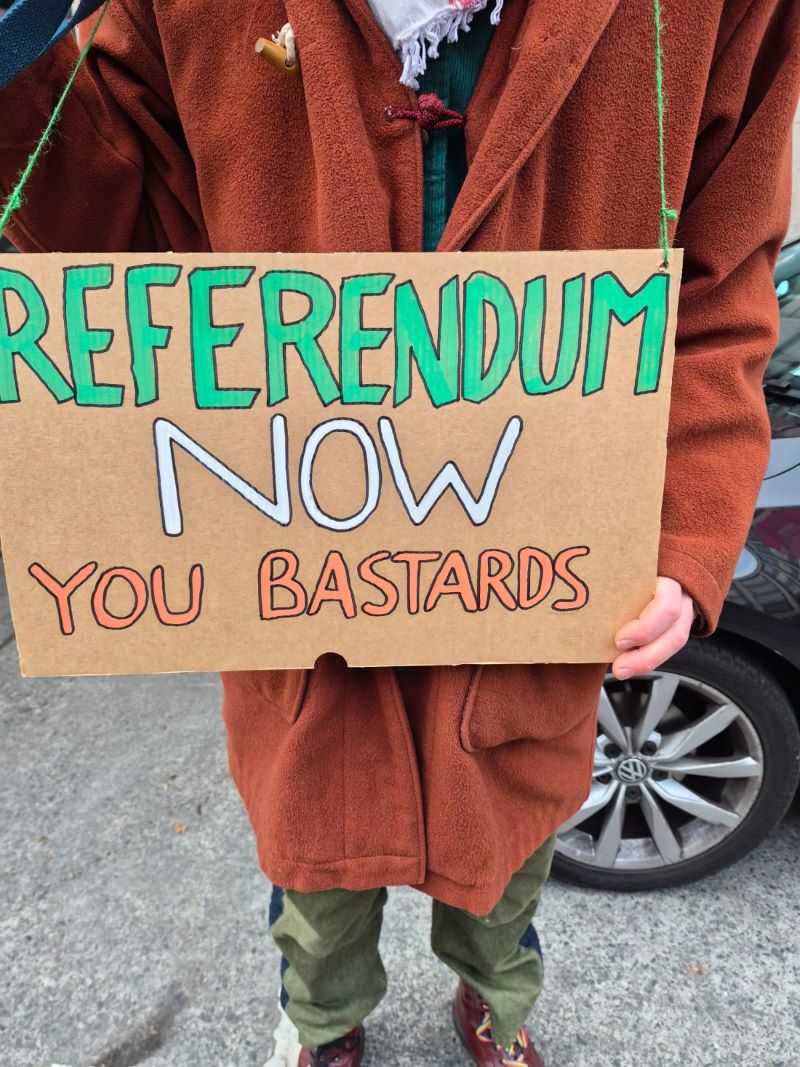
The slogans in the Mothers Against Genocide section were consistent throughout, one of them calling for a referendum. As indeed many others have done, the indications being that most of the population in the state are strongly opposed to being part of any foreign war.
From the PBP section behind came One, two, three, four, We don’t want your bloody war! which was fine but ruined by Five, six, seven eight, Ireland is a neutral state! To say that Ireland is a state is to accept the partition of the nation and the direct colonisation of one-sixth of its territory.
The problem is actually deeper because that sixth, those Six Counties are a UK colony and therefore part of NATO. And even the neo-colonial 26 Counties cannot be said to be neutral when US military flights are refuelled at Shannon and war material flies through Irish airspace.3
It is unlikely that either the Sinn Féin or Social Democrat parties will celebrate the action of Dáithí Ó Corráin, charged with causing $60 million (54,708,000 euro) worth of damage to a US warplane in Shannon Airport on 11th April this year.4 Will they even defend him?
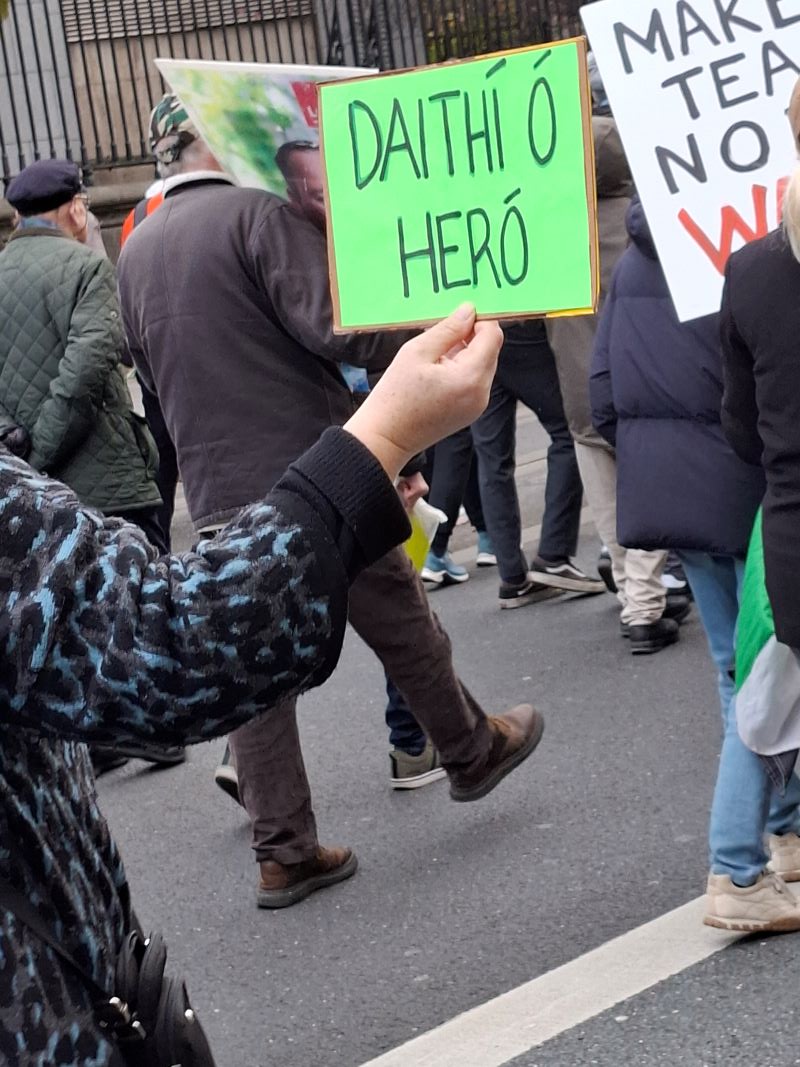
Ó Corráin is now charged in Ireland and in the USA. Shannon Airport has a long history of protests against its use as a US military flights stopover (including rendition of suspects to secret interrogation facilities, it is said), including Margaretta d’Arcy, Clare Daly and Mick Wallace.
Each of those was convicted but refused to pay the fine. Some were actually found ‘not guilty’, including the Pitstop Ploughares Five, in July 2006 after three trials, of damaging a US warplane in 2003 (in the lead-up to the war in Iraq). A number of others face current charges for recent actions there.
SAME DAY, SAME PLACE: ANOTHER MARCH
A little prior to the neutrality march a much smaller one departed the same rallying area and marched off to a separate destination, thought to be the offices of Dublin City Council. It had been organised by CATU (Community Action Tenants Union).
CATU’s march had probably been planned in advance of the Neutrality League’s but it seems strange to go ahead with it in the circumstances instead rescheduling or, even better perhaps, of joining the march for the defence of the Triple Lock.
NEUTRALITY PROGNOSIS
The Sinn Féin motion to put the issue to referendum was defeated on the 18th but this time by a majority of seven, one less than the vote on discarding the Triple Lock. The Bill now goes to committee stage dealing with amendments before coming back to plenary session.
The Government wants the process completed by the end of the parliamentary year but 124 amendments have been registered. If the Government uses its majority in committee to guillotine discussion it will be accused of curtailing discussion in an already controversial situation.
At the end of Leinster House processes, the bill would go to President President Connolly who would then have to decide on whether to sign the bill into law, consult with the Council of State, or refer it to the Supreme Court – if she believes it to be unconstitutional.
Fourteen other EU member states require parliamentary approval for an international deployment. In most cases, approval is granted, however there have been some notable exceptions.5
As the western imperialists gear up for war with the Russian Federation, the Irish State could hold back – after all, though neo-colonial, it is not an imperialist state. But no, its Gombeen ruling class is straining at the leash to get in there, to serve its imperial masters.
It is removing any constraints against doing that, lying through its teeth while accusing its critics of ‘misinformation’ and mobilising its creatures in the political class, the mass media and academia. It can be stopped, but not easily. A referendum might, which is why they won’t allow one.
Mass disturbances and the threat of revolution will stop them. At this stage, it is difficult to see what else might. It is equally difficult to see the present coalition of political forces of which the Irish Neutrality League taking their desire for Irish neutrality that far.
The trade unions as presently constituted and led will not lead a national strike against the war preparations. They have been unwilling to fight sufficiently hard to defend the wage levels of their own members and have overseen the huge drop in union membership over the last half-century.
To stop the Gombeen neo-colonialist class marching us to war for the benefit of the empires will take a mass movement under a different kind of leadership – one as determined as is the Irish ruling class but for an opposite objective.
End.
Note: If you found this article of interest, why not register with Rebel Breeze for free, so that you will be notified by email of subsequent articles. You can de-register any time you wish.
FOOTNOTES
SOURCES & USEFUL LINKS
March organiser and campaign to retain the Triple Lock: https://www.neutrality.ie/
Roundup of different Leinster House positions:
https://www.rte.ie/news/dublin/2026/1121/1600126-rally-neutrality/
The original Irish Neutrality League: https://cartlann.org/authors/irish-neutrality-league/
Pro-Triple Lock position of Teacher’s Union of Ireland (mainly post-primary levels): https://www.tui.ie/news/%E2%80%98triple-lock%E2%80%99-must-be-retained-%E2%80%93-tui.15598.html
Dáthaí Ó Corráin charges: https://www.irishexaminer.com/news/courtandcrime/arid-41939568.html
Triple Lock Explained: https://www.rte.ie/brainstorm/2025/0522/1514313-ireland-triple-lock-explainer-legislation-defence-forces-peacekeeping/
1This is not the organisation of the same name founded in Dublin in 1914 whose President was James Connolly, secretary Seán T. O’Kelly and which its members included Sinn Féin leader Arthur Griffith, Constance Markievicz and Francis Sheehy-Skeffington. (see Sources)
2When Ireland first sent Irish soldiers abroad as part of the UN observation mission in Lebanon in 1958, the Government did so without a vote in the Dáíl based on the assumption that it had the legal authority to do so. Following this, the Defence Act (1960) put in place the requirements we now call the ‘Triple Lock’. Later changes to the Act in 1993 extended the type of possible missions to ‘peace enforcement’ rather than just ‘peace keeping’ and the 2006 Amendment updated the language on UN authorisation and outlined the other circumstances when troops could be deployed for training, consular protection etc. https://www.rte.ie/brainstorm/2025/0522/1514313-ireland-triple-lock-explainer-legislation-defence-forces-peacekeeping/
3https://www.irishexaminer.com/news/munster/arid-41545903.html
4https://www.irishexaminer.com/news/courtandcrime/arid-41939568.htm
5Both votes on deployment to Iraq were only narrowly passed in Denmark. In the UK, David Cameron’s Conservative government lost a vote on deployment to Syria in 2013 and in the US Barack Obama lost a similar vote on Libya in the House of Representatives in 2011. https://www.rte.ie/brainstorm/2025/0522/1514313-ireland-triple-lock-explainer-legislation-defence-forces-peacekeeping/

