

Qassam Muaddi (Reprinted from Mondoweiss 12/ 11/ 2024) with current introduction by Diarmuid Breatnach)
(Reading time: 7 mins.)
INTRODUCTION:
Imperialist and Zionist intervention in Lebanon continues after the recent war as it did before, although the IOF failed thoroughly in its attempted invasion before the truce (if we can call it that, with near 500 recorded IOF ceasefire violations to date).
The USA’s envoy Hochstein’s claims the IOF will pull out at the fast approaching 60-day date stipulated in the ceasefire agreement.
Apart from decoupling Hezbollah from active support for the Resistance in Gaza, where the genocidal war may continue and possibly even intensify, the war against Lebanese sovereignty will continue, albeit in the shadows.
When the victorious powers in the imperialist World War I sat down to divide up the spoils, chiefly between the UK and France, the latter’s share included what is now Lebanon and Syria. The present constitution of the Lebanese state bears an unmistakeable French imprint.
The ‘international’ negotiators of the ceasefire sought by Israel therefore, France and USA, were the old French colonial imperialists of the region and their new supplanters, the US imperialists.1 These will continue their efforts to bring Lebanon firmly under imperialist control.
And ‘Israel’ will assist them in particular through its intelligence services: recall Netanyahu’s public attempt on 8th October to encourage political forces hostile to Hezbollah in Lebanon to rise up against the Resistance while simultaneously the IOF bombed Lebanese civilians!
The cavalier attitude of the head of Lebanon’s army, Josef Aoun, towards the Lebanese parliament last November seemed an early indication of this shadows war and, considering the importance of the Army in Lebanese politics, may bode ill for the future.2

In his first speech as the new Secretary General of Hezbollah, Naim Qassem said that the US Ambassador to Lebanon had been meeting leaders of Lebanese political parties opposed to Hezbollah.
According to Qassem, the Ambassador was trying to convince them that Hezbollah’s collapse in the face of Israel’s offensive was imminent, urging the Lebanese parties to oppose Hezbollah.
Two weeks earlier, a group of anti-Hezbollah parties gathered in the town of Maarab in Mount Lebanon, the headquarters of the “Lebanese Forces” — a far-right Christian party headed by its chairman, Samir Geagea.
The parties in attendance issued a joint statement that indirectly blamed Iran for pushing Lebanon into a war it had no stake in, hijacking the decision of peace and war in Lebanon, and recruiting Lebanese citizens and using them as soldiers and “human shields.”
The latter phrase was a veiled reference to Hezbollah, its social support base, and the people of southern Lebanon in general. The parties in Maarab also called for the election of a new president to the country.
Heading the meeting was Samir Geagea, a Maronite Christian known for his brutal suppression of Palestinian and Lebanese adversaries, including Christian rivals, during the Lebanese Civil War that took place between 1975 and 1989.

He is also known for his collaboration with Israeli occupation forces in Lebanon after 1982 and for having spent 12 years in a Syrian prison on charges of collaboration with Israel.
Geagea has also been openly voicing his will to run for the Presidency of Lebanon, which under the Lebanese constitution must be held by a Christian Maronite. The president’s chair has been vacant for two years now, as the opposing political forces have failed to agree on a candidate.
The president in Lebanon is elected by the parliament and thus needs a degree of consensus between represented parties, which has been absent since the latest president, Michel Aoun, finished his term in October 2022.
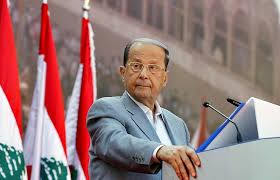
Michel Aoun was an ally of Hezbollah and represented an important trend of Christian community support for the resistance group in Lebanese politics since 2008.
During his presidency, Hezbollah’s adversaries in Lebanon, like Geagea, continued to accuse the resistance group of taking over the state, especially during the height of the Syrian Civil War, in which Hezbollah was actively involved in defending the regime of Syrian President Bashar al-Asad.
After Michel Aoun’s presidency, several political parties were unwilling to accept a president close to Hezbollah and its allies, entailing a vacancy to the recent election when Hezbollah’s preferred candidate Frangieh pulled out of the contest and endorsed Josef Aoun4‘s successful candidacy.
Diarmuid Breatnach
Why the Lebanese presidency is important for Israel
When Israel began its offensive on Lebanon with the exploding pager and electronics attacks in mid-September, some Lebanese politicians seemed to have sensed that the influential role of Hezbollah in Lebanese politics was approaching its end.
Calls to elect a new president increased, as the U.S. envoy, Amos Hochstein, brought his plan for a ceasefire.
Hochstein’s proposal included the retreat of Hezbollah’s fighting units north of the Litani River, essentially clearing Hezbollah’s stronghold in the south, and deploying more Lebanese army forces along the provisional border between Israel and Lebanon.

Hochstein’s plan, however, included another component — he called for electing a new president for Lebanon, even considering it a priority before a ceasefire with Israel.
The president in Lebanon is also the commander-in-chief of the army, which is why many army chiefs of staff were elected to the presidency in the past.
Historically, the president’s relationship with the army’s command influenced the role played by the armed forces, and this relationship has been especially crucial in the case of Hezbollah.
In the last years of Hezbollah’s guerrilla campaign against the Israeli occupation of southern Lebanon between 1998 and 2000, the Lebanese army played a role in covering safe routes for Hezbollah’s fighters in and out of the occupied area and in holding key positions.
This support by the army to Hezbollah’s resistance was the result of the direction and influence of the country’s President, Emile Lahoud, who had served as Chief of Staff of the army a few years earlier and refused to obey orders to clash with and disarm Hezbollah’s fighters.
The position of the Lebanese president, his influence on the army’s performance, and his relationship with the resistance have always been at the heart of Israeli and U.S. attempts to intervene in Lebanese politics.
It is not the first time that the U.S. and Israel have pressured for the election of a new Lebanese president as it is under Israeli attack. The presidency ploy is a worn U.S. tool for attempting to change Lebanon’s political landscape and to make it more Israel-friendly.
When Israel invaded Lebanon in 1982 and occupied its capital, Beirut, after the withdrawal of the Palestine Liberation Organization, the Lebanese parliament met to elect a new president — quite literally, under the watchful eye of Israeli tanks.
The parliament building was non-functional, and the Lebanese representatives had to meet with an incomplete quorum in the building of the military school to elect Bashir Gemayel as president.
Gemayel was the leader of the far-right anti-Palestinian Phalange party, or Kataeb. The Phalangists had helped Israel plan the invasion of Lebanon and fought on Israel’s side in the 1982 war.

Gemayel had travelled to Israel several times to meet with Israeli leaders and committed to signing a peace treaty with Israel as soon as he became president.
Gemayel was the strongman of the anti-Palestinian Lebanese Right, and he was the only leader with enough support and force to carry out Israel’s strategy in Lebanon.
His assassination 22 days after his election and before he was sworn in was one of the most devastating blows to Israel’s plans to bring Lebanon under Israeli influence.
In revenge for Gemayel’s death, the Phalangist militias entered the Palestinian refugee camps of Sabra and Shatila in the periphery of Beirut under Israeli cover. There, they committed the now infamous Sabra and Shatilla Massacre, slaughtering between 2,000 and 3,500 Palestinian refugees.3
Following the end of the Lebanese Civil War in 1989, the parties who had fought against each other entered into a power-sharing arrangement.
Meanwhile, the nascent Lebanese resistance group, Hezbollah — which started as an offshoot of the Shiite Amal militia during an episode of violence called the War of the Camps — increased its popularity and political influence.
This influence grew exponentially after Israel’s withdrawal from the occupied Lebanese south, which marked the first victory of an Arab resistance force against Israeli occupation.
By the beginning of the 2000s, Hezbollah had become a political party that ran for elections, secured parliamentary representation, and forged alliances with other Lebanese forces.
Political divisions in Lebanon began to appear once again on both sides of the question of the resistance, often attributed by its antagonists to Syrian, and later Iranian, influence in the region.
The identity of Lebanon’s president became a central issue again, especially after the 2006 Israeli war on Lebanon, during which Emile Lahoud’s presidency provided strong political support for Hezbollah. Lahoud finished his term the following year amid strong political division.
The state of fragmentation in Lebanese politics was so endemic that the president’s chair remained vacant for an entire year. The crisis was partially resolved with the election of the army’s chief of staff, Michael Suleiman, in 2008, who remained neutral.
Forty-two years after the first election of a Lebanese president at the behest of Israel, not much has changed. Lebanon is again under attack, and the resistance continues to be a central point of division over the future of the country and its position in the broader region.
Although Hezbollah insists that its resistance is tied to the genocidal Israeli war on Gaza, both Israel and the U.S. continue to look for ways to neutralize Lebanon through internal divisions and political disagreements.
As Israeli army officials begin to voice their demands to end the war — a war that was hitting a wall in the villages and mountains of southern Lebanon — it seems that Hezbollah’s adversaries continue to bet on Israel’s military capacity to bring about a “day after Hezbollah.”
Perhaps more confidently than Israel itself.
Qassam Muaddi
FOOTNOTES:
1 The condemnation by the USA of the UK/ France/ Israel attack on Nasser’s Egypt in 1956 was clearly an admonition that the old colonial rulers of the Middle East (and of much of the World) now had to give way to the new ruler – US imperialism — and the old ways of gunboats and invasion had to be replaced by suborning the local middle classes and control through finance and trade. Of course as time went on the USA too resorted to invasions and gunboats (or at least aircraft carriers). — DB
2 See https://thecradle.co/articles/beirut-in-the-dark-about-lebanese-armys-deployment-plan-for-south-lebanon-report
3 16–18 September 1982, its anniversary is not long past – RB.
4 1Not a close relation of Michel Aoun.
SOURCES:
Naim Qassem’s first speech as leader Hezbollah, November 2025: https://www.palestinechronicle.com/hezbollahs-new-leader-made-first-speech-today-this-is-what-he-said/
Israel ceasefire violations: https://www.aa.com.tr/en/middle-east/-lebanon-reports-4-more-israeli-violations-of-cease-fire-deal/3448885
Hezbollah’s preferred candidate Frangieh endorsed Josef Aoun: https://www.breakingnews.ie/world/lebanese-parliament-tries-for-12th-time-to-elect-new-president-1715733.html2Hezbollah’s preferred candidate Frangieh endorsed Josef Aoun: https://www.breakingnews.ie/world/lebanese-parliament-tries-for-12th-time-to-elect-new-president-1715733.html




 rebelbreeze