SWISS GOVERNMENT PLANS MASS SLAUGHTER OF WOLVES

Diarmuid Breatnach

(Reading time main text: 4 mins.)

The imagination’s land of the Red Cross, cheese, cuckoo clocks and chocolates plans the massacre of 70% of its wolf packs.1

In reality of course Switzerland is a very regulated country, with a rich financial/ industrial economy and is a major arms producer.

However in 2020 Swiss voters made their desire to protect endangered species clear, when 52% of voters rejected a hunting law that would have made it easier to kill endangered species such as wolves.2

Despite the vote, the Swiss parliament passed a new law in December 2022 that allows the wolf population to be ‘regulated’. Then, just days ago, the government proposed a regulation that will wipe out 19 of the 31 wolf packs remaining in Switzerland!

Eurasian Grey Wolf in snow (Photo sourced: Internet)

WOLF MYTH & REALITY

Childhood and adult fiction is replete with horror stories about wolves (to say nothing of werewolves) attacking humans but, when set against reality, these seem like propaganda. The reality is that it’s not to humans that wolves are generally a danger but to their livestock.

Wolves (Canis lupus) are highly intelligent pack canines and, apart from having donated the dog (Canis lupus famialaris) as a worker and companion for humans, is well aware of its survival boundaries with Earth’s very apex predator – humans (Homo sapiens).

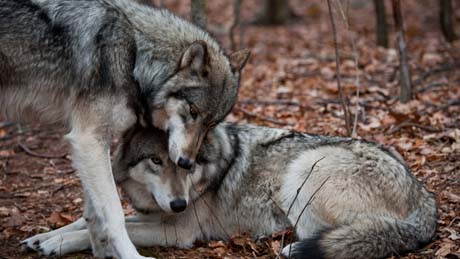
Wolf fondling another; pack members are very affectionate to one another while the alphas maintain boundaries. (Photo source: Internet)

Wolves prey substantially on rodents but must also, for pack survival, prey on larger mammals such as deer, mountain goats and boar. When these are in poor supply or other prey is temptingly easy, such as cattle and sheep, they will take those too.

The traditional human fear of wolves is therefore not one based on self-preservation but on economic priorities. And in the moralistic story of “The Boy Who Cried ‘Wolf’” it is not the human villagers that are attacked by the wolf pack but the community’s sheep.

However, if humans are to continue consuming a diet that will include meat, they will of course need to protect their livestock from wolves and have being doing so even before history was written.

Traditionally the main agent in that protection has been, ironically perhaps, the wolves’ own descendant, the dog – or more specifically, several livestock guardian breeds of dog.

Known livestock guardian dog (LDG) breeds include the Aidi (Atlas Mountain Dog), Carpathian Shepherd, Estrela, Greek Shepherd, Komondor, several breeds of Mastiff and Sardinian Shepherd; a known extinct breed is the Alpine Mastiff (before 5th century BC to 19th century AD).3

Mastín (Mastiff) amidst sheep it guards near Lagunas de Somoza (León, Spain). (Photo sourced: Internet)

Livestock guardian dogs are socialised to the livestock and to their immediate human ‘family’ and will not tolerate the close approach of any potential predator (which often includes even other humans). The primary role is to protect the herd, warn of danger and if necessary, attack.

Where employed in the past, LGDs have been highly effective in protecting their charges, in most cases not even having to fight predators but rather intimidating them. If they have to fight, they are bred for fearlessness and tenacity and their throats also protected by a “wolf-collar”.

Anatolian or Kangol Livestock Guard Dog, with sheep herd it is protecting, Eastern Turkey. (Photo sourced: Internet)

Predators, however courageous, also have strong survival instincts which warn against danger to life or limb (the latter, for a predator in the wild, often in time equalling the first). Unless absolutely desperate they will move on to safer although more difficult-to-catch prey.

For a good LGD however, there is no backing down possible, it is in defence of its own (as a wolf pack might defend its pups). The herder, when present with a firearm, is mainly an additional protection, as well as an alpha member of the dog’s ‘pack’ to obey and protect.

In contemporary times, LGDs have proved effective throughout the world, even in the experimental reintroduction of wolves to the USA.4 So why are they not being more widely employed and, instead, the remaining large predators being exterminated?

Central Asian breed of Livestock Guardian Dog beside its owner (Photo sourced: Internet)

It is no doubt more profitable for big livestock famers to have huge herds roaming freely and when they run out of edible pasture, to move the herd by herding dogs, mechanised herding vehicles or even helicopters. But is it all-around better? And are huge herds environmentally viable?

Apart from other considerations, wolves have been shown to have an environmentally positive effect in a balance between predator, prey and the environment, including vegetation and even water courses, for example in the famous case of the reintroduction of wolves to Yellowstone.5

Deer are pretty to look at but eat young trees and cause damage to reachable branches, while wild goats will eat almost anything, right down to the roots. Wild boar can also be very destructive and, being omnivorous like humans, even prey on ground-nesting birds.

Eurasian Grey Wolf in woodland (Photo sourced: Internet)

All of those invade agricultural crop lands to eat, in the course of which they also trample other crops; wild boar6 are now invading villages and suburbs in a number of towns and cities, overturning large refuse containers for their edible contents.

Female wild boar with litter of piglets in German urban area (Photo cred: Florian Mollers)

Wolves and other predators keep those species down to numbers in better balance with the environment but also of less bother to human settlements. Wolf packs on the other hand do not grow in size beyond the food supply that is fairly safely available.

The human race has made a huge impact on the environment which is sustainable up to a point beyond which, however, we are rapidly passing. We live in a sustainable balance with the environment — or we perish. Perhaps “let the wolf live” can be part of the lesson we need.

End.

FOOTNOTES

1https://theswisstimes.ch/rssfeed/criticism-of-planned-wolf-culling-by-environmental-groups-in-graubunden/

2Including the European Brown Bear, European Lynx and Eagles.

3https://en.wikipedia.org/wiki/Livestock_guardian_dog

4“After the reintroduction of wolves, that were eliminated in the United States in the 1930s, American farmers were losing about a million sheep annually to wolf attacks. 76 farmers took part in the Coppingers program, which introduced European livestock guardian dogs into the US sheep breeding (in their project they used Anatolian Shepherd Dogs). In all farms, where, in the absence of dogs, up to two hundred attacks of wolves per year happened, not a single sheep was lost under the protection of LGDs. At the same time, none of the predators protected by law got killed: the dogs simply did not allow them to approach the herd.” – https://en.wikipedia.org/wiki/Livestock_guardian_dog

5https://www.yellowstonepark.com/things-to-do/wildlife/wolf-reintroduction-changes-ecosystem/

6A wild boar is much more likely to attack a human than is a wolf in Ireland, where the Wolfehound breed was famous, it was a boar that mortally gored Diarmuid of the legendary Fianna after his return from exile. Wild boar also carry diseases that can infect domestic pigs and humans.

SOURCES

Planned Swiss wolf massacre: https://theswisstimes.ch/rssfeed/criticism-of-planned-wolf-culling-by-environmental-groups-in-graubunden/
https://euro.dayfr.com/local/792716.html

Switzerland as arms exporter: https://www.swissinfo.ch/eng/politics/switzerland-contributes-to-global-arms-trade-boom/46565762
https://www.swissinfo.ch/eng/culture/arms-trade–swiss-neutrality-as-business-strategy/48457830
https://www.bloomberg.com/news/articles/2023-03-07/swiss-arms-exports-jump-29-as-industry-laments-neutrality#xj4y7vzkg

Livestock guardian dogs: https://en.wikipedia.org/wiki/Livestock_guardian_dog

Boars as a problem in urban areas: https://www.nationalgeographic.com/animals/article/wild-boars-are-wreaking-havoc-in-europe-spurring-creative-solutions
https://www.nationalgeographic.com/animals/article/hong-kong-urban-dwelling-wild-boars

The Yellowstone Park wolf introduction experiment: https://www.yellowstonepark.com/things-to-do/wildlife/wolf-reintroduction-changes-ecosystem/

LOVELY BUT HARDY LATIN-AMERICAN MIGRANT

Diarmuid Breatnach

(Reading time: 2 mins.)

She’s been here a while now but has lost none of her beauty. She’s by no means fragile – very adaptable, in fact, like many of our own emigrants to other lands. She sounds kind of Japanese but isn’t, not at all.

It’s the fuchsia shrub, seen often in gardens but the hardy Fuchsia magellanica ‘Riccartonii’ variety grows naturalised in Ireland, especially along our west and south-west coasts where the soil tends to remain warmer than inland in winter.1

Naturalised Fuchsia (& Montbretia) in a country lane, West Cork (Photo cred: Stone Art Blog)

The first of her kind to receive European classification was Fuchsia triphylla on Hispaniola (now Haiti and Dominican Republic), baptised by French friar and botanist Charles Plumiere in the late 1690s in honour of the German botanist and medical investigator, Leonhart Fuchs (1501-1566).

We tend to pronounce her name as “foo-shia”, which sounds Japanese (to me at any rate) but in keeping with the origin of the name perhaps we should be pronouncing it “fooch-sia”, with the “ch” pronounced as the Irish one, e.g in the word “loch”.

Giúise (g’yoo-sheh) is its Irish botanical name but it has also been popularly known as “Deora Dé” which translates as “God’s tears” but can also mean “Drops of God’s blood” (more appropriately when the flower has yet to open).

There are 110 varieties of the plant, not counting cultivars, of which there are many also. The natural varieties are nearly all native to South and Central America, with a few varieties in New Zealand2 and Polynesia, testifying to the Silurian period connection between those landmasses.

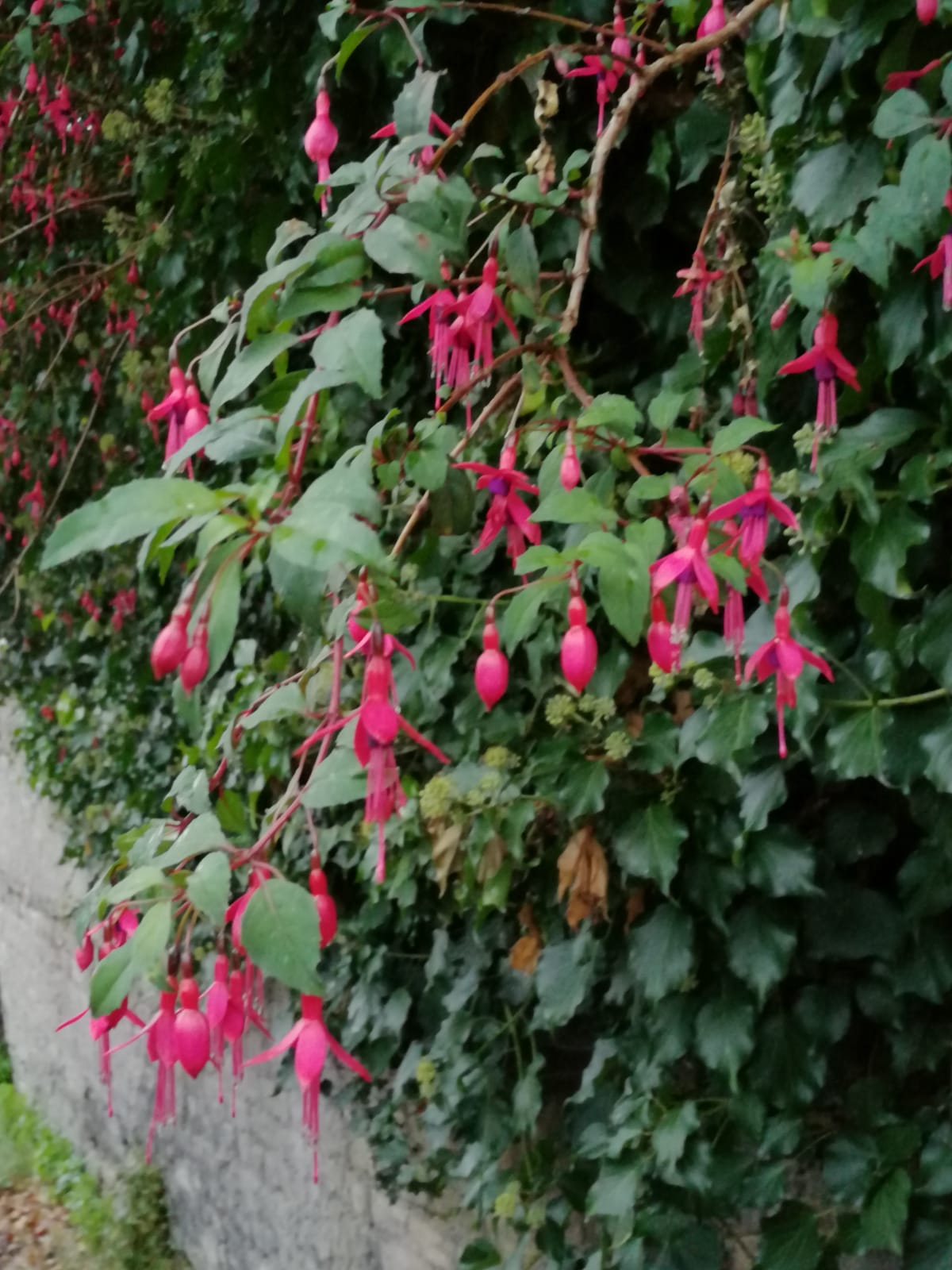
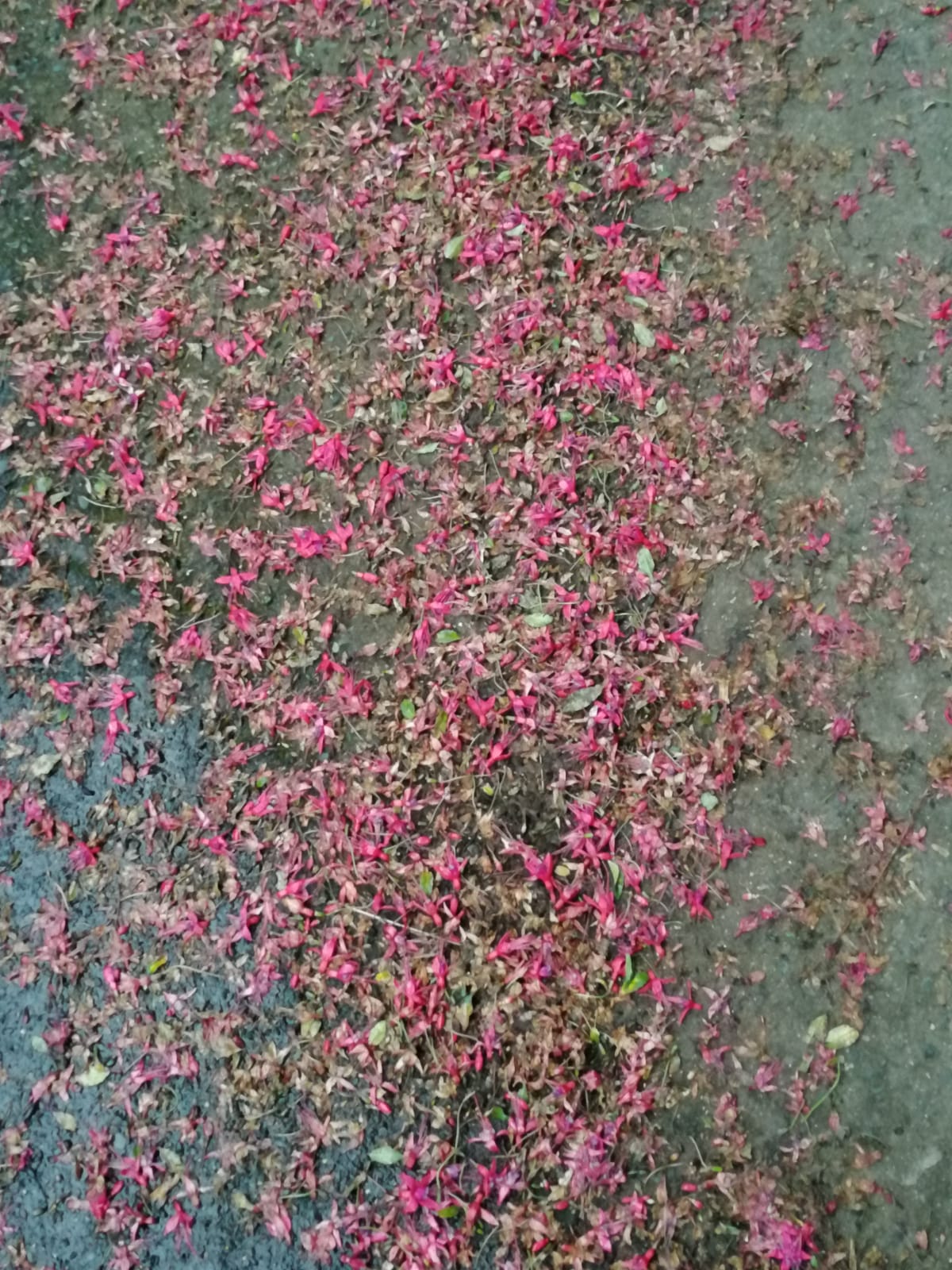
Hanging fuchsia blooms from a bush growing in a Drumcondra garden a few days ago against its back wall, with many dropping to form a carpet in the lane beneath. (Photo: D.Breatnach)

In many parts of Latin America the flowers were pollinated by different species of hummingbirds but here in Ireland they do well enough with bees, both native and imported, to assist in their procreation.

The fruits are small and vary from sweetly edible to unpleasant to taste. As children we didn’t try the developed fruits but we did pluck the flower and chew the dark red part of the stem that becomes the fruit when the flower drops – and could often taste a faint sweetness.3

The fuchsia has been in Ireland a long enough time – since the early 19th Century — and, though not native, is not generally referred to as “alien”, much less “invasive” to Ireland, unlike for example Cherry Laurel, Japanese Knotweed and a number of water plants such as Parrot’s Feather.

The Rhododendron and the Cotoneaster, which probably ‘escaped’ from gardens at the same time as the fuchsia, however do cause serious enough problems.

A fallen fuchsia bloom carpet in a Drumcondra lane at twilight a few days ago. (Photo: D.Breatnach)

The naturalised South American migrant fuchsia brings bright colour wherever she grows for four months of the year, from June to October.

Fáilte roimpi – bienvenida!

end.

FOOTNOTES

1That favours rooted plant life so long as they can withstand the wind-chill factor and Atlantic gales.

2An exception to the bush/ shrub nature of the fuschia is one New Zealand species, the kōtukutuku (F. excorticata), which grows up to 12–15 m (39–49 ft) tall.

3I admit that I still often do that.

SOURCES

https://en.wikipedia.org/wiki/Fuchsia

https://www.independent.ie/regionals/wicklow/lifestyle/fuchsia-a-not-so-fragile-beauty/34145375.html

EXTERMINATION WAR AND ALTERNATE UNIVERSES

Diarmuid Breatnach

(Reading time: 3 mins.)

I am engaged in an extermination war and I’m not winning.

It’s against those tiny brown fruit flies. Apparently they live by consuming bits of fruit and other vegetable stuff. But no matter how much I seal kitchen refuse and fruit into bags, large of small, they still fly around and around, annoying me. Deliberately taunting me.

Since I seal the bags, what do they live on? Just the faintest of smells is enough for the little f…ers, it seems! And I use the term advisedly. They are renowned fast breeders and an adult female fruit fly can lay up to 2,000 eggs on the surface of anything that’s moist and rotting.

Within 30 hours, tiny maggots hatch and start to eat the decayed food. Within 2 days, they’re all grown up and ready to mate, too! Luckily a fruit fly only lives 8 to 15 days – but still.

With such a fast turnaround, they’ve been used for genetic experiments, with even a flightless subspecies developed for the purpose.

Unfortunately, the ones at my place are all fully able to fly. And sometimes not just around me but flying right at me, inches away from my eyes. Do you know how difficult it is to kill something tiny mere centimetres away from your eyes? I really, really hate them.

I could spray them with insecticide, or course but that would mean poisoning my living space environment. I use anti-bacterial surface cleaner spray instead, hopefully less toxic for me. I know it’s less toxic for them also but it does slow them down or stick them to the wall so I get them.

Sometimes.

When they’re at a good distance for me to focus, I reach out really fast and smack my two hands together on them. Success rate? About one in ten. And even then, sometimes, when I open my hands, the little f..ker flies away, apparently unharmed and no doubt fly-sniggering.

But what about all those times I know for certain I caught one, open my hands and … nothing there. It’s not like I missed it because I didn’t see it fly away and it is nowhere to be seen. Except a few seconds later, it reappears – from nowhere.

Of course, it can’t appear from nowhere, not really.

So where did it go? Obviously, into an alternate universe and then back out to laugh at me. You don’t believe in alternate universes? Well a lot of physicists treat the subject with great seriousness and even think they might conform to quantum theory.

Don’t ask me to explain quantum theory but the multiple universes theory has to do with time and space or something. And we do know that time is objective (we’re getting older) but also subjective, as we experience when we sit through an interview or a haranguing from a partner.

Anyway, my war with the fruit flies continues. But what is their alternate universe like and why do they come back into mine? No fruit there? No oxygen? Really clever (but not quite quick enough) spiders?

I’m engrossed by the possibilities. Maybe there’s no cops or other fascists there.

So, I talked to this tech geek I know and he’s working on designing a micro-micro video camera. When he has it developed, we’ll trap some of those irritating flies, attach the micro-camera to one, threaten it until it jumps into the next universe and catch it when it returns.

Then, remove the camera and download the film.

What will we see? Who knows. Wonders, perhaps. But maybe only a giant hand swatting at the camera carrier as the fly dodges and shifts-universes back into this one.

End.

An t-Iascaire Coirneach ag pórú in Éirinn arís tar éis 200 bliain in easnamh.”

Aistrithe ag D.Breatnach ó scéal ag Rebecca Black PA24/08/2023
(Achair léitheorachta 3 nóim.)

Tá caomhnóirí ag ceiliúradh tar éis dóibh teacht ar fhianaise gur phóraigh an t-iascaire coirneach in Éirinn don chéad uair le breis agus 200 bliain.

Bhí péire ag pórú ag láthair nead rúnda i gCo. Fear Manach, de réir Fiadhúlra Uladh.

Dúirt an eagras neamhrialtach go raibh an t-éan creiche sainiúil tar éis athchoilíniú go nádúrtha sa cheantar agus gur éirigh leis dhá scalltán ar a laghad a shaolú, b’fhéidir trí chinn – an chéad phéire scaltan fiáine den chineál in Éirinn sa lá atá inniu ann.

Ba é Giles Knight, comhairleoir scéime feirmeoireachta comhshaoil le Ulster Wildlife, a rinne an fionnachtain.

Tá sé ag breathnú ar an mbeirt phóraithe le trí shéasúr anuas le linn a chuairteanna feirme áitiúla sa cheantar.

“Tá an scéala seo á choinneáil gar do mo bhrollach agam le fada an lá chun sábháilteacht agus leas na n-éan iontach ach soghonta seo a chinntiú,” a dúirt sé.

“In éineacht le mo mhac Eoin, tá mé ag faire ar na héin fásta ag filleadh ar an suíomh céanna ó 2021, mar sin d’fhéadfá a shamhlú go raibh sceitimíní orm ar an nóiméad a chonaic mé trí scalltán agus dhá éan fásta i mbliana.

“Nóiméad cimil-do-shúile a bhí ann, ócáid eisceachtúil; an buaicphointe is mó de mo ghairm bheatha fiadhúlra 30 bliain – cosúil len a theacht ar thaisce atá caillte le fada.

“Le dhá scalltán ar a laghad ag teacht aníos an séasúr seo, is scéal an-rathúil caomhantais é seo agus léiríonn sé éiceachóras bogach sláintiúil le neart gnáthóg agus iasc oiriúnach chun an creachadóir géibhinn seo a thabhairt ar ais chuig ár spéartha agus ag tumadh ins na Locha Fhear Manach.

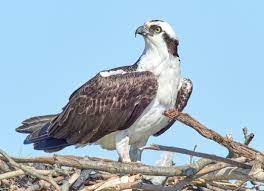
Iascaire Coirnech ar nead (íomhadh le: Wikipedia)

“Filleadh tuaithe beo i ndáiríre.”

Dúirt Fiadhúlra Uladh gur ceapadh go raibh na hiolair chreiche imithe in éag mar éan goir in Éirinn ag deireadh an 18ú haois mar gheall ar ghéarleanúint chórasach.

Cé gur minic a fheictear iad ar imirce chuig an Afraic Fho-Shahárach agus amach uaithi, ní raibh pórú deimhnithe in Éirinn do-ghlactha go dtí seo, agus Albain ina dhaingean pórúcháin sa RA.

Mhol an Dr Marc Ruddock, ó Northern Ireland Raptor Study Group, an “scéal iontach”.

“Tá na comharthaí agus na radharcanna go léir le blianta beaga anuas ag díriú air seo, ach anois tá fíor-rath póraithe dearbhaithe ar deireadh – nuacht iontach,” a dúirt sé.

Dúirt an tUasal Knight nach nochtfaí láthair an tsuímh le sábháilteacht na n-éan a chinntiú.

“Anois go bhfuil na héin seo ar ais in Éirinn agus ag pórú go rathúil, tá sé ríthábhachtach go bhfágfar faoi shíocháin iad ionas gur féidir leo leanúint ar aghaidh ag méadú trí phórú bliain i ndiaidh a chéile.

“Creidimid agus tá súil againn go bhféadfadh sé seo a bheith ina thús le ríshliocht éin chreiche,” a dúirt sé.

Iascaire Coirneach agus iasc gafa (Íomhádh le: Nick Brown)

“Ba ábhar misnigh agus croíúil é an t-úinéir talún, an pobal feirmeoireachta áitiúil agus ár gcomhpháirtithe a fheiceáil ag fáiltiú roimh fhilleadh na n-iolairí.

“Cuirfidh a dtacaíocht leanúnach ar chumas na nglún atá le teacht sult a bhaint as na héin iontacha seo i bhfad amach anseo.”

Ar fud na hÉireann, tá monatóireacht ag eolairí na n-éan creiche, tógáil ardáin neadaithe, agus pleanáil do chláir aistrithe agus athbhunaithe ar siúl le blianta anuas.

A chríoch.

WILDFLOWERS ALONG THE TOLKA

WALKING ALONG THE TOLKA AS IT RUNS THROUGH GRIFFITH PARK RECENTLY, I WAS PLEASED TO SEE A GREAT VARIETY OF WILDFLOWERS GROWING ON THE BANKS.

All were within a stretch of a few hundred yards.

Mint perhaps? (Photo: D.Breatnach)
Water mint maybe (Mentha aquatica Mismín mionsach) growing midstream so not able to pluck a leaf and smell it. Also brown seed-heads of Broad-leaved Dock (Rumex obtusifolius Copóg shráide) for contrast (Photo: D.Breatnach).
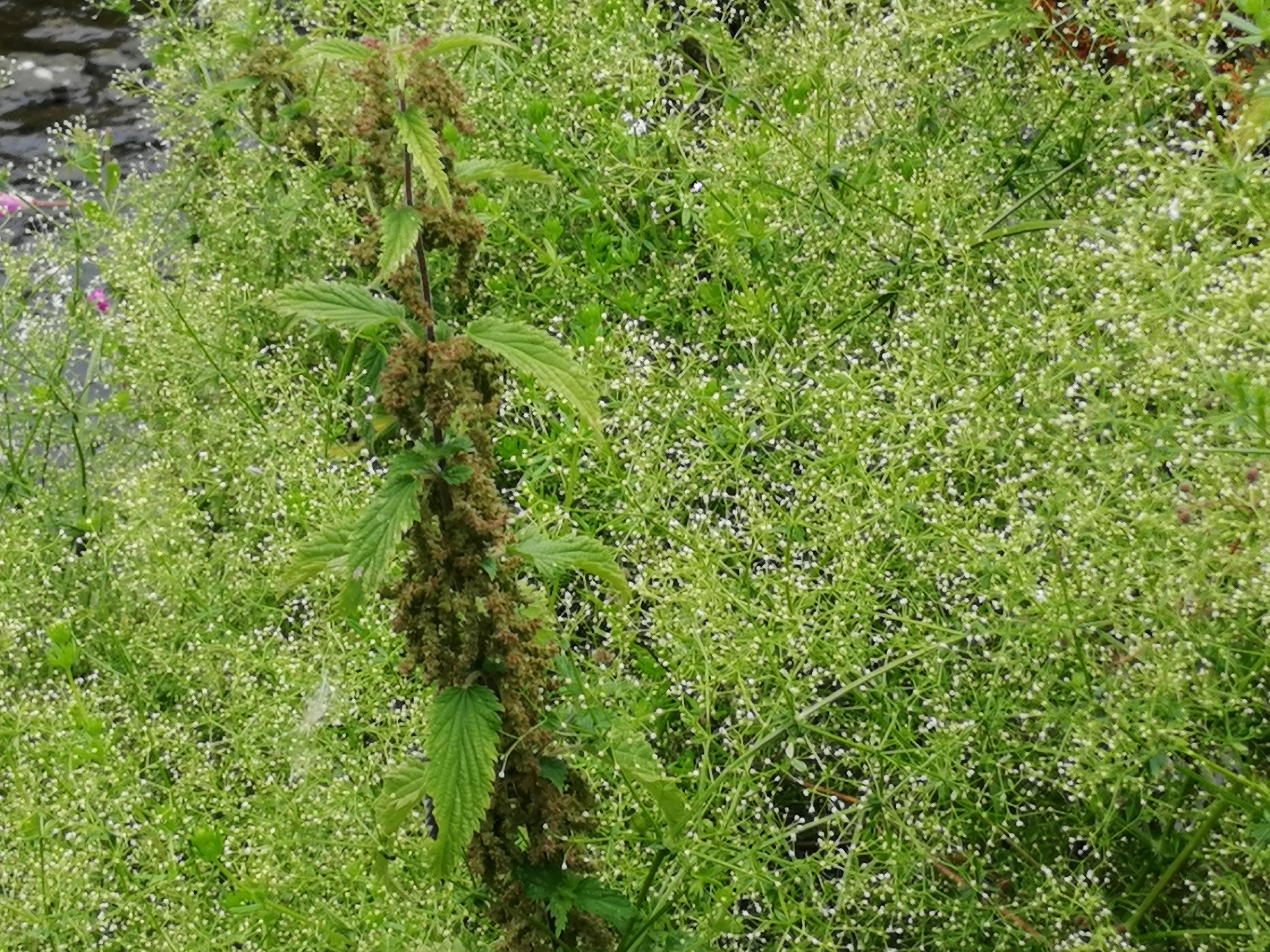
Not sure what this one is but breaks out into tiny white flowers. Almost centre is a stalk of stinging nettle (Neantóg/ Cál faiche). (Photo: D.Breatnach
Member of the thistle family (Feochadán) — but which one? — in flower and down (Photo: D.Breatnach)
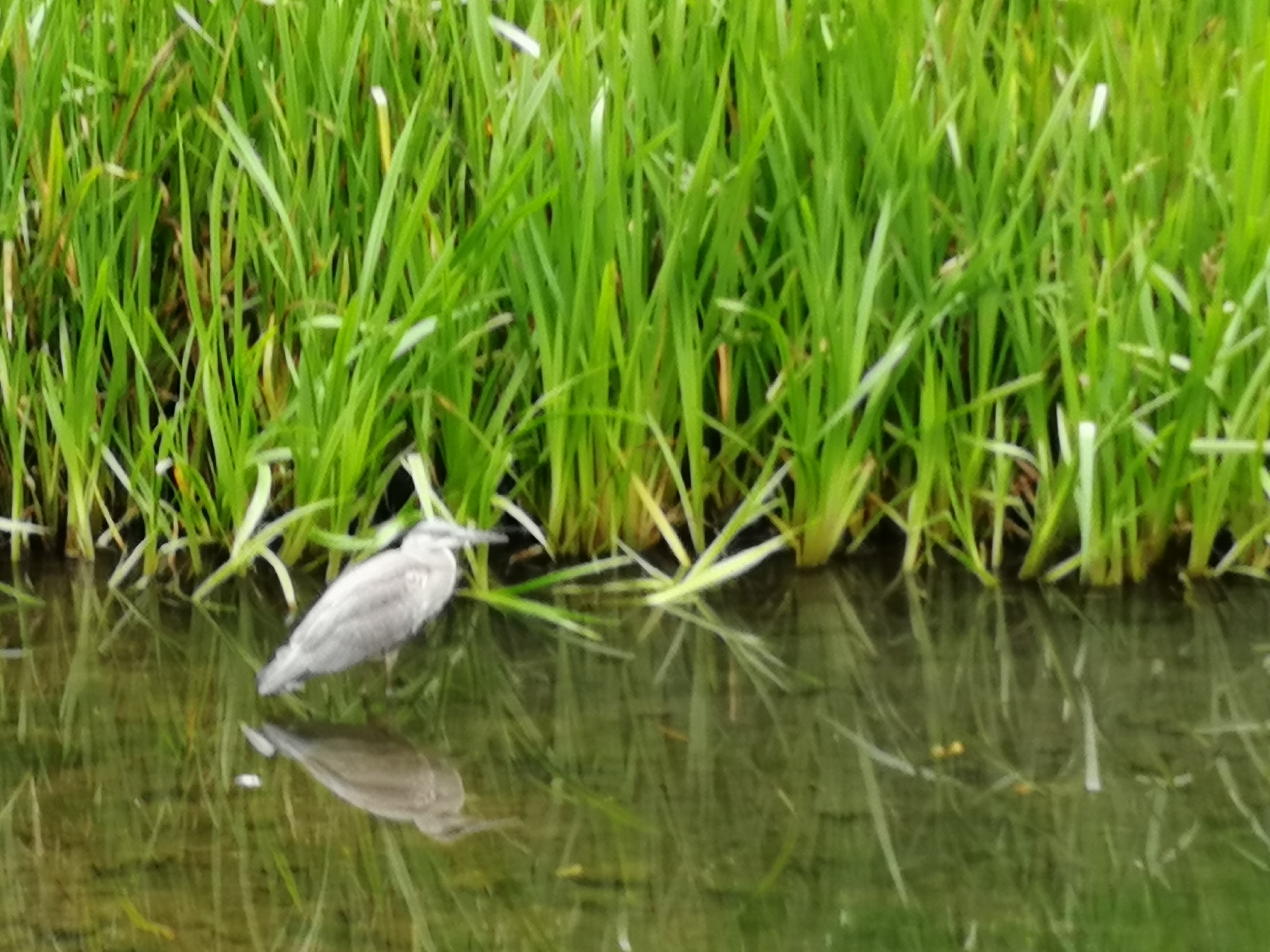
Little Grey Heron (Corr Éisc) waiting by the reeds for lunch to swim by (Photo: D.Breatnach)
Hollyhock in foreground and looks like another behind it — NOT a native plant. There were some growing each end of the bridge, as though planted or sown there. (Photo: D.Breatnach)

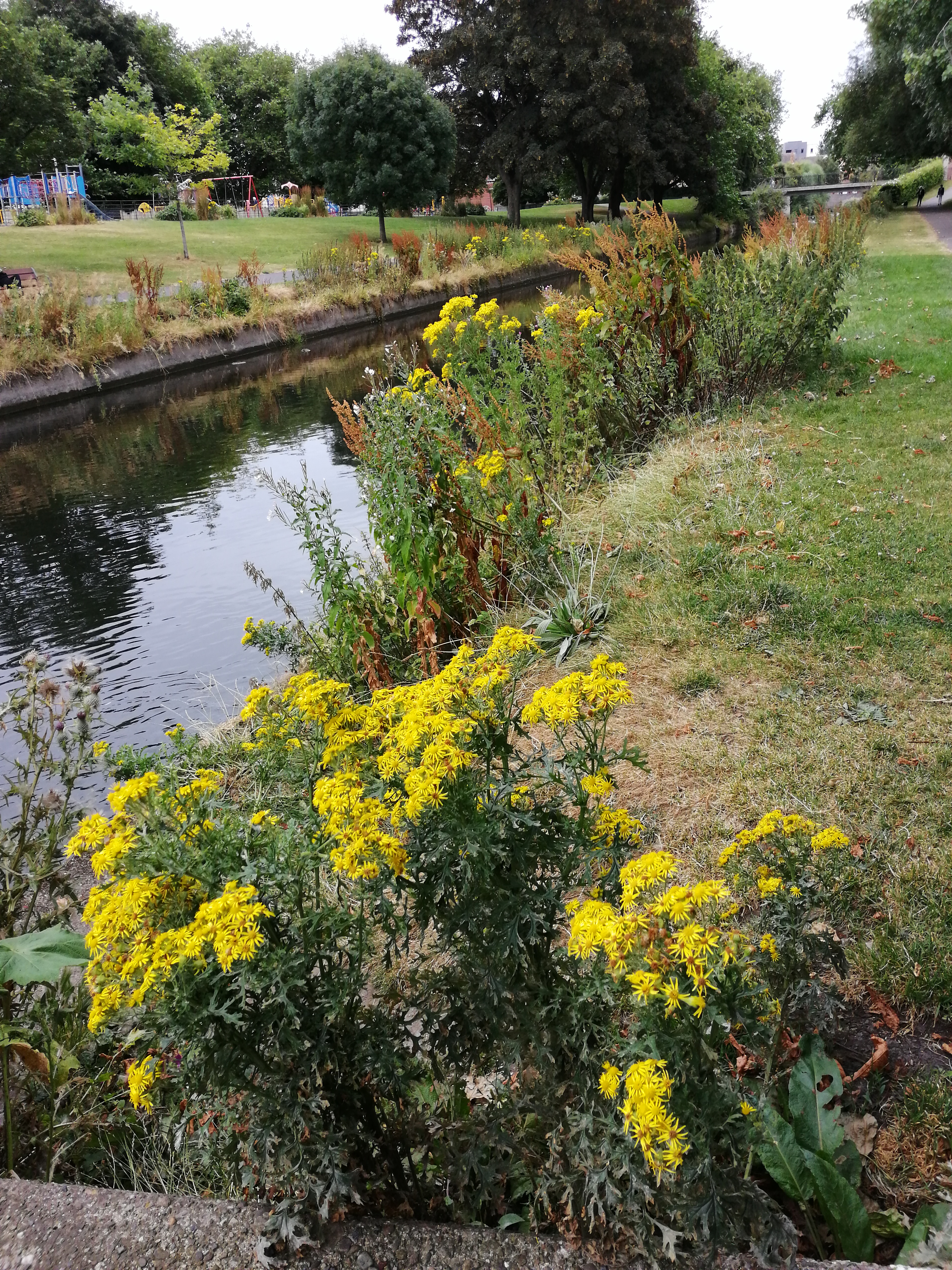
Groundsel/ Ragwort like constellations of stars before they go to down and seed. But which one? Common Ragwort (Senecio jacobaea / Jacobaea vulgaris Buachalán buí) I think. (Photo: D.Breatnach)
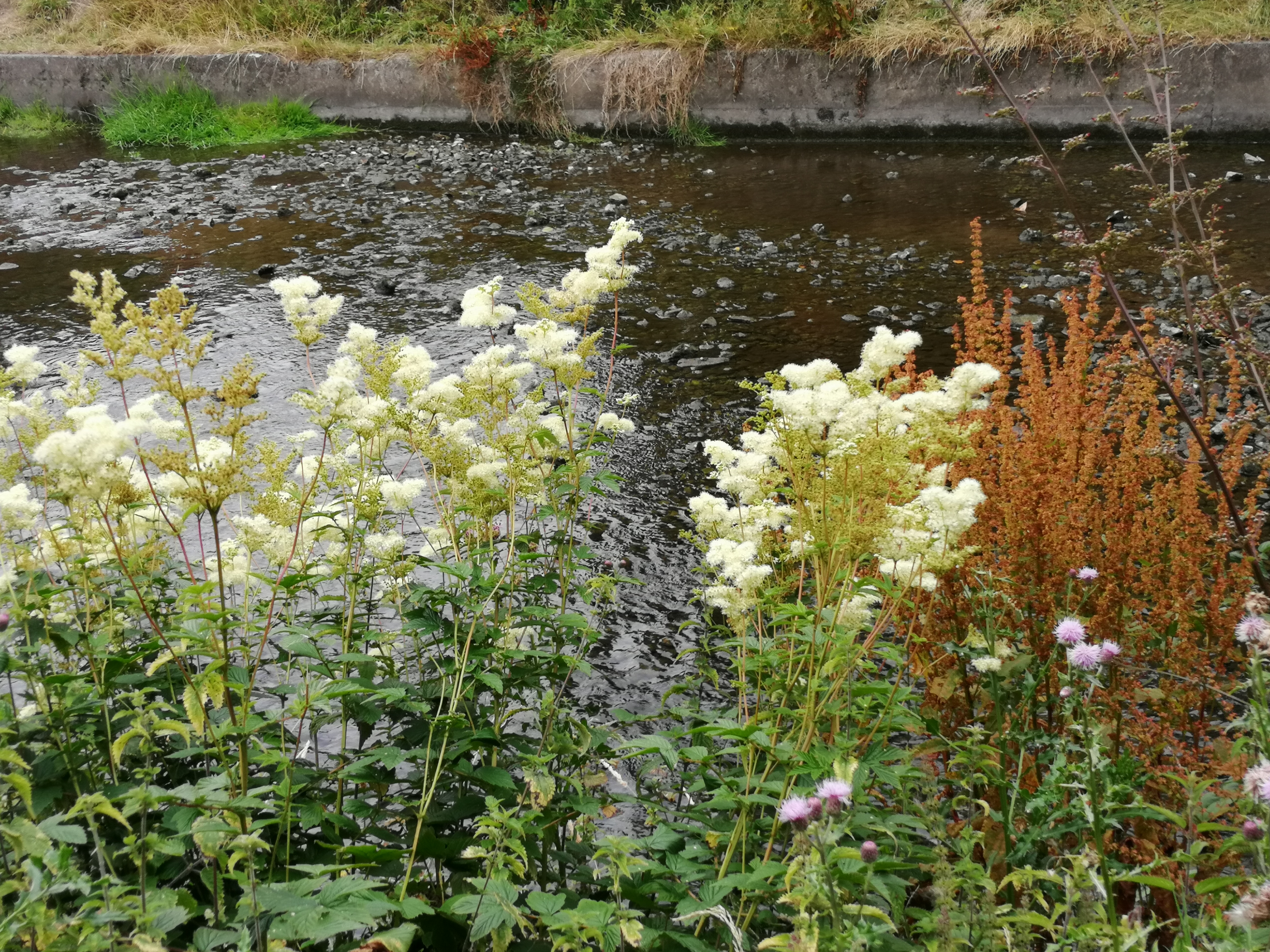
This one I do know — Meadowsweet (Filipendula ulmaria Airgead luachra) and dock seed heads again. (Photo: D.Breatnach)
Casadh sa tsruth — a bend in the flow — and view up from the weir. Willow trees on the right and a shrub I know to see but have not identified (a Skimmias?) on the right. (Photo: D.Breatnach)
Lesser Knotweed (Persicaria campanulata Glúineach an chlúimh), I’m pretty sure — an introduced plant. (Photo: D.Breatnach)

There were other flowering plants too but either had already flowered or were yet to do so.

(Photo: D.Breatnach)
Red Campion (Silene Vulgaris Coireán na gcuach) at centre-right here? (Photo: D.Breatnach)

End.

KISS OF THE PARASITE SPREADING THROUGH GLASNEVIN

Diarmuid Breatnach

(Reading time: 3 mins.)

At this time of year, using a parasitic plant as an excuse — and in spite of Covid19 transmission danger — many kisses will be given. The plant in question is of course the mistletoe and people buy sprigs or clumps of it to hang in strategic places to trap the unwary, ambushing them into receiving the sign of affection (or lust). Although the plant is native across Europe it is not so to Ireland1, though it can be found growing in widely-separated places here, believed to be the result of “garden escapes” but could also have been imported with saplings (for example of apple varieties).

IN FOLKLORE AND MYTHOLOGY

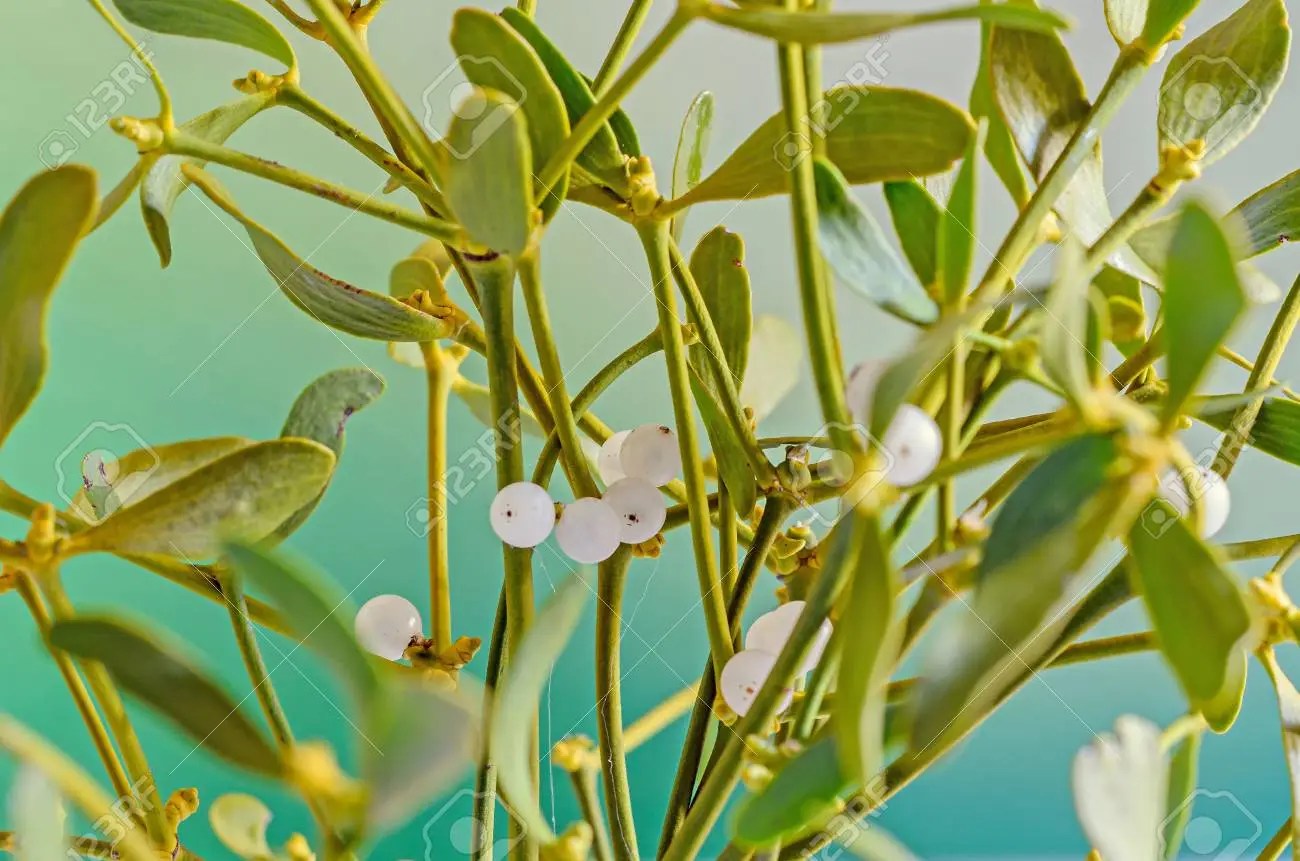
According to Wikipedia, the whole kissing-under-mistletoes custom was popularised by courting couples among servants of middle and upper classes during the reign of the English Queen Victoria. How that arose is not explained but there has been an association of the berries with fertility since antiquity, possibly through sympathetic magic, since the berries were thought to resemble sperm. Indeed, one of its medicinal uses historically has been in treatment of infertility, along with arthritis, high blood pressure and epilepsy. To the Celts, mistletoe represented the semen of Taranis, their god of thunder2, while the Ancient Greeks referred to mistletoe as “oak sperm”.

Closeup of Viscum album, the north European mistletoe, leaves and white berries.
(Photo sourced: Internet)

Modern medicine does not ascribe scientific value to treatments with misteltoe and instead points to the toxicity of the plants, with Tyramine, the active agent, causing blurred vision, diarrhoea, nausea and vomiting and, more rarely, seizures, hypertension and even cardiac arrest. The toxic agent is maximally concentrated in the fruits and leaves. Fatalities among adult humans are rare but children and pets are more vulnerable.

Mistletoe on tree in January 2017, Dublin area (possibly Botanic Gardens). (Photo: D.Breatnach)

In Ancient Rome it was customary to attach a sprig of the plant above the door to bring love and peace to the household while elsewhere it has also been seen as protection against evil spirits. What of the common belief that it was ingested by the druids, as in a “ceremony of the oak and mistletoe” with sacrifice of white bulls? We have only Pliny as an ancient source of that alleged ceremony and historians seem to dislike relying on him, seeing him as a historian who liked to please the patricians in Rome with his descriptions. Wiki comments: “Evidence taken from bog bodies makes the Celtic use of mistletoe seem medicinal rather than ritual. It is possible that mistletoe was originally associated with human sacrifice and only became associated with the white bull after the Romans banned individual human sacrifices.”3

Is mistletoe harmful to trees? Although it is not in the long-term interests of a parasite to kill its host, some species do appear to be taking over their host bush or tree but we don’t seem to have come to that pass in Ireland and indeed may never do so. Wikipedia notes a number of studies that have ascribed ecological importance to some species, as a food source, nesting material and even encouraging the spread of juniper through birds attending parasitised juniper trees and eating the mistletoe and juniper berries together, to pass through the gut unharmed and be deposited elsewhere.4

THE PLANT SPREADING IN IRELAND?

“The word ‘mistletoe’ derives from the older form ‘mistle’ adding the Old English word tān (twig). ‘Mistle’ is common Germanic (Old High German mistil, Middle High German mistel, Old English mistel, Old Norse mistil). Further etymology is uncertain, but may be related to the Germanic base for ‘mash’.”5 Its family Solanthacea (agreed in 2003) includes about 1,000 species in 43 genera. Many have reported traditional and cultural uses, including as medicine.6

Clumps of Drualus (mistletoe) on unidentified tree, Botanic Gardens, Dublin, October 2020. (Photo: D.Breatnach)

In Ireland, apart from its scientific name Viscum alba, the perennial plant has a number of names: Sú Dara, Uile Íce, Drua-Lus and it typically roots itself in the bark of trees such as Hawthorn, Lime, Apple, Poplar and Willow but according to its Wikipedia entry, “successfully parasitizes more than 200 tree and shrub species” (though probably much less in Ireland). Once established its roots tap its host’s sap for water and nutrients but it also carries out photosynthesis, processing sunshine through its fleshy leaves — which has it classified as a hemiparasite, ie. it does part of its own work. The tree also gives it elevation where it can catch the sun’s rays without too much obstruction.

A distribution map with the Wildflowers of Ireland entry shows it widespread throughout England and Wales and localised in Scotland and Ireland, possibly through the deforestation in those nations. Although imported deliberately or accidentally to Ireland and then escaping beyond its source, once established it can be be spread, largely probably by birds.

Smólach Mór (Mistle Thrush), Griffiths Park, Glasnevin-Drumcondra, June 2021. (Photo: D.Breatnach)

The Mistle Thrush (Smólach Mór/ Turdus viscivorus) is particularly associated with the plant by name and the bird is said to include the berries in its winter diet when invertebrate animals, its preferred food the rest of the year, are rarely about7. The bird is described as squeezing the berries in its beak, ejecting the seeds sideways and, to clean its beak, wiping it against a tree trunk. The seeds, being covered with sticky liquid adhere to the tree bark and the liquid hardens, maintaining a strong grip.

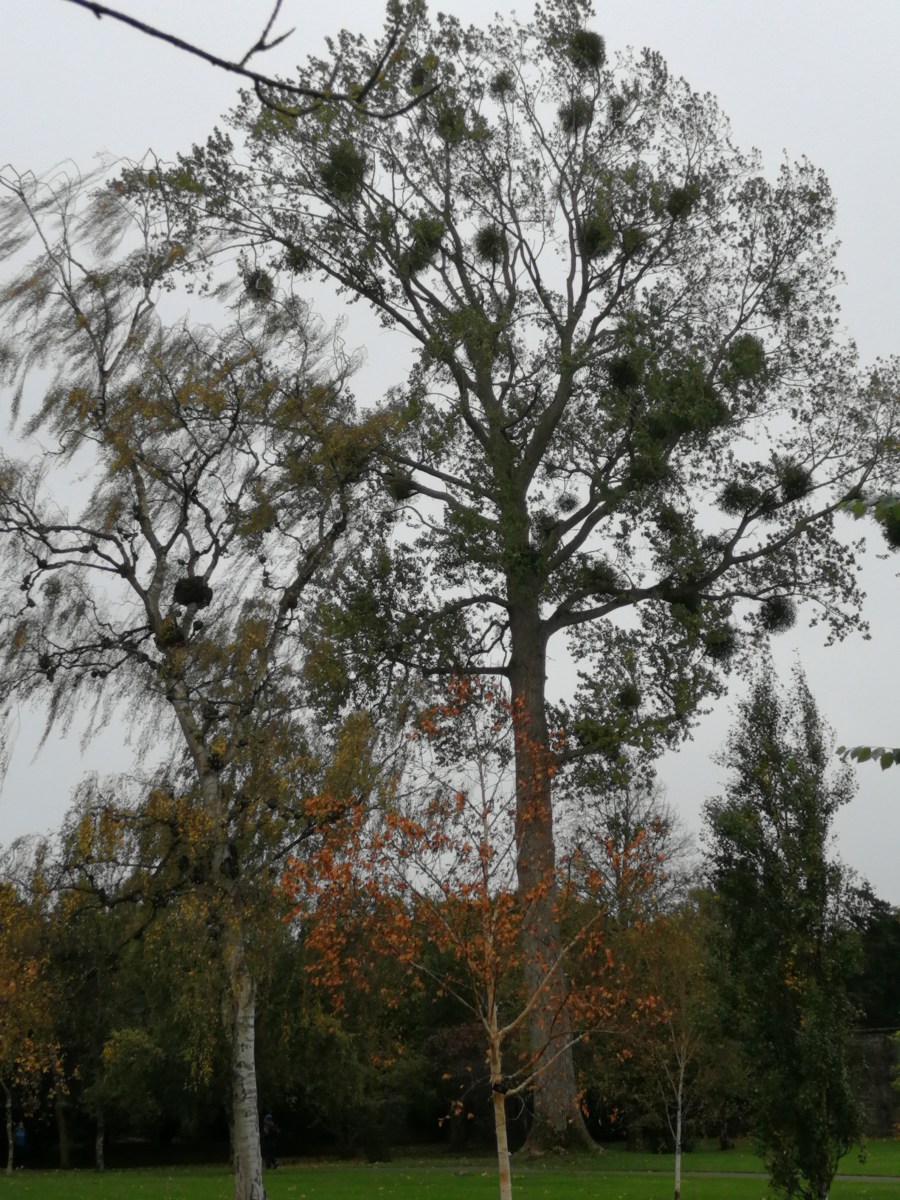
Clumps of Irish mistletoe on a north American Poplar, Botanic Gardens, Dublin, 19th December 2021. (Photo: D.Breatnach)
Nameplate on the bark of the poplar tree parasitised by the mistletoe picture above. (Photo: D.Breatnach)

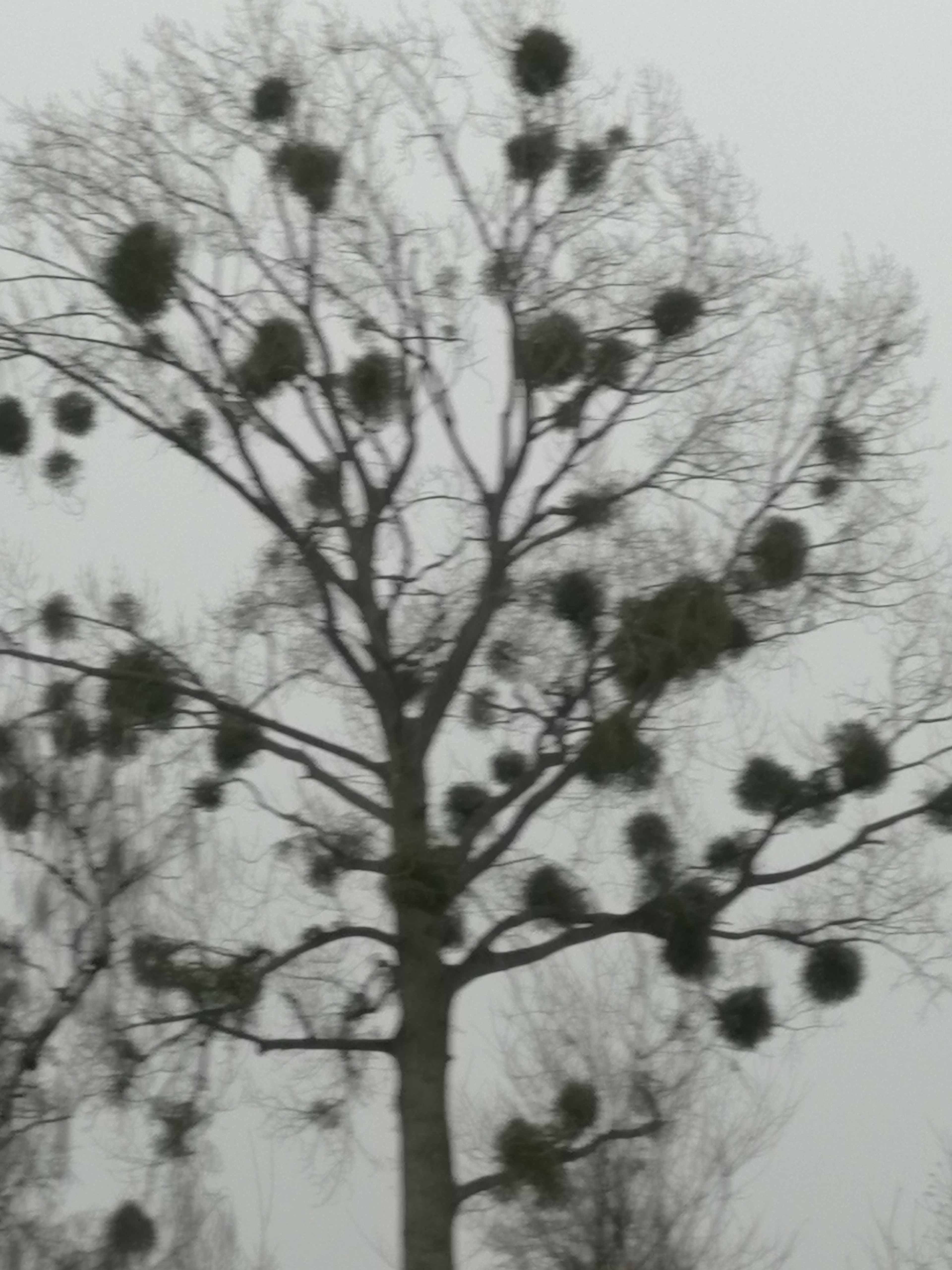
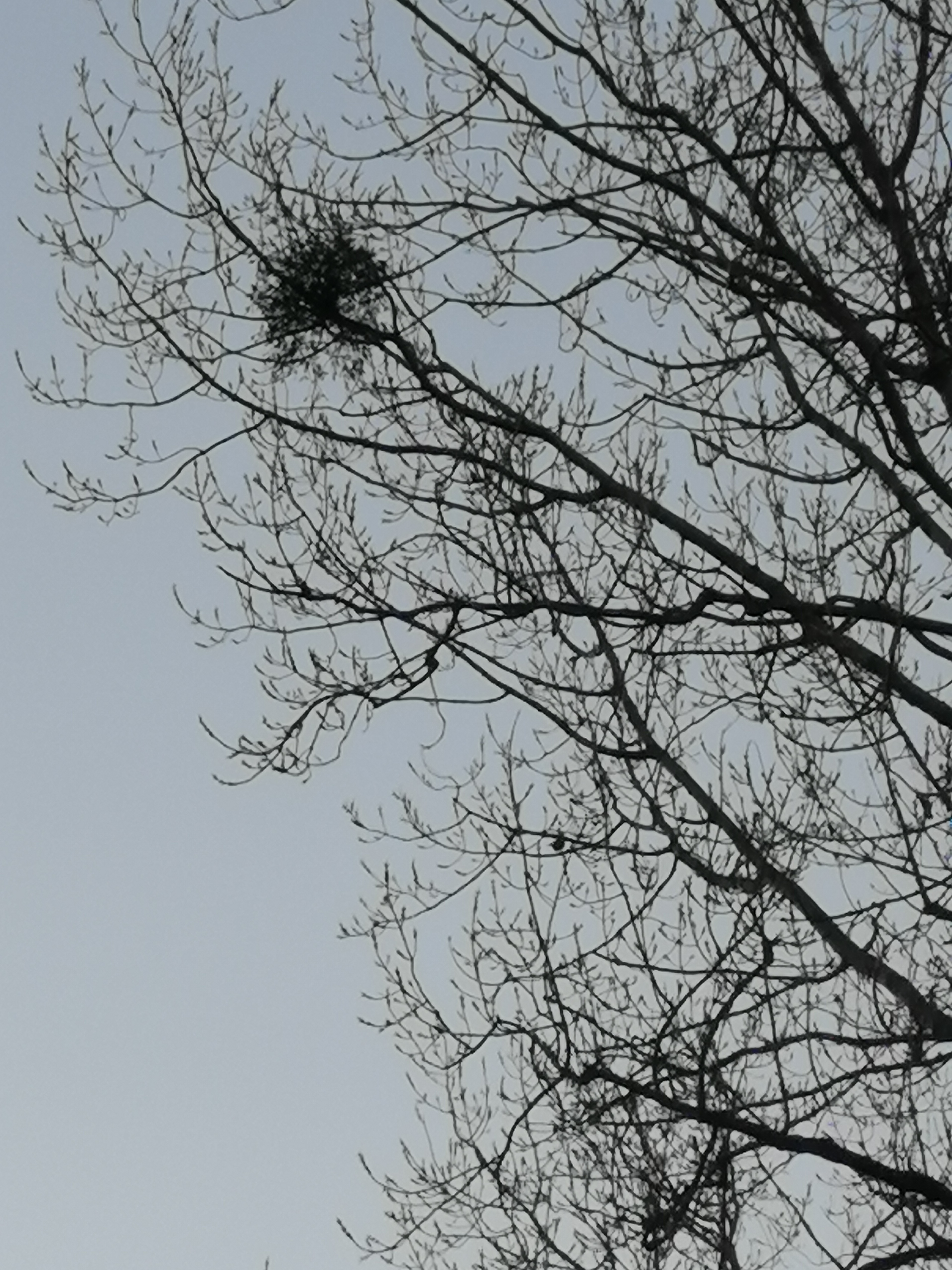
The parasitic plant has long been in evidence in the National Botanic Gardens in Dublin and to a lesser extent in the adjacent Glasnevin Cemetery and I wondered at times why it (along with the grey squirrels) did not make its way into Griffiths Park, only minutes away on foot and connected by the Tolka River. However, walking through that park the other day, I did indeed spy the tell-tale clump high up in a tree.

One of two clumps of mistletoe on a poplar tree in Griffiths Park in January 2022 (Photo: D.Breatnach)

So it is spreading.

End.

Footnotes

1According to the Wildflowers of Ireland website.

2From Proto-Celtic Toranos (note “torann”, Irish for “noise” and the word “tone” in English).

3While having humans killed in the arena in large-scale displays for mass entertainment!

4One of the many methods of seed dispersal and why plants produce seeds inside edible packages such as fruit.

5Wikipedia

6Ibid

7While the Wikipedia entry on the bird states that it eats mistletoe berries along with those of ivy and yew (all poisonous to humans), the Birdwatch Ireland web page states only that it eats berries in winter, without specifying which ones.

References

https://en.wikipedia.org/wiki/Mistletoe

http://www.wildflowersofireland.net/plant_detail.php?id_flower=641&wildflower=Mistletoe

https://birdwatchireland.ie/birds/mistle-thrush/

https://en.wikipedia.org/wiki/Mistle_thrush

1According to the Wildflowers of Ireland website.

2From Proto-Celtic Toranos (note “torann”, Irish for “noise” and the word “tone” in English).

3While having humans killed in the arena in large-scale displays for mass entertainment!

4One of the many methods of seed dispersal and why plants produce seeds inside edible packages such as fruit.

5Wikipedia

6Ibid

7While the Wikipedia entry on the bird states that it eats mistletoe berries along with those of ivy and yew (all poisonous to humans), the Birdwatch Ireland web page states only that it eats berries in winter, without specifying which ones.

THE UNDERWATER BALLET DANCER

Diarmuid Breatnach

The first time I saw a live octopus, we were both underwater and I will never forget it.

On a holiday in the Balearic Islands I had booked a sub-aqua dive with one of those diving schools one finds in those kinds of places. After safety instruction on the sub-aqua gear and rules of conduct, I went out in a boat with another novice and the instructor. It was only my second dive and I was very nervous; the first had been terrifying at first and some echo of that remained.

Once down below and looking at the plants, fish and other life down there, I forgot about my fear and, dallying, began to lag behind the other novice, who was swimming close to the instructor ahead. Then I passed a black rock from which a golden eye looked at me.

Stopping in amazement, I saw that it was indeed an eye. And the black “rock” resolved itself into a dark octopus, draped over a dark rock. It looked at me and I back at it. With its body less than the size of a football, I was startled but not at all frightened. After a few seconds I shot off fast after the instructor, to bring him back and show him.

Almost as bad as the initial fear of going down, I had found the frustration of being unable to speak underwater. But I quickly managed to convey that there was something of interest back there and that I wished him to come and look. When they both swam back to the rock, I showed them the octopus, which had remained in place.

Wait. Watch this, the instructor signalled and gently pulled the animal away from its resting place. Knowing something about the power of its tentacles and suckers, I did wonder briefly how he had accomplished this. But a few seconds later I was enthralled and so was the other novice.

The instructor began to lob the animal gently from one outstretched hand to another, guiding it in a ballet through the water, the tentacles now flaring open like a flower, then trailing behind like a mane. The octopus appeared to be more than enduring the experience passively – it seemed to be cooperating. We were spellbound.

After I don’t know how long, the octopus decided it wished to leave the dance and, finding itself still being tossed by its ballet partner, released a plume of ink and departed.

The instructor, clearly pleased, looked at us, we at him and at one another. The inability to speak, to express the wonder at what we had seen, was for me intense.

(Image sourced: Internet)

I don’t remember now much more about that dive. I have learned a lot more about octopuses over the years. Their group is called cephalopods and there are around 300 different known species of octopus in the world, inhabiting all seas. They display behaviour associated with intelligence, can distinguish between some different humans and learn some skills quite quickly (watch videos of them unscrewing the lid off a glass jar to get at the crab inside or see the My Octopus Teacher documentary on netflix).

Wikipedia tells me that the species vary in adult size from “The giant Pacific Octopus (Enteroctopus dofleini) (which) is often cited as the largest known octopus species. Adults usually weigh around 15kg (33lb), with an arm span of up to 4.3m (14ft). The largest specimen of this species to be scientifically documented was an animal with a live mass of 71kg (156.5lb). Much larger sizes have been claimed for the giant Pacific octopus: one specimen was recorded as 272kg (600lb) with an arm span of 9m (30ft). A carcass of the seven-arm octopus, Haliphron atlanticus, weighed 61kg (134lb) and was estimated to have had a live mass of 75kg (165lb). The smallest species is Octopus wolfi, which is around 2.5cm (1in) and weighs less than 1g (0.035oz).

(Image sourced: Internet)

Many of the species are highly-appreciated items in the seafood cuisine of many countries on all the inhabited continents of the Earth.

But I have never been able to eat octopus since watching that underwater ballet.

End.

CLIMBING EVERY TREE IN KIMMAGE

Artist Eoin Mac Lochlainn goes looking of oak galls (“oak apples”) to make the brown ink used by the Irish monastic scribes.

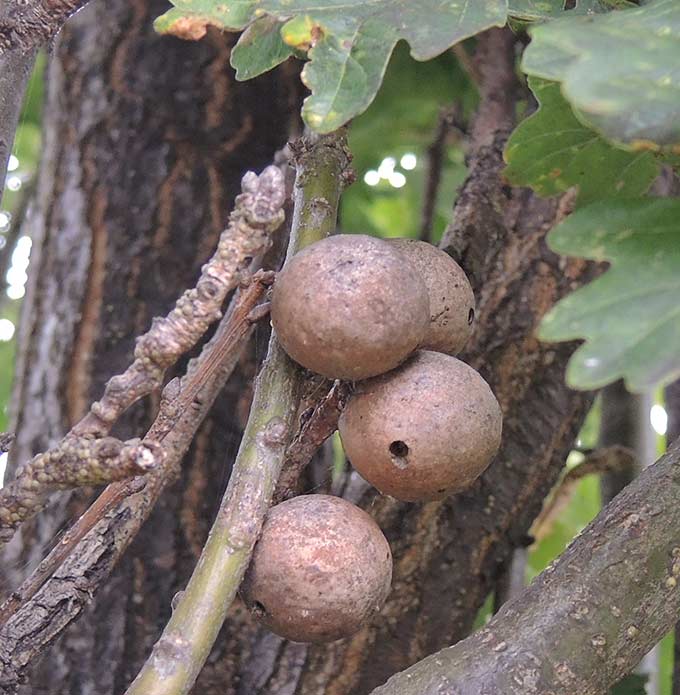
photo by eoin mac lochlainn of oak galls in harold's cross

Sometimes it’s right there under you nose but you don’t see it.  I’ve been looking all over for oak galls this last while, oak galls for making ink but no, any oak tree that I checked, I couldn’t find a single one. Until yesterday – and believe it or not, I found them here on the street where I live.

The dark brown ink used in the Book of Kells was made from oak galls. The monks used this ink in the 9th Century and it is still as clear and dark today as it ever was – so I thought to myself:  I could use some of that!

Page from Book of Kells showing brown ink.

These galls form on the branches of oak trees when a Cynipid wasp lays its eggs there.  The tree responds by forming a woody shell around the egg but inside, the larva continues to develop. If you see a little hole in the gall (like in the one above), you know that by now, the occupant has grown up and flown away – leaving the little gall behind for scribes (and artists like me) to collect and use to make pigment.

One recipe I found says that, along with the oak galls, you need rainwater, gum Arabic, some vitriol and 3 table-spoons of red wine.  I’m not sure about the vitriol, I try to avoid the internet trolls but everything else seems manageable.  I’ll let you know how I get on.

PS:  someone suggested since that ‘vitriol’ might be the medieval term for iron sulphate

The Wall of us All

Words and photos by Diarmuid Breatnach

This is a section of a limestone wall. You can see that it is composed of limestone blocks.

Small section and detail of a limestone wall

Each block is roughly rectangular but of different sizes, shades and colour.

Section of limestone wall in shade.

All of the blocks in different shades and sizes and types go to make the wall.

A different section of the same wall in strong sunlight.

It takes all of them together to make the wall; if put together well, the wall stands for centuries against all kinds of weather.

End.

FLAUNTING FLOWERS – AND FLIERS, SAILORS AND HITCHHIKERS

Diarmuid Breatnach

(Reading time: 3 mins)

          In a couple of previous posts I remarked that plants have developed amazing innovations in order to grow, adapt to conditions, colonise strange ground and to propagate their species. I commented also that their variety of methods outnumbered those of our section of life on Earth, the animals; this month of June is a good time to see some of them at work.

Along with all their other innovations, plants evolved some very impressive ones in procreation and in dispersing the next generation. Pollen, a fine powdery substance that is the equivalent of mammal sperm could be and was spread by the wind and plants developed early “flowers” like grass “heads” or catkins to catch the passing pollen. The development of the flower and blossom brought in a partnership with animal pollinators to greater efficiency. Attracted by nectar and to some extent pollen, insects and some birds visited male plants flaunting their flowers and unconsciously picked up pollen which they deposited at another flower they visited, thereby soon fertilising the female counterparts. And the plants developed different ways of dispersing their offspring too.

Flowering plants, angiosperms, are now the overwhelming majority of plant type on Earth not only in variety but in total bio-mass – but they are latecomers in the evolution of plants. Once arrived, in order to attract pollinators, flowers produced nectar and were developed in a huge variety of shapes (some we would not even normally describe as flowers) and colour.

Probably smell came later. Some botanists speculate that scent was first used by some plants to discourage insects and grazers which, if true, is amazing enough. To then go on to develop scent to attract pollinators is a leap that staggers the imagination. Flowers and blossoms using smell are particularly noticeable at dusk and night, a time of low visibility for flowers, when presumably they are visited by moths.

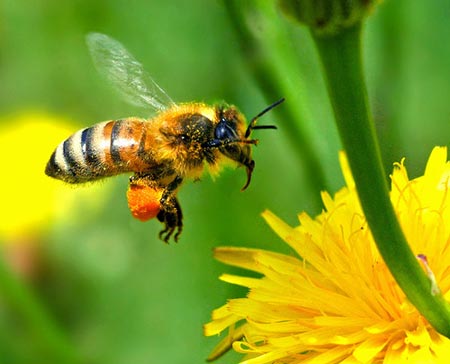
A hive honey-been, one of the most common pollinators, approaching a flower (perhaps a dandelion’s) intending to collect nectar and perhaps pollen but will certainly collect the latter inadvertently. Note the collection bag on its legs. (Photo source: Internet)

Early plants did not have seeds or flowers (some still don’t) so the whole paraphernalia around them had to be developed from other existing parts with originally completely different functions, an impressive feat of adaptive engineering (some of us could convert a bicycle, a machine for locomotion, into an electric power generator but still ….).

The petal seems to have been the key development which spurred huge flower diversity to outcompete others in attracting pollinators and it is known now that some carry identifying patterns in ultraviolet, invisible to us but advertising like neon lights to bees. Some, like the dandelion, group many single-petal florets together to make what appears to us as one flower, each floret capable of individual survival.

USING OTHERS TO SPREAD THE SPECIES

Just behind the flowers of many species is a little node which when fertilised begins to swell and form a fruit, with the developing seeds inside — or single seed in the case of some species, the Prunus plum family, for example. This is another amazing trick of the plant – it has produced attractive fruits, full of sugars when ripe, to attract animals (such as ourselves) to pick them and either discard the seeds as we eat the fruit or pass them through our gut to be deposited on earth — along with a handy dollop of manure.

On the grassy plains of the South American Pampas there are isolated copses of trees whose occurrence seems mysterious. An investigating botanist concluded that horses were eating the nuts of the parent trees some distance away then, as they travelled across the plains, at some point defecated with some intact nuts among their faeces resulting in some years later – a grove of trees. Of course horses (or their riders) might also seek the groves out for shade and, while there, drop a few more nuts. Horses have only been in the Pampas for a few centuries and probably the other local grazers are not overly-fond of saplings (or not of those tree species).

Nuts and seeds are also stored in different caches by some mammals and birds, for example here in Ireland by squirrels and magpies. They don’t always dig up all the stores later – perhaps they forget where some of them are – and in the spring, those nuts become saplings.

Well enough. But producing fruit and nuts is a lot of work and depends on the assistance of animals, especially mammals and birds, for dispersal.

WIND-SAILERS AND BOMBARDIERS

Immature lime tree seeds with their “kite”, Drumcondra roadside, June 2021. (Photo: D.Breatnach)
Seed-carrying parachute downy ball of the Meadow Salsify (I’m guessing) Dublin Botanic Gardens, June 2021. (Photo: D.Breatnach)

Some plants scorn to use animal helpers to disperse their young and instead employ the wind. Dandelions, thistles and many other plants send their seeds off on downy parachutes, often to land kilometres away. And some of those wind-sailers are tiny seeds of very large trees, like poplars and cottonwoods, using cotton tufts to carry their offspring off into the world, which is happening right now in June in Ireland. Some, like the sycamore, grow “wings” on their seeds which, when dry in the autumn and winter, spin away on the wind; not only that but when they strike mud they are sometimes twisted by the wind on their “wing” to ‘screw’ the seed into the soil.

The catkins of a poplar in June 2021 on Tolka banks as the river flows through Griffiths Park, north Dublin city; tufts of cotton carrying tiny seeds float away this time of year. (Photo: D.Breatnach)

Many plants with pods, for example the legumes, will have their pods crack open when dry to “spill the beans” upon the soil, or some might shake loose and fall as the rest are eaten by birds and mammals. That is all a bit pedestrian for the gorse or furze, the pods of which explode on a summer’s day, shooting the seeds away. One such afternoon I sat among gorse bushes on Killiney Hill and was startled to hear what sounded like a weak pistol shot. Then another …. and another …. and all around me the bushes were shooting out their seeds, the lucky ones to create new bushlets (yes, I did just make up that word) the following year.

HITCHHIKERS

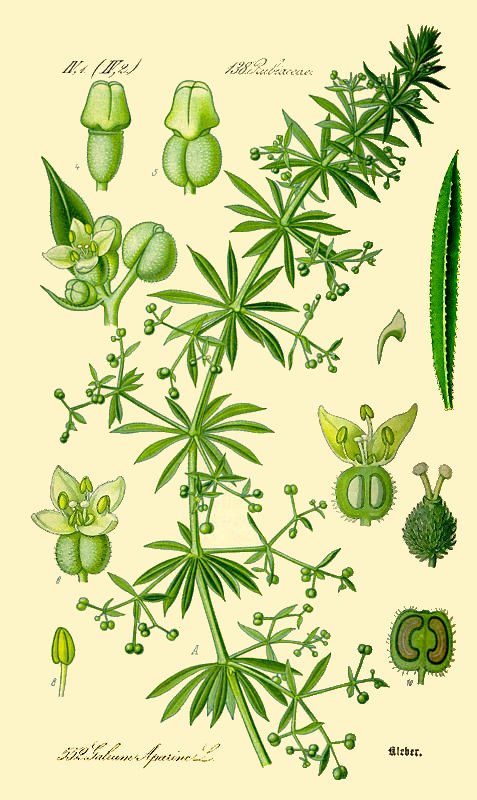
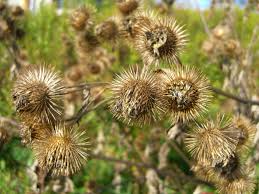
With fruit and nuts we saw plant offspring being cached or stowing away inside birds and mammals. But some hitch-hike on the outside too, like the burs that work their way into animal fur and into our woollen clothing. These are seed cases covered in tiny hooks, said to have been the inspiration for the invention of velcro fastenings in fabrics. The cleaver or “sticky-back” may attach many of its small burs to a passing mammal, while the burdock, with its much larger burs, is more likely to hitch a ride in ones or twos. Tiny seeds of many grasses stick to wool, fur and hair too, especially when damp, as we learn when we walk through meadows in late summer or autumn. But many other grasses with larger seeds, including cereals, grow “ears” with spikes attached to each seed and these too, when dry and ready to go, get picked up by the wool or fur of passing traffic.

All aspects of the Cleaver plant (“Stickyback”), another hitchhiker for its seeds. (Photo source: Wikipedia)
Hitchhiker seeds — the ‘fruits’ of the burdock after flowering become a bur to attach to passing traffic. (Photo source: Internet)

At some point in the future, these clingers will be brushed off or fall away, ready to sprout, if conditions favour them, in their new home.

Even the hot winds of forest fires are used by some conifers (which are of the non-flowering gymnosperms) to spread seeds from inside their cones – each seed has a little vane around it to help it sail the wind. Sure, many will burn before they sail or blow into another fire – but some will survive. The alternative is just to burn.

SURFERS

The coconut, on the other hand, floats its fruit to distant shores – it was not for tourist brochures that the palms grew fringing tropical beaches. Falling coconuts roll away from the tree too – if they don’t hit some unfortunate large animal first (bouncing and rolling of heavier seeds, though not normally described as a seed dispersal method, clearly plays a role).

Many other plants use floods to populate different areas, often creating stronger banks or islands as their offspring grow, sometimes even changing the very course of a river or stream. The various willows and alders are adepts at this, as are many kinds of reeds and rushes.

UNDERGROUND EXPANSION

Floating colonisation is carried out by some seeds but there are other surfing colonisers too: severed branches or leaves that grow roots into water, uprooted saplings, tubers and bulbs. Bulbs, rhizomes and strings of tubers have been used by many plants to store food for offspring, nascent new plants hiding below or on the ground. Even when a field of potatoes is harvested, there are often tiny potatoes remaining that escaped the harvesting procedure – the following year, they may be seen, sprouting new plants.

An unusually solitary Yellow Flag Iris on Tolka banks as it flows through Griffiths Park, north Dublin city in June 2021 (they can be seen in clumps along the nearby Royal Canal). The Yellow Flag uses both seeds — fertilised by pollinators in the flower — and underground rhizomes to propagate the species. (Photo: D.Breatnach)

RUNNERS

A somewhat similar method to strings of tubers – and possibly their actual origin – is the underground runner, like a root running just below and parallel to the surface, sending out shoots upwards and roots downwards at intervals, each of those becoming a new plant, a clone. Many grasses employ this procedure, some bunching close like the bamboo and others spreading away in different directions, as for example with the couch or scutch grass. The latter may be to the despair of the gardener, who however will use strawberry overground runners to grow new fruiting plants.

Grasses are an evolutionary late and special kind of plant that can be grazed down to ground level and grow again, year after year and as we saw earlier, wind and hitchhiking are their special seed dispersers. Grass provided a renewable food source for animals that could convert its leaves, stems and seeds into sufficient energy – enter herds of goat and sheep, horse, donkey, zebra, deer, antelope, bison and cattle! And therefore enter their predators too, in particular the big cats, canines and – homo sapiens.

She in turn would domesticate some of those species, including another predator as helper, the canine. That combination would change the world quite significantly and when homo sapiens learned to cultivate some of the grasses for their seeds, i.e cereals, well ……!

Some plants are capable of employing all of the various methods of reproduction and distribution: seed, tuber, branch or leaf regeneration. Plants are the innovators par excellence of visible life on Earth.

Some plants are capable of employing all of the various methods of reproduction and distribution: seed, tuber, branch or leaf regeneration. Plants are the innovators par excellence of visible life on Earth.

End.

Stray immature barley (maybe) seed heads, Drumcondra roadside, June 2021. Cereals such as these use hitchhiking inside grazers as well as hitchhiking by snagging passing wool and fur with spikes on the “ears” (Photo: D.Breatnach)

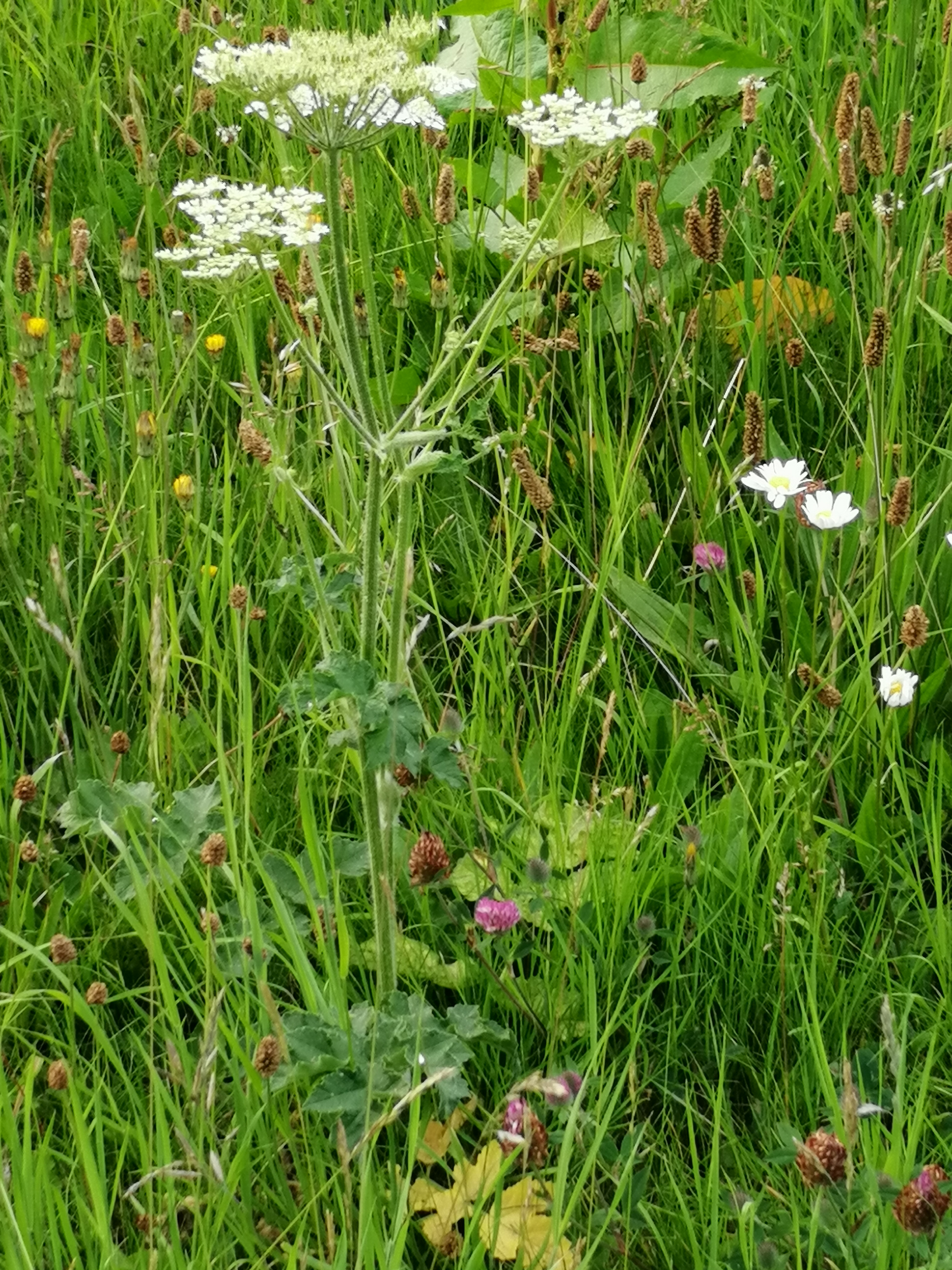
A mixed group of seed-spreaders: wind parachutes (dandelion or salsify maybe), pod-rupture (red clover), hitchhikers and wind-sailers (grasses), (scatter by movement and wind) broad-leaf plantain and one of the umbellifers, probably cow parsley (by the leaves). Drumcondra uncultivated garden, June 2021. (Photo: D.Breatnach)

SOURCES

Flower production:http://www.bbc.com/earth/story/20141017-how-flowers-conquered-the-world

https://en.wikipedia.org/wiki/Flowering_plant#Reproduction

https://www.nationalgeographic.com/science/article/big-bloom

Pollination by bees and what they see: https://www.beeculture.com/bees-see-matters/

Seed dispersal methods: https://www.sciencelearn.org.nz/resources/103-seed-dispersal

https://www.britannica.com/list/falling-far-from-the-tree-7-brilliant-ways-seeds-and-fruits-are-dispersed

Identification: https://www.teagasc.ie/media/website/crops/horticulture/vegetables/Illustrated_Guide_to_Horticultural_Weeds_2020.pdf