(From Rebel Breeze August 2023, after a similar period of days of practically incessant rain)
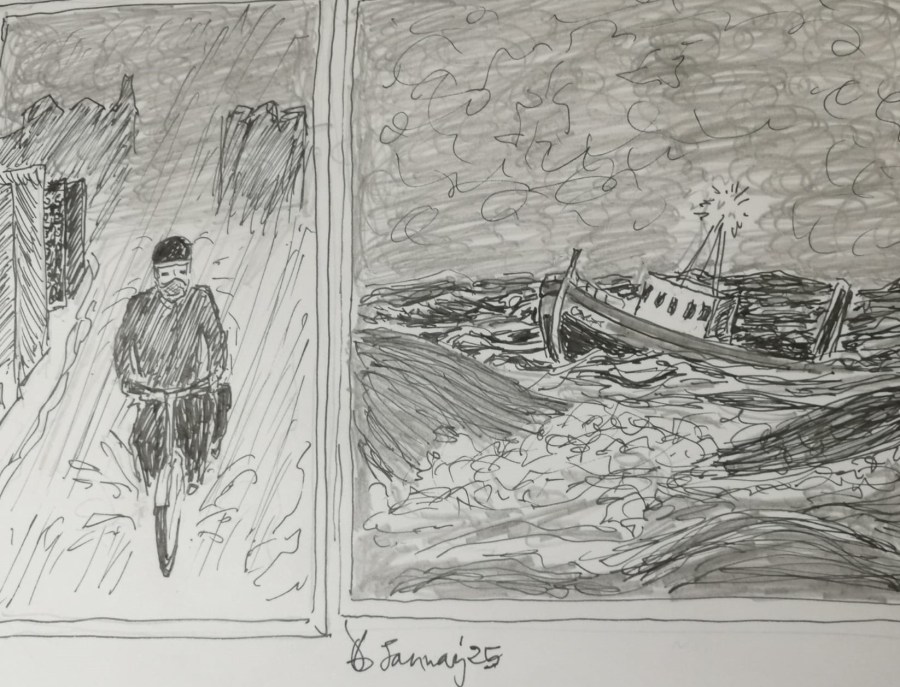
I slowed the car as we went to pass the Lotts but kept the engine running – the water was a foot high in the street and I didn’t want to have trouble starting it again.
What the jayzus are they building? asked Noah Parker (you can guess his nickname, though to be fair, his nose was hardly noticeable).
He was only voicing what was a general question in the neighbourhood. The Lotts, and I say the Lotts, because this was the acknowledged main branch of the clan here in Dublin, the other two being known respectively as the South Lotts and the North Lotts, were always a bit strange and secretive. And it’s not easy to combine those two qualities.
Strange but hard workers, all of them in one of the trades: carpenters, welders, electricians … Mrs. Lotts being the exception, into animal management. She had a nickname in the area from an idiosyncrasy of hers, of regularly glancing over her shoulder. ‘Backlook’ it was, though never mentioned in front of any of her brood, for self-preservation reasons.
Around their yard and their house there were cages, pens and runs for rabbits, chickens, geese and ducks but there was also an owl box on a tree, a pair of gaudy parrots flew around the house when it wasn’t raining, two llamas stared disconsolately from their pen at the rain and from somewhere a donkey brayed.
Holy Mother of God said, said Parker, will ya look at that giant rat?
It’s a coypu, replied Mary, who never took exception to the invocation of her namesake. They’re from South America.
Another one appeared and they began to run around one another playfully in the rain. Until one caught the other, climbed on top of it and began to … I blushed and looked in the rearview mirror, caught Mary’s stony glance and looked away hurriedly.
As well as all the animals, the yard was full of materials, sheets of metal and wood, planks, plastic sheeting and tarpaulin covering whatever the Lotts were building. I thought the shape was familiar in some way but couldn’t quite grasp what it was.
Stop the car a minute, will ya? said Parker, bringing down the window on his side. I tapped the brakes but kept the engine running.
You’re letting the rain in, complained Mary. He was too, but then he leaned the top half of his body out the window and, heedless of the rain on his head and shoulders, hailed the Lotts – or at least one of them.
Hey, Job, a fine soft day, wha’? called Parker.
Job Lott, trudging across their yard with some kind of machinery or tool clutched to his chest, his broad shoulder hunched, turned.
Ah, Noahsey, how’s it goin’? Then, peering into the car and nodding: Mary, Racker.
We nodded back.
What’re ya buildin’? Looks like a bloody big boat, Parker again, with a laugh and … something fell into place in my brain.
Job stopped dead, as if he’d been struck or walked into an invisible wall.
A moment stretched. The rain fell, a donkey brayed, parrots squawked.
Mister Lott – nobody called him anything but ‘Mister’ since he’d been a magistrate – hurried out with his wife from underneath a huge tarpaulin, put his big hand on his son’s shoulders and pushed him forward.
Sorry lads, we’re really busy right now, he called back over his shoulder. Job was glancing back at us as the three of them disappeared under the tarpaulin.
Parker pulled his wet torso back into the car and sent the window closed. We were silent in the car for a moment, the rain drumming on the roof and running down the windows, the engine idling.
Weird, commented Parker, unusually at a loss for words.
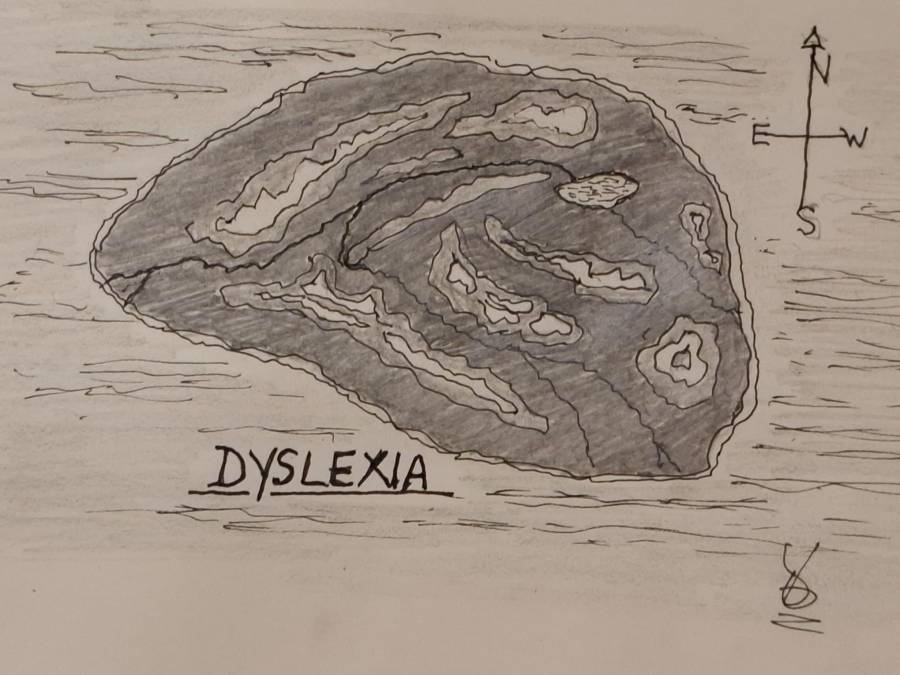
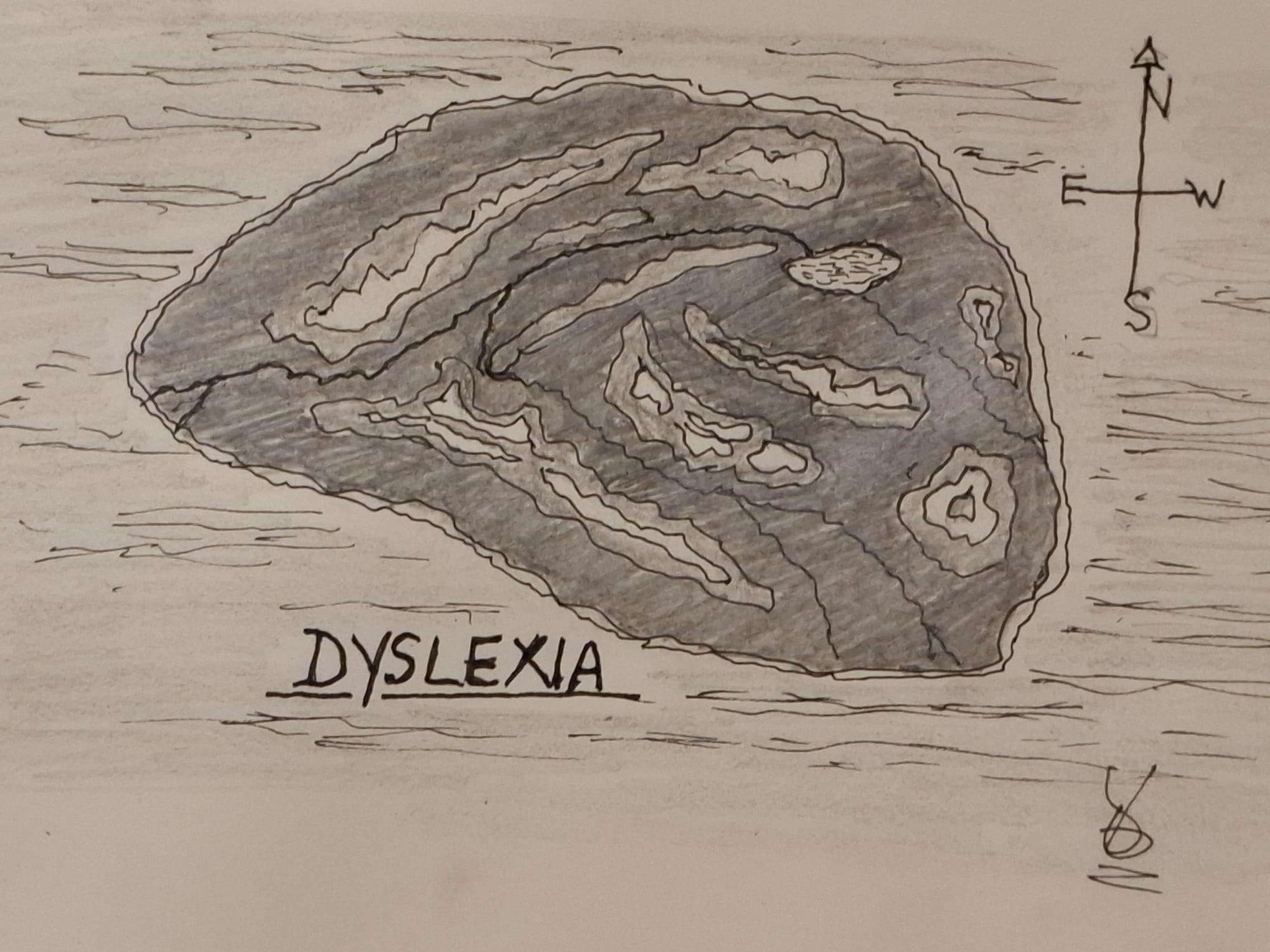
(The author is known as a traveller to many exotic places, including expeditions in search of mythical lands, most famously “The United Kingdom”, the “Republic”, “Norn Ireland” and “The Mainland.” Here he writes about the land of Dyslexia).
Dyslexia is, as the suffix “-ia” suggests, a country …. think of India, Mongolia, Russia, California [now relegated to a vassal state], Hibernia [also something of a vassal state], Narnia [er .. no, that is an imaginary land in a series of children’s tales].
Strangely the existence of Dyslexia was not even suspected until 1881, when Oslawd Khanber1 claimed to have visited the land. His discovery was widely doubted until confirmed by Ludorf Linber2 in 1887.
The people of this newly-discovered land were distinguished by all having a difficulty to varying degrees in spelling and/or in remembering sequences of numbers.
Khanber and Linber both named this land (and the rest of the world agreed) “Dyslexia”, from the Greek root “dys” meaning “bad/ abnormal/ difficult” and “lex” meaning “word” (although in Latin it means “law”, understood as “written word”).
Dyslexia was, like many other lands and people, not named by the natives themselves, but by people from elsewhere. Such examples abound, for example “Australia”, “America”, “Scotland”, “Eskimo”, “Teddy Boys”, “Pagans”, “Celts”, “Saxons”, “Teagues”, “Gypsies”, “E.T.s” etc.
Attempts to identify what the Dyslexics themselves called their land have so far collapsed in confusion, with different spellings and even pronunciations hotly argued for against others.
In fact, there have been accusations of racism aimed at those who named the land “Dyslexia” and the people “Dyslexics” — it seems particularly cruel to create a word itself so difficult to spell to name a people with a known disability in spelling.
Previously, Dyslexics just called themselves “people” and the land “the land”, while those who came across migrants from there before Dyslexia was actually discovered called them other names: such as “stupid”, “slow”, “thick” or “people with ADD or ADHD”.3
However, most “Dyslexics” today have not only adopted the name and learned to spell it but are wont to proudly declare “I’m Dyslexic” (but rarely “I am a Dyslexic”).
When Dyslexia came to the attention of the rest of the World no-one seemed astonished that it should be discovered long after the North and South Poles, the Mariana Trench, the Matto Grosso Plateau and indeed a great number of planets.
What did astonish the World was that Dyslexia had apparently independently within its borders invented television, radio, Ipads, microwave ovens, central heating and hot showers and of course the internal combustion engine and nuclear power.
This proliferation of technology would have been normally amazing (if anything normal can be said to be amazing, or vice versa) in a previously undiscovered country.
But what was really, really amazing was that everyone in Dyslexia had overcome a disability to climb to such industrial heights. The obstacles must have been tremendous.
Imagine confusing, for example, sodium chloride, a common table salt, with sodium chlorate, which is used as a weedkiller.
Also by the way, as an ingredient in making home-made bombs, a curious fact since nitrogenous fertiliser, with a directly opposite effect to sodium chlorate when spread on weeds, is also sometimes used in making home-made bombs).
Anyway, shake sodium chloride in small quantities on your weeds and they probably won’t like it but most will survive – especially those that actually like a little of it, like relatives of the cabbages and such. Shake a little sodium chlorate on your food, however and ….
well …. no, don’t try it – without urgent and skilled medical attention you will die quickly and painfully.
For another example, imagine confusing “defuse” with “diffuse”: one goes to de-escalate a conflict and ends up spreading it around. Other confusions are possible between the noun or verb “ware”, the (usually) adverb “where” and the past tense verb “were”. And so on.
For physics, knowledge of and accuracy in mathematics is essential – algebra, logarithms, binary codes, sines and co-sines, square roots (these last are mathematical constructs, not mythical regulated-shape carrots as propagated by anti-EU campaigners).
In calculating distances, heights and depths, spaces and circumferences, ability in geometry, trigonometry and ordinary mathematics is required. Somehow, the Dyslexics, the inhabitants of Dyslexia, had overcome their disability or compensated for it in some way.
They had developed as flourishing and environment-poisoning an industrial society as the most developed parts of the world, such as the United States of America (most developed industrially, that is).
Dyslexics are said, despite this disability with letters and numbers, to be of above-average intelligence. They had to be, to develop all those complicated benefits of industrial society despite their handicap.
Strangely, one may think, many Dyslexics have become literary figures famous throughout the world, Hans Christian Andersen, Agatha Christie, F. Scott Fitzgerald and WB Yeats among them. Contrary to popular belief among non-natives, James Joyce was not from Dyslexia.
This prevalence of Dyslexics among so many giants of literature and indeed of virtually every other field of human endeavour has given rise to a group of Dyslexians who call their disability “the gift of Dyslexia”.
The Dyslexics are often garrulous and sociable and this is especially true when in Dyslexia itself. The difficulty in remembering telephone numbers for example makes every telephone call an adventure.
Say a native wished to phone another native called Cathy (also known as Cthy, or Ktay, Thyca etc), and the phone number was 731 1062 (pleasenote, this is an imaginary telephone number by which neither Cathy nor anyone else can be reached).
The Dyslexic might phone 371 1026 – all the correct digits but in a different order (note, this also is an imaginary telephone number by which no-one may be reached).
The conversation, somewhat simplified, might go like this:
“Yes, hello?” (female voice, breathless with anticipation of another adventure).
Our caller: “Hi, is that Cathy?”
Recipient (giggling): “No, it’s not. There isn’t any Cathy here. I’m Wanda.”
Our caller: “Oh, hi Wanda, you sound very nice. How about going on a wanda with me?”
Wanda (with a little giggle but playing cautious): “Maybe …. What’s your name?”
Our caller: “Terry.”
Wanda: “Where were you thinking of wandering with me?” (A moment’s pause while both mentally translate the last part of that into “wandering on me”).
Terry (clearing his throat which has suddenly gone dry): “Well, there’s a nice new Indian restaurant opened up in town. Do you like Indian food, Wanda?”
“Ohhh, Terry, I love it. So spicy!” (Very slight pause as both translate “spicy” as a description for food flavouring into a metaphor instead). “When were you thinking of?”
“Er … tonight too soon?”
“No, I happen to be free tonight.”
“Shall I come and pick you up? Say …. seven pm?”
“That would be lovely, Terry. I live off the Trans City Road, tenth left, first right, eighth left, in Hopeful Street, the seventh house on the left-hand side if you’re coming from town, with a brown and white door and a hydrangea bush in the garden.”
“Got it – off the Trans City Road, tenth left, first right, eighth left, Hopeful Street, seventh house on the left-hand side, brown and white door and a hydrangea bush in the garden. At seven pm. I’m looking forward to meeting you.”
Most Dyslexics are always open to adventure, ‘going with the flow’. One never knows what a simple telephone call may bring or to what an appointment or written address may lead.
But as a result, Dyslexics are also philosophic about missed appointments, forgotten birthdays and so on; they waste little time mourning something lost and instead look forward to something gained.
Terry might or might not make it to Wanda’s but they both know the world is full of other possibilities.
Cathy, for example, who failed to receive a call from Terry to congratulate her on her gaining a dystinction in her dyploma, received later that evening what non-natives would term “a wrong number” call from a Sofia who had meant to call a Geraldine.
Sofia had intended trying to patch up a long-running difficult relationship with Geraldine and instead found herself making the acquaintance of Cathy, who seemed much nicer and more understanding than was Geraldine.
Putting her problems with Geraldine aside, Sofia agreed to Cathy’s suggestion to meet for a late coffee (which they both knew could lead to an early drink and who-knows-what from there). Cathy had by now forgotten that she was hoping Terry would call.
Dyslexia is not just another land, nor even just a strange one – it’s an entirely different way to live.
End.
Note: If you found this article of interest, why not register with Rebel Breeze for free, so that you will be notified by email of subsequent articles. You can de-register any time you wish.
3A supposed disability the existence of which is hotly debated but has exonerated many teachers accused of bad teaching methods and states accused of having too large classes in their schools and which has been profitable for some educational psychologists and extremely so for some chemical companies.
I slowed the car as we went past the Lotts but kept the engine running – the water was a foot high in the street and I didn’t want to have trouble starting it again.
What the jayzus are they building? asked Noah Parker (you can guess his nickname, though to be fair, his nose was hardly noticeable).
He was only voicing what was a general question in the neighbourhood. The Lotts, and I say the Lotts, because this was the acknowledged main branch of the clan here in Dublin, the other two being known respectively as the South Lotts and the North Lotts, were always a bit strange and secretive. And it’s not easy to combine those two qualities.
Strange but hard workers, all of them in one of the trades: carpenters, welders, electricians … Mrs. Lotts being the exception, into animal management. She had a nickname in the area from an idiosyncrasy of hers, of regularly glancing over her shoulder. ‘Backlook’ it was, though never mentioned in front of any of her brood, for self-preservation reasons.
Around their yard and their house there were cages, pens and runs for rabbits, chickens, geese and ducks but there was also an owl box on a tree, a pair of gaudy parrots flew around the house when it wasn’t raining, two llamas stared disconsolately from their pen at the rain and from somewhere a donkey brayed.
Holy Mother of God said, said Parker, will ya look at that giant rat?
It’s a coypu, replied Mary, who never took exception to the invocation of her namesake. They’re from South America.
Another one appeared and they began to run around one another playfully in the rain. Until one caught the other, climbed on top of it and began to … I blushed and looked in the rearview mirror, caught Mary’s stony glance and looked away hurriedly.
As well as all the animals, the yard was full of materials, sheets of metal and wood, planks, plastic sheeting and tarpaulin covering whatever the Lotts were building. I thought the shape was familiar in some way but couldn’t quite grasp what it was.
Stop the car a minute, will ya? said Parker, bringing down the window on his side. I tapped the brakes but kept the engine running.
You’re letting the rain in, complained Mary. He was too, but then he leaned the top half of his body out the window and, heedless of the rain on his head and shoulders, hailed the Lotts – or at least one of them.
Hey, Job, a fine soft day, wha’? called Parker.
Job Lott, trudging across their yard with some kind of machinery or tool clutched to his chest, his broad shoulder hunched, turned.
Ah, Noahsey, how’s it goin’? Then, peering into the car and nodding: Mary, Racker.
We nodded back.
What’re ya buildin’? Looks like a bloody big boat, Parker again, with a laugh and … something fell into place in my brain.
Job stopped dead, as if he’d been struck or walked into an invisible wall.
A moment stretched. The rain fell, a donkey brayed, parrots squawked.
Mister Lott – nobody called him anything but ‘Mister’ since he’d been a magistrate – hurried out with his wife from underneath a huge tarpaulin, put his big hand on his son’s shoulders and pushed him forward.
Sorry lads, we’re really busy right now, he called back over his shoulder. Job was glancing back at us as the three of them disappeared under the tarpaulin.
Parker pulled his wet torso back into the car and sent the window closed. We were silent in the car for a moment, the rain drumming on the roof and running down the windows, the engine idling.
Weird, commented Parker, unusually at a loss for words.
I left the dentist’s feeling like my mouth was not my own. The anaesthetic lasted, as it always does with me, long beyond the work. I knew I couldn’t speak as clearly as I wished, because I had a very short conversation with the receptionist about my next appointment before I left. My tongue was having difficulty forming words and I was lisping.
The anaesthetic always takes ages to act on me and by the time it finally starts to take effect the dentist has got fed up waiting and has given me extra shots, gets through the work quickly and lets me out on to the street, one side of my face feeling like a dead football, if that makes sense, and an itch in half my lips and one ear that scratching only makes worse.
On my way home from the surgery, I called in to my local grocery shop to purchase some necessaries – I didn’t think I’d want to come out again for the rest of that day at least.
When I heard the assistant call to indicate it was my turn in the queue, I went to the counter and handed over the items. She scanned them electronically and told me how much to pay. I hardly heard her but automatically checked the electronic display.
“Two thixty-three?” I asked with difficulty, double-checkin; for some reason. I do that – don’t ask me why.
“Yeth pleeth”, she replied with that look they often have which says they kind of see you but only kind of. I looked at her sharply. Was she taking the piss?
“Thanksh,” she said, taking the five note I gave her. My eyes narrowed but she was already ringing it up in her “done this a few hundred times today, a couple of thousand a week, could do it my sleep” kind of way. Then she gave me my change, her eyes sliding over me.
“Two twenty-theven change, thank you,” she said. “Neksht!”
I stared at her but her eyes were already on the next customer, who was approaching and looking at me a little impatiently. I moved on and came to a halt near the doors.
By now I was chiding myself for being paranoid. Had I never met someone with a lisp before? Suspecting her of taking the piss? Come on! She was hardly aware of anyone except as bearers of items to ring up, give them their change, thank them, call out for the next customer. Eight hours a day with a couple of breaks. She’d have to notice someone first before she could take the piss out of them.
Shaking my head at my paranoia, I moved towards the doors, which opened automatically. Then I heard it. “That’ll be six sixty-seven please.” Clear as a bell. Then “Thank you. Next!”
Bitch! No lisp — she’d been mocking my affliction! I raged inwardly. I had a good mind to march up to her and …. say what? “Ethcuth me Mith. You were taking the pith out of me”? And how could I prove it? I’d sound like some kind of paranoid or psychopath …. or thycopath ….
Oh, fuck it! I barged out of the door, almost banging into someone coming in.
“Oh thorry!” we both said simultaneously and passed one another, each watching the other out of the corner of his eye.
The festivities were being held in a small country town, probably in a hotel hired for the event – I’m not sure. I don’t even know what they were celebrating – their GAA team’s win? But that would be weird too, because I knew they weren’t from this town or county – I could tell that from the indulgent smiles of the locals passing in the street. Yes, at one point some of the gathering were in the street – I can’t remember why.
I was peripheral to the gathering – maybe a relative by marriage, someone’s partner (though I don’t remember being with anyone) or perhaps a visitor. But I was tolerepted – that’s more than tolerated but not the same as fully accepted. When the gathering turned to calling for singers and songs and I was prevailed upon to sing (which to be honest, didn’t take much prevailing), I could almost read the thought in the air afterwards: “That Jackeen can sing, all right.” And I was asked to sing again, which of course I did — maybe more than once.
I am pretty sure I wasn’t with anyone and I remember focusing at some point on a dark-haired woman whose eyes might’ve been blue, anywhere between thirty and fifty years of age, depending on genes and life-style and health but more likely the lower age of the range – and it definitely wasn’t makeup, of which she was wearing little.
We kind of clicked and were getting on well – she seemed intelligent and there was something definitely sexy about her but understated, like a strong current running underground. We became an item for a short while, obvious to people there but I don’t remember any intimate details – only a definite intimacy.
Then the scene somehow shifted and she got excited about the offer of a part in some production in the big city. I was glad for her, although it meant I was going to see less of her.
When I saw her next, it was in the big city, she and her male counterpart were still wearing the eye-masks and head-pieces from their performances, although in a public place, which was a little weird. They were laughing a lot … she was buzzing – they both were – and turned towards one another, me little more than an observer, though sitting at the same table.
For the next scene we were back at the gathering, which seemed to have moved on but little, and some of the women were tearing into her, verbally but at one point also physically; I’m not sure what about but part of it could have been about how she had treated me. I remember she got some clothes torn off her and marched past me (I had just arrived in the hotel lobby — or was it a big mansion now? — and caught the end of the altercation) ….. Yes, marched past me, tears taking a line of mascara down her face, wearing some kind of pink leotard with strips of outer clothing hanging off her …. Some of the women were jeering: “Look at her go, the great actress!”
Minutes later she stomped back past me again, her eyes flaring, head up and jaw jutting forward, heading back towards the women. “I’ll show them! I’ll show them!”
I watched her stomp past in that ridiculous pink leotard and fluttering strips of clothing and – you know what? Despite everything – I was mentally cheering her.
A new metal-detecting system has been developed which is revolutionising security detection, prospecting and archaeology. Previous systems have depended on magnetism and have not responded well to non-ferrous metals. The new system responds to all metals and, strange as it may seem, it functions through using baked beans in tomato sauce.
An Irishman developed the detection system after discovering the principle, like many great discoveries, through accident. “I often prepare breakfast of baked beans on toast,” said Dublin man Diarmuid Breatnach. “I noticed when I tipped a tin of baked beans into the pan for heating, that some of them remained stuck inside the can, even after vigorous shaking. I began to wonder if there might not be an attraction of some sort between them and the metal.”
The Garrett Ace 150 metal detector, at the lower price range of conventional detectors, sells at €199. The new bbp (baked bean principle) detector however is currently selling at around half the price.
The idea kept going around in Breatnach’s head until he decided to test it out. “In a friend’s garage, we ran a series of tests and discovered that yes, indeed, baked beans in tomato sauce are attracted to metal. And we discovered that they worked with many different kinds of metals – steel, obviously, but also aluminium, copper, zinc, tin, silver and alloys like brass and bronze. We didn’t have any large enough surfaces of gold and platinum to test – they have to be several millimetres across to work – but we thought it would work for them too.”
The Dublin man then set about designing the machine that would employ this attraction for metal detection. Using his skills learned in a former trade of fitter-welder, he constructed the first prototype and took out a patent on it.
“I went to a small metal-ware company on the outskirts of Dublin where I knew a guy and made a deal with the owner. They produced a few models and then we went to security firms and some metal mining companies, the models worked great under test conditions and we got supply contracts.”
Now the factory, Schiessen Ltd, has expanded its workforce four hundred per cent and struggles to keep up with orders. In addition, baked bean in tomato sauce production has soared, with attendant expansion in the cultivation of haricot beans and tomatoes abroad.
What impact have these developments had on Breatnach’s life? “When I started, I was in default on my mortgage and the bank was about to seize my flat,” said the Dublin man. “Those days are gone and I’m comfortable now. But I never forget how it started and still eat beans on toast in the morning,” he says with a smile.



 rebelbreeze