
(Reading time: 6 mins.)
Gearóid Ó Loingsigh
(Reprinted from author’s substack on 01/03/2026 and reformatted for WordPress. All graphic images created or chosen by R. Breeze editor)
The English band Chumbawamba recorded a song called The Day The Nazi Died about how the Nazis never really went away.1
The song references the Nazi leader Rudolf Hess, who was not executed following WWII but was instead held a prisoner in Spandau Prison until he took his own life at the age of 93.
The song asks why when we were told that the Nazis had died did they all come out on the day Hess died and points to the boardrooms of companies as maggots getting fat on the decaying flesh of capitalist society.
The band were not wrong. Some of the Nazis and boards of companies that did not go away are now involved in the genocide in Palestine.
Goosestepping as a military parade practice has gone out of fashion in most Western countries, but stomping on the peoples of the world is very much in fashion.
Many companies such as Porsche, Mercedes, Volkswagen and even IG Farben – the manufacturers of the gas used to murder millions in the camps – went unpunished after WWII. Some companies were even compensated for the damage to their factories.
Lots of other German companies passed under the radar.
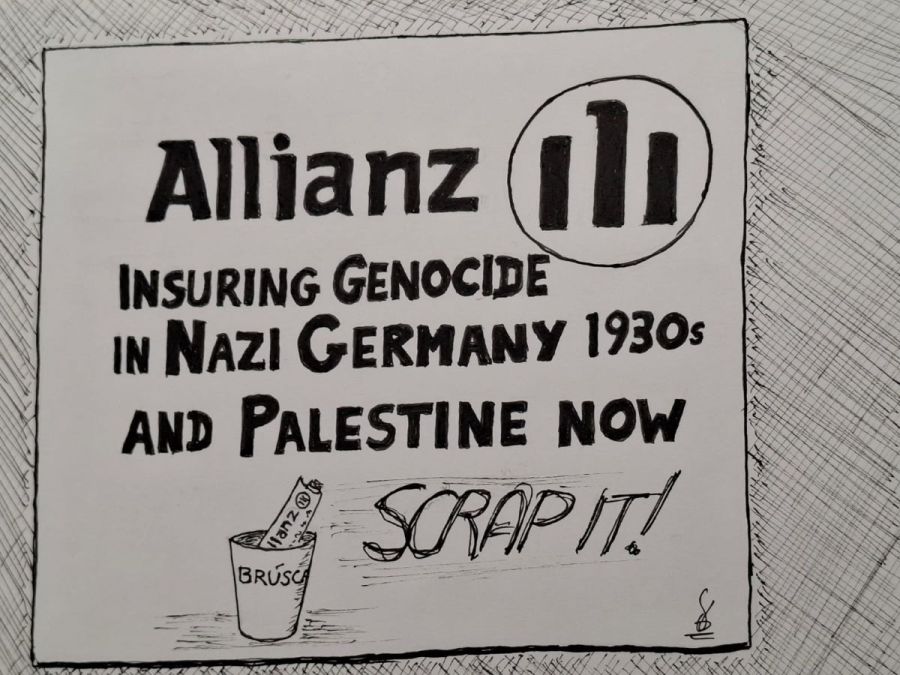
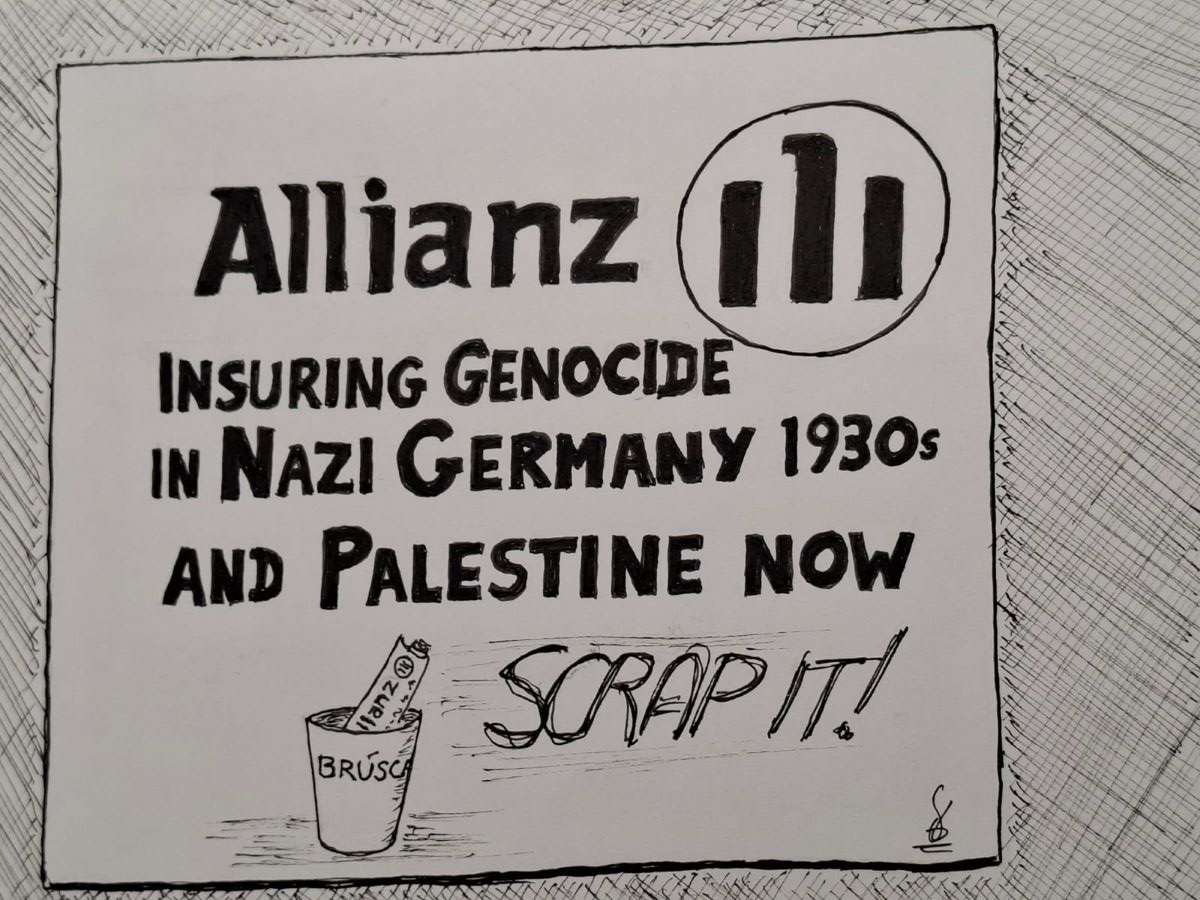
Hugo Boss was never taken to task for making the Nazis look so sexy in their murderous swagger and Allianz the German insurance company that insured parts of the camps and the ghettos against fire and damage to their installations survived intact.
Apparently, they didn’t specifically insure the ovens or gas chambers, but the camps were a whole unit. Any part insured contributed to all of it running smoothly.
Of course those who died in the gas chambers and were pushed like peat brickettes through the ovens were not covered, just the Nazi property.
Hugo Boss can make no claims to being pressured, he was a member of the Nazi party before Hitler ever took power. He wasn’t betting on which horse won the race, he was the horse in the race.
Allianz likes to present itself as just another company that did business with the Nazis in order to continue functioning and that they had no choice, Krupps makes similar claims about its use of slave labour, saying they had to.
That is a dubious claim, when you look at their history. But also morally there is no basis to it. You always have the choice, some Germans lost their lives fighting the Nazis, not losing your money is hardly an excuse.
What companies such as Allianz did is make a cost benefit analysis. They calculated that not doing business with the Nazis would affect their profits, so they insured the camps but not the people pushed through the ovens.
The company claims a certain naivety on its part about what was happening.
But you can only take that at face value if you ignore that the director general of the company the antisemite Dr Kurt Schmitt resigned his post with Allianz in 1933 to become Hitler’s first Reich Minister of Economic Affairs.
He had previously turned down the post when it was offered to him by the Von Papen government before the Nazis took over.
He had to step down for health reasons, but when he recovered he went back to Allianz to administer it. It also claims it made no money from the camps contract.
This does not mean there was no money to be made, it means it wasn’t as profitable a contract as it thought, but it managed to get other contracts from the Nazis.
If you read the company’s website you come away with the distinct impression that they would like us to think they were a victim of the Nazis and we should pity them.
It turns out because they were on the losing side and because the war didn’t go ahead as planned with Hitler steamrollering his way to Moscow, the war was not as profitable as it should have been for insurance companies.
In the following quote it is clear that 1943, following the Nazi defeat at Stalingrad, the tide turned not only in the war but in the accounts ledgers.
After Germany overran Poland in 1939, the business of the insurance sector became characterized by the risks associated with the war.
Doing business in wartime meant obeying the principle of “minimizing new dangers and taking maximum advantage of new business opportunities.”
The repercussions of the war were detrimental to business as a whole and at the end of the war, Allianz was on the brink of ruin. Even so, until 1943 the company had managed to increase its profits by a considerable margin.2
Even today the company whitewashes its record and states in glowing language that:
Kurt Schmitt’s energetic course of expansion in the 1920s had made Allianz the largest insurance company in Germany. In 1933, Schmitt became Minister of Economic Affairs in Adolf Hitler’s government.
In 1935, he resigned from this post as he was unable to implement his political ideas and his health was failing. After his recovery, he returned to Allianz and in 1938 became General Director of Munich Re.3
No, not true, the Nazi stepped down because he had a heart attack, not over disagreements about economic policy and though it is not stated, there is a sleight of hand which leaves you wondering whether he had disagreements over the treatment of Jews.
This antisemite had no such disagreements with the Nazis at all. He was well known to them before they ever took power. He knew who and what they were.
The company’s site is not that detailed about the period and there are lots of sleights of hands in how it presents information. For example, it is mentioned that the company opposed Nazi attempts to nationalise the insurance industry.
But not because they opposed the Nazis, but because it might affect their profit margins.
But not even Allianz can completely deny reality. Their site does acknowledge that it began to come clean about its role following a lawsuit in the US against insurance companies and set up a study into its activities.4
It did it, because it was forced to. Had they really been forced to insure the Nazis against their will they wouldn’t have waited till 1997 to start publicly owning up.
They commissioned Dr Feldman a Jewish historian to look at their history. He quotes Schmitt as talking about the Nazi position on Jews as explained to him by Göring that:
I must honestly say, that I had no reservations about this line, for it cannot objectively be contested that in our public and intellectual life, beginning with the Reichstag, in the press, and also in many scientific faculties, in the legal field and above all in the Berlin banking business, the Jews had too strong and too loud and also an unhealthy influence.5
Feldman goes on to say of this that:
…it is important to recognize that the responsibility for the evils that he [Schmitt] and his organization [Allianz] were to experience and perpetrate during the coming years lay to an important extent in the fact that he (and others like him) shared a political culture and an anti-Semitic posture that made the coming and installation of the Third Reich possible.6
Of Schmitt he says that:
Schmitt was rather more enthusiastic and active than his colleagues in pandering to the new order at this time.
Not only was he prominently on display at the aforementioned Hitler birthday festivities, he also catered to the “socialistic” side of the regime while playing the public defender of employer interests with the new rulers as well.7
Now we have come full circle. The people who tried to profit from the Third Reich and the camps are once again involved in a genocide, not only as an insurance company but also as a direct investor.
Allianz has invested USD 960 million in Israeli war bonds, or genocide bonds as they are more accurately known. I
n 50 years’ time, they might hire some Palestinian historian to write the history of collaboration in yet another genocide and their website might just say they had no choice but to maximise profits in line with their legal duty to their shareholders or some such rubbish.
Last time, none of the Allianz board were sent to the gallows. They all did very well out of the war and the company went on to become not just Germany’s largest insurance company but a major player in the global insurance industry.
It is as the Chumbawamba song says:
The world is riddled with maggots; the maggots are getting fat
They’re making a tasty meal of all the bosses and bureaucrats
They’re taking over the boardrooms, and they’re fat and full of pride.
This time, should we ever get a day of reckoning to cite the much abused quote from Karl Marx we should make no excuses for the terror. They should have all their assets confiscated and they should meet their end hanging from a rope.
So if you meet with these historians, I’ll tell you what to say
Tell them that the Nazis never really went away.
They’re out there burning houses down and peddling racist lies
And we’ll never rest again until every Nazi dies.
End.
Note: You may wish to read other articles by Gearóid Ó Loingsigh on his substack https://gearoidloingsigh.substack.com/
Note: If you found this article of interest, why not register with Rebel Breeze for free, so that you will be notified by email of subsequent articles. You can de-register any time you wish.
1 See https://www.youtube.com/watch?v=OLkPwxcIji0
2 See https://www.allianz.com/en/about-us/company/history/allianz-in-the-nazi-era/world-war-ii.html
3 See https://www.allianz.com/en/about-us/company/history/allianz-in-the-nazi-era/humans.html
4 See https://www.allianz.com/en/about-us/company/history/allianz-in-the-nazi-era/insurance-compensation.html#tabpar_6554_1Tab
5 Feldman, G.D (2001) Allianz and the German Insurance Business, 1933-1945. Berkley. University of California Press p.58
6 Ibid., p.59
7 Ibid., p.66
 rebelbreeze