(Reformatted entire for publishing in Rebel Breeze from article of same title in his Substack
(Reading time: 6 mins.)
The saga of the Occupied Territories Bill (OTB) has been dragging on for years now. It was first put forward by Senator Frances Black in 2018 and was approved by both houses of the Oireachtas (parliament) but never enacted.
The Irish capitalist class that is resolutely on the side of the Israelis, despite the illusions of many and the odd PR stunt, dragged its heels on the issue, even boasting that it had effectively blocked it.
Simon Coveney who was the Minister for Foreign Affairs at the time said during a visit to the Zionist state in 2019 that:
We don’t believe that it is legally sound because trade issues are EU competence as opposed to national competence in Ireland. And because we don’t believe it’s legally sound we have effectively blocked the legislation from moving through parliament as it normally would…
It’s essentially frozen in the process and it isn’t making progress. And I don’t expect that it will make progress, either, unless the government supports it, and the government won’t be supporting it.1
A demonstration outside Leinster House, parliament of the Irish State recently. (Image chosen and sourced: by RBreeze on line)
This came as no surprise to anyone paying attention. Ireland is not an independent capitalist state; it is what Marxists term a neo-colony with 88% of all corporate tax paid by foreign companies and just three companies accounting for 38% of all corporate tax.
Foreign corporate tax in turn represents 29% of the total tax take in the country.2 It is entirely dependent on the US and also the British state.
Many months prior to Coveney’s boast, the then Taoiseach (prime minister), Leo Varadkar had written a grovelling letter to Joe Biden to apologise for the behaviour of Irish politicians who had voted for the bill. In it he stated:
The Government has consistently and strongly opposed the Bill on both political and legal grounds and will continue to do so… Can I take the opportunity to reiterate my deep appreciation for the strong bonds of friendship between Ireland and the US, including our growing and mutually economic ties.3
There is no world in which the Irish state will stand up to the US. It won’t stop US planes shipping arms to Israel through Shannon Airport, just like it allowed the US to use the airport during the Iraq war.
Putting the OTB to parliament was not a bad idea, believing that is how we would achieve something concrete was.
They are now attempting to water it down further and exclude services from its remit, limiting it to only goods. (Note: at the time this article was written campaigners were still fighting an attempt to limit the bill in that way – Rebel Breeze)
IBEC (the Irish Business and Economic Confederation) came out with a statement that it would harm the Irish economy to enact the bill, whilst paradoxically accepting that trade in goods with Israeli “settlements” in the West Bank only amounted to €240,000.4
On the radio the Government reminded us that we are a trading nation, as if any of us thought that everything we buy in the country was made here and we exported nothing.
The reason they can make these statements of course, is because of the limited scope of the bill itself and the intentions of those pushing for its enactment.
The Irish government was at great pains to say that it would only apply to the territories occupied in 1967 and not to Israel itself i.e. not to the territories occupied in 1948 during the Nakba and the foundation of the Zionist state.
If you accept the legitimacy of the state of Israel or if you are one of those liberals still prattling on about a Two State Solution then all of this makes sense. It could have even been argued when it was first proposed that it was a stepping stone to a wider boycott of Israel, not that any of them said that.
For those who believe in the two-state solution (sic) the map shows what’s available for a Palestinian State (sic). (Image chosen and sourced: by RBreeze on line)
Events have overtaken our liberal friends and they shudder at the consequences. There is no longer any case to be made for a bill that limits business dealings with modern Zionist invasions of the West Bank.
Francesca Albanese in her recent report made it abundantly clear that many companies doing business with Israel are profiting from or contributing to the genocide.5 Now is not that time for half measures. Israel, just like the Nazis is carrying out a genocide.
Asking for a boycott of goods from the Warsaw Ghetto, rather than Nazi Germany would have seemed stupid at the time and actual calls for a boycott of the Nazis were portrayed as anti-German.
Some Jewish organisations opposed the boycott and the US government response to violence against German Jews was that the
U.S. Secretary of State Cordell Hull issued a mild statement to the American ambassador to Berlin complaining that “unfortunate incidents have indeed occurred and the whole world joins in regretting them.” He expressed his personal belief, however, that the reports of anti-Jewish violence were probably exaggerated.6
We know how this ended. The Nazis in the face of the timorous and timid response from the US and other western powers would eventually enclose Jews in ghettos, then camps and then push six million of them through the ovens.
Now is not the time to repeat history but to be bold and decisive. Now it is equally ridiculous to meekly petition, those who grovelled to Genocide Joe in 2019, to restrict goods from the West Bank.
In the midst of a genocide there is only one option on the table: a complete and total severance of all trade, military and diplomatic ties with Israel. There are no “settlements” without the Nazis in Tel Aviv, without the Israeli military, without the companies that keep Israel going.
A Banner on the IPSC National March 19th April 2025 in Dublin, appearing to show a believed organic connection between the enacting of the OTB and ending the Zionist genocide in Palestine. (Image sourced and chosen: R.Breeze)
Total isolation of the entire regime is needed. Not an orange, not a single electronic component, not a kilobyte of software. Such isolation should continue not just till the acts of genocide have ceased.
They will cease when the repugnant reality that Israel has run out of Palestinians to murder comes to pass.
Israel should be isolated until all those involved have been tried, had all their assets confiscated, given lengthy prison sentences or hung until dead, depending on the actual degree of participation.
This is not an outrageous proposal, it is what was theoretically done at Nuremberg, though many of the businessmen were given back their assets after a number of years and only a handful of Nazis got the actual death penalty and most never saw the inside of a jail.
No such leniency should be shown to the Zionists.
Those campaigning on the OTB will never make such a call. They will continue to petition the government. They do have another weapon to hand in fighting the Nazis in Tel Aviv, but they won’t call for that either.
The Irish Council of Trade Unions denounced the government’s handling of the OTB and called on the Oireachtas to reject the “business lobby scaremongering” and to pass the OTB.7
Of course, the unions don’t need to persuade the Zionists who dominate the coalition parties, they could just have told their members in 2018 to refuse to handle all products coming from the Occupied Territories, or indeed the entire Zionist state and that would have settled it.
They would have to organise that and back all their members who engaged in such boycotts. But under no circumstances will the fat cat bureaucrats ever confront the government over this issue.
If they are not prepared to fight for decent wages, a proper health system, public housing etc, all of which directly affect their members, less still will they fight for Palestinians. They are traitors to their class and also betrayers of the Palestinian people, despite all their lofty statements.
The OTB was a nice propaganda measure whose time has passed. It is, in the midst of a genocide, no longer fit for purpose, neither is a solidarity movement which limits itself to half measures. We need to be bolder.
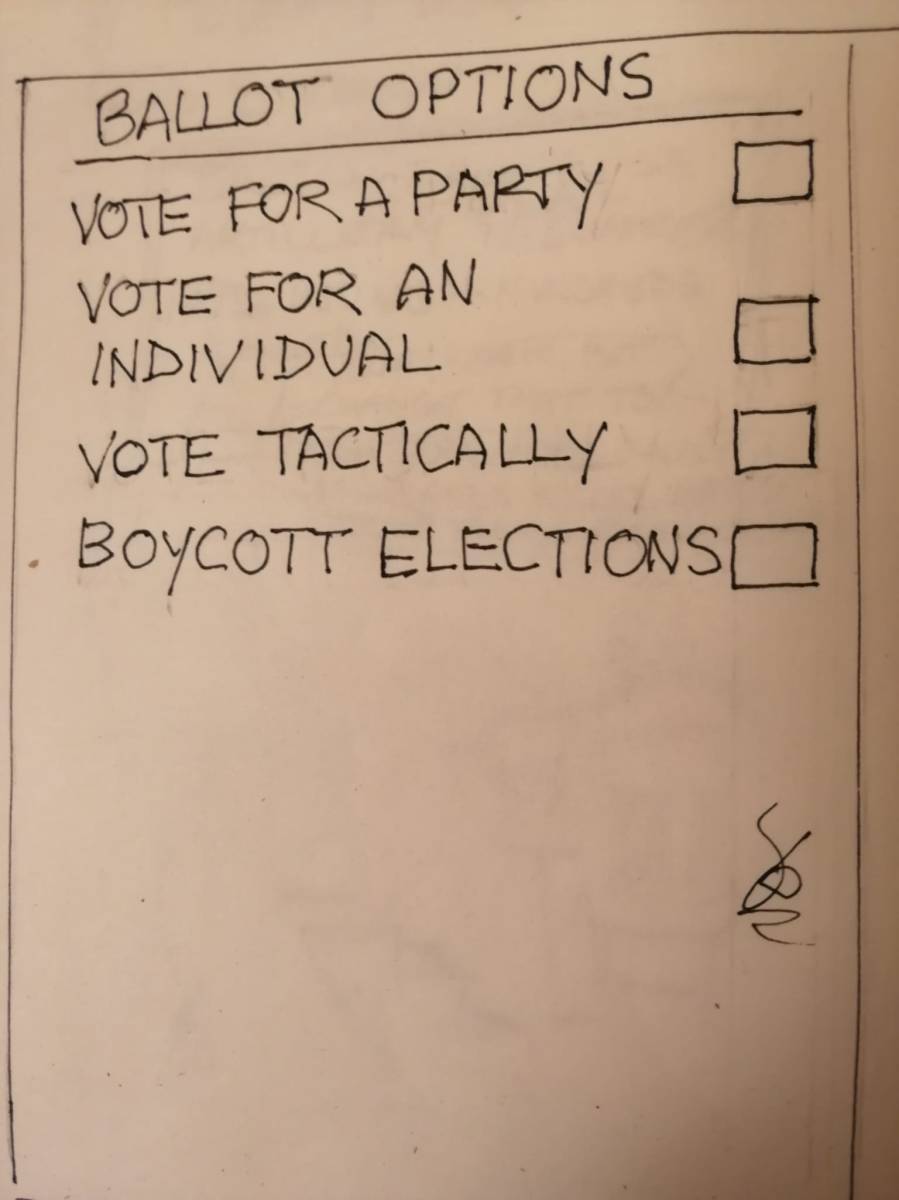
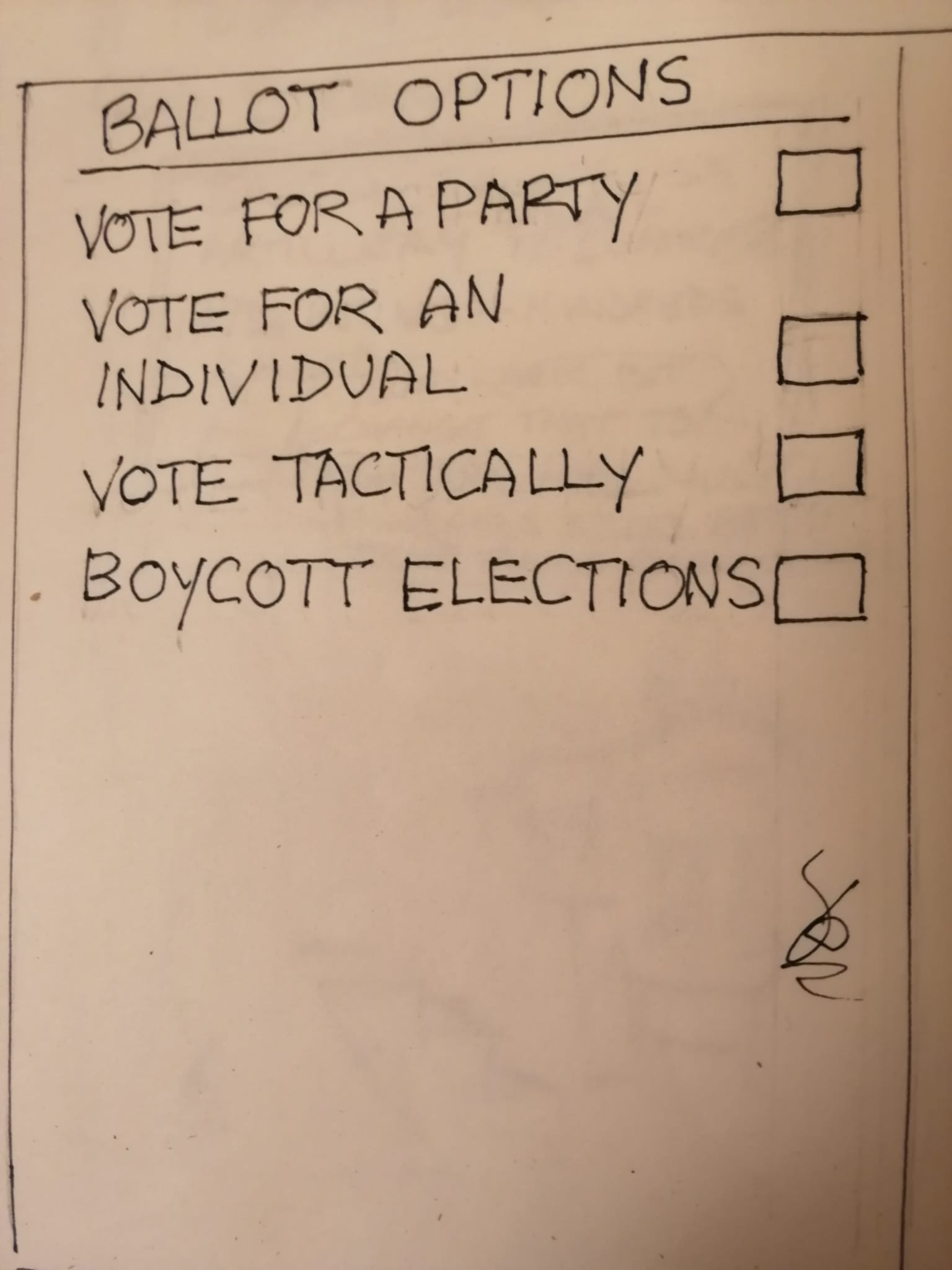
The elections for a government in the 26-County state are only days away now and, while many are advocating a vote for this or that party or candidate, some are opposed to voting at all.
ARGUMENTS AGAINST VOTING
An amusing take on abstention advises: Don’t vote – it only encourages them! Anarchists have long been opposed to voting in national elections and I recall a poster in Britain exhorting people to Vote for Guy Fawkes – the only man ever to enter Parliament with honest intentions. 1
Revolutionary marxists have also often called for a boycott of elections.
The position that they hold in common is that changing this or that party in government does not change the system and that it is that which is in need of change; as Connolly2 famously declared capitalist governments to be “committees of the rich to manage the affairs of the capitalist class.”
However, it is possible to hold that opinion but yet to vote – and even to advocate voting – in some circumstances. However among some Irish Republican circles there has been a trend maintaining that voting in these elections is a recognition or acceptance of their alleged legitimacy.
A massive spoiling of ballot papers is often advocated by those who wish to ensure that the boycott may not be interpreted as apathy among the electorate. The number of spoiled ballot papers is supposed to be recorded and the papers available for inspection.
ARGUMENTS FOR
Those arguing in favour of voting in elections come at the question from a variety of points, including that voting is a democratic right for which our ancestors fought; that if we fail to vote we have no right to complain about government actions (or inaction).
They may maintain that not voting for some parties is equivalent to voting in favour of their opponents; or that voting a particular party into power can be used to overturn undesired legislation or conversely to promote desired legislation or to put them in power so that they may be exposed.3
The reformists and social democrats (often presenting themselves as revolutionaries) advocate for reforming or at least controlling capitalism under a Left Government. Despite the impracticability of the latter in many historical experiments, the hopeful and deluded keep advocating it.
Then of course, there is the ‘Lesser Evil’ argument, which is probably the most seductive; we witnessed that during the Harris-Trump USA Presidency competition. The Greens in Europe even appealed to Stein of the USA Greens, running against Harris on an anti-Genocide ticket, to desist.4
The claim that we might as well use our votes to elect a ‘lesser evil’ government is seductive precisely when we feel that no other option is available, combined with fear of worse economic and social conditions to be imposed upon us by the ‘worse evil’ party or candidate.
To follow the ‘lesser evil’ road is not only to perpetuate the system in one form or another but also fail to recognise our potential strength as the producers of all wealth; to fail to strengthen our energies to break firstly the mental chains, then the physical ones; to make fundamental choices.
THE TACTICAL VARIANT
Some argue that although in general national elections don’t change the system, they can be used at times to effect a tactical change: show rejection of a specific government position or individual.
They sometimes argue in favour of voting to put a specific individual or group of individuals into parliament for tactical reasons.
Can it be of use to have a few individuals in the Irish parliament who will attack the government and ruling class in speeches? Or to put specific issues forward on which to expose the ruling elite? Or to ask questions to gather government information? I am sure that it can and has been at times.
Can it be useful to have a handful of individuals elected to the Irish parliament who are prepared to seek entry to prisons to talk to political prisoners? Or who will head an investigation into some kinds of abuses and publish the results? Such can be and has been of use at times.
The important thing is to ensure that the message we give is that useful though such people and positions may be at times, they are not the solution, which can only be the overthrow of the system and the establishment of a socialist system with power in the hands of the working people.
ELECTIONS IN A CAPITALIST DEMOCRACY
What are known as ‘democracies’ are states concentrated across ‘Western’ regions, i.e western Europe and its former colonies of the USA, Canada, Australia and New Zealand, with varying degrees of effect upon states on the African and Asian continents, along with ‘Latin America’.5
These are without exception, regardless of variety, systems of governing their working people without having to resort to wide-scale constant repression and suppression. For that project, the illusion of choice is essential, hence the regular elections and different political parties.
But the illusion of any fundamental choice is failing. Increasingly, governments in many European ‘democracies’ are becoming coalitions between a number of political parties and in Ireland, the main Government-Opposition parties for decades have exposed the reality by governing together.6
The effect of such exposure of the lack of real choice is impacting upon the consciousness of the populations concerned so that progressively less of them are willing to participate in the charade. In Ireland now more than one-third of the population do not vote.
This situation is of great concern to the ruling classes and to their intellectuals who are busy trying to devise schemes to offset the drift such as advocating voting from home, spectacles such as televised confrontations between competitors and ‘Citizenship’ programs in schools.
Clearly revolutionaries should not assist in any attempt to justify the system or to perpetuate the illusion of elections in capitalist ‘democracy’ being anything else than a periodic choice for slaves between the overseers employed by their masters.
DOES IT MATTER ANYWAY?
The nub of the question as to whether to vote boils down to what we hope to achieve and its prospects. If there were a massive abstention from the polls then of course that would be seen as a huge vote of no confidence in the parties standing and perhaps in the system itself – but from what perspective?
From the Right? From the Left? From apathy? In any case at the moment that looks like a moot question since there’s a likelihood of a turnout of around 60% of the registered voters.7
Will abstention make people more politically aware or conversely will participation in the elections turn people away from the possibilities of organising on the ground and ultimately of revolution? Perhaps for some – but overall, I think not many in either case, not on a longer-term basis.
From a revolutionary point of view, does it matter whether people vote or not? Or even sometimes who they vote for? Surely what matters is organising and supporting the movement for fundamental progressive change? Can that be done by people who vote as well as by those who don’t?
I’d say that is at least as likely.
During capitalist state elections the best we can do, I think, is to point out the inadequacy of the choices presented to us and to advocate stronger and more militant organisation as an alternative to the calls to vote for one party or another.
Whatever party or individual gets elected to Leinster House, the principal struggles remain: for a free united independent Ireland, for a socialist system, against the imperialist world system, against environmental destruction. It is on that we need to concentrate.
The newly-elected management committee of the capitalist class should be savaged mercilessly for its inevitably broken promises and its continuing attacks upon the economic and social conditions of the working people, and on Irish national neutrality.
Most of all, we need to improve our organising, strengthen our ranks and find ways to strike blows against the system to win victories in our march towards the overthrow of the neo-liberal and neo-colonial Gombeen ruling class and its foreign masters.
End.
1While amusing as a caption, given that Guido Fawkes plotted to blow up the English Parliament on 5th November 1605, upholding Guido Fawkes as some kind of historical hero is problematic, as he was a militant Catholic and the date of capture, Guy Fawkes’ Day, was a regular occasion for the exhibition of anti-Catholic prejudice even into the 20th Century in Protestant Britain, which more often than not, manifested itself as anti-Irish racism.
2James Connolly (1868-1916), revolutionary socialist activist, theoretician, journalist, writer and trade unionist, leading participant in the 1916 Irish Rising for which he was sentenced to death and shot by British firing squad.
3Lenin famously advocated voting the British Labour Party into government for the first time to ensure their exposure, supporting them “as a rope supports a hanging man”, advice misused by social democrats and others on the electoral Left and about which revolutionaries have argued ever since.
6Throughout the existence of the Irish State, the Fianna Fáil party has been the longest in government, with Fine Gael second, both socially conservative parties with strong loyal electoral bases. However now they are governing in coalition, along with the Greens. It is worth noting that there has not been a government of absolute majority by any party in the Irish state since 1981, when Irish Republicans stood as H-Block (e.g. hunger strike) candidates and two were elected with another having a near miss.
7Despite a trend of dropping percentages of the potential voters actually participating, in 2020 the turnout was a little over 62%.
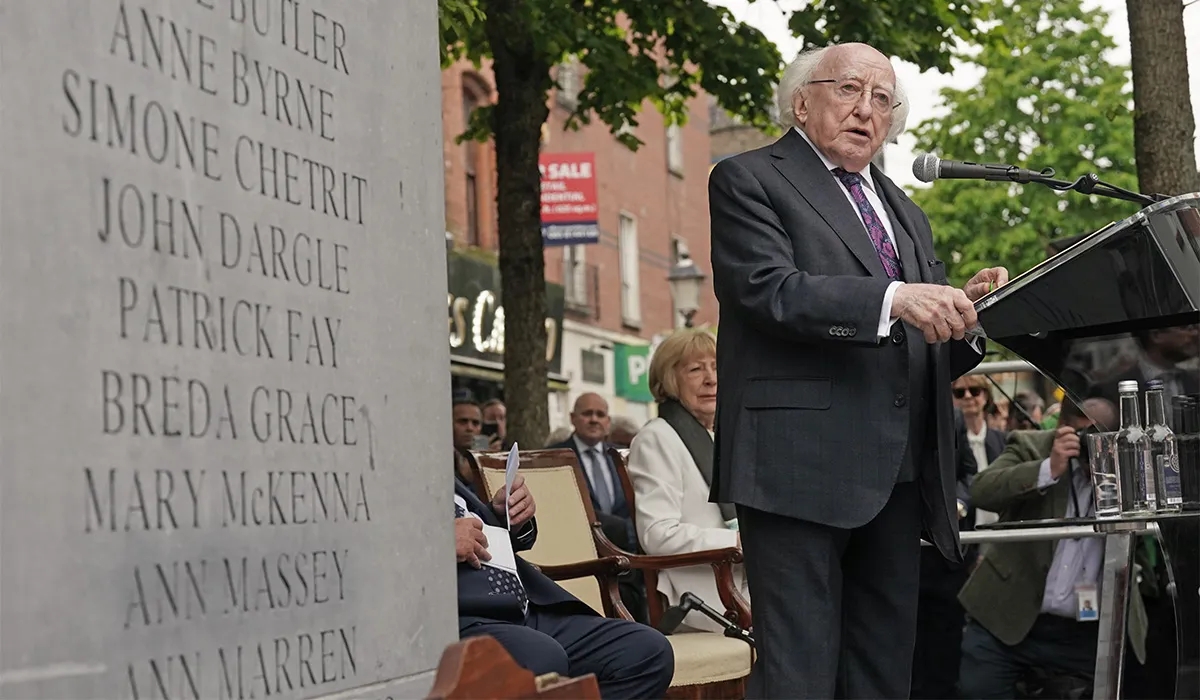
President Michael D Higgins speaks during a wreath-laying ceremony at the Memorial to the victims of the Dublin and Monaghan bombings on Talbot Street in Dublin, to mark the 50th anniversary of the Dublin and Monaghan bombings. (Photo cred: Brian Lawless/PA Wire)
Fifty years ago, on May 17th bombs exploded in Dublin and Monaghan killing 34 people. The anniversary was marked in Talbot St. Dublin beside the monument erected in memory of those murdered on that day.
The attendance at the anniversary was addressed by Michael D. Higgins, the southern president.(1)
He made a number of points in his speech, mixing his praise for the Good Friday Agreement and Elizabeth Windsor’s visit to Ireland with calls for the rights of the victims to know the full truth, oblivious to the inherent contradictions in his statement.
He did acknowledge that there were huge problems with the subsequent investigations and cited the Barron Report.
The report compiled by the late Judge Henry Barron, published 10th December 2003, provided some of the answers, pointing as it did to systemic failures at State level, one that included possible collusion between the security forces and loyalist paramilitaries.
Also featured was the disappearance of important forensic evidence and files, the slow-motion conduct of the investigation, a reluctance to make original documents available, and the refusal to supply other information on security grounds.(2)
There is nothing surprising about this. The dust had barely settled in Dublin and Monaghan and the Irish Government and the Opposition rushed out to deflect and suppress any debate.
Both the Taoiseach at the time, Cosgrave (Fine Gael) and the Opposition leader Jack Lynch (Fianna Fáil) both issued statements that were remarkably similar.
In them they broadened out responsibility for the attacks to anyone who had been involved in any violent act; i.e. they blamed the IRA by implication and failed to mention loyalists at all. This was not accidental. It was deliberate.
The nature of the bombings, the coordination, technology used all indicated the involvement of the British secret services, coupled with the fact that the loyalists never again showed the same capability ever.
Under no circumstances was the southern establishment going to accuse the British of anything.
Just over two years earlier, following the murder of 14 people on the streets of Derry by the Parachute Regiment in full view of TV cameras, an angry nation protested and burned the British Embassy in Dublin to the ground. Cosgrave and Lynch sought to avoid a repetition of that.
As the Barron Report pointed out the Garda investigation was poor, forensic evidence was destroyed, the team set up to investigate it was wound down after just two months and the murder inquiry itself was closed after seven months.
All of this shows clearly that they had no interest in getting to the bottom of it. So much so, when the RUC informed them that they had arrested some suspects in relation to the bombing, the Gardaí did not follow it up.
Years later when Judge Barron carried out his investigation, it was not just the British who were uncooperative. The Gardaí and the Department of Justice didn’t provide him with any information, their files were “missing”.
So, any call for truth means demanding the southern government reveal what it knows and also who shut down the inquiry, why, what happened to the files etc.
It was ironic that the Taoiseach, Simon Harris, the former Taoisigh, Micheál Martin (Fianna Fáil) and Leo Varadkar (Fine Gael) who were present and laid wreaths represent those who covered up the bombings.
If we are going to talk about truth, then a starting point should be that Fine Gael and Fianna Fáil covered it up and bear part of the blame for the failure to prosecute anyone.
But when Higgins and others demand the British hand over files and information, including the information offered at the time but not sought by the Gardaí, a question arises. Why would you ask the British government for information and files on a bombing that took place in Dublin?
There is only one possible answer: the British were involved in the bombing.
So, a good starting point would be not so much to talk euphemistically of full disclosure, but rather for them to admit their guilt and tell us all what they did and how and provide all the documentation relevant to their admission of guilt.
No Irish politician has ever demanded that the British own up for it. The demand is they give over information on those who carried it out, as if they were not serving members, at the time, of the British security forces.
The Irish state deliberately failed the victims of the bombings and continues to do so, to this day.
It is telling that the Barron Report on the bombings in not available on Irish government sites but rather on a site set up by victims of the bombings, Justice for the Forgotten (http://www.dublinmonaghanbombings.org/home/).
The Irish state has little interest in talking about the issue or of informing the Irish public, most of whom were born after the bombings.
Though Higgins criticised the Legacy Act, which puts a time limit on prosecutions, the Good Friday Agreement was always about drawing a line under what had happened. The GFA rewrote history to portray the British as honest brokers in a tribal sectarian conflict and not as an imperial power.
Acknowledging their role in the Dublin and Monaghan bombings would undermine that carefully crafted and now universally accepted lie about the British role in Ireland. The British will not release the files as to do so would be an admission of what their role in Ireland is.
The southern establishment despite its occasional calls for clarity and truth, dreads the British even considering such a move, as again it would undermine their role in the conflict as well and their responsibility for the ensuing cover up.


 rebelbreeze