Meloni skirts around the word ‘neofascist’ on the anniversary of the Bologna Massacre

Opposition leader Elly Schlein accused the prime minister of “historical revisionism” over her ambiguous language.

08/03/2023 PUBLICO / EFE (Translated by D.Breatnach)

Italian Prime Minister Giorgia Meloni completely avoided using the word ‘neofascist’ in her message marking the 43rd anniversary of the Bologna Massacre, a terrorist attack by a far-Right organization that killed 85 people.

Meloni did not go to Bologna to participate in the commemoration.

“43 years have passed but, in the heart and conscience of the nation, the violence of that terrible explosion still resonates with all its force,” said the leader of the Executive and the ultra-right party Brothers of Italy.

Giorgia Meloni, the Prime Minister of Italy. (Photo: Fabio Frustaci / EFE)

In her message, she asked to “get to the truth about the massacres that marked Italy in the postwar period,” an ambiguous phrase that makes no direct reference to the far-right groups that carried out the massacre on 2nd August 1980.

The absence of specific terms in Meloni’s speech to refer to the attack has prompted opposition leader Elly Schlein, a progressive, to accuse Meloni of promoting “historical revisionism.”

“We are here in Bologna together with the families of the victims of the massacre to reiterate that we do not accept any further attempts to rewrite history. The judicial evidence already makes it clear that it was a neo-fascist massacre and also with subversive intent,” Schlein said.

In the message shared by the president, Sergio Mattarella, to commemorate the date, he did refer to “the neo-fascist matrix of the massacre.” Likewise, he recalled that in the subsequent trials “ignoble deviations, in which secret associations and treasonous agents of the state apparatus participated,” came to light.

Meloni has ruled out any anti-democratic nuance of her formation, but she maintains as a symbol of the Brothers of Italy the so-called “tricolor flame”, emblem of the youth organisation of the old and post-fascist Italian Social Movement (MSI) in which she was a member of her youth.
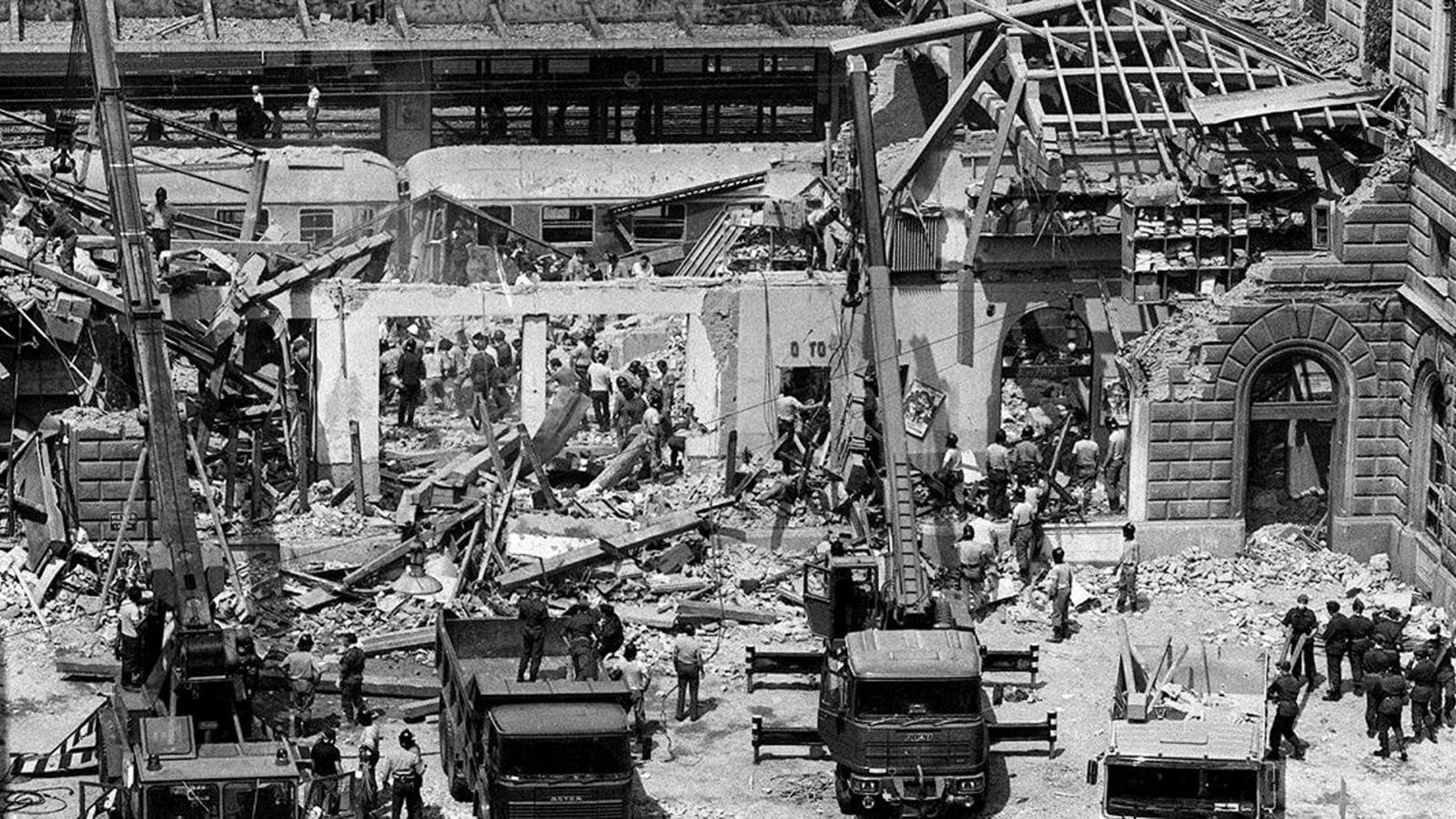
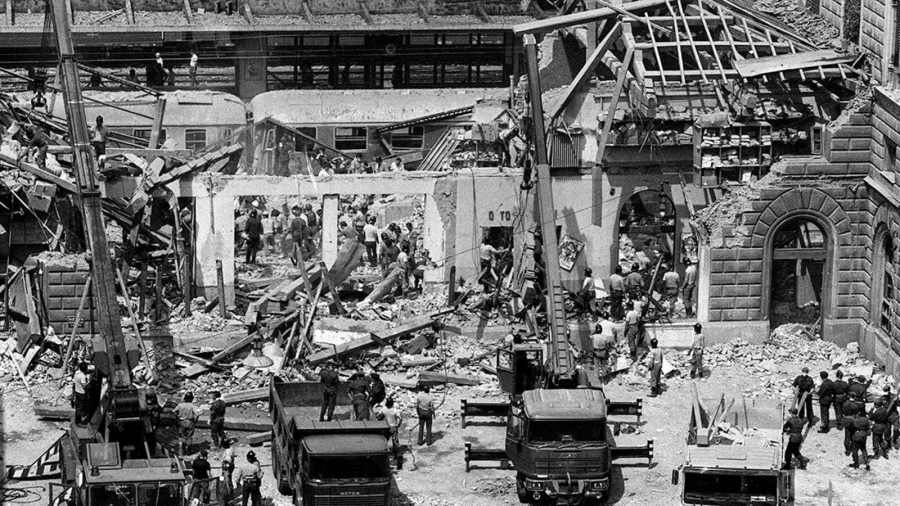
The Bologna Train Station, Italy, following the fascist explosion on 2nd August 1980 (Photo sourced: Internet)

The Bologna Massacre

The Bologna massacre was the most serious terrorist attack in Italy after World War II, in which 85 people died and more than 200 were injured and extreme right-wing militants belonging to the organization Armed Revolucionary Nuclei were convicted for it.

Comment by D.Breatnach: However, parts of the Italian State were implicated in the bombing and/or coverup too, with elements in the Italian police, judiciary and secret service but also with suspicions of CIA/NATO involvement. It seemed that the purpose of that bombing and others in the period was to create fear and confusion in which the State could return to fascism.

Broad Cospito Solidarity Picket at Dublin Italian Embassy

Ireland Anti-Internment Campaign

(Reading time: 3 mins.)

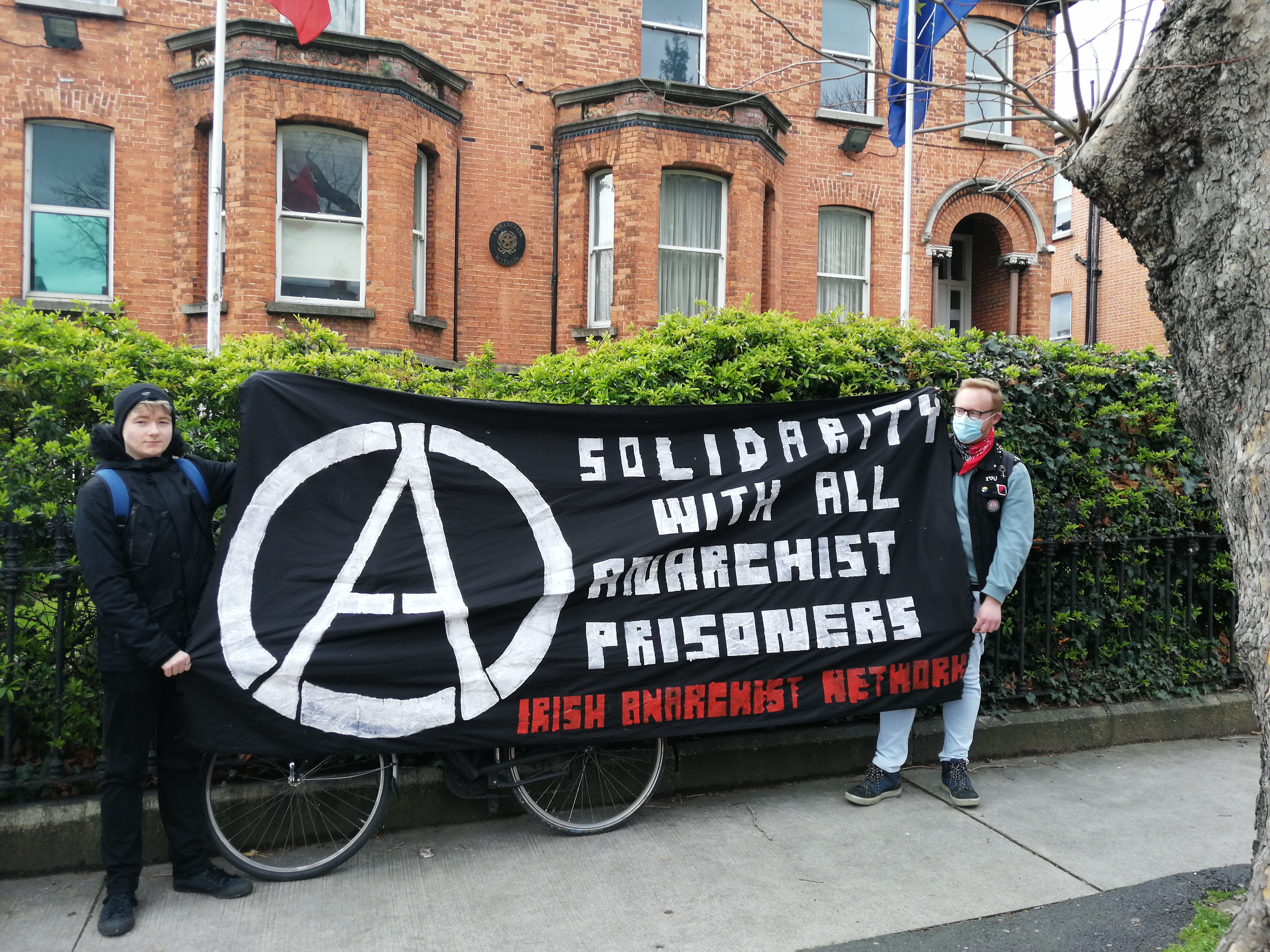
A picket outside the Italian Embassy in Dublin on Thursday (23rd) was part of a day of action across Europe in solidarity with an Anarchist prisoner on hunger strike since October in a struggle for more humane prison conditions.

The picket, organised at short notice, included Irish Republicans, Anarchists and revolutionary Socialists. Banners and placards indicated the presence of Saoradh, Irish Anarchist Network and Ireland Anti-Internment Campaign.

At one point five uniformed Gardaí stood near the Embassy’s gate while three plain-clothes Special Branch (i.e. political police) watched from a car across the road. The police numbers may have been due to a request from the Embassy in the midst of attacks on some Italian Embassies in Europe.

Despite the presence of Gardaí, Embassy staff appeared nervous, meeting one visitor at the gate to check her reason for attendance after speaking to her on her mobile phone, rather than first allowing her to enter the garden and approach the main entrance.

Some of the uniformed Gardaí attending the solidarity picket and some of the protesters. (Photo: IAIC)
Three Special Branch Gardaí (political police) parked across from the picketers, surveilling them (Photo: IAIC)

THE HARSHEST ITALIAN PRISON CONDITIONS

Alfredo Cospito is an Italian political prisoner kept under the harshest Italian prison conditions, “41-bis”, which include solitary confinement for most of the day, family visit once a month through glass, no reading matter sent from outside and no phone calls in either direction or lawyer privacy.

According to information on the Internet, these inhumane conditions were developed for Mafiosa leaders, in order to prevent them running their organisations from inside jail and also to pressure them into breaking ranks and informing on their colleagues.

Whatever we may say about that, what can be the intention of subjecting a political prisoner to those conditions, except to break him or to destabilise him mentally? EU recommended rules on prisoner management don’t recommend more than three weeks in solitary confinement.

Lawyers for political prisoner Nadia Lioce, who has been living under the 41-bis regime for two decades, have said due to limited hours permitted contact, she has effectively only interacted with people for a total of 15 hours in the space of a year.

Italian media reported Lioce’s lawyers as saying she is now so “psychologically isolated” that, when her mother and sister visit, she is unable to speak to them for more than a few minutes.

Some of the picketers, the Italian Embassy in the background (Photo: IAIC)

Amnesty International and the European Court of Human Rights have both criticised several aspects of the 41-bis, and in 2007 a US court refused to extradite a convicted Mafia drug trafficker on the grounds that the 41-bis regime he would face in Italy would have “constituted torture”.

The Anti-Imperialist Front gave a call for an international solidarity day of action which found an active response in many countries.

Alfredo Cospito’s case is up for review by the Italian prison system this month and pickets and other actions have been organised around Europe to exert pressure on the Italian penal authorities to release Cospito into house arrest in his sister’s home.

The picket displayed not only internationalist solidarity but exemplary broad unity of disparate political forces in solidarity with an Anarchist political prisoner. Hopefully this unity will continue to be built upon as time goes on, for the unfolding struggles of class and nation demand it.

Hopefully the international actions will cause the Italian authorities to relax the inhumane conditions of Alfredo Cospito’s incarceration but now Italian authorities are claiming that Cospito is somehow coordinating violent actions from within his extreme isolation.

Another two of the picketers (Photo: IAIC)

A side trip into history

The Italian Embassy is in Northumberland Road, on the south side of the Grand Canal (near the Israeli and US Embassies).

As they were leaving, some of the picketers took time to look at a plaque and monument to the Mount Street Bridge Battle between Irish Volunteers and British soldiers in 1916. Four Volunteers were killed and between 26 and 30 Sherwood Foresters, with 134 more wounded.

Mount Street Battle Monument, on the Bridge over the Grand Canal itself. The English explanation is on the reverse. (Photo: IAIC)

A number of Volunteers were captured but a number got away also. Two of the buildings from which the Volunteers fought remain, bearing the marks of bullet strikes. The third, Clanwilliam House was set on fire by the British and was replaced by a 1960s-type office building later.

End.

(Photo: IAIC)

Sources

Alfredo Cospito: Hunger-striking Italian anarchist moved amid protests – BBC News

FS_Prisoners_health_ENG (coe.int)