THOUSANDS OF ISIS FIGHTERS FREED IN SYRIAN FORCES ASSAULT ON AL-SHADADDI PRISON

Diarmuid Breatnach

(Reading time: 8 mins.)

Thousands of ex-ISIL (ISIS) fighters and their families have been freed during the Syrian government forces assault on the SDF-guarded Al-Shaddadi jail. Both sides blame the other for the release although the Government forces admit their assault.

The SDF, mainly Kurdish forces supported by the US/ NATO coalition to oust the former Assad regime, have been guarding an estimated 10,000 prisoners in the jail since the collapse of the ISIS offensive in the region.1

Observers have feared the release of the ISIS fighters and their ‘radicalised’ families since the December 2024 collapse of the Assad regime in a Turkey-supported offensive.

That attack was led by Ahmed Hussein al-Sharaa, former Al Qaeda fighter and second-in-command of the ISIS-supported al-Nusra forces in Syria, a coalition of fundamental Islamist jihadists fighting under ISIS leadership though their leader claims to have fundamentally changed.

Ahmed Hussein al-Sharaa changed his name to al-Jolani and claims to have renounced ISIS, proclaimed himself President of Syria and filled his cabinet with ‘former’ ISIS commanders, since which Western imperialist leaders have accepted him and Trump praised him greatly.

Cartoon by Carlos Latuf depicting the Western imperialist makeover of the ISIS Ahmed al-Sharaa to al-Jolani, self-appointed President of Syria (Sourced: Internet)

The western powers cancelled his designation of ‘terrorist’, presented their compliments at his throne, some, including French and German envoys, travelling to meet him2 (even before the $10m bounty on his head3 had been removed). Or invited him to call, as Macron did for France.4

Al-Jolani offered friendship to ‘Israel’ even as the IOF occupied additional parts of Syria and bombed any remaining military installations of the Assad regime.5

THE KURDISH-LED SDF, TURKEY AND AL-JOLANI

The objective of the SDF had been to overthrow Assad so as to form a Kurdish state within Syria in order to link up with other Kurdish regions to create a federal Kurdish state. Turkey feared this project, having fought decades of bloody war against the PKK in its own Kurdish region.

Apologies for use of CIA map but difficult to get publishable image showing Kurdish-controlled areas within Syria. (Image sourced: Internet)

Consequently Turkey was at odds with US/NATO forces and the participation of the SDF within it, although Trump, as his previous Presidency drew to an end, publicly withdrew support for the Kurdish coalition. Turkey has welcomed the Damascus forces defeat of the SDF.

Since al-Jolani and his own coalition came to power, he attempted to integrate the SDF fighters within his own forces. The Kurds reluctantly agreed but insisted they be incorporated as a unit and not dispersed among al-Jolani’s forces, a proposal declined by the new President.

Since then there have been numerous clashes between the different forces, with the SDF holding their own, until the recent few days when they lost a number of strongholds, including that guarding the Al-Shaddadi prison, leading to thousands of former ISIS fighters being freed.

This prison breach, welcomed by Turkey,6 must be viewed with horror by many Syrians, in particular by the Yazidi, Alawite, Druze and Christian communities who have been subjected to home invasions, humiliation and massacres, along with rape and kidnapping of women.7

Neighbouring Iraq, Lebanon and even Jordan have cause to worry too.

Again, difficulty in getting publishable map showing Syria with its neighbours but also Iran. (Image sourced: Internet)

In sifting through the disputing claims, it is worth noting that the SDF claimed that the International Coalition base, only two kilometres away from the jail in Syria’s Hasakah province, did not respond to calls for assistance8 and the SDF denounced the failure of the USA’s forces to support them.9

It is relevant too that the SDF are not Islamist Jihadists and fought them many times in Syria, although it is true that the Western powers, while supporting the SDF, also supported and instigated ISIS to overthrow Assad, although bombing them too in periodic control operations.10

Events from the coming to power of Al-Jolani to the freeing of the Al-Shaddadi Prison may hold lessons of importance too for some strains of the Western Left and Liberals who supported the insurgent opposition to Assad in favour of ‘democracy’ while parroting mass media propaganda.11

It may also add a cautionary example to the dictum that ‘the enemy of my enemy is my friend’, often quoted by otherwise anti-imperialists who supported the IDF’s alliance with the US/NATO to overthrow the Assad regime.12

CUI BONO? WHO GAINS?

What now? (Cartoon by D.Breatnach)

One might think that the Western Powers, who have been in coalitions fighting ISIS and have suffered some attacks on themselves, including the Al Qaeda attack on New York’s Twin Towers, would be strongly opposed to this liberation of thousands of experienced Islamist jihadist fighters.

But if so, how are we to understand the refusal of the Coalition forces to intervene during the attack on the SDF forces guarding the jail? Or the Western Powers legitimising of the Al-Jolani regime running Syria, despite the al-Nusra background and religious sectarian massacres since?

It is difficult to avoid the conclusion that the imperialist powers wish to see those Islamic fundamentalist ex-fighters freed — but what could be their purpose? To instigate an internal conflict in Lebanon, perhaps, occupying Hezbollah away from ‘Israel’ and excusing foreign intervention?

Or keeping the Iraqi Government busy and deepening its reliance on US forces just as it seems to be asserting some independence. Or to sent north-eastwards against Iran. One thing is clear, the Western Powers allowed it and the reason nothing to do with concern about jail conditions.

End.

Note: If you found this article of interest, why not register with Rebel Breeze for free, so that you will be notified by email of subsequent articles. You can de-register any time you wish.

FOOTNOTES

1At the end of 2020, the U.S.-backed militia in northeast Syria held at least 10,000 ISIS prisoners, one of the largest populations of detained Islamists in the Middle East. Thousands of ISIS fighters were captured as the Islamic State collapsed in early 2019. The fighters were held in approximately 14 detention centers operated by the Syrian Democratic Forces (SDF), the U.S.-trained Kurdish and Arab militia that fought ISIS in Syria. https://www.wilsoncenter.org/article/islamists-imprisoned-across-middle-east

2https://edition.cnn.com/2025/01/03/middleeast/eu-ministers-syria-visit-intl

3US scraps $10m bounty for arrest of Syria’s new leader Sharaa: https://www.bbc.com/news/articles/c07gv3j818ko

4https://thecradle.co/articles/julani-in-a-suit-how-france-turned-a-pariah-into-a-partner

5https://www.middleeastmonitor.com/20250416-syria-leader-jolani-privately-promised-to-normalise-ties-with-israel-by-2026-ex-uk-diplomat-says/

6From The Cradle, on Telegram: Omer Celik, spokesman for Turkish President Recep Tayyip Erdogan’s ruling AK Party, said that recent gains by Syrian government forces had “thwarted” attempts by Kurdish groups to obstruct Turkiye’s peace process. Feti Yildiz, deputy leader of the government-aligned Turkish nationalist MHP party, described Sunday’s agreement in Syria as having “a favorable impact.” “Things will become easier,” Yildiz told reporters in the Turkish parliament when asked how the Syrian deal affects the PKK process. “It had been standing like an obstacle, and for now it looks as though that obstacle has been removed.” Turkish security sources, speaking to Reuters on condition of anonymity, called the deal a historic turning point.

7https://www.reuters.com/investigations/syrian-forces-massacred-1500-alawites-chain-command-led-damascus-2025-06-30/ and https://www.catholicworldreport.com/2025/03/21/the-situation-in-syria-is-worse-now-than-under-isis/
8Quoted in https://shafaq.com/en/Middle-East/Syria-s-SDF-loses-control-of-Al-Shaddadi-prison-holding-ISIS-detainees and many other sources.

9https://thecradle.co/articles/syrian-forces-overrun-isis-prison-as-sdf-condemns-us-inaction

10The SDF contains female Kurdish and Yazidi fighters too which would be anathema to Islamist fundamentalists.

11It should not be understood from this that I was a supporter of the Assad regime; I attended demonstrations against imperialist invasion and regime change while also refusing to support the regime itself. I had arranged with Eva Bartlett, a much-publicised critic of the regime-change operations of the US/NATO forces, to organise a Dublin public meeting for her to address and had her stay at my home. After learning that I was also going to criticise the regime position against the Kurds she left without explanation and I had to cancel the meeting venue booking.

12In discussions with Anarchists of the WSM (organisation no longer in existence) and Irish Republicans of (Éirigí organisation much diminished since and now in coalition with another group) I refuted the correctness of application of this principle to the major imperialist power in the world, the USA. At a conference of the Éirigí group I spoke from the floor in criticism of that and some other aspects of the SDF and was heavily criticised from the floor also while the Chairperson reiterated support for the SDF. Though no-one spoke in my support, at least three Irish Republican activists approached me afterwards to express their support for my statements.

SOURCES & FURTHER READING

https://thecradle.co/articles/syrian-forces-overrun-isis-prison-as-sdf-condemns-us-inaction

Battle over the jail with different outcome in 2022: https://en.wikipedia.org/wiki/Battle_of_al-Hasakah_(2022)

See Syria section in https://www.wilsoncenter.org/article/islamists-imprisoned-across-middle-east

https://www.catholicworldreport.com/2025/03/21/the-situation-in-syria-is-worse-now-than-under-isis/

https://en.wikipedia.org/wiki/Ahmed_al-Sharaa

TURKEY’S PAYOFF FROM NATO LOOKS BAD FOR ROJAVA

Diarmuid Breatnach

(Reading time: 8 mins.)

Against the bigger war going on in the Ukraine, a smaller one hotting up has been getting little attention. Turkey started shelling a region in Syria which the inhabitants call Rojava and killed some of those inhabitants, including military leaders, who have had mass funeral protests.

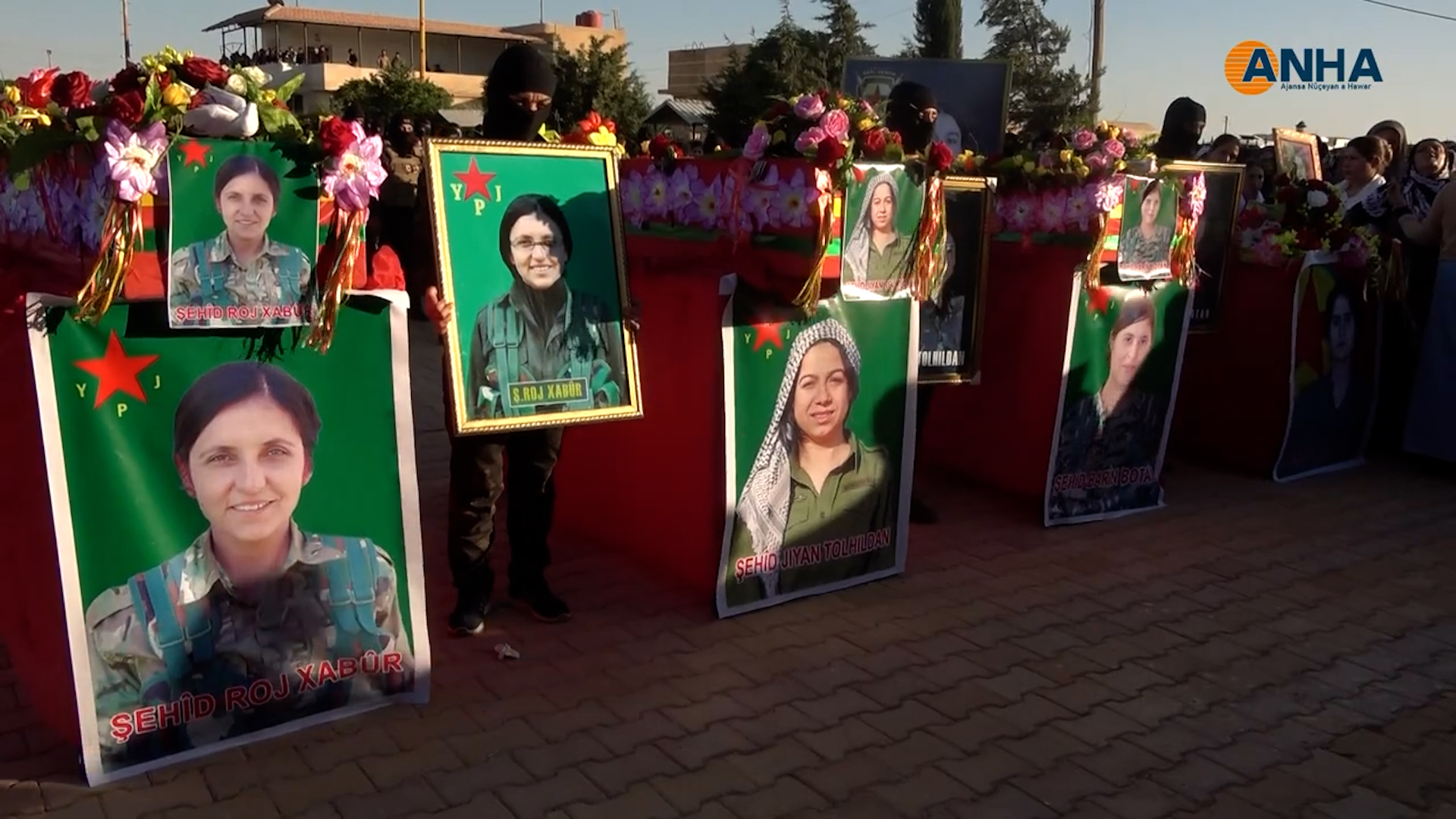
Salwa Yusuk, a deputy commander of the US-backed Syrian Democratic Forces, was killed in a Turkish drone attack in Syria on Friday. Also killed in the same vehicle were Joana Hisso, 30, also known as Roj Khabur, and Ruha Bashar, 19, also known as Barin Botan. (Image sourced: Internet)

The Kurds’ representatives were blaming the USA and Russia but most of all the former, saying it’s part of a deal for Turkey to lift its objections to Sweden and Finland for membership of Nato.

The official quid pro quo was for those countries to repress their Kurdish diaspora and to remain silent on repression in Turkey. But it seems an unofficial part of the deal was to let Turkey set its military loose on Rojava, the inhabitants of which are now living in fear of a full Turkish invasion.

Far indeed do the consequences of the war in the Ukraine reach around the world – Rojava is over 2,000 km from the Donbas region (and they will reach much further than this before it’s over)!

The Kurdish-led Rojava sector fought ISIS from 2014 to March 2019, at first without any external help and later assisted by NATO bombing runs.

The USA’s earlier policy had been to boost Islamic jihadism as a counter to left-wing nationalism and Russian influence (for example in Afghanistan) – until jihadism threatened western interests also. Then it waged war to eradicate it and, in the course of that, supported the Kurds in Rojava.

But US/NATO wants a solid block facing (not to say encircling) Russia – so now previous bets are off and the Rojava region can be thrown to the wolves – or to Turkey; first by Trump to screams of outrage from US Democrats but now by Biden, to probable silence.

BACKGROUND

But why does the Turkish military want to shell Syria? Why specifically shelling the Rojava region? If you know, you know but if you don’t, a little background might help.

The Kurds are the largest ethnic minority in Turkey, comprising around 18% of Turkey’s population; the largest concentration (2 million) of which lives in Istanbul. The majority of Kurds are Sunni Muslim, with Alevi Shi’a Muslim, Christian, Jewish, and Yezidi communities.

Together with Kurdish populations in Iraq, Syria, Iran and Armenia (all “Kurdistan”) the Kurds number between 25 and 35 million in the Middle East (with a very large diaspora in Europe, the USA and other areas).

The area occupied by Kurds in the Middle East is of huge strategic and resources importance and none of the major states in the area have agreed to their having a state.

After World War One and the defeat of the Ottoman Empire, the victorious Western allies made provision for a Kurdish state in the 1920 Treaty of Sevres.

However the new leader of Turkey, Kemal Attaturk, the “father of modern Turkey” rejected a reduction in the size of the state and the subsequent imperialist Treaty of Lausanne set the boundaries of modern Turkey without any reference to the Kurds (“mountain Turks”, according to Attaturk).

Also in 1920, the Royal Air Force of the UK bombed the Kurds with chemical weapons and machine-gunned them during the Iraqi (then Mesopotamia) uprising,

In 1946 the USSR supported a Kurdish state in a part of what is Iran today but in the face of the western powers’ opposition and support for the state of Persia’s (then a client state of the West) claim to the territory, the USSR withdrew its support and the Kurdish state was suppressed.

Every attempt to set up a Kurdish state since then has been violently suppressed and, in Turkey, even an autonomous Kurdish region was beyond contemplation by the authorities, who suppress even Kurdish language and music.

THE KURDS IN SYRIA

In 2013 an uprising began against the Assad regime which, though it had some popular elements quickly became dominated by Jihadists and NATO proxies. The Syrian part of the Kurdish liberation movement saw an advantage for itself here and set up its own liberated areas.

Also in 2013 the fundamentalist islamist group ISIS burst on to the scene and, taking advantage of the Assad regime’s beleaguered situation, attacked large areas of Syria, to overthrow the regime but also to subjugate all peoples in the region, including the Kurds and Arabs of any kind.

The Kurds of Rojava fought to protect their areas from ISIS but also carried out a heroic rescue action to save Yazidis, opening and defending a corridor for Yazidi refugees to reach safety in the Kurdish liberated area where they built a cross-community alliance with Yazidis, Turkmen and Arabs, in which they state that all its citizens have equal rights.

Whether this is as true as they (and as their supporters in parts of the European Left) say or not, certainly women have a formally equal status and women are elected – and also appointed — to positions of high administrative and military responsibility.

Demonstrators in Stockholm against the NATO deal with Turkey and in solidarity with the Kurds (whose flags are also visible (Image sourced: Internet)

The Turkish regime has been at war with the Kurds within the state’s territory led by the PKK since 1974 and viewed the setting up of an independent republic under Kurdish leadership across the border in Syria with great alarm.

In 2014 Turkey began attacking support and supply lines from Kurds in Turkey to Rojava, which caused outrage among the extended Kurdish diaspora and other opponents of ISIS in the West.

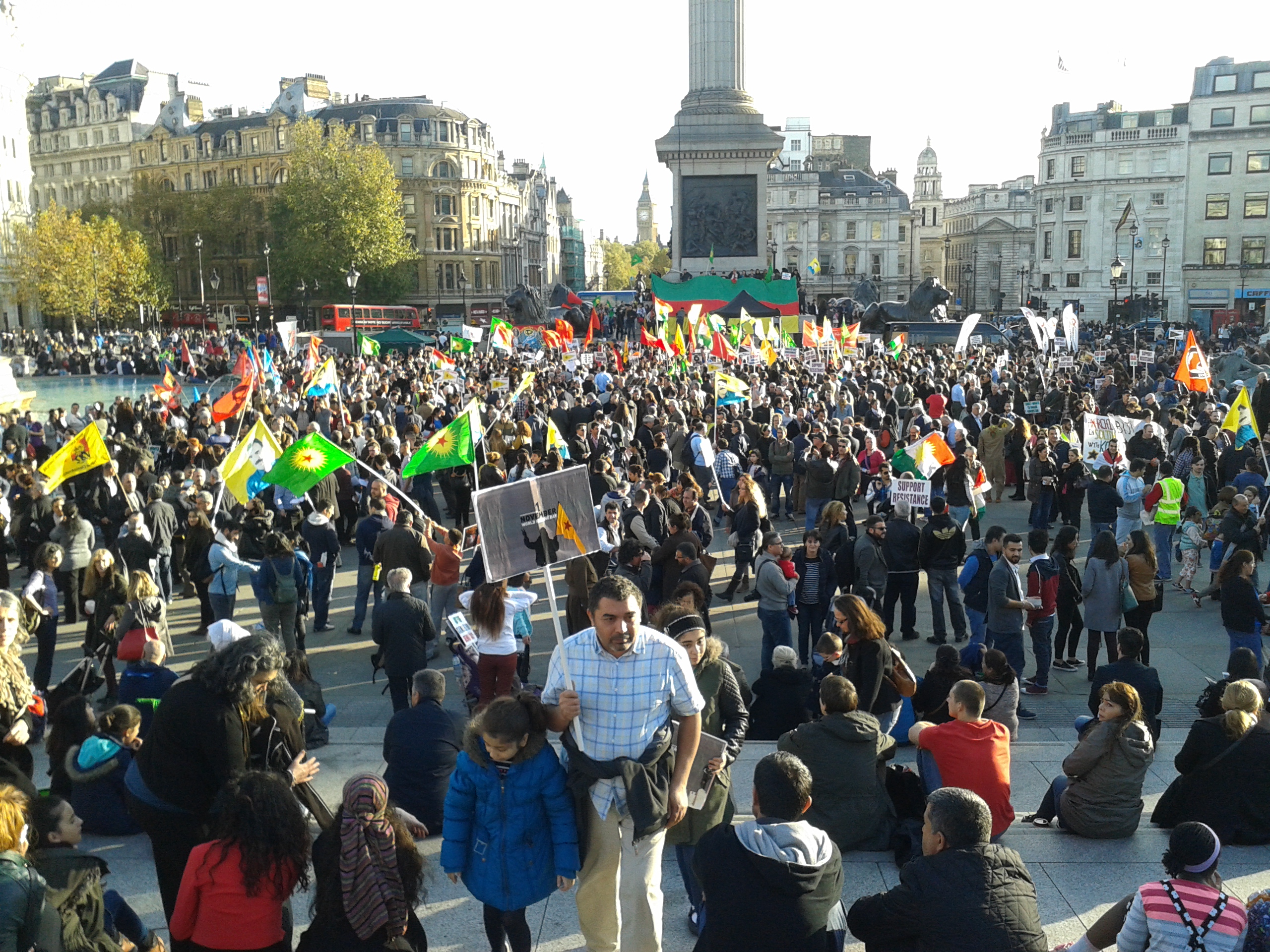
London rally November 2014 in solidarity with Kurds in Syria and condemning Turkish attacks. (Photo: D.Breatnach)

And in fact, although Turkey is an important member of NATO, Turkish military attacked the enclave a number of times, both directly and through the use of muslim fundamentalist jihadists.

Nevertheless, NATO’s concentration on wiping out the ISIS threat in the area had to have a restraining effect on Turkey. And then there was Russia too, also supplying air cover — but to the Syrian regime.

MY ENEMY’S ENEMY IS ….” — an understandable but dangerous philosophy

At first in 2013 it seemed that the Kurds around Rojava were merely taking advantage of the Syrian regime’s trouble to go for establishing their own republic, in addition to fighting the dire threat of ISIS.

In the latter struggle, they would of course gladly accept NATO bombing of ISIS and liaise with NATO commanders on where ISIS forces were gathering – for the Kurd’s own safety and for destruction of a dangerous enemy.

However some years ago an interview with the Kurdish commander of the Rojava military forces was published in which he said that the intentions of the Rojava military went further and involved overthrowing the Assad regime, an objective that they shared with NATO.

At a meeting organised by socialist Irish Republicans about five years ago, while expressing admiration for the Kurd’s struggle for self-determination in general and specifically against ISIS, I questioned from the audience a Kurdish speaker from London.

When I commented on what seemed a clear alliance with western imperialism and in particular the USA, the biggest imperialist power in the world, the speaker replied that they were merely accepting necessary aid for their defence against ISIS.

But when I pointed him towards the Kurdish military commander’s interview on the regime change objectives of his forces and of NATO, all he had to say was that I should visit Rojava.

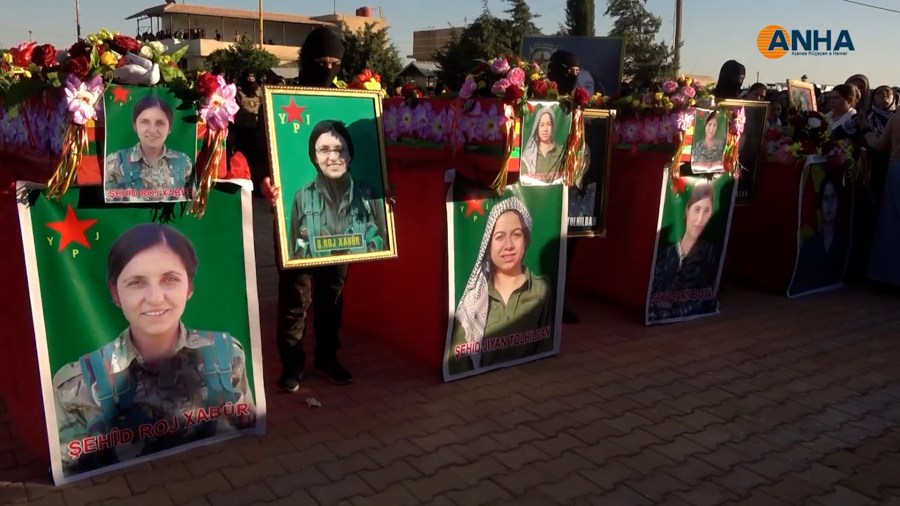
Mass funerals (despite fear of further Turkish drone strikes) of three fighters of the Women’s Protection Unit (YPJ) killed recently (Image sourced: ANHA)

CONCLUSION

This situation and its history once again highlights the dangers of revolutionaries doing any deal with imperialism, most of all one where the long-term survival of one’s people depends on the continued support of an imperialist power.

It also raises the question of whether it is justifiable or at least wise in the longer term to use a major world power’s assistance in order to remove a smaller power.

The main Kurdish liberation movement of the PKK fought a heroic struggle for decades, in particular against the ferocious Turkish regime, with many martyrs and political prisoners.

One of its weaknesses was the almost deification of their leader Oçalan and the way his attempted embracing of the proposed “peace process” undermined the movement, as similar processes have done wherever they have been introduced.

Of course, as with the Spanish state, another fascist but supposedly democratic regime, the Turkish regime is not interested in any “peace process”, a slow sapping of the resistance movement. For its ruling elite, crudely crushing the resistance with brute force is the only way .

The Kurdish movement in Syria was seen as a spinoff from the PKK which supported it in its struggle against the Syrian regime but in particular in its heroic struggle against the Islamic State/ ISIS/ Deish.

However the Turkish state would view any independent Kurdish area, let alone one in nearby Syria as encouragement to Kurds within its territory. The ISIS movement threatened some Western interests and so NATO went to war with it, the Syrian Kurds linked themselves with NATO not only to defeat ISIS but also to overthrow the Assad regime.

US-led NATO wanted to overthrow the Assad regime but as part of its Middle Eastern encirclement of Russia (which is why Russia came to the aid of Assad against ISIS). Iraq and Libya had fallen already and, after Syria, Iran would be next on the list.

Thousands of people joined a demonstration in Tel Rifaat town of the Shehba Canton on Sunday 10th Nov 2019 in protest at the Turkish state’s invasion and genocidal practices in northern Syria. 40% of the population of Efrin (Afrin) having to survive in a semi no-man’s land, defended by the multi-ethnic SDF of AANES, after expulsion by the Turkish invasion, plantation and Turkification of their homes and properties.

But as the ISIS threat and the likelihood of deposing Assad faded, NATO support for the Rojava fighters declined. In October 2019 the SDF had to conclude an agreement with the Syrian regime to have it move into their area to end five days of attacks by Turkey.

When their protection from Turkey could be dropped in exchange for a US/NATO advantage in Eastern Europe, nothing stood against a Turkish all-out attack on Rojava. Nothing, that is, except the Russian airforce.

If Turkey is to attack Rojava with ground troops it will need to use air cover both in manned and unmanned vehicles, which would require Russia not policing the no-fly zone in Syria near the Turkish border.

In February 2021, a Russia-brokered agreement between the SDF and the Syrian regime to lift the SDF’s siege of regime-held towns showed strains. But last month, at a summit in Tehran between leaders of Iran, Russia and Turkey, the other two warned the latter not to attack the Kurds in Syria.

However, despite Turkey’s NATO membership, Russia does get along with the state’s rulers from time to time and the recent discussions between the ruling elites of Russia and Ukraine on unblocking the flow of grain and fertiliser out of the war zone were held in Turkey.

The Syrian regime does not want an autonomous area within the territory of its state and Russia’s leaders will be anxious to keep on good terms with its ally – but it will also wish to wean Turkey away from NATO.

The Rojava enclave, though never as wonderful as it was proclaimed to be from a socialist point of view, is nevertheless an interesting experiment in federalism and multi-ethnic administration.

It will be sad if Rojava falls to Turkish aggression and a mean repayment for their heroic struggle to rescue the Yazidis and to hold off the advance of ISIS which cost them 10,000 dead fighters. It may also be yet another disastrous byproduct of the proxy war NATO is waging in the Ukraine.

End.

SOURCES & FURTHER READING:

Turkish military attacks on Rojava: https://thefreeonline.com/2022/07/12/mass-funerals-as-terrorist-turkey-shells-towns-and-refugees-before-new-rojava-invasion/
https://thefreeonline.com/2022/07/23/sdf-says-two-of-its-female-commanders-one-fighter-were-murdered-in-turkish-drone-strike-video/

NATO dumps the Kurds: https://www.lemonde.fr/en/international/article/2022/06/28/nato-says-turkey-has-agreed-to-support-finland-and-sweden-joining-alliance_5988282_4.html

Trump dumps the Syrian Kurds: https://progressive.org/latest/foreign-correspondent-trump-kurds-empire-crumbles-erlich-101918/

Russia blocks Turkey’s plans to attack Rojava: https://www.irishtimes.com/world/middle-east/2022/07/20/iran-and-russia-warn-turkey-against-military-offensive-against-syrian-kurdish-forces-in-syria/
https://thefreeonline.com/2022/07/26/turkish-invasion-cancelled-did-putin-just-save-rojava/

Syrian Democratic Forces, the Kurdish-led Rojava alliance: https://en.wikipedia.org/wiki/Syrian_Democratic_Forces

Long history Turkish State conflict with Kurds: https://www.cfr.org/global-conflict-tracker/conflict/conflict-between-turkey-and-armed-kurdish-groups

A modern history of the Kurds: https://www.bbc.com/news/world-middle-east-29702440

YOUNG WOMAN GOES TO TRIAL IN LONDON ACCUSED OF TRYING TO JOIN KURDISH WOMEN FIGHTING ISIS

C0mpiled with introduction by

Diarmuid Breatnach

An 18-year old woman of the Kurdish diaspora in London, Silhan Ozcelik, has been sent for trial at London’s Central Criminal Court (the “Old Bailey”) accused of trying to join the Kurdish-led resistance against ISIS (“Islamic State”).  A British journalist called the trial “disgusting” and said it left him “almost without words” to describe the travesty of justice.  (article below)

http://www.independent.co.uk/news/uk/crime/silhan-ozcelik-disgusting-trial-for-young-woman-who-tried-to-fight-against-isis-10105004.html

Face Paint Kurdish W Fighters
A different kind of face paint: female fighter of the Kurdish guerrilla YPG checks another female comrade as they prepare to go into action with their male comrades on the front line against ISIS in Syria.

This post contains:

  • An article about the trial by J0nathan Owen in yesterday’s British newsaper The Independent (see above)

  • A short article from pro-Kurdish PUK Media containing a discussion on the role of Kurdish women fighters in Syria, with quotes from a wide variety of sources (right at end of this post)

  • A video of an Australian documentary, “60 Minutes”, from the war zone, with war footage, interviews with women fighters and commanders, victims of ISIS (see further down)

  • Background comment or introduction from me (immediately below)

Background Comment:

The Kurds in the region, numbering around 28 million, have the right to self-determination.  They are divided by borders of states set up in the past by the colonial imperialists of Britain, France and the Ottoman Empire and also by ambitions of the states subsequently created: Turkey, Syria, Iraq, Iran and Azerbaijan (there is also a huge Kurdish diaspora in parts of Europe, the USA, Canada).  The Kurds in the region also face differences in political leadership, dialect and religious influence as well as containing among them other ethnic groups (many of these also oppressed): Arabs, Armenians, Azeris, Turkmen, Yazidis …. The whole Kurdish region extends across an area of great strategic importance (the gateway to Europe and to the East) and also of considerable natural resources, including water.  It is envisaged that an oil pipeline will cross this area and a number of dams have already been built there.

The Kurds in Turkey (the largest population of Kurds) has been mostly led by the PKK (and various political organisations friendly to it), a communist-type national liberation organisation, largely secular (though some of their areas can be religiously conservative) and with a very large guerrilla force which has included many women fighters.  They have fought the Turkish armed forces for decades and remain undefeated.  Turkey’s nationalism under Kemal Attaturk declared that Kurds did not exist — they were just “mountain Turks”.  Kurdish has been forbidden, the flying of Kurdish national colours a crime, and state repression has included bannings of parties and newspapers, jailings of political and human rights activists, kidnapping, torture, assassination squads, creation of strategic villages, aerial bombardment, etc.  The imprisoned leader of the PKK, Abdullah Ocalan, last week from prison called on his followers to lay down their arms and to engage in a “peace process” in which however the Turkish Government shows no interest.  Ocalan enjoys an adulation among the PKK and its supporters somewhat as Chairman Mao did among Chinese communists and his portrait can be seen on demonstrations, in pickets and in their secure areas.

The Kurds in Iraq have mostly come under the political dominance of two political leaders with tribal following, Barzani and Talibani.  Iraqi Kurds are mostly Sunni Muslim with a minority Shia population (Fayli) in central and and SE Iraq.  The Kurds were oppressed by the Iraq regime and rose up against them a number of times only to be massacred, including when the US called on them to rise during the Kuwait war but left them on their own.  Their fighters, “peshmergas” are mostly male and during the Iraq Invasion by the US-led coalition, they fought the Iraqi Armed forces but entered Baghdad like bandits and set up various areas of control under different war lords, occasionally fighting even one another.  In the past on one occasion the peshmergas were also deployed against the PKK in conjunction with a Turkish attack on them.

The Syrian Kurds have their own fighters but have not been as prominent in the past as those of the Kurds in Turkey and Iraq.  The Syrian regime does not favour declarations of different ethnicity coupled to aspirations of self-determination and has suppressed expressions of Kurdish nationalism, including jailing singers and musicians whose work includes those expressions. In recent months, the Syrian Kurds and their fighting organisation, the YPG, have had the most success in halting and in places forcing back ISIS — the “Islamic State”.  The YPG rescued a large population of mostly Yazidis (including also some other ethnic groups) after ISIS swept aside the army of the NATO-client Iraqi regime, massacred tens of hundreds of civilians and kidnapped tens of hundreds more, including women which they took or sold as concubines.

The Kurds in Iran have been in recent times the most suppressed perhaps of all the Kurdish populations.  Under the Islamic clerical regime a number of Kurdish political activists have been executed for “crimes against God” (i.e. being atheists and socialists and sharing their political beliefs).  Under the Shah the repression was also heavy and Savak, the secret police, along with their informers, were almost everywhere.  Torture was endemic under the Shah and almost certainly continues under the present regime.

Although the NATO powers fear ISIS, they have also had a hand in its creation in the drive to overthrow regimes resisting NATO’s penetration of the area (and encirclement of Russia) by direct assault or by proxy: Libya and Iraq (already overthrown), Syria (under attack), Iran (constantly being threatened).  They are trying to bring the YPG into the fold but Turkey, an important member of NATO, would rather see the Kurdish fighters wiped out and seals its border to prevent fighters and supplies reaching the YPG.  The USA therefore confined itself to some bombings of ISIS positions around Rojava and diplomatic overtures to the Kurds.  They have not committed ground troops (which the YPG have not asked for) or supplied arms (which the YPG have asked for — repeatedly) and continue to support forces attempting to overthrow the Syrian state.  The YPG rarely fight alongside the state’s Syrian Army but at times both forces are simultaneously in action against ISIS, though seemingly not in coordination

.

The Kurds, as the largest force in their region of Syria and one of the largest ethnic group in the whole region, form a focus of resistance to assimilation and to repressive regimes of states but may be seen by other ethnic groups as themselves posing a threat of assimilating them.

Video documentary “60 Minutes” by Australian television containing Syrian war area footage of Kurdish women fighters and commanders and interviews (and also occasionally irritating comment by the interviewer)

Less Photogenic Kurd Women Fighters
Less photogenic perhaps than the images we are currently being shown of Kurdish female guerrilla fighters, this photo is probably of a female guerrilla unit of the PKK in Turkish Kurdistan taken perhaps a couple of decades ago. In order to counter accusations by the Turkish state of female guerrilla “immoral” behaviour, the PKK kept the genders in separate fighting units.

Two Kurdish Women Fighters kefiyah headscarf
Two female guerrillas of the YPG resting but ready to go into action. They are on the front line against ISIS in Syria.

A discussion on women in Kurdistan and Kurdish women fighters (note that there are two parts of Kurdistan under discussion here – Iraqi and Syrian; however there is also Turkey, where the majority of the Kurds live and Iran):

http://pukmedia.com/EN/EN_Direje.aspx?Jimare=22709

Kurdish Women Heavy Machine gun v ISIS N_Iraq
Female fighters of the guerrilla YPG with a heavy machine gun (light cannon?) in the front line against ISIS

Kurdish women guerrilas against FSA, Syria
Kurdish female guerrilla fighters opposing the Free Syrian Army, sponsored by NATO against the Syrian state, in 2011. The FSA has since been overcome or incorporated into ISIS.