FIRE WEATHER

Chris Hedges (shared from his substack Subscribe here for more)

(Reading time: mins.) NB: Edited by RB from original article for formatting purposes

The wildfires in California replicate the massive fire storms in the boreal forest in Canada and Siberia, the lungs of the earth. Our addiction to fossil fuel has ignited an age of fire.

The apocalyptic wildfires that have erupted in the boreal forest in Siberia, the Russian Far East and Canada, climate scientists repeatedly warned, would inevitably move southwards as rising global temperatures created hotter, more fire-prone landscapes. Now they have.

The failures in California, where Los Angeles has had no significant rainfall in eight months, are not only failures of preparedness — the mayor of Los Angeles, Karen Bass, decreased funds for the fire department by $17 million — but a failure globally to halt the extraction of fossil fuel.

The only surprise is that we are surprised. Welcome to the age of the “Pyrocene” where cities burn and water does not come out of the hydrants.

The boreal forest is the largest forest system on earth. It circumnavigates the Northern Hemisphere. It stretches across Canada and Alaska. It travels through Russia where it is known as “the taiga.”

It reaches into Scandinavia, picks up again in Iceland and Newfoundland, and moves westward across Canada, completing the circle. The boreal forest has more sources of freshwater than any other biome, including the Amazon Rainforest.

It is the lungs of the earth, able to store 208 billion tons of carbon, or 11 percent of the world’s total.

Yet it has been steadily degraded, assaulted by deforestation and the extraction of the tar sands in Alberta, Canada — which produces 58 percent of Canada’s oil and is the U.S.’s largest source of imported oil — man-made drought and rising temperatures from carbon emissions.

Almost two million acres of boreal forest have been destroyed by extraction industries and timber companies. They have scraped away the topsoil and left behind poisoned wastelands.

The Final Toast by Mr. Fish (Source: C. Hedges substack)

The production and consumption of one barrel of tar sands crude oil releases between 17 and 21 percent more carbon dioxide than the production and consumption of a standard barrel of oil.

The oil is transported thousands of miles to refineries as far away as Houston, through pipelines and in tractor-trailer trucks or railroad cars.

This vast assault, perhaps the largest such project in the world, has accelerated the release of carbon emissions that, unchecked, will render the planet uninhabitable for humans and most other species. There is a direct line from the destruction of the boreal forest and the raging wildfires in California.

The boreal forest system has, for over a decade, seen some of the planet’s worst wildfires, including the 2016 Wood Buffalo (aka Fort McMurray) wildfire, which consumed nearly 1.5 million acres and which was not fully extinguished for 15 months.

The monster wildfire, which was, according to journalist John Vaillant, about 950 degrees Fahrenheit — hotter than Venus — destroyed thousands of homes and forced the evacuation of 88,000 people.

The fire ripped into Fort McMurray with such ferocity and speed that residents barely escaped in their cars as buildings and houses were instantly vaporized. Flames shot 300 feet into the air. Fireballs rolled up into the smoke column for another 1,000 feet. It was a harbinger of the new normal.

More than 100 climate scientists have called for a moratorium on the extraction of tar sands oil. Former NASA scientist James Hansen warned over a decade ago that if the tar sands oil is fully exploited, it will be “game over” for the planet.

He has also called for the CEOs of fossil fuel companies to be tried for “high crimes against humanity and nature.”

It is hard to get a sense of the scale of the destruction unless you visit, as I did in 2019, the Alberta tar sands. I spent time with the 500 inhabitants of Beaver Lake, the Cree reserve, most of whom are impoverished and live in small, boxy prefabricated houses.

They are victims of the latest iteration of colonial exploitation, one centered on the extraction of oil that is poisoning the water, soil and air around them.

Beaver Lake, as I wrote at the time, is surrounded by over 35,000 oil and natural gas wells and thousands of miles of pipelines, access roads and seismic lines.

The area also contains the Cold Lake Air Weapons Range, which has appropriated huge tracts of traditional territory from the native inhabitants to test weapons.

Giant processing plants, along with gargantuan extraction machines, including bucket wheelers that are over half a mile long and draglines that are several stories high, ravage hundreds of thousands of acres.

These stygian centers of death belch sulfurous fumes, nonstop, and send fiery flares into the murky sky,” I wrote. “The air has a metallic taste.

Outside the processing centers, there are vast toxic lakes known as tailings ponds, filled with billions of gallons of water and chemicals related to the oil extraction, including mercury and other heavy metals, carcinogenic hydrocarbons, arsenic and strychnine.

The sludge from the tailings ponds is leaching into the Athabasca River, which flows into the Mackenzie, the largest river system in Canada.

Nothing in this moonscape, by the end, will support life. “The migrating birds that alight at the tailings ponds die in huge numbers,” I noted. “So many birds have been killed that the Canadian government has ordered extraction companies to use noise cannons at some of the sites to scare away arriving flocks. Around these hellish lakes, there is a steady boom-boom-boom from the explosive devices.

The water in much of northern Alberta is no longer safe for human consumption. Drinking water has to be trucked in for the Beaver Lake reserve. Cancer and respiratory diseases are rampant.

John Vaillant, author of “Fire Weather: On the Front Lines of a Burning World” describes the tars sands landscape:

…mile upon mile of black and ransacked earth pocked with stadium-swallowing pits and dead, discolored lakes guarded by scarecrows in cast-off rain gear and overseen by flaming stacks and fuming refineries, the whole laced together by circuit board mazes of dirt roads and piping, patrolled by building-sized machines that, enormous as they are, appear dwarfed by the wastelands they have made.

The tailings ponds alone cover well over a hundred square miles and contain more than a quarter of a trillion gallons of contaminated water and effluent from the bitumen upgrading process.

There is no place for this toxic sludge to go except into the soil, or the air, or, if one of the massive earthen dams should fail, into the Athabasca River. For decades, cancer rates have been abnormally high in the downstream community.

The out-of-control fire storms and blizzard of swirling embers, he chronicles, are what we are witnessing in California, a state which normally experiences wildfires during June, July, and August.

Neighborhoods burn “to their foundations beneath a towering pyrocumulus cloud typically found over erupting volcanoes” and fires generate “hurricane-force winds and lightning that ignites fires miles away.”

These cyclone-like fires resemble the firebombing of Hamburg or Dresden during World War Two, rather than forest fires of the past. They are almost impossible to control.

You can see an interview I did with Vaillant here.

Fire wants to climb,” Vaillan told me. “[W]e all know heat rises. It’s rising up into the treetops and it’s sucking in wind from underneath because it needs oxygen all the time. So the fire, it’s helpful to think of it as a breathing entity.

It’s pulling oxygen in from all around and rising into the architecture of the trees and so there’s this rushing chimney-like effect. Where the fire is in a way happiest, most energetic, most charismatic, and dynamic is up in the treetops, and then it’s pulling in wind from down below.

As that heat builds, as the whole tree is engaged, you have this increasing heat and increasing wind which then builds on itself so it becomes almost a self-perpetuation machine. If you have hot enough, dry enough, [and] windy enough conditions, those flames will then begin to leap from treetop to treetop.”

The heat releases vapor, hydrocarbons from the fuels around it, which is why we see

explosive fireballs and massive surges of flame coming out of big boreal fires because that’s the superheated vapor rising up and then ignited. Imagine an empty gas can — even though there might not be a lot of liquid in it, it will still explode in a spectacular fashion.

Well, that’s really what the fire is enabling in the forest, for all those hydrocarbons to release in this gaseous cloud that then ignites. That’s when you see, especially a boreal fire, in full run. It’s called a Rank 6. It’s comparable to a Category 5 hurricane.

When houses and buildings become very hot they, like trees, release hydrocarbons. Vaillant calls modern buildings “incendiary devices.” They are packed with petrochemicals and often sheathed with petroleum products like vinyl siding and tar shingles.

When fires push temperatures to over 1,400 degrees the vinyl siding, tar shingles, glues and laminates in the plywood vaporize.

The modern home is in fact more flammable than a log cabin or a 19th-century home that’s made mostly out of wood, mostly furnished with cotton-stuffed furniture or horse hair stuffed furniture, things that we think of as antiques now,” Vaillant said.

“But the modern home is really in a way a giant gas can and we don’t think of that when it’s 75 degrees. But when it’s 300 degrees because of the radiant heat coming off a fire, or 1,000 degrees because of the radiant heat coming off a boreal wildfire, it turns into something completely different.”

All of us alive today have grown up in the petroleum age,” Vaillant said. “It feels normal to us the way I think people smoking on airplanes and in doctors’ waiting rooms felt normal to people in the 1950s. We’re completely habituated to it, to the point that it’s invisible to us.

But if you really stop and think about how petroleum is rendered and what it in fact is, it’s literally toxic at every stage of its life. From the moment it’s drawn from the ground through the incredibly polluting refining process, into our cars and where it’s burned…

Petroleum will kill you in every form, whether as a liquid, as a toxic spill, as a gas, as an emission.

It’s strange to think that we have surrounded ourselves and persuaded ourselves that this profoundly toxic substance is an ally to us and an enabler of this wonderful lifestyle that we live that is now being compromised in measurable and visible ways by that very energy source.”

We have harnessed the concentrated energy of 300 million years and set it alight. We are addicted to fossil fuels. But it is a suicide pact. We ignore the freakish weather patterns and disintegration of the planet, retreating into our electronic hallucinations, pretending the inevitable is not inevitable.

This vast cognitive dissonance, fed to us by mass culture, makes us the most self-deluded population in human history. The cost of this self-delusion will be mass death. The devastation in California is the harbinger of the apocalypse.

end.

The Chris Hedges Report is a reader-supported publication. To receive new posts and support his work, consider becoming a free or paid subscriber.

SOURCE:
Irish painter of Native Americans

Few people know the pain of being dispossessed of their land better than the Irish, but tragically in the 1870s, thousands of impoverished Irish immigrants ended up enlisting in American armies that were fighting to push Native Americans off their land.

Irishmen fought and died in the most iconic conflict between Native Americans and the United States Army at the Battle of the Little Bighorn in Montana. The defeat of the General Custer’s 7th Cavalry by Native Americans on June 25, 1876 has become legendary. Many people know the story of Custer’s defeat, but few are aware of the role the Irish played in fighting the battle, and in creating the most famous painting of it.

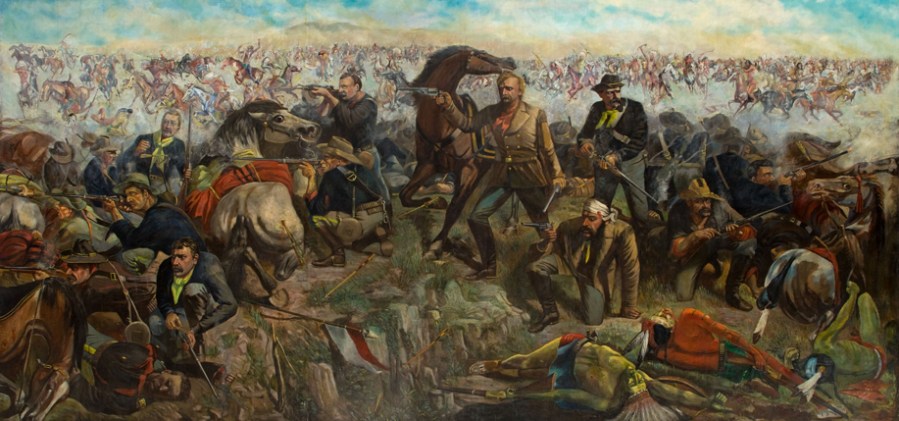
One hundred and three Irish soldiers perished on that fateful day, and yet another Irishman, John Mulvany, realizing the popularity a canvas of the battle would create, painted his iconic “Custer’s Last Rally,” which remains today one of the most celebrated paintings of the American West.

Custer’s Last Rally, painted by John Mulvaney (Photo sourced: Internet)

In the 1870s, the hard and dangerous life of an American cavalry trooper was still the best option for many poor, newly arrived Irish immigrants. In 1875, Custer’s 7th Cavalry was full of Irish-born recruits when gold was discovered in the Black Hills of South Dakota, the sacred ground to the Lakota. These soldiers must have known the danger they faced when the United States claimed the land and invaded it, despite treaties the American government had signed with the Lakota, guaranteeing them its ownership. The military’s armed incursion into the area led many Sioux and Cheyenne tribesmen to leave their reservations, joining the rebel leaders, Sitting Bull and Crazy Horse, in Montana. By the spring of 1876, more than 10,000 Native Americans were camped along the Little Bighorn River – defying a War Department order to return to their reservations and setting the stage for the famous battle.

The charismatic General George Armstrong Custer and almost 600 troops of the 7th Cavalry rode into the Little Bighorn Valley, determined to attack the native encampments. Riding with Custer were over 100 Irishmen, ranging in rank from newly recruited troopers, many of whom could barely control their mounts, to Captain Myles Keogh, a heroic veteran of the Civil War from County Carlow. There were 15 Irish sergeants and three Irish corporals in Custer’s command, the backbone of his noncommissioned officers.

Today, we imagine Custer wearing his trademark buckskin jacket – it was sewn by an Irishman, Sergeant Jeremiah Finley from Tipperary, the regiment’s tailor. The song of the 7th Cavalry was another Irish influence. Just prior to Custer’s arrival in Fort Riley, Kansas, where he took command of the 7th Cavalry, Custer ran into an Irish trooper who, “under the influence of spirits,” was singing “Garryowen,” an Irish song. Custer loved the melody and began to hum the catchy tune to himself. Custer made it the official song of the 7th Cavalry and it was the last song played before Custer and his men separated from General Terry’s column at the Powder River and rode off into history.

Centre section of The Battle of Aughrim, by John Mulvany. (Photo sourced: internet

John Mulvany, who is known for his paintings of the American West and in particular “Custer’s Last Rally,” also painted “The Battle of Aughrim,” in 1885, which was exhibited in Dublin in 2010.
The battle, fought between the Jacobite and the Williamites forces in Aughrim, County Galway on July 12, 1699, it was one of the bloodiest battles in Ireland’s history, over 7,000 killed. 
The battle marked the end of Jacobitism in Ireland, a movement that aimed to restore the Roman Catholic Stuart King James II of England and Ireland (as James VII in Scotland) to the throne

Before the battle, the legendary Lakota chief Sitting Bull had a vision in which he saw many soldiers, “as thick as grasshoppers,” falling upside down into the Lakota camp, which his people saw as a foreshadowing of a major victory in which a large number of soldiers would be killed. Custer, however, blinded by ego and visions of glory, made a reckless decision to attack the huge gathering of Native Americans head on, saying, ironically, “Boys, hold your horses, there are plenty down there for us all.”

Foolishly splitting his command into three units, Custer tried in vain to attack and envelop the largest concentration of Native American fighters ever to face the American Army. The first assault against the Native American encampment was launched shortly after noon by three companies – 140 officers and men – led by Major Marcus Reno, whose men attacked along the valley floor towards the far end of the camp. Thrown back with many casualties, the survivors scrambled meekly for their lives to the top of a hill. Custer, with five companies totaling more than 200 men, advanced along the ridgeline, commanding the river valley on its eastern side. He further divided this force into two groups, one of them led by Captain Keogh.

There is debate about what occurred when Custer engaged the Native American forces just after 3 p.m. because the General and all his men were killed, so no one from Custer’s command could tell their tragic tale. Archaeological evidence suggests that Keogh and his men fought bravely, being killed while trying to reach Custer’s final position after the right wing collapsed.

On June 27, 1876, members of Gen. Terry’s column reached the Little Bighorn battlefield and began identifying bodies. Keogh was found with a small group of his men and his was one of the few bodies that had not been mutilated, apparently owing to a papal or religious medal that he wore about his neck (Keogh had once served in the in the Battalion of St. Patrick, Papal Army). Although Captain Keogh did not survive the battle, his horse, Comanche, did. The horse, spared by the Native American fighters for its heroism, recovered from its serious wounds and was falsely honored as the lone survivor of the battle (many other U.S. Army horses also survived). Comanche was retired with honors by the United States Army and lived on another 15 years. When Comanche died he was stuffed, and to this day remains in a glass case at the University of Kansas.

Comanche, Keogh’s horse, which survived his master who died at the battle. (Sourced: Internet)

White Americans, shocked and angered by the defeat of Custer and his men, demanded retaliation. And they got it. Soon after, over 1,000 U.S. troops under the leadership of General Ranald Mackenzie opened fire on a sleeping village of Cheyenne, killing many in the first few minutes. They burned all the Cheyenne’s winter food and slit the throats of their horses. The survivors, half naked, faced an 11-day walk north to Crazy Horse’s camp of Oglalas.

The victory at Little Big Horn marked the beginning of the end of the Native Americans’ ability to resist the U.S. government, but 37-year-old John Mulvany from County Meath saw opportunity in the tragedy.

John Mulvaney, photo by Anne Webber (Sourced: Internet)

12 YEARS OLD IN THE USA

Mulvany arrived in America as a 12-year-old. He went to art school in New York City and became an assistant of famed Civil War photographer Mathew Brady. He later covered the Civil War as a sketch artist for a Chicago newspaper, developing an amazing ability to capture battlefields on canvas.

Mulvany knew that a painting of the fight would be a sensation. He visited the battlefield twice and also found Sitting Bull in Canada so that his painting could capture even minute details of the battle and its combatants. Mulvany finished the epic 11 ft. x 20 ft. canvas in 1881, which was hailed as a masterpiece, and began a 17-year tour of the United States. The canvas made Mulvany the toast of Chicago, but his good fortune would not last.

Sitting Bull of the Lakota, photo by William Notman. John Mulvany sought him out to consult him about the Battle of the Little Big Horn. (Image sourced: Internet)

Mulvany eventually sold his painting and ended up destitute in Brooklyn, where he drowned in the East River in 1909 in what many labeled a suicide. Mulvany quickly became forgotten, but not the fame of his great canvas, which recently sold for $25 million. Mulvany painted many great works, but they are lost and there is a concerted effort to find these missing canvases. Perhaps we will soon find more works of this great, tragic Irish painter.

end.

The Defiant Sprit of the Lakota Nation

Geoffrey Cobb

(Reading time: 8 mins.)

If people know anything about the Lakota nation, known to Americans as the Sioux, then it is the 1876 Battle of the Little Bighorn, in which the Lakota dealt the United States Army a humiliating defeat, completely destroying the Seventh Cavalry of General George Custer. This battle, however, was merely one chapter in the continuing struggle of the Lakota people against the ongoing colonialism practiced by the United States government.

Lakota houses on reservation land. (Photo: Larry Towell/ Magnum Photos New York Times)

The Lakota, a semi-autonomous people whose reservations occupy huge Areas of North and South Dakota have defined themselves over generations by stubbornly clinging to their culture, language and values against the forces of cultural assimilation wielded against them by the United States government.

In the 1860s, conflict arose as settlers entered the Lakota homeland, which covered a huge swath of the American Great Plains. A nomadic people, the Lakota lifestyle centered around hunting the massive herds of bison. The Lakota signed treaties protecting their homeland in 1851 and 1868, but the United States government broke them before the ink was even dry. After the disaster at Little Big Horn, the American army hungered for revenge and it responded with a campaign of terror, beginning with the Wounded Knee massacre, in which soldiers slaughtered hundreds of Native people, including women and children.

American bison — main resource of the nomadic plains tribes for food, clothing, tools and weapons (Photo source: Wikipedia)

The sovereignty of the Lakotas depended on bison, and the American government embarked on a program of systematic extermination of these herds, In a three-year period, hunters butchered more than three million bison, close to 3,000 animals a day. Their food source gone, the Lakota were forced to end their armed struggle and live on reservations, which was often the poorest and most desiccated land.

The genocide of the Lakota through the extermination of the American Bison — a mountain of bison skulls. (Photo source: Wikipedia)

The Lakota were to experience even worse horrors than the destruction of their traditional way of life. Their very culture was targeted for extermination. The American government mounted a nearly 100 year-long calculated assault on the Lakota as the state tried to force them to assimilate. The government banned the Sundance, the Lakota’s most sacred ceremony, with its days of fasting and ritual bloodletting and they were forbidden to openly practice their religion. However, perhaps most devastating to the Lakota psyche were the boarding schools, in which generations of Indians were forced to assimilate into white culture. Lakota children were severely beaten for even speaking their native tongue. As a result, many Lakota began to doubt the worth of their indigenous culture and lack of cultural pride still is an issue haunting many Lakota today.

The Lakota still struggle to cope with the attempts to destroy their culture. Their reservations are the scenes of grinding poverty. The Lakota have tragically high rates of unemployment, alcoholism, drug addiction, family abuse and suicide. There is a severe housing shortage on the reservations, which has magnified the effects of the covid pandemic on the Lakota.

Lakota culture, though, proved difficult to exterminate and their faith survived. Central to that faith is the belief that nature is our mother and that humans should live in harmony with nature. This belief manifested itself in 2014 when the Dakota access pipeline was announced. The 3.78 billion dollar underground oil pipeline was intended to run for 1,172-mile-long (1,886 km) across Lakota lands. The Lakota immediately objected to the project because it not only threatened the Missouri River, their water supply, but also would destroy sites of cultural, historic and religious significance to the Lakota.

A dead car carries a live message on Lakota land. (Photo: Larry Towell/ Magnum Photos New York Times)

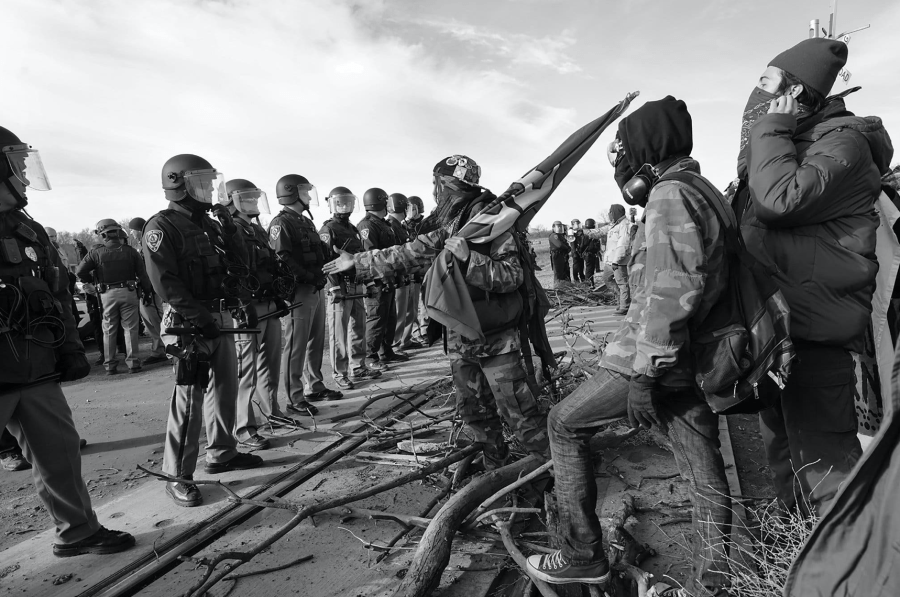
In the Spring of 2016, The Lakota mobilized to protest the pipeline, but it seemed like David fighting Goliath. The protests, which lasted months through sub-zero winter temperatures, were organized by Lakota teenagers on the Standing Rock Reservation. In the vanguard of the protesters were women who defied mace attacks, arrests and strip searches. The police used teargas, bulldozers and “military-style counterterrorism measures” to suppress the protesters, but the Standing Rock protests attracted tens of thousands of Native Americans from across the continent, becoming the largest Native American demonstration against the government in over a century. The rallying cry of the protestors in Lakota was “Mni wichoni! Water is life!” The protests became a cause célèbre, drawing media attention from around the world, as international environmentalists supported the Lakota defiance.

President Donald Trump supported construction of the pipeline and spoke out in favor of crushing the Native American protestors, but in a shocking decision on August 5, 2020, a district court ruled in favor of the Lakota. ” Mike Faith, the chairman of the Standing Rock Sioux Tribe, expressed delight at the verdict, “Today is a historic day for the Standing Rock Sioux Tribe and the many people who have supported us in the fight against the pipeline.”

Trump, though, was not finished in his battle with the Lakota and would continue disrespecting them. Trump deliberately chose to target the Lakota by celebrating the July 4th holiday of American Independence at an inflammatory site: Mt. Rushmore, where massive heads of American presidents were carved into mountains the Lakota hold sacred. “Wherever you go to connect to God, that’s what the Black Hills are to the Lakota,” said Nick Tilsen, a member of the Oglala Lakota tribe and the president of NDN Collective, an Indigenous activist group. Prospectors seized the land during a gold rush in the 1870s, violating the Fort Laramie Treaty of 1868, which recognized the Black Hills as Lakota property. In 1980, A Federal Judge sided with the Native Americans in a suit to reclaim the Black Hills but awarded them a monetary settlement in lieu of the land. The Lakota, offended by the decision, have never touched the money.

(Photo: Larry Towell/ Magnum Photos New York Times)

The statues were carved by a white supremacist with strong ties to the Ku Klux Klan. Harold Frazier, the chairman of the Cheyenne River Sioux Tribe, called the monument a “brand on our flesh” that needed to be removed. He said,” Visitors look upon the faces of those presidents and extol the virtues that they believe make America the country it is today. Lakota see the faces of the men who lied, cheated and murdered innocent people whose only crime was living on the land they wanted to steal.” Washington and Jefferson were both slave owners, and Lincoln ordered the hanging of 38 Lakota men in Minnesota after an uprising of 1862. Theodore Roosevelt once said, “I don’t go so far as to think that the only good Indians are dead Indians, but I believe nine out of every ten are.”

Trump’s arrival again spurred Lakota protests and at least fifteen activists were arrested for blocking the highway leading to Mount Rushmore. One of the activists, Michael Patrick O’Connor, said he came because he wanted to express his outrage at the desecration of his people’s sacred lands and his frustration at a president who has failed the people of America. “I couldn’t find any reason not to be up here,” he said. “I felt like I owed it to the grandmas and grandpas, owed it to the people who suffered before us to do something and to come here because our people were gathering.”

Campaign banner during the struggle (Photo sourced: Wikipedia)

Good Voice Elk, a spiritual advisor for the Lakota, was among the older protestors. He said this was by no means his first protest. “I grew up in protests,” he said. “The seventies were really bad, and those kids, now they are the leaders.” Protesters ranged in age from senior citizens to children as young as 10. One girl was brought by her father from the Ute Mountain tribe in Colorado so she could experience Indigenous communities coming together.

Nick, Tilsen, the leader of the non-violent protest, has been singled out for retribution by local officials. He is facing felony charges that bring his potential prison sentence to 17 years. Tilsen is just the latest victim in the American government’s attempt to crush Lakota resistance. Despite the heavy-handed response to the protests, it’s hard to imagine the tenacious Lakota giving up anytime soon.

End.

USEFUL LINKS

Defend, Develop, Decolonise collective: https://ndncollective.org/