IN SOLIDARITY WITH THE PALESTINIAN RESISTANCE, THOUSANDS MARCH IN BASQUE CITIES

Diarmuid Breatnach

(Reading time: 4 mins.)

Thousands marched recently in two cities of the Basque Country, Bilbo and Iruña/ Pamplona,1 respectively the capitals of the Bizkaia and Nafarroa2 provinces, in solidarity with the Palestinian people and with their Resistance.

And almost immediately posters could be seen calling for the same on the 11th November, but in four Basque cities, including a city in one of the provinces on the French state’s side.3

“Well that’s great but sure we do that here every second week or so,” some might say. But they’d be wrong. The marches organised by the Ireland Palestine Solidarity Campaign, while calling for solidarity with the Palestinians and BDS4 of the ‘Israeli’ state and businesses, do not support the Resistance.
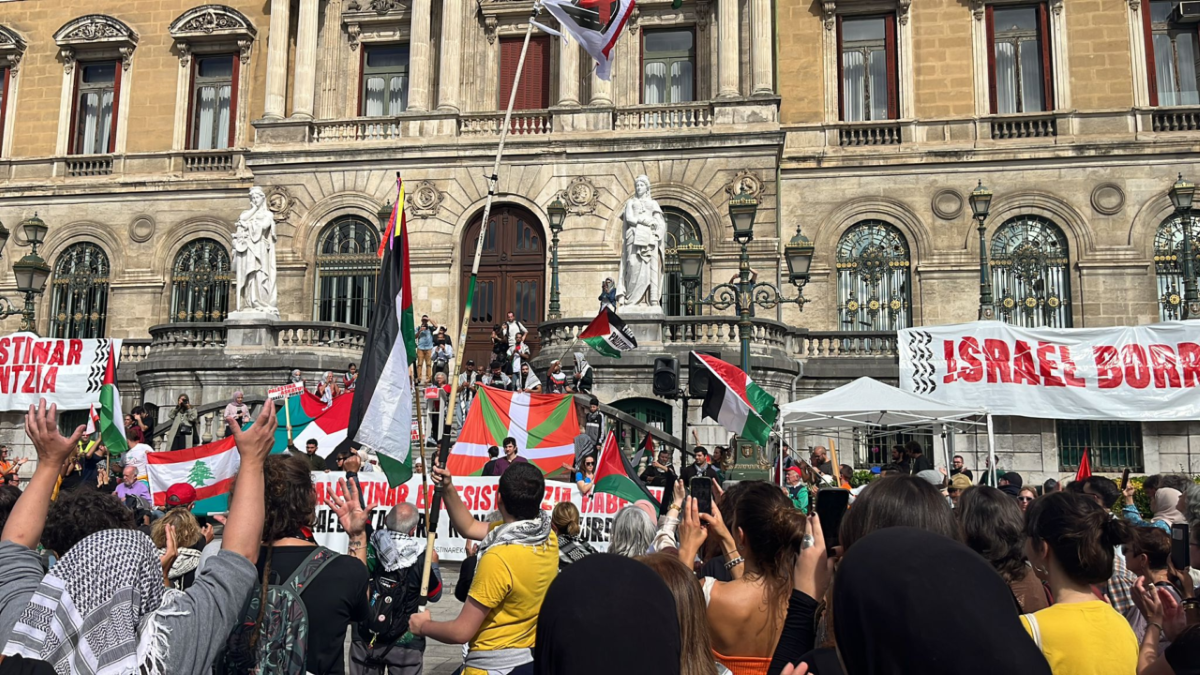
The rally stage at the end of the march in Bilbao, on the east bank of the Nervion river. Banner exalting the Resistance in the centre facing the crowd, banner to the left calling for solidarity with the Resistance and another to the right calling for struggle against ‘Israel’. (Photo cred: Resumen Latinamericano)

Nor do the marches organised by the main Palestine solidarity organisations in England or in Scotland. It might be pleaded that in the UK at least, people could be arrested for declaring support for a number of Palestinian resistance organisations that are on the EU “terrorist” list.5

The leadership of the Basque Patriotic Left6 does not support the resistance either, preferring to draw the Palestinians and Basques together as victims under a Gernika-Gaza initiative and even criticising the resistance along with the Zionists in a “both sides” kind of analysis.

But no law exists in these countries forbidding expression of “solidarity with the Palestinian Resistance.” The organisers of those campaign organisations don’t declare for the Resistance because a) they don’t support it or b) wish to remain tolerated by the upholders of the status quo.

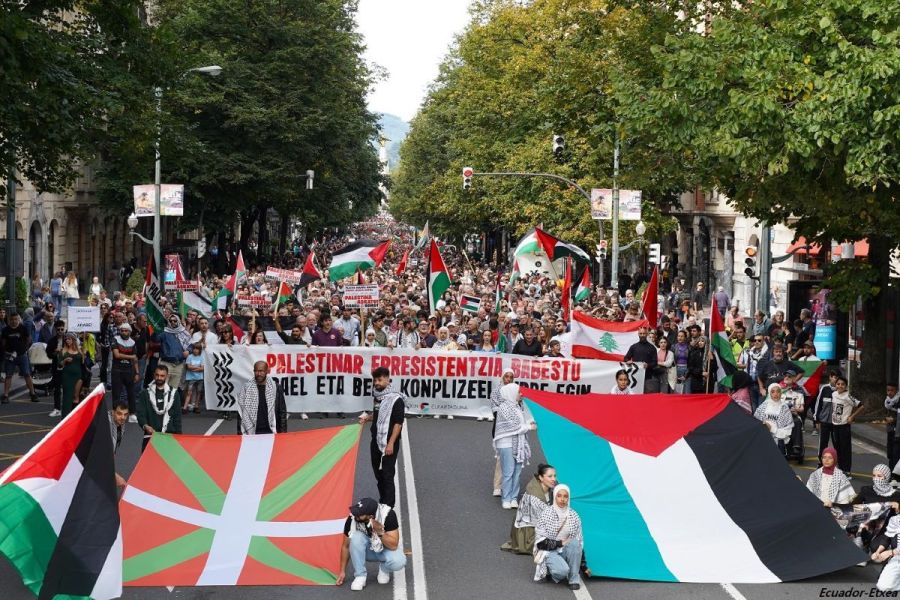
View of section of the crowd, giving an idea of its size, the largest Palestine solidarity demonstration in the Basque Country since the present phase of Zionist genocide began on 8th October last year. (Photo cred: Resumen Latinamericano).

IT MATTERS

Well, ok, but does it really matter? Yes, it does and it matters a lot, for the Palestinians, for others struggling against imperialism elsewhere around the world – and for us. Not supporting the Resistance leaves open the question of, for example, the Palestinian Authority.

This Vichy-like organisation headed by a corrupt Quisling sends its security force to intimidate and beat up critics and demonstrators, to arrest them and also Resistance fighters (including invading hospitals to chase down the wounded) and removes defences against IOF invasion.

The PA, despite its widely-acknowledge corruption and the contempt in which it is held by broad Palestinian society, is formally recognised as the ‘representative of the Palestinian people’ by the western imperialists and by many social-democratic parties in Europe.

It is an offence against the Palestinian people and internationalist solidarity to accept the PA as any kind of representation of the heroic Palestinian people – or even to leave the question open. Furthermore, such a stance leaves the door open to all kinds of traitors and confusion.

In our own struggles, we need to be clear who are our enemies and friends. To accept treasonous agencies as representatives of struggling people contaminates our own attitudes in struggle, confuses and undermines our thinking, clouding our vision.

A woman holds high a placard calling to “Free Palestine” and to “Boycott Israel.” (Photo sourced: Internet)

BEING CLEAR AND MAKING IT CLEAR

We need to be clear – and to make it clear – that we support the Palestinian resistance in all its forms: popular, armed, trade unionist, cultural, artistic … and that we abhor collaboration and collusion with the enemy.

We can do that – and it has been done on occasion – by mobilising all who agree on a demo behind a banner celebrating the Palestinian Resistance. But how much better, if like the Basques today in Bilbao and in Iruña/ Pamplona, the whole demonstration marched behind that kind of slogan!

It might be thought that the demonstrations on 5th October would gather less than the safer Gernika-Gaza group of the official leadership of the Left Basque Patriotic movement (Otegi & co.) and other liberals but this was not the case in Bilbo anyway, on the biggest solidarity demonstration since October last year.

Advance posters for the solidarity march. (Photo sourced: Internet)

Two Palestinian Resistance factions, the Popular Front for the Liberation of Palestine and the Democratic Front for the Liberation of Palestine sent messages of thanks to the organisers and the demonstrators.

The demonstration and its theme were covered widely in Basque, Spanish, European and Latin American media, usually with photos.

Addressing the rally after the march in Bilbo on 5th October, a speaker listed the many crimes of the Zionist State and was loudly cheered when she said that only the abolition of that state could bring that career of genocidal crimes to an end.

The cheers grew louder still as she called for solidarity with the Palestinian resistance and all others fighting against imperialism and Zionism. And continued as she went on to call for a break with all states and political parties that support the Zionist State.7

The cheers might even have reached EH Bildu’s office and the leadership of the Gernika-Gaza group.

The march on its way to the rally across the river pauses on the way for photos. The long banner calls for “Support for the Palestinian Resistance” but also ” Oppose Israel and its accomplices.”(Photo cred: Boltxe)

End.

FOOTNOTES

1A number of places with Basque toponymics, under Spanish colonialism, were given Spanish names.

2Also known as ‘Navarre’ and ‘Navarra’.

3There are seven provinces in the Basque Country, three on the French side of the Border (Iparralde, ‘the North Country’) and four on the Spanish side (Hegoalde, ‘the South Country’).

4Boycott, Divestment and Sanctions

5https://www.gov.uk/government/publications/proscribed-terror-groups-or-organisations–2/proscribed-terrorist-groups-or-organisations-accessible-version There is actually no universally agreed definition of ‘terrorism’ neither in objectives nor in actions but if we were to accept “use of violence to achieve a political end” then we’d had to include the chief actors fitting that definition in the world – the western imperialist states, in particular the USA and the UK!

6That was the broad movement of legal and banned organisations of revolutionary Left and independentist outlook, the movement now reformist, much reduced and fragmented under the leadership of Arnaldo Otegi and the EH Bildu party.

7That clearly includes the conservative Basque Nationalist Party (PNV) and the social-democratic Spanish Socialist Workers Party (PSOE) currently in coalition government in the Basque Autonomous Regional Government.

SOURCES
THE REPRESENTATION OF REVOLUTIONARY ICONS

The role of culture in revolution is of great importance – greater even than that of the armed struggle, certainly in the initial and later stages. We are created by evolution but we are born into and raised in culture.

The question of whether that culture is to be revolutionary or liberal is of crucial importance.

I have remarked on how Mandela, jailed for his revolutionary armed activities, was marketed as a peacemaker and later became a figurehead of pacification of the South African struggle. Bobby Sands, a revolutionary fighter to the last, has also been represented as a peaceful icon.1

And so also was Terence McSwiney who, like Bobby Sands, died on hunger strike.2

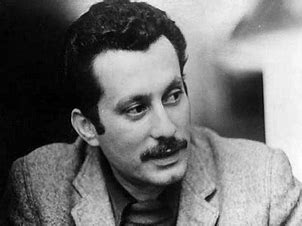
The following article from Resistance News Network, reflecting on the work of the revolutionary writer Ghassan Kanafani who was murdered by Israeli Zionism and his subsequent representation as an icon is I think of substantial interest. D.Breatnach

Translated by Resistance News Network
Originally by 
Nidal Khalaf, 16 July 2022

(Reading time: 6 mins.)


Ghassan the poet? Ghassan the Palestinian? No, 
Ghassan the revolutionary!

In colonial wars, the creation and dissemination of symbols to the public is a crucial battle in the war of consciousness building, even if its effects are not clearly visible in the present.

Perhaps the most prominent example of these battles was the image of Che Guevara in the wars of liberation in Latin America. Ernesto Guevara’s persona represented an individual model that encapsulated the revolutionary spirit of people fighting for their freedom from American hegemony.

As the American empire recognized its inability to destroy Guevara’s image, they transformed his image into a consumer commodity.

This was to divert his image from its original revolutionary meanings and repurpose it in the service of economic and cultural agendas that contradicted Guevara’s own principles and what he represents.

In the Arab context, the war to liberate Arab symbols from the captivity of history monopolists continues to intensify, as it involves obscuring forgotten heroes in favour of fabricating mythical legends designed to tamper with the boundaries of nationalism and betrayal in the Arab mind.

In this context, the fiftieth anniversary of the assassination of the martyr Ghassan Kanafani is being observed, with pages and websites filled with commemorations of Ghassan’s life, his quotes, and his most significant works.

It is no longer surprising that Ghassan Kanafani is celebrated on both normalization platforms as well as liberal ones, when voices are raised to commemorate Ghassan even as they are in the heart of the hostile project under the umbrella of its military bases.

Thus, the question arises: which Ghassan Kanafani are we commemorating today? And how do we protect the Ghassan we know?

Ghassan Kanafani’s life provided rich material for readers, followers, and analysts after his martyrdom.

However, the perception of Ghassan was not independent of the political contexts of the recipient interpreting his word, resulting in multiple “versions” of Ghassan Kanafani, some of which we review below.

Ghassan Kanafani: The Writer (only?)

The most widespread version of Ghassan Kanafani is that of a “writer” who wrote stories, plays, and depicted the Palestinian reality.

The spread of this version may be justified since Ghassan’s literary works are the most popular among people and have played a significant role in spreading his name.

However, confining Ghassan Kanafani to the realm of “literature” is not always innocent, and in some respects, it is a deliberate reduction of Ghassan Kanafani’s political work.

Ghassan was responsible for mobilization, media, and was a part of the political decision-making circle in the Popular Front for the Liberation of Palestine since it was part of the Arab Nationalist Movement. He remained in this role until his martyrdom.

Moreover, Ghassan’s literary output never compromised or was at the expense of his political positions or took precedence at any point in his career.

In terms of production, his political studies, research, articles, and editorial journalism are as abundant and important as his narrative and theatrical works.

Even the latter were never detached from the political context; instead, the narrative served as a framework through which Ghassan conveyed his political, social, and even philosophical ideas.

Consequently, the image of Ghassan as “the writer engaged in politics” falls away, replaced by the truth of Ghassan — the politician who harnessed literature in the service of a political cause.

The danger of this deliberate reduction lies in paving the way for a sanitized image of Ghassan Kanafani, presented to the public by liberal (and even normalization) pages and platforms to gain credibility in Ghassan’s name.

Kanafani tackles a fundamental dilemma that burdens our political reality to this day, which is the crisis of “the prioritization of internal change over liberation.”

Thus, reductionism turns into deliberate distortion, making Ghassan Kanafani’s name a “honey” slipped into the poison of isolationist, liberal, and anti-resistance ideas on our land under the guise of freedom and liberation.

Otherwise, how can we understand the celebration of Ghassan Kanafani by liberal platforms and influencers at Al-Udeid Air Base?

Ghassan Kanafani: the Palestinian (only?)

One of the unjust reductions of Ghassan Kanafani is the confining of his personality and his works to “Palestine,” as delineated by colonialism.

Again, one can find an excuse for this reduction because Palestine represents the primary aspect of Kanafani’s political and literary identity, and his experience is closely tied to the general Palestinian experience of war, forced displacement, diaspora, and the struggle for return.

Some people overly emphasize Ghassan’s Palestinian identity, overshadowing his Arab dimension, which he never concealed.

In reality, examining Ghassan Kanafani’s political studies unveils to us the truth of Ghassan as an Arab nationalist thinker who worked hard and struggled to develop practical frameworks for Arab revolutionary theory.

This is made clear in his in-depth study, “The Arab Cause in the Era of the United Arab Republic,” where he discusses the essence of the imposed war on our region, identifying enemy and friend camps, and ultimately defining the main goal of the war: liberation as a condition for unity and renaissance.

Ghassan further elaborates on this study’s conclusions in another study titled “The Revolutionary Applications of Arab Nationalism,” published in 1959, in which he masterfully details the concept of Arab unity and the tools for its practical implementation.

Ghassan Kanafani goes beyond this by considering the confrontation of isolationist (regionalist) thought a revolutionary necessity, describing “isolationism” as something that “contradicts the nature of the formation of societies.”

Isolationism or “regionalism” are anti-unity tendencies, based on defining society’s interests from colonial borders and treating each Arab state as “independent” in itself, as Sykes and Picot intended.

Kanafani tackles a fundamental dilemma that burdens our political reality to this day: the crisis of “the prioritization of internal change over liberation.”

No better formulation to this question can be found than Ghassan’s own words when he stated that “raising the concept [of focusing on internal development first] is a deliberate exclusion of the popular current directed towards unity with determination,

and diverting it to side and regional battles that are easily manipulated (as long as each Arab country is not -nationally- at a level of complete liberation worthy of proper social construction).”

Ghassan concludes his argument by asserting that “unity is a prerequisite of the renaissance… even its regional aspect.”

We mention these ideas as examples of Ghassan Kanafani’s Arab nationalist thought, which fundamentally opposed isolationism and the canned projections of Marxism and others, with strength and clarity.

Therefore, the celebration of Ghassan by the proponents of these ideas indicates their exploitation of Ghassan’s legacy (from their side) and a significant failure in protecting Ghassan (from the side of those who believe in his ideas).

How, then, do we protect Ghassan Kanafani?

The starting point lies in defining ourselves. Are we believers in Ghassan Kanafani’s approach and vision for the ongoing conflict on our land, which comes at the expense of our blood, lives, and destinies?

If so, our foremost duty is to reclaim Ghassan Kanafani from the chains of cheap consumerism and to present him to the public in his true and impeccable form: an Arab nationalist fighter who made among the most significant contributions to modern Arab revolutionary theory.

Additionally, our responsibilities also include reviving the spirit of party work, in which Ghassan was a pioneer, and correcting the Arab party frameworks to harness the wasted energies in the prisons of virtual activism,

within the halls of “non-governmental organizations” and the labyrinths of despair and discouragement.

Our obligation towards Ghassan Kanafani demands that we comprehend our reality and its conditions and that we clearly define our goals, grounded in a deep conviction in our civilizational role as a nation.

We must believe that the liberation of the land is a step towards unity, and that unity is a prerequisite for the renaissance that will elevate us to our rightful civilizational status among nations. Finally, here is a part from Ghassan Kanafani’s ongoing will:

“A human being who does not live the average of sixty years will not find enough space to live peacefully; instead, they will carry the crisis from the moment they are born… and pass it on to their children at the hour of their death.

“The results of this struggle will be for a generation we do not know when it will arrive, even though we are optimistic about witnessing its early days towards the end of our lives…

“Our only reward may be that the next generation, the happy generation that will enjoy our victories, will envy us for having earned the honour of living in the age of struggle for life. And that is enough for us temporarily.”

End.

Footnotes

1In particular by the constant reproduction of his statement that “our revenge will be the laughter of our children”, completely abstracted from his role as an armed freedom fighter and what he wrote in support of that.

2Similarly to Bobby Sands, his statement that is those who who endure, rather than inflict the most who will triumph. The statement taken in isolation seems to endorse passive resistance but McSwiney was an officer of the IRA in the War of Independence, a role skated over in the Wikipedia entry dedicated to him.