

Diarmuid Breatnach
(Reading time: 9 mins.)
Friends and relations of Terence Wheelock and supporters of the campaign for justice for his family rallied outside the GPO Thursday afternoon before marching to Leinster House and on to the Department of Justice.
Terence Wheelock was 20 years of age when he was arrested by Gardaí following a car stealing by others in Dublin and taken to Store Street Garda Station. Subsequently he was removed to hospital in a coma from which he never recovered, dying three months later.

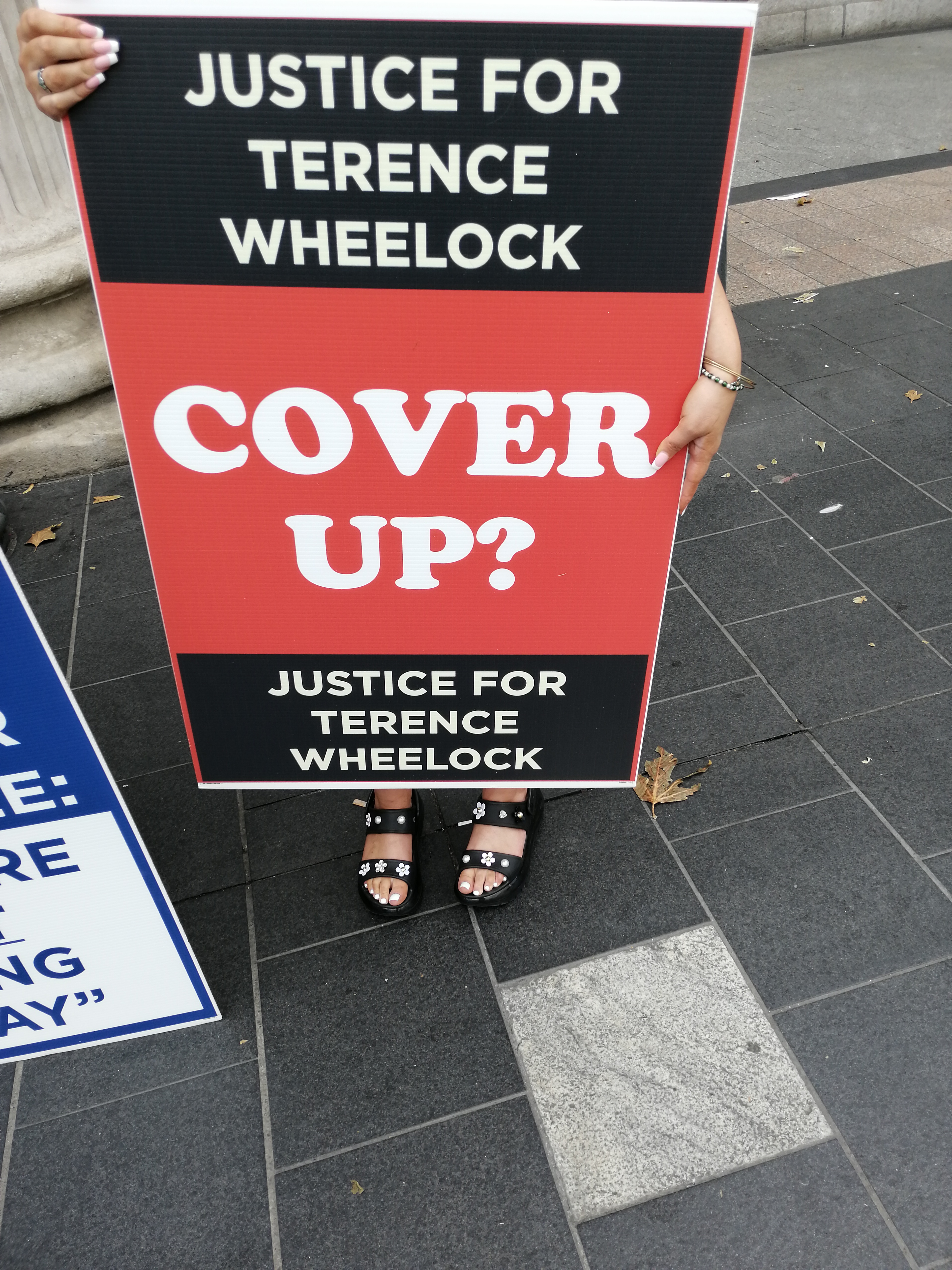
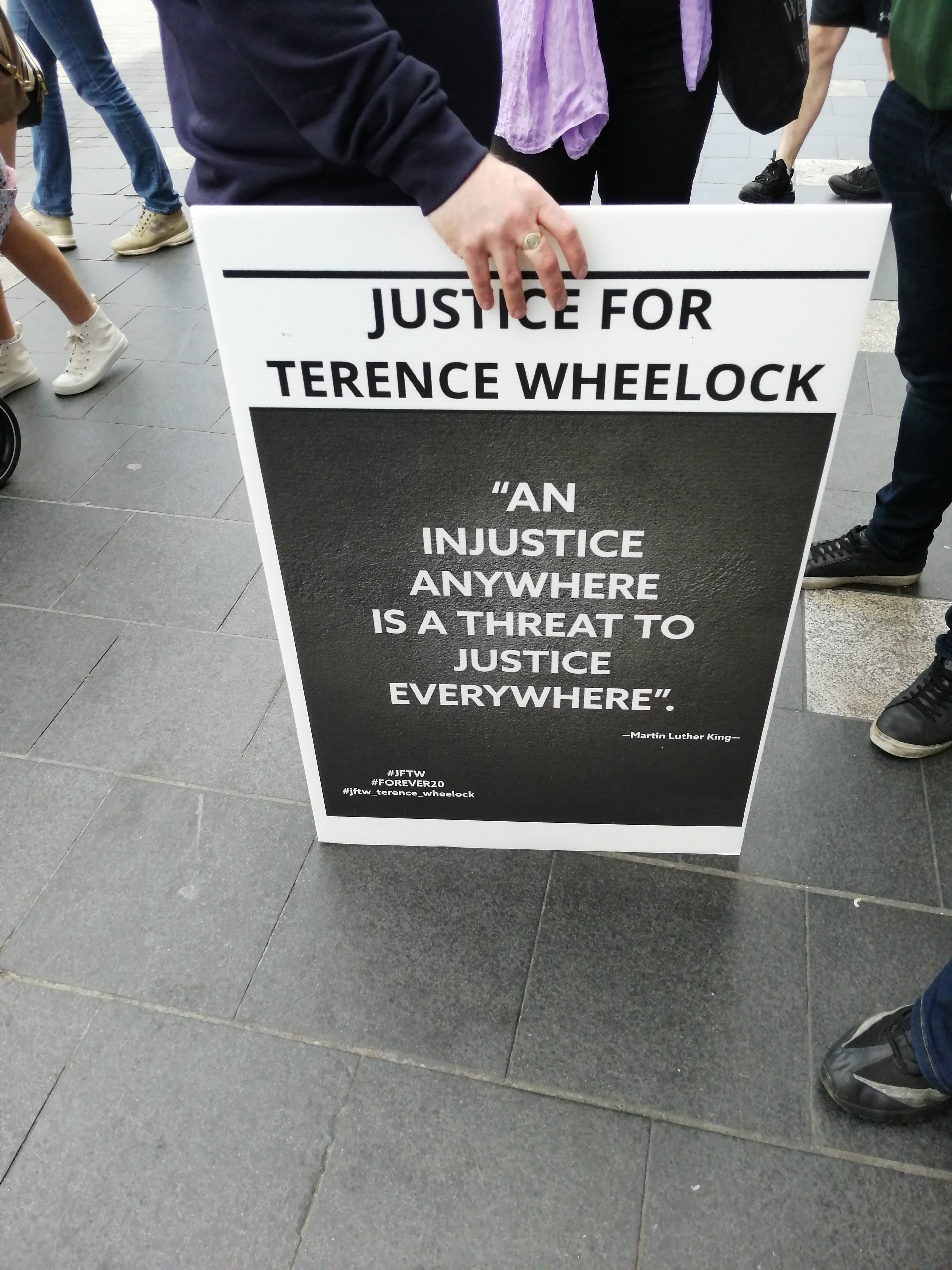
The cause of the coma? A severe beating. Not that it should be relevant but he had nothing to do with the car stealing and has been officially cleared of involvement. On the day of his arrest, Terrence was on his way to buy a paintbrush to decorate his room and stopped to talk to some youths he knew.
Though this occurred 18 years ago the family has not ceased seeking acknowledgement of the Garda crimes and are now insisting on an independent official enquiry.

MARCH THROUGH CITY CENTRE & THREE RALLIES
Wheelock family supporters, including people from Terence’s north inner city area, socialists, socialist republicans, anarchists and independent activists gathered at the advertised rally point outside the iconic building of the General Post Office on Dublin city centre’s main street.
James O’Toole of Rebel Telly briefly addressed the march supporters outside the GPO before the march set off, speaking about antisocial behaviour in the city and its connection to deprivation of working class areas, a fact admitted by the Gardaí in a report, a copy of which he held aloft.

Large printed placards were provided with a variety of texts – one also carrying Terence’s image – and most participants carried one for a group photo and again as they crossed O’Connell Street to march southwards to Leinster House, seat of the Irish Parliament.
Many tourists and shoppers watched with interest, read the placards and listened to the chants of call and reply led by Sammy Wheelock, older brother of Terence: “Say his name!” “Terence Wheelock!” “For justice to be imposed, the guilty must be exposed!” “Guilty:” “Garda!”
“What do we want?” “Justice!” “When do we want it?” “Now!” “No justice!” “No peace!” “Say his name!” “Terence Wheelock!” The driver of an occasional passing car or taxi blew its horn in solidarity as the march crossed O’Connell Bridge and swung around Trinity College.
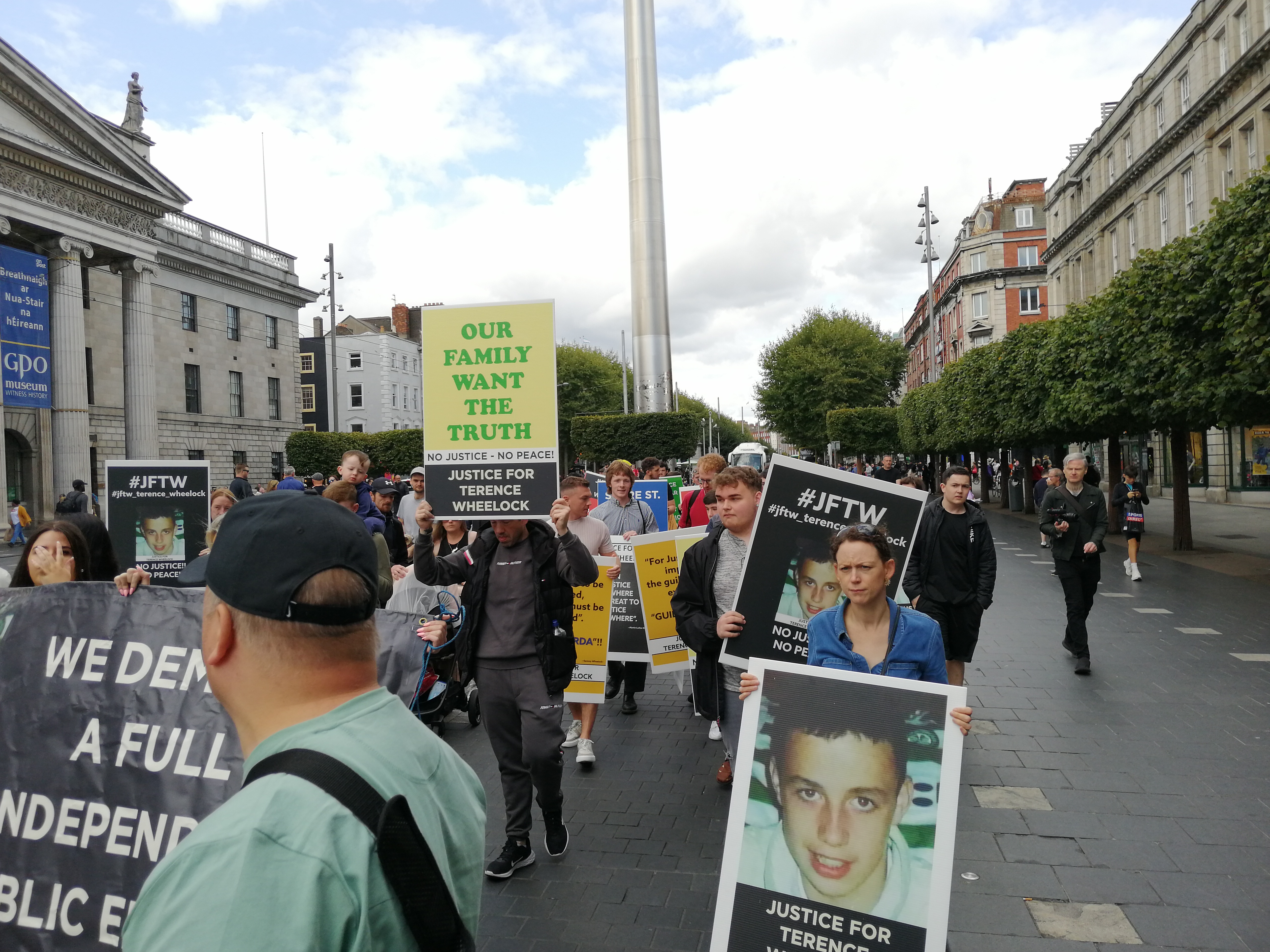
Outside Leinster House the marchers stopped for a second rally which was addressed by Sammy Wheelock and the slogans were repeated there too. Senator Marie Sherlock addressed the crowd also, promising her support for the campaign.
Cllr Madeleine Johansson, one of a group who recently fought a successful holding action against a mass eviction at Tathony House, also spoke at the rally outside the Dept. of Justice and quoted James Connolly as having stated that ‘an injury to one is an injury to all’.
Sammy Wheelock then led the crowd on again chanting slogans in a march up Kildare Street, left at the Shelbourne Hotel and right again, along the buildings facing Stephens Green to the Department of Justice building, where another rally took place.

GARDA HARASSMENT OF THE FAMILY
Larry Wheelock, another brother of Terence’s, had been the driver of the campaign but died in January last year. Outside the Department of Justice building Sammy read a letter from his widowed mother Esther, who felt unable in recent years to attend the protests.
“When this whole ordeal first happened it left a hole in my heart so big that for me it’s like a window … or a door that won’t close because as his mother I refuse to let it go, our family refuses … my son was stolen from me at such a young age …” Mrs. Wheelock had written.
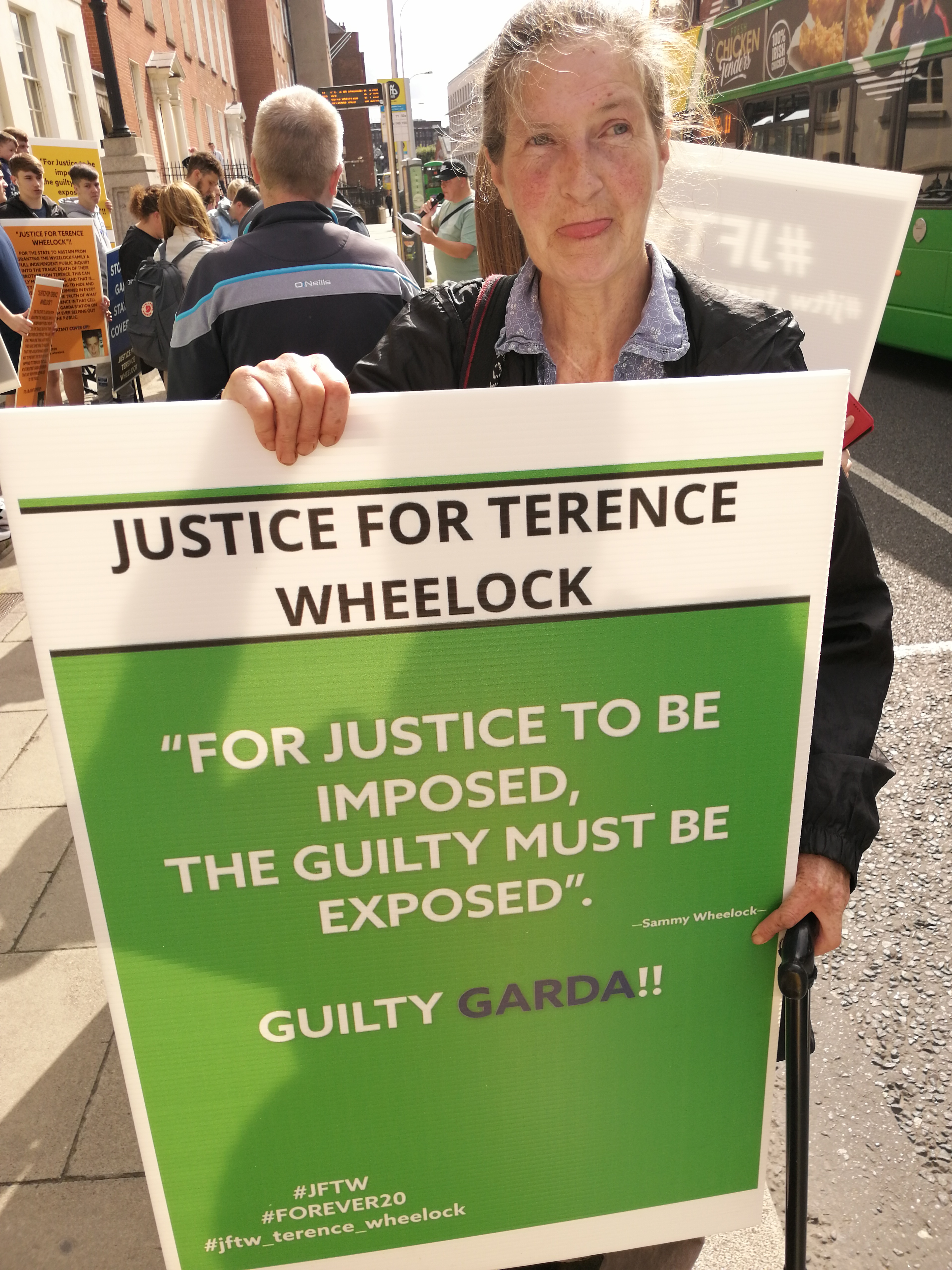
For a long time during the campaign for justice, as Sammy told the rally outside the Dept. of Justice Thursday afternoon, the Gardaí harassed the family home by passing at night in vehicles blowing their horns and riding police horses on to the road outside their house.
In addition the Gardaí also stood in the family’s garden and shone lights on to the windows, raided the house and struck their pregnant sister in the stomach, knocking her to the ground, also stopping and searching Trevor’s brothers in the street.
The Gardaí also drove slowly in their vehicles past Trevor’s younger siblings, laughing as they made ‘hanging’ gestures at them through the windows. Despite the harassment and intimidation of the family, they “are not going away”, Sammy said.

The initial ‘independent’ Garda investigation into Terence’s death, Sammy told his listeners, was headed by an officer who had spent 15 years of his career stationed at Store Street Garda station and it was no great surprise that he found that Gardaí had committed no wrong in the case.
Due to Terence’s case being in the public eye in 2006 when the Garda Síochána Ombudsman Commission (GSOC) was set up, it was the first case to be examined by them, Sammy Wheelock told the rally but once again the Gardaí were exonerated.
The Wheelock family believe such investigations, Sammy told the rally, are a case of “friends investigating friends”.
Announcing he was going to deliver a letter to Minister for Justice McEntee, Terence’s brother read its content out to the participants before mounting the steps to deliver the letter by hand to the Department of Justice, stepping inside for a period.

Shortly thereafter, Sammy Wheelock once again thanked the participants for their solidarity on that day and in the past and assured them that the campaign for an independent public enquiry would continue.

DEATHS IN GARDA CUSTODY
There were 34 fatal incidents in 2001 in which people died either in or shortly after Garda custody, official figures show; this represents almost three per month. The statistics also reveal a steady increase in such deaths over the years.
The Garda Síochána Ombudsman Commission (GSOC) compiles a database of what are known as Section 102 referrals, which involve situations where the conduct of a member of the Gardaí may have resulted in the death of, or serious harm to, a person.
However, GSOC has not separated referrals for deaths from those of serious harm, meaning the number of people who have died in garda custody is not available.
Vicky Conway, Associate Professor at DCU School of Law and Government, who sadly died prematurely last year, attempted to compile the data on deaths in custody and expressed concern last year that this information is not readily available and broken down into categories.

COMMENT:
The fatal treatment of Terence Wheelock by the Gardaí 18 years ago may or may not be an extreme case but the discriminatory treatment of working-class people is a pattern, of which violence often forms a part, followed by official collusion by ensuring impunity for the Gardaí.
The treatment of the family in their long campaign is a disgrace. It is said also that Terrence’s parents were told that he was in St. James’ hospital, which gave the Gardaí time to get to him first in the Mater and remove his clothes, which have never been produced for forensic tests.

It is of course of great importance to support campaigns to hold the repressive forces of the State to account, as pointed out by Conor Reddy (People Before Profit) to the rally at the Department of Justice building across from Stephens Green.
The message that revolutionaries give in such campaigns is of great importance in reflecting and strengthening the spirit of resistance of the working people, that it may serve them beyond overcoming individual injustices towards achieving justice for the class as a whole.
The reference at the rally outside the GPO by O’Toole to antisocial behaviour in the city, though a live subject at the moment, was inappropriate for the occasion since it could be understood to indicate that Terence had been engaged in such when he was arrested, which was not the case.

Marie Sherlock, a Labour Party Senator, addressing the rally outside Leinster House, of course put forward the liberal positions of “Garda accountability” and the equivalent of the “few rotten apples in the barrel” analysis of the police force of the Irish State.
While the support of a senator in Leinster House is to be welcomed, revolutionaries have to ensure that social democrats are not permitted to steer campaigns towards unhealthy compromise and that the liberals’ view of the State is countered by the more realistic revolutionary one.
The Gardaí were founded to be a first-line repressive force of the Gombeen Irish State, replacing the repressive police forces of the British occupation, the Dublin Metropolitan Police Force, the Royal Irish Constabulary, Black and Tans and Auxiliary Division.
Their second Commissioner appointed , Eoin Duffy, was the founder of the Blueshirt Nazis in 1932 and the force has amply demonstrated its anti-working class and anti-Irish Republican bias repeatedly since; if the “apple” analogy is to be used, we’d have to say that the orchard itself is rotten!
The death of a teenager is a devastating experience for any family but the importance of this case goes far beyond that of one family as was pointed out by a number of speakers and as is clear from some of the statistics quoted earlier.

Garda violence towards sections of the community followed by impunity cannot be tolerated and must be combatted. In that respect it is sad to note the low number of Irish Republicans in the campaign, though they tend to be the chief political target of Garda repression.
End.

References & Further information:
https://www.facebook.com/justicefor.terencewheelock
https://www.irishexaminer.com/news/courtandcrime/arid-40919204.html
 rebelbreeze