CIVILIAN CONCENTRATION CAMPS: ‘ISRAEL’, USA AND THE BRITISH

Diarmuid Breatnach

(Reading time: 5 mins.)

The Zionist state’s latest genocidal plan involves driving the inhabitants into a densely-packed area in the south of Gaza where they will be examined on the way in and then never allowed to leave unless to emigrate to another state.1

This plan was announced recently by ‘Israeli’ Minister of Defence (sic) Israel Katz and has been enthusiastically approved by a number of ‘Israeli’ politicians, including Finance Minister Smotrich.

It’s being suggested Katz’s plan is to be run by the GHF food-and-bullets organisation and to connect to Trump’s earlier remarks about turning Gaza into a seaside resort once the Palestinians had left. However, Trump and his administration have declined to comment on this latest plan.

The Gaza Humanitarian (sic) Foundation, responsible for the deadly food traps in Gaza, has been suggested as the organisation to run the concentration camp (also being called Humanitarian Camp). (Image: Cartoon by D.Breatnach)

But wasn’t Gaza previously a concentration camp? Well, it has been called “the largest open-air prison in the world”2 due to its intensified blockade since 2007 with Israeli control over who went in or came out.3 The intention was to make living intolerable but the Palestinians managed.

The refugees who came there from the Nakba in 1948 and 1967 Arab-Israeli War built houses, shops, community centres, mosques and churches, shops and markets, schools, colleges and university, farmed land and grew produce in polythene tunnels, dug wells, desalinated sea-water …

The IOF have destroyed nearly all of that (even roads and sewage treatment facilities) and now of course with water, fuel and food blockaded and frequent forced internal displacement, Gaza conditions are much much worse, with starvation andcontagious disease spreading.

This new plan however, is to compress the population into a smaller and smaller area, a concentration camp within that prison.
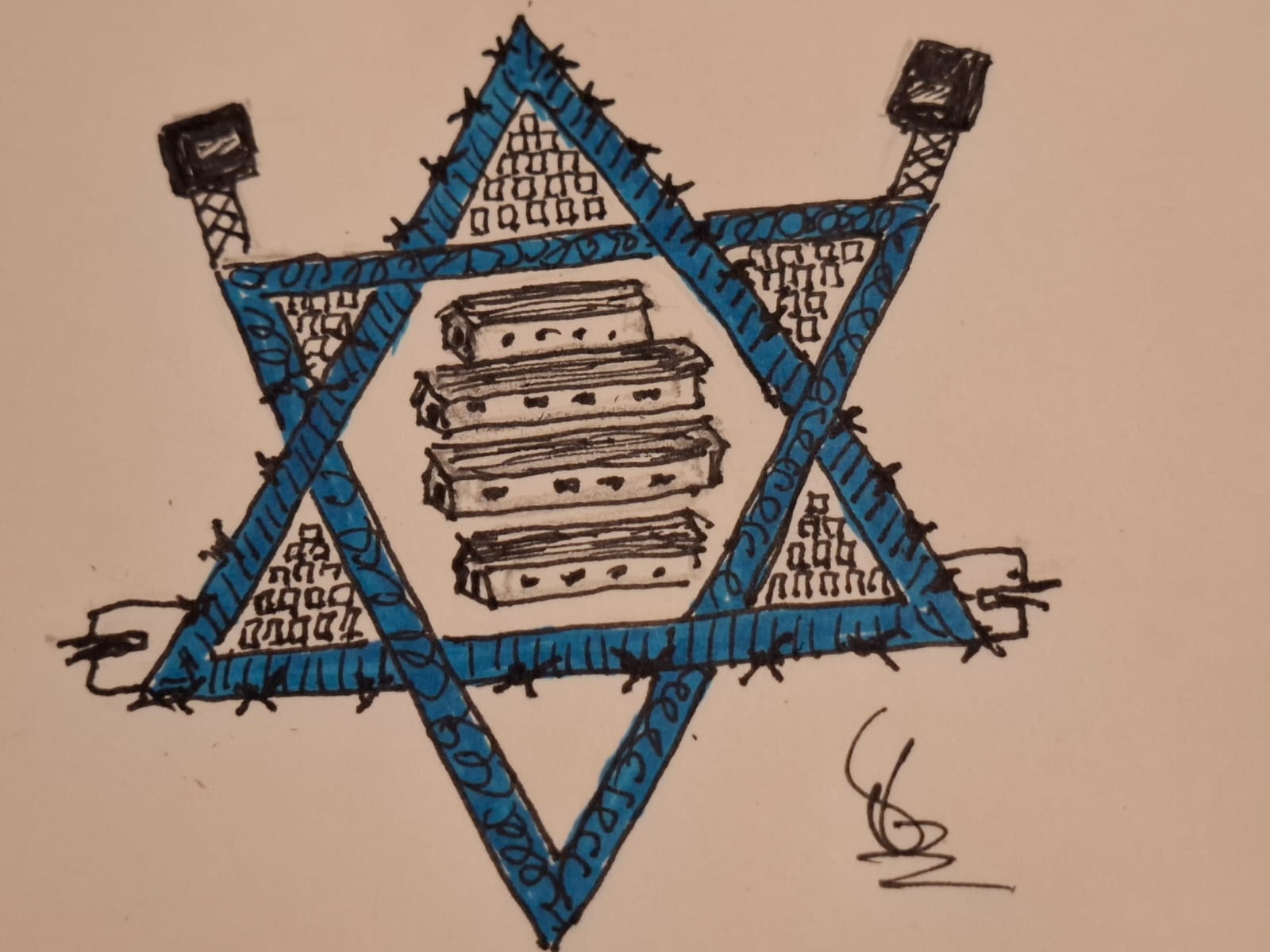
CIVILIAN CONCENTRATION CAMPS

The plan announced by the Zionazis is a concentration camp for civilians and this was in fact admitted by an Israeli journalist on one of their news channels. It’s fascist and racist but it’s not a new idea, having been practised by others including the British, USA and the Turks previously.

Concentration camps for civilians were used by the Nazis and Spanish fascists4 for example; in those cases their punitive function was clear. But during WWII the British interned Germans (including Jewish refugees) and allowed the Poles to run camps for dissidents in Scotland.

‘Concentration Camp’, drawing by David Ludwig Bloch. (Image sourced: Internet)

The British too built two Jewish concentration camps in Germany to prevent them from emigrating to the British Protectorate of Palestine, where the Zionists, encouraged to emigrate there by the British originally, were now destabilising British control and antagonising the indigenous people.6

The British also held Jewish civilians in a concentration camp in Cyprus, many of them Holocaust survivors who had tried to enter Palestine without British authorisation.7

During their war in Malaya (1948-1960) also the British ran civilian concentration villages, a model which the USA were to adopt later in Vietnam. These British measures were under the Briggs Plan and formed part of widescale repressive measures including forced deportations of Chinese.8

Those interned by the British in Frongoch concentration camp after the 1916 Rising were not all military personnel but included civilian members of Irish nationalist organisations.

The USA interned Japanese ethnic minority people during its war with Japan, allegedly as a purely security non-punitive measure. 1,862 deaths (out of 180,000) were recorded in those camps9 for which the USA did not apologise until 197610 or pay reparations until 1998.

The Imperial Japanese forces during the same war period established concentration camps in their conquered territories for civilians, mostly Dutch and British colonial settlers, administrative officials and their families. More than 140,000 of those died in the camps.11

Previously the USA had briefly used concentration camps against Native Americans but later shifted to removal and reservations policed by state-appointed officials. They also interned civilians, tens of thousands dying, in the US-Philippines War of 1898-1914.

In its war against the PKK (1978-2025) the Turkish State forced the evacuation of Kurdish villages where it felt unable to prevent guerrilla penetration, forcing relocation of the people and placing them under a collaborator administration in the new residential location.

The Turks also created a paramilitary police force to operate in the local areas but responsible centrally to the State which they called the Jandarma. In fact this was on the model of similar gendarmerie of the British in Ireland, of the Spanish, French and Italian states.12

Large rural areas of Turkish Kurdistan villages were cleared and relocated forcibly by the authorities. Arguably, despite the difficult conditions, the final defeat of the PKK was internal through adoption of a pacification process under the orders from captivity of their leader Ocalan.13

The village had Turkish-appointed guards and the headman was expected to ensure that the guerrilla forces did not enter and, if they did, to inform the South Vietnamese authorities (and through them the US military). Presumably he was also charged with informing them of ‘disloyal’ villagers.

Of course this put those recruited by the authorities in danger from the insurrectionary forces who viewed the guards and any collaborating headman as traitors. On the other hand, the headman might come under great pressure from the authorities to comply with their plan.

The USA’s version in Vietnam, the Strategic Hamlet Program was practised in 1962 during their War through their proxy, the South Vietnam government.14 Villagers either had their hamlet fortified or more often, they were forcibly relocated to a fortified location.

The Program was reportedly sabotaged but it is doubtful if it would have succeeded in any case as the forced relocations alienated even those who did not already sympathise with the insurrectionary forces. It marked President Kennedy’s last attempt to fight their war in Vietnam ‘indirectly’.

The living conditions in Israel’s version currently being contemplated for Palestinians in Gaza will be intolerable and the clear intention is for those who survive to want to emigrate – so, once again ethnic cleansing within a genocidal framework.
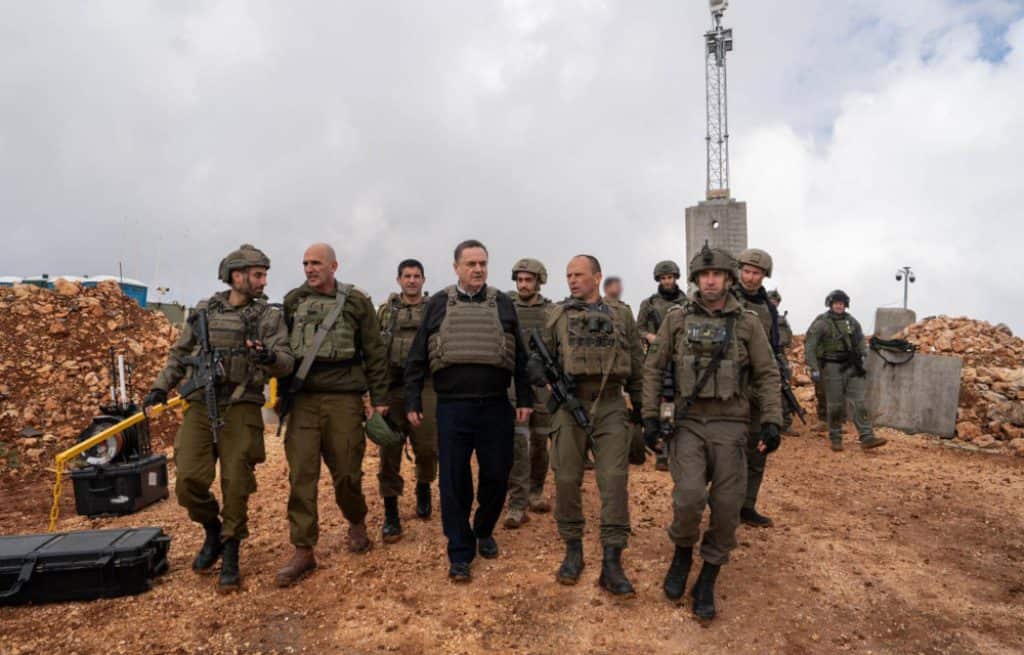
Israel Katz, Minister for Defence (sic) in centre of photo on his sally with IOF into Lebanon with IOF occupying troops. (Photo sourced: Internet)

It will also be very dangerous for those trying to enter, especially men, having to pass the interrogation process at the gate. Those suspected of Resistance activities – or even related to such suspects – will be deeply interrogated and many no doubt interned without trial.15

Families which have survived the genocidal bombing and starvation will be broken up as some enter and some refuse to enter (or are refused).

Overall, the historical experience of people confined in civilian concentration camps has been oppressive but for many a death sentence also. Despite the suffering, as a measure of repression against insurgency amongst the population, it has largely been ineffective.

Actually, there is one recorded case of the civilian concentration camp being successful in a counter-resistance context and that was of the British (again!) against the Boers of South Africa. In the Second Boer War the British (who had been defeated in the first) killed Boer livestock and burned their farms.

The British constructed a civilian concentration camp16 in which they placed the abducted Boer women and children in order to get their menfolk to submit. (The IOF are not above using relatives also, frequently arresting relatives in order to coerce a ‘wanted’ resistance person to surrender.)

80,000 Boer civilians were interned and, in separate camps, 115,000 African servants of the Boers. Due to the conditions, between 18,000 and 28,000 Boers died, 80% of them children. The British kept no records of African deaths but their losses are believed to have been similar.17

However, the British-Boer wars were between one group of settlers and another. So far, for all the suffering it causes, the record of the civilian concentration camp as a repressive measure by an occupying state against a resistant nation is one of failure.

End.

FOOTNOTES

1https://www.theguardian.com/world/2025/jul/07/israeli-minister-reveals-plan-to-force-population-of-gaza-into-camp-on-ruins-of-rafah

2David Cameron, Prime Minister UK called it a prison in 2010, as did others, including Omar Shakir, Israel and Palestine Director Human Rights watch in 2022. As late as 2023, so did British-Israeli historian and emeritus professor of International Relations at Oxford University Avi Shlaim who said it had evolved into “an open-air graveyard” at the time of his writing (there are numerous sources for the description by various people).

3https://en.wikipedia.org/wiki/Blockade_of_the_Gaza_Strip

4The civilians in General Franco’ hugely overcrowded camps and jails contained large numbers of Basque, Catalan, Galician nationalists, Republican, Communist non-combatant nationalist civilians in addition to opposition military.

5https://jacobin.com/2017/05/uk-concentration-camps-wwii-poland-internment-prisoners

6Ibid.

7https://www.nbcnews.com/id/wbna24457292

8A good account is given in this admittedly anti-communist biased report: https://biblioasia.nlb.gov.sg/vol-15/issue-3/oct-dec-2019/civilians-in-crsfire

9https://simple.wikipedia.org/wiki/Japanese_American_internment

10Admission by US President Gerald Ford.

11https://www.iwm.org.uk/history/a-short-history-of-civilian-internment-camps-in-east-asia

12The RIC (later RUC now PSNI in the British colony) in Ireland, the Guardia Civil in the Spanish state, Gendarmerie in France and Carabinieri in Italy. Those forces in the last three named operate throughout the different nations that are incorporated in those states.

13Highly critical analysis https://noria-research.com/ceasefire-and-the-end-of-the-pkk/

14https://en.wikipedia.org/wiki/Strategic_Hamlet_Program, a hostile source like most I’ve found on line.

15A process the Zionist State calls ‘Administrative Detention’, resulting in six months trial without judicial process, which can be renewed.

16The main reason for the belief that the British originated the practice of concentration camps.

17https://nzhistory.govt.nz/media/photo/south-african-concentration-camps

SOURCES & FURTHER READING

Israeli plan: https://www.theguardian.com/world/2025/jul/07/israeli-minister-reveals-plan-to-force-population-of-gaza-into-camp-on-ruins-of-rafah

Turkey civilian concentration villages: https://smallwarsjournal.com/2024/06/19/assessment-turkish-kurdish-conflict-1984-1999/

British concentration camps for Boer civilians: https://nzhistory.govt.nz/media/photo/south-african-concentration-camps

and for civilians in Malaya, good account is given in this admittedly anti-communist biased report: https://biblioasia.nlb.gov.sg/vol-15/issue-3/oct-dec-2019/civilians-in-crsfire

USA civilian concentration camps for ethnic Japanese civilians https://simple.wikipedia.org/wiki/Japanese_American_internment and ‘strategic hamlets’ in their Vietnam War: https://en.wikipedia.org/wiki/Strategic_Hamlet_Program (a hostile source, like most I’ve found on line).
PKK FINALLY SWALLOWS THE PACIFICATION PILL

Diarmuid Breatnach

(Reading time: 4 mins.)

The Kurdish group, the PKK announced on Monday that it has disbanded its armed organisation of the last nearly 50 years.1 The change was carried out on instruction or request of their leader Abdullah Ocalan who’s been in a Turkish jail since 1999.

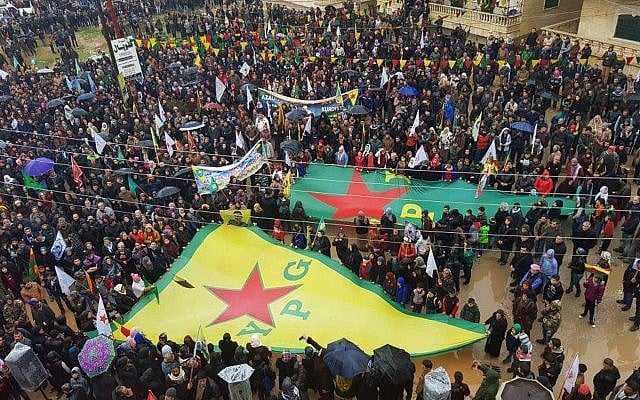
Supporters in Dusseldorf November last year defy German ban to demonstrate and call for release from Turkish jail of Abdullah Ocalan, leader of the PKK (Photo credit: AP)

The marxist-leninist PKK set up its armed organisation in 1978 to resist the Turkish state repression of the Kurdish independence movement. The Kurdish area is of huge strategic importance, encompassing parts of what are now Turkey, Iraq, Syria, Iran and Azerbaijan.

The population of Kurdistan is estimated at between 30 and 45 million, with up to another two million in its diaspora. The PKK waged armed struggle in Turkey until 1999 then again as the YPG and SDF in Syria, against the Assad regime and against ISIS.

PERSONAL CONNECTION

I was for a time in London myself active in solidarity with the Kurdish national liberation struggle and, as a result, part of a trade union delegation to Turkish Kurdistan around 1991/92, organised through a Kurdish community centre in North London.

The trade union activists participating were required to raise the money for the flights from their union organisations and I was successful in obtaining the necessary funds through the Lewisham Nalgo/ Unison local government branch and through the Nalgo/ Unison Irish Workers Group.2

Our delegation flew to Istanbul and from there to Batman province where the driver, supplied by the Petro-Is trade union took the three of us and our interpreter and photographer to many parts in the region, including to the border with Syria and seeing the oil being smuggled across the Iraq border.

Evidence of the ongoing war between the PKK and the Turkish State was plentiful, including Turkish gendarmerie checkpoints, bullet-riddled walls in towns and a shell hole in the wall of my bedroom in one hotel in which we stayed.

Much worse was the visit to an outlying village house burned by German flame-throwing tank of the Turkish Army and viewing the photos of the children immolated inside.

Turkish secret police visited our driver’s house while he was away, commented to staff of one hotel that we were not tourists (declaring ourselves a trade union delegation would have been asking for trouble) and on our last day kept driving past us and even followed us on to the plane.

Even then I was very concerned at what seemed to me like near deification of Ocalan. Years later, in Bilbao as part of a panel of speakers on national liberation struggles, off the platform the speakers on the Irish, Palestinian and Kurdish resistance discussed issues in the liberation movements.

The Palestinian and I became concerned by the almost violent agreement of the Kurd with everything that Ocalan did or said. We had to abandon all attempts to discuss and debate with him.

PACIFICATION PROCESSES

Pacification processes of various types have been around for centuries but a particular wave of them began to be deployed in the early 1990s, starting with South Africa and Palestine,3 then spreading to Ireland, the Basque Country and Colombia, each affected subject infecting in turn the next.

Typically the subject was told they had to disarm and disband their armed organisation, after which they would be accepted into the system and could organise politically for admission to the ruling political circles through the standard electoral process.

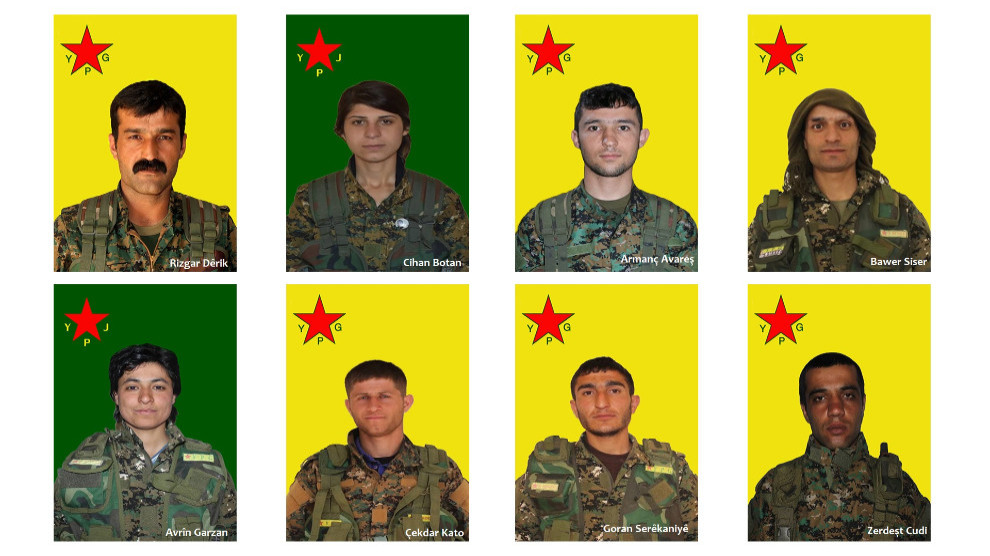
Portraits of eight martyrs of the YPG announced fallen in battle in Afrin against ISIS (note two are female) December 2019 (Source: YPG media)

Of course each subject would have to renounce even the idea of armed struggle or revolution. And would be required to control their own fighters and denounce their dissidents.

It is somewhat surprising that it has taken this long for imperialism to land the PKK fish since Ocalan swallowed the baited hook back in the late 1990s. The war in Syria I suppose extended their armed organisation’s life for a while beyond that which it would have had if confined to Turkey alone.

But their role in Syria in the YPG, whether it began as an independent Kurdish national liberation struggle or not, soon degenerated into leading a US/NATO proxy force, the SDF.4

This March the SDF agreed to integrate into the imperialist proxies’ army of ISIS types led by Ahmad al Shaara (i.e the ‘former’ ISIS leader Jolani), currently being embraced by imperialist leaders while his forces continue to carry out sectarian murders of Syrian Alawites and Druzes.

More recent reports have them, while agreeing to disarmament in Turkey, refusing it in Syria, which makes sense from a self-preservation stance alone, given the nature of the new state’s forces.

We can imagine the imperialist-driven virtual “Pacification Express” in the late 1990s and early 2000s, as it left South Africa and Oslo-Palestine, calling on Ireland and from there to the Basque Country and outward bound to Colombia. Turkish Kurdistan was one of the planned stops.

In not one of the areas of national liberation struggle passed through by the Pacification Express did the liberation organisation win that for which they had declared they were fighting, or indeed anything apart from in some cases the freeing of political prisoners.5

In S. Africa they did at least get ‘majority rule’, so that the leadership of the liberation organisations could form a corrupt imperialist-serving government.6 The Irish travelling on that Express got their prisoners freed but the Kurds and Basques on board did not receive even that.

Supporters YPG and other militias and parties protest threats from Turkey in Afrin, Aleppo province, north Syria 18 Jan 2018 (Source: YPG Press Office/AP)

Whoever the leaders of the Kurds are now, they claim that they continue on the track to democracy and Kurdish national liberation.

Of course they do. The passengers on the Pacification Express always declare that sovereignty and self-determination are the train’s destinations, even if it shows no sign of heading there. And that some of the stations passed on the way are quite clearly on another line completely.

end.

Footnotes

1https://apnews.com/article/turkey-kurdish-militants-disarm-9f4347a04cba48ceb509d2e82023a19e

2This was one of the self-organised groups of NALGO (National Association of Local Government Officers), now subsumed into UNISON but which the union’s leadership refused to recognise and worked to undermine. I had been a founding member. The union leadership tried to get us to change our founding principle of self-determination for the whole of Ireland and when we refused, they worked against us.

3The ‘Oslo process’ which set up the Palestine Authority and the popular rejection of which led to the Second Intifada.

4Even though some anarchist groupings and at least one Irish socialist Republican group refused to see this and focused instead exclusively on the YPG’s anti-ISIS fighting and their federal administration of ‘liberated’ Rojava.

5But not in Turkey or in the Basque Country, nor of the ELN in Colombia.

6As Bishop Tutu, who supported the Process said of Mandela’s ANC: “They stopped the gravy train long enough to get on it.”

Sources

https://apnews.com/article/turkey-kurdish-militants-disarm-9f4347a04cba48ceb509d2e82023a19e

https://thekurdishproject.org/kurdish-ypg-to-lead-new-syrian-democratic-forces/

TURKEY’S PAYOFF FROM NATO LOOKS BAD FOR ROJAVA

Diarmuid Breatnach

(Reading time: 8 mins.)

Against the bigger war going on in the Ukraine, a smaller one hotting up has been getting little attention. Turkey started shelling a region in Syria which the inhabitants call Rojava and killed some of those inhabitants, including military leaders, who have had mass funeral protests.

Salwa Yusuk, a deputy commander of the US-backed Syrian Democratic Forces, was killed in a Turkish drone attack in Syria on Friday. Also killed in the same vehicle were Joana Hisso, 30, also known as Roj Khabur, and Ruha Bashar, 19, also known as Barin Botan. (Image sourced: Internet)

The Kurds’ representatives were blaming the USA and Russia but most of all the former, saying it’s part of a deal for Turkey to lift its objections to Sweden and Finland for membership of Nato.

The official quid pro quo was for those countries to repress their Kurdish diaspora and to remain silent on repression in Turkey. But it seems an unofficial part of the deal was to let Turkey set its military loose on Rojava, the inhabitants of which are now living in fear of a full Turkish invasion.

Far indeed do the consequences of the war in the Ukraine reach around the world – Rojava is over 2,000 km from the Donbas region (and they will reach much further than this before it’s over)!

The Kurdish-led Rojava sector fought ISIS from 2014 to March 2019, at first without any external help and later assisted by NATO bombing runs.

The USA’s earlier policy had been to boost Islamic jihadism as a counter to left-wing nationalism and Russian influence (for example in Afghanistan) – until jihadism threatened western interests also. Then it waged war to eradicate it and, in the course of that, supported the Kurds in Rojava.

But US/NATO wants a solid block facing (not to say encircling) Russia – so now previous bets are off and the Rojava region can be thrown to the wolves – or to Turkey; first by Trump to screams of outrage from US Democrats but now by Biden, to probable silence.

BACKGROUND

But why does the Turkish military want to shell Syria? Why specifically shelling the Rojava region? If you know, you know but if you don’t, a little background might help.

The Kurds are the largest ethnic minority in Turkey, comprising around 18% of Turkey’s population; the largest concentration (2 million) of which lives in Istanbul. The majority of Kurds are Sunni Muslim, with Alevi Shi’a Muslim, Christian, Jewish, and Yezidi communities.

Together with Kurdish populations in Iraq, Syria, Iran and Armenia (all “Kurdistan”) the Kurds number between 25 and 35 million in the Middle East (with a very large diaspora in Europe, the USA and other areas).

The area occupied by Kurds in the Middle East is of huge strategic and resources importance and none of the major states in the area have agreed to their having a state.

After World War One and the defeat of the Ottoman Empire, the victorious Western allies made provision for a Kurdish state in the 1920 Treaty of Sevres.

However the new leader of Turkey, Kemal Attaturk, the “father of modern Turkey” rejected a reduction in the size of the state and the subsequent imperialist Treaty of Lausanne set the boundaries of modern Turkey without any reference to the Kurds (“mountain Turks”, according to Attaturk).

Also in 1920, the Royal Air Force of the UK bombed the Kurds with chemical weapons and machine-gunned them during the Iraqi (then Mesopotamia) uprising,

In 1946 the USSR supported a Kurdish state in a part of what is Iran today but in the face of the western powers’ opposition and support for the state of Persia’s (then a client state of the West) claim to the territory, the USSR withdrew its support and the Kurdish state was suppressed.

Every attempt to set up a Kurdish state since then has been violently suppressed and, in Turkey, even an autonomous Kurdish region was beyond contemplation by the authorities, who suppress even Kurdish language and music.

THE KURDS IN SYRIA

In 2013 an uprising began against the Assad regime which, though it had some popular elements quickly became dominated by Jihadists and NATO proxies. The Syrian part of the Kurdish liberation movement saw an advantage for itself here and set up its own liberated areas.

Also in 2013 the fundamentalist islamist group ISIS burst on to the scene and, taking advantage of the Assad regime’s beleaguered situation, attacked large areas of Syria, to overthrow the regime but also to subjugate all peoples in the region, including the Kurds and Arabs of any kind.

The Kurds of Rojava fought to protect their areas from ISIS but also carried out a heroic rescue action to save Yazidis, opening and defending a corridor for Yazidi refugees to reach safety in the Kurdish liberated area where they built a cross-community alliance with Yazidis, Turkmen and Arabs, in which they state that all its citizens have equal rights.

Whether this is as true as they (and as their supporters in parts of the European Left) say or not, certainly women have a formally equal status and women are elected – and also appointed — to positions of high administrative and military responsibility.

Demonstrators in Stockholm against the NATO deal with Turkey and in solidarity with the Kurds (whose flags are also visible (Image sourced: Internet)

The Turkish regime has been at war with the Kurds within the state’s territory led by the PKK since 1974 and viewed the setting up of an independent republic under Kurdish leadership across the border in Syria with great alarm.

In 2014 Turkey began attacking support and supply lines from Kurds in Turkey to Rojava, which caused outrage among the extended Kurdish diaspora and other opponents of ISIS in the West.

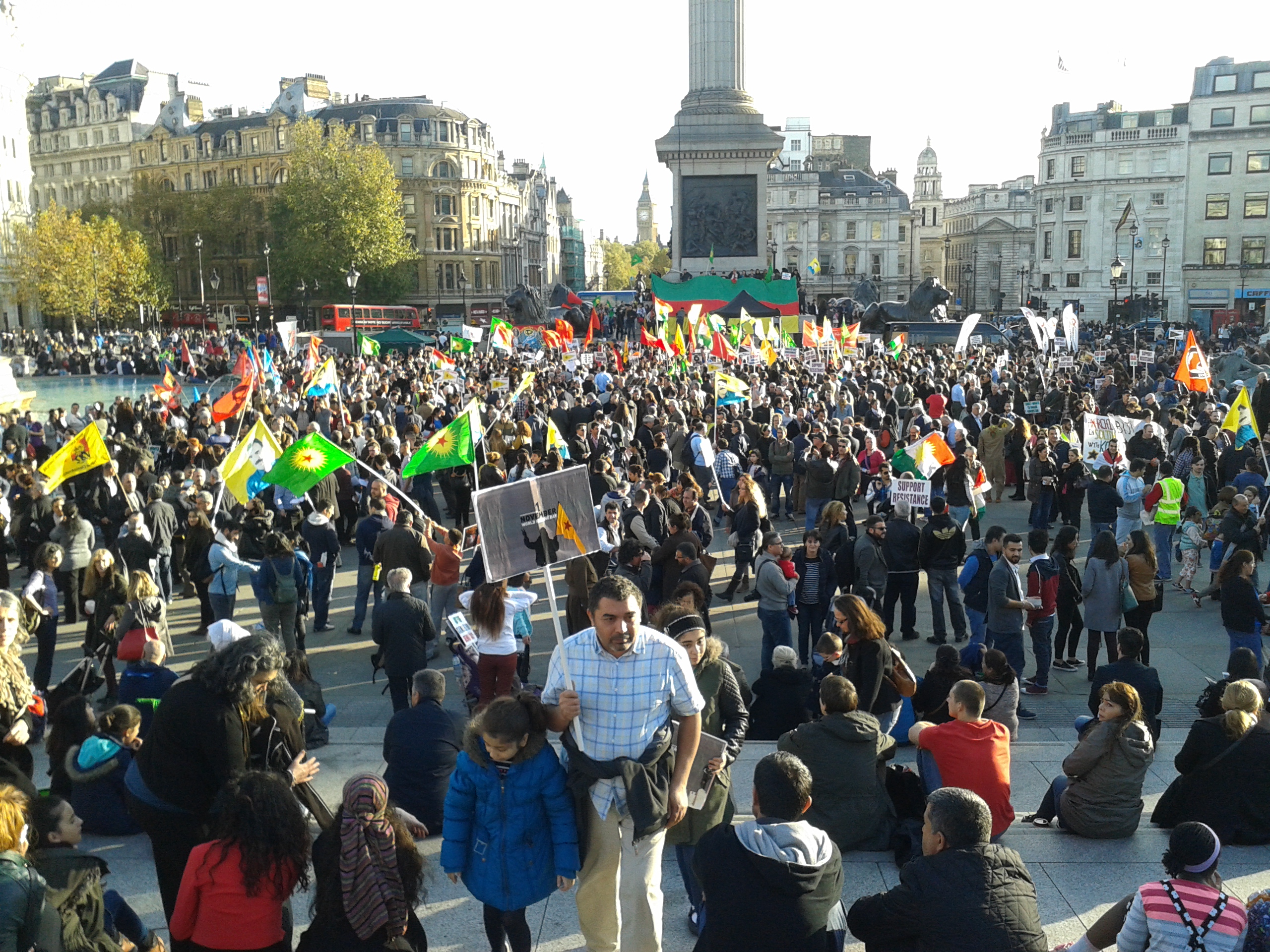
London rally November 2014 in solidarity with Kurds in Syria and condemning Turkish attacks. (Photo: D.Breatnach)

And in fact, although Turkey is an important member of NATO, Turkish military attacked the enclave a number of times, both directly and through the use of muslim fundamentalist jihadists.

Nevertheless, NATO’s concentration on wiping out the ISIS threat in the area had to have a restraining effect on Turkey. And then there was Russia too, also supplying air cover — but to the Syrian regime.

MY ENEMY’S ENEMY IS ….” — an understandable but dangerous philosophy

At first in 2013 it seemed that the Kurds around Rojava were merely taking advantage of the Syrian regime’s trouble to go for establishing their own republic, in addition to fighting the dire threat of ISIS.

In the latter struggle, they would of course gladly accept NATO bombing of ISIS and liaise with NATO commanders on where ISIS forces were gathering – for the Kurd’s own safety and for destruction of a dangerous enemy.

However some years ago an interview with the Kurdish commander of the Rojava military forces was published in which he said that the intentions of the Rojava military went further and involved overthrowing the Assad regime, an objective that they shared with NATO.

At a meeting organised by socialist Irish Republicans about five years ago, while expressing admiration for the Kurd’s struggle for self-determination in general and specifically against ISIS, I questioned from the audience a Kurdish speaker from London.

When I commented on what seemed a clear alliance with western imperialism and in particular the USA, the biggest imperialist power in the world, the speaker replied that they were merely accepting necessary aid for their defence against ISIS.

But when I pointed him towards the Kurdish military commander’s interview on the regime change objectives of his forces and of NATO, all he had to say was that I should visit Rojava.

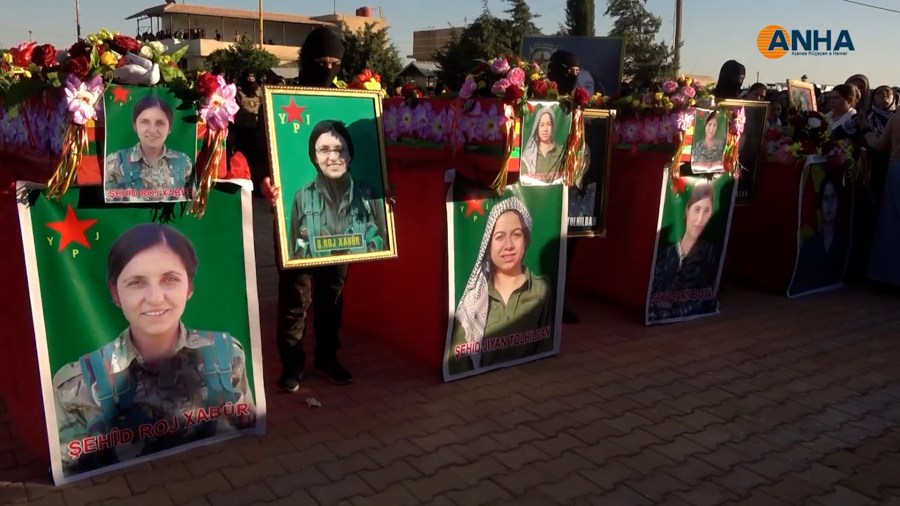
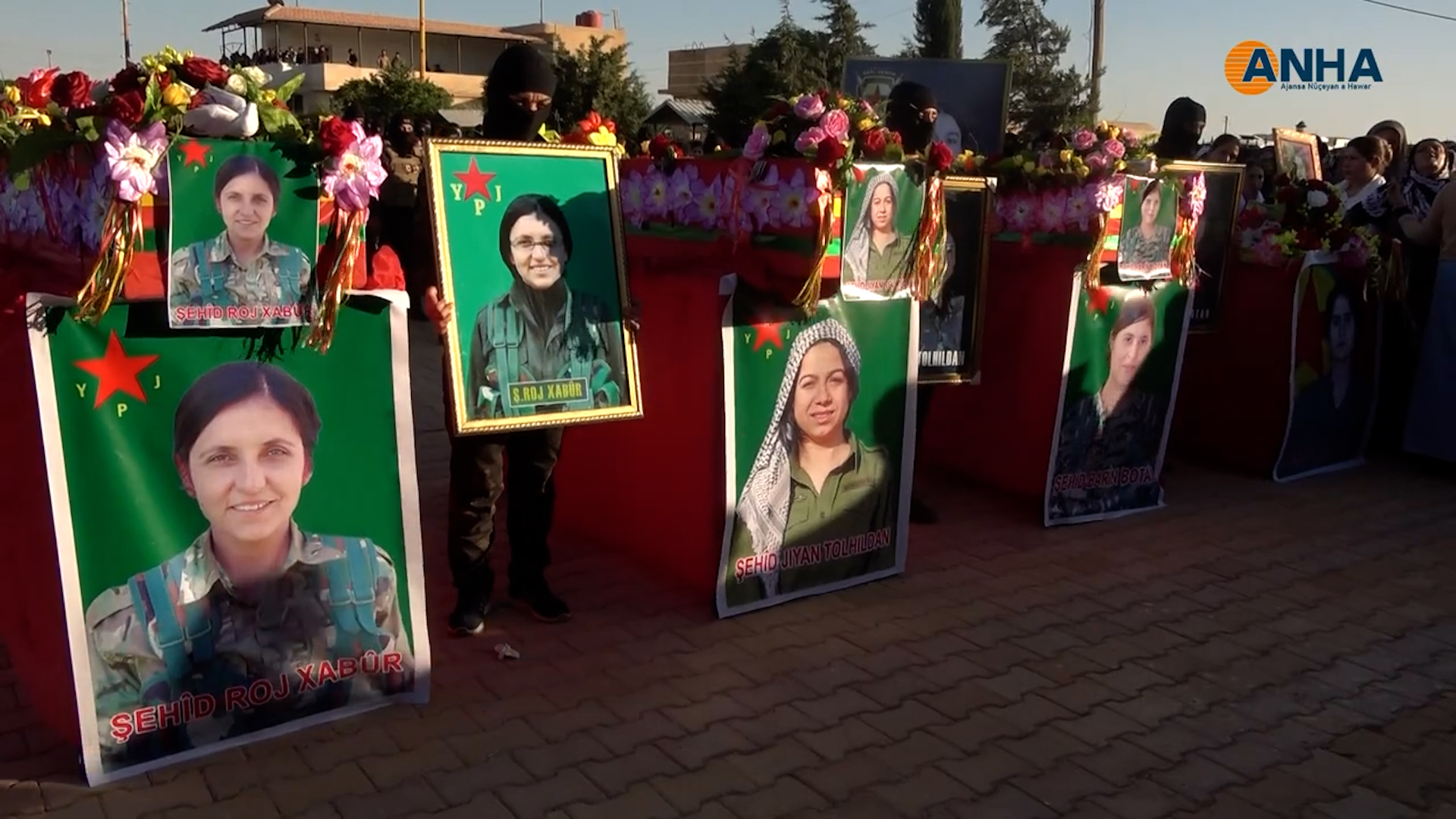
Mass funerals (despite fear of further Turkish drone strikes) of three fighters of the Women’s Protection Unit (YPJ) killed recently (Image sourced: ANHA)

CONCLUSION

This situation and its history once again highlights the dangers of revolutionaries doing any deal with imperialism, most of all one where the long-term survival of one’s people depends on the continued support of an imperialist power.

It also raises the question of whether it is justifiable or at least wise in the longer term to use a major world power’s assistance in order to remove a smaller power.

The main Kurdish liberation movement of the PKK fought a heroic struggle for decades, in particular against the ferocious Turkish regime, with many martyrs and political prisoners.

One of its weaknesses was the almost deification of their leader Oçalan and the way his attempted embracing of the proposed “peace process” undermined the movement, as similar processes have done wherever they have been introduced.

Of course, as with the Spanish state, another fascist but supposedly democratic regime, the Turkish regime is not interested in any “peace process”, a slow sapping of the resistance movement. For its ruling elite, crudely crushing the resistance with brute force is the only way .

The Kurdish movement in Syria was seen as a spinoff from the PKK which supported it in its struggle against the Syrian regime but in particular in its heroic struggle against the Islamic State/ ISIS/ Deish.

However the Turkish state would view any independent Kurdish area, let alone one in nearby Syria as encouragement to Kurds within its territory. The ISIS movement threatened some Western interests and so NATO went to war with it, the Syrian Kurds linked themselves with NATO not only to defeat ISIS but also to overthrow the Assad regime.

US-led NATO wanted to overthrow the Assad regime but as part of its Middle Eastern encirclement of Russia (which is why Russia came to the aid of Assad against ISIS). Iraq and Libya had fallen already and, after Syria, Iran would be next on the list.

Thousands of people joined a demonstration in Tel Rifaat town of the Shehba Canton on Sunday 10th Nov 2019 in protest at the Turkish state’s invasion and genocidal practices in northern Syria. 40% of the population of Efrin (Afrin) having to survive in a semi no-man’s land, defended by the multi-ethnic SDF of AANES, after expulsion by the Turkish invasion, plantation and Turkification of their homes and properties.

But as the ISIS threat and the likelihood of deposing Assad faded, NATO support for the Rojava fighters declined. In October 2019 the SDF had to conclude an agreement with the Syrian regime to have it move into their area to end five days of attacks by Turkey.

When their protection from Turkey could be dropped in exchange for a US/NATO advantage in Eastern Europe, nothing stood against a Turkish all-out attack on Rojava. Nothing, that is, except the Russian airforce.

If Turkey is to attack Rojava with ground troops it will need to use air cover both in manned and unmanned vehicles, which would require Russia not policing the no-fly zone in Syria near the Turkish border.

In February 2021, a Russia-brokered agreement between the SDF and the Syrian regime to lift the SDF’s siege of regime-held towns showed strains. But last month, at a summit in Tehran between leaders of Iran, Russia and Turkey, the other two warned the latter not to attack the Kurds in Syria.

However, despite Turkey’s NATO membership, Russia does get along with the state’s rulers from time to time and the recent discussions between the ruling elites of Russia and Ukraine on unblocking the flow of grain and fertiliser out of the war zone were held in Turkey.

The Syrian regime does not want an autonomous area within the territory of its state and Russia’s leaders will be anxious to keep on good terms with its ally – but it will also wish to wean Turkey away from NATO.

The Rojava enclave, though never as wonderful as it was proclaimed to be from a socialist point of view, is nevertheless an interesting experiment in federalism and multi-ethnic administration.

It will be sad if Rojava falls to Turkish aggression and a mean repayment for their heroic struggle to rescue the Yazidis and to hold off the advance of ISIS which cost them 10,000 dead fighters. It may also be yet another disastrous byproduct of the proxy war NATO is waging in the Ukraine.

End.

SOURCES & FURTHER READING:

Turkish military attacks on Rojava: https://thefreeonline.com/2022/07/12/mass-funerals-as-terrorist-turkey-shells-towns-and-refugees-before-new-rojava-invasion/
https://thefreeonline.com/2022/07/23/sdf-says-two-of-its-female-commanders-one-fighter-were-murdered-in-turkish-drone-strike-video/

NATO dumps the Kurds: https://www.lemonde.fr/en/international/article/2022/06/28/nato-says-turkey-has-agreed-to-support-finland-and-sweden-joining-alliance_5988282_4.html

Trump dumps the Syrian Kurds: https://progressive.org/latest/foreign-correspondent-trump-kurds-empire-crumbles-erlich-101918/

Russia blocks Turkey’s plans to attack Rojava: https://www.irishtimes.com/world/middle-east/2022/07/20/iran-and-russia-warn-turkey-against-military-offensive-against-syrian-kurdish-forces-in-syria/
https://thefreeonline.com/2022/07/26/turkish-invasion-cancelled-did-putin-just-save-rojava/

Syrian Democratic Forces, the Kurdish-led Rojava alliance: https://en.wikipedia.org/wiki/Syrian_Democratic_Forces

Long history Turkish State conflict with Kurds: https://www.cfr.org/global-conflict-tracker/conflict/conflict-between-turkey-and-armed-kurdish-groups

A modern history of the Kurds: https://www.bbc.com/news/world-middle-east-29702440