NEWS & VIEWS No.1 – Fascists and Women

28th February 2022

(Reading time: 7 mins.)

The mass media is not great for accuracy or wide coverage and even less for trustworthy analysis but it does often provide entertainment.

Today the Belfast Telegraph reported that Gerry McGeough failed in court to obtain a restraining order against Michelle Anne Lyttle Robinson Ex-IRA gunrunner Gerry McGeough fails in bid to get restraining order against woman who punched him in the face at Gay Pride parade – BelfastTelegraph.co.uk .

People may remember that McGeough and an assortment of other far-Rightists and fascists (such as Niall McConnell) were rosary-protesting a local Gay Pride march in the small Co. Tyrone town of Cookstown in September last year, the first ever in the town it seems. Michelle just walked up to Gerry and punched him in the face.

Well, not quite – she did say “Hello, Gerry” a second before she smacked him.

There was some confusion initially, as many thought Michelle was an antifascist or at least an LGBT rights supporter but it turns out that she and Gerry had history that had turned nasty in the branch of the Ancient Order of Hibernians of which Gerry had been a member – hence the knuckle complaint.

Anyway, this allegedly ex-Republican and definitely ex-Provo (both military and political wings — he had been on the Ard-Choiste, equivalent to Executive Committee) took his case to the courts of the British colony but failed as the judge in Dungannon took the view that the punch was a “one-off” (which is perhaps why some people prefer the old “one, two”).

It is remarkable how many of our native far right-wing and fascist stalwart fighters, constantly calling out the corrupt political system and the need to overthrow it, seek the endorsement of the State’s legal system, whether British colonial, as in the Six Counties, or Irish Gombeen, as in the Twenty-Six.

Gemma O’Doherty and John Waters for a while seemed to have season tickets for the High Court; Dee Wall “The Screaming Crutch” of QAnon was heard enough times threatening legal action, as was Right-Wing Ranter-in-a-Vehicle Carey; Ben Gilroy was a frequent (and ineffective) defence representative for people being evicted from their homes.

Gerry McGeough claimed in court that the assault was not merely an attack on him but was also an attack on the Virgin Mary. News & Views staff attempted to contact the Mary in question to hear her views but she failed to respond.

Actually, her main support organisation, the Irish Catholic Hierarchy, was keeping quiet on the matter too, although they are known to share Gerry’s view on the alleged sins of consenting LGBT adults.

It’s just that the ICH management board like to tone it down these days since their position of moral superiority has been eroded over the years, largely but not alone due to exposés of the sexual practices of many of the ICH’s employees with non-consenting minors.

Gerry claimed that on the occasion he had just been there in Cookstown to pray in public, as he does and that he should have the right to do so without being assaulted. Ah Gerry, now, really? News & Views investigative staff enquiries in the locality have found not one local who has ever seen Gerry praying there on any other day.

Which of course leads one to suspect that he and the other fascists and right-wingers were there to protest against the Gay Pride parade and using religion as a cover.

In fact, we recall Niall McConnell and other fascists and far Right-wingers on a number of occasions objecting to the right to pray in semi-public, when Muslims hired Dublin’s Croke Park to celebrate their Eid festival.

Which reminds us, on the occasion that Dublin Republicans Against Fascism organised a counter-protest in July 2020, women were accused of punching or slapping some of the fascists too.

And Niall McConnell, Fuehrer-of-Five of Síol na hÉireann1 took one of the women to court, requiring her to attend court a number of times and then failed to attend himself when the case was to be tried.

There does seem to be a thing about male fascists and women, come to think of it.

At the recent bust-up of the also fascist National Party’s congress at a luxury resort in Co. Fermanagh, the only injuries of consequence inflicted on the anti-fascists were on three female comrades, while five of the would-be stormtroopers – all male — ended up in hospital in exchange.

End.

FOOTNOTES

1The title means “Seed of Ireland” but ‘seedling’ might be a more accurate description and one suffering from damping-off or withering in recent times.
APRIL 2nd – ANNIVERSARY FOUNDING OF CUMANN NA MBAN

Diarmuid Breatnach

(Reading time: 4 mins.)

Cumann na mBan (“Women’s Association”), a female military auxiliary and counterpart to the Irish Volunteers, was founded on this day in 1914, one hundred and seven years ago. Its members took part in the 1916 Rising and perhaps even more importantly in keeping up the momentum of the militant movement for independence during martial law after the defeat of the Rising and for years afterwards. They were part of the War of Independence and the Civil War in military and political activities. Many were jailed. The Easter Lily emblem, which many will wear to commemorate the Rising, is their invention. The role of Cumann na mBan, along with that of other women in Irish history, is to this day still not sufficiently highlighted or valued.

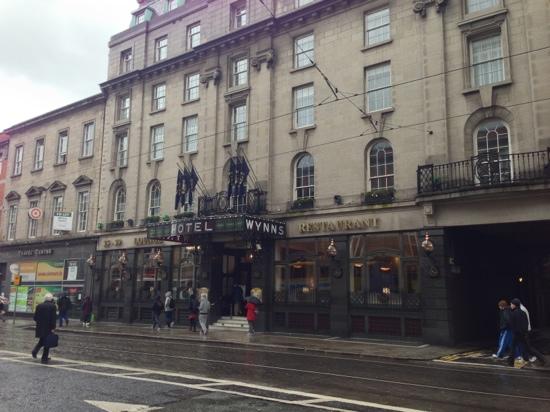
Wynne’s Hotel, Lwr. Abbey Street, viewed almost from the junction with O’Connell Street, looking eastward. (Photo sourced: Internet)

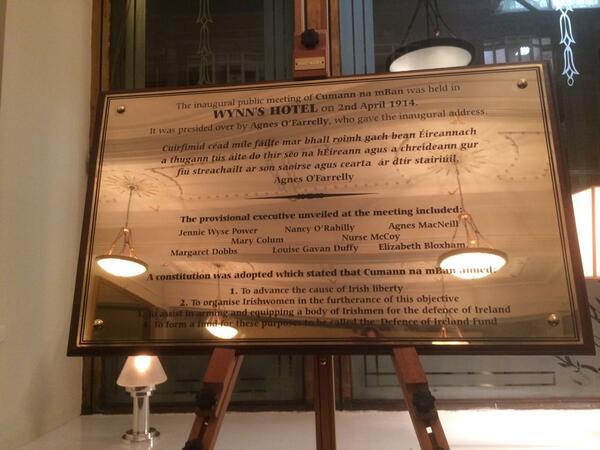
Cumann na mBan was formed as a female counterpart and auxiliary to the Irish Volunteers, which had been formed the previous year (as had, separately, the Irish Citizen Army). The inaugural public meeting was held in Wynn’s Hotel, Thursday, 2 April 1914. It was presided over by Agnes O’Farrelly, who was elected President. The provisional executive unveiled at the meeting included Jennie Wyse Power, Nancy O’Rahilly, Agnes MacNeill, Margaret Dobbs, Mary Colum, Nurse McCoy, Louise Gavan Duffy and Elizabeth Bloxham. A constitution was adopted which stated that Cumann na mBan aimed: 1. To advance the cause of Irish liberty 2. To organise Irishwomen in the furtherance of this object 3. To assist in arming and equipping a body of Irishmen for the defence of Ireland 4. To form a fund for these purposes to be called the ‘Defence of Ireland Fund’.

Plaque constructed to be located in Wynne’s Hotel on the centenary of the founding of Cumann na mBan (Photo sourced: Internet)

It was not the first organisation of women to stand for Irish independence that century – Inghinidhe na hÉireann had been formed in 1900 as a cultural organisation and had developed a militant Irish independentist political outlook along with a suffragettist one. Inghinidhe formally dissolved itself and joined Cumann na mBan in 1914 but in effect formed one of its branches and continued to represent a trend for greater activism and female independence within Cumann.

Unlike the Volunteers, membership of the socialist Irish Citizen Army, founded in 1913, was open to both genders and the women who joined that tended to disdain the membership of Cumann na mBan because not only did they not have a social program but were, at that time, under the overall authority of the all-male Irish Volunteers.

Prior to 1916, Cumann na mBan took part in agitation and publicity actions, a number of which they organised themselves. Their marching in the procession to the grave of O’Donavan Rosa’s grave in 1915 was apparently what most impressed other women, in particular young women; they had never witnessed a self-organised women’s organisation on the streets before and the Cumann’s membership swelled thereafter. When Redmond promised Irish men to the rulers of Britain to fight in WW1 the minority part of the movement but the most active split in order to fight for independence from the UK. Cumann na mBan split also but in their case, the majority went for fighting against Britain.

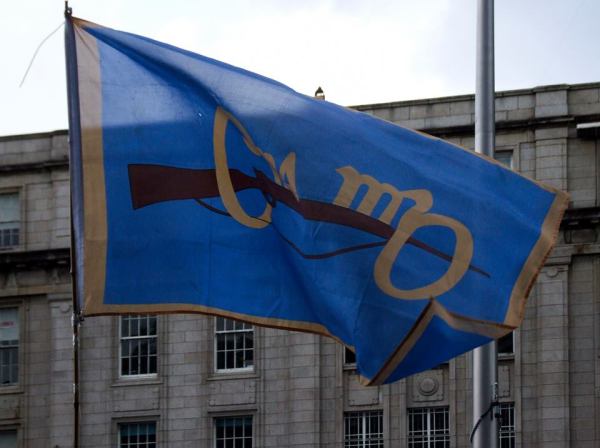
The flag of Cumann na mBan, flying in Dublin (Photo sourced: Internet)

In preparation for the 1916 Rising all members of the main female organisation learned First Aid and prepared field dressings for wounds, which perhaps brought them to face the physical dangers of insurrection more than did the training schedules of the Volunteers. They also engaged in anti-British Army recruitment activities which, after Britain declared War in 1914, increasingly meant being assaulted and arrested by the Dublin Metropolitan Police and the Royal Irish Constabulary. Many also transported secret messages and weapons, often storing the latter. In an informal way, they also provided intelligence they were able to gather. Through their cultural and social activities they provided diversion for male activists as well as a cover for clandestine meetings and other activities. During the Rising, Cumann na mBan members helped deliver arms, ammunition and equipment, construct barricades, set up field hospitals, provided food and water/ tea to combatants, acted as messengers. ICA women did most of that but a number of them were snipers also and one of those, Vol. Margaret Skinnider was gunshot-wounded three times while sniping and in other military activity in the Stephen’s Green/ College of Surgeons garrison area. Most of the Dublin garrisons had Cumann na mBan in them and those in the GPO garrison were asked to leave with some wounded when the building was in danger of collapse. Three women refused to leave with them and were there at the final surrender in Moore Street: Vols. Elizabeth O’Farrell, Winifred Carney and Julia Grenan.

Around 300 women are known to have taken part in the Rising and from the relative numbers of women in CnmB and the ICA, most of those had to be Cumann members; only 157 womens’ names appear on the Roll of Honour for the Rising.

Cumann na mBan was the first organisation of its kind in the world, a point that is often lost sight of: an insurrectionary female military organisation with its own uniform and officers.

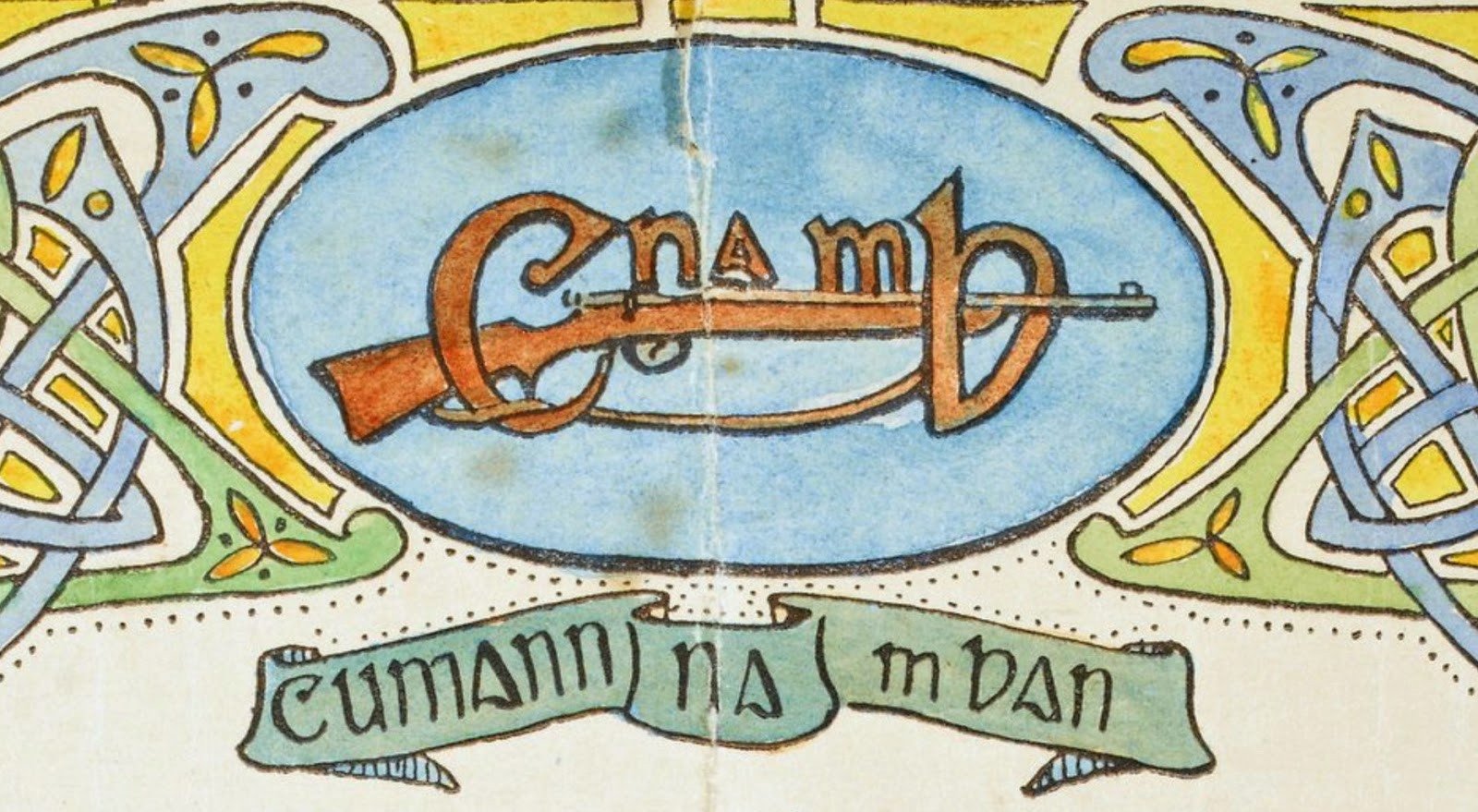
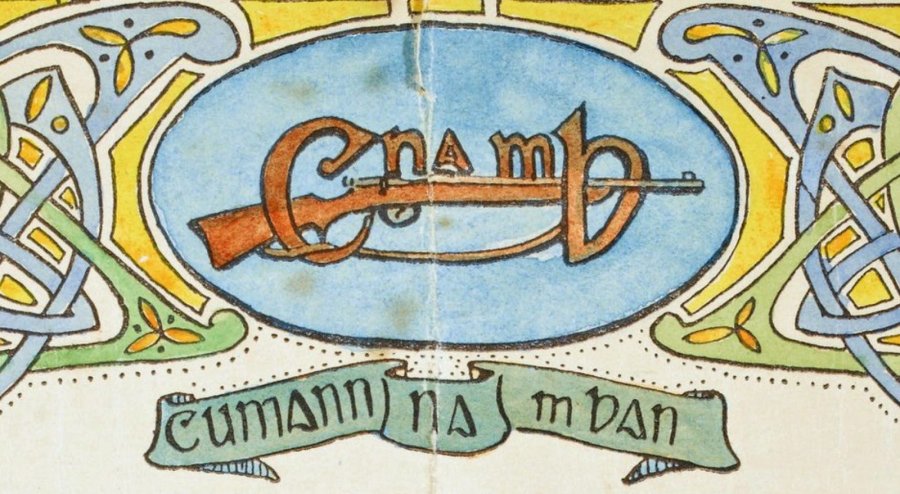
Highly decorative and artistic logo of Cumann na mBan — note the rifle fitted into the acronym in the centre. (Photo sourced: Internet)

The greater role of the women in general and in particular of members of Cumann na mBan however was after the Rising when, even under martial law, they organised fund-raising for relief for families who had lost a breadwinner to death or prison; organised also public commemorations, defying arrest to keep the flame and memories alive, helping to create the sea-change in attitude to the Rising and giving a fertile ground for them to plant the seeds of resistance, along with the male and female prisoners released under amnesty.

In 1918 members of the Cumann worked to help the landslide victory for Sinn Féin in the British General Election in Ireland and then helped in the War of Independence, this time greatly organised into intelligence work but also as before as couriers, carrying and hiding weapons, caring for the wounded, running safe houses and other actions, as well as in public demonstrations and pickets, for example outside prisons. They were assaulted on occasion and jailed, sometimes replying with a hunger strike. They could not easily go “on the run” and were subjected by British Army and colonial Police to invasions of their homes and ill-treatment which included shearing their hair.

In 1921, Cumann na mBan again split over the Treaty but once more with the majority against it and in 1922 took the Republican side in the Civil War, for which they suffered repression, home invasions and imprisonment anew, this time by the forces of the Free State.

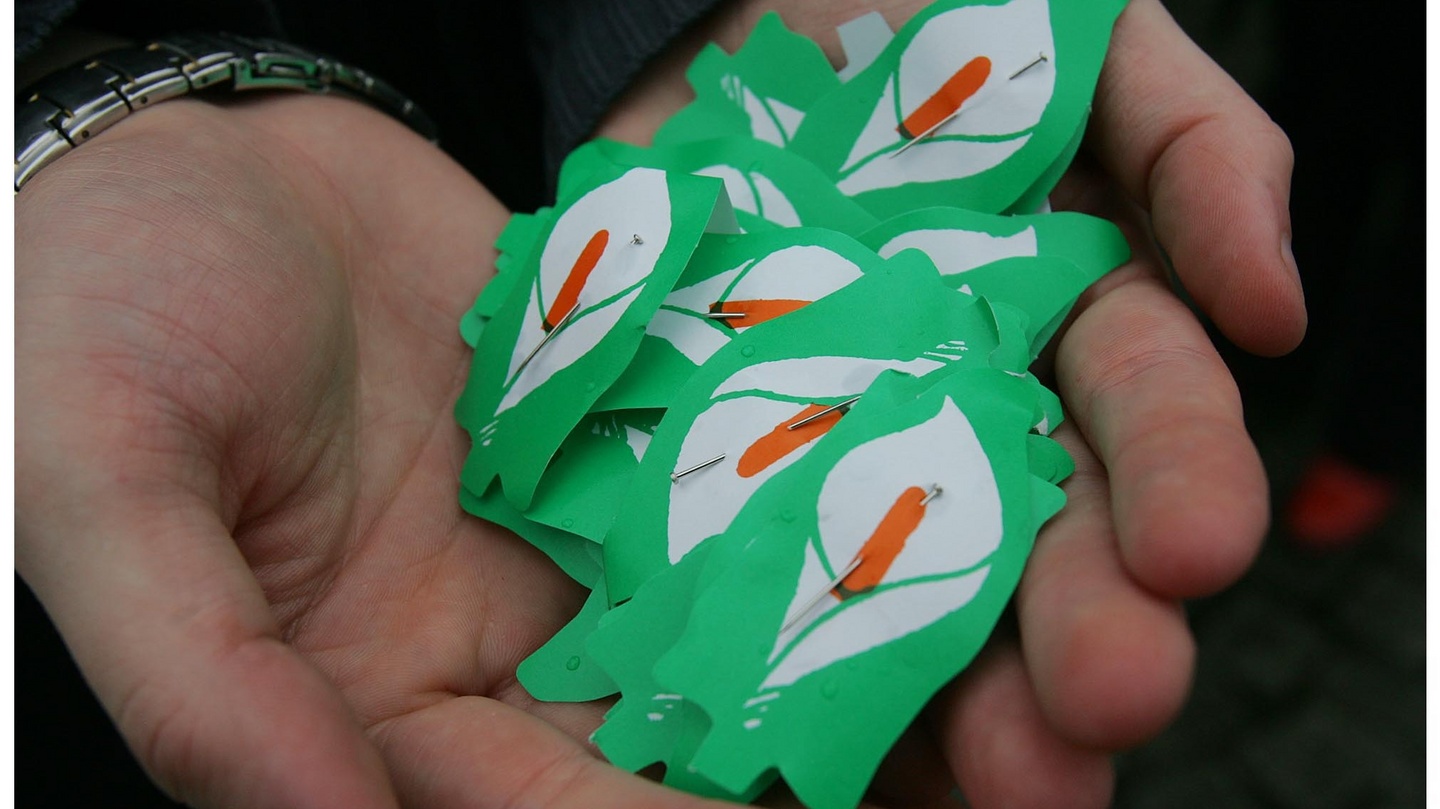
In 1926 Cumann na mBan invented the Easter Lily emblem in order to raise funds for the dependents of prisoners and killed in action fighters, in addition to those officially and unofficially executed, abducted an murdered. It is purely as a result of their efforts at this time that the emblem is so widely worn and appreciated in the wide Irish Republican movement, especially around this time of year.

Easter lily emblems printed on paper, attached with a pin. (Photo credit: Bryan O’Brien, Irish Times)
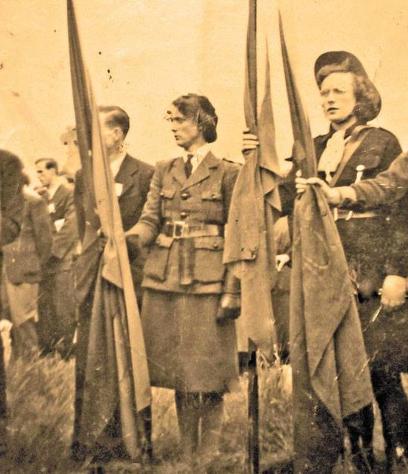
Two Cumann na mBan members as part of a Republican commemoration in 1944 (Photo sourced: Internet)

Cumann na mBan ceased to exist soon after the split between the “Officials” and “Provisionals” in 1969 but women continued to be active in the political organisations and also to be recruited into the various military ones.

End.

REFERENCES & FURTHER INFORMATION

https://www.rte.ie/news/2014/0328/605079-cumann-na-mban-centenary/

https://www.rte.ie/history/the-ban/2020/0109/1105376-cumann-na-mban/

(note the omission of the Moore Street battlefield at the end, with a Winifred Carney, Elizabeth O’Farrell and Julia Grenan noted as staying on in the GPO but omitting to mention where they went soon afterwards, or Farrell’s important roles thereafter): https://www.richmondbarracks.ie/women-1916/cumann-na-mban/

https://www.irishtimes.com/culture/heritage/women-of-1916-1.2535291

157 women who took part in the Rising: https://microsites.museum.ie/rollofhonour1916/roleofwomen.aspx

The creation and popularisation of the Easter Lily by Cumann na mBan: https://rebelbreeze.com/2018/04/20/a-resistance-symbol-sown-and-grown-by-irish-republican-women/