Like many others through much of the genocidal attack on Gaza since October last 2022, I’ve been attending pickets, demonstrations and vigils organised by others. I’ve also written some reports on those events and analyses of the solidarity movement.
But in addition, I’ve been drawing cartoon comments in a sketch book, most unpublished and I thought I would publish a selection here.
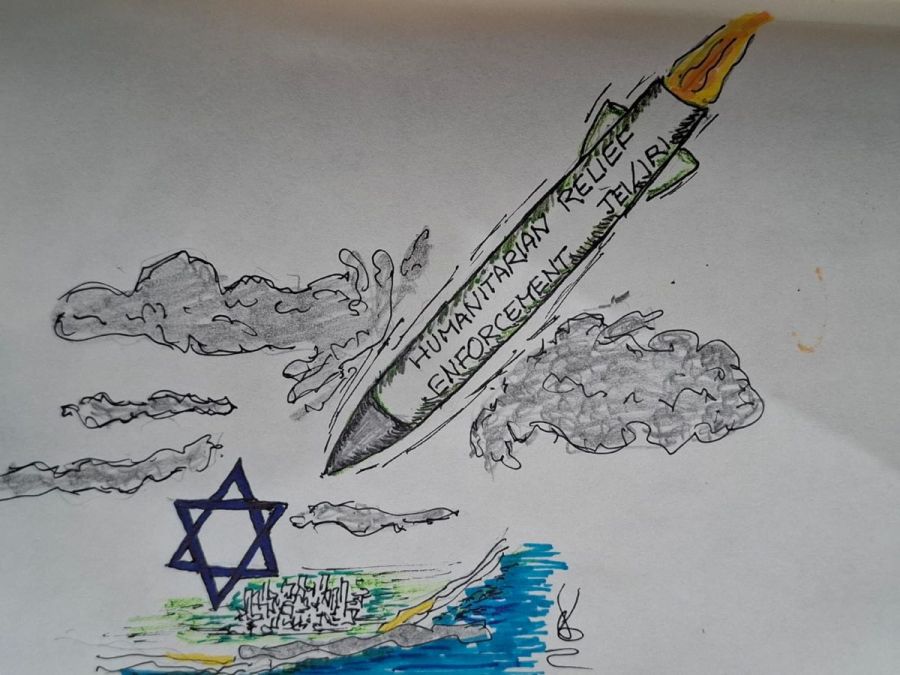
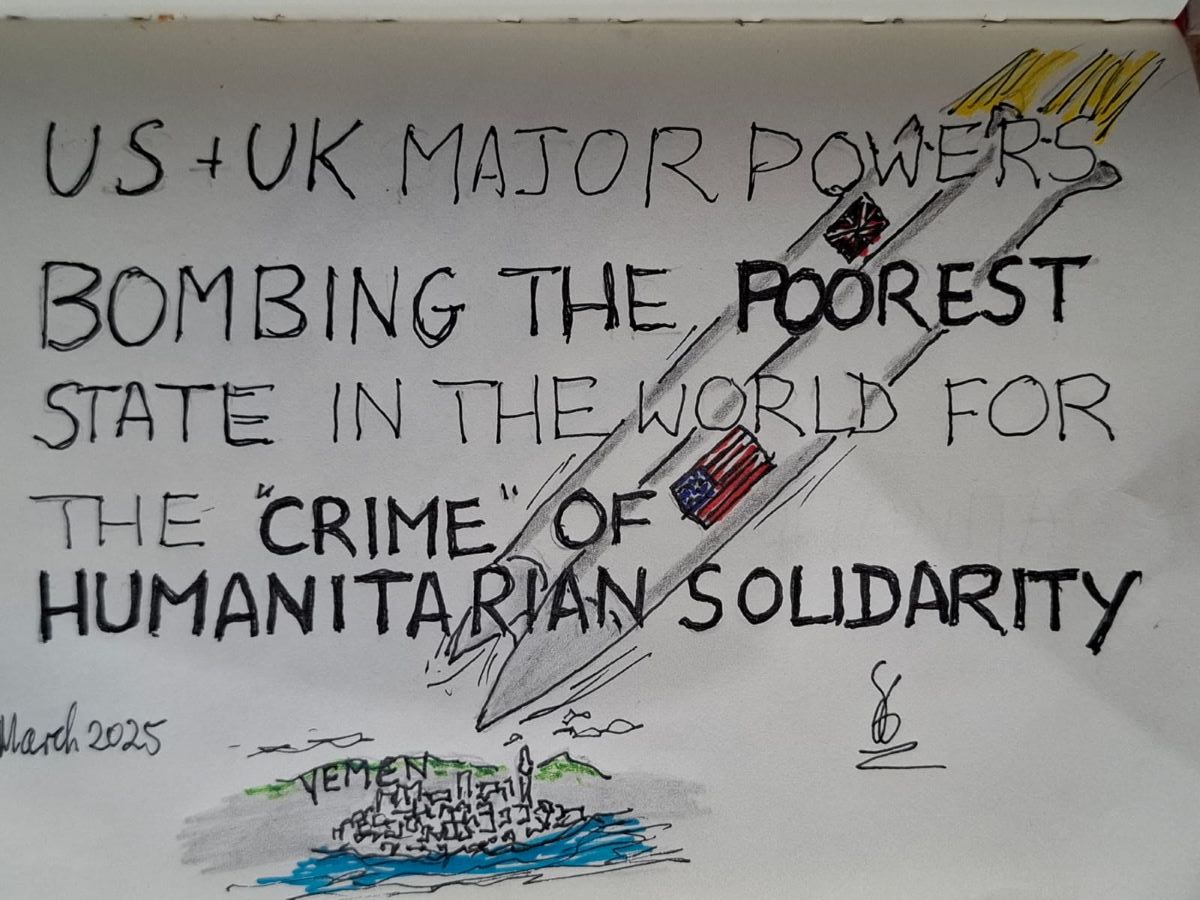
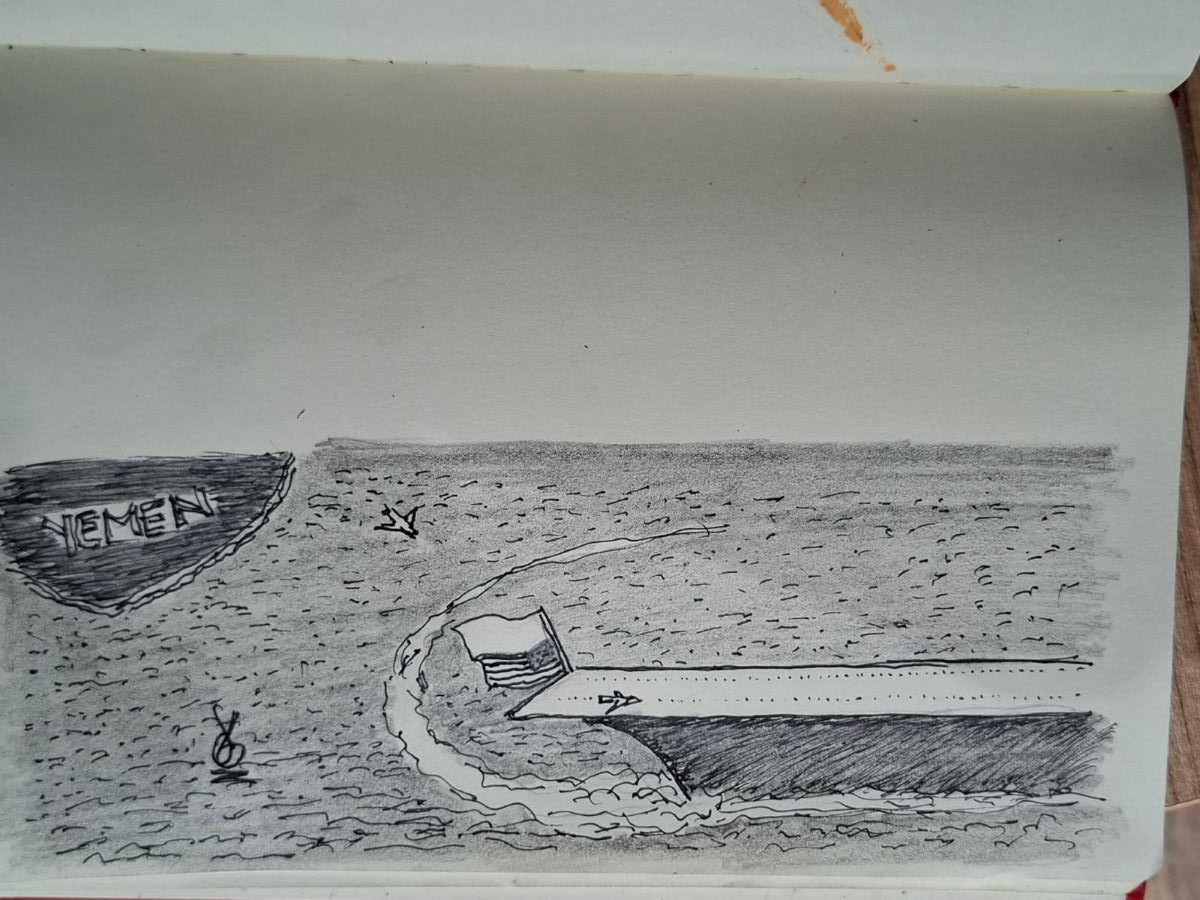
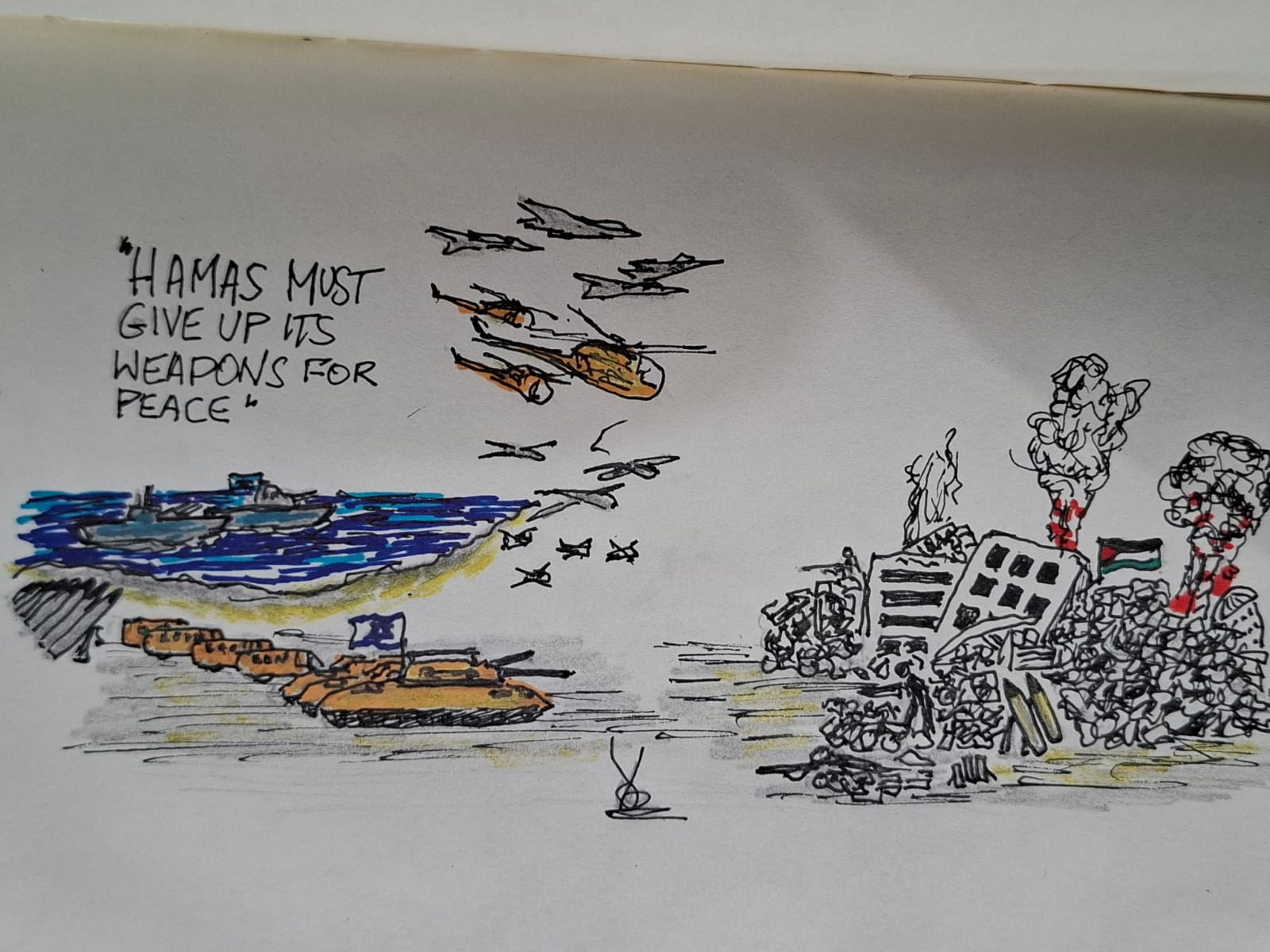
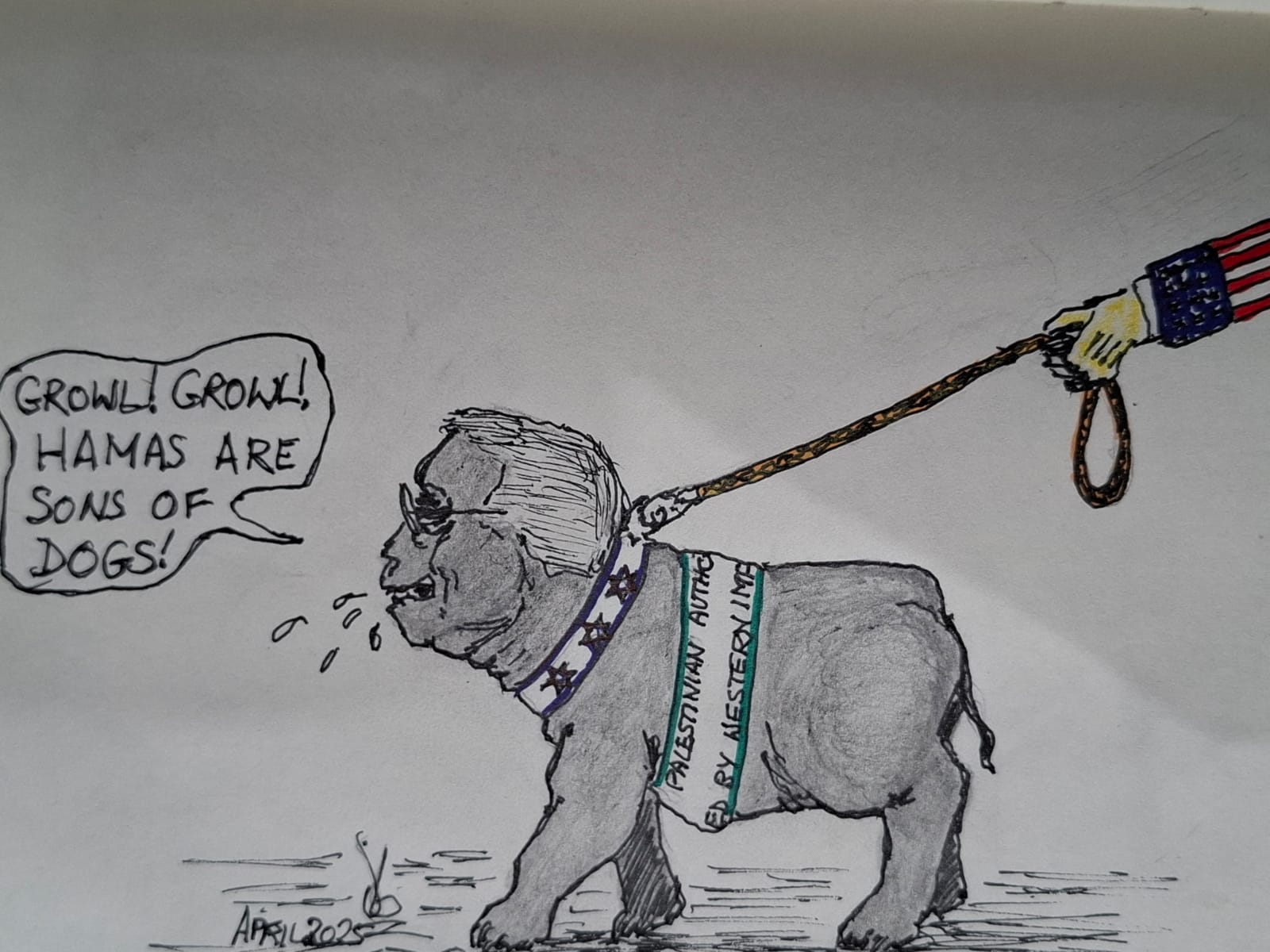
One of the poorest states in the world, Ansarallah is the only one to uphold its duty to prevent genocide, which it does by putting heavy pressure on the Zionist state’s economy through maritime blockade. For this, the UK and USA rain missiles and bombs down upon it. But it does not yield.This one is at least as much placard as it is cartoon but I never got around to making the placard. Ansarallah escalates to attack the ‘Israeli’ state directly, then again in response to Zionist airforce bombing of Yemen.The USA Navy sends two aircraft carriers to assist the genocidal state by attacking Yemen. Ansarallah attacks the US Navy, forcing the retreat first of one aircraft carrier followed by capitulation of the US which offers Ansarallah to end attacks on Yemen if they end attacks on US Navy. The deal makes no provision for defence of the Zionist state and is accepted by Ansarallah.Facing some of the most heavily armed forces in the world but somehow, it’s always the national liberation forces that must disarm. For the sake of peace, of course.The physical war against the Palestinians by the Zionist State was armed by a number of western imperialist states but also ideologically by the whole western media. In the face of real and ongoing genocide the WMM reported propaganda, repeated lies and framed its reports in the Zionists’ terms of reference – while courageous journalists reporting from the actual killing grounds were picked off by the IOF.The western imperialists promote the two-states solution (sic) and a Palestine colony of Israel as a ‘Palestinian State’. This would be run by Zionist proxies such as the Palestinian Authority with its Fatah boss, Mahmoud Abbas, who recently publicly insulted the national resistance fighters of Hamas, calling them ‘sons of dogs’.
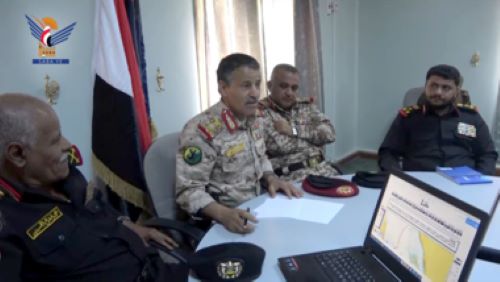
Yemeni Defense Minister Major General Mohammed Nasser Al-Atifi during a commemorative event held by the Ministry of Defence spoke a good lesson for the Irish ruling class:
Hesitation or retreat from Yemen’s supportive stance towards Gaza is impossible and not subject to negotiation or compromise.
Yemen’s powerful and resounding response to the Nazi entity is coming without hesitation or concern, and we will meet Zionist madness with Yemeni strength, which they have tasted in the seas.
We continue to develop our capabilities quantitatively and qualitatively, in accordance with the latest military building concepts we seek.
Major-General Mohamed Nasser Al-Atifi, Minister of Defence in Yemeni Government. (Photo sourced: Internet)
Yemen’s position is central in the Axis of jihad and resistance, in defense of the nation, its sanctities, values, lands, and our national security.
Yemen is on the path of liberation and independence, and will not accept any foreign subordination or domination. It will not be a backyard for any regional regime or subject to international guardianship.
National wealth is a sovereign resource, and we will not allow its waste, corruption, or neglect in its investment, in a way that serves the higher interests of all of Yemen.
We will not allow any threat to destabilize the security and stability of our country, and we will not accept the presence of any foreign forces on our land and islands.
Major-General Mohamed Nasser Al-Atifi in planning conference with senior Yemeni military officers, August 2024. (Image sourced: Internet)
Thanks for those words as an example of national independence from Major-General Mohamed Nasser Al-Atifi. The Irish government on the other hand, as a management committee of the Irish ruling class:
Allows the partition of the country and occupation of six counties by an invader; also our air space and sea to be flown and sailed by UK and US warplanes and warships and our foreign policy dictated by NATO & EU.
And our natural resources and infrastructure sold to foreign companies and our educated labour force to be exploited by foreign companies.
Also, our produce taken by foreign companies and food we used to grow ourselves imported and sold to us in foreign-owned supermarkets, even our national airline sold to another country.
April 2023: Leaked files reveal that British intel used local Yemeni NGOs and social media in a covert campaign to undermine the Sanaa government and influence the war-torn country’s peace process.
Kit Klarenberg
(Reading time: mins.)
The CradleEditor’s note:All Yemeni NGO employees, journalists, and other private individuals named in this article appear in the ARK documents seen by The Cradle.These Yemenis may be unaware of the UK’s role and/or intent in funding their activities.
Yemen’s civil war, considered the world’s gravest humanitarian crisis, appears to be nearing its end due to a China-brokered detente between Iran and Saudi Arabia, who support opposing sides in the bitter conflict.
Early signs suggest that the rapprochement between Tehran and Riyadh may not only end hostilities in Yemen, but across the wider region.
The US, Israel, and Britain have the most to lose from a sudden onset of peace in West Asia. In the Yemeni context, London may be the biggest loser of all.
For years, it provided the Saudi-led coalition with weaponry used to target civilians and civilian infrastructure, with receipts running into billions of pounds sterling.
During the entirety of the war, Yemen was struck by British-made bombs, dropped by British-made planes, flown by British-trained pilots, which then flew back to Riyadh to be repaired and serviced by British contractors.
In 2019, a nameless BAE Systems executive estimated that if London pulled its backing for the proxy war, “in seven to 14 days, there wouldn’t be a jet in the sky.”
A Typhoon at RAF Akrotiri, near Limassol in Cyprus, after striking Houthi targets in Yemen (Photo cred: Sgt. Lee Goddard/ AFP)
In addition to supplying weapons, the war also presented a golden opportunity for Britain to establish a military base in Yemen, fulfilling long-held fantasies of recovering the Empire’s long-lost glory days “East of Suez.”
Al-Ghaydah airport in al-Mahrah, Yemen’s far eastern governorate, has for some time quietly housed “a fully-fledged force” of British soldiers, providing “military training and logistical support” to coalition forces and Saudi-backed militias.
There are even indications that this involvement could extend to torture methods, which is a troubling reflection of one of London’s leading exports.
The Cradle has obtained exclusive information about a previously undisclosed aspect of London’s role in the proxy war against Yemen’s Ansarallah-led resistance.
It has been revealed that a multi-channel propaganda campaign, led by the intelligence cut-out ARK and its founder Alistair Harris, a veteran MI6 operative, has been operating in complete secrecy throughout the nine-year-long conflict – one that specifically targeted Yemen’s civilian population.
Anti-Ansarallah ops
Leaked Foreign Office documents have revealed that ARK’s “multimedia” information warfare campaign was designed to undermine public sympathy for the Ansarallah movement and ensure that the conflict would only end on terms that aligned with London’s financial, ideological, and geopolitical interests.
For instance, public acceptance of the UN’s widely unpopular peace proposal required propaganda support from local NGOs and media organizations that “support UK objectives” to “communicate effectively with Yemeni citizens” and change their minds.
It was also necessary to counter “new actors” in the information space that were critical of the Saudi-led coalition’s brutal bombing campaigns and the illegitimate, US-backed puppet government that the aerial assaults sought to protect.
Considering the high rate of illiteracy in the local population, ARK conceived the creation of a suite of “visually rich” products extolling the virtues of a Riyadh-dominated peace plan.
These products would be disseminated on and offline and would “deliberately include different demographics, sects, and locations to ensure inclusivity,” informed by focus groups and polling of Yemenis.
ARK’s campaign even extended to convening “gender-segregated poetry competitions using peace as a theme” and “plays and town hall meetings.”
Publicly, many of these propaganda products appeared to be the work of Tadafur – Arabic for “work collectively and unite” – an astroturf network of NGOs and journalists constructed by ARK.
Its overt mission was to “resolve local level conflicts” and “unite local communities in their conflict resolution efforts.”
The campaign began initially at a “hyper-local level” across six Yemeni governorates, “before being amplified at the national level.” Activities “[in] all areas and at both levels” had unified messaging across “common macro themes,” such as the slogan “Our Yemen, Our Future.”
In each governorate, a “credible” local NGO was identified as a messenger, along with “well-known” and “respected and influential” journalists who served as “dedicated field officers” across the sextet, managed by ARK.
In Hajjah – “a site of strong Houthi influence” – the Al-Mustaqbal Institute for Development was ARK’s NGO of choice; in Ansarallah-governed Sanaa, it was the Faces Institution for Rights and Media; in Marib, the Marib Social Generations Club.
In Lahij, ARK’s choice was the Rouwad Institution for Development and Human Rights; in Hadhramaut, Ahed Institute for Rights and Freedom; in Taiz, Generations Without Qat.
These local NGOs were instrumental in promoting ARK’s agenda and advancing the narrative that aligned with Britain’s objectives in Yemen.
The company’s roster of “field officers” comprised of individuals with various backgrounds, such as:
“Human rights abuse” specialist Mansour Hassan Mohammad Abu Ali, TV producer Thy Yazen Hussain, Public Organisation to Protect Human Rights press official and “experienced journalist” Waleed Abdul Mutlab Mohammed al-Rajihi,
Also producer from Alhadramiah Documentary Institute Abdullah Amr Ramdan Mas’id, editorial secretary of Family and Development magazine and the Yemen Times’ Taiz news manager Rania Abdullah Saif al-Shara’bi, as well as journalist and activist Waheeb Qa’id Saleh Thiban.
A Trojan Horse
Once ARK’s field officers and NGOs “successfully designed and implemented hyper-local campaigns,” coverage of “information around the related activities will then be amplified at the national level.”
A key platform for this amplification was a Facebook page called “Bab,” launched in 2016 with tens of thousands of followers who were unaware that the page was created by ARK as a British intelligence asset.
Under the guise of a popular grassroots online community, ARK used the Bab page to broadcast slick propaganda “promoting the peace process,” including videos and images of “local peacebuilding initiatives” organized by its NGO and field officer nexus.
“Campaign content will highlight tangible, real-life examples of compelling peacebuilding efforts that all Yemenis, regardless of their political affiliation, can relate to,” ARK stated.
“These will offer inspirational examples for others to emulate, demonstrating practical ways to engage with the peace process at a local level. Taken together, these individual stories form the broader campaign with a national message: Yemenis share a collective desire for a peaceful resolution to the conflict.”
When “high engagement levels” with this content were secured, Bab users were invited to submit their own, which demonstrated “support for the peace process.” They were explicitly asked “to mirror content ARK has produced, such as voxpops, short videos, or infographics.”
This was then “shared by the project and field teams through influential WhatsApp messaging groups, a key way of reaching Yemeni youth.”
ARK’s “well-connected communications team” would then “strategically share packaged stories with broadcast media or key social influencers, or offer selected journalists exclusive access to stories.”
Creating a constant flow of content was a deliberate ploy to “collectively be as ‘loud’ as partisan national political and military actors.” In other words, to create a parallel communications structure to Ansarallah’s own, which would drown out the resistance movement’s pronouncements.
ARK’s role in Yemen’s peace process
While one might argue that the non-consensual recruitment of private citizens as information warriors by British intelligence was justified by the moral urgency of ending the Yemen war quickly, the exploitation of these individuals was cynical in the extreme.
It amounted to a Trojan Horse operation aimed at compelling Yemenis to embrace a peace deal that was wildly inequitable and contrary to their own interests.
Multiple passages in the leaked files refer to the paramount need to ensure no linkage between these propaganda initiatives and the UN’s peace efforts. One passage refers to how campaign “themes and activities” would at no point “directly promote the UN or the formal peace process.”
Another passage says concealing the operation’s agenda behind ostensibly independent civil society voices “minimizes the risk” that “outputs are perceived as institutional communications stemming from or directly promoting the UN.”
Yet, once ARK’s campaigns began “performing successfully at the national level,” the company’s field officers planned to “build a bridge” between its local foot soldiers and national “stakeholders” – and, resultantly, the UN.
In other words, the entire ruse served to entrench ARK’s central role in peace negotiations via the backdoor.
Diminished western influence
At that time, the ceasefire deal proposed by the UN required Ansarallah and its allied forces to virtually surrender before Riyadh’s military assaults and economic blockade of the country could be partially lifted, along with other stringent requirements that the Saudis refused to compromise on.
Newly recruited Houthi fighters gathered for training outside Sana, the capital of Yemen – they became the Ansarrallah Army. (Photo credit: Yahya Arhab/EPA, via Shutterstock)
The US aggressively encouraged such intransigence, viewing any Ansarallah influence in Yemen as strengthening Iran’s regional position.
However, these perspectives are no longer relevant to Yemen’s peace process.
China has now encouraged Riyadh to offer significant concessions, and as a result, the end of the war is within sight, with critical supplies finally allowed to enter Yemen, prisoners returned, Sanaa’s airport reopened, and other positive developments.
Evidently, Washington’s offers of arms deals and security assurances are no longer sufficient to influence events overseas and convince its allies to carry out its agenda.
The failure of ARK’s anti-Ansarallah propaganda campaigns to coerce Yemenis to accept peace on the west’s terms also highlights Britain’s significantly reduced power in the modern era.
Whereas wars could once be won on the coat-tails of well-laid propaganda campaigns, the experiences of Yemen, Syria, Iraq, and Afghanistan show that the tide has turned. Subversive information campaigns can confuse and misdirect populations but, at best, can only prolong conflict – not win it.







 rebelbreeze