
Diarmuid Breatnach
(Reading time: 2 mins.)
On 13th September 1845 the widely-read British weekly publication The Gardener’s Chronicle apprehensively reported the appearance of the blight on potatoes in Ireland but doubtful if the full extent of the holocaust to follow was expected.

True, no other national population in any other known part of the world was as heavily dependent on the potato as was Ireland’s. Other crops were grown but were mostly destined as feed for domestic animals1 or for export directly or indirectly as in the case of alcoholic drinks.2
A national diet is that of the mass of the population, which in Ireland was the peasantry. On the potato and a little milk the Irish peasantry grew strong enough to be recognised in Britain as healthy able workers, seasonally in agriculture or longer-term in manufacturing and construction.
They were reputed to be the tallest and most fecund in Europe, according to Frederick Engels writing in Britain a year before the piece in the Chronicle.3 In Ireland the peasantry were for the most part tenants-at-will or landless labourers for the settler big landowners and descendants.
The original Irish had been expropriated by sword, fire and pen (legal decrees) and their expropriators lived on the rents they extracted from their tenants in a mixture of crops, animals, cash and labour. After the abolition of the Irish Parliament,4 most big landowners found no reason to even live in Ireland.
The estates of the absentee landlords were then managed by agents, middlemen who forwarded the extracted wealth to their masters in Britain, or perhaps travelling ‘on the Continent’, or trying their hand in the American colony, minus the agents’ commission, of course.
As people went hungry, meat, dairy and grain continued to be exported.
The dependency of the Irish mass on the potato was known of course and even mocked in some ruling British quarters at times. But so were the Irish landlord aristocracy who seemed to have no interest in developing industry.
But could anyone predict that the blight would intensify each year and that the Government of the UK would tolerate such devastation in one of its parts? By the time it had run its course six years later, Ireland had lost at least 2.5 million of its original over eight million5 and more were emigrating.
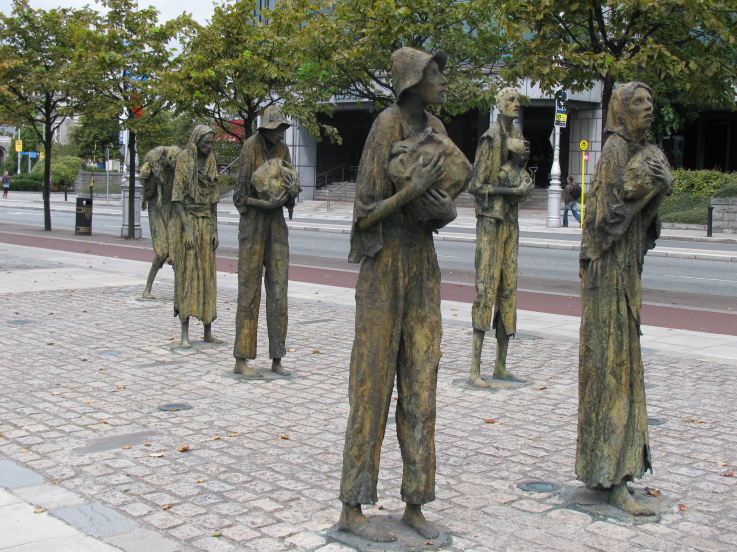
And both the Irish planter aristocracy and the cotter class of Irish peasantry had been wiped out, leaving the field to the Gombeen6 class of money-lenders and bigger farmers, the latter now expanding their holdings and who would farm meat instead of agricultural produce.
When the overall national population stabilised again it did so at five million,7 at which level, despite a high birth and survival rate, it remained until the early 1990s. The magic trick was achieved by constant annual emigration, giving the Irish one of the largest diasporas in the world.8
The Gardener’s Chronicle’s writer noting the arrival of Phytophthora infestans could not have imagined the extent of its devastation. But if he knew the history of Ireland as well as that of the blight, he would have concluded that it was not the worst blight upon the Irish nation.
No, that was the arrival of the Anglo-Normans in 1169, with the second-worst blight being the growth of the Gombeen class.
end.
Note: If you found this article of interest, why not register with Rebel Breeze for free, so that you will be notified by email of subsequent articles. You can de-register any time you wish.
FOOTNOTES
1Grazing animals live on forage in Ireland but in winter or if overgrazed must be given additional food, while draught animals need cereal feed, typically oats. Pigs and domestic fowl were fed on mixtures of potato, beet, pulses and domestic leftovers.
2Typically eorna (barley) for beer brewing and whiskey distilling. These products continued to be produced and exported during the years of famine. Hops are also used for brewing but much was imported from southern England where climatic conditions are more favourable.
3The Condition of the Working Class in England (1844).
41799, followed immediately in 1801by Ireland becoming part of the United Kingdom and Irish MPs being required to attend the Westminster Parliament.
5A historical and statistical riposte to the anti-immigration claim that today “Ireland is full”.
6Originally from the Irish word Gaimbín and applied to moneylenders and land speculators during and following the holocaust period it, came to be applied by many to the Irish neo-colonial national bourgeoisie.
7Of the whole nation, with over 3 million in the Irish state and under two million in the British colony, the Six Counties.
8The bleeding through emigration was constant but fluctuated in degree, with a high point in the 1950s when it amounted to 15% of the Irish state (i.e. of the 26 Counties) and another in the 1980s.
SOURCES
https://www.irishhistorian.com/OnThisDayInHistory.html#SEPTEMBER
https://en.wikipedia.org/wiki/The_Gardeners%27_Chronicle
https://www.sciencedirect.com/topics/agricultural-and-biological-sciences/phytophthora-infestans
https://www.ucc.ie/en/emigre/history/
 rebelbreeze