This time of year, as we near the end of August, is in Ireland the season of seeds and berries. The trees and bushes are bearing berries and nuts in a plan to disperse their seeds a fair distance away.
Dispersal is a strategy, an evolutionary bet for survival of the species, spreading its chance against local disasters of flood, fire, pest and disease.
Also, it is not generally healthy for the seeds to germinate too near the parent plant, where penetrating sunlight will be poor and roots sucking the soil nutrients. Dispersal is the survival plan for many animals too, including humans.
Seeds may be dispersed by water, fire or they may hitch-hike on animals, stow away in human transport. But some parents entrust their young to the winds; some of those are blowing past us now.
Even in the city, the seeds of the lime trees crunch underfoot and the thistledown float gently past.
Small-Leaved Lime (Linden) tree showing ordinary leaf and the leaf ‘sails’ attached to the seeds, formed after flowering. Photographed in Dublin this time of year but in 2014. (Photo: D.Breatnach)
Lime trees (Linden, not the Citrus bearers of the lime fruit) are common enough in Ireland, even in cities like Dublin. Earlier in the year, they produced a faint scent from small nearly unrecognisable blossoms but which functioned the same way, to attract pollen-collecting insects.
The flowers are hermaphrodite, i.e both male and female but are not self-fertilising, so that insect pollination, particularly by bees, is necessary. Honey made from lime tree flowers has a distinctive taste but is somewhat restricted to where the source is available in large enough numbers.
Once fertilised, the tiny flowers begin to produce groups of two or more seeds on stalks. This time of year, they have ripened and come away, attached to a single specialised leaf as a sail.
Two clusters of seeds from Small-Leaved Lime trees, still attached to their “sails” from this month on a Dublin street (Photo: D.Breatnach)
They float and twirl in wind, whether falling from the tree or when thrown up by gusts from the leaf litter in the woods, on the roadside, etc.
They will lie dormant during the winter and sometime in the following Spring, some will germinate and begin the long struggle to grow into a tree.
The wood of lime is soft, light, fine in texture and resists splitting. Easy to work, it is used in turnery, carving, furniture; its resistance to warping makes it useful for construction of sounding boards and piano-keys.
Meanwhile this month, the thistles that flowered earlier are converting flowers to cotton down, billowing into a globe parachute ready to carry a single seed. They float leisurely through the air or are swept along by breezes and updrafts or tumble along the ground – before detaching the seed.
Marsh or Spear (?) Thistle plants by the Tolka, Dublin at the end of July, some flowers already producing the seed-carrying down. (Photo: D.Breatnach)
Thistles are not generally highly regarded but are important for many insects and therefore for many species of bird — and ultimately for us too.
I also observed years ago on an allotment I managed that young thistles could be pulled from the ground and the white stem eaten, crisp and faintly tart but not unpleasantly-tasting.
Many plants use the wind for seed and even pollen-dispersal, from grasses to flowering plants, shrubs and trees.
Ferns also send their spores on the winds, as do many fungi, including when in algae partnership to create lichens.
However only some species have developed the parachute – for example dandelions, thistles and groundsel/ ragwort – and only some trees grow wind-catching wings attached to or enveloping the seed, such as do the lime tree, sycamore and pine.
Obviously, this dispersal by wind is a hit-and-miss strategy – seeds may fall on stone, in river, lake or sea, where no growth for them is possible. To compensate for the wide number of unhelpful possibilities, each individual plant produces hundreds and thousands of potential offspring.
For higher mammals, that invest large sections of their lives in raising young1 before they are ready to disperse, the numbers of offspring per parents must be kept low, allowing for focus and concentration in care, defence and education/ training.
However, it is healthy for some of our human young to disperse too, though that should be a choice, not forced by war, disease, persecution, economic hardship or environmental destruction.
Certainly in the case of mammals, a wide gene-pool is good survival strategy – as long as we have a healthy world in which to spread.
End.
FOOTNOTES
1For humans, typically between a third to a fifth or their lives; for elephants about a third of the females’ lives, chimpanzees about a quarter. Rodents tend to opt for frequent litter of numerous offspring but their lives are short. Cats and Canines tend to have small litters unless pack or pride animals, when normally the alpha pair only breed and some of each litter become part of the pack as they grow (domestic dogs are not part of this natural scheme).
Total watching time (but can view sections): 36.15mins.
INTRODUCTIONby D.Breatnach: In a modern war, artillery will be fired by both sides. Often, civilian sites will be hit even if not actually targeted (which they sometimes are too). At the back of our minds, we know and realise this. But if we rely on the mass media in the West, it seems like in the Ukraine, it is only the Russians that are shelling, only the Russians that are hitting civilian factories and homes. And actually targeting them, we are told. Patrick Lancaster, a war journalist has been showing us the other side, for which he has been labelled many things, among which the mildest is “Russian shill” — as though the Western mass media is independent, objective and non-aligned.
Patrick Lancaster, a US citizen and ex-US Navy, has been covering this conflict since March 2014 when he arrived in Ukraine to document the exit polls in the middle of the Crimea independence referendums but has covered other areas in the past. Currently he covers the conflict from inside anti-Ukraine Government-controlled territory, very often near the front line. On May 20 of 2022, Lancaster shared the breaking information about the Deputy Commander of the Russian Black Sea Fleet Andrei Play who was killed in the midst of the battle in Mariupol. .
In this video coverage we can note a number of things:
The frequency of shells hitting the area.
That shells are hitting houses and what seems to be a civilian factory and infrastructure.
Some of those engaging are trying to deal with the situation with humour and, in one scene, singing and some of the women are quite cheerful.
Patrick Lancaster (unlike many of the Western journalists reporting) is clearly in some danger and he goes down stairways very quickly (stairways are the most vulnerable if hit by bombs since they are in a shaft within the building). His guide/ security person and camera person (possibly Russian military) is also at risk.
Some of the civilians seem to fear being filmed — why, if the film is anti-Ukrainian forces? This seems to indicate a fear of the Ukrainian forces, should they manage to capture the area. Let’s remember that Donetsk has been under attack for eight years before the Russian invasion this year.
Inside the factory basement (using it as a bomb shelter) there is a boy who doesn’t remember a time when there was no war there — again, let’s remember that Donetsk has been under attack for eight years before the Russian invasion this year.
Patrick ends up helping paramedics and a neighbour to evacuate a civilian wounded in the foot (lost a fair amount of blood)
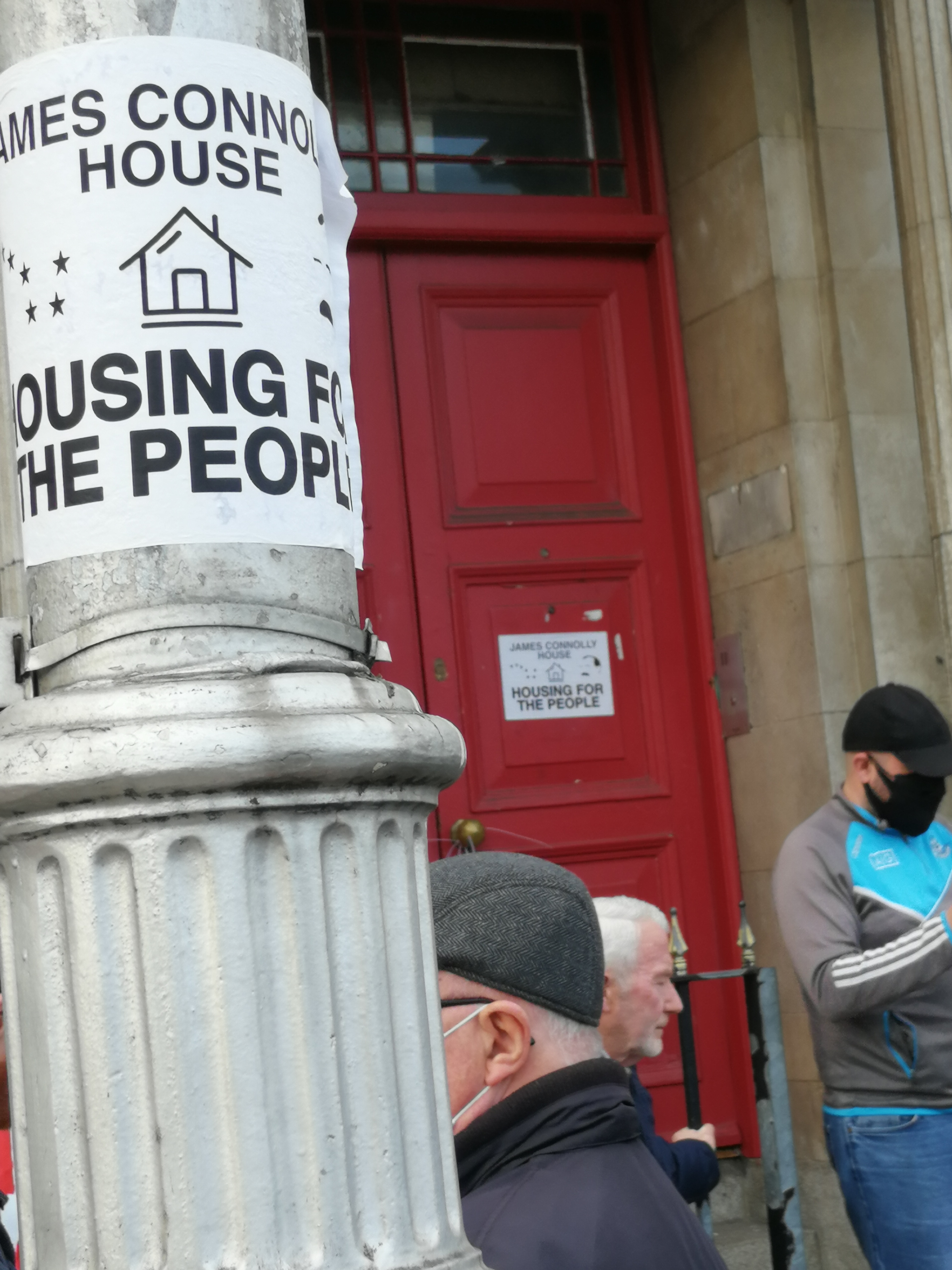
The Salvation Army went to court yesterday to obtain a court order against the Revolutionary Workers’ Union, the latter currently occupying a building on Dublin’s Eden Quay since earlier this month. The RWU occupied the building — which had been empty last year — in order to house the homeless and as a public protest against continuing homelessness in the city, property speculation and high rents. The RWU were not represented in court, which granted the Salvation Army the order they sought, but some RWU supporters held a protest picket outside the court and held a rally outside the Eden Quay building a few hours later, their speakers and songs expressing determination to continue the struggle and defiance of the authorities.
(Photo: Rebel Breeze)
The occupied building formerly known as Lefroy House and now renamed James Connolly House by the occupiers, in honour of the celebrated revolutionary socialist James Connolly executed in 1916, was constructed on the site in 1925 (all the terraces along Eden Quay had been demolished by British artillery and fire during the suppression of the 1916 Rising). Extended in 1948, the legend “Seamen’s Institute” suggests it served for a time as a seamen’s hostel but in more recent times served as hostel for young people run by the Salvation Army1 organisation, which closed the facility last year when their government funding was cut.
The Salvation Army organisation hold a long lease on the building and claimed in court that they had been renovating the building to house Ukrainian refugees, for which one assumes they have funding. However, a quick independent inspection of the building’s interior found it in good repair but with no sign of ongoing renovation work of any kind. Their claim was repeated in media reports without any attempt to check its veracity. The RWU in a statement date the 17th and of which copies were handed out supporters attending the rally yesterday headed off any attempt to use racism in their support, stating that: “The Revolutionary Workers’ Union is a pro-refugee and migrant organisation” and went on to call for housing for all residents, regardless of nationality and “an end to the shameful prison system of direct provision”.
In common with previous statements, it went on to call on people across the country, all 32 counties, to take similar action. This seems a new departure from housing occupation actions in recent years, of which the most famous was that of the large formerly NAMA building Apollo House in December of 2016. That occupation received a lot of activist support and media attention, the latter due at least in part to the participation of celebrity personalities such as the musicians Glen Hansard and Damien Dempsey and support from actress Saoirse Ronan and film-maker and author Jim Sheridan. After the building was abandoned to its owners for demolition however no similar action followed – except for a protest concert outside Leinster House the following year — and the housing crisis continued to intensify. Some minor occupations have occurred without usually any follow-up action after the occupants were evicted and protest marches have taken place – but the crisis continues to worsen.
Section of the crowd at the rally (Photo: Rebel Breeze)
A wide public housing program is urgently needed to address the crisis but, although by no means a revolutionary solution, has the support of not one of the major political parties, in or out of government. Not only should the sale of any public land to private concerns by declared illegal but other facilities and empty buildings need to be seized for conversion into public housing to rent according to means. Those rents would not only fund repairs and maintenance but new building also.
But any local authority wishing to carry out this program is starved of the necessary funding from the State, which feeds it instead into private landlords and speculators, who then use it to further deepen their grip on the housing market. Not only is the problem not resolved but it gets worse.
According to Department of Housing, there were more than 9,800 people experiencing homelessness in Ireland at the end of March, representing an increase of 3.5% in one month and a 23% increase compared to the same time last year.
Of the 9,825 homeless people, 2,811 were children and there were 5,143 single adults and 1,238 families in emergency accommodation. Youth homelessness is more than double other categories as there was a 58% increase in the number of homeless people aged between 18 and 24 (1,230) when compared to last year.
The Simon Communities of Ireland said it was “the highest level of adult homelessness and young person homelessness ever recorded” by the Department of Housing.2
In addition, the number of homeless people dying is sharply increasing: a total of 115 homeless people died in Dublin last year, more than double the number who died in 2019. In 2020, there were 76 deaths recorded while in 2019 and 2018, the number was under 50.3
Part of the building under occupation on Eden Quay (Photo: Rebel Breeze)
RALLY ON THE QUAY – SPEECHES AND SONG
The rally yesterday evening outside “Connolly House”, which had been called at fairly short notice, started a little late but was fairly short, concluding even as people were still arriving. The average age profile was noticeably young and a number of political tendencies seemed to be represented.
A man chairing the rally apologised for the lack of a PA system and asked people go gather closer. He informed the audience that the Revolutionary Workers’ Group has occupied “a second long-term vacant property in Dublin City, naming it Liam Mellows House, “the great socialist Republican executed by the Free State counterrevolution in 1922 …. which we continue to live with the consequences of and continue to fight to this day.”
A speaker addressing the rally (Photo: Rebel Breeze)
Apart from the man chairing the event, there were two speakers from the RWU, one of whom gave his entire speech in fluent Irish. The message in summary from all was that the housing crisis is artificially created for the benefit of landlords and property “vulture” speculators, that the buildings belong by right to all of us, that housing is a human need that requires fighting for and the time for fighting – “to shake off the paralysis” — is now. All the speeches were cheered.
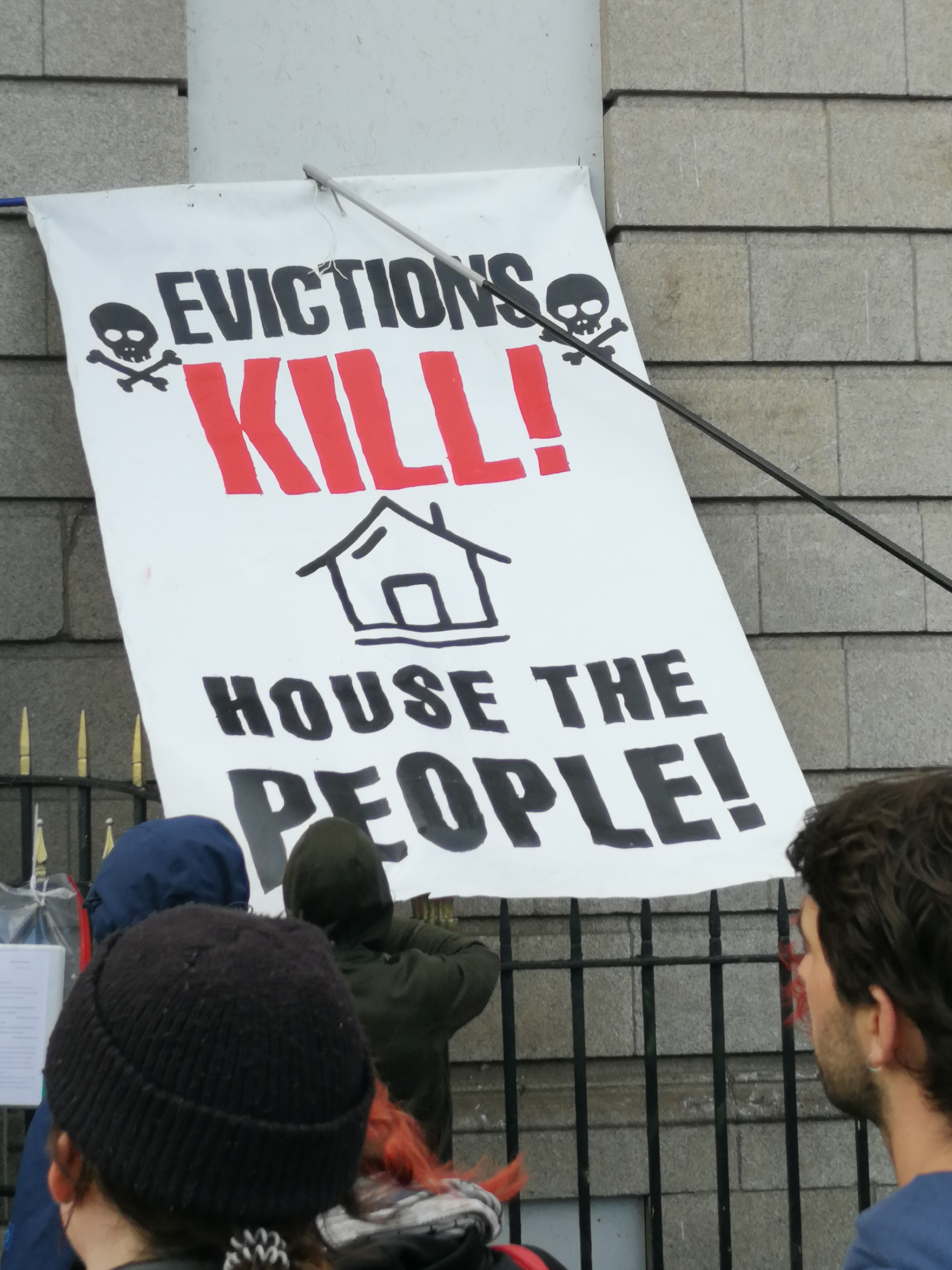
A performer accompanying himself by guitar sang a new resistance song while a giant banner was waved, reading “EVICTIONS KILL — HOUSE THE PEOPLE ”.
Musician performing for the rally (Photo: Rebel Breeze)
The event concluded with a man singing a cappella The Larkin Ballad4 (also known as the Lockout Song). He introduced his performance by saying that on that very Quay in August 1913 the police had killed two workers and that the Irish Citizen Army had been formed as a result, which had gone on to participate in the 1916 Rising — with the lyrics referencing both periods.
Following that, the chairperson invited those who wished to do so to enter the building but to treat it with respect in general and to abide by the rules of the occupiers of which he mentioned in particular that there were to be no photographs taken. A long queue formed for admittance even as some latecomers still arrived to join it.
End.
(Photo: Rebel Breeze)
FOOTNOTES
1The Salvation Army is a Protestant religious charity and temperance organisation and its funding by the State to address homelessness is another example of the ubiquitous private status of social services in Ireland whether through different faith organisations or other NGOs.
4“In Dublin City in 1913, the Boss was rich and the workers slaves ….” The original lyrics were composed by Donagh McDonagh, son of Thomas McDonagh, Signatory of the Proclamation of Independence and executed by British firing squad in 1916, with some further lyrics by his own son.
It is no secret that the United States of America has a deeply dark and disturbing history in regard to how Native Americans were treated in this country. After wiping out large portions of the indigenous populations with European diseases, the federal government took to forcibly assimilating the remaining population in government institutions.
In the 19th and 20th centuries, hundreds of federal schools were set up across the country in which Native children were taken from their families and tribes to be re-educated into the American way of life. Within these facilities, tens of thousands of children were both physically and sexually abused as “teachers” forced them to talk, dress and act “American.”
In these boarding schools, children were prohibited from speaking their Native American language and forced to assimilate into society. The abuse they suffered at the hands of staff was often times fatal and many of these schools began digging mass grave sites as a result.
A new study conducted by the interior department has given us glimpse into the deeply disturbing nature of these schools. The study found more than 50 burial sites, in which they suspect tens of thousands of native children have been buried — and, they expect that number to grow.
The study is far from complete, but some of the findings are being released as they focus on trying to identify the children and their tribal affiliations.
” “The consequences of federal Indian boarding school policies – including the intergenerational trauma caused by the family separation and cultural eradication inflicted upon generations of children as young as four years old – are heartbreaking and undeniable,” Deb Haaland, the interior secretary, said in a statement.”
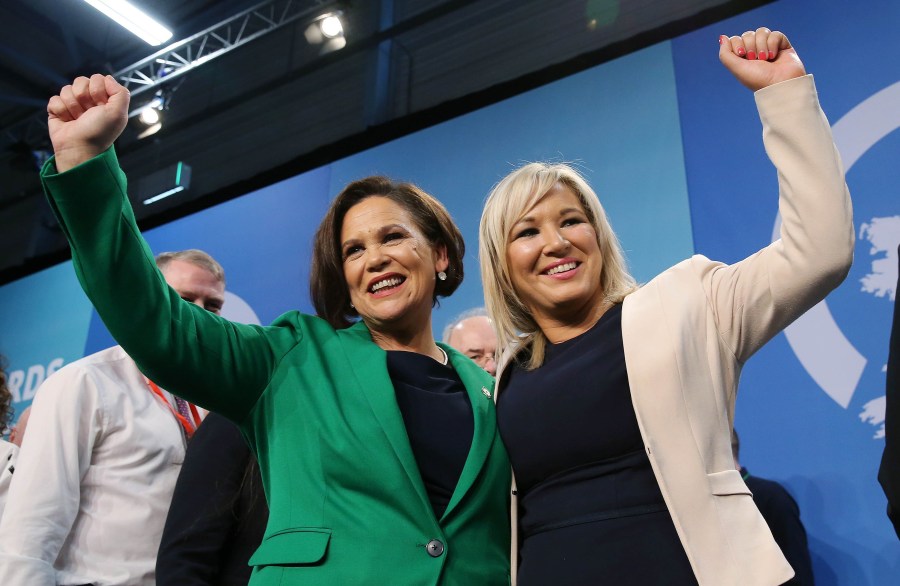
A lot of partisan views have been expressed on the results of last week’s regional elections in the north of Ireland. And principally by commentators in the United Kingdom or sympathetic to the UK (including the usual suspects here) attacking and downplaying the vote for Sinn Féin and/or northern nationalist parties in general while defending and hailing the vote for the Democratic Unionist Party and/or unionist parties in general. However, despite all the obfuscation, it is clear that there is more than mere symbolism in the possibility of a member of what was the minority community in the north-east of the country leading its regional government, with SF’s Michelle O’Neill likely to be chosen as the new First Minister. If the DUP agrees.
If fact, the electoral landscape of the Six Counties has now divided itself into three somewhat fluid constitutional blocs: pro-union, pro-unity and pro-neutral. That division is even…
Published 21 April 2022 in Socialist Democracy (Reading time: 2 mins.)
Amidst the flurry of articles and commentaries by Irish journalists eager to crank up the war machinery and in some cases arguing for WWIII as the lesser of two evils, the decision by Irish MEPs Clare Daly and Mick Wallace to not sing along with the blood curdling chorus for war, came as shock to the smug mandarins that rule the Irish print media and the airwaves.
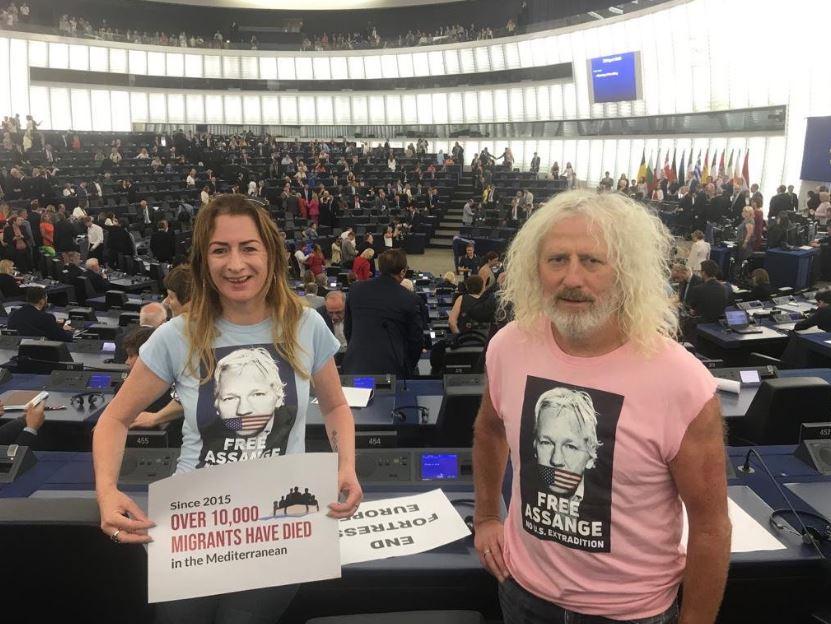
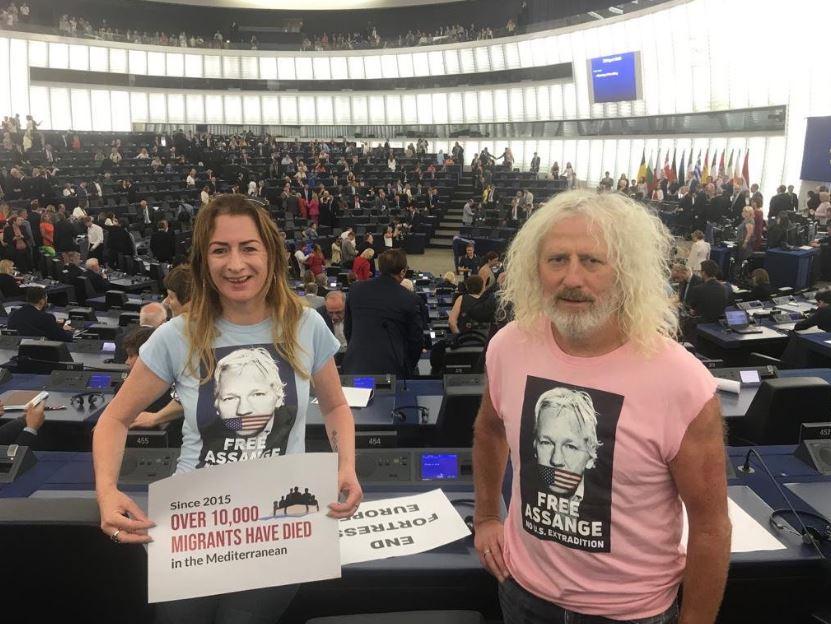
Clare Daly and Mick Wallace pictured in the European Parliament.
They dared to go against the flow, though it was hardly surprising that they did so. They have had a consistent stance on war and militarism. Nonetheless, the media were taken aback and went into overdrive to challenge, ridicule and besmirch them both. Their decision to not support an EU resolution was widely criticized in the media. They did so, as part of a group of 13 MEPs who refused to back the motion because of its call to militarily aid Ukraine. The reaction from the Irish media was swift and brutal and as with almost all coverage of the war, so over the top it resembled a parody of the state media of North Korea, without the creativity and nuance you might expect from Kim and his family.
It is ironic that a media that resembles a parody of the media in an authoritarian regime have tried to link both Daly and Wallace to such regimes. Writing in the Irish Independent, Kim Bielenberg wrote that “The MEPs’ support for authoritarian regimes has come under closer scrutiny after Russia’s invasion of Ukraine. Now they are accused of ‘victim blaming on a mass scale’.(1) He went on to say that it was not just him but that…there is growing concern about how two Irish MEPs, Mick Wallace and Clare Daly, have spoken in support of authoritarian states…
Their performance as globetrotting junketeers defending authoritarian regimes is likely to come under scrutiny from voters if they go before the electorate again.(2)The hyperbole is not worthy of Fox News or the ghost of Senator McCarthy, who is most certainly traipsing through the halls of RTE, the Irish Times and the Irish Independent. There is nothing to the accusation that they support Putin or any other authoritarian regime. As for the globetrotting, they were not part of a 2016 trip of 100 officials to Uruguay…which included 40 MEPs as well as administrators and staff, was to attend the annual “Euro-Latin American Parliamentary Assembly.” It included a champagne reception to celebrate an obscure literary award and a grilled fish dinner at a beachfront Hyatt hotel, all budgeted at €517,140, according to a European Parliament official.(3)Nor were they even MEPs when John Hume and others flew to Cyprus at a cost of £120,000 for a two-day meeting that coincided with a wedding one of the organisers of the trip was due to attend.(4) Unlike their champagne quaffing colleagues, both of them have travelled abroad on solidarity trips, a concept which is alien to the Irish media.
Wallace and Daly in protest trespass at Shannon airport years ago, a time when the Left and the Media would not be found in agreement. (Photo: Shannon Watch
The Irish Times, not to be outdone by their competitors have published a number of articles decrying the fact that clips of Daly and Wallace have been shown on television networks in countries that are on the current We do not like list. They exclaim that their correspondent Naomi O’Leary has carried out a year-long investigation on the “international footprint of the two MEPs.”(5) The article links to a podcast that opens with Clare Daly’s address to the European Parliament. I wasted 26 minutes of my life, that I will never recover, listening to it. It is a travesty of Daly’s and Wallace’s positions on a host of issues and seeks to link both of them to positions they don’t hold and a simplification of issues, that we have come accustomed to. The podcast by the Irish Times journalist is akin to old McCarthyite tactics of guilt by association, simplification of issues and a twisting of the truth. To listen to the podcast you would think that the two MEPs were singlehandedly responsible for all criticism of the EU position on the war in Ukraine. O’Leary should apply for a post in the next Trump administration in the US or even the current one. Her skills are on the same level as Sean Spicer and Sarah Sanders.
It is part of an overall assault not only on the truth but also on the right to dissent. Any criticism of the EU and NATO is akin to support not only for Putin but for all authoritarian regimes in the world. The Irish media has been practically unanimous in its support for NATO, and rather uncritical of US policy. It should be borne in mind that the Irish media has never played a leading role in anything other than support for the gombeen politicians that run the country. If we look at all the scandals that have rocked Irish society, none of them have been uncovered by the Irish media or promoted till they had no choice in the matter. Not the industrial schools, the church sex abuse, the Birmingham Six and Guildford Four, the Tuam baby scandal, nor any of the issues that led to various tribunals over the years. Most of the media turned their backs on these issues and had to be dragged kicking and screaming to give any coverage to them.
So, it comes as no surprise to find this same media ganging up on Clare Daly and Mick Wallace, an assault that will continue into the future. The two have hit back and filed a defamation suit against RTE. Though, they should perhaps consider extending that to the Irish Independent and Irish Times. Even on this point they are referred to, by the media, as controversial and outspoken, qualities that would normally fit the job description for an MEP.
The Irish media are determined to stamp out any dissent. Daly and Wallace have not backed down and continue to condemn the war. They have stuck to their guns, understanding that backing down won’t mean the media will go any easier on them or represent their positions correctly. The People Before Profit TDs could do well to learn the lesson. Following Zelensky’s address to the Dáil, they decided to stand as a sign of respect but not applaud as they didn’t agree with everything he said. The media piled on them over their refusal to applaud. This is totalitarian media, only complete surrender on the issue will do for them. They show no quarter and those who think there is some way to be nice to them on this issue are sadly mistaken.
Clare Daly and Mick Wallace pictured in the European Parliament.
Amidst the flurry of articles and commentaries by Irish journalists eager to crank up the war machinery and in some cases arguing for WWIII as the lesser of two evils, the decision by Irish MEPs Clare Daly and Mick Wallace to not sing along with the blood curdling chorus for war, came as shock to the smug mandarins that rule the Irish print media and the airwaves.
They dared to go against the flow, though it was hardly surprising that they did so. They have had a consistent stance on war and militarism. Nonetheless, the media were taken aback and went into overdrive to challenge, ridicule and besmirch them both. Their decision to not support an EU resolution was widely criticized in the media. They did so, as part of a group of 13 MEPs who refused to back the motion because of its call to militarily aid Ukraine. The reaction from the Irish media was swift and brutal and as with almost all coverage of the war, so over the top it resembled a parody of the state media of North Korea, without the creativity and nuance you might expect from Kim and his family.
It is ironic that a media that resembles a parody of the media in an authoritarian regime have tried to link both Daly and Wallace to such regimes. Writing in the Irish Independent, Kim Bielenberg wrote that “The MEPs’ support for authoritarian regimes has come under closer scrutiny after Russia’s invasion of Ukraine. Now they are accused of ‘victim blaming on a mass scale’.(1) He went on to say that it was not just him but that…there is growing concern about how two Irish MEPs, Mick Wallace and Clare Daly, have spoken in support of authoritarian states…
Their performance as globetrotting junketeers defending authoritarian regimes is likely to come under scrutiny from voters if they go before the electorate again.(2)The hyperbole is not worthy of Fox News or the ghost of Senator McCarthy, who is most certainly traipsing through the halls of RTE, the Irish Times and the Irish Independent. There is nothing to the accusation that they support Putin or any other authoritarian regime. As for the globetrotting, they were not part of a 2016 trip of 100 officials to Uruguay…which included 40 MEPs as well as administrators and staff, was to attend the annual “Euro-Latin American Parliamentary Assembly.” It included a champagne reception to celebrate an obscure literary award and a grilled fish dinner at a beachfront Hyatt hotel, all budgeted at €517,140, according to a European Parliament official.(3)Nor were they even MEPs when John Hume and others flew to Cyprus at a cost of £120,000 for a two-day meeting that coincided with a wedding one of the organisers of the trip was due to attend.(4) Unlike their champagne quaffing colleagues, both of them have travelled abroad on solidarity trips, a concept which is alien to the Irish media.
The Irish Times, not to be outdone by their competitors have published a number of articles decrying the fact that clips of Daly and Wallace have been shown on television networks in countries that are on the current We do not like list. They exclaim that their correspondent Naomi O’Leary has carried out a year-long investigation on the “international footprint of the two MEPs.”(5) The article links to a podcast that opens with Clare Daly’s address to the European Parliament. I wasted 26 minutes of my life, that I will never recover, listening to it. It is a travesty of Daly’s and Wallace’s positions on a host of issues and seeks to link both of them to positions they don’t hold and a simplification of issues, that we have come accustomed to. The podcast by the Irish Times journalist is akin to old McCarthyite tactics of guilt by association, simplification of issues and a twisting of the truth. To listen to the podcast you would think that the two MEPs were singlehandedly responsible for all criticism of the EU position on the war in Ukraine. O’Leary should apply for a post in the next Trump administration in the US or even the current one. Her skills are on the same level as Sean Spicer and Sarah Sanders.
It is part of an overall assault not only on the truth but also on the right to dissent. Any criticism of the EU and NATO is akin to support not only for Putin but for all authoritarian regimes in the world. The Irish media has been practically unanimous in its support for NATO, and rather uncritical of US policy. It should be borne in mind that the Irish media has never played a leading role in anything other than support for the gombeen politicians that run the country. If we look at all the scandals that have rocked Irish society, none of them have been uncovered by the Irish media or promoted till they had no choice in the matter. Not the industrial schools, the church sex abuse, the Birmingham Six and Guildford Four, the Tuam baby scandal, nor any of the issues that led to various tribunals over the years. Most of the media turned their backs on these issues and had to be dragged kicking and screaming to give any coverage to them.
So, it comes as no surprise to find this same media ganging up on Clare Daly and Mick Wallace, an assault that will continue into the future. The two have hit back and filed a defamation suit against RTE. Though, they should perhaps consider extending that to the Irish Independent and Irish Times. Even on this point they are referred to, by the media, as controversial and outspoken, qualities that would normally fit the job description for an MEP.
The Irish media are determined to stamp out any dissent. Daly and Wallace have not backed down and continue to condemn the war. They have stuck to their guns, understanding that backing down won’t mean the media will go any easier on them or represent their positions correctly. The People Before Profit TDs could do well to learn the lesson. Following Zelensky’s address to the Dáil, they decided to stand as a sign of respect but not applaud as they didn’t agree with everything he said. The media piled on them over their refusal to applaud. This is totalitarian media, only complete surrender on the issue will do for them. They show no quarter and those who think there is some way to be nice to them on this issue are sadly mistaken.
The grasshopper was enjoying the early May sunshine, playing his fiddle a bit, eating succulent new grass a bit, just enjoying life – a lot. Now and again, the grasshopper noticed an ant scurrying by but at first paid it no attention. Eventually though, he began to be a little curious and also, probably, a little irritated by this constant scurrying to and fro.
“Hey, Ant,” the grasshopper called out, the next time the busy insect passed him, “Why are you so busy? Why can’t you just enjoy life?”
The ant stopped and looked around to find out where the voice had come from.
“Ah, Grasshopper …. sorry, what did you say?”
“I asked why be so busy, why not just enjoy life?”
“Because food has to be gathered while it’s growing,” replied the ant, disbelieving anyone could be so stupid as not to know that. “And stored.”
“But Ant,” said the grasshopper indulgently, “there’s plenty of food around. No need to store it at all.”
“Yes, there’s plenty of food now, Grasshopper. But when the winter comes, hardly anything will grow. We gather the food now and store it so we won’t starve come winter.”
“Oh Ant, let winter look after itself. Now is the time to enjoy life.”
How can anyone be so stupid, thought the ant, shaking her head.
“Please yourself”, she said, hurrying on.
“Don’t worry, I will,” replied the grasshopper, striking up a merry tune.
He’ll only learn when it’s too late, thought the ant.
But she was wrong. The grasshopper began to think about the coming winter and absence of food. In between chewing the juicy grass-stems and playing tunes on the fiddle, the grasshopper went about making arrangements.
Summer turned to Autumn and Autumn turned to Winter. Most growing plants either died or went dormant. Cold winds blew through leafless branches.
Underneath the ant-hill, inside the ant-nest, it was warm and there was plenty of food, thanks to the hard work of the ant colony throughout the Summer and Autumn. The ants were enjoying their food, warmth and old stories.
A thunderous knocking announced someone at the main door. When the ants cautiously opened the door, whom should they see but the grasshopper, looking cold and hungry.
“I need some of your food,” he said. “Hunger is making me cold. And when I get cold, I get hungrier.”
“Too bad,” chorused the ants in the doorway.
“You should have listened to me in the Summer,” exclaimed one ant smugly.
“Oh, I did,” replied the grasshopper, even more smugly and let out something like a whistle, whereupon a large and aggressive crowd of blue beetles jumped out of hiding and ran for the door, overcoming the ants there in minutes. Into the the ant-nest they poured and sounds of fighting and injury could be heard within.
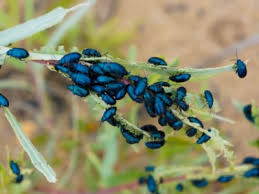
The blue beetles had been hiding but at the Grasshopper’s command, stormed the ant nest.
After a while, an injured but surviving ant at the doorway saw a blue beetle come staggering back out and approach the grasshopper.
“We need reinforcements, Master,” it whined. “The ants are massed and fighting hard defending their food stores. We threatened their young but they’re protecting them too.”
The grasshopper seemed unsurprised, almost as though he could have predicted that. He gave a different kind of whistle and a horde of dark green beetles poured out of hiding and into the nest. The noise of fighting grew louder and then ceased.
When the blue beetles ran into stiff resistance, the Grasshopper sent in the green beetles to finish off the opposition.
Any hope the ant had that the silence meant the elimination of the beetles was destroyed as a steady stream of beetles began to emerge, most of them carrying bundles of food.
“Lazy scum!” cried the surviving ant at the nest’s door. “You’re leaving us to starve!”
“No such thing,” scoffed the grasshopper. “If you all died of starvation, who would gather the food and store it next year? And the year after? You will probably go hungry – but you won’t starve. Not most of you anyway.”
The ant said nothing in reply, just watched the food parcels being carried out of the nest.
When they were all ready to leave, the grasshopper turned to the ant.
“No fighting next year, Ant. You just give us what you gather and we’ll give you back enough to live on and to raise new ants. No need for all that fighting, is there?”
The grasshopper turned away without a backward glance and followed the long lines of his food-carrying beetles in dark green and blue, his personal security platoon of blue beetles around him.
End.
The Grasshopper and Ants (Source image: illustration in book Aesop’s Fables, Library of Congress)
Corsican patriot Yvan Colonna died on Monday 21st March 2022 in France as a result of injuries sustained in a murder attempt by Muslim fundamentalist jihadist prisoner Franck Elong Abé, who attacked him on 2nd March while Colonna was exercising in the prison gymnasium. The attack put the Corsican into a coma from which he never recovered. News of the assault led to demonstrations, marches and riots in French-ruled Corsica, in addition to promises of concessions from the French Government, both with regard to the relocation of prisoners and the national status of the island’s governance.
Colona’s death joins the list of the deaths of many freedom fighters in jail, from Irish to Basque to Turkish and Kurdish backgrounds. On 30 Mar 2013 Basque freedom-fighter Javier Lopez Pena died in custody while other Basque political prisoners have died in Spanish jails down through the years. In defiance of widely-recognised human rights norms, both states disperse their political prisoners throughout their territories, locating them far from home and from family and friends.
Protest demonstration at murderous attack on Yvan Colonna in the French prison of Arles
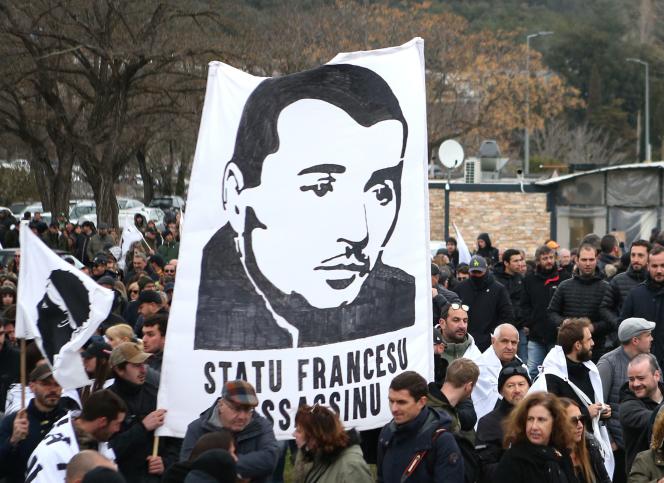
News of the attack provoked an instantaneous and militant response. The four nationalist political parties (Femu A Corsica, Partitu di a Nazione Corsa, Corsica Libera and Core in Fronte) denounced the attack, and two of them (the pro-independence Corsica Libera and Core in Fronte) supported the slogan of the demonstrations: “Statu francese assassinu” (“French state, murderer”).
A mass demonstration on March 6th saw thousands of participants in Corti, mainly young students, strongly denouncing the attitude of the French government. On March 9th youths set fire to part of the Palace of Justice in Ajaccio. And on March 13th, the streets of Bastia saw the largest demonstration in recent years, called by political parties, trade unions, the University, students and other social agencies. There were serious disturbances in front of the Prefecture.
More demonstrations have taken place since including school and college strikes and when news of Colonna’s death reached the island a Corsica police spokesman confirmed that “a full security alert” was in operation, and that riot police were on standby in all major towns and cities.
CORSICAN HISTORY AND CURRENT CONDITIONS
Corsica is a nation currently under French rule but which has been occupied by many different invaders over the years – including Greeks, Phoenicians, Carthaginians, Romans, Vandals, Goths, Byzantine Empire and later was fought over by the Holy Roman Empire and the Saracens. The city states of Pisa and Genoa ruled Corsica for five centuries; it came under French rule in 1768 and again when annexed by the French state in 1796 in which possession it remains to this day. Among its world-famous people was Bonaparte Napoleon, who became Emperor of France.
In 1976 two groups of Corsican revolutionary nationalists joined in armed resistance and formed the FLNC (Corsican Nationalist Liberation Front) which engaged in bombing French police stations and also attacks on foreign second homes in Corsica. In 2016 the organisation declared its intention to scale down armed resistance in the context of jihadist attacks, including the Charlie Hebdo killings. Last year, however, the organisation released a video of a scene witnessed by journalists, showing a group of armed masked men with the organisation’s banner, in which one read out a statement. The content declared unhappiness with the pace of change from the authorities, criticised nationalist politicians for sitting on the electoral gains (see below), pointed out that the balance of French population against theirs militated against a pacifist campaign and also criticised French owners of second home on the island “who think they are at home on Corsican soil,” saying “our country is not yet yours – your country will never be ours”.1
A logo of the Corsican armed resistance movement (Image sourced: Internet)
The population of the 8.680 km2 island-nation is 316.250 inhabitants (2014 census) of which 40% are reported as speakers of the national language, Corsu but all speak French – the only official language. Unemployment is around 8% (but higher among youth) as are accommodation prices, driven higher by the large number of holiday homes owned by people from other countries.
For much of its French history, the island has elected MPs of the French constitutional Right or Left but this changed during the 2017 French national elections, when a coalition of Corsican nationalist parties easily took three of the four available seats.
Preceding this success, the coalition had been formed for the 2015 Corsican regional elections, following an agreement to form a coalition called Pè a Corsica made up by of two main nationalist parties, the pro-autonomy Femu a Corsica and the pro-independence Corsica Libera. The coalition took 45% of the seats as well as the Presidency of the Corsican Assembly. The coalition’s priorities include the status of the island residents, officialdom of Corsican language, amnesty for FLNC prisoners, and a native legislating power, to mention but a few.
As of 2021 the nationalist coalition has 73% of the seats in the Corsican Assembly.
YVAN COLONNA’S PERSONAL & POLITICAL HISTORY
Yvan Colonna war born He was born in Marseille, France, on 7th April 1960 but at 15 years of age his family moved to Nice, (which is on the usual route betwee France and Corsica). After completing his French high school education, Yvan studied to become a teacher of physical education and sports but broke off his studies in 1981 to go and live in Corsica. He moved to accommodation in Cargèse and his brother later opened a beach bar there. Colonna took up goat herding in the area, a common occupation in Corsica and became integrated in the nationalist ethos of the majority of the Corsican population and in consequence was no doubt under French authority surveillance.
On 6 February 1998 at 9:05 pm, the prefect of Corsica, Claude Érignac, i.e the representative of the French State in Corsica, was shot receiving three 9mm bullets in the neck, and died shortly thereafter.
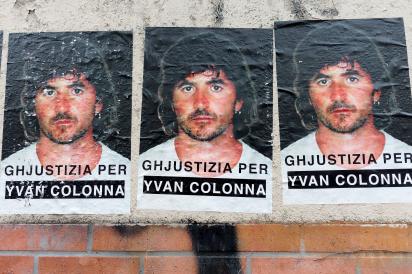
Posters demanding justice for Yvan Colonna (his image around the time of his detention). (Photo sourced: Internet)
French state roundups of Corsican nationalist activists followed but Colonna fled. The hunt for Colona became the biggest manhunt in French history and eventually Colonna was detected hiding in the Corsica mountains where he was arrested on 4 June 2003. Colona was in custody without bail but not tried until November 2007, his trial taking a month. Colona repeatedly stated his innocence during his internment awaiting trial, saying that he was the victim of unfair press coverage convicting him before trial. On 13 December 2007, Colonna was pronounced guilty and sentenced to life imprisonment. His later appeal was rejected in June 2011.
“Freedom for the Patriots”, i.e Corsican political prisoners (Image sourced: Internet)
At the time of his murderous assault Yvan Colonna was serving his sentence in the Arles jail, a 331 km direct journey by ship from Corsica (which is actually nearer to Italy than to France), between nearly 10 and 12.30 hours depending on the route, over land and sea. Any visits by family and friends in those circumstances necessitate considerable expense, including overnight stays to return the folowing day. Basque political prisoner support assocations have commented on the strain and streess upon the family and friends of the prisoners by this deliberate dispersal, with long motorway journeys resulting in serious and even fatal accidents. Corsicans also point out that had Colonna been serving his time in a Corsican jail, he would not have been in the same jail as the jihadist who murdered him.
LOOKING AHEAD
The murder while in French custody and rise in Corsican nationalist militancy, in particular among the youth, will make problems for French rule on the island. Already the authorities have conceded that prisoners from Corsica will serve their sentences in jails on the island and some kind of autonomy is being talked about. Independence is however out of the question from the point of view of the French State and as a result the Corsican nationalist coalition will also come under pressure, from the militant resistance movement as well as from the French authorities.
End.
Demonstration March 06, 2022 in Corte during a rally in homage to Yvan Colonna (banner declares the “French State Is A Murder). The following day the French State Prefect of Corsica declared that “The French state is not a murderer.” (Photo by Pascal POCHARD-CASABIANCA / AFP)
As I sit down to write this there is an armed conflict occurring in eastern Europe, in the Ukraine, with the potential to escalate into a greater – and possibly even world – war. The mass media is quite clear on its position, which side it supports and which it opposes. Considering the antagonists involved and the conflict’s background, that is not surprising. What is surprising perhaps – and certainly concerning – is the confusion in the Irish Left1.
This may not have much practical effect on the conflict itself but it will indubitably affect the minds of the Irish general population and, in doing so, is highly likely to assist a move of the Irish ruling class to membership of US-led NATO (North Atlantic Treaty Organisation) or to contributing towards an imperialist EU military force. That would be an end to formal Irish state neutrality for the foreseeable future with Irish military in foreign conflicts and Ireland seen as a legitimate target.
Ukraine solidarity rally alongside the General Post Office building, Dublin City centre, 26 February 2022 (Photo: D.Breatnach)
One position, let’s call it position A, is totally or mostly condemning Russia. The invasion is seen as an attack on the national sovereignty and self-determination of a nation: Ukraine (which Putin has declared does not even exist as a nation). Furthermore it is being carried out on behalf of a capitalist Russian ruling class, is hurting ordinary working people and possibly endangering the world through war, as NATO moves to support Ukraine. Therefore Russia should withdraw from the Ukraine and we should mobilise in solidarity with the Ukrainian nation.3
(Image sourced: Internet)
Position B takes almost a diametrically opposite view: the invasion has been necessary because NATO is encircling Russia and doing so with the assistance of many former USSR states, in particular in this case, Ukraine, with which Russia shares a border. Furthermore a legitimate government in the Ukraine was overthrown by a NATO-supported coup in 2014, which led to attacks on – an protests by — ethnic Russians in the Donbas region and an armed conflict during which civilians were bombed, ethnic Russians targeted along with communists, at least 39 of which were burned to death in a trade union hall by organised fascists (a unit of which is integrated into Ukraine’s armed forces). Therefore we should call for an end to NATO encirclement of Russia.
Map showing NATO-aligned states in Europe and also the incremental increase over years. (Image sourced: The Economist journal)
Position C seeks to straddle the opposing views, condemning both the Russian invasion and NATO’s encirclement of Russia. It urges us to call for the withdrawal of Russian troops from the Ukraine and for diplomatic negotiations around resolving the conflict between NATO’s expansion and Russian national security.4
My position is different from all of the above, arrived at by seeking to identify the fundamental causes of the conflict and proceed from there while taking into account another serious danger (to be addressed in the section below).
US military aid to Ukraine in millions of $ (Source: Defence Priorities)
The specific fundamental cause of the conflict is NATO’s expansion against Russia in Eastern Europe (and not alone there but in the Middle East also) therefore calling both NATO and Russia out equally is not only incorrect but unhelpful. Not that the Russian ruling class would listen to us anyway but if it should for some reason pull out of the Ukraine now that would only bring the situation back to the previous status quo, i.e the very situation that led to this conflict in the first place. NATO would have no reason to agree to Russian demands for its withdrawal and, indeed, it and its allies are arming the Ukraine to the teeth. NATO would in fact press its advantage seeking the total defeat of Russia and to bring it under its control.
There is not only that to consider but on a world scale too, the expansion of US Imperialism in alliance with other imperialist states through NATO is by far the greatest culprit in terms of wars and suppression of liberation struggles in Africa, the Middle East and Latin America5 and therefore ridiculous to be viewed in equal terms with Russia.
On the other hand the Russian state is a capitalist state and a (smaller) big power with its own agenda of expansion and we cannot appear to be supporting it. Nevertheless, the first step towards peace in the region has to be a withdrawal of NATO.
Danger of the Irish State joining a military alliance
There are no doubt elements in the Irish armed forces that would welcome involvement with the armed forces of NATO – interesting military exercises, the chance to use more sophisticated weapons and systems, along with probably greater chance of promotion for officers. A part of Ireland is already in NATO – the British colony of the Six Counties.
There are also elements in the Irish capitalist ruling class (the Gombeens6) who are striving to get Ireland into an EU strike force and/ or NATO. The non-military status of Shannon Airport has been repeatedly violated by the US military with clear collusion from the Irish State. Just recently Leo Varadkar, Taoiseach (i.e Deputy Prime Minister) was quoted as saying, arising out of the conflict in the Ukraine, that Ireland’s independence status might need to be reconsidered. This is of course spurious reasoning, since Ireland is a long way from Russia across a NATO-full Europe, but joining a European military alliance has been a proposition of Fine Gael politicians for over a decade7.
A small anti-PESCO (proposed EU joint armed force) demonstration outside Leinster House (Irish parliament) on 15 January 2019) with unreasonably high level of Garda security behind them.
Then there is the section of the Gombeen class that has been muttering for years about joining the UK, promoting historical commemoration of the UK’s repressive forces in Ireland and particularly in earlier decades, along with the wave of revisionist historians seeking to undermine the national history of resistance to invasion and occupation. Jumping into a military alliance is no big step for the Gombeen class, having acted historically as a broker selling Irish resources, networks and labour to foreign capitalists as well as laundering their taxes for them.
Resistance among the general population to permitting the State to merge with the UK is probably at a fairly high level but is not necessarily so with regard to NATO, as a US-led military alliance. This is not because Irish people are fond of US imperialism as such but because we have been fed so much of its mass culture as to affect how we speak and even think. And not only general mass culture but specifically representations of the military, with films showing US military in action from WWII to Afghanistan and Iraq. Futuristic films depicting the military also often present us with an imagined future version of the US military or even worse, perhaps, a solar system or wider military which is run by the US or its future projection. Spy films and novels tend to give us the CIA or some similar force; crime fiction gives us US Police or FBI heroes while the tough private investigator is often not only ex-US military but from their special forces.
If the Irish state should join a military alliance, the countdown begins to the participation of Irish military personnel in conflict, against power blocs competing with NATO and even more likely in suppression of liberation struggles, insurrections etc, whether in other parts of the world or in Europe itself. In turn that also entails Ireland becoming a target for retaliation in destruction of bases or even simply in revenge.
Needed steps forward
If we are to avoid being sucked into wars, if we are to defeat any plans of the Irish ruling class to take us into a military alliance, we need to ensure the mass of people are prepared ideologically to oppose any such moves.
We urgently need to build (or rebuild) an anti-war movement in Ireland. Such a movement needs to be
Broad, encompassing as many as possible under basic principles (which presupposes not permitting itself to be ruled by any particular political party or clique)
anti-imperialist (i.e not against liberation struggles)
specifically targeting the imperialist powers nearest to us – in particular the UK and EU
targeting also the currently major imperialist power in the world, the USA
and upholding Irish state neutrality in opposition to the state joining NATO or an EU military force.
The movement needs to be as broad as possible to include all the viable forces for alliance and to do that must be free of manipulation by any one party, organisation or clique. It cannot be one that is simply against all armed struggle (though pacifists should be free to join it), since imperialist and colonialist aggression brings many people to justified resistance in arms.
It must target imperialism, the chief cause of war for over two centuries and in solidarity with the people oppressed by it around the world and by implication we must also oppose colonialism, even had we not our own reasons to oppose it here. In that regard, our chief targets both in terms of size of threat and practical application must be the UK, NATO and any EU military alliance. Therefore, logically, we must strenuously oppose the Irish ruling class taking us into alliance with any of the aforementioned.
The application of the above principles into organisational measures will need to be developed but once some initial agreement on the need to act along those lines is taken, unity is best built in practice, in action. The need to get to work on this initiative is urgent.
Nor is this only about keeping Ireland out of wars, urgent though that need is. In the event of a revolutionary regime in Ireland at some time in the future, do we have any need to fear invasion? I would say “Yes, certainly” — unless the whole world were in revolution at that time. Where is such danger of invasion most likely to come from? From a capitalist Russia, however repressive? Hardly. From places closer? Yes, obviously: from an unrevolutionised UK, from an unrevolutionised western Europe and from NATO – should it still be in existence.
Realistically, we can exercise little influence on the decisions of either NATO or Russia. We can have an effect on the decisions made on Ireland’s behalf and for that we need a strong and informed popular movement. We have two practical self-preservation reasons to get this right.
End.
FOOTNOTES:
1 I am including the Left Republicans in the “Irish Left”.
2I have consciously refrained from identifying these positions with particular organisations or individuals on the Irish Left. I am arguing with the positions rather than targeting those who hold them in a debate which is becoming increasingly acrimonious, making agreement even further unlikely.
3This is a major position on the Left or if not, certainly the most visible. It is also to one degree or another, the position of the political parties of the State (in which I include Sinn Féin) and of the mass media.
4This is another major position on the Irish Left.
5It is US imperialism that is the fundamental cause of the current armed conflict in Iraq and was the chief cause in the war in Afghanistan, where it funded Islamic Jihadists and has been arguably the cause of the rise of militant Islamic fundamentalism. The US is the chief supporter of the criminal Israel Zionist state; it overthrew the Libyan regime and tried to do the same in Syria, where another ally, Turkey, is also involved in armed action. Saudi Arabia, an ally of the US, is the chief cause of the ongoing war in Yemen. US imperialism instigated the coup in Chile to instal the Pinochet dictatorship with huge loss of life and misery for survivors; it instigated other coups and supported military dictatorships across South America and indeed Africa. Vietnam, Laos, Cambodia, Korea ….
6From Gaimbíneachaí, disparaging Irish term for a middleman strata under colonialism who profited on the misfortunes of their co-nationals and after colonialism constitute a foreign-dependent ruling class.













 rebelbreeze