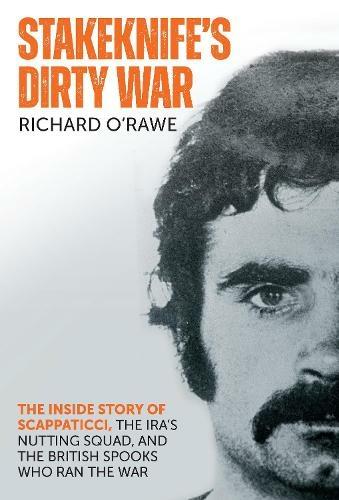
Book Review: Stakeknife’s Dirty War by Richard O’ Rawe, Merrion Press, 2023

Gearóid Ó Loingsigh 02 November 2023
Richard O’ Rawe’s Stakeknife’s Dirty War is a timely book, coming as it does after the death, or supposed death of Stakeknife in England and what looks like a thwarting of the intent and findings of Boutcher’s Kenova Inquiry into the affair.

It is now accepted by all that IRA Volunteer Scappaticci was also the British agent known as Stakeknife.

O’Rawe had access to IRA volunteers and former intelligence operatives and weaves together aspects of Scappaticci’s life and role into a narrative that is convincing and despite the nature of the subject matter, torture, murder and betrayal it is an easy read.

O’Rawe also introduces us to Scappaticci the person. The person however, isn’t any more likeable than the British agent, torturer and murderer. In fact, it would seem they are flip sides of the same coin. Scappaticci was an industrious character, always on the make, running private tax scams.

He was used to money long before he became a paid British agent. His fortune earned from murders on behalf of the British and the IRA, though the IRA weren’t giving him anything like the sum the British did, is estimated to be in the region of a million pounds in pay-outs.

He also had various properties. Scappaticci was also a lowlife thug long before the British and the IRA gave him carte blanche to murder and torture his way through republican ranks. Some of things he did, had he not been in the IRA would have led to him being kneecapped by the IRA.

A man called Collins made the mistake of publicly calling the area in Twinbrook in which Scappaticci lived ‘Provie Corner’. Scappaticci did not like that and decided that Collins had to pay for his transgression.

He knocked on Collins’ door and, when it was answered, the informer battered the older man multiple times over the head with a sock containing a brick. Only when Collins collapsed did Scappaticci walk away.

This is the type of low life thuggish behaviour that the IRA was willing to tolerate and perhaps even encourage from people like Scappaticci. In a genuinely political movement, a thug like Scappaticci would have been out on his ear. But not in the IRA nor in Sinn Féin.

He was, to paraphrase the Yanks when talking about the Nicaraguan dictator Somoza, “he may be a son of a bitch, but he is our son of a bitch”, though in this case it would seem that not only was he theirs he had just the qualities that both the IRA and the British valued, ruthless thuggish qualities.

Scappaticci the person and agent are intimately related it would seem though O’Rawe doesn’t explicitly say so. He does however, give us ample material with which to draw that conclusion.

One of the issues never dealt with it in the press and not really fully covered here is what type of organisation recruits, tolerates and promotes such people. He was a reprobate who should never have graced the ranks of the IRA. That he did so, is down to Adams and co.

That is also clear from the book. It is not an aspersion on Adams or on McGuinness either to question their role.
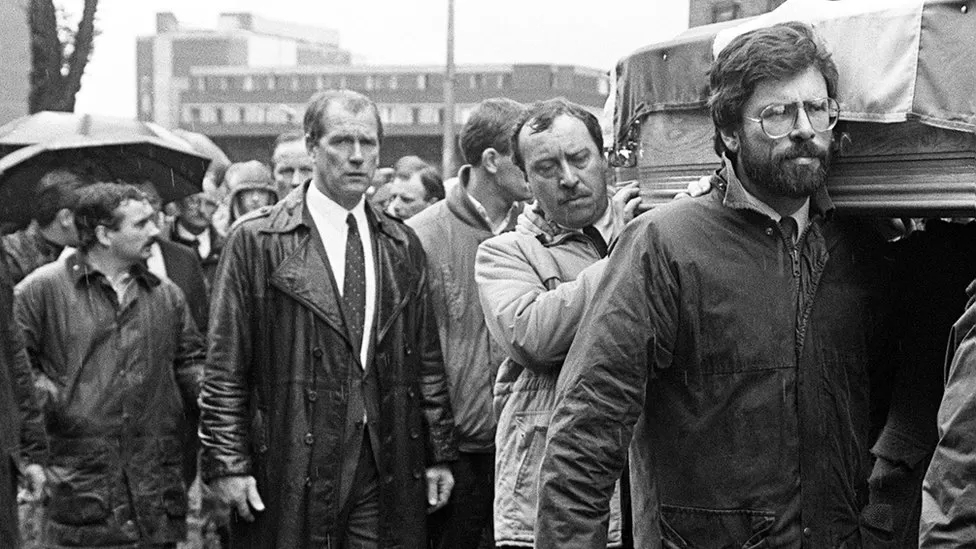
Republican funeral, Scappaticci on left photo, Adams on right (Photo cred: Pacemakers)

The latter of the two comes in for some questioning in the book regarding his role and O’Rawe goes into some detail and also explains in the epilogue that before beginning his research he was unaware of the level of unease amongst republicans about McGuinness’ trustworthiness.

Though he does point out earlier that if McGuinness was a tout, why was it necessary for the British to have a spy such as Willie Carlin get close to him. The same could also be said of Adams.

The British had an agent, Denis Donaldson, whispering sweet nothings in Adam’s ear over many years, shaping Adam’s view of the world and reporting back to the British how successful he had been in his endeavours.

The Peace Process, in that regard, was partially the result of what ideas the British planted in Adam’s and McGuinness’ minds through their various agents. However, it does seem unlikely either of them were touts in the classical sense of the word.

They didn’t need to be, they were at a different level. They were both on the same side as Scappaticci in winding down the war, they just had different methods of going about it.

It is possible that at some stage they had dealings with the British security services in pursuit of common aims. O’ Rawe is not the first to question McGuinness either.

Ed Moloney has put forward the idea that the reprehensible proxy bombs that provoked so much revulsion were signed off on, precisely because they would strengthen the hands of those who sought to wind up the war.

O’Rawe gives many examples of what Scappaticci and the other British agents in the Internal Security Unit did. It wasn’t limited to executing alleged informers or those the British thought should be removed for various reasons under the guise of them being informers.

They were also in a position to give information on operations which led to the British either arresting or killing the Volunteers involved.  The book opens with an account of one such operation, where fortunately they were able to pull back from it without the planned British ambush going ahead.

There were of course other incidents, one of them being Loughall where the British ambushed an entire unit of the IRA. Scappaticci and his ilk did great harm to the IRA, but they were not the reason the IRA lost the war, and O’Rawe doesn’t argue it was either.

However, others have made this point. But the IRA was never going to win the war, they weren’t going to outgun the Brits ever.

Another part of the problem of course, is related to Scappaticci. A movement so highly infiltrated would always have problems, but it is telling of the political weakness of the IRA and Sinn Féin that a thug like Scappaticci could rise through the ranks and remain at the top for so long.

That says more about their weaknesses, than anything else.

That Denis Donaldson, a British agent was the chief advisor to the IRA and Sinn Féin on strategy, for so long, shaping policy, whilst Scappaticci weeded out of the ranks anyone who would oppose it, says more about the weakness of republican politics than whether operations went ahead or not.

O’Rawe, however, is more interested in what happened and who bears responsibility for it.

He is quite clear that the IRA are to blame and is equally clear that those in the intelligence services who allowed Scappaticci and other British agents in the ISU to murder their way through republican ranks are also to blame.

He is not wrong in that, Danny Morrison described Scappaticci as Number 10’s murderer(1) and that he was, he was also the IRA and Sinn Féin’s murderer.

Adam’s infamously justified in a blasé fashion the IRA murder of alleged informer Charles McIlmurray in 1987 when he said that “like anyone else living in West Belfast [he] knows the consequence for informing is death.”(2)

Neither the British, the IRA, Sinn Féin and Gerry Adams in particular, get to wash their hands of the affair.

This book is an important contribution to uncovering the truth of Troubles, one which will neither please Sinn Féin nor the British and Irish governments written from the perspective of a former IRA volunteer.

It deserves to be read and kept on the book shelf as the issue is not going away any time soon.

end.

Notes

(1) Morrison, D. (30/01/2016) No 10’s Murderer – Scap https://www.dannymorrison.com/the-times-of-no-10s-main-murderer/

(2)  See https://www.youtube.com/watch?v=8Kwrj6Ku9ZU


Book Review: I’ll Burn That Bridge When I Come to It.  Norman X. Finkelstein.

Norman X. Finkelstein. Substation Media 2023

Gearóid Ó Loingsigh 26 April 2023

(Reading time: 9 mins.)

Norman Finkelstein has published a new book on cancel culture. It comes from a man who as he points out became a high-profile victim of one of the more modern iterations of cancel culture, that of Zionism.

The latter was unashamedly right wing and did not dress itself up in liberal or even bastardised Marxist tropes, peddled by people who should know better. 

He is perhaps, one of those with a vantage point on the issue, who deserves to be listened to.

He opens the book with an epigraph from Bertrand Russell: “I feel a real and solid pleasure when anybody points out a fallacy in any of my views, because I care much less about my opinions than about their being true.”

A statement that should be basis of all discussion is now frowned upon in a world of unassailable truths, wicked witches who should be burned at the stake, dogmas that once enunciated can never be challenged.

And whether the statement is true, matters not as it is more important how many semi-literate university graduates are offended by it that counts.  Of his own cancellation and the hypocrisy of some of those who signed the Harper’s Letter decrying cancellation he is not bothered.

This is because he contends that “Hypocrisy was rife, for sure.  But the irrefragable fact remains that “woke” politics are intellectually vacuous and politically pernicious.”  He forewarns us that the book is laced with vitriol… because so much of “woke” culture deserves contempt.”

But that “a large amount of space is devoted to dissecting this nonsense… because it’s not immediately obvious why it’s nonsense.”  This Foreword alone entices the reader to delve deeper into its pages and the plea from Tariq Ali for him not to throw a tantrum makes it all the better.

Cancel culture as Finkelstein points out is not new. 

He gives a short list of some of his heroes who were cancelled at one point or another, Pete Seeger, Paul Robeson, Lee Hayes and even Malcolm X and Martin Luther King and even Chomsky were cancelled and reviled in their day.

Pete Seeger, veteran folk singer, folk song collector and political activist, was among victims of cancel culture in his day. (Photo sourced: Internet)

Yes and by the same newspapers, journals and political quarters that are now to the fore in cancelling one and all and in some cases, those involved in the cancelling now decry the cancel culture that affects them.

He divides the book into two parts, one dealing with woke politics and the other with academic freedom, though they are not separate and there is some overlap, even in the book. 

In the first part he looks at some of the figures of woke politics, those who make the case for identity politics in particular.  Some of the people he looks at, such as Ta-Nehisi Coates and Ibram X Kendi, are well known in the US but not so much outside of it. 

He eviscerates them rather well describing Kendi’s writing as being “as supple as a calcified femur and as subtle as an oversized mallet”.  Obama is of course, well known, though his politics are modern in how they are sold. 

Obama is all about style over substance, partly because the substance is not new, he represented no great change in US society, though that is not the image he sought to portray.  His message was vacuous, Yes we can, and Finkelstein asks the question, can what?

And gives the very direct and truthful answer “Yes we can, elect me”.  Obama is shredded in the book, his famed oratory derided for what it is, speeches that were written by an all-white team of writers, despite Obama’s identitarian claims.

A parsing of Obama’s public addresses reveals a relentless concatenation of the most vapid, sententious, shoeworn, fatuous, hollow, saccharine clichés—a cornucopia of the commonplace—without a single clever phrase, metaphor or aperçu to redeem or relieve them, interlarded with oleaginous homilies to humility before God.

That does not mean that his speeches and politics are devoid of consequences.  Obama epitomises the reality of identity politics.  It is another con job.  For all his blackness Obama did very little for blacks in terms of socio-economic advancement. 

Not even in terms of a relatively simple issue, police violence against blacks.  In one of the first rows in his presidency on the issue, he backed down and instead of taking action invited the policeman and his victim for a beer. 

Identity politics is waived about, not to solve any problems but to divide.  Finkelstein asks whether it advances causes or provokes their retreat.

The objective of politics, Mao Tse-Tung famously exhorted, was to “unite the many to defeat the few.”  Whereas, identity politics divides the many so as to, designedly or not, enable the few. 

It conjures a hierarchy of oppressions, in which each group vies with the others for the position of most oppressed— Kimberlé Crenshaw says Black women are most oppressed, Angela Davis says it’s transgender people, Ibram X. Kendi says it’s poor transgender Black women. 

The victors in this inverted Oppression Sweepstakes, where you win by being the biggest loser, get to leap to the head of the queue as most worthy of preferential treatment, while, simultaneously, fomenting new resentments among those shoved further and further behind…

This, in effect, performance politics has spawned a disgusting den of thieves who brand themselves with radical-sounding hashtags, churn out radical-sounding tweets, and insinuate themselves into positions of prominence, as they rake in corporate donations and cash corporate paychecks.

Theyhang out at the watering holes of the rich and famous, and thence can be safely relied upon not to bite the hand that feeds them.  In a word, identity politics is a business—in the case of Black Lives Matter “leaders,” a most lucrative and dirty business.

Cancel culture is about silencing voices other than those sticking their snout in the trough and their grubby hands in the greasy till, a point he is right about, not just in the US but around the world. 

Finkelstein found himself cancelled, though not silenced, as he points out, because his views go beyond the grimy quest for self-aggrandisement and enrichment.  Identity politics is utterly reactionary. 

He contrasts the fumbling for pennies and the endless categories of oppressions with an historical figure that our perpetually offended money grabbers in search of the latest shakedown could never match: Rosa Luxemburg.

My mind drifts back further still to Rosa Luxemburq, this exotic creation of a lost epoch: Polish, Jewish, bourgeois, handicapped, female—

Rosa didn’t wallow in or capitalize on her “intersectionality” but, on the contrary, triumphed over it as she became the brilliant, impassioned (and then martyred) revolutionary leader of the German workinq class;

A class which—be it noted as a robust class rejoinder to claustrophobic identity politics —fervently embraced this Polish-Jewish-bourgeois handicapped-female as one of their own.

And that is exactly the point. Luxemburg is a real hero, many of the heroes of the woke do not measure up to their own standards, not even Frederick Douglass, who had a very poor opinion of native Americans, a fact overlooked by modern day identitarians. 

Though many don’t have a positive opinion of native American themselves.  Douglass however, is despite this a towering admirable figure in history, not one that should be cancelled, a hobby now of every spoilt ignorant brat that mammy and daddy got into an overrated expensive university. 

And though it is only a matter of time before some hippy in Berlin decides to reinvent Luxemburg as intersectional, she was not and had no time for the woke equivalents of the day.

Academic freedom is the other area of concern for Finkelstein, conformity, banal ideas and salivating over money is not limited to our woke warriors in the press, NGOs and politics but in academia.  It is not new, but is more pronounced now than before. 

Bertrand Russell summed it up nicely and Finkelstein agrees that “As a rule, by the time a man becomes a professor, he has been tamed, and has learnt the advantages of submission” the advantage being measured now in euros, dollars, yen and shekels, though many would deny this.

Again  as he points out “For self-deception, you can hardly beat academics,”.  There are of course exceptions, but in the current atmosphere, the younger new academics are bowed and beaten by those who went before them.

Given his own personal experience, he is obviously in favour of academic freedom which he describes as not just the freedom to teach but to enquire and travel the road less travelled. 

He points out that in the US the idea went through various stages, freedom from churches, then from corporations and later the state (MacCarthy).  Nowadays, all three encroach upon it, sometimes in unison and to the same end. 

He goes again into some detail on the issue and chooses the thorny ground of Holocaust denial. 

He is Jewish, so he is clearly not advocating that the Holocaust did not happen, but rather how it is dealt with on campus and links it up to other issues, giving examples when he himself has been uncomfortable teaching and the examples he relies on. 

He makes an argument for challenging ideas.  This section, like the Obama part is overly long and could also have done with a bit of editing.  But he clearly comes out against censorship and new morality police that abound everywhere.

It’s easier to fight against codified speech restrictions than against “enlightened” campus opinion, which, in the name of its “special duty,” insinuates itself in campus life and throttles free speech with its asphyxiating pieties.

The situation now is that debate is being stifled on a whole range of issues, beyond the obvious ones and the high profile debates on Men’s Rights i.e. the right to id your way into women’s spaces. Due to his own experience, he does seem to think that it is more the case when an academic goes off campus that the trouble arises. 

But actually, the baying mob throttling free speech are doing so on campus now to people who have never ventured off it, or at least have never been given much opportunity to do so.  He cites a very interesting case, that of Bertrand Russell when he was appointed to City University. 

His morals, his sex life and general outlook were brandished about as reasons for not hiring him.  Russell defended himself, saying they were irrelevant, he was appointed as a lecturer in “modern concepts of logic,” “foundations of mathematics,” and “relations of pure to applied science.” 

In the modern cancel culture that wouldn’t stand.  People are sacked precisely because of their private lives or their opinions on matters wholly unrelated to the area in which they teach. 

It didn’t stand back then either, Russell lost the case precisely because he argued in favour of homosexuality and premarital cohabitation, amongst other things.  Our woke liberals on campus, those who hounded Kathleen Stock out of her job are as reactionary as the judge in the case. 

He goes on to look at other cases before finishing off with the details of his own case and his unemployment and unemployability in academia.

The book is interesting, though far too long with too much detail about some cases and aspects which makes it difficult to see the wood from the trees at times.  But it does offer arguments on issues that are current with reference to historical precedents and also to philosophy. 

It is worth reading, as he is a rather high-profile victim of cancel culture.  His book the Holocaust Industry was thrashed by the New York Times, which had positively reviewed the Bell Curve and even gave a better review of Mein Kampf than Finkelstein’s book. 

They probably keep quiet about that aspect.

Cancel culture, identitarianism, intersectionalism are amongst the biggest intellectual challenges to the left. 

They deny class and reduce politics to the acceptance of pre-ordained dogmas, that are espoused by the US Democratic Party, Facebook, Google and many major multinationals i.e. from the right of the political spectrum. 

They are the wolf in sheep’s clothing, though the sheep is clearly showing the fangs for anyone who wants to see.  History is unlikely to be kind to them. 

Whilst Finkelstein has some illusions of his own in some liberals like Bernie Sanders, his point about freedom of speech, the search for the truth, discussion and debate are his main point in the book. 

A point that cannot be overemphasised in its importance, nor of the need to persevere through the current darkness.  As Finkelstein says.

Many of the heroes of my youth had been blacklisted, but also had, despite all, stayed true to their youthful convictions; not dogmatically, as almost all of them had left the Communist Party, but still unreconciled to the capitalist system, and committed, at any rate in theory, to its overthrow.

A picture of Robeson sits on my bookshelf beside a picture of Marxist economist Paul Sweezy.

The cancel culture advocates and wokerati have, unlike Finkelstein, reconciled themselves to fumbling in the till and harassing those who might speak out against the system in any meaningful way.