SOUTH DUBLIN DOCKLAND COMMUNITIES ORGANISE FOR THEIR NEEDS

Diarmuid Breatnach

(Reading time main text: 5 mins.)

On a wet Tuesday night in the large lobby of Windmill Lane Recording Studios, local community representatives met with representatives of political parties, Dublin City Council and the Gardaí to press for their community’s needs to be met.

The meeting on 24th October 2023 was convened by the City Quay Committee and its organiser, Patrick (“Paddy”) Bray raised concerns about the unmet needs of the local communities currently and for following generations.

Apart from the City Quay Committee, also represented were representatives of housing areas Markievicz House and Conway House, along with volunteer-managed youth service Talk About Youth.

Also in attendance were representation from political parties Fianna Fáil, Labour and Sinn Féin, all of which have TDs (members of Irish parliament) elected in the area. Dublin City Council was represented as the local municipal authority and Pearse Street as the nearest Garda station.

Presumably the presence of a Garda representative was in relation to discussion around a recent period of violent confrontations between opposing gangs of youth on the Samuel Beckett Bridge (but also Sean O’Casey Bridge) connecting South and North Liffey docklands.

It was striking that nearly all the community representatives were female, while most of the political representatives and each of DCC and the Gardaí were of male gender.

Paddy Bray opened the meeting outlining the local concerns about the area’s youth and the lack of constructive activities for them, the local youth service being underfunded, under-staffed and with no permanent base.

Bray went on to outline a dire absence of any kind of community facility for the local community, while property development went on around them, including four hotels in recent times, with no sites designated for affordable housing or community needs.

Looking across from the north quay, central background, the 8-storey Clayton Hotel, along with other buildings dwarfing even the four-storey reconstructed The Ferryman, the last of the original pubs along the South Docks between Tara St. Station and the East Link Bridge. (Photo sourced: Internet)

Other community representatives also pressed their needs hard and raised issues of applications for building on existing sites without consideration of the community’s needs in housing, parking, child and young person development, mental health or green space.

A number raised concerns about rat infestation in a housing area, emanating from a derelict site, followed by some discussion about where responsibility lay to address the problem as the site is in private ownership (though there was a suggestion of an enforceable abatement order).

The responses of the political party representatives and the Dublin City Council Area 2 officer were generally supportive, though a disagreement did emerge as to whether the City Council were doing enough to control the rat infestation.

Evoking a medieval or early 1900s scenario, a community representative reported that a man visited their housing area on a voluntary basis to kill rats and at a recent visit, had killed seven. Photos of live and dead rats on a phone were handed around (to shudders from some of the men).

The meeting concluded with an agreement to form a campaigning committee for the resources and sites needed, for the political representatives to support its aims and for the Area 2 DCC Manager to report back to his own management.

Paddy Bray asked all present to spread the word among their contacts to enlist further support.

THE COMMUNITY: LOSS, NEEDS AND HISTORY

The name of the building in which the meeting was held is famous in Irish recording events though most probably associate it in particular with the previous recording studio on the site and the rock group U2.

A plan for a six-storey block on the site was defeated by local protests in 2008 but the original studios were demolished with the exception of the U2 fans’ graffiti wall, which was later sold and proceeds donated to a charity fundraising for awareness of men’s health and treatment needs.

The new building is owned by the formerly investment trust company, now Hibernia property development company which, despite the name, as is now common in Ireland, is owned by a foreign corporation.1

Property speculators plan to demolish the City Arts Centre, a resource for the community but derelict and empty for two decades on Moss Street on the South docks, in order to build a 24-storey office block.

City Arts Centre building, derelict for years, property speculator high-rise plan appealed by many including Dublin City Council to An Bord Pleanála, now speculator taking DCC to court. (Photo sourced: Internet)

Unusually perhaps, the demolition application is being opposed by Dublin City Council2 which has appealed it to an Bord Pleanála3 and the speculator has taken the case to court.

As mentioned in the meeting, an existing facility for the community, the Markievicz swimming pool, despite 1,600 signatures to save it, is to close for the construction of a station for the projected underground Metrolink, another infrastructure planned for private or part-private ownership.4

As one of the community representatives commented, there is already a train station nearby; not only that but the tracks of that station are several storeys above ground, making an underground connection with Metrolink quite feasible.
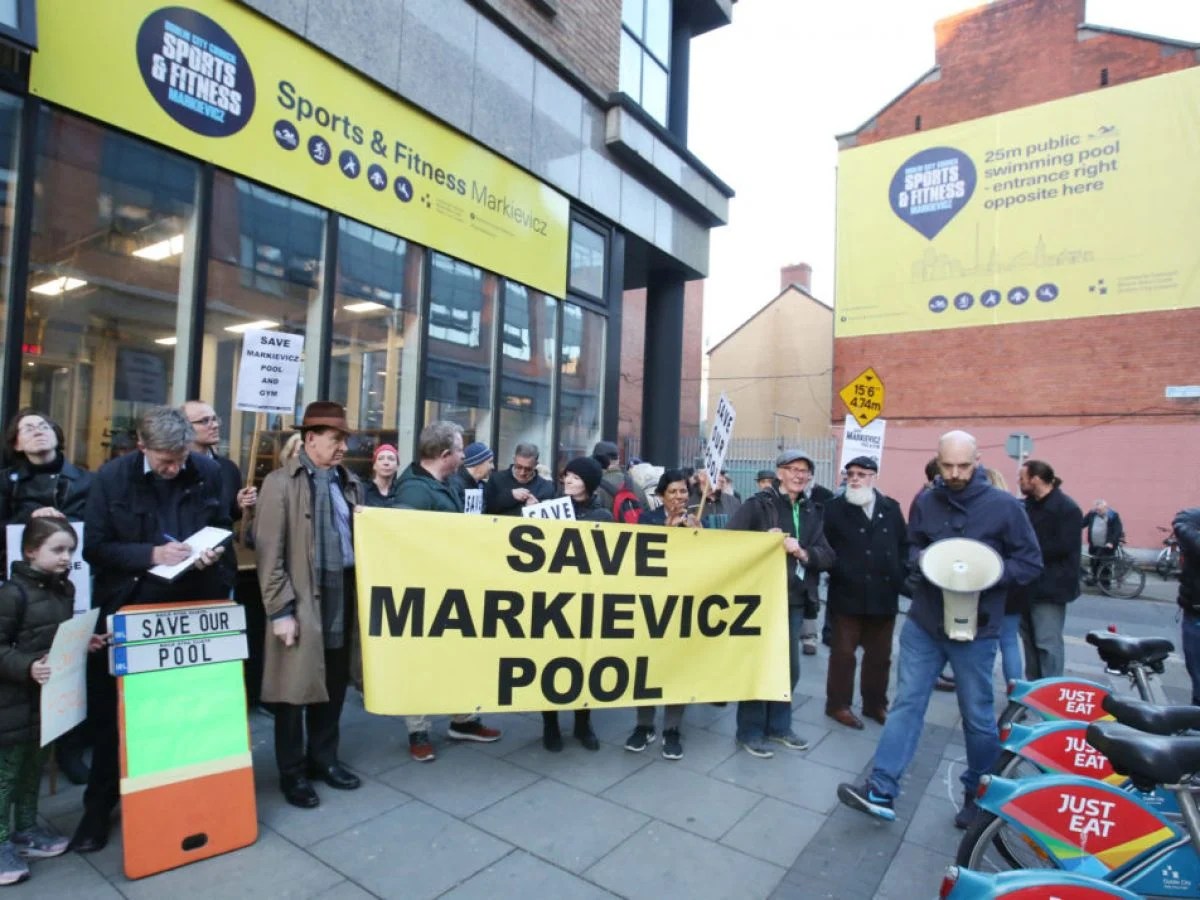
A rally to promote saving the swimming pool in 2019 (Photo sourced: Internet)

The swimming pool facilities are now to be located at a site 3 km away in Ringsend, a housing district at the end of the docks and partly on the seafront, which has football pitches and green space very close nearby. 5

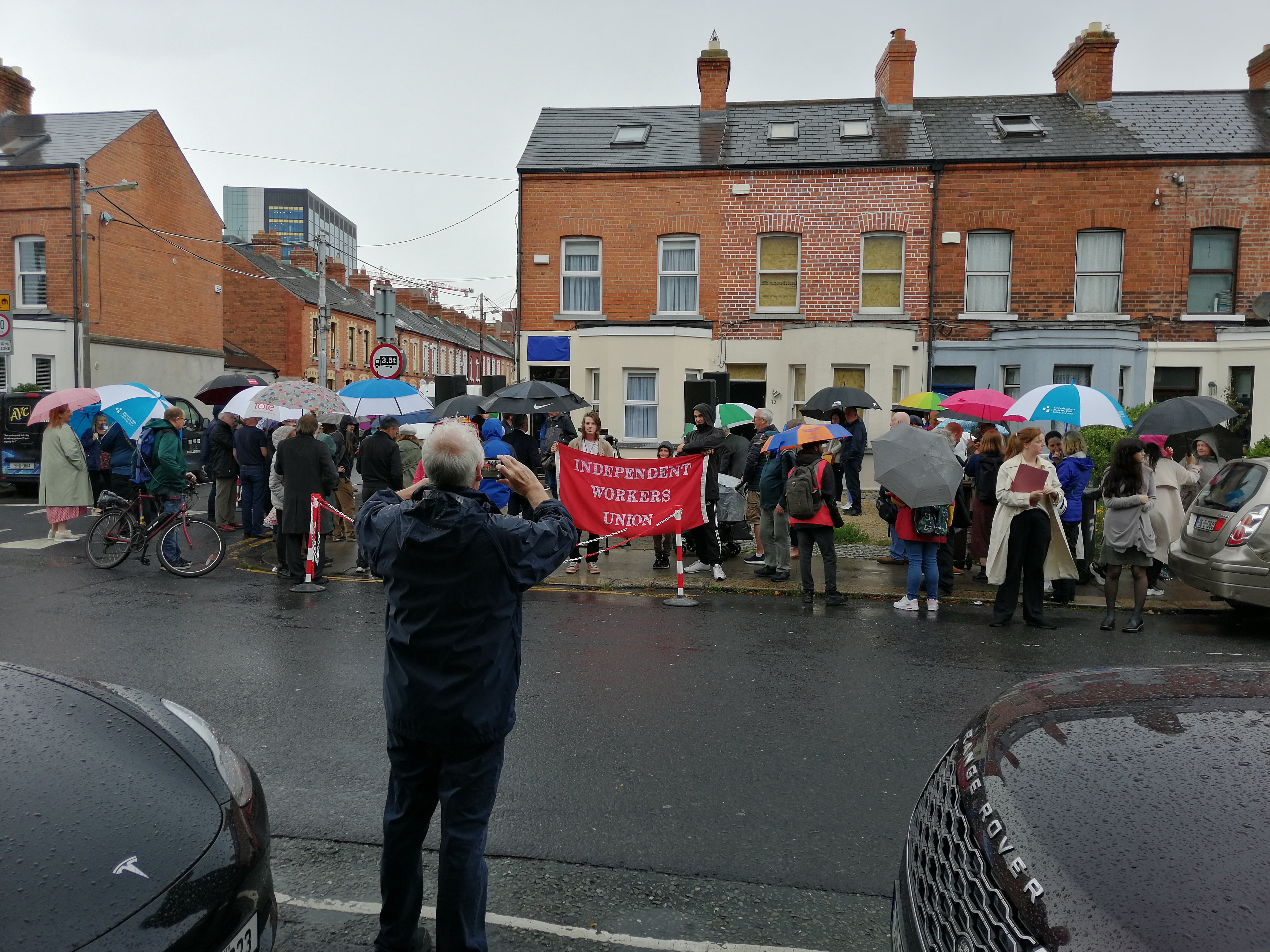
It is indeed late in the day as indicated by the huge property development on the South Quays but the communities are getting organised as can be seen from this meeting, a commemoration of a fatal 1960s housing collapse and protests about local church neglect by the Diocese.6

Some may think it is too late or that the speculative property and financial forces ranged against them, with their multiple political and other connections, are too strong. But their community’s needs now and for generations to come are powerful incentives for which to struggle too.

The south and north quays communities, neglected by the authorities and rode over roughshod in the past, with their remnants now under threat, are essentially working and lower-middle class communities which have never been given the resources they earned and deserved.

As in many other parts of Dublin, working class communities were ravaged by the heroin epidemic in the 1980s and regarded in the main by the authorities as a policing problem, with anti-drug campaigners ironically targeted more than drug lords.

In the course of that social crisis, many developments of physical and political nature took place which the working class was not well-placed to resist.
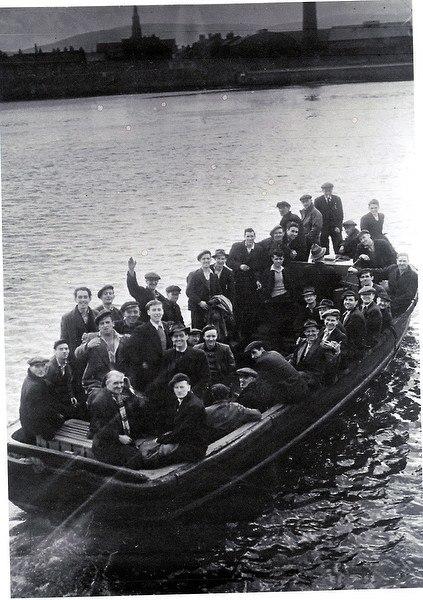
An outing on the old Liffey ferry boat, in regular use when there was no bridge crossing the Liffey eastward and downriver past Butt Bridge (Photo sourced: Dublin Dockers’ Preservation Society)

However, the people of the docklands were an important part of the working class movement in the early 1900s, winning many union battles against the employers until defeated by the latter’s alliance with police, magistrates, churches and media after eight months of struggle 1913-1914.

They rose out of that defeat and rebuilt their fighting organisations, including the first workers’ army in the world (and which recruited women, some of them appointed officers),7 fought again in the 1916 Rising and after that in Dockland areas during the War of Independence.

Indeed, during the 1916 Rising it is remarkable that despite British shelling from naval units in the Liffey, they did not attempt to land soldiers on any of the Dublin quays at that time, disembarking British reinforcements into Dun Laoghaire instead and marching 8 miles8 in from there.

If the working class of the south Dublin dockland is stirring it may still achieve more than many may expect.

End.
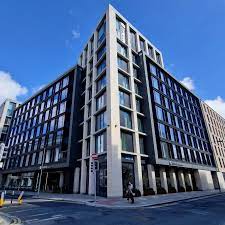
The Travelodge Hotel, corner of Townsend and Moss Street (Photo sourced: Internet)

FOOTNOTES

1Purchased by Brookfield Asset Management, a Canadian company, in 2022

2https://www.breakingnews.ie/ireland/city-arts-centre-would-cost-e90000-to-get-to-satisfactory-condition-court-told-1488548.html

3Many applications agreed by DCC Planning Department have also been appealed to An Bord Pleanála and that organisation has been immersed in controversy over criminality in management and low staff morale leading to a high backlog of appeals awaiting judgements.

4https://www.irishtimes.com/business/2023/06/05/up-to-300m-spent-on-various-dublin-metro-projects-to-date/ for the Metrolink but also notably in the LUAS tram network and Transport for Ireland buses in Dublin with regard to public transport infrastructure but also to be seen in toll roads and in electronic communications infrastructures.

5One could form the suspicion that the ultimate plan is to move south docks working class facilities to Ringsend and Irish Town, with the communities themselves to follow or to fade away, leaving the whole area free for property speculators.

6The diocese protest was not reported on in Rebel Breeze but the housing collapse commemoration, at which the lack of local affordable housing was raised, was.

7The Irish Citizen Army, founded after calls by both James Connolly and Jim Larkin.

814 kilometres.

SOURCES

https://en.wikipedia.org/wiki/Windmill_Lane_Studios

https://en.wikipedia.org/wiki/Hibernia_Real_Estate_Group

https://en.wikipedia.org/wiki/MetroLink_(Dublin)

https://www.irishtimes.com/business/2023/06/05/up-to-300m-spent-on-various-dublin-metro-projects-to-date/

https://en.wikipedia.org/wiki/MetroLink_(Dublin)

https://www.irishtimes.com/ireland/2023/04/03/relocation-of-markievicz-pool-for-metrolink-to-cost-up-to-48m/

CLASS-CLEANSING IN DOCKLANDS

Diarmuid Breatnach

(Reading time main text: 6 mins.)

People who have lived for generations in the Dublin dockyards have been getting the feeling for some time that the city planners don’t want them there and that as in Ewan McColl’s song they’d “better get born somewhere else” and “go, move, shift!”1

Recently I met with a small group of people, men and women from the Dublin docklands area south of the Liffey2 as they discussed their difficulties and what they might do about them. They wanted an article written on the issues for circulation among their communities.

Artist’s impression of the “Two Fingers” tower blocks planned by property speculator Johnny Ronan amidst existing “glass cages”. The tower blocks were ultimately denied planning permission but many others got the go-ahead. (Image sourced: Internet)

They observe their areas being taken over by high-tech and service industries, accommodation blocks built for those who can work for the high-tech corporations and pay the high rents but their own class largely employable only in low-earning service work for the corporations.

They see in this a process being facilitated by the State, the municipal authority, the banks and of generally little concern to the political class, who either benefit from the process direct or indirectly or at best, view it as regrettable but inevitable.

Wallace’s coal depot, Ringsend Road, Great Canal Basin circa 1950s perhaps. Imported coal was unloaded mechanically or by physical labour and stored here to be delivered to smaller depots and large establishments in lorry loads, or to houses and more modest commercial establishments by physical labour (coal-heavers) working from horse and cart or, later, lorries. (Photo: Toírdhealach Ó Braoin)

One only has to consult living memory or to compare photographs of some scenes in the past with “the new glass cages that spring up along the quay3 in the same locations today to see that they are not imagining things or unduly exaggerating them.

Contemporary photo: This is the only traditional pub left and one of the few traditional-type buildings on the South Dublin Docks once Butt Bridge is passed. (Source photo: Dublin Dock Workers Preservation Society)

FURTHER BACK

Previously the docklands both sides of the river were, for the most part working class areas. The employment available for men was labouring on the docks, unloading and loading ships and delivering or distributing those loads by horse and cart.

There were also small industries and warehouses and even small animal enclosures or yards, including even a couple of tiny dairies.

The major work for women was in the home, raising large families but with some outside work available in food processing such as in bakeries, factories such as Boland’s Mill, clothes-making, mending and laundry. Second-hand clothes were sold too and fresh farm food, fish and shellfish.

Another coal importing company with an unloading and storage space on the south Dublin quays, circa 1950s. (Source photo: Dublin Dock Workers Preservation Society)

It was in these areas that Jim Larkin and James Connolly mostly made their mark in the first decade of the last century, forming the largely unorganised ‘unskilled’4 workers into the Irish Transport & General Workers’ Union, winning wage rises and improvements in working conditions.

It was surely no accident that the ITGWU’s headquarters, the original “Liberty Hall”, was located in dockland, just off Eden Quay in Beresford Place and across the road from the Custom House.

When the union began to impinge on William Martin Murphy’s commercial empire in 1913, Murphy began to build a union of employers determined to break the workers’ union.

The working class of Dublin, whether ITGWU members or not,
Stood by Larkin and told the Boss man
We’d fight or die but we would not shirk.”

For eight months we fought
And eight months we starved –
We stood by Larkin through thick and thin;
But foodless homes and the cry of children,
They broke our hearts and we could not win.”
5

In the 1913 Lockout the employers had the main mass media on their side: the anglophile Irish Times, the nationalist Irish Independent and Freemans Journal. The church hierarchies, Catholic and Protestant, stood with the employers; the Legion of Mary refused help to strikers’ dependents.

Mass meeting of workers and children (some of the children also workers, e.g the newsboys) on a Dublin quayside during the 1913 Lockout. “Murphy” refers to William Martin Murphy, prominent capitalist, owner of the Dublin Tram Company, Irish Independent and the Imperial Hotel in the Clery’s building. (Photo sourced: Internet)

The magistrates fined and jailed strikers and supporters, while the Dublin Metropolitan Police clubbed them. After two workers were fatally injured by police batons on Eden Quay,6 the ITGWU formed the Irish Citizen Army, the first army in the world of workers for the working class.

People with few economic and financial resources find it difficult to sustain long struggles and eight months would be a very long industrial struggle even today.

In the Dublin of 1916 and with the living conditions of the working class of the time, and mostly with previously unorganised workers, it was a heroic effort.

The ITGWU was temporarily defeated – Connolly called it “a draw” – but the working class remained. Those that were not sucked into the butchery of WWI continued living in the area and tried to find work where they could.

Despite that defeat and emigration or British Army WWI recruitment, the Irish Citizen Army was able to field 120 disciplined fighters, male and female, in the 1916 Rising and fought in a number of engagements. By 1919 the union’s recruitment surpassed that of 1913.

Over years the docks area saw slow decline as shipping traffic decreased. Emigration soared and, despite large families, the Irish population remained stable7. The working class population of Dublin city centre’s tenements was cleared and moved to large housing schemes on the city’s outskirts.

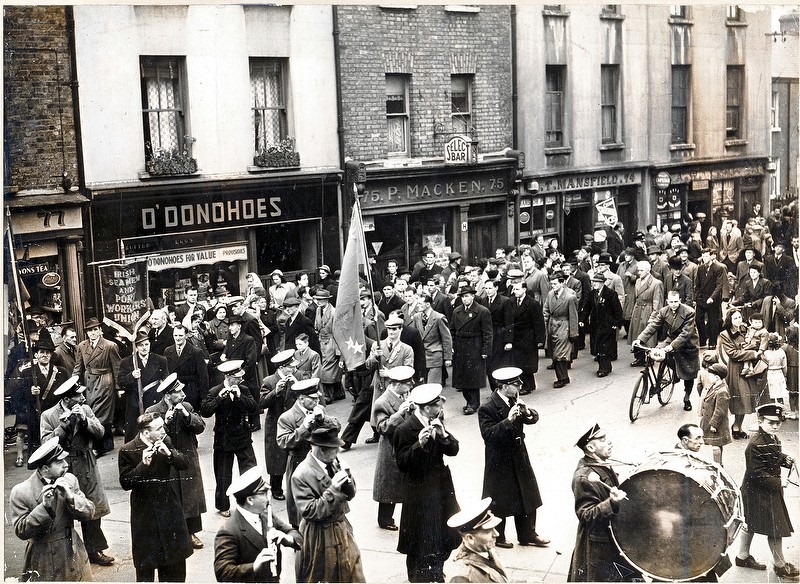
Men, women and children in a march of the Irish Seamen & Port Workers’ Union (now amalgamated into others) along south Liffey dockland some time before 1955. Note the medals on elderly man front left, possibly IRA medals from the the 1916 Rising and/ or War of Independence. (Source photo: Dublin Dock Workers Preservation Society).
Another view including the flute and drum band, Starry Plough Flag (the Tricolour is being carried on the far right of photo) and trade union standard. (Source photo: Dublin Dock Workers Preservation Society).

Those who remained received some municipal housing in pockets, often neglected by the municipality, their children educated but very rarely to university8 level, their traditional work largely disappearing. And a significant minority turning from lack of hope to substance misuse.9

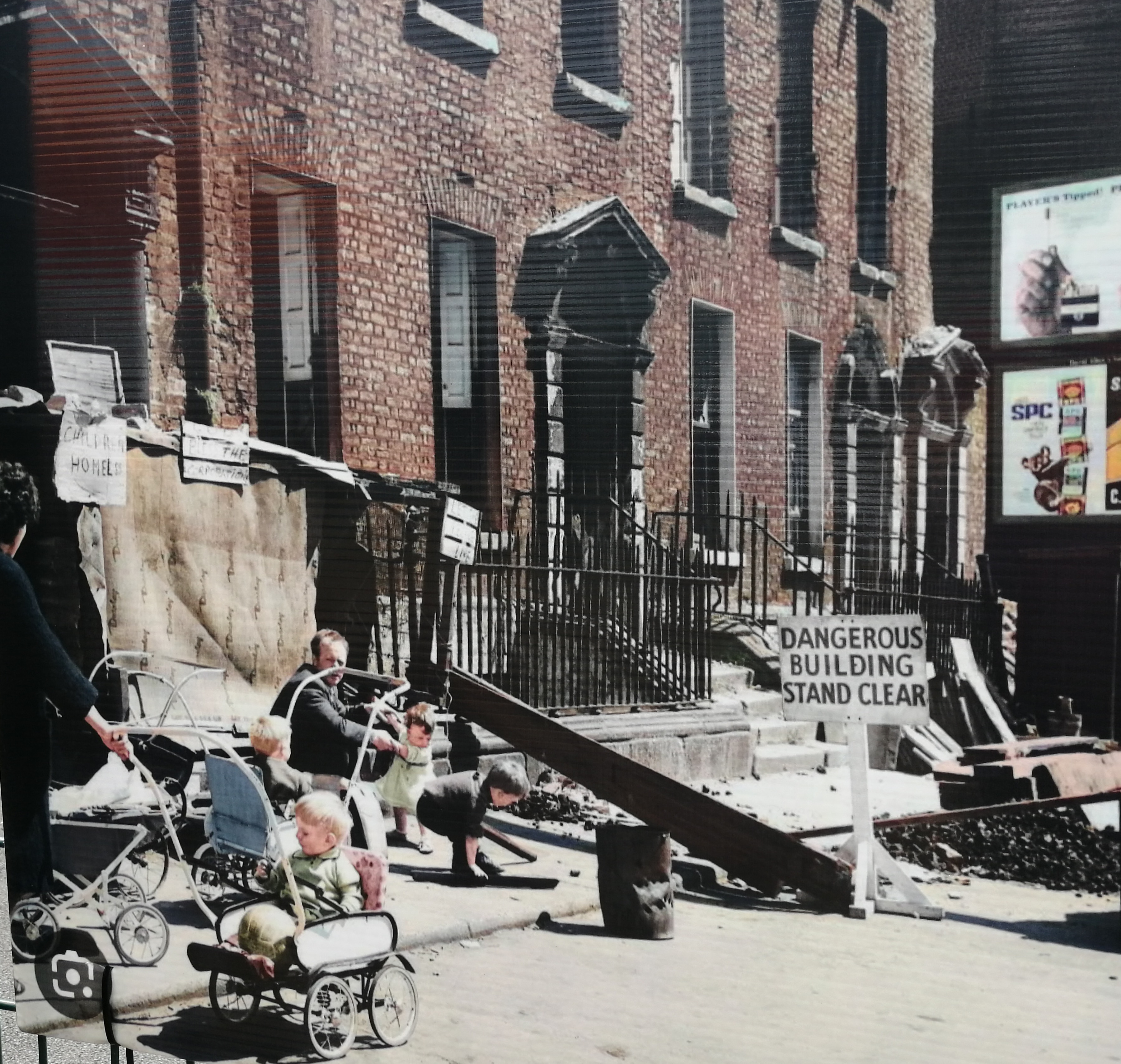
Houses in danger of collapse after an already collapse, Fenian Street, south Liffey dockland, 1963 (Photo source: Display at Andrew’s Court commemorative event of 1963 building collapse that killed two girls).

SOLUTIONS

Inclusion was a key word brought to the discussion I was invited to hear, with a number saying that “social inclusion” had been listed among objectives of a number of plans for the area but which failed to be achieved despite its listing.

The character of the area is of course changing with a certain amount of gentrification and some people even feeling they were looked at as though not welcome in the park they had played in as children and teenagers, or not welcome in local pubs under new management or new cafes.

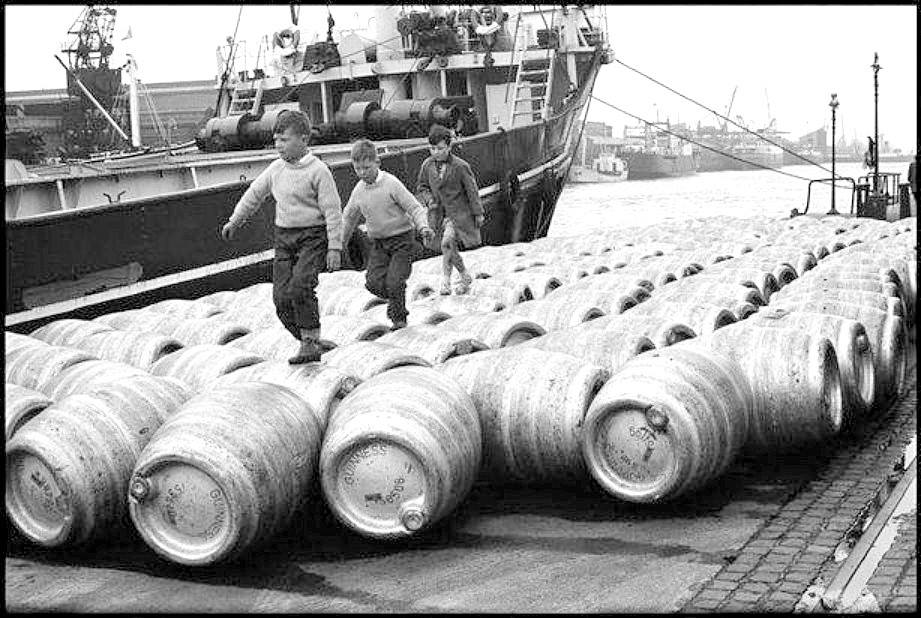
Children balancing on Guinness aluminium kegs beside docked ship on south Dublin quay with ships docked on the north quays also, circa 1950s. (Source photo: Dublin Dock Workers Preservation Society)

The kind of education working class people receive was discussed as an important factor with the mention of STEM, an educational program to prepare primary and secondary students for college, graduate study and careers in the fields of science, technology, engineering and mathematics.

Without that kind of preparation and qualifications, the group felt that children from their area had no chance of employment with the corporations now basing themselves in the docklands.

One of the group stated there is an annual special STEM seminar run at the RDS; however none of the others had heard of the seminar.

Another described a “Speed-date-type” careers advice session attended once, where students could spend a short time at one career table and move on to another. Another talked about career-planning advice for parents with which to to help their children.

Circa 1950s, family group, Gasometer in background [note also the old gas street lamppost behind man on the right]. (Source photo: Dublin Dock Workers Preservation Society)

The feeling of a lack of corporate responsibility for the people of the area in which the corporations have set up was clear.

The Ballybofey urban regeneration project was mentioned as a possible model along with Our Town urban centre projects.

If education is the key for integrating the local working class into most of the employment available locally, I wondered aloud, how would that work without housing? One of the group has already had to move out of the area for an affordable home and is intending to move further out still.

Already this means use of private transport and hours added to the working week, increasing the further out is the next home. Another said a survey found that the employment of 88% of the community was outside the area, while only 12% was local (with the carbon footprint involved).

Two-storey housing in good condition on South Lotts in south Liffey docklands – photo shows July commemoration of socialist revolutionary James Connolly and his family living there 1910-1911 (Photo: D.Breatnach)

COMMENT

My own feeling is that the first requirement is that homes need to be available for working class people in their area and that, I also feel, has to entail a local construction program of affordable public housing, ideally by a State or municipal building company.

But if people are not to have to travel outside their areas to work, as 88% are doing currently (according to the aforementioned survey figures), then they must have local employment and in turn that, in the main means with the hi-tech corporations, for which they need to be trained.

The group was very clear and in agreement on this point, whether the training is to be delivered by the corporations, by the State or by a mixture of the two.

When area developments or redevelopments are being undertaken, it is essential that the local communities are part of the process; otherwise tree-planting, city squares and delicatessen-cafes become not so much an addition to the people’s lives, as markers for their class’ replacement.

Whether in the end I agree with the way the group sees the solutions or don’t is not I feel the most important thing, which IS that they are wanting to organise and to take their future into their own hands. It is in that act alone that there can be hope for the future.

End.

FOOTNOTES

1A song about the persecution of the nomadic people, e.g Romany Gypsies and Travellers.

2Basically from the Pearse Street and Ringsend areas.

3Line from Dublin In the Rare Aul’ Times song by Pete St.John.

4A term often applied but rarely understood – labourers quickly become skilled in their work or they lose employment or become injured or killed at work. What the term really means is “manual worker who does not have a recognised qualification in at least one manual trade”. I have worked at both ends of that spectrum.

5 The Larkin Ballad by Donagh Mac Donagh, son of executed 1916 commander Tomás Mac Donagh, executed after the surrender of the 1916 Rising by British firing squad.

630th August, the first month of the dispute by DMP baton-charge on mass meeting around Liberty Hall. The following day (Bloody Sunday 1913, wrongly accounting for the two fatalities in many on-line sources), the DMP rioted again in O’Connell Street but most of the ITGWU had avoided it by rallying at their Fairview premises.

7The Irish population – though habitually of large families – remained largely stable for roughly a century after the Great Hunger’s death toll and mass emigration had reduced the island’s population by three million – until the upswing of the ‘Celtic Tiger’ economy began to increase it through immigration and reduction in emigration.

8Indeed, until 1966 most working class children left school at fourteen years of age, since secondary-level schooling was only ‘free’ (not for books, equipment, uniforms) up to that age.

9Middle and ruling class people misuse substances too – indeed some drugs, such as cocaine are much more used by “professional” classes – but they have living conditions varying from comfortable to luxurious and a range of choices for themselves and their children – not to mention expensive rescue services when they fall.

SOURCES

https://www.donegalcoco.ie/services/planning/regenerationprojects/ballybofey-stranorlar%20regeneration%20strategy/

https://www.donegallive.ie/news/home/1196127/concerns-over-ballybofeys-9-8m-project-raised-by-cllr-martin-harley.html