
Diarmuid Breatnach
(Reading time: 8 mins.)
On the 49th anniversary of the Dublin and Monaghan Bombings a number of speakers criticised the Garda closure of its investigation a mere four months after the bombing with the highest number killed in any one day of the 30 years war.
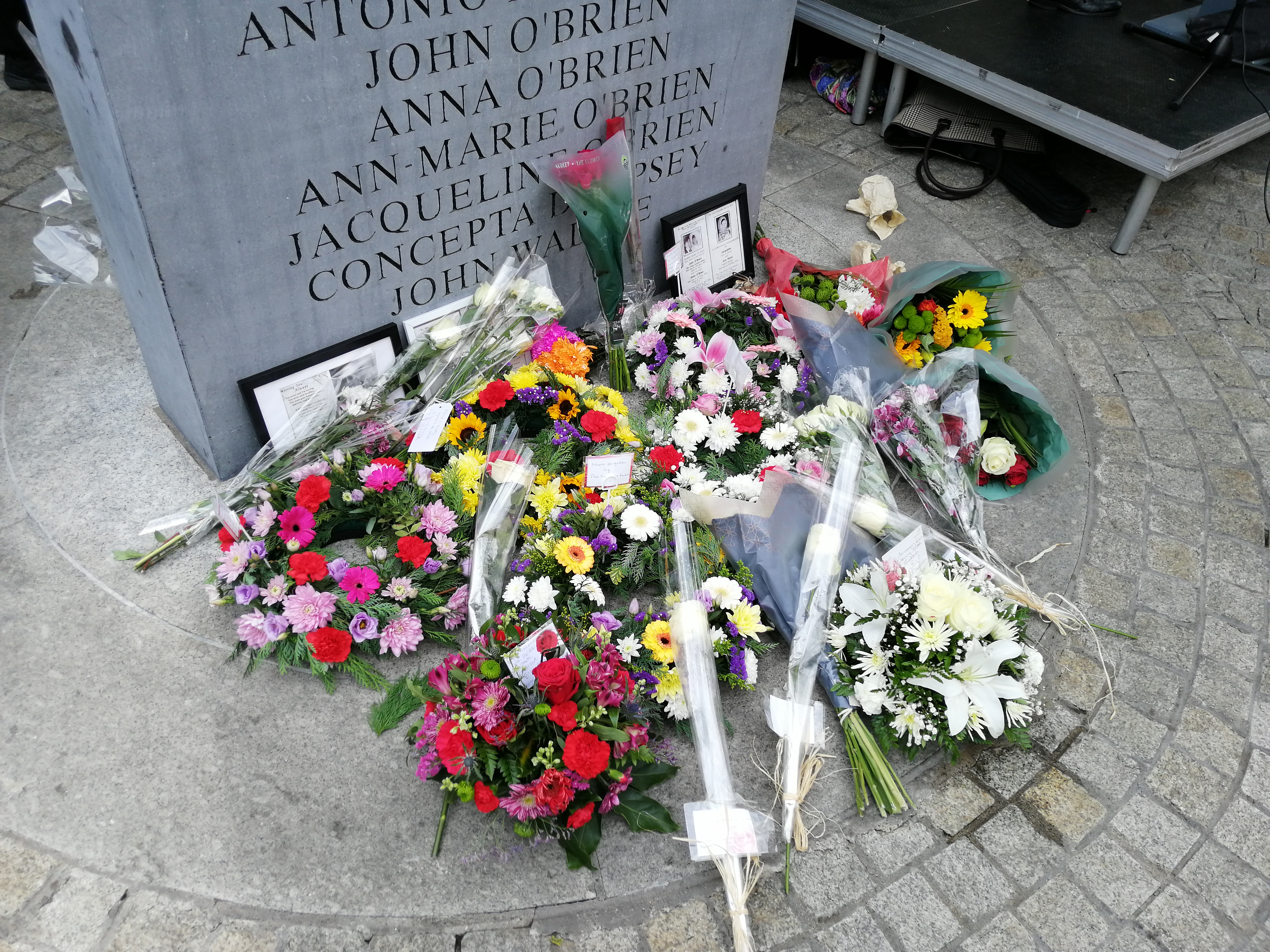
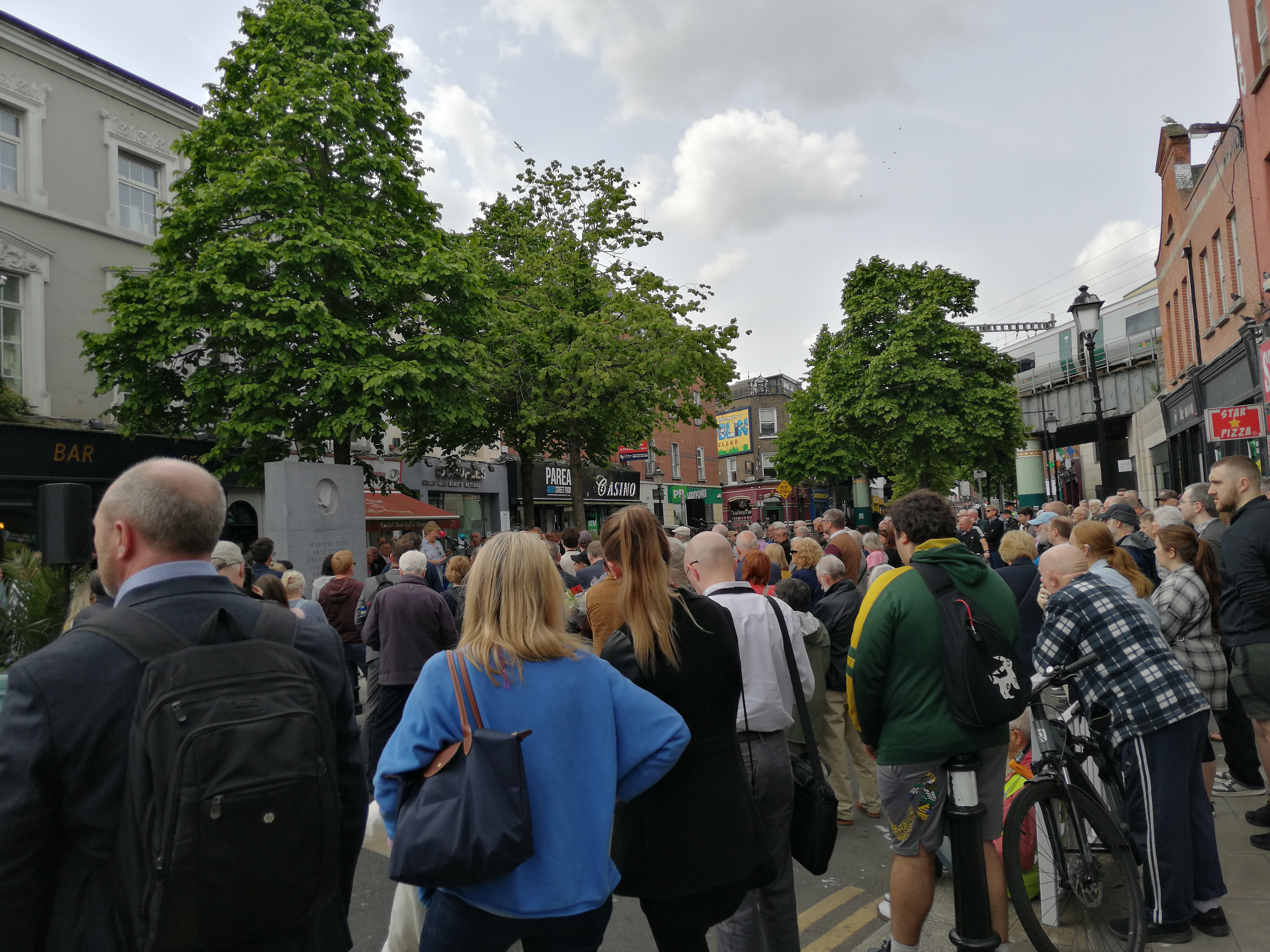
The criticisms were made on 17th May at the annual commemoration of the atrocity in Talbot Street, Dublin, organised by the Justice For the Forgotten campaign, held at the location of the memorial on the site of one of the bombings of that day.
The annual commemoration has been organised for many years by the Justice For the Forgotten campaigning group at the Talbot Street monument to the bombing1. It usually comprises reminiscences, poetry and music and a call for the British State to release its secret papers.
As of rote, an Irish Government Minister is invited to speak who routinely says how hard the Irish Government has been trying to get the British State to release the secret papers revealing the latter’s connection to those who carried out the bombing.
Years after the bombings, a British TV company (!) pointed the finger at the Ulster Volunteer Force, a British Loyalist paramilitary group but believed acting under British Intelligence agency direction, named some of those involved and a week later the UVF claimed responsibility.
In addition to British Intelligence, the British colonial police2 and British Army3 had been widely known to be working in collusion with Loyalists.
But few would have suspected Irish State collusion.
THE BOMBINGS AND AFTERMATH
On 17th May 1974 three car bombs exploded without warning in crowded Dublin city centre streets and another in Monaghan town centre. Thirty-three people were killed along with a full-term baby and a miscarriage with around 300injured. No-one was ever even charged in relation to the atrocity.
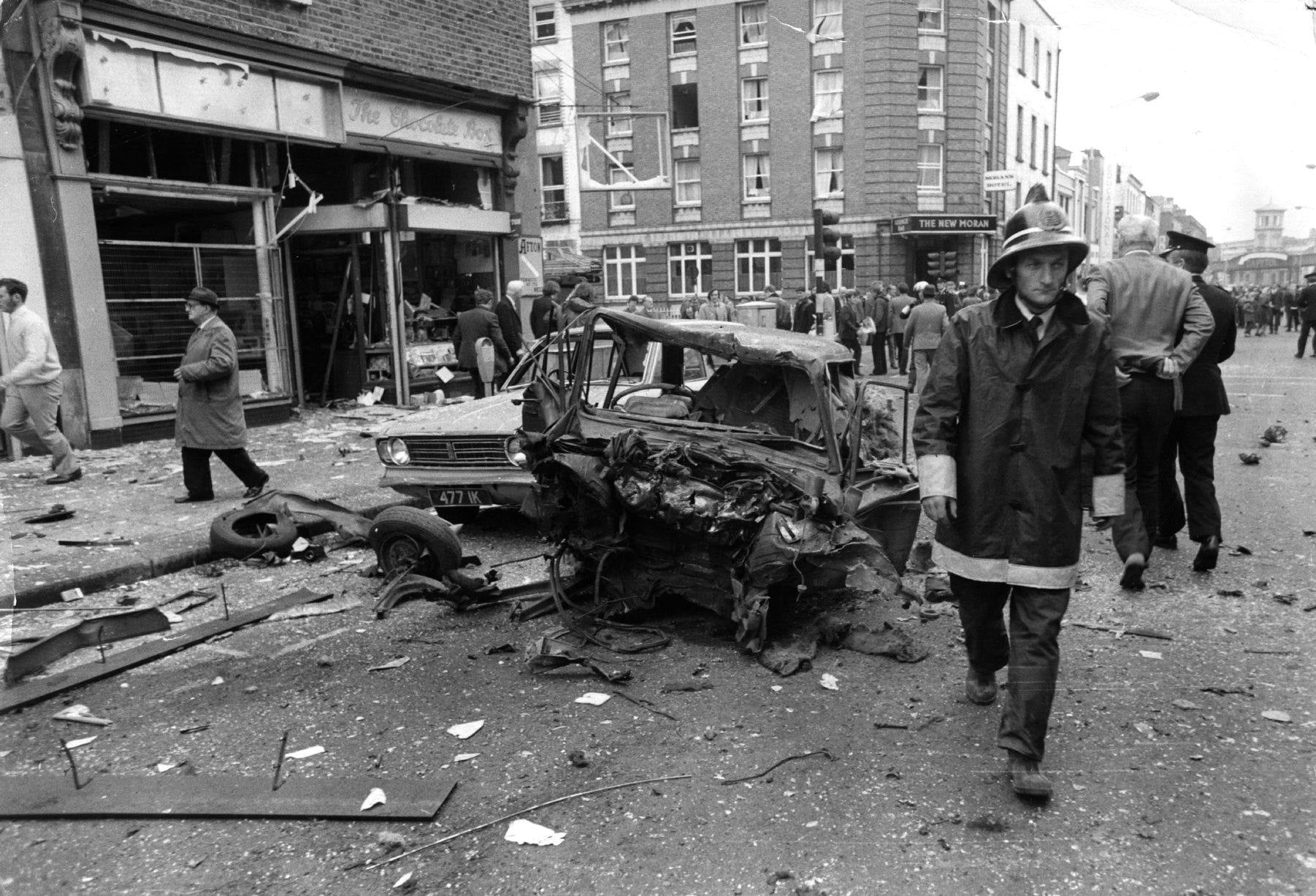
The intention, unlike that of many other city car-bombings in the Six Counties and in England, was clearly to cause maximum death and injury to civilians. The areas chosen in Dublin were full of shops with bus stops and 5.30pm was going home time from shopping and work.
And no warning was given.
In the course of the short Garda4 investigation, in macabre irony the remains of the exploded cars were sent for forensic examination to their very source: the Six Counties, i.e to the colonial police force (at the time, the RUC5). Unsurprisingly, nothing useful came back.
In a war that was already five years old (six years, if the civil rights marches are included) the collusion between the British colonial police and Loyalist paramilitary murder gangs was well known and collusion with the British Army widely suspected.

CAMPAIGN OF BOMBING DUBLIN
The Loyalist bombing of two cities in the Irish state in 1974, although by far the worst of the whole period, were not the first in Ireland, not even the first fatal ones.
In 1973 a Loyalist bomb in Dublin city killed Tommy Douglas and the year before that another killed George Bradshaw and Tommy Duffy – all were employees of Irish public transport state company CIE.
Even after the horror of 1974, on 29th November 1975, another a bomb at Dublin Airport killed John Hayes, a worker there.
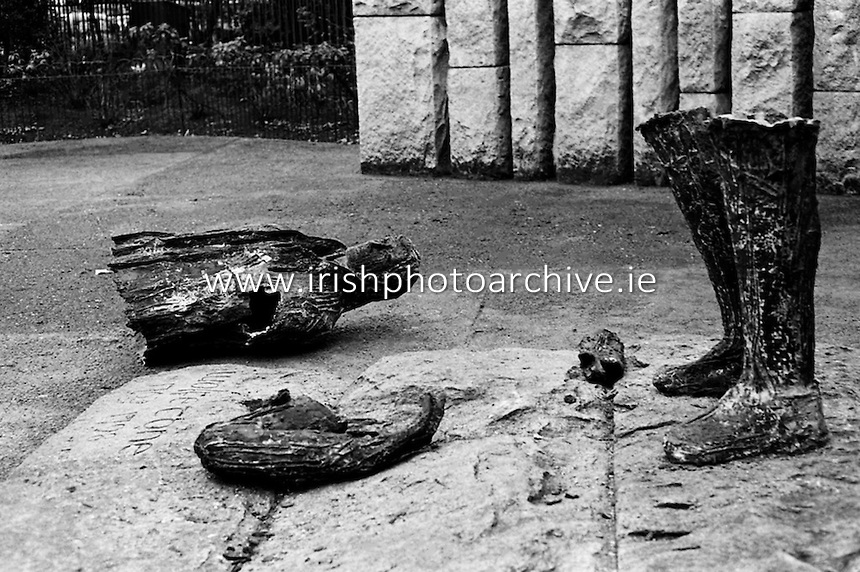
And there were other earlier ones where no-one was injured, such as the blowing up of the Wolfe Tone monument just outside Stephens Green on 8th February 19716 and the Daniel O’Connell Monument in Glasnevin Cemetery (the round tower) in December 1971.

If the Irish State had pursued investigations and cross-Border links after the earliest of those bombings, they might have headed off the carnage that followed later.
Not only did they not do so but in fact used the 1972 bombing to blame Irish Republicans so as to get an unpopular piece of repressive legislation through parliament, the Amendment to the Offences Against the State Act, along with the establishment of the no-jury Special Criminal Court7.
The Garda Commissioner at the time of the 1974 bombings was Patrick Malone and Ed Garvey, his Assistant Commissioner, was later exposed as a British Secret Service asset run by Fred Holroyd, a disenchanted British agent who revealed he had visited the policeman in his Dublin HQ.
Garvey, by then Commissioner, denied being a British agent and claimed no memory of the visit.
The Barron Report (2003) concluded that visit had undoubtedly occurred and that he had not informed his superiors, contrary to all rules regarding contact with agents working for a foreign government.8 When Fianna Fáil came into Government again, they sacked Garvey.
Since FF had not subjected him to a regular disciplinary process, probably in order to avoid the sordid story going public, Garvey was able to sue the Irish Government, win damages and ensure he received his former pension entitlements.
THE COMMEMORATION EVENT
Aidan Shields, who lost his sister Maureen in the bombing, chaired the event for Justice for the Forgotten and introduced its Secretary Margaret Unwin who, as all speaking or performing at the event seemed conscious that next year would be the 50th anniversary of the atrocity.
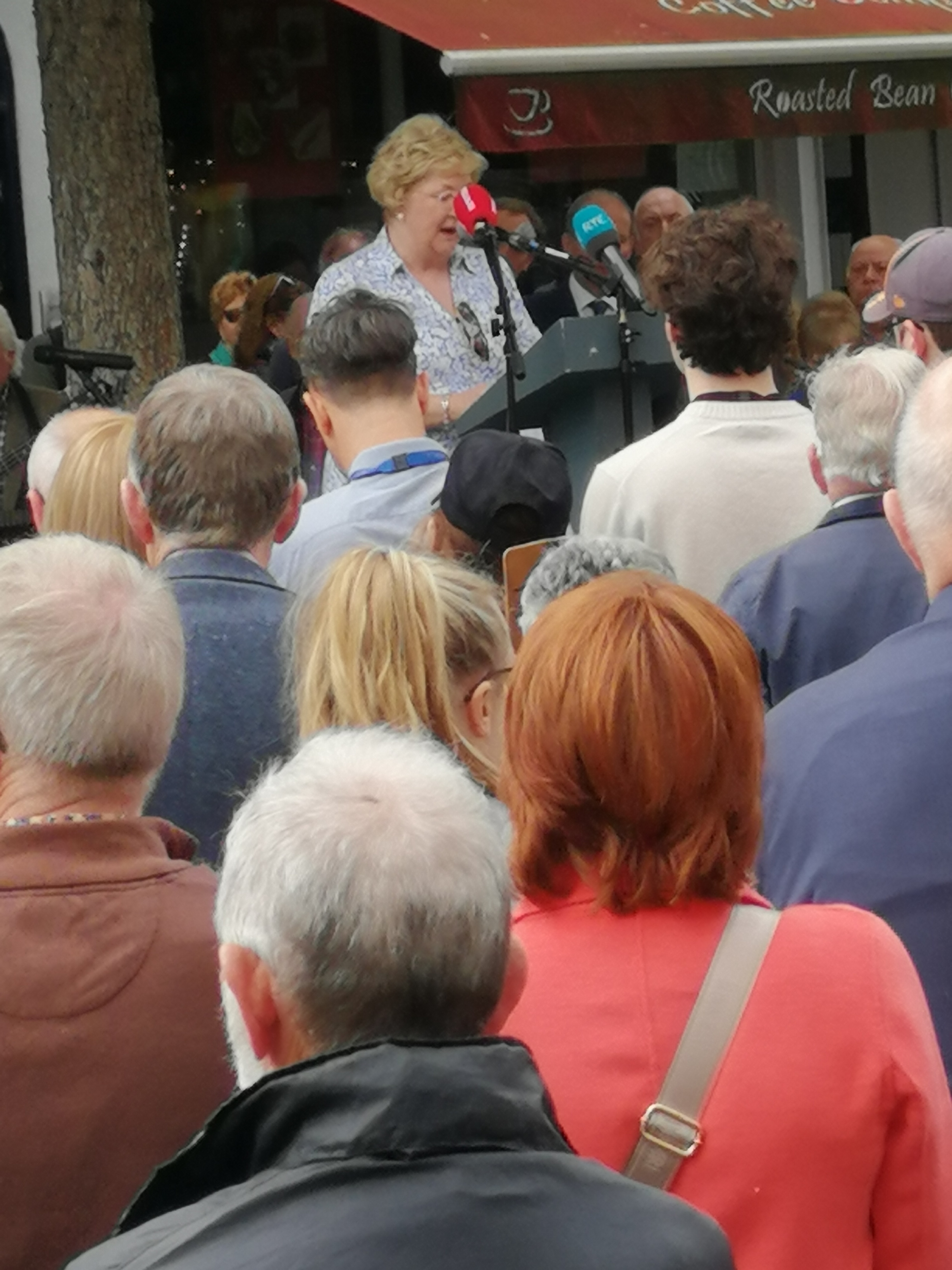
The regular Government slot was occupied by the current Tánaiste (Dep. Prime Minister) Mícheál Martin who, as has every Government representative since the JFTF commemorations began, claimed energetic diplomatic discussions for release of the papers with their British counterparts.
Martin also criticised the British Government’s widely-criticised intended legislation to prevent official investigations and trials regarding past crimes committed by British forces, while he simultaneously praised the British pacification process.
A young Italian woman played the theme from the Schindler’s List film and another air on violin. A visiting Italian couple had been killed in the bombing also but that was not mentioned when she was introduced.
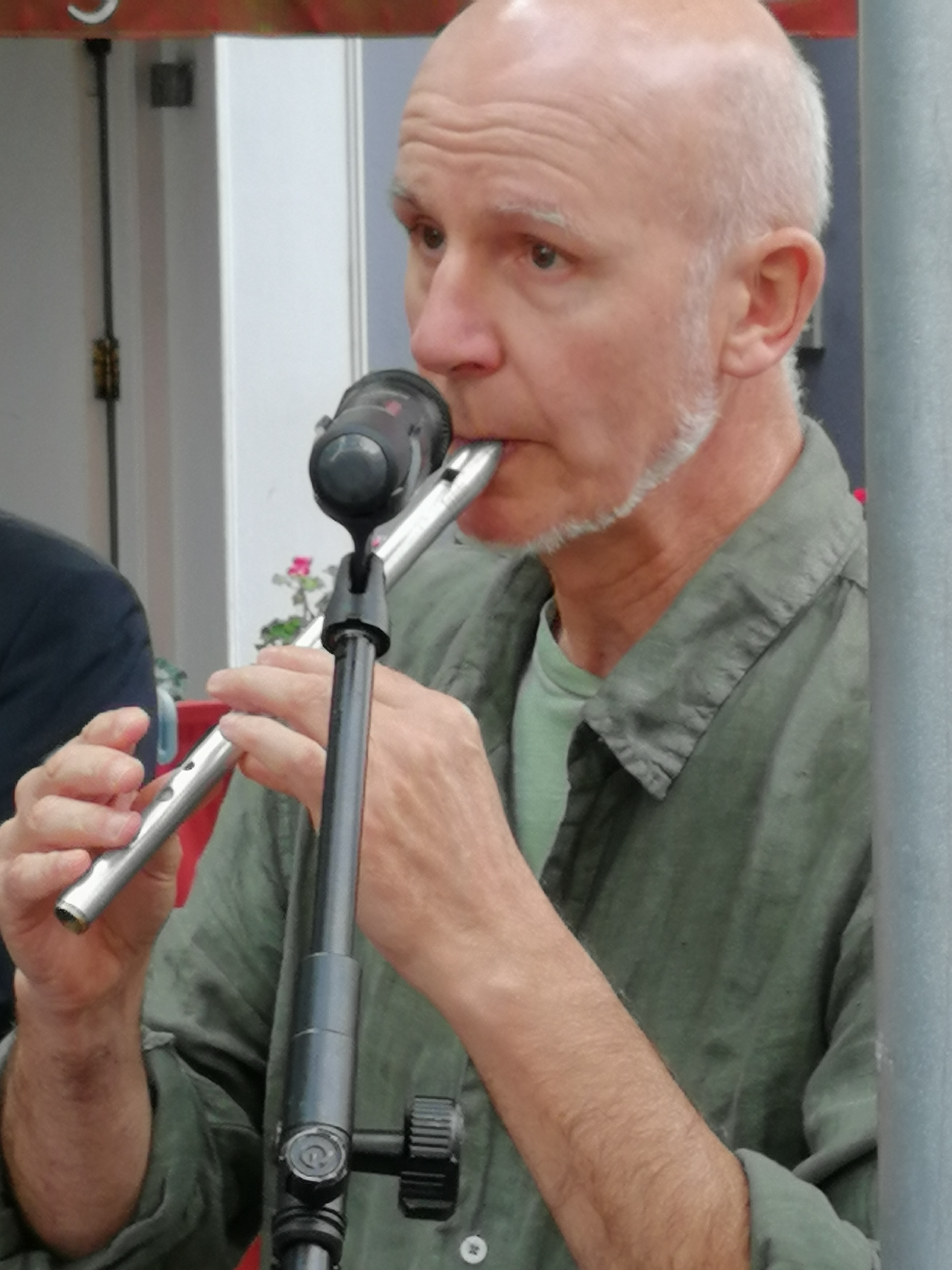
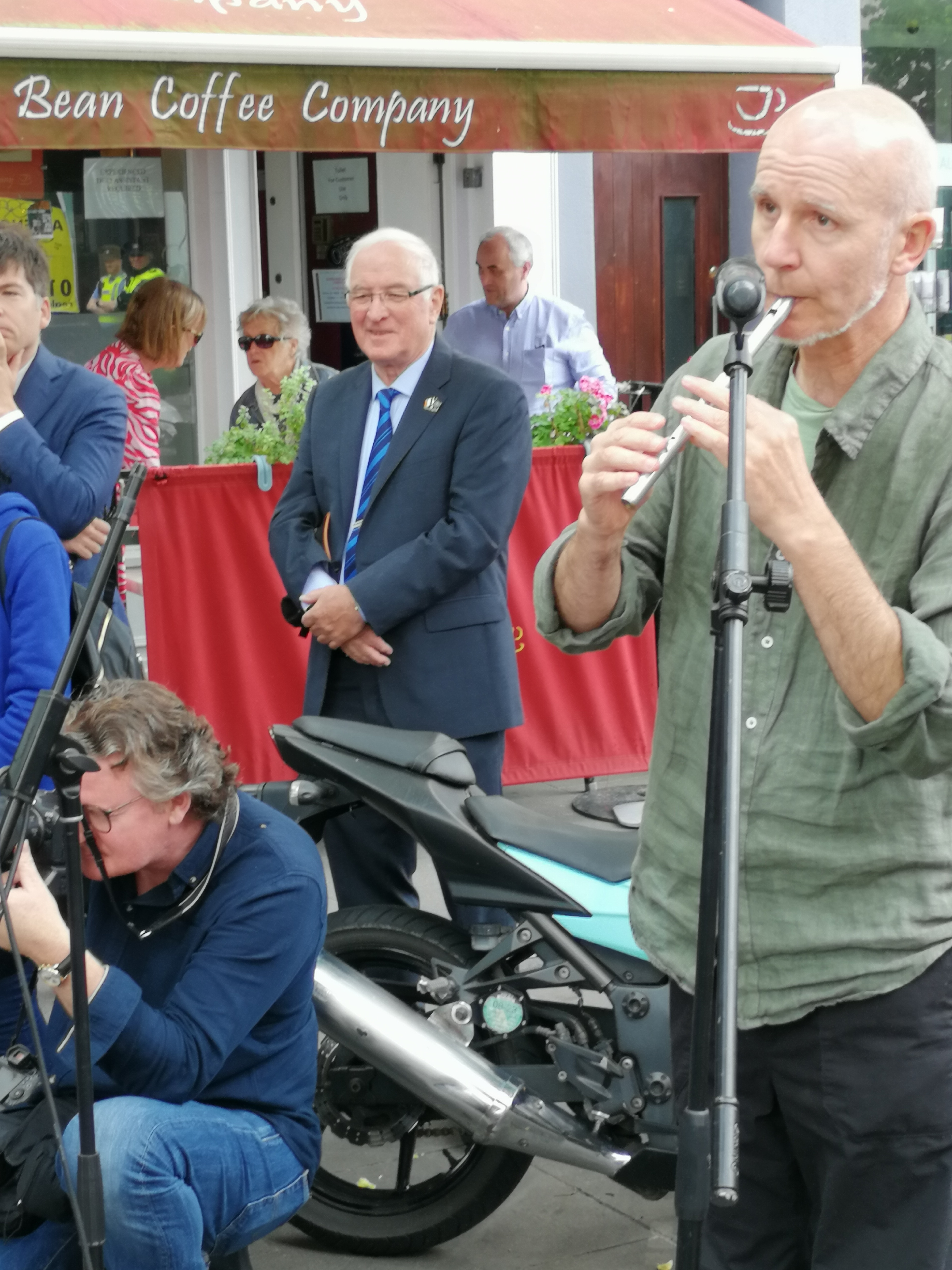
Rachel Hegarty read from her poetry compilation about the victims, based on testimonies by surviving relatives and friends. Cormac Breatnach on high D whistle and Eoin Dillon on uileann pipes played the Irish air Tabhair Dom Do Lámh (“Give Me Your Hand”).

The Shillelagh North Ukulele Group played and sang The Sound of Silence and Things (we used to do), both appropriate in metaphorical context, the first for the official silence about the perpetrators and their British intelligence organisation, the second about the loss of the victims and to their loved ones.
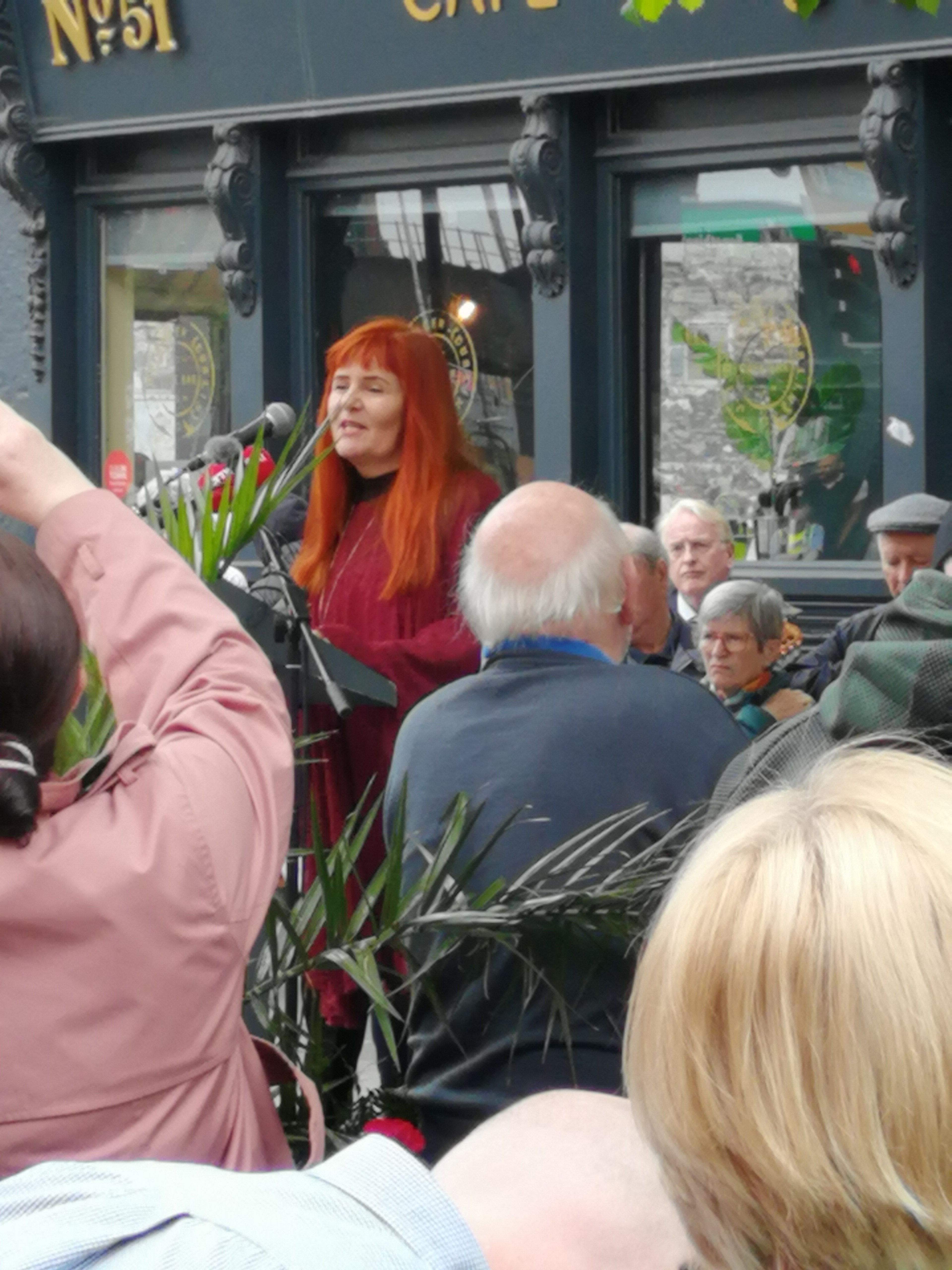
Dublin City Lord Mayor Caroline Conroy, of the Green Party, spoke about the atrocity and criticised the closing of the Garda investigation a mere four months after the bombing.9
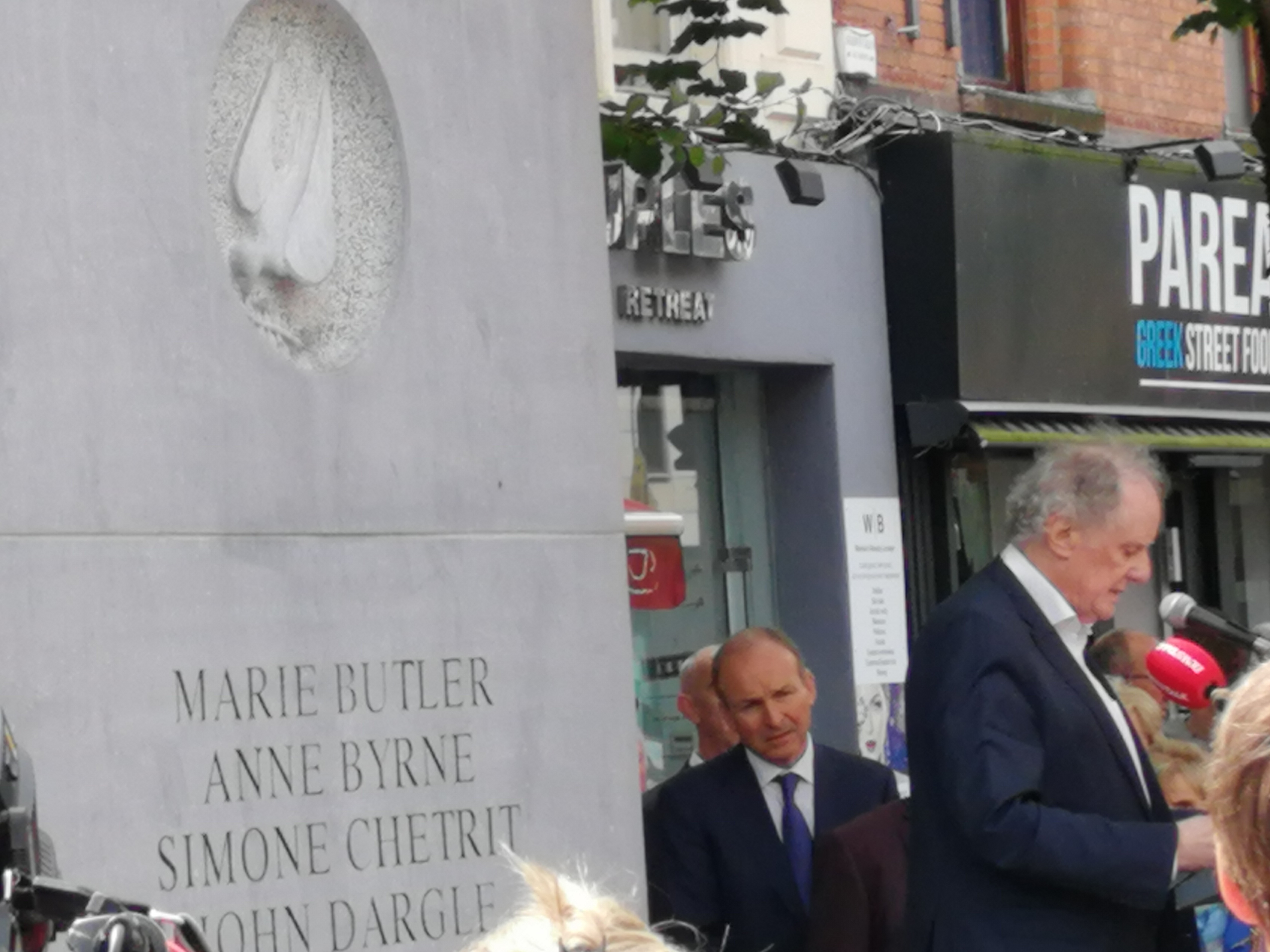
Well-known journalist and former TV presenter Vincent Browne gave the oration at the event and went into horrific detail on some of the injuries he had witnessed as a journalist at the scene with his doctor brother as they struggled to help the victims still alive.
Browne departed from the subject of the bombing, as a few had done to speak of the long war and the Good Friday Agreement but in his case also to accuse the Provisional IRA of having killed most of the people during the 30 Years War which seemed not appropriate on this occasion.
Seán Conlon, Cathaoirleach (Chair) of Monaghan Council10 spoke of the bombing and focused on the effect on his town. He also condemned the early closing of the Garda investigation and the failure to pressurise the British State into releasing security papers relevant to the bombing.11
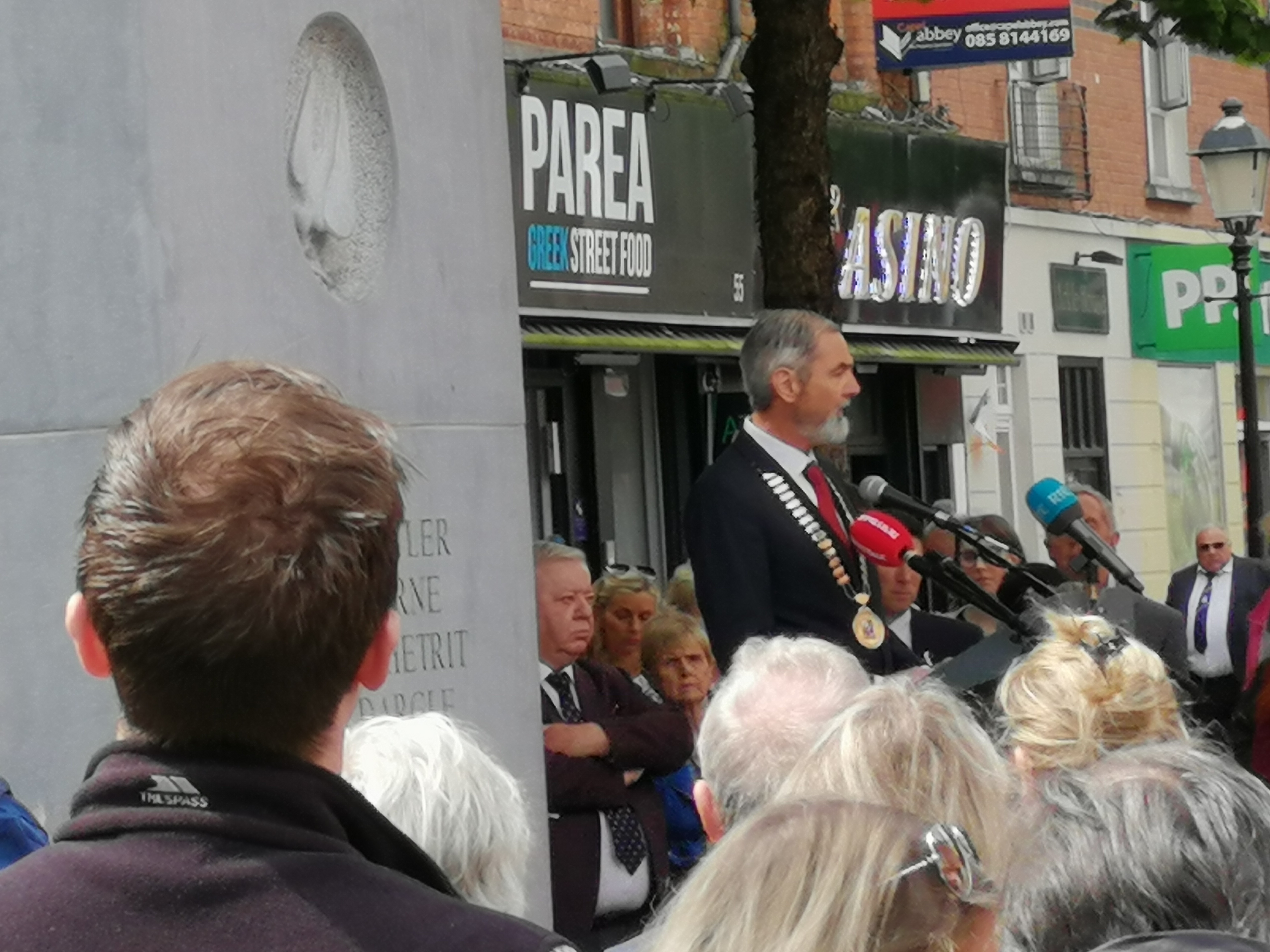
A number of speakers referred optimistically to the investigation into the Glenanne Gang by former English police chief Jon Boucher, who was present in the crowd at the commemoration. Boucher is heading a number of other historical investigations, including that of Stakeknife.12
The older age profile of the attendance was noticeable with only two teenagers visible and this in itself must be of concern.
FATAL CONSEQUENCES OF STATE COLLUSION AND COVER-UP
The failure to investigate the earlier Loyalist bombings and apprehend the perpetrators made the planning and execution of the Dublin and Monaghan bombings much easier. The early closing of the Garda investigation of the 1974 bombings ensured the perpetrators would run free.
As well as failing relatives and friends of those murdered and injured in Dublin on the 17th May 1974, the lack of pursuit had repercussions for many other victims of Loyalist murder squads, in particular the over 120 victims of the Glenanne Gang, including the Miami Band Massacre in 1975.
An aspect not normally commented upon was the choice of predominantly working class areas for Dublin massacre victims. It was not the high-end Henry or Grafton Streets that were chosen but the more working-class shopping areas of Talbot Street and Parnell Street.
The fatal Dublin bombings of 1972 and 1973 had also been directed at workers by location: three public transport workers and an airport worker.

THE GOMBEENS: A CRAVEN CLIENT RULING CLASS
The whole chain of events from the first Loyalist bombing of Dublin points quite clearly to the client nature of the Irish national bourgeoisie, the ruling class of the Irish State. Even if it wanted to, it is too weak to make strong demands of the British State.
What self-respecting national ruling class would allow a foreign power to send terrorists to bomb its capital city? And then collude with that power in drawing silence and secrecy over the atrocity?
None, of course. But the Irish bourgeoisie came into being in a truncated client state and, armed and equipped by its master, went to war for two years (1922-1923) against the very national liberation forces that had brought the British State with offered concessions to the negotiation table.13
To talk of uniting Ireland under such a class, apart from being impractical nonsense, is a travesty. To expect any real change by electing a party or combination of parties to government in such a situation is a pipe-dream.
The 1974 bombing, the subsequent investigation and the record of Irish governments since in relation to the bombing are together a stark illustration of the spineless nature of the Irish bourgeoisie when dealing with their masters.
A client ruling class yes but more accurately, a servant.14
End.

FOOTNOTES
1There was originally a plaque at the Garden of Remembrance and the Talbot Street monument was erected in 1977 after campaigning by relatives and victims. There is also a monument in Monaghan Town. In Dublin there is also a plaque at the site of another explosion that killed people that day in Parnell Street.
2Now the Police Service of Northern Ireland, formerly the Royal Ulster Constabulary (and before that, up until 1921, the Royal Irish Constabulary, when the whole of Ireland was under direct British rule).
3In particular the Ulster Defence Regiment, which had recruited from the part-time RUC B-Specials when the latter were disbanded but also special units such as the MRF in special operations and more generally across the whole of the occupation forces.
4Irish State police force.
5When the Irish State and colony statelet were created in 1921, the colonial gendarmerie of the Royal Irish Constabulary in the colony became the Royal Ulster Constabulary. In more recent years the force has change its name to the Police Force of Northern Ireland.
6The body of the monument to the Anglican leader of the United Irishmen was destroyed but the head was salvageable and rests on the re-cast body of the monument today.
7The Irish Council for Civil Liberties has dubbed that Court “a sentencing tribunal” but every party in government since has upheld those repressive provisions and Sinn Féin has abandoned its decades of opposition to them as it prepares to enter government in coalition with one party or another.
8Having a Garda Commissioner who was or became a British Intelligence agent might be shocking until we remind ourselves that the current Garda Commissioner, Drew Harris, coming from being Assistant Commissioner of the PSNI, was at least formerly part of MI5 operations in the colony and that must have been known to those who appointed him!
9Mayors of Dublin City are selected for one year from among the elected councillors. It is more of a ceremonial role than an executive one and the choice is usually negotiated in turn from among the represented political parties.
10As above with Cathaoirligh of Monaghan Council.
11A number commented that his contribution was so much better in every way than that of last year’s Monaghan Cathaoirleach. Conlon is a member of the Sinn Féin party and some may say his posture would therefore be expected. However, given changes in the party’s public position on many questions in recent years, a hard stand against the British administration no longer seems natural for this party’s public representatives.
12Operation Kenova.
13Irish Civil War (or as some see it, the Irish Counterrevolution) 1922-1923.
14It should be noted that the Gombeen class has also been a client in turn of US Imperialism and of EU Imperialism, with all of which it aligns itself on most questions of international policy and to which it opens up its markets, natural resources and infrastructure networks.
REFERENCES
Justice For the Forgotten: https://www.facebook.com/Justice4theForgotten1974
https://www.patfinucanecentre.org/projects/justice-forgotten#:~:text=Justice%20for%20the%20Forgotten%20was,single%20day%20of%20the%20Troubles.
The anniversary event: https://www.thejournal.ie/dublin-monaghan-bombings-anniversary-2-6069847-May2023
https://www.98fm.com/news/commemoration-dublin-monaghan-bombings-1466373
https://www.dfa.ie/news-and-media/press-releases/press-release-archive/2023/may/remarks-on-the-commemoration-of-the-49th-anniversary-of-the-dublin-monaghan-bombings.php
https://en.wikipedia.org/wiki/Dublin_and_Monaghan_bombings
https://www.garda.ie/en/about-us/our-history/garda-commissioners-since-1922/
Ed Garvey, former Chief Commissioner of the Garda and British Intelligence asset (interestingly there is no Wikipedia page on this man, nor is his creation of the infamous Garda ‘Heavy Gang’ or his British Intelligence work mentioned by Ferriter): https://www.dib.ie/biography/garvey-edmund-a342
Earlier Loyalist bombings in the Irish State: https://en.wikipedia.org/wiki/1972_and_1973_Dublin_bombings
Lethal Allies – British collusion in Ireland (2015), Ann Cadwaller: https://www.irishtimes.com/culture/books/lethal-allies-british-collusion-in-ireland-a-shameful-part-of-our-troubled-history-1.1578119
The Glenanne Gang: https://en.wikipedia.org/wiki/Glenanne_gang
Barron Report: https://www.irishtimes.com/news/barron-report-conclusions-1.398978
Jon Boucher investigation: https://www.irishnews.com/news/northernirelandnews/2019/11/30/news/jon-boucher-to-take-on-investigation-of-glenanne-gang-1778903/


 rebelbreeze