Petro’s government announced another measure against Israel, or to be more precise the Foreign Minister Laura Sarabia, who despite all the criticisms we made of her seems more trustworthy than the erratic Petro, made the announcement.
Colombia will require an entry visa for Israeli citizens.
Before celebrating another blow to Zionism and a gesture of solidarity with the suffering people of Palestine, we have to read the reasons behind it. It is not a response to the genocide, but rather because Israel unilaterally imposed a visa on Colombians from May 14th of this year.[1]
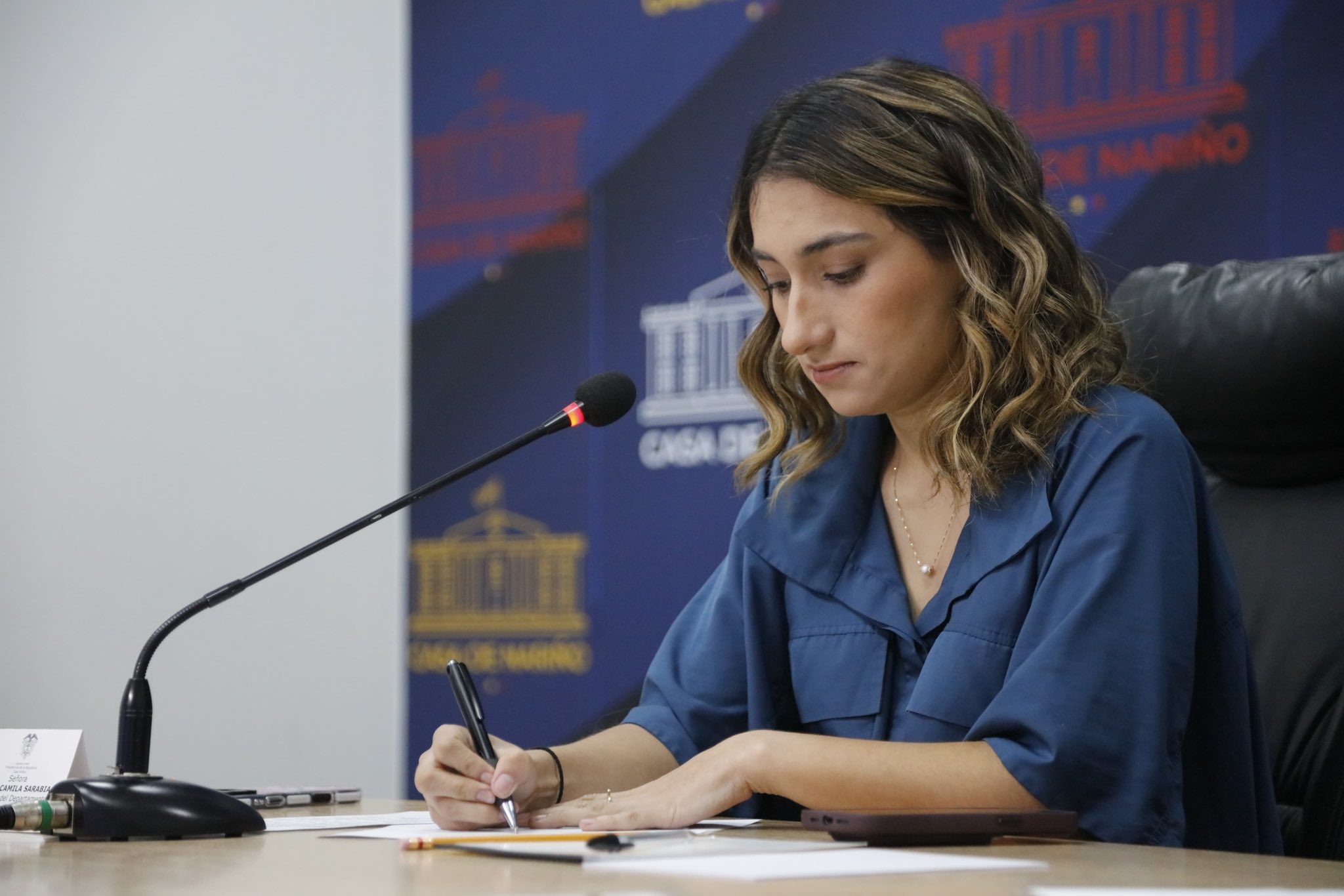
Laura Sarabia, Foreign Affairs Minister in the Petro government, at work. (Photo sourced: Internet)
When Colombia broke off diplomatic relations with Israel last year, at the very least it should have required a visa from Israelis travelling to the country. But Petro learnt very well the lesson of the nuns in the schools that it more important to appear to be than to be.
And he and his government appears to be the most progressive on the planet and an adversary of the Zionist state. But it is not true. It is not the case in migratory issues nor on economic issues and despite Colombia announcing it would no longer export coal to Israel, it continues to do so.
What is the point of requiring a visa from Israelis when many have double nationality and can enter with another passport? We have to be more radical.
Firstly, Colombia should state that those who have Israeli nationality automatically lose their Colombian citizenship. There are many countries in the world that do this, amongst them Nepal and India.
There are others that do not accept double nationality, you can only have one passport, though the loss of citizenship is not automatic. And further still there are countries, such as Ireland, that accept triple nationality.
Colombia should not recognise double nationality when the second nationality is Israeli. It could go even further.
Some countries, especially the USA, restrict visitors who have travelled to countries such as Iran or Cuba. Colombia could deny entry to anyone who has an Israeli passport, regardless of whether they enter with that document.
There are certain difficulties when it comes to implementing this, but there are legal implications for the person that uses another passport to enter Colombia if they are an Israeli citizen. With that alone they would close the brothels in Taganga and the sex tourism of Israeli soldiers in Colombia.
But neither Petro, nor Sarabia, when she stands in for the drunkard, aim to do anything like that. What they are about is appearances and this is to be seen in the economic measures taken against the genocidal state of Israel.
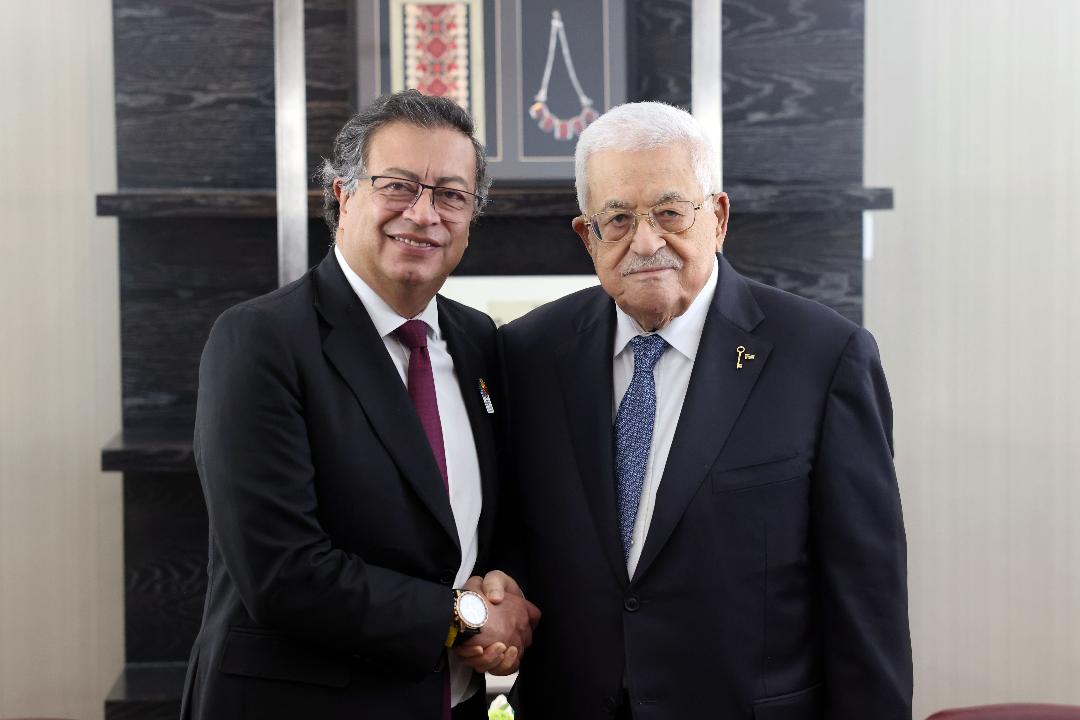
Gustavo Petro in handshake with Mahmoud Abbas, leader of the Palestinian Authority, the repressive Israeli and US proxy regime in the Palestine West Bank. (Photo source: WAFA)
With great showmanship they announced the end of coal exports to Israel.
But a recent communiqué from a group of trade unions and social organisations, amongst them the oil workers union, USO and the coal workers union, Sintracarbon, show that they continue to export coal to Israel.
According to the communiqué, based on data from Colombian Customs and Tax Office (DIAN) they exported 905.666 tonnes of coal to the tune of US $90 million since August 2025 when Petro issued his decree.
It is worth pointing out that Petro’s statement gained him fans in many parts, the Progressive International that includes personalities such as Walden Bello and Jeremy Corbyn reproduced an article from the US social democratic magazine Jacobin.
The article pointed to Colombia as a model to copy and that 60% of Israeli coal came from Colombia and that
…the Israeli power grid depends on coal for 22 percent of its output. The same grid supplies electricity to Israel’s illegal settlements and arms factories as well as the infrastructure used by the Israeli military in perpetrating genocide…
…this decision is not only a victory in symbolic terms but shows the enormous impact that a wider energy embargo could have in ending Israel’s genocide in Gaza.[2]
In fact, according to data from the DIAN, between January and April 2024, i.e. before Petro’s decree US $101,658.000 worth of products were exported to Israel and in 2025 for the same period US $ 75,247,000 was exported.
This represents a reduction but it is clear that Colombia not only continues to export coal but many other products to the Zionist genocidaires.
So, what does it matter if Israelis are required to have a visa? What the government says is that it is going to impose a visa on Israelis because they did it first.
But the Zionist soldiers can come on other passports or even on an Israeli passport, providing they have a visa, i.e. the response to the genocidaires is a bureaucratic inconvenience when what we really need is to ban the entry of all Israelis to Colombian territory.
And to close all the brothels in Taganga and other places that function as places for the “rest and recreation” of the murderers after their “exploits” in Gaza.
As the Zionist state of Israel made headway in its genocide of Palestinians, although it dithered, the Petro government took various solidarity actions with Palestine such as deciding not to allow the sale of Colombian coal to Israel.
One of the other measures it announced earlier in the midst of the genocide was the suspension of military purchases from Israel.
It is worth pointing out that it was he, as President, who revived those contracts through his decision to buy Howitzers from Israel instead of the Caesar from the French company Nexter.[1]
However, Petro announced that he would replace the Israeli-made KFir planes as they were old, and difficult and expensive to maintain and opened up negotiations to buy 16 Rafale planes from the French company Dassault.[2]
In October of last year, Israel suspended the sale of arms to Colombia,[3] due to the differences and tensions between the two governments.
Now Petro has gone into reverse and announced that he set aside US $ 761,000 for the maintenance of the KFir in addition to the sum from the contract signed in December 2022.[4] Of course this contract is with the Israeli company Israel Aerospace Industries.
It openly contradicts his public statements regarding Israel and also regarding the “modernisation” of the Colombian fleet and as El Tiempo points out.
… itis indeed surprising the large financial increase made last September 30th(bold in original) to reactivate the maintenance contract on the aeroplanes. Money that, furthermore, comes in the midst of serious questioning from political groups given the increase in air accidents amongst the Armed Forces.[5]
Barely 25% of the Kfir fleet is in working order at the moment.[6] But its maintenance is an unnecessary expense. The KFir are fighter jets, with the capacity for air to ground attacks and are supposedly needed to protect the country’s infrastructure.
KFir fighter jets (Photo sourced: Internet)
But that isn’t true either. More than to protect pipelines or other installations from guerrilla attacks they are to repel an attack from neighbouring countries. Their specifications are clear.[7]
The last time Colombia went to war with another country was in 1933 and it lost it, along with a significant part of its Amazon territory.
If Petro really wants to demilitarise the country, why does he insist on maintaining a fleet of planes that are not much use? He should give up on the maintenance of the KFir and as was done in another period with the buses in Bogotá, turn them into scrap metal.
Also, he should forego an unnecessary military expense in a country with so many needs. Are there not schools, hospitals and universities to be built or equipped?
And where is the solidarity with Palestine that he has so often proclaimed?
Gustavo Petro in Palestine-solidarity mode (Photo sourced: Internet)
If breaking off relations with Israel and suspending military contracts in the name of solidarity is a good idea, then it is a good idea at all times and more so now when there can be no doubt that Israel is a genocidal state …
and every dollar that its arms industry receives is another bomb falling on Gaza or an attack on Lebanon. Cheap talk is costly to the Palestinians, but also to Colombians who see how his proposal to demilitarise society has come to nought.
He did not abolish the ESMAD (specialised riot squad), as he promised, nor the obligatory military service, rather they now propose an obligatory social service for those who refuse to carry out military service.
If the rich can’t have youths to fight their wars, at least they will have cheap or free labour through this supposed social service. It is worth remembering that in Spain military service was defeated by a campaign that also defeated the alternative social service. Neither cannon fodder nor slaves.
It is time to be coherent. What does Petro want? Solidarity with Palestine or war planes? He can’t have both. The demilitarisation of society or a social service in addition to military service? It is one thing or the other.
Statements from Petro’s government and the Historic Pact on drugs are as trustworthy as those of Duque, Santos and Uribe. In their haste to show results they resort to deception or statements not sustained by any real figures.
So much so that, a few days prior to publishing his drug policy, Petro declared victory in the war on coca due to the increase in fentanyl consumption in the USA.
Coca crop growing in Colombia (photo cred: GOL)
It didn’t matter that his actual drug policy that he later published stated the exact opposite, something I have dealt with in a previous article.1
Once again they announce a victory on the basis of imprecise figures. Gustavo Bolívar through his twitter account states that:
The result of a change in strategy in the fight against drug trafficking. The Government stopped fumigating crops, the supply increased and the price fell. Now thousands of families are substituting coca for cacao.3
Picked coca leaves (photo cred: GOL)
The figures are not false, but they portray a falsehood. Bolívar wants us to believe that the price of coca leaf has fallen over the course of this government, compared to previous ones.
He also wants us to believe that the price of cocoa is due to the policies of the current government and the increase in crops can be explained by the same reason.
However, the same documents from the government give us a price for a kilo of coca leaf in 2021 or $2,300 pesos, which significantly lower than the $6,000 cited by Bolívar for 2024.4 The UN has come up with similar figures. Thus the price has risen not fallen since 2021.
Also, Bolívar doesn’t cite any figures of the price of base or paste, or the final product. Many peasants usually process the coca leaf rather than sell it on, though the sale of coca leaf does take place.
As for the cocoa, the area sown has doubled between 2009 and 2022, rising from 109,357 hectares to 229,974 hectares.5 Though it is worth pointing out that the UN uses lower figures on this.
Cocao “pods” in tree (photo cred: GOL)
Every government saw in cocoa a cash crop, even before Plan Colombia when the USA included it as a crop to promote amongst coca-growing peasants.
In 2006, the infamous minister of agriculture, Andrés Felipe Arias included cocoa as one of the main crops he wanted to promote through his Export Drive awarding subsidies, loans and tax benefits to those who grow cocoa.6
In 2009, the year in which the slow rise in the planting of cocoa began, the Dioceses of Tumaco warned about a number of projects that, in its opinion, damaged the communities, amongst them, the monoculture of cocoa.7
Cocao “beans” in the harvested fruit (photo cred: GOL)
This monoculture was not achieved through large companies, but rather through thousands of small scale producers, all growing the same.
In many parts, including the cocoa municipalities par excellence of Carmen de Chucurí and San Vicente de Chucurí in the department of Santander, the monoculture of cocoa is the end result of the planting by thousands of small scale producers.
It accounts for 25% of arable land in the department.
Then with the Plan Diamante proposals for the “development” of the north of the country, they didn’t just talk of road infrastructure such as the Ruta del Sol, but they also talked about cocoa and other cash crops such as African palm.8 There is nothing new under the sun.
So coca is more expensive than when Petro won the presidency and the increase in the production of cocoa has nothing to do with this government.
It is an old policy, which has not been able to undo the fall in the international price of cocoa since the 1970s, despite an increase at the beginning of this century due to wars in the Ivory Coast. It is a policy that sectors of the left criticised.
There are sectors that continue to criticise these proposals and there are left sectors who have jobs in the current government and pay more attention to their bank balance.
But, if we wish to discuss drug policy we need transparency and honesty from this government.
Coca processing lab, Colombia (photo cred: GOL)
Petro’s previous declarations on this issue leave a lot to be desired and this latest statement from Gustavo Bolívar indicates that just like the Catholic nuns in the schools, he believes that appearances are more important than being.
Petro’s government will come to end without resolving this problem, it is beyond the ability of any one government, but neither will it have done anything of substance, but will, without a doubt present a report that says the exact opposite.
On the 21st of April as he reached his house paramilitaries murdered Narciso Beleño, the leader in Southern Bolívar, Colombia, just two years after the murder of two other leaders Teo Acuña and Jorge Tafur.
I knew Narciso Beleño. Our paths crossed many times, on occasion on literal paths in the countryside as Narciso travelled the country in his struggle to defend rural communities in Colombia.
But I don’t want to talk too much about Narciso, the person, as there are others who can pay greater tribute to him in that regard, though his name always made me curious: Narciso (Narcissus).
Narcissus was a figure in Greek/Roman mythology who as a punishment from the gods fell in love with his own reflection. It is where we get the word narcissist from. But unlike the Greek/Roman figure, our Narciso was kind, caring, generous and selfless.
There are thousands of people, whole communities that can testify to his qualities as a person, a fighter and a leader.
When he was murdered the President, Gustavo Petro tweeted that “we failed Narciso”. But who failed Narciso? The communities? His comrades in Fedeagromisbol? Or were they the youths from the Front Line who are still in jail? Tell us who! A generic “We doesn’t do it, it is a lie.”
He should explain who failed him, how and why and Petro should also tell us what he intends to do prevent there being more murders of leaders.
Once upon a time we never doubted to putting a name and surname to the matter. We didn’t hesitate in naming the company, the board of directors, the landlord, the local politician. Sometimes we even ran the risk of putting a name and military rank to the affair.
A long time ago a gradual process began whereby some stopped naming them. And now under the Petro government it is not thought well to name them. Once upon a time we all named Fedegan, the cattle ranchers’ association, as backing the paramilitaries.
The Fedegan functionaries even acknowledged this. Now one of the representatives of that association, which is currently involved in refounding paramilitary structures, represents the State in the dialogues with the ELN.
Once upon a time we named the mining companies that have been trying for decades to take control of the gold in Southern Bolivar and other regions. It is worth remembering that Narciso travelled the country. More than one mining company had it in for him.
In Science Fiction and Fantasy novels, evil and magic lose their power over mortals when they are named by their real name and so the best kept secret is their real name. In real life something similar happens. Paramilitaries as something dark, shadowy and hidden defeats us.
When we name those behind this black magic with their real names, it begins to lose its power over us. They are not unknown to us. We withdraw cash from their ATMs every day, we purchase their services, we drink their products, we work in their companies and the odd eejit votes for them.
No company will say, “buy my product we are the murderers of social leaders” or “vote for me, I have murdered thousands.” They hide this for a reason and for that same reason we should expose their dark souls to the light of day.
The best tribute Petro can pay is to explain who failed and name the murderers just like he used to do before he was President. They are the usual suspects. Petro likes to say he governs but does not have power.
Well, tell us who holds that power that he don’t have, with names and surnames, economic group, foreign company. If we all failed, then nobody failed, if he was murdered by those who cannot be named, then nobody murdered him.
We usen’t to hesitate in talking about paramilitaries, the economic and political interests and reasons behind their actions. We named the business associations, the megaprojects in each region, we proved it.
Some sought justice in international tribunals, others in Russell style tribunals of opinion. We have to pay tribute to Narciso and other victims of the paramilitaries and name the murderers. Uribe tried to fool us with the Bacrim (Criminal Gang) euphemism. Neither Gulf Clan or anything else.
The same ones who disappeared Edgar Quiroga and Gildardo Fuentes in 1999 (in Southern Bolívar) murdered Narciso 25 years later. Say it loud and clear, Mr. President.
The coca zones of Colombia are in crisis. The cash crop par excellence, i.e. coca is going through an unprecedented crisis, or so we are told.
The main promotors of the idea that the coca is in crisis because fentanyl has displaced it and sooner or later it will finish off the coca were from the government. Amongst those promoting this stupidity are Colombian state functionaries from the NGOs, social organisations and of course high-ranking members of the Historic Pact. The very president of the country, Gustavo Petro stated in August that
The cocaine market in the USA has collapsed and has been replaced by an even worse one: fentanyl that kills 100,000 per year. Cocaine used to kill 4,000 due to the poisonous mixtures from the market clandestine.(1)
It is simply the case that nothing that Petro said at the time was true. Whereas Clinton exaggerated the deaths due to cocaine consumption in order to justify Plan Colombia, Petro sought to minimise them. First of all, we should be clear that fentanyl did not displace cocaine, but rather another opioid, heroin. And the most notorious aspect of fentanyl is not the increase in consumption, but rather that due to its toxicity, a dramatic increase in overdoses. Petro’s government makes statements on the drugs issue without even understanding basic concepts.
The overdue publication of its drug policy allows us to analyse properly what it aims to do, as up till now we have had to put up with a year of contradictory speeches, tweets that don’t say much and complete incoherence in the matter, without even mentioning his stated aim of handing over the Colombian Amazon region to the US military, something that not even Pastrana openly proposed when he announced Bill Clinton’s Plan Colombia.
In a US study published in May of this year, the researchers found that the deaths from fentanyl tripled between 2016 and 2021, increasing from 5.7 per 100,000 inhabitants to 21.6 in 2021. The deaths from cocaine overdoses increased in the same period from 3.5 to 7.9. At the same time there was a 40% decrease in heroin related overdoses, falling from 4.9 in 2016 to 2.9 in 2021.(2) The study just confirmed the analysis of previous research published in December 2022 that looked at increases in mortality since 2001.(3)
Fentanyl is a new problem for the USA, but neither the increase in its consumption nor deaths tell us anything about the future of coca as Petro and Roy Barreras claimed. Quite the opposite. According to the UN, coca crops reached the figure of 230,000 hectares in 2022.(4) Of course, Petro is not to blame for that, he only took over the presidency in August 2022, but it belies his statements that coca is a thing of the past due to the economic crisis in the coca regions of the country.
So, what can be said of Petro’s new drug policy? Well, the first thing is that there is at last a policy outlined in a public document. They took their time in doing it but better later than never. The document proposes with a certain amount of hyperbole Oxygen for the communities affected, through support from licit economies, environmental measures and treating the matter of consumption as a public health issue. It also proposes Asphyxiation for drug trafficking organisations. Furthermore, it proposes being the voice and leadership of “an international diplomatic strategy to change the paradigm in how the drugs phenomenon is dealt with.”(5)
The document kicks off with a correct analysis that contradicts the public declarations made by Petro and other high ranking government functionaries, a few weeks prior to its publication. It is inexplicable how the president can boast about the collapse of coca at a point when it is almost certain his drugs policy was at the printers. It must be due to mediocre functionaries, as this government has continued with the policy of Duque and the previous governments of hiring mediocre friends. But in any case, the document gets somethings right, at last.
For decades, Colombia has made an enormous investment in human and economic terms in fighting drug trafficking. Although there are no official figures on the outlay in fighting drugs, but the Drugs Observatory of Colombia calculates an annual average expenditure of 3.8 trillion pesos [885.2 million euros] ascending to an approximate investment in the last twenty years of 76 trillion pesos [17.7 billion euros]. Whilst some results have been achieved along the way, it is true that the two main goals have not been reached: reduction in the supply and demand for illicit drugs.
Even though 843,905 hectares of coca were forcibly eradicated between 2012 and 2022, the planted area in this period increased by 327%. In 2022, Colombia had 230,000 hectares of coca with a productive potential of 1,738 tonnes of cocaine. As for demand for psychoactive substances, between 1996 and 2019 an increase of 5.1% to 8.7% in the consumption of all illicit substances (marijuana, cocaine, base, extasy or heroin) was observed.(6)
The document then goes on to acknowledge that the collapse in cocaine consumption is not real but rather on the contrary there has been an increase. It states that one of the first hypotheses was a global fall in demand for cocaine.(7) They are trying to save their own skin. There was no data to sustain the supposed hypotheses: none. It was dreamed up by mediocres and no one else made the claim. The document goes on to say “However, according to the lastest Global Cocaine Report from the UNODC (2023), demand has risen.(8) At least we are having a debate about the reality of poorly written studies from the children of the lovers of their friends who they hired.
So, what do they propose? It would seem that they propose a shift in the punitive model without abandoning it completely. They accept that the fumigations have not worked and that the periods of greatest fumigation do not match those of a lesser supply of the drug.(9) But the punitive element continues to be an integral part of the policy, the supposed shift is a mirage.
The evidence has shown that a security strategy on its own is not enough [the emphasis is mine] but rather it must go hand in hand with actions to prevent crime and deal with the underlying causes.(10)
The document takes a look over the international treaties in the area, softening the real demands of the Single Convention of 1961 stating that it doesn’t prohibit anything but rather submits the plants and the drugs produced to a strict control. There is not enough space here to go into detail on that debate. But once again what the government is saying is not really the case. The Single Convention does actually allow for some coca crops for medical and industrial purposes, mainly in Peru and also opium in India. But it is not the case that Colombia has misinterpreted those treaties. And this is a major issue, as any change in the paradigm is dependent on changes in those treaties or better still their complete derogation and the drawing up of new treaties under a new paradigm.
Whilst it is true that a country can allow coca crops for licit purposes, that is done with the permission of the UN control bodies, i.e. the USA. Even traditional consumption of the coca leaf is frowned upon in the Convention. Article 26.2 states that.
The Parties shall so far as possible enforce the uprooting of all coca bushes which grow wild. [emphasis is mine] They shall destroy the coca bushes if illegally cultivated.
Although Article 49 permits chewing of coca leaf in countries where it was already legal on the 1st of January 1961 (subparagraph 2a), it does so on the condition of banning it and eradicating it once and for all by 1986 (subparagraph 2e), something which was not achieved. Whether they like it or not, this treaty has not been misinterpreted and the whole UN framework i.e. US policy in the area is the problem and not a misinterpretation of previous governments. The supposed freedom to grow and licit use of coca that Petro imagines is not real.
Some states in the US legalised the production and recreational consumption of marijuana and clashed with the federal banking system that was not willing to receive funds from the industry, forcing many producers to resort to mechanisms more suited to money laundering in illicit industries. Something similar happened in Uruguay. The country regularised the recreational production and authorised and regulated the state control of it. However, not even the Bank of the Republic of Uruguay was willing to receive money from a lawful activity in the country due to a fear of reprisals from the USA.
It would seem that the architects of the law did not foresee the problem that would arise in the banking industry, owner and lord of the commercial and financial transactions in Uruguay. Were the Uruguayan legislators aware that it was not just a matter of convincing the international system of prohibition to reclassify cannabis as a substance in the drugs conventions but that they also had to convince the banking system to accept money from cannabis transactions? Everything seems to indicate that the directives the banks implement are those that are simply related to the formality of Cannabis being a prohibited substance and the fact that the money from the cannabis market is legal, illegal, black or white has no bearing on decisions.(11)
Uruguay found itself at the mercy of the repressive whims of the US government and in practice was not autonomous nor sovereign. Any drugs policy should take as its starting point that Colombia is not sovereign in the matter and it faces a massive enemy when it comes to solving the problem: the USA. It is not a matter of a restrictive interpretation by Colombian governments, but rather the reality of imperialist domination. This was the case with Uruguay.
… according to the Uruguayan government implementing a national law [on drugs] depends on the modification of a foreign law. Note that at no stage is a modification of international drug treaties that Uruguay has ratified mentioned, but rather a federal law that internally classifies cannabis in the USA.(12)
The government has no proposals in the matter and its proposals for the peasants are remoulds of the previous policies with a slightly modified language. They no longer talk of crop substitution but rather licit alternatives or economies. And the licit alternatives for the countryside are the usual ones, exportable monocultures.
And the iron hand continues for the peasantry. They have talked a lot about distinguishing between large and small-scale coca producers, increasing the definition of small-scale producer as one that has up to 10 hectares. But the iron hand continues. They have said that they will not use forcible eradication but…
Forcible eradication will be applied to crops that: (i) do not fall into the category of “small-scale grower”, (ii) increase in area, (iii) planted after the publication of this policy (regardless of size), (iv) have infrastructure for the production of base and cocaine hydrochloride, (v) do not fulfil their commitments to substitution and other mechanisms on the path to licit economies.(13)
Many peasants have some infrastructure to produce base, an infrastructure that is not all that complicated. So, I don’t know who these peasants who will not be subjected to forcible eradication are. It is not all that different from the policies of Uribe and Pastrana and borrows policies from Plan Colombia, the Exporting Stake of Uribe and the directives of the former Social Action and of course the Peace Laboratories of the European Union and the nefarious apologist for the economic policies of Uribe and also in passing the World Bank, the priest Francisco de Roux: the so-called Productive Alliances.
Productive agreements between the public sector, private sector and grassroot economies
These consist of a tripartite collaboration between the state and the private sector as drivers of the productive reconversion, through actions such as capitalist investment, transfer of know-how and insertion into local, national and international markets. To that end the “Productive agreements for life and hope” will be implemented, in which the state will offer benefits to the businesses that commercially associate themselves with the communities. The Ministry of Industry, Commerce and Tourism will facilitate and strengthen these type of alliances.(14)
Not that long ago in 2017, various current senators and representatives of what is now called the Historic Pact publicly denounced a proposal from Santos on the countryside. They stated:
… limits [the communities] chances of defining the productive and economic model that would allow the building of peace with social justice, by tying it to technical criteria… that give priority to the establishment of alliances and chains of production between small and large producers and the efficient use of rural land, technological innovation, technical aid, credit, irrigation and commercialisation that favour an entrepreneurial large-scale agro-industrial production.(15)
So, what about now? Ah of course, the proposal is yours, and it doesn’t matter whether it is the same proposal or not, but rather who makes it. And if the peasants do not agree with the economic model being imposed, what will happen to them? Well, “a differential treatment will be promoted that will be transitory and conditioned on their signing up to processes on a path to licit economies”.(16) In other words, they are going to jail.
As for money laundering, there is nothing new. The government is obliged by various international treaties to fight against money laundering. But the language used is telling.
This last point [laundering] is based on identifying high value financial targets, understood to be persons or legal entities, goods, assets or bodies that due to their nature, volume or characteristics may be exploited by criminal groups (emphasis is mine) to hide or channel illicit funds and thus launder money from criminal activities.(17)
HBSC Tower, Mexico (Photo source: Wikipedia)
As with other governments, including the USA, the banks are seen as another victim. More so than the peasants, exploited by criminal groups when in reality they themselves are criminal enterprises. The massive laundering of assets that HSBC carried out in Mexico cannot be understood in any other light. There are no measures taken to jail the banks’ directors, cancel their banking licence, freeze their assets, fine them to the point of leaving them naked in the street. No. The asphyxiation the government talks about is like the law, to be applied to some but not to others. They are more concerned about illegal mining in coca zones than the laundering of assets only yards from the Presidential Palace.
The document is very similar to previous policies with some small changes, a slightly distinct language and “new” proposals that are not new. Perhaps we could say that it indicates some goodwill in some aspects, but nothing more. Petro can’t fight for a new paradigm without changing the current one.
Proposing a revision of the international legal framework does not imply a conflict between prohibition or total freedom in the market for psychoactive substances. On the contrary, it means coming up with intermediate solutions such as alternatives to prison, harm reduction strategies and the responsible regulation adult use substances such as cannabis. The progress, failure and lessons learnt from international cooperation on drugs represent an opportunity for the international community to evidence based innovative strategies and policies.(18)
Harm reduction is policy in most of the world, including some parts of the USA. Alternatives to prison also, though in practice it is not always the case in all countries. What is put forward is the current state of play, not a big struggle to change the paradigm. It is a disappointing document, more so than previous policies, as this one tries to play with the language to stupefy, fool and lie to us. In the end, it is another lost opportunity. If you want to see something innovative in drug policy, you would be better off taking a drug, preferably a magic mushroom.
(2) Spencer, M.R. et al. (2023) Estimates of drug overdose deaths involving fentanyl, methamphetamine, cocaine, heroin, and oxycodone: United States, 2021. Vital Statistics Rapid Release; no 27. Hyattsville, MD: National Center for Health Statistics. May 2023. DOI: https://dx.doi.org/ 10.15620/cdc:125504. P.3
(3) Spencer MR, Miniño AM, Warner M. Drug overdose deaths in the United States, 2001–2021. NCHS Data Brief, no 457. Hyattsville, MD: National Center for Health Statistics. 2022. DOI: https://dx.doi. org/10.15620/cdc:122556.
Gearóid Ó Loingsigh 12 April 2023 (first published in Socialist Democracy)
(Reading time: 5 mins.)
The president of Colombia, Gustavo Petro, announced in a National Peace, Reconciliation and Harmony Council (CNPRC) meeting that the state didn’t have sufficient funds to fulfil the Havana Accord signed with the FARC.(1)
The situation seems to be so serious that according to the President it will take 125 years to fulfil it. There are some points in which he is right, but only if we ignore the most obvious things: the nature of the Accord itself.
He alludes to this and asks some rhetorical questions, ones which he should really ask as proper questions, not as some gesture in his oratory, but rather as questions to the FARC, Santos and all those who promoted the Accord nationally and internationally.
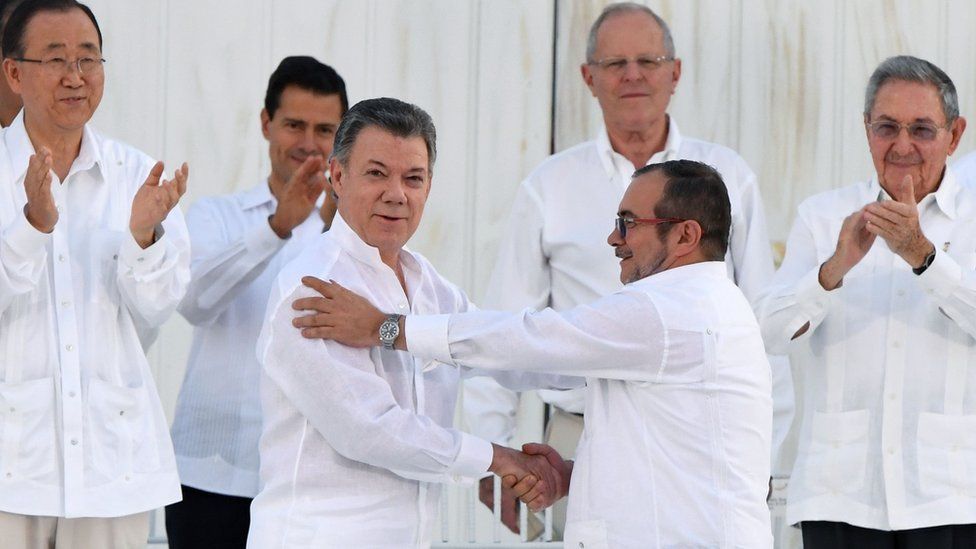
Among guarantors of the Colombian conflict pacification deal signed by, at the time, Colombian President Juan Manuel Santos, left, and leader of the Revolutionary Armed Forces of Colombia (FARC) Timoleón Jiménez, known as “Timochenko,” during a news conference announcing an agreement between the two parts in Havana on Sept. 23, 2015. Among those applauding, Cuban President Raul Castro at far right of picture. (Source photo: Internet)
Petro asks “was that Accord signed with the aim of applying it, or with the aim of disarming the FARC and later, Colombian style reworking everything?(2)
Well of course it was sonny boy. That much was clear. At the time you were told so and those of us who criticised the Accord were accused of wanting more war, ignoring that many of us had never participated in or supported the war. It was a debate they didn’t want to have.
During the not very open process negotiated behind closed doors, it was said, in the midst of the euphoria of the signing and the parties in public squares with huge screens in the streets so one would miss it, that criticisms were not welcome.
They were, as an old friend used to say, as welcome as a fart in a space suit.
Petro continued and stated something he certainly believes is very important.
I want to implement the Peace Accord, but it costs 30.5 billion Euros. If the Santos government signed this in the name of the state and society is represented in this, then, tell me where am I to get this 30.5 billion?(3)
There is an easy answer to that question. The money can be got from the same place that they, and in that I include Petro, thought it was when they signed the Accord in 2016. Don’t ask where they are going to get the money, but rather tell us where you expected to get it in 2016.
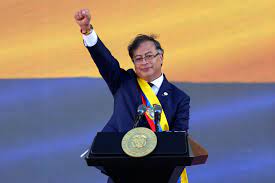
Petros giving a clenched fist salute after his inauguration as President of Colombia. (Source photo: Internet)
Senators such as Iván Cepeda who played an important role in the process can point to where. The cost of the Accord was obvious from day one, this problem is not new and it is just not credible thatPetro and his Congress benches have just realized how much money was needed.
But the truth is Petro, Cepeda wanted to bring the FARC to an end and rework things later. All of them without exceptions. Of if this is not the case, maybe they can tell us where they thought they would get the money.
The former FARC commander, Timochenko said that war against the FARC (he excludes all of the other guerrilla groups that have existed) cost 83.7 billion Euros and the 30.5 of Petro is a minimal cost for the chance of a country in peace.
He is partially right, except that the problem is not about money or amounts, but rather the Accord itself and their perspective that what is needed is money and not political changes. The Havana Accord reads like shopping list, like a list of demands and a not very precise list at that.
A Land Bank would be set up with three million hectares, but it doesn’t say where and left it to the whim of whichever government.
So Petro announced that he would fulfil that part by buying land off cattle ranchers. The same ranchers whose spokesperson José Felix Lafaurie accepted that Fedegan’s affiliates, rice growers and various multinationals financed the right-wing paramilitaries.(4)
Nothing happened to him, nor to the 10,000 cattle ranchers who had signed an open letter where they acknowledged their crime.(5) At the time it was argued that the Prosecutor was not in a position to process that many people.
It wasn’t true, the crime had been publicly vindicated and they also said that there was nowhere to put 10,000 criminals. This wasn’t true either.
According to the prison service’s own figures and the calculations of the Corporación Excelencia en Justicia, in 2006 the Colombian prison system had a capacity for 52,414 prisoners with 60,021 actually held in them.
In 2011, that figure had risen to a capacity of 75,260 with 100,451 people in them i.e. they managed to put 40,000 poor prisoners in overcrowded conditions, but they had no room for 10,000 paramilitaries and their lackies.
In 2006 there were 19,353 prisoners on remand.(6) A little bit of creativity with the judicial abuse of remand and they could have put the paramilitary funders in jail without any problems.
The prison population eventually reached the figure of 125,000 prisoners in overcrowded conditions whilst others rambled around their lands despite having acknowledged their crime.
What was missing was the will. But instead of spending money buying land from paramilitaries and their backers, Petro could confiscate the land of those 10,000, amongst others. It wouldn’t cost that much.
There are other measures he could take with a view to peace, justice and truth. Petro could ask for the extradition of the Board of Chiquita who paid a 25 million dollar fine in the US having accepted their responsibility in the crime of financing paramilitary groups.
It wouldn’t cost more than the price of posting the request. There are other measures that have some bureaucratic costs, like forcing public bodies to comply with land restitution findings, something which does not happen. It also only requires the will to do so.
Petro’s focus is the same one as the FARC and the Santos’ government and other peaceniks, who are now Congress reps: it is a question of money. But this is not the case. It is a question of returning stolen land, reviving organisations, guaranteeing the right to exercise one’s rights.
It is also the disbandment of the specialised riot squad, ESMAD. It is more expensive to change its name and give it a makeover, as Petro proposes, than abolishing it.
He wanted to buy fighter jets at a cost of 3,150 million dollars. Due to public reaction, he backtracked but he did buy the Barak MX air defence system from Israel at a cost of 131.2 million dollars.(7) He also bought 18 Howitzers from Israel at a cost of 101.7 million dollars.(8)
Such systems are for conventional wars between countries, they are of no use against insurgents, i.e. they are toys for the military. Maybe they will be used in the Coup that Petro’s followers announce all the time. It is what happened in Chile.
So, is there any money or not? And what will be done with the things that don’t cost much? Why don’t they reduce the extravagant salaries of the magistrates in the Special Jurisdiction for Peace who to date have produced little?
But then, at least he partly accepts what was always the case, that the peace process and the Havana Accord were a mockery of the victims of the Colombian conflict. Their only purpose was to remove the FARC from the field, particularly in areas with oil and other natural resources.
No one sought to solve any deep-seated problems in the country and here we are with the tale that there is a lack of money, when really what was lacking throughout the entire process were clear political positions.
(3) Ibíd., Euro figures were calculated at 4906 pesos to the Euro and the original figure of 150 billion in the article was taken using the Spanish definition of billion, which is a million, million.
(4) El Cambio No 704 diciembre 2006/enero 2007 Diez Preguntas (Entrevista con José Félix Lafaurie p. 48)
(5) El Espectador (17/12/2006) La hora de los ganaderos, p. 2A
1) What do you think the elections of May 29th will mean for the future of Colombia? What are the stakes of these elections?
The elections are not as key as some commentators would like to make out in terms of profound changes in Colombia. Though, the reaction in some sectors and fears about the transparency of the elections are well founded and even some fears of a violent reaction from some sectors of the bourgeoisie and the army. So, on one level the elections are about the degree to which the bourgeoisie, including the narco-bourgeoisie are willing to accept electoral defeat. This election is likely to bring about a long period of uncertainty in the country as Petro tries to manage the expectations and demands of the bourgeoisie and contain the hopes of his own supporters.
People displaced in the north of Santander by ongoing violence try to get by as best they can (Photo cred: GÓ Loingsigh)
2) What is the political scenery like, one week before the elections? These elections take place midst what kind of atmosphere?
The atmosphere oscillates between one of hope that Petro will be elected and bring an end to a long conflict that has been going on for almost 60 years and one of fear. No one knows what the far right are capable of doing and thinking at the moment. General Zapateiro intervened in the election campaign, which is unconstitutional as the military don’t even have the right to vote in Colombia. There are other fears about electoral fraud, a portal has been set up to report electoral fraud. Already it has tallied 3,500 incidents and no one has cast a vote yet. Leading businesses have stated they will sack any workers who vote for Petro and have demanded that their employees take photos of the electoral card that they mark and send it to them. It is expected that Petro has the ability to win in the first round, sufficient electoral fraud to force a second round run off with any candidate other than Fico would make matters more complicated for Petro as people may vote against him out of fear were it to come to a second round against one of the other candidates other than the reincarnation of Uribe that is Fico.
The Colombian military are not permitted to vote but there is always the possibility that they will intervene militarily (Photo cred: GÓ Loingsigh)
3) In the surveys, we see that Gustavo Petrois is ahead. How do you interpret this? What are the social alliances he has created? What are people’s expectations from him?
Petro has been around for a long time and this is not his first but third outing as a presidential candidate. After 20 years of Uribe as the leading figure in Colombian politics, there is a growing tiredness coupled with really serious levels of poverty, whilst kleptocrats openly steal the resources of the state. However, he hasn’t built social alliances as such. There has been a confluence of various social organisations and sectors more out of a hope that there might be some change. Petro for example opposed the wave of protests that erupted in the country last year. At a moment when Duque looked very weak, Petro came out to say that he didn’t want Duque to fall through the protests and demanded that the protests be called off. He more than anyone was responsible for the defeat. Petro is building an electoral alliance not a social force and his electoral alliance includes the bourgeoisie. He has long called for a programmatic agreement with the bourgeoisie and his alliance includes people from various previous governments, including Uribe’s governments. Leading functionaries from the Santos government play lead roles in his campaign, such as Alfonso Prada, who is also a close friend of Santos. Former president Samper, the man who implemented the decree that gave us the Convivir, the legal façade for the paramilitaries in the 1990s is also involved in his campaign. This is not a minor point, Samper managed to reinvent himself as a man of peace, even though he more than any president bears responsibility for the blood bath of the mid 1990s to the early years of the 21st century. He also tried to include the former president Cesar Gaviria, the man who gave us the economic aperture of the neoliberal period. It was opposition from his electoral base which forced him to rethink that one. These people play a greater role than any social movement.
Marchers on the annual Victims’ Day in March with placards of murdered trade union and human rights activists (Photo cred: GO’Loingsigh)
4) If Gustavo Petro wins the elections, what possibilities/room does he have to implement a progressive/social democratic policy for the people΄s classes, the workers, the poor, the precarious, etc?
This goes back to the last question and his programmatic alliance with the bourgeoisie. So, there are two elements, to what degree does he actually want to implement a progressive policy? He has spoken about reforms in health and education, some of which sound almost Keynesian, but Petro is not Keynesian. His programme does not contemplate a break with neoliberalism but to work within it, controlling deficits etc, subsidies for industry etc.. His economic policies are a continuation of the last 30 years, with one difference, he wants to move away from mining and oil exploitation, the former coming to an end in any case with various coal mining companies announcing their withdrawal from the country, though some gold mining companies are staying and these companies have legal guarantees on continuing with mining prospecting and exploitation that Petro will not and cannot legally bring to an end. He has however, said that he will promote agribusiness and continue with the policies that are in place, again with some minor tweaking.
Gustavos Petro campaigning (Photo cred: Financial Times)
5) How do you see the next day, after the disaster that the four years of Duque’s neoliberal policy has brought? What are the most important problems that the new government will face? What are the difficulties?
The next day, the one problem Petro will have is how the right will react to destabilise his government. A situation similar to that of Allende of a long drawn-out phase of destabilisation from some sectors is a possibility, though unlike Allende, Petro’s campaign is electoral, he does not believe in organising people and is in fact opposed to it. Part of his base has been bought off with the promise of jobs for the leaders of organisations and access to the public purse, which is normal for Colombian elections. Offers of jobs and government contracts in communities is the normal way elections are bought in Colombia.
Colombian military looks towards a protest demonstration (Photo cred: GO’Loingsigh)
Petro also does not have a majority in Congress, in fact he is very far from it. And will have to negotiate many things, which will push his programme further to the right as he will not use popular mobilisation to counter any blocking of policies by Congress. In the long term, this presents a problem for him and we will almost certainly see another wave of protests like those of last year, but this time against the Petro government. I also predict that his Vice President, Francia Márquez will not complete her term of office and will resign at some point in the face of the reality of Petro’s government as opposed to the expectations.
He has proposed renegotiating the free trade agreements, a task that is just not possible. He will also face problems in reforming the health sector as many international health companies have invested heavily in the sector and will most like sue the government for any changes that affect their profits, something he will be forced to back down on. In fact, within his campaign there have already been retreats on this point, as he no longer proposes to abolish the role of these companies, just to change how much of the public purse they have access to.
end.
People fishing in Cesar Department, Colombia (Photo cred: G.Ó Loingsigh)Coal miner in Colombia (Photo cred: G.Ó Loingsigh)







 rebelbreeze