REVOLUTIONARY BLOC IN DUBLIN MAYDAY MARCH

Clive Sulish

(Reading time: mins.)

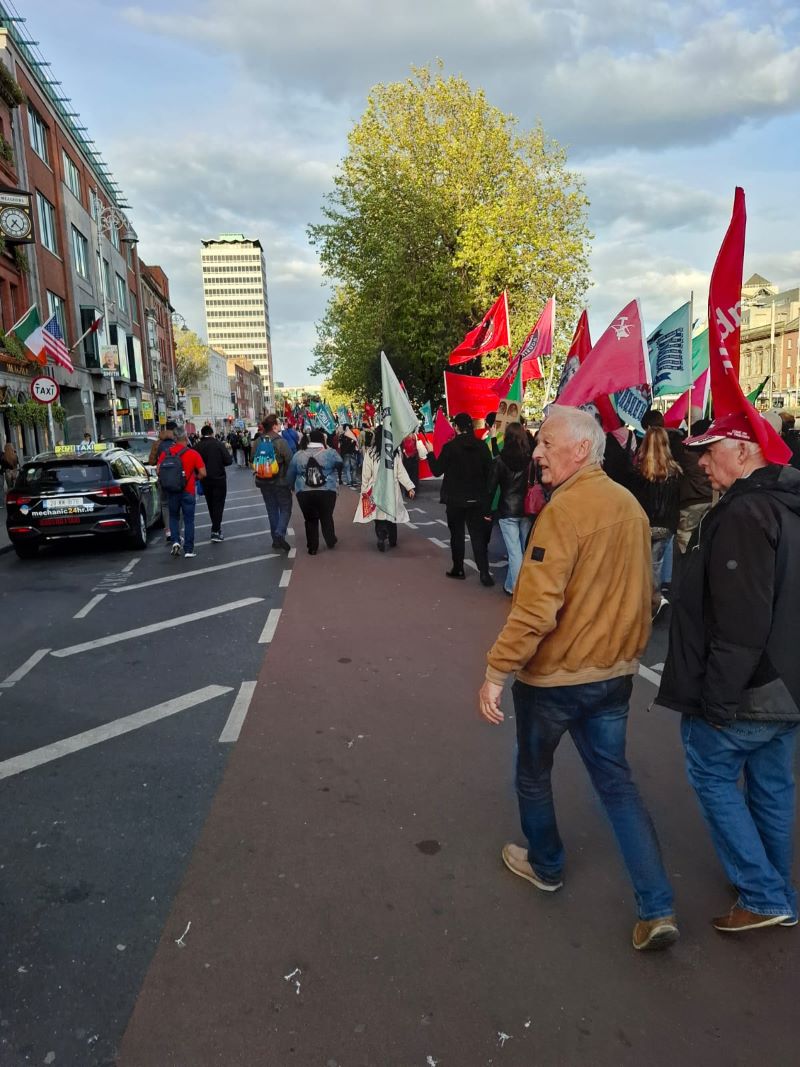
Composed of Socialist Republican, Communist and Anarchist contingents, along with independent activists of various tendencies, a broad Revolutionary Bloc marched among other groups and individuals in the annual May Day march in Dublin on May 1st.
Eden Quay, as the march turns off O’Connell Street, heading for Beresford Square, by the tall Liberty Hall building in the left background. (Photo: R.Breeze)

At intervals the banners of the Communist Party of Ireland, the Independent Workers’ Union and flags of the Anti-Imperialist Action contingents could be seen and a number of flags denoting specific groups or campaigns were on show but the Bloc was mainly identifiable by its slogans.

Led in call-and-answer almost non-stop from departure point at the Garden of Remembrance to Beresford Place in front of Liberty Hall,1 slogans called on workers to strike work and fight, to oust imperialist states and NATO from Ireland, for resistance unity, revolution and a socialist republic.
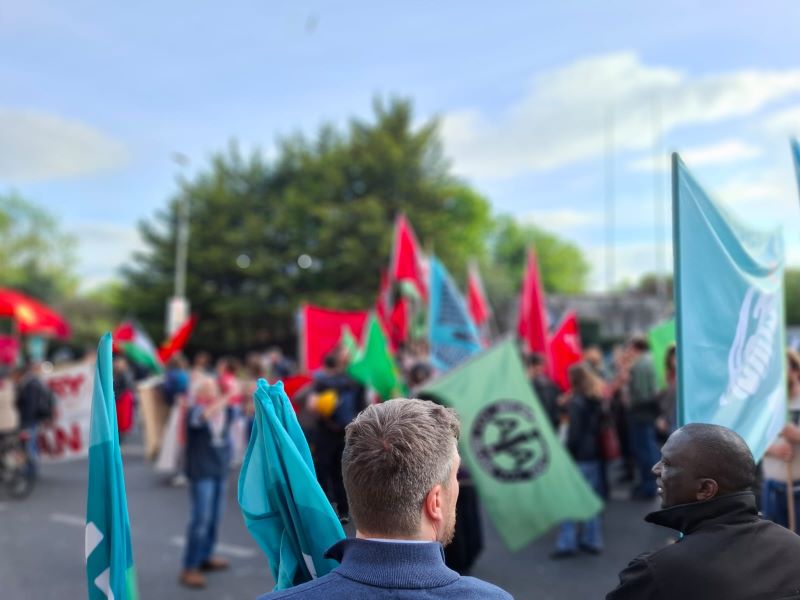
Section of the Revolutionary Bloc, centre image. (Photo: R.Breeze)

It was notable that an Irish Tricolour and a number of Starry Plough flags were visible among the Bloc and indeed one of the chants was against the appropriation of the Tricolour by ‘traitors’. They also called for funding for education and not for big corporations and for a hotel-free city centre.

At least one of the flags was of the Revolutionary Housing League and the march passed an empty building appropriated three years earlier by the RHL who were then evicted by a Garda force of 100 with helicopter and armed unit as backup. The building remains empty to this day.

People in Dublin stopped in the early Friday evening to watch and in the northern reach of O’Connell Street an elderly man stepped off the pavement to march along with the Bloc, though in silence while further along, two teenage girls in school uniform joined the Bloc also.
The Priory Market, Tallaght, Dublin prior to opening (Photo: Supplied by supporter)

Led by a long piper, the various contingents marched into Beresford Place, where a stage had been set up in front of the SIPTU2 headquarters building but most of the Revolutionary Bloc marched past to congregate for a group photo around the nearby monument to James Connolly.

Using the Bloc’s megaphone, one of the group then sang the Be Moderate song (also known as We Only Want the Earth) composed by James Connolly3 and, as the singer informed his listeners, published in the Songs of Freedom songbook by Connolly in New York in 1907.

As most of the Bloc dispersed, speeches were being made from the nearby stage and a group of mostly younger people from Turkey were assembling at the Connolly Monument also for a group photo.

The May Day march and rally in Dublin is traditionally organised by the Dublin Council of Trade Unions. However the participation of union banners was low in numbers and those present mostly of the FÓRSA union.
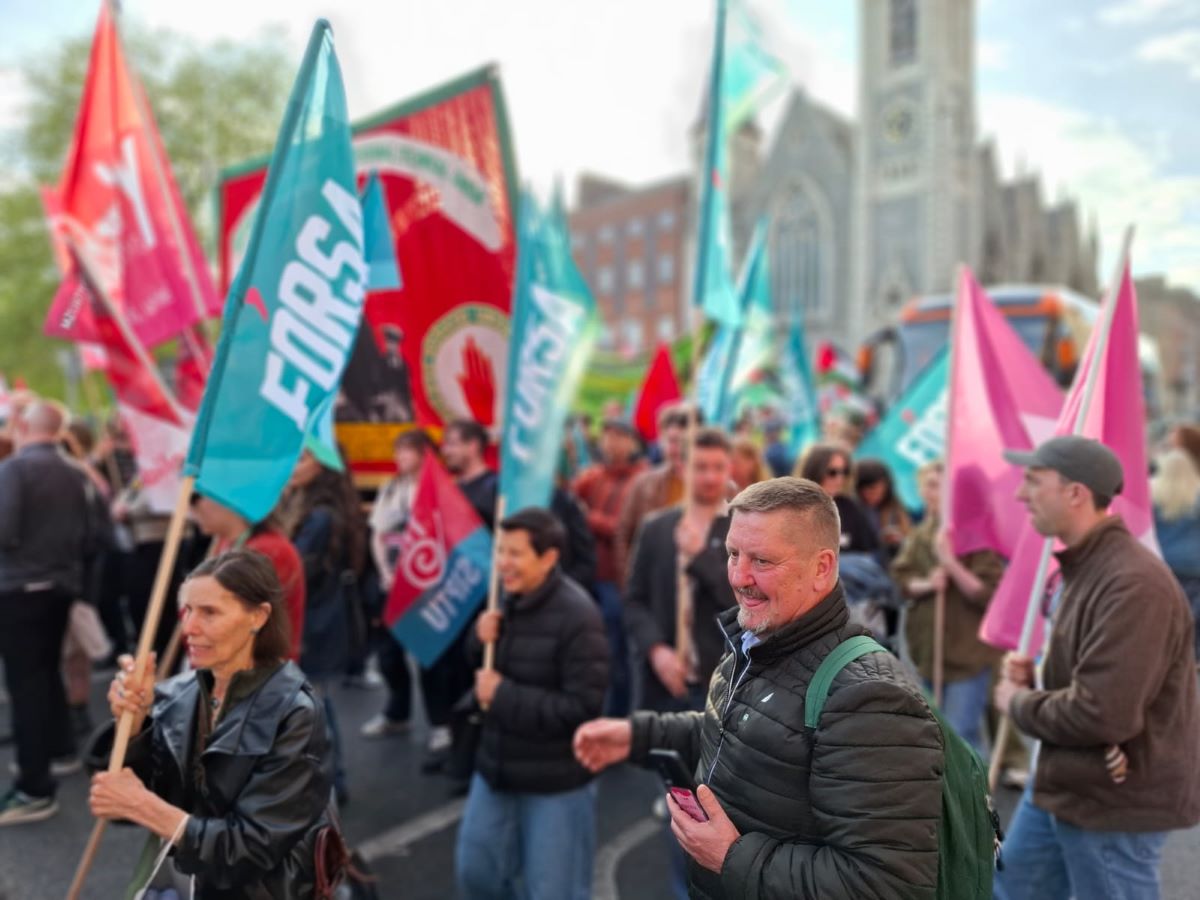
Section of the march showing FORSA union flags being carried. (Photo: R.Breeze)

Distinct from other European states, the foremost struggle in Ireland for centuries has been on the national question which has entailed less development in the forces devoted to socialism, so that in general May Day does not bring out the numbers one can see in the capitals of the EU and UK.

However, Ireland’s long history of resistance to colonial occupation has entailed a greater history of insurrection than most European states and it has also produced a remarkable number of leaders of labour struggles among the Irish diaspora in Britain, the USA and Australia.

End.

Note: If you found this article of interest, why not register with Rebel Breeze for free, so that you will be notified by email of subsequent articles. You can de-register any time you wish.

FOOTNOTES

1A highly-visible very tall building on the site of the original Liberty Hall, HQ of the IT&GWU, now of SIPTU.

2One of the largest (possibly the largest) trade unions in Ireland, formed by amalgamation of other unions on the base of the Irish Transport and General Workers union, of which James Connolly had been an officer and for a period, its overall leader.

3James Connolly ( – 12 May 1916), born and raised in the Cowgate area of Edinburgh, revolutionary socialist activist-theoretician and Irish Republican, author, journalist, historian, union organiser, executed by the British occupation along with another 15 prominent insurrectionists of the East Rising.

GOING THROUGH THE SOLIDARITY MOTIONS

Diarmuid Breatnach

(Reading time: 4 mins.)

The week before last in Ireland we were led through motions of Palestine solidarity actions once more, motions without practical effect, first by the Irish trade unions, followed the following day by the Ireland Palestine Solidarity Campaign.

Seen on the IPSC National march (Photo by: Participant)

On Friday, the unions announced a ‘stand out for Palestine’ day – well, not a day exactly, more like a lunch break. It was not a strike, not even a work stoppage, rather some dedicated employees surrendering their lunch break to stand with Palestinian flags etc in front of their workplaces.

Not even a work stoppage of one day, half-day, or even an hour. The union leaderships, in most cases, organised nothing, leaving it up to their members to get together and to sacrifice their lunch breaks.

More of us went through the motions again on Saturday 29 November. From the Garden of Remembrance, down O’Connell Street, across the river, around by Trinity College, up Dawson Street and into Molesworth Street, facing Leinster House.

Seen on the IPSC National march (Photo by: Participant)

The Ireland Palestine Solidarity Campaign organised this ‘National Demonstration’ as it does roughly every month. It is supposed, presumably, to impress the Government with its numbers and pressure them to end their collusion with the ongoing genocide of Palestinians.

It has not done so — nor did it in any month or any year in the life of the IPSC, the longest-active Palestine solidarity organisation in Ireland. Nor have the monthly marches brought about any change in Irish Government collusion since the genocide of Gaza began in October 2023.

That is not the fault of the IPSC. What they are to be blamed for is not recognising that and adjusting appropriately to actions of greater pressure. Or, perhaps they recognised it indeed but nevertheless refused to change towards any effective pressurising methods.

The IPSC was for a long time near the ‘middle of the road’ but it has moved further into that position as the genocidal actions of the Zionist colony became worse and as awareness of Israeli crimes spread and grew in Ireland (which it did in part thanks indeed to the work of the IPSC).

Section of the IPSC National march (Photo by: Participant)

Solidarity work however is not about education in the abstract, raising awareness without using that awareness to bring about change. I am sure the IPSC leadership is aware of that and would wish much change but they do not adapt their actions, rather continuing with the monthly motions.

Probably they do not increase the pressure out of fear of losing their influence with the political class. Which would perhaps be well and good if the political class were delivering on ending collusion with the genocidal state – but they are not, nor is there any indication that they will.

Ireland remains the biggest single importer of Israeli products next to the USA and the biggest in the EU. The Irish Government permits military consignments to fly to Israel through ‘neutral’ Irish airspace and USA aircraft and military personnel to stopover and refuel at Shannon Airport.

Seen on the IPSC National march as passing O’Connell monument (Photo by: Participant)

Occupying the ground near the middle is only a good thing if it can be used to support action for change; it is a hindrance if the act of being there comes to be more important than the end objective: an end to genocide and the Occupation, with freedom and independence for Palestine.

The IPSC could use its mass base to blockade Dublin Port, through which Israeli products come into the country. It could also blockade other major stocking and distribution points.

The IPSC could organise mass days of action against retail and tech outlets handling Israeli exports and mobilise pickets in support of retail workers refusing to handle Israeli products, such as a Tesco worker currently facing disciplinary procedures (i.e punishment) for that very ‘crime’.

The worker in question, employed by Tesco in Newcastle, Co. Down is a member of the IWW and also of USDAW, main union for retail workers in the UK (as in the colony) but while the word is that his union is defending them, it is not seeking to extend and widen the boycott.

Defending a worker’s right not to act against their conscience is an individual and personal issue.1 It is understood that the motivation of this worker is one of solidarity with the Palestinian people and against genocide, which is what the trade unions need to be promoting and mobilising.

Union leaderships become bureaucracies with buildings and paid officials, employing administrative staff, growing more and more cautious and afraid of State action (particularly against their funds), moving further away from the ethos that first led to the unions’ creation.

Organised workers in Italy have shown the potential in dock strikes and mass mobilisations but again it was not the mainstream unions that led the action. Canadian provincial trade union Federations have marked all ‘Israel’ goods and services as ‘hot’2 and not to be handled.

Union membership in Ireland has declined as union leadership collusion with management and government escalated from the 1980s and resistance actions decreased; an increase in militant action is likely to boost recruitment but in any case organising resistance is the supposed role of trade unions.

Questions around solidarity with Palestine bring many other underlying issues to the fore: media partiality, government collusion, imperialist and colonialist influence, effective means of applying pressure, appropriate leadership, resistance to oppression, solidarity with prisoners.

We have been taught lessons of great importance – but at a terrible cost; we owe it to the Palestinians and to ourselves to apply them.

End.

Note: If you found this article of interest, why not register with Rebel Breeze for free, so that you will be notified by email of subsequent articles. You can de-register any time you wish.

FOOTNOTES

SOURCES & FURTHER INFORMATION

APPENDIX

From The Cradle news updates on Telegram 6 December 2025:

Ontario’s largest labor federation backs ‘hot cargo’ boycott of Israeli goods

The Ontario Federation of Labour has become the fourth provincial labor federation in Canada to adopt a “hot cargo” resolution against Israeli goods and services.

The move designates all trade ties with Israel as products and services workers will refuse to handle due to their connection to exploitation and oppression. The OFL’s decision follows growing momentum across the country as labor groups escalate solidarity actions.

The New Brunswick Federation of Labour first set the precedent in May when it voted to stop handling weapons destined for Israel. Similar resolutions soon followed in Nova Scotia and Newfoundland and Labrador, culminating in Ontario’s endorsement last week.

Together, these federations represent a significant portion of Canada’s organized labor movement.

The OFL’s stance signals a widening labor-led boycott effort, reinforcing a broader push within Canadian unions to apply economic pressure and support calls for accountability over Israel’s war crimes.

1Individual ‘conscience’ can object to many things we consider necessary, for example to give contraception methods information, or about pregnancy termination, to deal politely with migrants, to serving people in the national language, to sending children to integrated education or even to any school, etc. etc.

2‘Blacked’ was a common term for such cases in the recent past, as was ‘tainted’ further back still (á la Larkin and Connolly) – see Appendix.