

Pat Reynolds & Diarmuid Breatnach
(Reading time main report: 3 mins.)
The photo of the massive antifascist rally in London on 28th July following a march from Russel Square shows the recapture of Trafalgar Square from Tommy Robinson and his sea of Union Jacks. Not for the first time, the Irish made their mark upon the place.
There the only two high flying flags were the Irish Tricolours and the Palestinian flags, the Irish contingent being one of the few on the day to see the fight in Britain against the fascists as part of the same fight against the fascist Zionist regime.

We are mindful of the history of our occupied territories and our 1930s fight against the anti-Semitic Blackshirts1 in London (e.g. standing with the Jewish community at the Battle of Cable Street, 1936) and against the Bridgeton Billy Boys in Glasgow in the 1930s.2
On 28th July our flags sent out a message: We stand against all fascists, at home or abroad. That day we could not but remember all our brave men and women who marched past here from 1971 to 1998 carrying our fight to the heart of government3 in harder times.
We also know that the anti-racist movement now takes its new life from the strength of the Palestinian solidarity movement in Britain and needs to recognise this.
It was strange being in Trafalgar Square again with Tricolours given that we were barred from being there during the ‘Troubles’. Irish solidarity events were banned from using the Square under any circumstances from 1972 to 2001, well after the Good Friday Agreement.
The ban was lifted only once for an Irish event during that period and that was for the Peace Women4 (sic) calling for an ‘end to violence’ (mainly that of the Resistance) and famous US folk singer/ political activist Joan Baez displayed her ignorance of the Irish situation by speaking there.
It was interesting that a reporter for GB News of the British mass media was aware that a picket had been held in Dublin in protest against the assassinations of Palestinian and other Arab resistance leaders. He tried to link the Irish contingent in Trafalgar Square with ‘support for Hamas’.
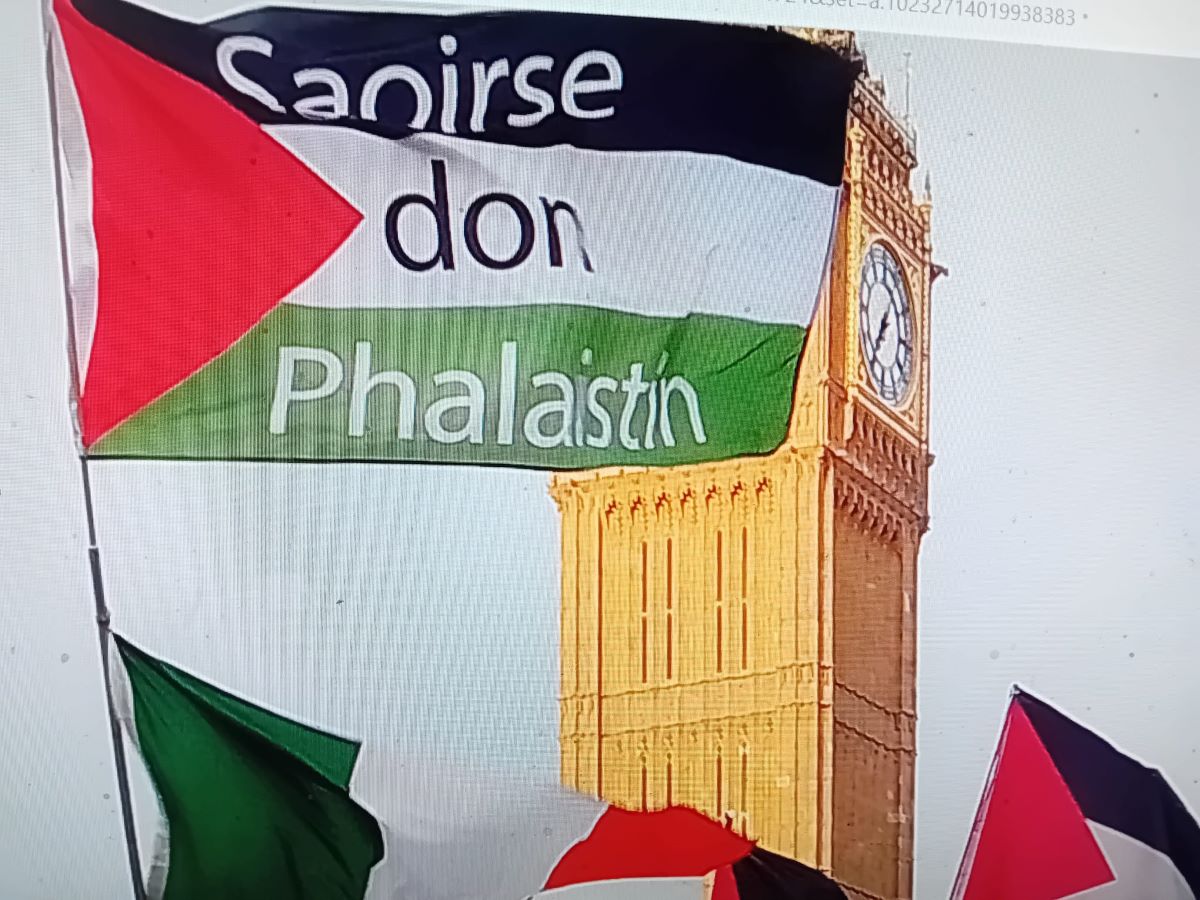
The linkage was hinted in his broadcast report though he was careful enough not to report a direct link as the Irish group in Trafalgar Square had in fact no connection with the Dublin group. The reporter asked how to pronounce ‘Saoirse Don Phalaistín’ — but still got it wrong in his report.
One of the Irish contingent spoke to the young GB News journalist: He had the stuff from Dublin on his phone and wanted to say that the Irish in the Square were part of the Dublin group.
“Next thing you’d know the Zionists would call for a ban on the Irish for ‘supporting Hamas’”,5 commented one of the veteran Irish activists. “We also get targeted because of the flag and our placards.”
The UK State and the police are all pro-Zionist and the Zionist press tries to trap the Irish into dangerous statements but “We know our history and are well able for them; we just say we support Palestinian resistance to Israeli occupation just as we did with the British in Ireland.”
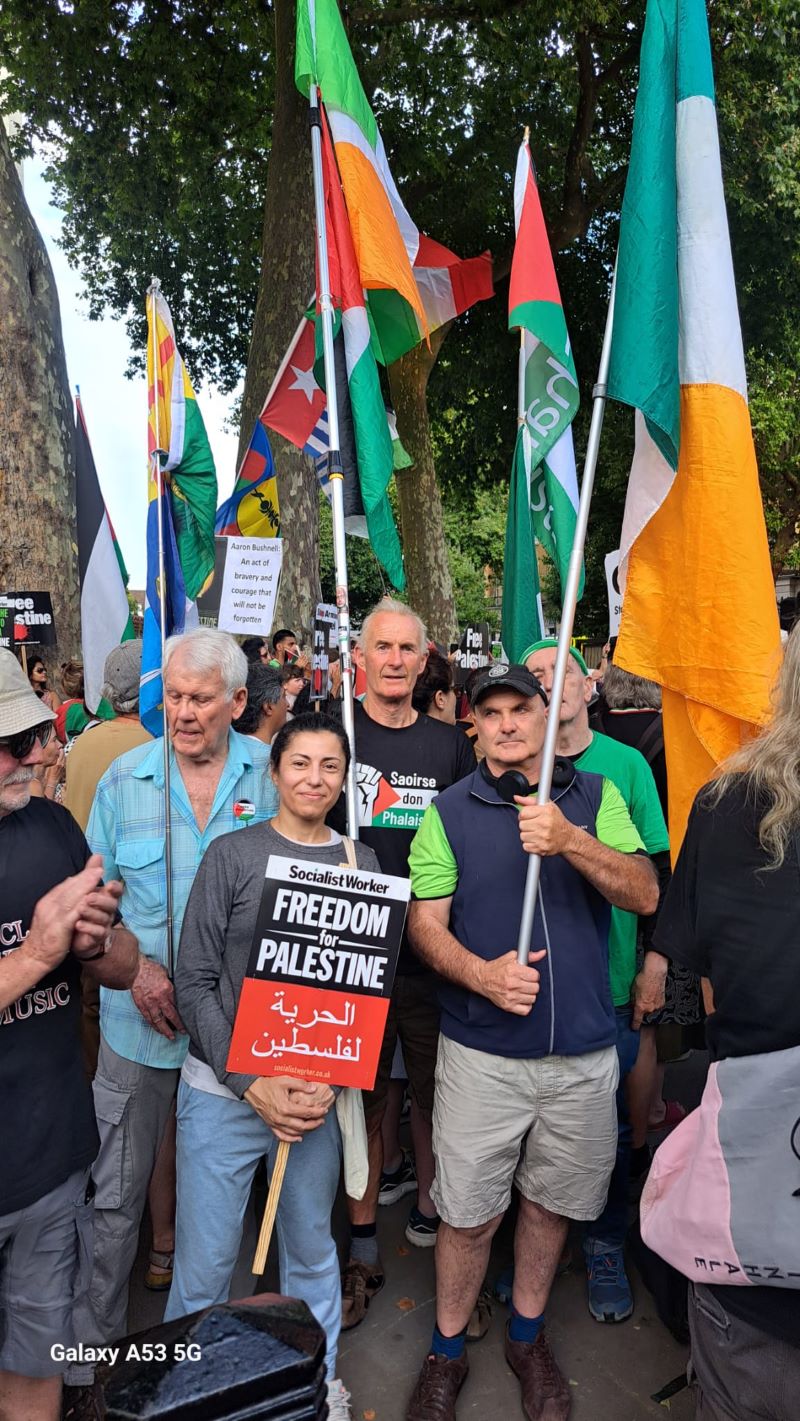
The Irish Tricolours, often in the company of the Palestinian national flag with Saoirse Don Phalaistín printed on it have been seen on Palestine solidarity marches in London since the current Zionist genocide began but also on anti-fascist rallies and in support of Julian Assange.
This is in keeping with the history and tradition of the Irish in Britain who helped found the republican United Englishmen6, the Chartists,7 many trade unions, a section of the First International8 and also gave the British working class their anthem9 and their classic novel.10

In later times they were prominent in organising solidarity with Vietnam and of course Ireland, against repressive legislation and fascist organisations, solidarity with Nicaragua, Palestine etc. and in struggles against state repression, including within the jails.
The Prevention of Terrorism Act (1974), forerunner of the current Terrorism Act (2000) specifically targeted the Irish community in Britain with suspension of habeas corpus for a period of up to five days, refusal of access to solicitor, as did also the framing of a score of people.
In the midst of the Irish Hunger Strikes of 1981, the Irish community broke out of the State terror stranglehold and formed the Irish in Britain Representation Group, among its objectives being the abolition of the Labour Government-introduced Prevention of Terrorism Act.
End.
NOTE ON AUTHORS
Pat Reynolds is a former trade unionist, social worker, a veteran anti-racist, anti-fascist activist, also for Irish independence and for rights for the Irish community in Britain. He was PRO for the Irish in Britain Representation Group for two decades, founding the Haringey Branch and the Green Ink Bookshop. Reynolds is from Granard in Co. Longford and lives in London.
Diarmuid Breatnach is a former trade unionist, worker with homeless/ substance misusers (manual worker before that), also a veteran anti-racist, anti-fascist activist and campaigner for Irish independence. For a decade he was on the Ard-Choiste of the IBRG, founder of the Lewisham Branch and of the Lewisham Irish Centre. Breatnach is from Dublin to which he has returned to settle.
FOOTNOTES
1The British Union of Fascists led by Sir Oswald Moseley which had substantial support in the British elite, including the publisher of the The Daily Mail with police attacks on anti-fascists.
2The Billy Boys were founded and led by Billy Fullerton, a former member of the British Fascists. Fullerton also later became a member of the British Union of Fascists in the 1930s. The Billy Boys adopted a militaristic style of behaviour, marching on parades, forming their own bands, composing their own songs and music, and all dressed in a similar manner.[3] The Billy Boys also formed a junior group whose members were teenagers called the Derry Boys. (Wikipedia)
3From Trafalgar Square to the Houses of Parliament in Westminster runs a broad thoroughfare, in the centre of which is the Cenotaph and a little further, the entrance to Downing Street.
4The organisation/ campaign was founded by Betty Williams and Mairead Corrigan in 1976 after a car driven by an IRA fighter mortally wounded by British soldiers in Belfast crashed into pedestrians and mortally wounded three children of Anne Maguire, sister of Mairead. Branding itself as against all violence the Peace Women in fact targeted primarily the Republican movement, secondarily the Loyalist paramilitaries and hardly ever the Occupation Army. Williams accused the IRA unit of having fired on the Army unit that killed the driver which was untrue (but is repeated on her Wikipedia entry). Both founders received the Nobel Peace Prize in 1976 and a substantial cash prize. Williams resigned from the group in 1980 and disappeared from Irish-related activities though prominent externally. Corrigan however remained politically active in Ireland and elsewhere against war and has campaigned among other things for the end of the ‘Israeli’ siege on Gaza, being arrested with crew and passengers on the Spirit of Humanity aid ship in 2009 by by the Zionist navy, taken to ‘Israel’ and subsequently deported.
5Hamas is proscribed organisation in the UK since March 2001 and a person promoting it would be liable to prosecution under the Terrorism Act.
6A spin-off from the United Irishmen in Ireland; the English chapter led the Spithead and Nore naval mutinies. The Irish also reformed the United Scotsmen when it was faltering.
7Karl Marx called the Chartists “the true mass movement of the working class” – two of its principal leaders, Bronterre O’Brien and Fergus O’Connor were Irish, as their surnames would suggest.
8The Fenians were accepted into the First International Workingmen’s Association.
9The lyrics of The Red Flag were composed by Jim Connell from near Kells, Co. Meath and set to the brisk air of The White Cockade, later changed to the mournful air of Tannebaum.
10The Ragged-Trousered Philanthropists was written by Robert Tressell (real name Robert Noonan) from Dublin.
SOURCES & FURTHER READING




 rebelbreeze