EPIC LEBANESE RESISTANCE TARGETS INVADING COMMANDERS?

Diarmuid Breatnach

(Reading time: 3 mins.)

The operations of Hizbollah in defence of South Lebanon against the IOF, the most powerful military power in the region, have been epic enough. But now the ‘Israeli’ military fear their commanders are being specifically targeted by the Resistance.1

It may be unlucky coincidence that two commanders have been seriously wounded and one killed in a matter of weeks but the High Command of the Zionist army don’t think so, according to media in the Zionist entity, speculating instead ofn high level Hizbollah intelligence to target IOF commanders.

On Saturday/ Sunday night the Deputy Commander of the Commando Brigade’s Maglan unit was among 13 IOF injured by a Resistance drone strike and one killed.2 On Friday Lt. Colonel Dor Gedalia Ben Simhon, commander of the 52nd Battalion of the 401st Armored Brigade, was killed.3

Three members of Ben Simhon’s crew were killed with him after their tank was struck during operations near Kfar Tebnit in South Lebanon. The 52nd Battalion is the unit implicated in the killing of 6-year-old Hind Rajab while she called for help after the killing of six family members.4

Northern Command’s Major-General Rafi Milo had a very lucky escape when his car was hit by an explosive drone minutes after he had left it in South Lebanon.5

Of course, assassinations are and have been a regular part of the offensive package of the IOF – not only assassination of military leaders but also civilian administrators, technicians, first responders, news reporters, writers, artists and poets. But the IOF are unaccustomed to being paid in kind.

It won’t be in kind from Hizbollah, for the Lebanese Resistance is hitting tanks, armoured troop carriers, military personnel and, when they killed an ‘Israeli’ civilian and injured his son, the man was driving an earth remover for the military, demolishing South Lebanese homes not yet bombed level.6

Hizbollah has been carrying out around 30 operations a day against the invading IOF, employing rockets, guided missiles and drones but also IEDs, RPGs and small arms fire. Hardly a day passed without their drones striking at least one Merkava tank, a Namer troop carrier and an earth-moving machine.7

Despite failing militarily, the IOF have killed at least 4,192 people (mostly civilians) in Lebanon since the current round of hostilities began, and displaced more than 1.2 million people, reports the Lebanese health ministry, as the IOF applies its Gaza destruction plan to South Lebanon.

According to a UN report, the IOF completely destroyed 11,095 buildings, affecting 17,891 housing units, while 2,242 buildings were partially damaged, equivalent to 5,219 housing units. The report also revealed that 9,311 buildings sustained minor damage, equivalent to 18,282 housing units.8
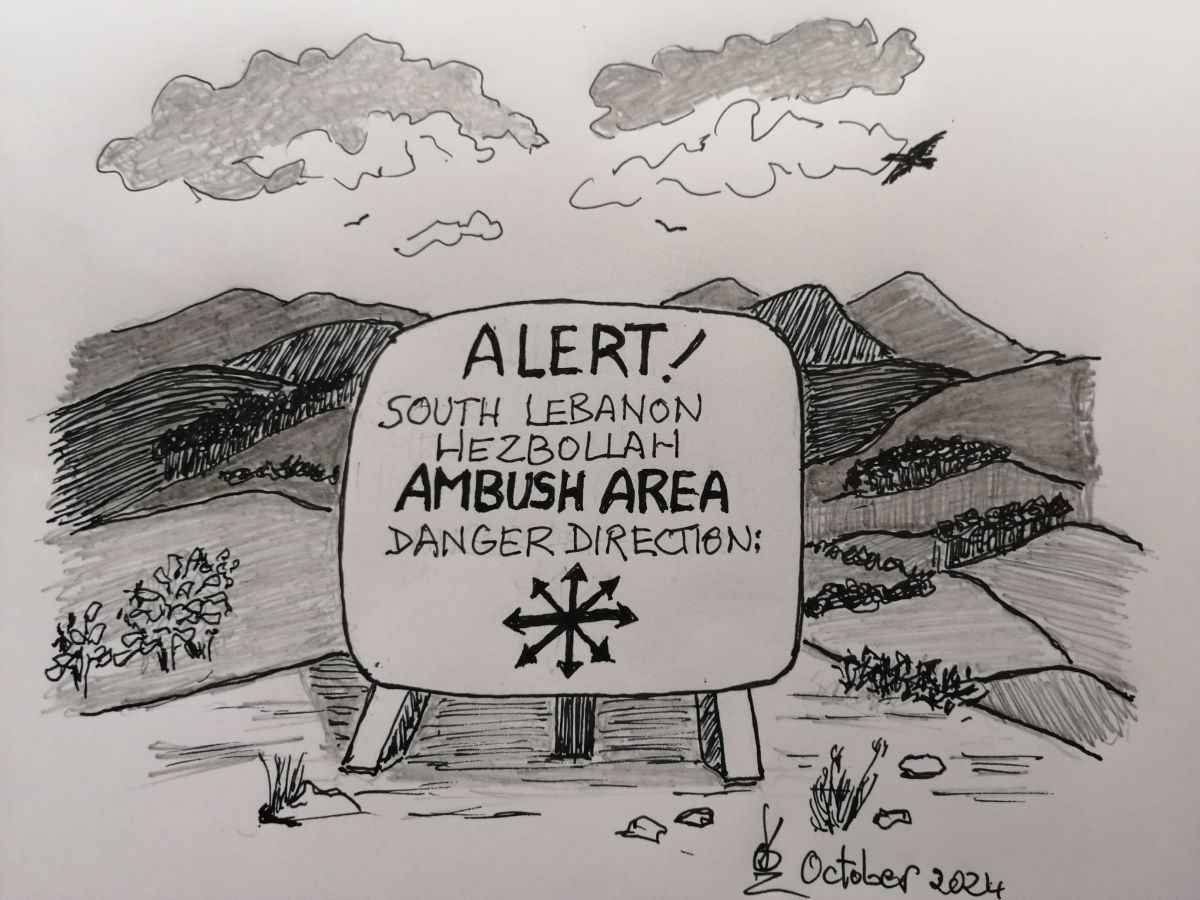
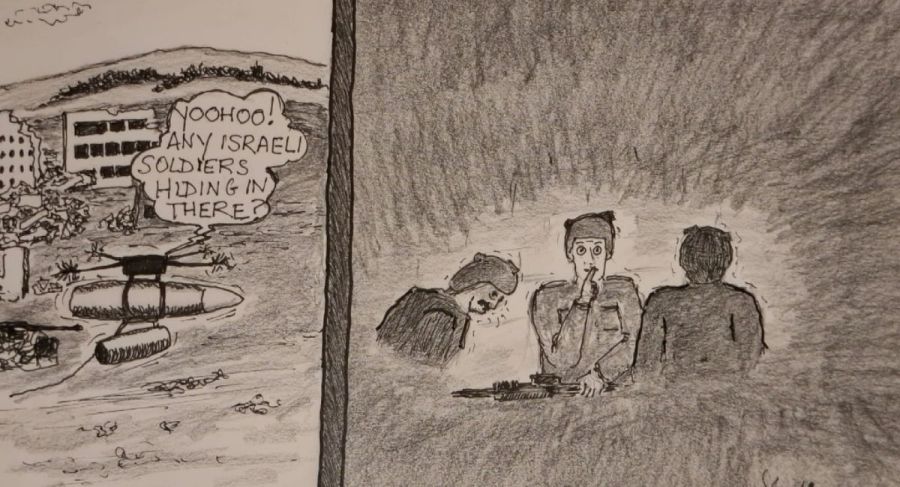
D.Breatnach cartoon drawn prior to the 2026 resurgence of February, during previous IOF invasion of South Lebanon, prior to the ‘exploding pagers’ and assassination of Nasrallah

Career progression from entry to NCO ranks in the IOF is largely based on service length rather than merit and for commanders, also based on meeting the requirements of command training school, so it is not easy for them to replace commanders injured or killed in battle.

The greatest damage perhaps will be to the IOF’s morale, already at far from optimum level.8 Personnel know that they will be required to remain on active service longer than normal and that they are outmatched on a level field, while currently the Haredim9 are exempted from service.10

Typically the IOF retreat quickly from contact with the Resistance and call for shelling or bombing but now Hizbollah’s mortars and rockets can bombard them too and thoughts of small explosive-carrying quadcopters appearing out of nowhere to hunt them down is really scaring them.

In some cases an explosive drone has followed running IOF into buildings, in one case into an IOF operations room. A drone targeting a covered IOF Humvee filmed two leaping out the back without attempting to shoot it down, leaving it to explode against the rest in back and against cab at front.

And what if the Resistance really can track commanders in the battle area, determine where they are and strike them down? IOF soldiers will be uncertain and nervous without leaders, (feelings which might be even worse if they are required to spend time close to possibly targeted commanders!).
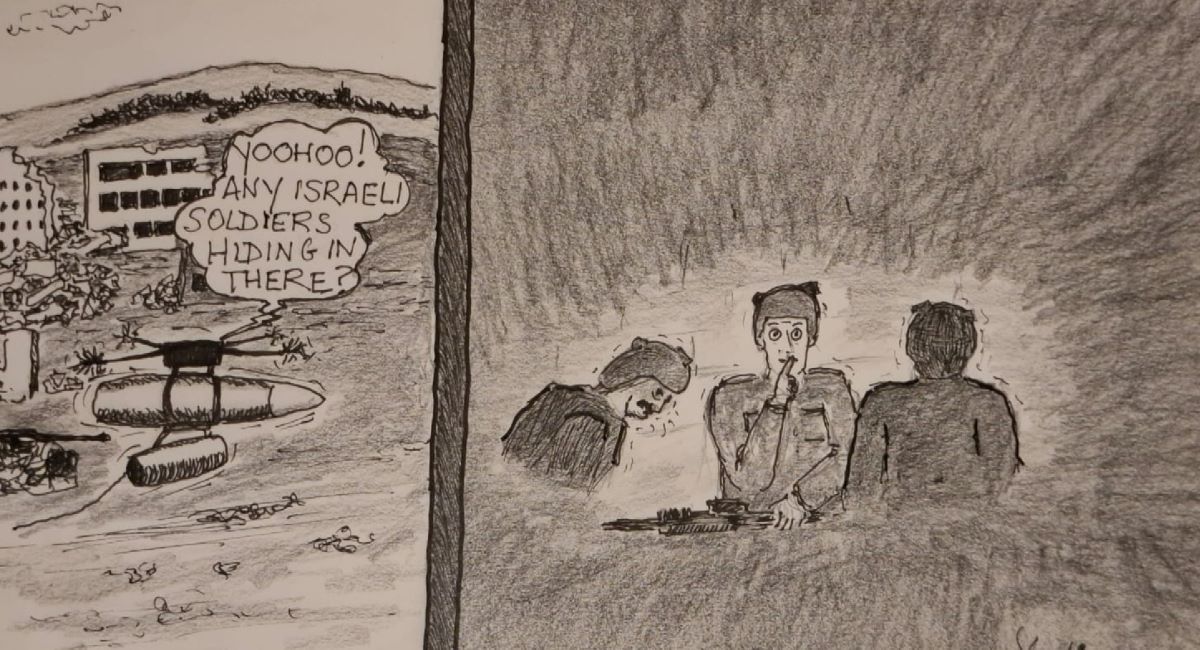
D.Breatnach cartoon, June 2026

Zionist fragmentation is breaking out inside the Zionist entity with some arguing that the IOF should bomb Beirut, others claiming that the IOF is being held back from effective action in South Lebanon and a third group claiming that the IOF should retreat from Lebanon completely.

And hostility towards what Vice President Vance called their “only powerful ally” and sole superpower in the world currently sympathetic to the Israeli state, has grown hugely among the Zionists as they perceive the US-Iran agreement under current negotiation as shattering their military and expansion illusions.

End.

Note: If you found this article of interest, why not register with Rebel Breeze for free, so that you will be notified by email of subsequent articles. You can de-register any time you wish.

Footnotes:

1https://www.jpost.com/israel-news/article-900206

2https://www.jpost.com/israel-news/article-899975

3https://english.almayadeen.net/news/politics/hezbollah-attack-kills-israeli-soldier–wounds-13-commando-t

4On January 29 2024 – Two paramedics who set out to save her were also killed by the IOF unit.

5https://www.jpost.com/israel-news/article-900206

6https://www.haaretz.com/israel-news/israel-security/2026-04-28/ty-article/civilian-contractor-working-for-defense-ministry-killed-in-southern-lebanon/0000019d-d5ca-d9f6-a1dd-ddca943a0000

7https://militarywatchmagazine.com/article/israel-largest-tank-losses-40yrs-ambushes-21-merkava

8https://www.aa.com.tr/en/middle-east/lebanon-building-damage-in-israeli-attacks-estimated-at-138b/3974843

9https://www.middleeasteye.net/news/israeli-army-calls-reserves-amid-fears-low-turnout-and-lower-morale

10Fundamentalist Orthodox ‘Israeli’ sect who have been exempt from employment and military conscription, though including 10% of ‘Israel’s’ military age males. Their political representatives are part of Netanyahu’s coalition but are calling now for dissolving the Government and new elections, after other parts of the coalition passed an ordinance removing the Haredim exemption from conscription..

11https://www.jpost.com/israel-news/article-880294

Sources:

Targeting IOF commanders: https://www.jpost.com/israel-news/article-900206

IOF looting homes in Lebanon: https://www.haaretz.com/israel-news/israel-security/2026-05-20/ty-article-magazine/.premium/it-was-okay-to-be-crazy-idf-soldiers-discuss-moral-decay-in-lebanon/

Declining IOF morale: https://www.middleeasteye.net/news/israeli-army-calls-reserves-amid-fears-low-turnout-and-lower-morale

https://militarywatchmagazine.com/article/israel-largest-tank-losses-40yrs-ambushes-21-merkava
MOROCCO OCCUPATION USING DRONES AGAINST SAHARAWI RESISTANCE

POLISARIO FIGHTER WOUNDED IN DRONE-GUIDED ATTACK

JAIRO VARGAS MARTÍN@JAIROEXTRE

(Reading time: 3 mins.)

SPECIAL REPORT FROM THE SAHARAWI REFUGEE CAMPS IN TINDUF (ALGERIA)

(Report in https://www.publico.es/internacional/drones-marroquies-combatiente-saharaui-herido-guerras-marruecos-me-ataco-dron-gran-diferencia.html translated by D.Breatnach)

Mohamed Fadel states that he was seriously injured last April by a Moroccan drone, during the same action in which the head of the Saharawi National Guard was killed. Morocco is silent on the use of these unmanned devices that have become the obsession of the Polisario Front troops.

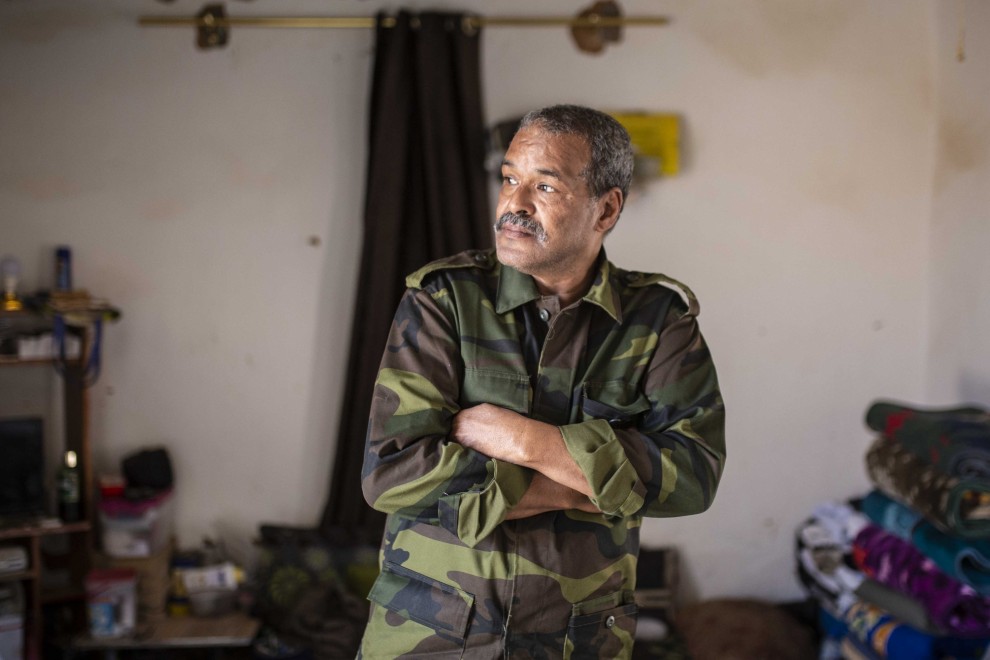
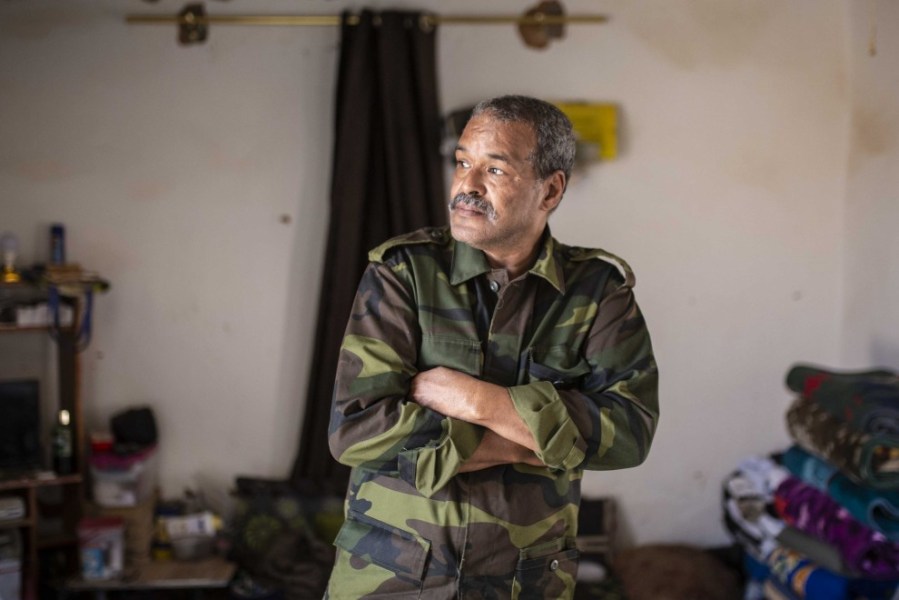
Mohamed Fadel, ‘Mundi’, in a tent in the Saharawi refugee camp of Bojador, in Tindouf, Algeria, on October 15.

Mohamed Fadel can say that he has firsthand experience of the changes between the two wars against Morocco in which he was wounded. The first was in 1985, when a shell fragment hit him in the arm. But he recovered and returned to the front in no time. The second time was the recent April one and “it was more serious,” he says, showing the marks on his body under his military jacket.

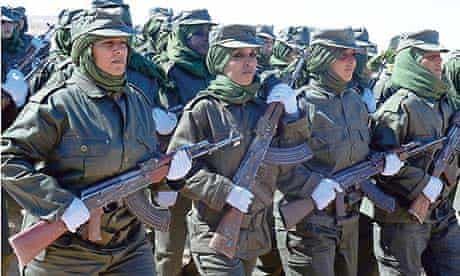
Polisario female fighters (Photo cred: Dominique Faget/ Getty)

Burns to his face, hands and arms, two scars the size of a coin on his right side and an incision of more than a foot long across the middle of his belly. “They had to open me up to remove the three pieces of shrapnel that I had inside. It took me three months to fully recover,” he explains in perfect Spanish. “It was a drone attack. That is now the big difference,” insists this seasoned 64-year-old Saharawi fighter.

But Mundi, as everyone knows him in the refugee camps in Tindouf, Algeria, does not like to talk about two different wars. This, he says, the one that the Polisario Front declared on November 13 after 30 years of ceasefire, “is just a continuation of the previous one”, the one that began in 1975, after the military occupation of the former Spanish Sahara by part of Morocco. “The enemy is the same and the objective is the same: the referendum that has not been held and the independence of the Sahara. The only things that have changed are the means, the technology,” explains the Saharawi fighter, in the shade of a tent in the Bojador refugee camp.

“They are neither seen nor heard, but they are there and attack at any moment”

Moroccan drones are the worst nightmare in this new stage of hostilities, according to all the Sahrawi fighters interviewed by Público during the Polisario-organized trip to the camps last week.

“They are neither seen nor heard, but they are there and attack at any moment,” insists Mundi, although at the moment they have not shown any documentary evidence certifying the presence of armed or surveillance drones. The two parties accuse each other of using them, although both deny it, according to the latest report on this conflict by the UN Secretary General, Antonio Guterres.

Saharawi women living in Gastheiz (San Sebastian) in the south-west Basque Country demonstrate in solidarity with their people’s struggle and the Polisario Front (“askatu” = “free”) in May 2020. (Photo source: Internet)

An almost paranoid obsession

After each Sahrawi attack against the defensive Wall built by Morocco, all eyes are on the sky. Drones feel close almost always, even if they are not there, like an almost paranoid obsession. One of the main military directives of the Polisario is to stay away from cars when they halt, because they are their main target. When they believe that a drone is following behind, the old Sahrawi vehicles separate, stop and the unit that was on board runs away.

Morocco has embraced the purchase of Turkish-made armed drones, according to ‘Reuters’

These unmanned devices make up much of modern warfare and have been instrumental in recent conflicts. One of the most recent, for example, was the capture by Azerbaijani troops of Nagorno Karabakh last year. They defeated the Armenians thanks to Turkish-made drones, deploying practically no soldiers to the front, recalls the arms trade expert Tica Font, from the Delàs Center for Peace Studies.

Font emphasizes that Turkey, Azerbaijan’s main ally in the conflict, is one of the few countries that manufacture and sell drones capable of loading and firing missiles, along with the United States, Rabat’s main military supplier, followed by France and Spain.

Indeed, as Reuters recently revealed, Turkey has expanded the sale of armed drones to Morocco. Specifically, several sources cited by the British agency speak of purchase requests from Rabat of the Bayraktar TB2 model, of which they would have already received a first batch ordered in May.

The Moroccan Army attack on the protest camp at Guergat on 13 Nov. 2020 which sparked the long-delayed renewal of Polisario armed struggle (Photo source: Internet)

As we moved away, a drone followed us

Although that was two months after the attack Mundi is talking about. According to him, the bombing that wounded him was on April 11. “In broad daylight, at four in the afternoon. We were near the Wall, we had just carried out an operation against a Moroccan base and they responded. First with artillery and, later, when we were moving away, a drone followed us,” he described.

His vehicle stopped and his three companions followed the rules of dispersing, but Mundi had no time to get to safety. “The missile landed very close to the car and I was level with the front wheel,” he recalls. He claims that that afternoon he was able to see one of the aircraft in the air, although he did not see it fire. He believes there had to be more than one, “because eight or nine missiles were launched, and that cannot be carried by a single drone,” he maintained.

Mohamed Fadel ‘Mundi’, wounded Saharawi Fighter photographed in Saharawi refugee camp, Tinduf, Algeria 15 Oct 2021 (Photo cred: Jairo Vargas)

In that Moroccan bombardment, Mundi explained, the esteemed head of the Saharawi National Guard, Adah el Bendir, 61, a noted military strategist expert in engineering and combat, died. The Polisario announced the important loss. Morocco, for its part, opted for its most effective tactic since the resumption of hostilities: silence and indifference. Only the Alawite news portal Le Desk reported that an Israeli-made Harfang model drone had participated in the attack on El Bendir. Morocco did not even want to claim a goal in a war that does not exist for Rabat.

However, the Delàs Center expert warned that most of the marketed drones are for surveillance and monitoring, and that they do not need to carry weapons to attack a target. “Many have all kinds of built-in radar and sensors that send information to a central computer. With that data, you can open fire with precision from any platform, be it a ship, an aircraft or a ground unit. Tens of kilometers from the target” says Font.

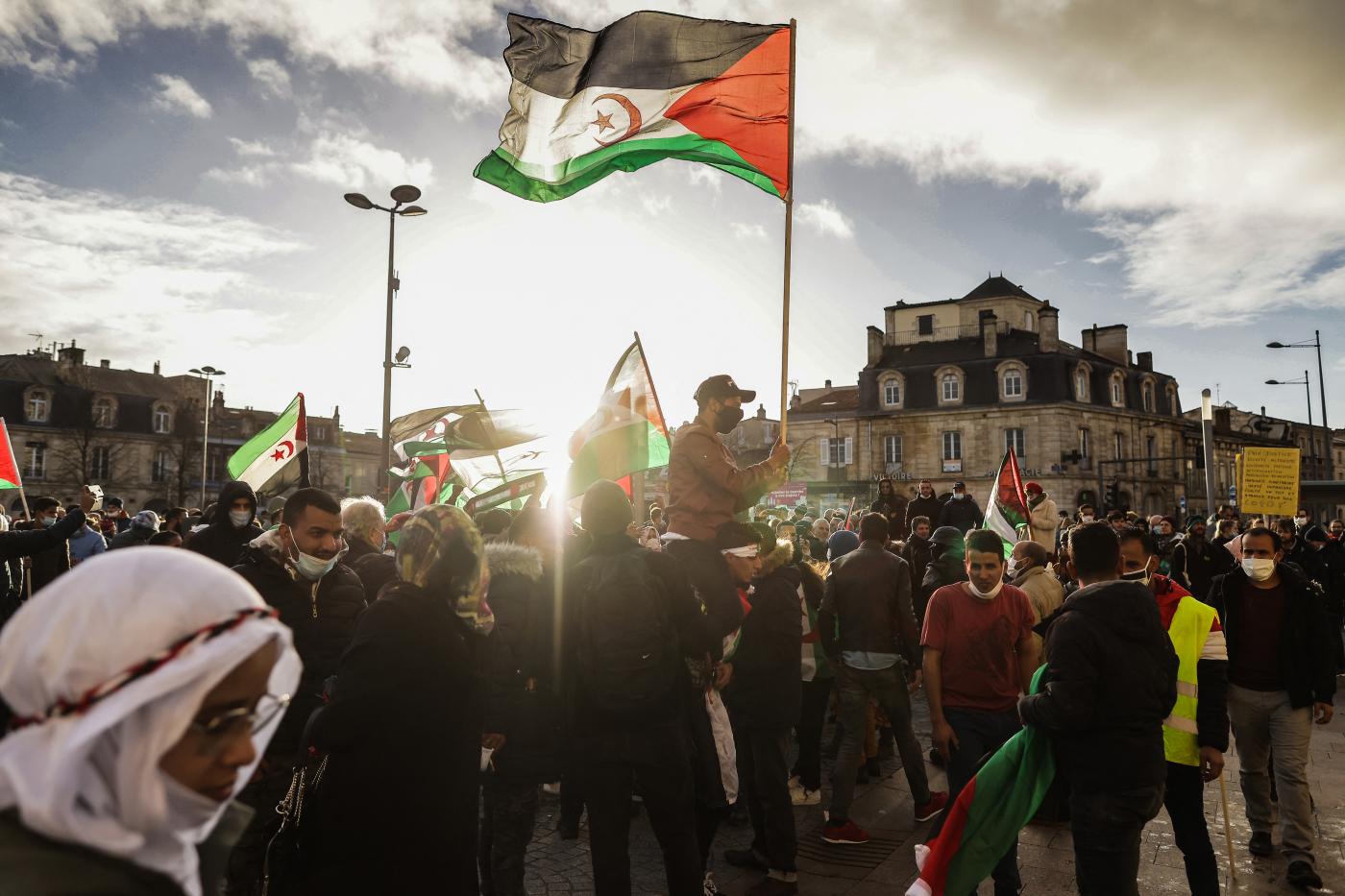
Saharawi struggle supporters in Bordeaux, France on 11 December 2020 (AFP). France is a Permanent Member of the UN Security Council and is the main European state supporting Morocco.

That’s Le Desk‘s version of the attack in which Mundi was wounded and El Bendir killed. According to this Moroccan portal, the drone laser marked the target and an F-16 fighter launched the projectiles.

“They do not scare us, because with fear nothing is done in war. But there is a lot of uncertainty, a lot of anxiety and tension,” he affirms after 46 years as a soldier in the Saharawi people’s army.

Mundi is confident that sooner or later they will find the formula to detect and demolish the Moroccan aircraft. “We learned to fight them when they raised the wall, we learned to shoot down their planes and we learned to capture their armour,” he says. “We are still starting. At the moment we are using a tactic of attrition. We attacked bases and retreated. In the 80s we also started that way when they built the wall. Until 1984 we did not carry out large-scale attacks. War has its times,” he says. This one has already lasted more than 40 years.

End.

USEFUL LINKS

SOLIDARITY

Western Sahara Action Ireland: https://www.facebook.com/groups/256377861125569/?

Algargarat Media

OTHER MEDIA ARTICLES

Youth yearning for independence fuel Western Sahara clashes: https://apnews.com/article/middle-east-africa-united-nations-algeria-morocco-507429fe13915902668f589179ce0c67?

https://www.mondaq.com/human-rights/1021716/war-resumes-in-occupied-western-sahara-an-interview-with-polisario-representative-kamal-fadel

https://www.euronews.com/2020/11/17/sahrawi-arab-democratic-republic-declares-war-on-morocco-over-western-sahara-region

https://www.middleeasteye.net/news/morocco-western-sahara-european-court-annuls-eu-deals