Basque actress Clara Galle, criticised for not wearing a bra under her t-shirt at Basque team Osasuna’s football ground, kicks the ball back to score. “You have learned nothing,” she adds.
From Publico.es 09/26/2023Translation by D.Breatnach (Reading time:2 mins.)
The Navarrese actress Clara Galle went to Osasuna’s stadium, El Sadar, last weekend. As a famous fan of theirs, the club decided to honour her with a reception before the match against Sevilla. Luis Sabalza, president of Club Atlético Osasuna, gave her a t-shirt with her name on the back.
Actress Clara Galle photographed while watching her team play Sevilla at El Sadar, Osasuna’s stadium.
The visit was eagerly showcased on the official accounts of X and the club’s Instagram. However, as is often the case, the photos in which the outlines of her nipples were visible due to the absence of a bra triggered a multitude of sexist comments.
The actress, far from remaining silent, decided to respond forcefully with a comment on Instagram: “I’ve been going to El Sadar to see my team since I was a little girl … Given the comments I’ve read, I feel that I have to react.
“When I was getting dressed before arriving at the field, it didn’t occur to me that my nipples were to be such a topic of conversation,” she said. “If you notice them, it’s because I have them. I have never seen this kind of hullabaloo when any player from any team takes off his shirt on the field,” she added.
Osasuna’s president presents actress Clara Galle with a club t-shirt with her name on the back.
“I have a clear conscience, I’m not doing anything wrong by not wearing a bra.
“It doesn’t bother me that they say that I was wearing the two points that they didn’t win, it bothers me that my breasts are the only topic, among so many more interesting ones in existence, that many choose to talk about”, she declared.
Gale ended with an urgent reminder after the controversy over Luis Rubiales’ kiss of Jenni Hermoso: “It seems that we have learned nothing in recent weeks,” the actress concluded.
COMMENT
Sexism and adolescent behaviour by male adults is oppressive to women and at least tiresome to everyone else. It is an unfortunate feature of many – perhaps all – countries but the Spanish state seems to have a particularly high share of it.
E. Conde NOTICIAS DE NAVARRA (translation by D.Breatnach)
Never could a coffee have been so bitter. This Wednesday the First Section of the Provincial Court of Navarra is to judge a Guardia Civil officer, belonging to the Citizen Security Unit of the Command of Navarra, accused by the Prosecutor’s Office and the private prosecution of the crime of illegal detention by a public official after he arrested a waitress at a gas station, with whom he argued because the coffee was not to his liking. They ask for him to be fined a sum of 2,160 euros and that he be disqualified for nine years from his post. In addition, they demand that he compensate the victim with 1,000 euros for moral damage.
The events occurred around 10:30 p.m. on July 27, 2019 when the defendant, a Guardia Civil since 2005, in command of a unit arrived with his colleague at the Acciona service station on the A-12, in the area of Legarda. There they went into the café and ordered some coffees. According to the Prosecutor’s Office, “since he did not like the coffee, he argued with the waitress and manager, who was serving the rest of the customers.”
Neither the complaint form nor her driver’s license was acceptable to him
He did not restrict himself to mere protest. He requested the complaint sheet, arguing with her to give it to him immediately. The defendant considered that said sheet was not the corresponding one and asked for her National ID and the woman gave him her driving license. The Guardia insisted that this sheet was not the correct one and considered her driving licence identification insufficient.
The waitress continued working, but the defendant called her, made her step outside away from where the customers could see what was happening and “with abuse of authority, telling her that she was disrespectful”, proceeded to arrest her at around 10:45 p.m. and to put her in the patrol car. She was taken to the Puente la Reina barracks, and handcuffed as a detainee. She was held until 2:00 am, when a statement was taken and she was released. As a result, the victim suffered from anxiety.
During the investigation of the case there was an attempt to resolve the matter by the criminal mediation procedure but as this was unsuccessful, it goes to trial. In principle, any possibility of agreement is ruled out since the officer, if convicted of said crime, would be disqualified from any similar job for a relevant period of time.
COMMENT
by Diarmuid Breatnach
The case is an extreme example of a common aspect of the Guardia Civil – arrogance, a sense of entitlement and impunity and lack of respect for issues of justice or ordinary people. Contempt and hostility towards socialists, LGBT and aspirations of the nations within the state are common too but, although this took place in Nafarroa, in one of the Basque regional autonomies, the report does not reveal whether this played a part.
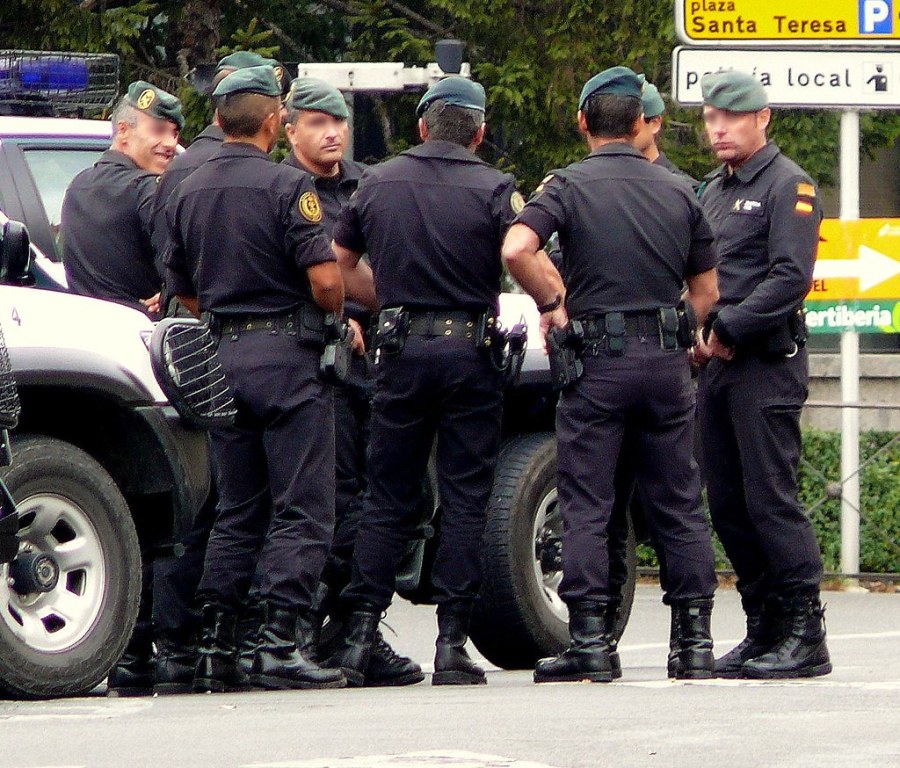
The Guardia Civil is one of two “national” police forces of the Spanish State and the oldest police force of the kingdom. It is a gendarmerie, an armed police force with military organisation and role in addition to a civil one, such as the Gendarmerie of the French state, Carabinieri of the Italian state and the Royal Irish Constabulary all over Ireland until 1921 and its remnant, the Police Force of Northern Ireland (British colony) today. The force is quartered in barracks for accommodation with police station facilities, cells etc.
GUARDIA CIVIL AND FASCISM
When the fascist-military coup was launched against the republican Popular Front Government of the Spanish state in 1936, the Guardia Civil split evenly between those who remained loyal to the Government and those who defected to the fascist-military, with those loyal becoming the Guardia Republicana. However, that percentage was in the lowest order of police force loyalty to the republican Government, with elected government loyalty in other police forces at around 70% of membership. After the defeat of the republican forces, the superior officer of the Guardia Republicana, General José Aranguren was tried by Francoist military court, sentenced to death and executed in Barcelona.
Often thought to be of Franco prisoners during the Civil War, in fact this photo is of prisoners of the Guardia Civil during the suppression of the Asturias Miners’ Strike in 1934 by General Franco during the right-wing period of the Republican Government, which was overturned in the 1936 elections of the Popular Front. (Photo sourced: Internet)
In the areas conquered by the fascist-military forces and in the whole state after the defeat of the republican forces, the Guardia Civil were one of the chief forces seeking out and rounding up former supporters of the republican Government along with communists, socialists, anarchists, republicans, Basque, Catalan and Galician nationalists. Most of the detainees were brought before military courts and either sentenced to death, to penal servitude or to heavy fines and confiscations of property. Some never made it to court, being summarily executed. Rapes were also recorded and infants of murdered parents were trafficked to fascist childless families.
In the nations that had shown wishes for independence or autonomy, such as Catalonia and the southern Basque Country (of which Navarre is a part), along with other areas where antifascist resistance had been strong such as some areas of Madrid, the Guardia Civil was a constant and visible force of surveillance and repression of the civil population in terms of culture, morality and politics.
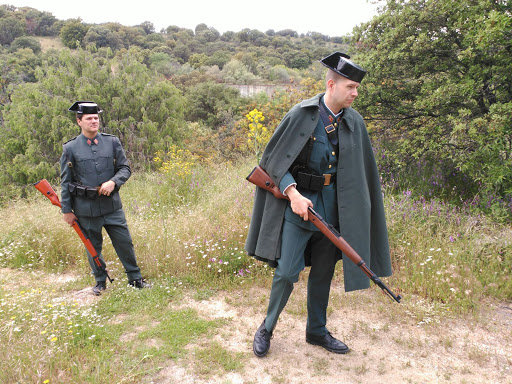
Guardia Civil searching country area during the later decades of the Franco regime. (Photo sourced: Internet)
During times of guerrilla conflict, the Guardia at times killed prisoners and routinely tortured detainees during interrogation (the Wikipedia entry says that they were accused of “heavy-handedness”!). Colonel Tejero of the Guardia Civil led 200 of that force in a failed attempted coup in 1981 which included an armed invasion of the Spanish Parliament. Several Guardia including very high-ranking officers were convicted of organising the fascist murder squads of the 1980s (GAL etc) run by the Spanish PSOE Government.
The Guardia until recently was the primary police force acting against the Basque national resistance and numerous of their detainees over decades have testified to being tortured, humiliated (including sexually) and threatened almost immediately after arrest, during their transportation by the Guardia to the force’s barracks in Madrid, where the torture etc continued up to the five days incommunicado detention permitted under Spanish State “anti-terrorist” legislation. The treatment usually produced “confessions” which were then used to secure a conviction and long prison sentence. The European Court of Human Rights has a number of times found the Spanish State guilty of not investigating allegations of torture by detainees and a number of human rights organisations such as Amnesty International have condemned the impunity of the torturers.
Guardia Civil in action in Catalonia during the Referendum on independence there on 1st October 2017. (Photo sourced: Internet)
The Guardia Civil frequently break up demonstrations and in 2017 both they and the Policía Nacional invaded Catalonia in force, the Guardia Civil seizing ballot boxes in the Catalonia Independence Referendum and beating voters and people protesting their actions (also firing rubber bullets which are banned by the regional Government).
Since 2020, actions against Basque and Catalan independence campaigners have been carried out mostly by their autonomous regional police forces (Ertzaintza and Forales in the Basque autonomous regions and Mossos d’Escuadra in Catalonia) but, if charged with “terrorism” or “security crimes”, detainees were delivered to the Guardia Civil who then took them to Madrid for interrogation.




 rebelbreeze