Campaigners fighting for the release of individuals or of small groups of prisoners do not usually make the case that the release of those specific prisoners will affect the macro issues which led to their activism and encarceration. This has occurred on a number of occasions, however, those of Nelson Mandela in South Africa, the Kurdish PKK leader Ocalan and Basque movement leader Arnaldo Otegi being cases in point.
However, when the numbers of prisoners is large, their release is often connected by the campaigners to the objective of resolution of the conflict.
The line often taken is that “the prisoners are (or should be) a part of the resolution of the conflict” or that “release of prisoners is necessary to create goodwill” or “to win support for the resolution process”. These lines emerged here in Ireland, in Palestine, South Africa and in the Basque Country; they form part of a popular misconception, all the more dangerous because of its widespread acceptance and seductiveness.
At first glance this kind of line seems reasonable. Of course the political activists and the prisoners’ relatives, not to mention the prisoners themselves, want to see the prisoners home and out of the clutches of the enemy. The prisoners should never have been put in jail in the first place. And all the time they have been in the jail has been hard on them and especially on their relatives and friends. An end to the conflict is desirable and so is the release of the prisoners.
But let us examine the proposition more carefully. What is it that the conflict was about? In the case of the recent 30 years’ war with Britain, it was about Britain’s occupation of a part of Ireland, the partition of the country and the whole range of repressive measures the colonial power took to continue that occupation. In the case of the Basque pro-Independence movement, it was also about the partition of their country, occupation and repressive measures (particularly by the Spanish state). But what was the fundamental cause? In each case, occupation by a foreign state.
OK, so if Britain and the Spanish state ended their occupations, that would end the conflicts, would it not? It would end the anti-colonial conflicts – there would be no British or Spanish state forces for Irish or Basque national liberation forces to be fighting; no British or Spanish colonial administration to be issuing instructions and implementing repressive measures. Other struggles may arise but that is a different issue.
So, if Britain and the Spanish state pull out, leave, those struggles are over. What do prisoners have to do with it? They are obviously in that case not part of the solution, which is British or Spanish state withdrawal – though their release should be one of the many results of that withdrawal. Prisoners may well be part of rebuilding a post-conflict nation but that is a different issue. They are not part of “the solution”.
PART OF THE PACIFICATION
As pointed out earlier, here in Ireland it was said that “the prisoners are part of the solution” – and most of the Republican movement, some revolutionary socialists and some social democrats agreed with that. And British imperialism and most of Irish capitalism agreed too. But what happened? Only those Republican prisoners who agreed with the abandoning of armed struggle and signed to that effect were released. And they were released ‘under licence’, i.e. an undertaking to “behave” in future. And as the years went by, a number of those ex-prisoners who continued to be active —mostly politically — against the occupation, or against aspects of it like colonial policing, had their licences withdrawn and were locked up. Some who had avoided being prisoners because they were “on the run”, or had escaped – many of those, as part of the Good Friday Agreement, had been given guarantees of safety from future arrest but this too, it soon became apparent, could be revoked.
In other words, the prisoners’ issue became part of imperialism’s ‘peace’ or, to put it more bluntly but accurately, part of imperialism’s pacification. The issue also became part of the selling of the deal within the movement, on one occasion prisoners being released early, just in time to make a grand entrance at a Republican party’s annual congress.
The release of prisoners can be presented by those in the movement supporting pacification as evidence of the “gains” of the process. Those who argue for the continuation of the struggle then find themselves arguing not only against those who pushed the pacification process within the movement but also against some released prisoners and their relatives and friends.
THEY ARE NOT LEAVING
And prisoners continued to be hostages for the “good behaviour” of the movement. If British imperialism had left, there would have been no cause for the anti-colonial struggle to continue – so why would there be any need for any kind of release ‘under licence’ or any other kind of conditional release? Besides, the British would not be running the prisons in the Six Counties any longer. But the British are not leaving, which is why they need the guarantees of good behaviour.
Suppose the British were serious about leaving, sat down with the resistance movement’s negotiators and most details had been sorted out, including their leaving date in a few weeks’ time say, what would be the point for the British in trying to hang on to the prisoners? Can anyone seriously believe that they would take them with them as they left? If perhaps they had some in jails in Britain and were trying to be bloody-minded and hanging on to them there, well of course we’d want our negotiators to put as much pressure on the British as they could to release those as well. It would be in the interests of British imperialism to release them but the reality is that the anti-colonial war would be over, whatever ultimately happened to those prisoners.
In South Africa and Palestine, the prisoners’ issue became part of the imperialist pacification process too. It did not suit the imperialists to have numbers of fighters released who would be free to take up arms against them again. So in South Africa, they were incorporated into the “security forces” of the corrupt new ANC state, forces the corruption and brutality of which were soon experienced by any who argued with them or opposed the policies or corruption of the ANC, NUM and COSATU leadership – including the two-score striking miners the “security forces” murdered over a couple of days at Marikana in 2012.
In Palestine, the prisoners also became part of the “security forces” of Al Fatah after the shameful agreements at Madrid (1991) and Oslo (1993). The level of corruption of the Al Fatah regime and their “security forces” became so high that in order to oust them, in 2006 the largely secular Palestinian society voted for a religious party, the opposition Hamas. And then the “Palestinian security forces” took up arms against Hamas in order to deny them the fruits of their electoral victory. Unfortunately for them, Hamas had arms too and used them.
In both those countries, the occupiers had no intention of leaving and so it was necessary for them, as well as using the prisoners as bargaining chips, to tie them in to a “solution”. In fact, many of the prisoners became “enforcers” of the “solution” on to the people in their areas, i.e pacifiers in imperialism’s pacification process.
Teased out and examined in this way, we can see not only that the prisoners are NOT “part of the solution” but that accepting that they are plays right into the hands of the imperialists as well as facilitating their agents and followers within our movement, within our country.
Political prisoners, as a rule, are an important part of the struggle and need our solidarity. But for anti-imperialists, prisoners are not “part of the solution”, to be used as hostages for a deal with imperialism, even less as enforcers of a deal, forcing it upon the colonised people.
Our call, as anti-imperialists, without conditions or deals, is for the prisoners to be released and, while they remain in prison, to be treated humanely. We also call for them to be recognised as political prisoners. With regard to the solution to the conflict, there is only one: Get out of our country!
POSTSCRIPT:
The organisation representing relatives and friends of Basque political prisoners is Etxerat http://www.etxerat.info/. A separate organisation concentrating on campaigning, Herrira, has suffered a number of arrests and closure of offices by the Spanish state in 2013 and is under threat of outright banning.
Regrettably, I cannot give a similar link for Irish Republican prisoners, because of the existence of a number of organisations catering for different groups of prisoners and often with tensions between them. One day perhaps a united non-aligned campaign will emerge, along the lines of the H-Block campaign of the past, or the Irish Political Status Campaign that arose in London after the Good Friday Agreement. There is also a non-aligned Irish Anti-Internment Committee (of which I am a part), campaiging for an end to long periods of incarceration imposed on political “dissidents” through removal of licence, refusal of bail or imposition of oppressive bail conditions.
[Article by TOM, a contributor to Socialist Voice, newspaper of the Communist Party of Ireland and reprinted with their kind permission. In essence it agrees with the analysis of Mandela and South Africa given by Stephen Spencer and Diarmuid Breatnach in an article reviewing statements of the Irish Left and Republican movement following the death of Mandela — Rebel Breeze]
The presence of such friends of genuine democracy as the war criminals George W. Bush and Tony Blair, David Cameron, Bill Clinton and such right-wing media hangers-on as Sir Bob Geldof and Sir Paul Hewson (Bono) at Nelson Mandela’s funeral raises questions about the real content of the new South Africa that appeared in 1994, when the apartheid elite seemed to cede political power to the African National Congress.
Twenty years later, given the continuing racial inequality in present-day South Africa, the much lower life expectancy of blacks and their much higher rate of unemployment, the increased vulnerability of the country to world economic fluctuations and accelerated environmental decay during his presidency, did Mandela really change South Africa? And, if not, how much room had he to manoeuvre?
For many are still remembering the Mandela years as fundamentally different from today’s crony-capitalist, corruption-riddled, brutally securitised, eco-destructive and anti-egalitarian South Africa. But could it be that the seeds of the present were sown earlier, by Mandela and his associates in government?
Ending the apartheid regime was, undoubtedly, one of the greatest events of the past century. But, to achieve a peaceful transition, Mandela’s ANC allowed whites to keep the best land, the mines, manufacturing plants and financial institutions, and to export vast quantities of capital.
The ANC could have followed its own revolutionary programme, mobilising the people and all their enthusiasm, energy, and hard work, using a larger share of the economic surplus (through state-directed investments and higher taxes), and stopping the flow of capital abroad, including the repayment of illegitimate apartheid-era debt. The path chosen, however, was the neo-liberal one, with small reforms here and there to permit superficial claims to the sustaining of a “National Democratic Revolution.”
The critical decade was the 1990s, when Mandela was at the height of his power, having been released from jail in February 1990, taking the South African presidency in May 1994 and leaving office in June 1999. But it was in this period, according to the former minister for intelligence services Ronnie Kasrils, for twenty years a member of the Central Committee of the South African Communist Party, that “the battle for the soul of the African National Congress was lost to corporate power and influence . . . We readily accepted that devil’s pact and are damned in the process. It has bequeathed to our country an economy so tied in to the neo-liberal global formula and market fundamentalism that there is very little room to alleviate the dire plight of the masses of our people.”
Nelson Mandela’s South Africa fitted a pattern, that of former critics of old dictatorships—whether from right-wing or left-wing backgrounds—who transformed themselves into neo-liberal rulers in the 1980s and 90s: Alfonsín (Argentina), Aquino (Philippines), Arafat (Palestine), Aristide (Haïti), Bhutto (Pakistan), Chiluba (Zambia), Kim (South Korea), etc. The self-imposition of economic and development policies, because of the pressures of financial markets and the Washington-Geneva multilateral institutions, required insulation from genuine national aspirations—in short, an “elite transition.”
This policy insulation from mass opinion was achieved through the leadership of Mandela. It was justified by invoking “international competitiveness.” Obeisance to transnational corporations led to the Marikana Massacre in 2012 and the current disturbances on the platinum belt, for example. But the decision to reduce the room for manoeuvre was made as much by the local principals, such as Mandela, as it was by the Bretton Woods institutions, financiers, and investors.
Much of the blame, therefore, for the success of the South African counter-revolution must be laid at the door of the ANC leadership, with Nelson Mandela at its head. Hence the paeans of praise for the dead leader from the doyens of international reaction.
[TOM]
He was a friend of Ireland, it is true — I often heard him speak on Irish solidarity platforms in England. I don’t remember him supporting the hunger strikers in 1981, however. You may recall that Concannon, representing the Labour Party, visited the dying Bobby Sands to tell him that Labour would not support him or his comrades. In London, we marched to Benn’s house (VERY long, hot march) to get him to break with Labour on this but I don’t remember whether we were successful.
In the balance must also be put that when Secretary of State for Energy in a Labour Government, along with the rest of the Gvt, he conspired to break the embargo on apartheid South Africa by covertly selling them oil routed through Portuguese African colonies.
Someone referred to him as an “Ant-fascist fighter” — I don’t know about that. He served as a pilot in Rhodesia (now Zimbabwe) and South Africa during the war. Hundreds of thousands joined up during those years and many others were conscripted. His reasons for joining could have been any, whatever he may have said afterwards. He certainly didn’t fight fascists on the streets of Britain as some did, both before and after the War.
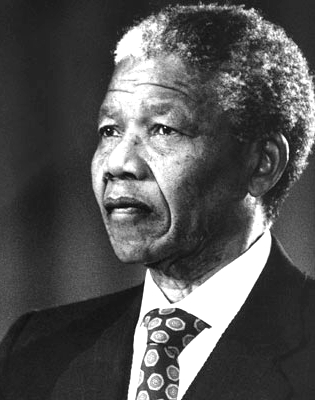
On 5th December 2013, Nelson Mandela died. This was a major event in South Africa and in many other parts of the world. His funeral was reportedly attended by representatives of 90 states, including those of major imperialist states such as the United States and the United Kingdom. In addition, many political organisations and some national liberation organisations were invited to attend, including representatives of the Dunne’s Stores anti-apartheid strikers of 1984-1987, perhaps the most significant non-military anti-apartheid solidarity action taken in any country.
Mandela had been an iconic figure during the South African liberation struggle, both inside and outside South Africa. He was not only an educated and eloquent speaker against the apartheid system but also a senior member of the African National Congress (ANC), the major political organisation opposing the white minority regime in South Africa, and also of the Central Committee of the South African Communist Party (SACP), as well as a founder of the armed national liberation group Umkhonto we Sizwe (‘Spear of the Nation’, generally known as MK), a guerilla group associated with the African National Congress. In 1964, along with nine others he was convicted of charges relating to ‘terrorism’ and sabotage and sentenced to life in jail. The UN Security Council had unanimously condemned the trial, showing that the main imperialist countries in the world were of the opinion that the SA state was wrong in the way it was handling the opposition (and probably thinking that it would encourage its overthrow in revolution).
Mandela was really launched as a practically household name and resistance icon in 1988, as anti-apartheid campaigners around the world sought to use the occasion of his 70th birthday and 26th year in prison as a focus against the SA regime. The “Mandela birthday concert” played to 15,000 people at Wembley Stadium in London and to hundreds of millions around the world in a live TV event, and to others in recorded screenings. Many famous pop and rock bands, singers, actors, comedy performers etc. contributed, with Tracy Chapman becoming famous on that event with her song “Talkin’ About a Revolution”.
That concert and other smaller ones, which were nevertheless huge events (a previous free one on London’s Clapham Common organised by Jerry Dammers, of ska band The Specials,had an estimated 200,000 in attendance), were adding to an international campaign for boycott (particularly in sport and in music), sanctions and divestment from South Africa; it had become an international pariah state.
In the 1980s, the South African white minority regime was under heavy pressure, with the internal resistance movement growing politically, in the communities and in the trade union movement. Wide-scale civil disobedience continued as part of the anti-apartheid movement inside South Africa; all of this despite police shootings, disappearances, torture, the jails being full and many of the anti-apartheid leaders being in jail too.
Recognising the vulnerability to revolution of the regime and of their investments, foreign banks were pressurising the SA regime to abandon apartheid and bring in universal suffrage. The United States, behind the scenes, was adding to that pressure.
Mandela had been moved from Robben Island prison in 1982 to the much better conditions of Pollsmoor prison, where he had regular discussion with operatives of the National Intelligence Service (NIS) of South Africa, and at some point with its leader Niel Barnard and with the latter’s Deputy Director General, Mike Louw. Almost certainly, initial approaches had been made earlier, perhaps even years earlier. At the same time, others began to have meetings with ANC leaders in exile.
Further meetings with Mandela took place, including with foreign representatives and with successive Presidents of South Africa. In 1990, the ANC was legalised and Mandela was released. In 1991 the National Peace Accords were signed and apartheid, as a legally-constituted measure, was abolished. There followed negotiations, as well as a number of crises including assassinations and communal massacres; but in 1994 the ANC took 64% of the vote in the South African national elections and formed the government.
By the time Mandela came out of jail, the ANC and MK were already riven with corruption, personality cults and dictatorial procedure. Some of MK’s training camps in other states bordering SA were run wholly or in part as concentration camps where internal critics of the way things were run, so-called MK ‘dissidents’, were tortured and at times killed. Mandela’s wife, Winnie, was in one ANC clique which had murdered at least one youth and eventually Mandela divorced her. But there were bigger cliques in the ANC from which Mandela never once distanced himself. Nor did he ever condemn the torturers and murderers of MK dissidents – in fact, many of those torturers are in the state security apparatus and some were even in his own bodyguard while he lived.
The ANC had an economic programme which was encapsulated in the Freedom Charter, part of which stated:
“The national wealth of our country, the heritage of South Africans, shall be restored to the people; the mineral wealth beneath the soil, the Banks and monopoly industry shall be transferred to the ownership of the people as a whole; all other industry and trade shall be controlled to assist the well-being of the people.”
Mandela had stated shortly after his release that the Freedom Charter was not up for negotiation. In the event, not one mine, one bank or one monopoly industry was nationalised; instead the ANC government agreed to burden the state it would be running with a rich pension to apartheid-era civil servants, IMF repayments and restrictions, and also signed up to GATT and WTO1 without any consultation with its electorate.
History shows us that the elevation of a living individual as an icon in a liberation struggle is fraught with dangers, and the case of Mandela is no exception. As the ‘face’ of the ANC he led the organisation in a deal with the SA ruling class and with foreign imperialism, a deal in which formal equality and the vote was given to every non-white citizen, but in which all other social objectives and all the economic measures for which so many had suffered beatings, imprisonment, torture and death, were dumped. In terms of wages, housing and services, the vast majority of South Africans are even worse off now than they were under apartheid.
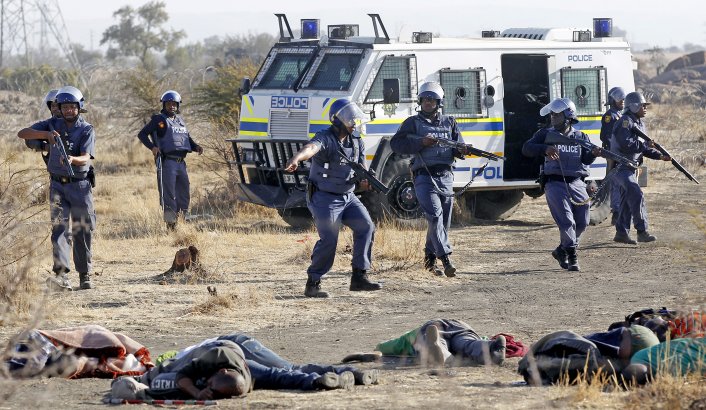
While the South African apartheid regime was certainly capable of massacring 34 protesters in one day, as the ANC state police did last year with striking miners at Marikana (and another ten a few days previously), not even they would have charged the comrades of the slain with their murders, which is what an ANC state judge did.
South African police executing striking miners at Marikana, August 2012
And certainly under apartheid, one would not have found any of the ANC, the SACP, the National Union of Mineworkers or the Congress of South African Trade Unions (COSATU) ranged against black miners striking for better wages against a foreign multinational mining company.
It was South African capitalism, imperialism and a small clique of the ANC that benefited from the deal to which Mandela and the ANC agreed, and they got richer while the mass of South Africans got poorer. Would, or even could, that deal have been clinched without Mandela’s complicity? Possibly – with difficulty, certainly. Would, or could, it have been sold if he had come out and opposed it, as others such as Desmond Tutu began to do soon afterwards? Almost certainly not. The South African regime would have had to concede at least some economic and social benefits or risk outright revolutionary war – which is precisely what releasing Mandela and legalising the ANC was intended to avoid. But Mandela went along with it all and had nothing to say – even after the police murder of 44 strikers.
Irish Republican and Left-wing responses to Mandela’s death – an analysis
So, all this being so, how did the Irish republican and left-wing groups respond to Mandela’s death? The answer is generally poorly, and the significance goes far beyond the man himself, or even South Africa; it reveals a deeply worrying general attitude to imperialism, national liberation and working class struggle, among those who are supposed to be anti-imperialist, democratic and, in many cases, for socialism. We will look at these below.
Two organisations had nothing whatsoever posted on the subject: the anarchist WSM and republican socialist éirigí. Many of the rest of the organisations took up themes in common – reference to the armed struggle in South Africa, remembering the many who fell in the struggle against the South African regime, noting the role of international solidarity with the South African people, criticism of the ANC and the South African government today, with particular reference to the Marikana massacre of striking miners by the ANC government, criticism of the perceived hypocrisy of imperialist leaders at the funeral – and, with two exceptions, a totally uncritical attitude to Mandela himself and his role in bringing about the South Africa of today.
On the ‘hypocrisy’ of the imperialist state leaders’ praise
The responses of the various parties and organisations of Irish republicanism and the left, Sinn Féin (SF), the Irish Republican Socialist Party (IRSP), Republican Network for Unity (RNU), Republican Sinn Féin (RSF), the 32 County Sovereignty Movement (32CSM), the Communist Party of Ireland (CPI), the Workers Party (WP), the Socialist Workers Party (SWP) and the Socialist Party (SP), have been varied. On one point, with the exception of Sinn Féin and the 32CSM (who had no criticism to make), they tend to agree: the supposed hypocrisy of the western establishment in their praise of the man as a ‘peace-maker’ and a ‘visionary’. These were the same imperialists, like the British Tory party and government, who condemned Mandela and the ANC movement he helped found and lead as ‘terrorists’ and ‘murderers’.
This point initially seems a fair observation, until one digs a little deeper, and attempts to answer the question as to why Mandela’s former enemies would be heaping such praise on him today. Instead of the unfailingly imperialist and predatory capitalist governments of the world coming around to Nelson Mandela’s way of thinking, it was he who eventually came around to theirs.
When Mandela was an enemy, and seemingly a determined one, of the South African ruling class and of imperialism, he was condemned by many world leaders and, from their point of view, rightly so; when, as the public face of the movement, he helped avert revolution and safeguarded South African capitalism and foreign imperialism, they praised him; when he died, they continued their praise, and may even be apprehensive of a future South Africa without him. Is this hypocrisy? Or is it rather being entirely consistent with their position?
As stated, Sinn Féin, whether in word by the SF Lord Mayor of Belfast, Mairtín Ó’Muilleoir, or in party president Gerry Adams’ report, had no criticism of other world leaders and their words, past or present.
Rory Duggan of RNU in his speech in Dundalk dismissed the “hypocritical gathering” which would be Mandela’s funeral, which he said “will include many heads of state, who cared nothing for this brave freedom fighter when he was incarcerated by the foul apartheid regime.”
The IRSP commented on “The sickening outpouring of hypocritical tribute from the same politicians who worked against Mandela, and in the case of Britain’s Prime Minister Cameron, actually called for his brutal execution, should not pass without comment.”
No such comment was reported originating from Des Dalton, president of RSF, but it is unlikely he would have disagreed with what RNU or the IRSP had to say on the subject.
The SWP was nearer the mark with “.. one of the reasons why so many of the world’s rulers will praise him is that when apartheid was brought down neither he nor his movement, the African National Congress, went on to challenge the economic grip on South Africa of the old ruling class and of international capitalism. They compromised with the wealthy instead of taking the fight further…”
Reporting on a civic event at which the SF Mayor of Belfast officiated, its publication An Phoblacht claimed “Mandela’s triumph”, and that a poem entitled ‘Never, Never and Never Again’ “summed up that victory”:
“Never again shall I be called a ‘Kaffir’/ Never again will my children be segregated in the land of their ancestors/ Never again will I speak Afrikaans/ Isixhosa is my language/ In my land, South Africa, I shall walk free carrying no ‘Dom Pass’.”
Of course the ending of forced segregation by colour, no longer being called pejorative names, not having racial restriction on movement and being permitted to speak their language were good things and of course it was a victory to achieve them. But did people face beatings, torture, imprisonment and death to overcome those things alone? Very doubtful. In the South Africa of today, people will be segregated by class and they can speak whatever language they like in the shanty towns or housing projects lacking sanitation and running water services. The poor will be called other names by black policemen (or maybe even the same names, who knows?); the police are brutal and corrupt but black. The poor will not be free, nor anything like it.
On the many who fell in the struggle against the South African regime
The RNU site announced their vigil as being for “all those who died in the struggle against imperialism and apartheid in South Africa” and in his speech at the vigil, Rory Duggan paid tribute to “the tens of hundreds who spent decades in prison at the hands of the colonisers, many of whom met their ends on a gallows rope.” A number of those in attendance also carried placards dedicated to ANC martyrs.
None of the other organisations commented on the past martyrs of the struggle.
On the ANC-led government, social and political conditions in South Africa today
Some facts from 2007 (the situation may be better or worse today)2:
Since 1994, the year the ANC took power, the number of people living on less than $1 a day has doubled, from 2 million blacks to 4 million in 2006.
Between 1909 and 2002, the unemployment rate for black South Africans more than doubled, from 23% to 48% (down to 25.5% in 2012 – still worse than under apartheid).
Of South Africa’s 35 million black citizens, only 5,000 earn more than $60,000 dollars a year. The number of whites in that income bracket is twenty times higher and many earn more than four times that amount.
The ANC has built 1.8 million homes but in the meantime 2 million people have lost their homes.
Close to 1 million people have been evicted from farms in the first decade of democracy. Such evictions have meant that the number of shack dwellers has grown by 50%.
In 2006, more than one in four South Africans lived in shacks located in informal shanty towns, many without running water or electricity.
One would search the Sinn Féin commentary on Mandela or the funeral in vain for any criticism of the ANC or of the Government. Gerry Adams, President of Sinn Féin, who wrote a long piece on his participation for eight days of events, along with his SF colleague McAuley, said that they were participating “as comrades in struggle honouring a comrade for whom we have the greatest admiration and respect.” Adams recalled that in 1994, Mandela said, “as he took on the mantle of President of a free and democratic South Africa: ‘Let there be justice for all.Let there be peace for all.Let there be work, bread, water, and salt for all…Let us as a Rainbow Nation keep this in focus and move forward.”
Neither Sinn Féin nor Adams apparently saw any irony in those words contrasted with the reality of life for the vast majority in SA under Mandela’s Presidency nor up to his death.
Indeed, Adams speaks of “a stirring speech from President Jacob Zuma” at the MK event, neglecting to mention the chorus of boos from MK and ANC veterans, reported on by a number of journalists, which the President’s appearance stirred. Zuma has been accused of corruption and rape but his trial was abandoned after long delays and accusations of political interference with the Prosecution.
What is absolutely without dispute is that he has been on the ANC National Executive since 1977; in 1994 he was elected National Chairperson of the ANC and was re-elected to the position in 1996. Zuma was elected Deputy President of the ANC in 1997 and consequently appointed executive Deputy President of South Africa in June 1999. He is part and parcel of the general corruption in the ANC. It was his judge who charged Marikana massacre survivors with murder of their comrades; it took a direct challenge from their legal representatives, published in a newspaper and addressed to Zuma, to have those charges dropped and the strikers released.
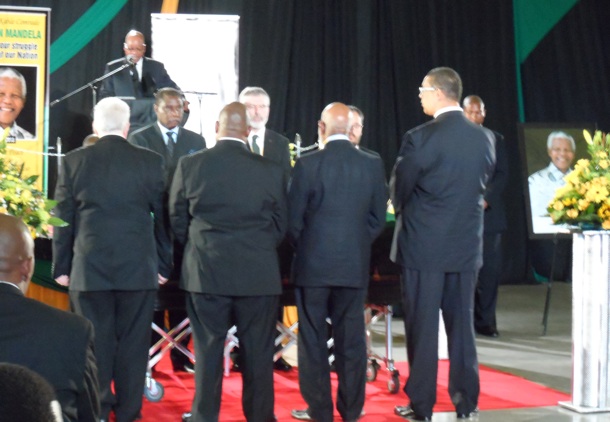
Guard of honour at Mandela’s coffin: Sinn Féin’s Richard McAuley (left) and Gerry Adams, with Urko Aiatza of the Basque organisation SORTU, as President Zuma addresses the crowd
Adams also reported that “the event was hosted by Cyril Ramaphosa, who has close associations with the Irish Peace Process.” Indeed: Ramaphosa is also a multi-millionaire, and among his many company directorships is one on the board of the Anglo-American Platinum Company of the Lonmin mine where 44 workers were killed. It turned out that Ramaphosa had been sent for by the company to sort out the strike, and the suspicion is that the shooting may well have been part of the “sorting out”. Ramaphosa was formerly General Secretary of the National Union of Mineworkers until 1999, when he resigned to take up the position of Secretary-General of the ANC.
Adams goes on to mention contributions from the South African trade union federation COSATU, an organisation dominated by the National Union of Mineworkers (NUM), the ANC and the South African Communist Party and also involved in political corruption. The SACP, which also contributed a message, runs the NUM which is also involved in, at least, political corruption and called for the Lonmin strikers to be arrested.
Neither Adams himself nor his party has commented on these aspects of, on the one hand, social deprivation among the mass of South Africans and, on the other, corruption among the ruling ANC and their allies in the SACP and COSATU, along with attendant brutal repression of workers by the state. The reason for this silence is probably the Irish ‘Peace Process’. The Palestinian resistance organisation Al-Fatah and the ANC, the first to go down the “peace process” road, were used as shining examples to convince the Sinn Féin membership and IRA to travel the same road. Al Fatah is never mentioned any more, largely as a result of the Oslo process by which they lost confidence among most Palestinian people, and were replaced as the dominant Palestinian resistance organisation by Hamas. It would hardly do to show how little was won by the ANC in the end, as a result of their own ‘process’, when that might heap more loss of faith on the 15-year old Irish one.
The 32-CSM went further than a lack of criticism of the South Africa of today, choosing to praise what they saw as the achievements of the ANC in government: “During his term in office he brought about national reconciliation among white and black South Africans, tackled the AIDs crisis, boosted employment, basic needs that were denied due to apartheid brought about and social welfare for all citizens of South Africa was introduced.”Unfortunately, these perceived victories contrast rather sharply with the reality of the facts of modern-day South Africa, where capitalism still runs rampant and unimpeded.
However, the RNU’s national PRO Ciarán Cunningham, speaking about the current situation in South Africa at their Drogheda event, was clear on the reality of the ANC’s South Africa: “…drawing comparisons between James Connolly’s ‘if you remove the English flag from Dublin castle’ argument, to the situation today in which foreign business interests see fit to murder striking workers, albeit under the flag of an apparently free South Africa.” Some of the participants also carried placards in memory of the 34 miners killed in one day at Marikana.
This theme was also taken up by local RNU veteran republican Rory Duggan:
“We gather here tonight in the spirit of National Liberation, Socialism and International Solidarity; from those perspectives it is impossible to state that the ideals espoused by comrade Mandela have been realised in today’s South Africa.”
The IRSP statement was also direct:
“… his movement, the African National Congress in time abandoned all commitment to socialism and social welfare …. Despite the ANC’s remarkable achievements in democratizing South Africa, workers there still face brutal repression, such as the massacre of 34 striking miners in 2012.”
Des Dalton of RSF commented in passing “that the current South African state falls short of the high ideals by which he lived life”.
But how is that these organisations manage to separate Mandela himself from all this? Was not Mandela an important figure in the ANC? Was he not the national icon, the binding figure, throughout the negotiation process? Was he not President from 1994 to 1999? The discourse of the republican organisations gives not even a hint as to what rationale they have for absolving Mandela of responsibility for what became of the ANC and, in particular, of the state after the end of apartheid.
The Communist Party of Ireland and Workers’ Party refrain from any criticism whatsoever of the current South African state and therefore avoid having to deal with the tripartite alliance of the ANC, SACP and COSATU.
If the CPI and WP are bound perhaps by some kind of loyalty to the SACP, with which they have fraternal relations, the Trotskyists have no such problem. The SWP attacks the social reality in South Africa, and does not shy away from some attempt at implicating Mandela himself in the ANC’s betrayal of its ideals; indeed it quotes one of his statements from as far back as 1956, in which he states the ANC’s intention to create a “prosperous non-European bourgeois class”3. However it could be argued that it is somewhat unfair to quote a statement from over half a century ago, during the development of the man’s ideas and the early days of the party.
By far the most in-depth and extensive analysis of the country and of Mandela comes from the Socialist Party,written by two members of the Democratic Socialist Movement, the Socialist Party’s sister organisation in South Africa:
“The ‘nation’ that Mandela has bequeathed is as unreconstructed today as it was before the end of apartheid, disaggregated into its two main social forces – the working class on the one side and the capitalist class on the other. SA is reputed to be the most unequal society on Earth. As many as 8 million are unemployed, 12 million go to bed hungry, millions are excluded from decent education, health and housing. The ruling ANC elite is exhibiting the same characteristics as the one which it replaced – corrupt, inept and with an insatiable appetite for self-enrichment and power.”
However, the SP statement goes further – it explicitly foists blame on Mandela himself, as opposed to his wayward lesser comrades, for the direction South Africa took after apartheid formally ended. It states Mandela’s key role in the adoption of the ‘GEAR’, the so-called ‘Growth, Employment and Redistribution’ programme, at the core of which was an agenda of privatisation and economic liberalism:
“Mandela played the decisive role in the abandonment of the Freedom Charter and everything the ANC was believed to have held sacred until then … The difference between Mandela’s reign and that of all his successors is more in style than substance … GEAR was adopted under Mandela’s presidency. In spite of the fact that Mbeki spearheaded the adoption of GEAR, he did so with Mandela’s (and that of the rest of the ANC leadership including the SACP’s) full blessing … privatisation – at the heart of GEAR’s original strategic objectives – was now the ANC’s fundamental policy.”
The piece also quotes the Guardian article written in June of 2013 by Ronnie Kasrils, a former leader of the ANC’s armed wing, central committee member of the SACP and former Minister for Intelligence in government, in which he mercilessly exposes the ANC’s shady business deals, pacts with international capital and imperialists, and their betrayal of South Africa’s poorest.4
The SP statement is the longest of those analysed here, and contains much information on Mandela’s business deals, secret pacts and the likes, all of which contributed to the destruction of the socialist ideals that the ANC at least claimed to once hold dear.
On the armed struggle
As might be expected of organisations with a history of armed struggle, albeit for some more recently than for others, the armed guerilla struggle in South Africa came in for some mention from the republican organisations.
A fair amount of the statement by RSF’s Des Dalton was concerned with Mandela’s guerrilla background and his attitude to armed struggle. Dalton claims inside knowledge of Mandela’s attendance at a lunch with Irish newspaper editors in the home of Tony O’Reilly in 2000: “…questioned as to whether or not the Provisionals should be decommissioning their arms, Mandela’s response was unequivocal, ‘…my position is that you don’t hand over your weapons until you get what you want.’ Needless to say this was a response that was not welcomed nor reported on.”
Surprisingly the 32-CSM had nothing to say on the armed struggle in South Africa or Nelson Mandela’s role in it, beyond referencing it in passing as the reason for Mandela’s being sent to prison for 27 years in 1962, for ‘sabotage’.
RNU also drew attention to the armed struggle in South Africa at a Dundalk vigil it organised on December 12th, as some of its members held up a banner bearing the name and logo of Umkhonto we Sizwe.
The IRSP alluded to armed struggle too (but only in passing), as did the Socialist Party article, which stated Mandela’s role in setting up MK with help from friendly countries such as Algeria: “His willingness to make the ultimate sacrifice for the cause is borne out by the fact that he personally undertook the task of establishing the ANC’s armed wing, Umkhonto we Sizwe (MK), secretly paying visits to countries like Algeria to seek support for the armed struggle leading him to be installed as MK’s first commander-in-chief.”
Gerry Adams, no doubt mindful of his organisation’s history up until a few decades ago, also of the emotional attachment of many of his party’s supporters to the idea of armed struggle (despite the organisation’s renunciation of it), referred to Mandela’s membership of MK more than once. He also attended Mandela’s ‘send-off ceremony’ from Pretoria which “was given over to his comrades in the ANC and to the veterans of Umkhonto we Sizwe (Spear of the Nation), or MK … Two thousand specially-invited ANC and former MK activists, and international guests from liberation and solidarity movements, were present in solidarity with the family, to give an ANC farewell to their former Commander and President.” Adams also posted, among other photos in his report, one of himself with a number of MK and ANC veterans.
None of the organisations made any reference to the ill-treatment, torture and death meted out by MK officers to a number of fighters in their training camps in other countries, particularly the Quatro camp in Angola. Stories of these were in circulation in solidarity circles by the 1980s and some testimonies were given by victims at the hearings of the Truth and Reconciliation Commission in the 1990s.
International solidarity
The IRSP drew attention to the role of anti-imperialist and communist solidarity in “that this victory would not have been possible without the widespread support of other anti-imperialists and the international communist movement. Mandela credited Cuba with helping to end apartheid: Cuba’s military intervention in Angola against South Africa led to the end of the apartheid regime.”
The CPI also took up this theme: “In one of his first speeches Mandela paid tribute to the unbreakable and unselfish solidarity given to the oppressed masses of South Africa by the Soviet Union and the socialist bloc, as against the inaction and active collaboration of almost all western governments with the apartheid regime…” The WP statement echoed these sentiments, and also paid tribute to the Dunne’s Stores anti-apartheid strikers.
The RNU took the angle of Irish solidarity for the struggle, as Rory Duggan “paid tribute to the many anti-apartheid activists from the Dundalk/Newry area, who in the 1980s, raised awareness of the evils of the apartheid regime and prevented South African commercial and sporting interests from raising its head in Ireland at the time when it mattered most.”
Surprisingly nothing was said on this theme in the RSF statement or in SF’s, not even from an Irish perspective. Only one organisation (WP) referred to the Dunne’s Store strike, a specifically workers’ action, certainly the most significant solidarity action in Ireland and one which lasted years. The 32CSM statement mentions only that Mandela was released from prison in 1990 “after mounting pressure from international groups”; it does not state who or what these groups were.
Mandela’s legacy
Gerry Adams of Sinn Féin concluded his report saying that Mandela’s “words are all around us. The legacy of hope and courage and forgiveness and of reconciliation is one we must aspire each day to achieve. In our several conversations about the Irish Peace Process, Madiba understood at once the complexities but also the only direction we could go to avoid decades more of conflict. He supported the Peace Process in Ireland unequivocally and on the basis of equality and inclusivity.” He continued: “Richard Haass and Meghan O’Sullivan will shortly produce their proposals for moving forward on the difficult issues of flags and emblems and the past.”
Clearly the social and political reality for the vast majority in SA is of concern to neither Adams nor SF and one may speculate that both would be happy to see a similar result from their own process in Ireland.
Similar praise comes from the CPI: “Mandela was a towering and inspirational figure, a leader of the oppressed of South Africa and beyond …
Concluding the vigil organised by the RNU, “Rory Duggan called for a one minute clenched fist salute, in honour of all those – living and dead – whose cause was embodied in the image of Comrade Nelson Mandela.”
The IRSP claims that Mandela remained “a foe of imperialism for the remainder of his life, frequently criticising US aggression and maintaining his support for socialist Cuba, Gaddafi’s Libya and Palestine” and that he “…supported Ireland’s long struggle for freedom.” According to the IRSP, “at a time when such examples are desperately needed, Mandela’s heroic example proves that revolutionaries can create lasting change.”
Dalton, for RSF, agrees: “Nelson Mandela was and remains an inspirational figure for all who are engaged in the struggle for human freedom and national self-determination” and he concludes commenting that “his legacy will remain an inspiration for those who continue to seek true political and economic democracy in South Africa and around the world.”
The 32CSM also praises Mandela as “a true freedom fighter and an anti-apartheid revolutionary who spent 27 years in prison for his beliefs.”
Conclusion
The lack of any criticism of Mandela and his important role in creating the state of today by any organisation other than the two Trotskyist parties is disturbing. All of those organisations would describe themselves as anti-imperialist and socialist, yet they have heaped praise on one who was key in surrendering the people’s struggles to domestic capitalism and imperialism. Do they seriously suffer from such idealistic delusions?
That Sinn Féin, the CPI and WP should not wish to criticise, even in passing, the social reality in South Africa today is even more disturbing. SF may not wish to do so for fear of undermining an example of a process that they used to recommend the Irish process, whereas the CPI and WP may wish to avoid implicitly condemning the Communist Party of South Africa. Whatever their reasons for not condemning the conditions in South Africa, to have not done so must stand as an indictment of their integrity and, particularly in the case of SF, the ultimate aims of their own parties.
Although both the SP and the SWP produced much better analyses, in particular the former, drawing on contributions from within South Africa itself, there are some disquieting elements in their analyses too. Neither of them sees a country which is, despite the presence of domestic capitalists, essentially dominated by imperialists. One wonders therefore what their analyses of the way forward can be.
For us, the experience of South Africa and of our own country raises an important question: is it even possible today for a struggle to complete the national liberation stage, without being led by revolutionary socialists? We are reminded of James Connolly’s years of work, largely unsuccessful, to build up a revolutionary socialist leadership in Ireland and his various remarks about the kind of revolution that was necessary. We do not reject Connolly’s example of uniting with the Irish Republican trend in order to overthrow British imperialism – far from it. However, we wonder whether one of his famous statements may not be paraphrased thus: “Only the Irish working class remain as the incorruptible leadership of the fight for freedom in Ireland.”
Let us sincerely hope that Mandela’s legacy will remain a cautionary tale from which we will learn and apply the necessary lessons. One of those essential lessons is never to abandon our critical faculties, and to examine real circumstances; another must surely be never to make an icon out of a living person.
End
Footnotes:
1 GATT: General Agreement on Tariffs and Trade; WTO: World Trade Organisation
2Naomi Klein (2007), The Shock Doctrine – the Rise of Disaster Capitalism, chapter 10: “Democracy born in chains”
Republican Sinn Féin‘s website posted one entry about Mandela’s death, a relatively short statement by its President, Des Dalton on December 16th: http://rsfnational.wordpress.com/nuacht-news/
Sinn Féin: An Phoblacht published an item about a Belfast civic event honouring Mandela, over which presided the Mayor, SF Máirtín Ó Muilleoir http://www.anphoblacht.com/contents/23631; also a much longer report by Gerry Adams on his – along with Richard McAuley — representing Sinn Féin at the funeral http://www.anphoblacht.com/contents/23628



 rebelbreeze