Diarmuid Breatnach
(Reading time: 5 mins.)
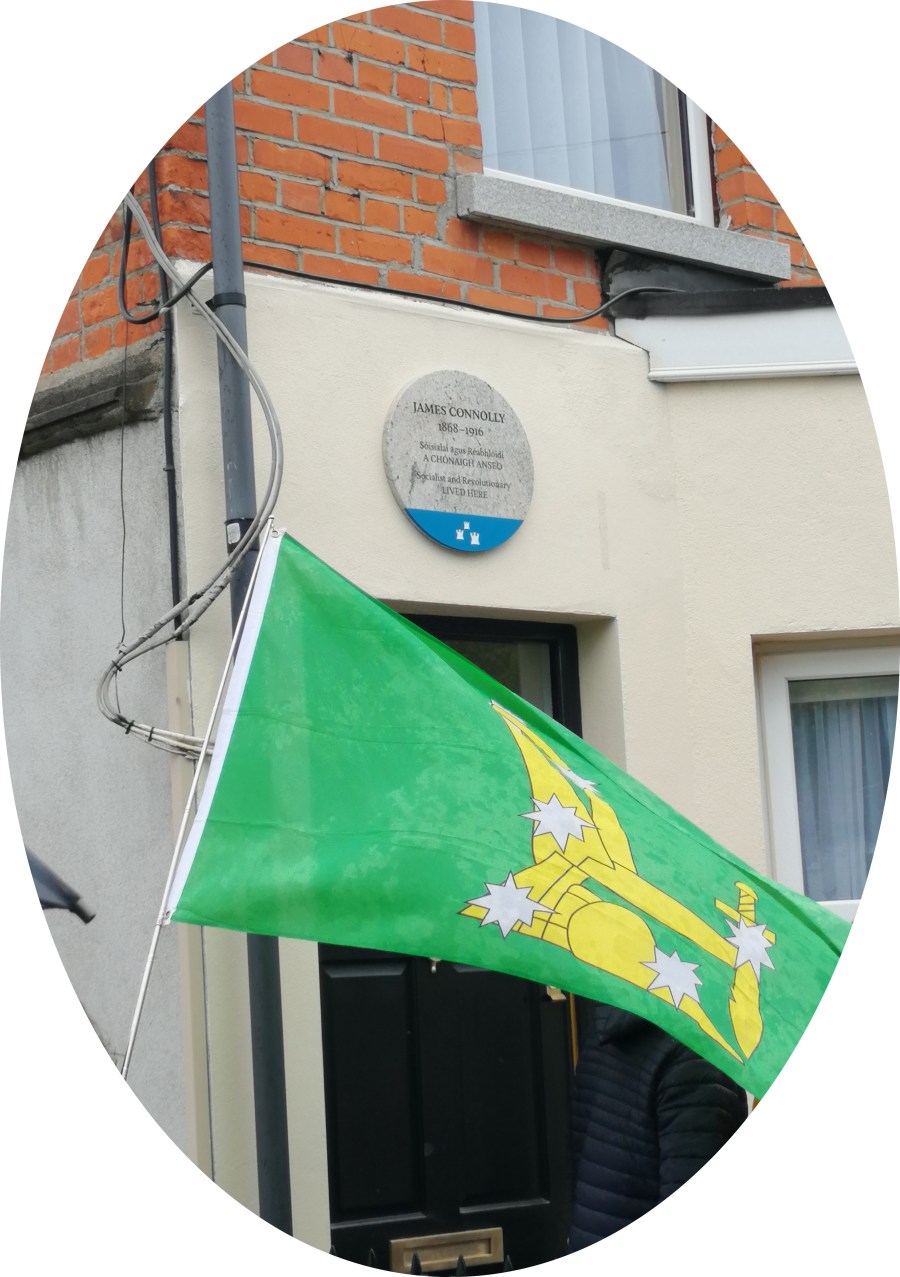
A new plaque commemorating James Connolly was unveiled on the morning of 31st July on 70 South Lotts, the house to which he returned from New York with his wife Lillie and children in 1910 and lived there until May 1911.

Connolly was born and reared in Edinburgh, left school at 10 and worked with his older brother John for the local authority as a carter, lied about his age and name to join the British Army, in which he first saw Ireland and where he met Lillie Reynolds; they were married soon afterwards.
Like his brother, Connolly became a militant socialist and trade unionist and returned to Ireland at the request of socialists to form the Irish Socialist Republican Party, the first socialist party in Ireland but left for the USA when the party failed to recruit significant numbers.
The ISRP’s office was in Middle Abbey Street, across the road from the premises of the Irish Independent, owned by Irish nationalist William Martin Murphy who was to become an arch-enemy from the Lockout and strikes of 1913 onwards1.
Connolly was a historian and journalist as well as a socialist, trade union organiser and a revolutionary. A report in Breaking News on the unveiling infers that he reluctantly committed to the Rising with the Volunteers; in fact, he had been pushing them to rise for months!
Unveiling speeches
The event started late and in rain. Dáithí De Róiste2, Dublin’s current Lord Mayor, opened the proceedings and commented that the plaque on the house was a reminder that Connolly lived a life in some ways like many ordinary Dubliners, living in a Dublin house and walking city streets.


Historian Dr Conor McCabe, of Queen’s University Belfast, proposed the plaque as his research established the background that Connolly was living at the address around the time that his most famous work, Labour In Irish History, was first published in book form.
In deference to those in attendance standing in the persistent rain, Conor McCabe kept his speech very short. This was not the case with every speaker.
Joe Cunningham, General Secretary of Siptu3, an amalgamation with other unions of Jim Larkin’s ITGWU which Connolly had led for six years, commented in his speech that it was Connolly who ensured that the interests of working people were incorporated in the 1916 Proclamation4.
Also that, at the ceremony of raising an Irish flag over Liberty Hall5 in April 1916, had declared that “The cause of labour is the cause of Ireland, the cause of Ireland is the cause of labour.”6
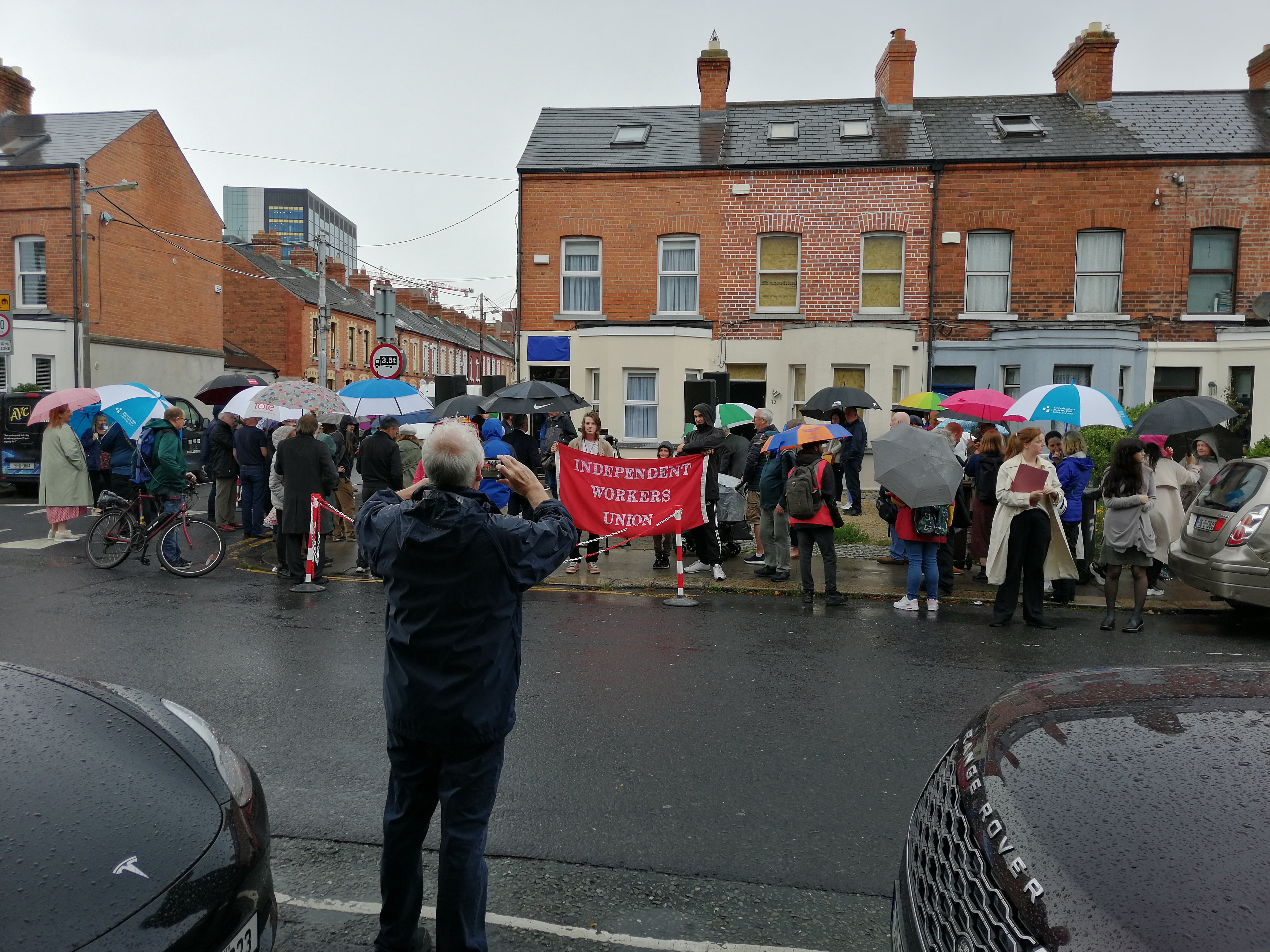
Dublin City Council Commemorations & Naming Committee was responsible for the placing of the plaque, in consultation with the house occupants and its chairman, Councillor Mícheál Mac Donncha7 welcomed suggestions from the public for commemoration of people and events.
Sinn Féin Councillor Mac Donncha also commented that James Connolly was a personal hero of his.
Jim Connolly Heron, great-grandson of James Connolly, was called to say a few words and invited family members present to join him in front of the house while he spoke and commented also on the importance of commemorative plaques in protecting historical sites.
He did so in reference to the plaque on a house in Moore Street that had disappeared and come to light in a property developer’s office, raising concerns that had led to the long Moore Street conservation struggle.8
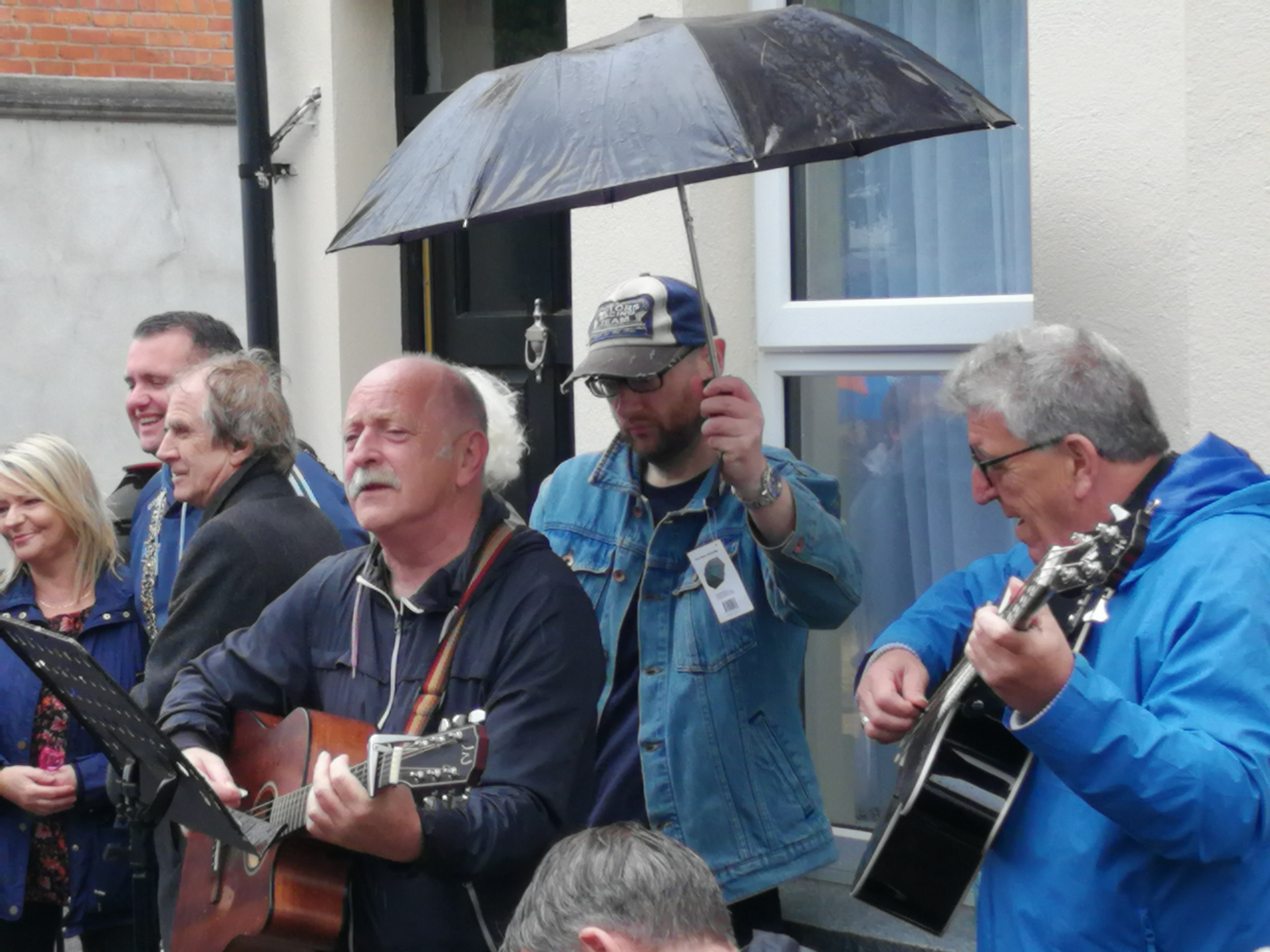
Music and song for the event was performed by The Pullovers ballad group but the amplification system had been removed by then which was a pity as it was needed for the music.
The 1913 Lockout
James Connolly and family returned to Dublin when Jim Larkin9 offered Connolly a post in the young breakaway Irish Transport and General Workers’ Trade Union, which he took up in 1910. Three years later the union was in a fight for its life.
It is sometimes wrongly claimed that the 1913 Lockout was an attempt by employers in Dublin to prevent workers from joining a trade union but there were other unions operating in Dublin during the period and they were accepted by most of the employers.
Apart from the ITGWU recruiting large numbers of ‘unskilled’10 manual workers, it pursued its objectives militantly, using sympathetic solidarity action by other workers to increase the effectiveness of the workers who were in industrial dispute with their employer.
In August 1913 a combination of around 200 employers presented their workforce with a declaration to sign which committed them to having nothing to do with the ITGWU. En masse, the workers refused to sign, were locked out while others struck work and were locked out too.
Right from the beginning the Dublin Metropolitan Police11 attacked the workers on behalf of the employers and in a baton charge on Eden Quay on 30th August fatally wounded two workers, also beating strikers and onlookers the following day in O’Connell Street (‘Bloody Sunday 1913’)12.
As a direct response, Connolly and Larkin set up the Irish Citizen Army as militant response to police attacks, dedicated also to Irish independence and their flag was the gold Starry Plough on a green background,13 which they flew over the Clery’s building in 1916.14

Comment
The only Starry Plough to be seen at the event was one unfurled during the event independently of the organisers and speakers.
Many who claim to admire Connolly or even to follow his teachings do so on occasion in words but never in action and if Connolly were alive and acting as he did when he was, most of the speakers at the unveiling event would call, if not for his shooting, certainly for his jailing.
SIPTU is much larger than the ITGWU was but it and other unions are much less effective; as a result of the lack of active resistance by the leadership, union membership in Ireland is at an all-time low in modern times. Nor would Connolly have ever agreed to the partition of Ireland.
The Irish Labour Party, which Connolly and Larkin formed in order to give the working class a voice in municipal affairs, has been in coalition government a few times, always capitalist and most often with the right-wing Fine Gael, when they have joined in attacks on the working class.
Joan Burton, while Tánaiste15 of the Labour-Fine Gael coalition government in 2014, complained about working class people being able to afford video-phones and tried to get people jailed for organising an effective protest against her in Jobstown.16 She too attended the unveiling today.

Fianna Fáil is a party of the Gombeen client class and has been in government more often than any other, whereas Sinn Féin in its current incarnation is seeking to replace it with more of the same.
It is a tribute to the memory of James Connolly held so dearly among the working people that these types, so far from Connolly in their reality, are obliged to pay public homage to the man and to his principles while their daily practice is in opposition to all that he stood for.
End.
FOOTNOTES
1An editorial in his newspaper, The Irish Independent (still one of two main newspapers of the state), after a number of British executions of a number of 1916 leaders, called for continued executions of leaders prior to the execution of Connolly and Mac Diarmada, the last of the 14 to be executed in Dublin (Kent was shot in Cork and Casement hanged in London).
2Fianna Fáil elected councilor.
3The largest union in Ireland, owner of the current Liberty Hall which stands on the ground of the original union building.
4There is no record that this is the case but it is a natural and widely-held assumption. It is a fact that the Proclamation was printed in Liberty Hall.
5Cunningham said it was “the Irish flag” which most would think a reference to the Tricolour. However that flag had not yet been accepted by the majority as the primary flag of the nation, which really occurred after the 1916 Rising. The flag raised instead by teenager Molly O’Reilly at Connolly’s request had the golden harp on a green background, the essential flag of Irish Republicans from the 1790s until the 1916 Rising.
6This was not a random statement by Connolly but rather a strategic one; on an earlier occasion he had observed that of all social classes in Ireland, the working class remained “the incorruptible inheritors of the fight for Irish freedom”. Connolly wrote that in his foreword to his work Labour in Irish History, clearly indicating that only the working class could be trusted to lead the national struggle through to successful conclusion.
7A prominent member of one of the groups campaigning for Moore Street Battlefield conservation, the Save Moore Street Trust, of which Mac Donncha is Secretary.
8That occurred at the beginning of this century and the struggle has been ongoing since.
9Like Connolly, also a migrant and member of the Irish diaspora but from Liverpool. He founded the Irish Transport & General Workers’ Union after his departure from the British-based National Union of Dock Labourers, for which for a time he had been chief organiser in Ireland. Most of the NUDL’s members in Ireland left to join the ITGWU but in Belfast there was a division along sectarian lines.
10This is the general appelation for work not requiring long periods of training. However, anybody who has been employed in work of this category soon learns that such work requires skill to achieve the objectives set, to pace oneself and to guard against injury. This is the reason those recruiting for such ‘unskilled’ work prefer ‘experienced workers’, a code for ‘skilled’.
11A police force of the period for Dublin City, most of its members being without firearms, unlike the armed all-Ireland colonial gendarmerie of the Royal Irish Constabulary (of which the Police Service of Northern Ireland is a descendant body). DMP minimum height requirements were 5ft 9” in a city where many working people were of low stature; this disparity gave substantial momentum to the swing of a truncheon.
12The event wrongly named as leading to the death of two workers, whose deaths were caused by the previous day’s police attack on Eden Quay, just by Liberty Hall. However, a previously healthy Fianna Éireann boy, Patsy O’Connor, who was clubbed in the O’Connell Street police riot while he administered first aid to a victim, suffered frequent headaches thereafter and died in 1915 at the age of 18.
13The design has seven stars in the Ursa Mayor configuration, with the design of a plough following the stars and a sword as the ploughshare. There is also a plainer version flown by the Republican Congress of the 1930s, the outline of the Ursa Mayor constellation in white or silver stars alone on a blue background.
14The flag survived the shell explosions and raging fires along the southern half of O’Connell Street and is currently in the Military History Museum, Collins Barracks, Dublin, along with a number of other flags flown by the insurgents during the Rising.
15Title of the Deputy Prime Minister in the Irish government.
16A number of activists from different organisations, including Paul Murphy TD (member of the Irish parliament) were arrested in raids some time later and among the charges was “kidnapping” Burton. The untruthfulness of a number of witnesses for the Prosecution including a senior Garda officer were exposed (ironically by video taken by protesters) and the jury acquitted all the defendants of all charges.
end.
REFERENCE
 rebelbreeze