ANOTHER SHOCKING STATE ATTACK ON THE RIGHTS OF A WOMAN BRINGS DEMONSTRATORS ON TO THE STREETS

A suicidal woman refused an abortion, is then force-fed to preserve her embryo which is later delivered at 25 weeks by caesarian section.

Diarmuid Breatnach

A woman considered suicidal by a medical panel was recently refused an abortion in Ireland and was subsequently force-fed. Within days a call was made for a protest demonstration and was answered by a substantial number in Dublin on Wednesday night last. The protestors filled the central section of O’Connell Street from the Spire to the Larkin monument and also spilled out into the road. Numbers of protestors took up station on the pavement fronting the GPO. A weekend demonstration was also convened in Dublin and another in Cork.0
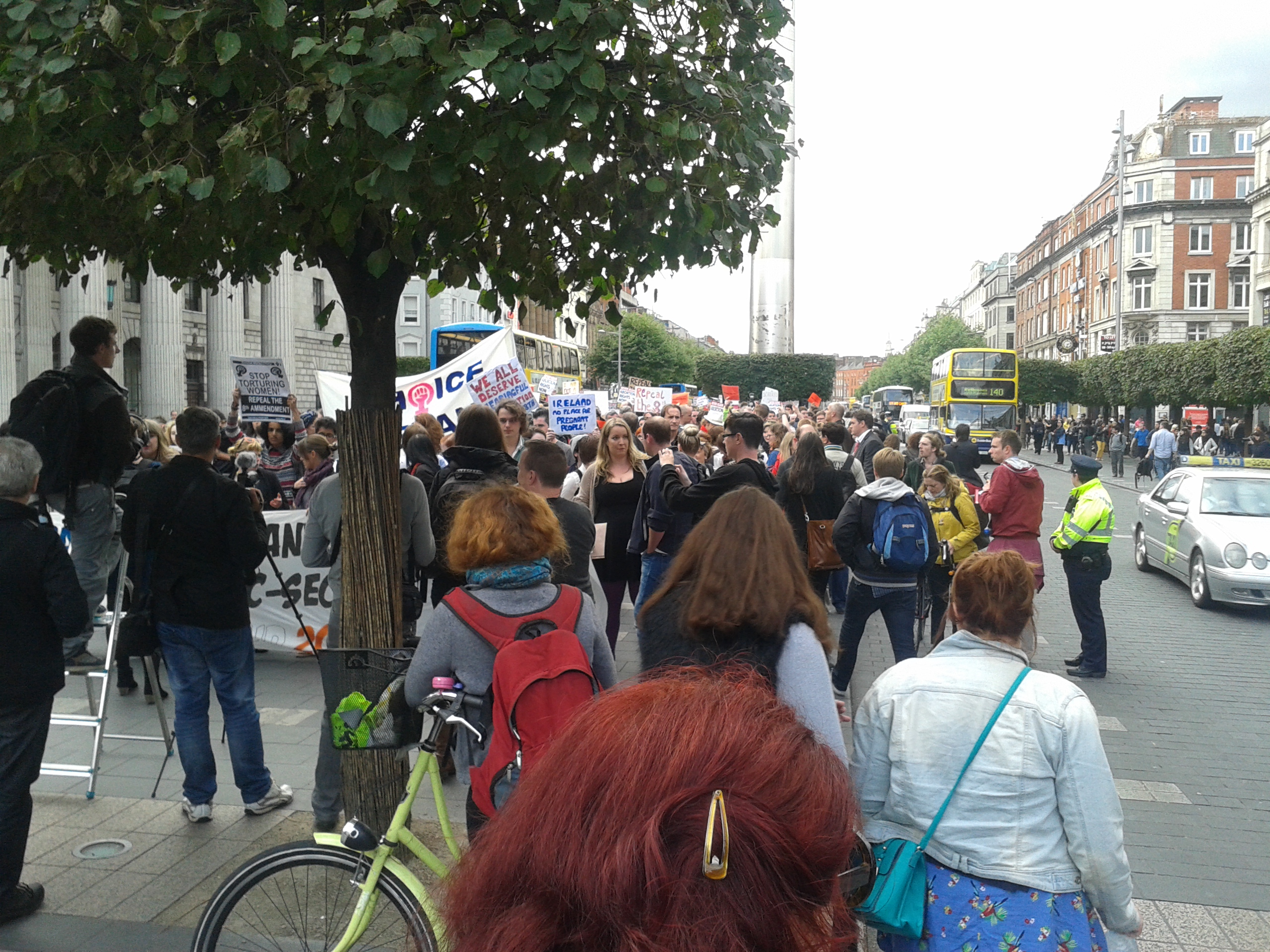
Protest Caesarian etc rally 20Aug2014
Protesters in Dublin on Wednesday evening denouncing the treatment of the woman refused an abortion and force-fed. They called for the repeal of the Eight Amendment to the Irish Constitution.  (photo D. Breatnach)

The pregnant young woman, apparently under 18 years of age, was a migrant, who sought an abortion in Ireland. Some media reports say that her pregnancy arose as a result of a rape in her native country prior to her travelling to Ireland. Not all the details are clear but it seems that an Irish advice centre gave her the necessary information to travel to Britain to receive an abortion but that she was unable to afford it (there is also some question about her immigration or asylum status should she wish to reenter Ireland). It seems she then became depressed, not surprisingly, and expressed suicidal ideation. Under the Right to Life During Pregnancy Act 2013, introduced following the “X” case, a woman is entitled to receive an abortion if carrying the foetus should result in a substantial risk to her life – suicidal ideation being one of of those risks.

In accordance with the 2013 Act the young woman’s case was reviewed by a panel, consisting of two psychologists and an obstetrician. According to reporting in the mass media, the psychologists agreed that she was suicidal and that she she should therefore have the termination. The obstetrician apparently agreed that she was suicidal but argued that in a short while (two weeks has been mentioned), a caesarian could be carried out and a baby delivered alive and viable. Since the Act requires the unanimous concurrence of all three members of the panel, the young woman was refused an abortion.

It seems the woman became further depressed and stopped eating, whereupon lawyers for the hospital went to the High Court to obtain a court order permitting the woman to be force-fed, which procedure was carried out (probably intravenously). The woman is said to have subsequently agreed to a caesarian section by which method a baby was delivered. The fate of the woman is not in the public domain at this time but the baby was reportedly delivered alive and well after 25 weeks in the womb.

A number of speakers at the rally made the point that “here we are again”, i.e. that the lack of the necessary legislation has led to another case of terrible mistreatment of a young woman, a reference to other cases of refusal of abortion that have become scandals and lead to demonstrations such as about the death of Sadita Halappanavar in 2012 and the “X” case in 1992.

At the rally, all the speakers, campaigners and providers of services and a male doctor from Doctors for Choice, called for a referendum to repeal Amendment Eight of the Bunreacht (Irish Constitution). This is the amendment passed in 1983 in order to prevent abortion becoming legal. Some very telling points were made, one speaker saying that no-one in Ireland but a pregnant woman would be force-fed or bullied into submitting to an invasive surgical operation. Perhaps we cannot say that none of those things would ever happen to anyone else but it is certainly true that only in the case of a pregnant woman would that combination of coercive and intrusive procedures, clearly in violation of the Hippocratic Oath, have been considered so readily and applied in conjunction. That the woman was a migrant probably made it easier for the authorities but it is the legal position on abortion in Ireland and its moral underpinning which reduces the pregnant woman to the status of some kind of living vessel, the status of the unborn foetus being higher than that of the mother.

Men’s place in the movement

Breaking from the general trend at the rally, one of the speakers addressed many of her remarks specifically at the males present there in support. She told them “they should know their place” and that they had no right to express any opinion on the issue except to support the women. Some women applauded her and some did not.
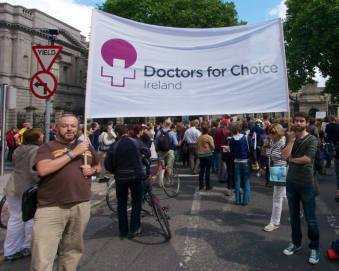
Drs for Choice 23Aug2014 AF
On the Dublin march for the repeal of the 8th Amendment on Saturday. This banner was also present at the Wednesday protest rally where one of their representatives spoke. (photo Andrew Flood)

Since variations of this view have emerged quite frequently, including the view that it’s a women’s issue or that men should just follow the opinion of women in the movement, it is worth examining this a little further. The current situation on abortion in Ireland of course impacts in the first place on women but it does not affect them only. An unwanted pregnancy, especially at an early age or stage in a relationship can force decisions that may later be regretted, including marriage or abandonment. Raising a child from what was an unwanted pregnancy has long-term social and economic implications, not just for the mother but for a much wider circle – as well as for the child growing up in society. The existence of legislation on abortion and its repeal is in the realm of criminal law — but above all it is a social issue, one affecting society. The provision of abortion is also a medical and social question: medical and social structures and services will need to be put in place, funded, monitored and its practitioners trained. Therefore all of adult society has a right to a voice on it. To call on a section of society to be mute supporters is to treat them as voting fodder and should not be supported by any genuinely democratic person.
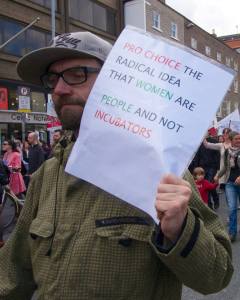
Pro-Choice that W not incubators
Man on the Dublin march for repeal of the 8th Amendment (photo Andrew Flood)

Also, if men, because they are not after all going to be the ones being impregnated and bearing children, should not have a voice but should only support women, which women’s opinions should they support? Why not support the many women who are totally against abortion? And even if supporting women who are for greater access to abortion, which section of opinion about which degree of access should men support?

Clearly men have to think about these issues to come to decisions. Are they to think silently, expressing no opinion and discussing with no-one, and then be expected to develop rational opinions to inform their actions and, in the case of a referendum, their voting too? Clearly the expectations expressed in such calls or statements are not only undemocratic but unrealistic too. Men not only have the right to express opinions on these issues but need to be able to do so in order to have the discussions that make it possible for them to make rational choices.

The attitude of the state and a referendum

The Dublin pro-choice demonstration on Saturday, according to observers, matched the numbers at the anti-abortion demonstration in the city on the same day – about seven hundred. The pro-choice demonstration took an unusual route from O’Connell Street and became the third demonstration to cross the Rosie Hackett Bridge (opened in May this year). The Bridge is the only one in Dublin named after a woman and Rosie was a trade union militant active in the Dublin Lockout of 1913, as well as taking part in the 1916 Rising as a member of the Irish Citizen Army. The demonstration rallied just across the river at the Department of Health in Hawkins Street (the Department under which the young woman had been refused an abortion and force-fed) and then went on to demonstrate at the Dáil (the Irish parliament).
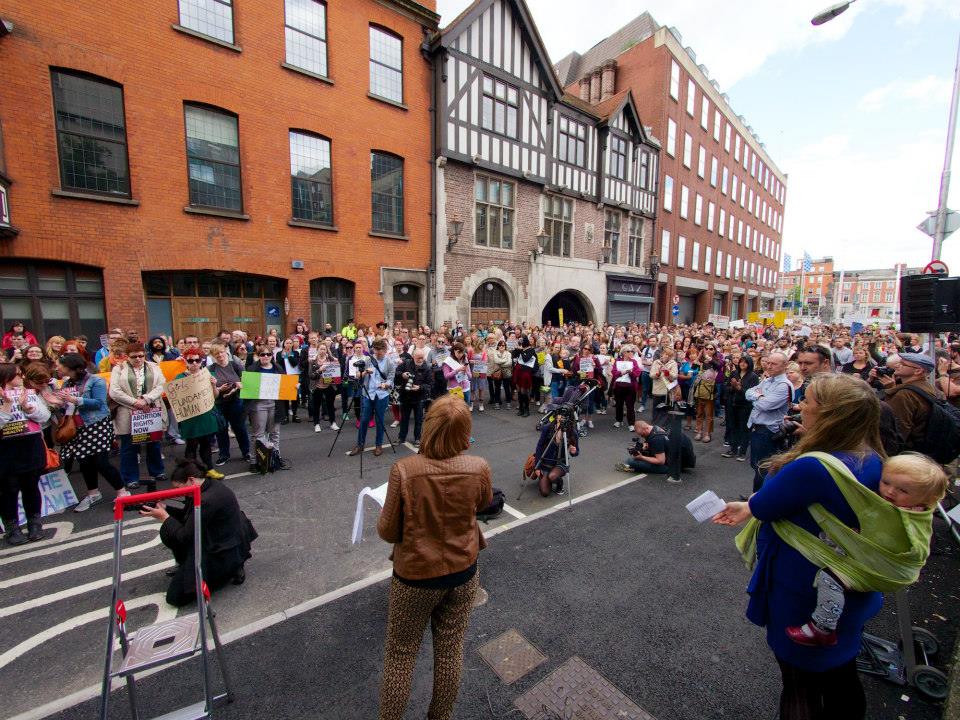
ProChoice DeptHealth 23Aug2014 AF
Speaker addresses the crowd in Hawkins Street, outside the Department of Justice — Rosie Hackett Bridge is to the far right of the photo. (photo Andrew Flood)

Some supporters of a change in the law have presented the issue as though it is essential to the State and to the Catholic Church, two institutions closely linked, to control women’s bodies through refusing access to abortion, free and on demand. I do not think it is so. Certainly those forces may want to control women’s bodies (and indeed, men and women’s minds) but such control is not essential for the continued existence of the State. Many capitalist countries have either easy access to abortion or much more liberal laws than has the 26-County state. This state can afford to give that right but that does not mean that it will. When a state is able to give something but does not want to, sufficient force must be mobilised in order to convince it that yielding will cost it less than denying. Substantial pressure will need to be brought to bear on the State so that it agrees to holding a referendum.

But having a referendum does not mean that the correct and necessary outcome will be the result. We have had referenda in which the side of progress and justice was successful but also those in which it was not. The present Amendment Eight to the Bunreacht (Constitution), which the movement seeks to repeal, was the result of a referendum.

Yes, true, that was 30 years ago and opinions have changed since. In recent years, opinion surveys have shown a majority in favour of some relaxation of the law. Also, two legislative attempts to tighten restrictions on access to abortion, in 1992 and 2002, failed. On the other hand, the Thirteenth and Fourteenth amendments, both in 1992, were successful in loosening the ban, establishing the right of a pregnant woman to travel, even if to obtain an abortion, and to be given information about abortions services abroad. However, although the numbers in favour of unfettered access to abortion have grown substantially they do not yet constitute a majority.

According to analysts of the socio-economic background of respondents to the questionnaire, the indication is that the areas of greatest resistance are among a section of the middle class and a section of the working class. That particular section of the middle class is one of generally right-wing views and not amenable to change. Besides, they have the economic resources to lessen the chances of unwanted pregnancies including, despite their ideological position against it, to send their pregnant daughters quietly to Britain, having them return after a brief holiday without the neighbours being any the wiser. Or for a wife to go on a weekend visit to a friend in Britain even without her husband knowing the real reason for the trip.

The working class is in a different situation. High social and economic deprivation in Western countries tends to be accompanied by a higher degree of unplanned pregnancies and single parenthood than is the case with other socio-economic groups. Most working class families would also struggle to find the funds to send a family member to Britain (or to the Netherlands, apparently a new trend) to have an abortion, usually accompanied by at least one friend or family member, paying for travel, accommodation and the procedure itself. And the level of care is likely to be at the lower end of the scale. Of course many, many families and friend groups do manage it somehow.

The working class has a vested interest in this reform and this is recognised among some sections of the class but not in others. Traditional obedience to the Church has broken down in many areas, for example in ideas about sex before marriage and in using barriers to impregnation. However, the opposition to abortion remains, for many, a line not to be crossed. If a referendum is to be forced from the State and, in particular if the outcome is to be such as needed, a change in the outlook of at least a substantial section of this class needs to be achieved. Most working class people outside the immediate circles of the pro-choice movement tend not to see any campaigning on the issue except after such scandals hit the headlines – then a flare-up is briefly visible until things die down again.

The pro-choice movement will need to get out on to the streets and into communities on a regular basis if it is to win. I think it also needs to counter the work of the anti-choice propagandists, particularly those who put up their stalls in public areas or picket information centres. In discussion with some activists in the pro-choice movement, they say they do these things to some degree but don’t have the numbers of activists needed to do it more regularly. I confess that I find it hard to believe that in Dublin, for example, the movement is incapable through lack of activists to put a stall – indeed a number of stalls in different areas – on the street at least once a month. Some of those in the movement have been campaigning for decades and others for many years – and yet, as so many of their speakers said on Wednesday night in O’Connell Street, “here we are again”, responding to another fatal tragedy or shocking violation of human and civil rights.
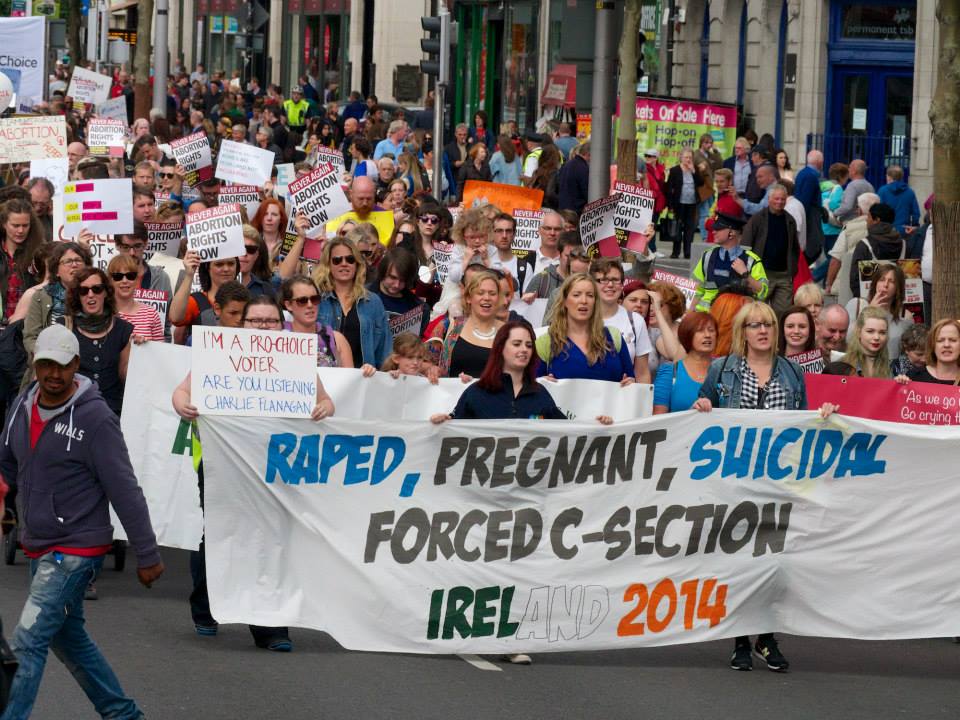
Front Rally Repeal 8th 23Aug2014
Front of the march on Saturday in Dublin (photo Andrew Flood)

Facebook organising and networking by pro-choice campaigning groups can produce quick mobilisation of substantial numbers of people. These people are already convinced. Most of the working class remains untouched by these mobilisations and certainly their overall outlook remains unchanged. If the pro-choice movement is to have its desires become reality, it needs to get out into the working class communities and promote its cause, hopefully recruiting from among those communities to better carry the message among their own. The movement needs to engage in dialogue with movements with a high percentage of people of working class background, such as – dare one say it? — the Irish Republican movement. The latter is, despite one very deep idealogical divide and the existence of a number of factions, the political opposition movement with the largest active participation of people of working class background. At the moment, the overall position of the movement is anti-choice but that is nowhere near as monolithic or as unassailable as it was even a decade ago.

The hope is that the necessary mobilisation will be done and that very soon the State will be forced to concede a referendum on the abolition of Amendment Eight. The hope is also that the necessary educational work will be done to achieve an overwhelming victory in that referendum. The activists in the movement need our support, men as well as women, in all of that.

End.

BERNADETTE McALLISKEY SPEAKING AT TRINITY COLLEGE

Diarmuid Breatnach

The auditorium in Trinity College on Friday 20th June was nearly empty at the advertised starting time for the lecture on “The Legacy of Power, Conflict and Resistance”. The start was delayed and more people came in but, by the time the speaker and the theme was introduced, the hall was still not full. That was surprising, because the speaker was Bernadette Mc Alliskey (nee Devlin), who had been at 18 years of age one of the leaders of the Civil Rights movement in the Six Counties (“Northern Ireland”), at 21 years of age elected MP for Mid-Ulster in 1969 and still, 45 years later, holding the record for the youngest woman ever elected to the British Parliament.

Bernadette Devlin circa 1968 or 1969.  She was elected MP on a People's Democracy ticket in 1969 but later classified herself as an "independent socialist".
Bernadette Devlin early 1969. She was elected MP on a People’s Democracy ticket in 1969 but later classified herself as an “independent socialist”.

The same year as her election, Bernadette went to the USA to gather support for the Civil Rights movement in a trip being used by others, rumouredly, to gather funds for arms. She shocked the conservative part of Irish USA, Ancient Order of Hibernians and Democratic Party political allies, by some of her statements and actions regarding blacks and chicanos and in visiting a Black Panthers project. Bernadette returned home to serve a short prison sentence after conviction for “incitement to riot” arising from her role in the defence of Derry against police (RUC and B-Specials) and Loyalist attack.

In 1972, during her five-year tenure as a Member of Parliament, enraged by his comments about the murder a few days previously of 13 unarmed protesters (a 14th died later of his wounds) by the Parachute Regiment in Derry, she stormed up to the then British Home Secretary and, in front of a full House of Commons, slapped him in the face. Bernadette had been there in Derry that terrible day – she was to have addressed the anti-internment march upon which the Paras opened fire.


The Tyrone woman was also a founder-member of the Irish Republican Socialist Party in 1974, which she left after failing to bring the armed organisation, the Irish National Liberation Army, under party control.  She continued to be a Left-Republican political activist, in particular campaigning against the treatment of Republicans on arrest and subsequently as prisoners in jail, in the H-Blocks Campaign.  She learned to speak Irish.  In January 1981, she and her husband Michael McAlliskey were the victims of an assassination attempt by a squad of the “Ulster Freedom Fighters” (a cover name for the Ulster Defence Association, which was not banned until 1992).  They both survived, though Bernadette had been shot seven times.


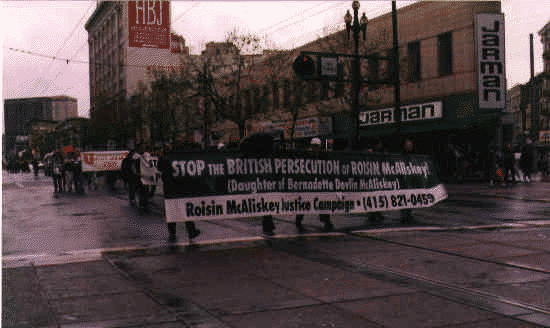
In 1996, while four months pregnant, Bernadette’s daughter was arrested on a German extradition warrant, charging her with being part of a Provisional IRA mortar attack on a British Army base in Osnabruck, Germany. Although taken to England, where a judge agreed to her extradition to Germany, a long and vigorous campaign fought by Roisín’s mother and her supporters eventually defeated the extradition and Roisín gave birth to a healthy daughter.

Recent portrait of Bernadette (Devlin) McAlliskey by Francis McKee
Bernadette's daughter was arrested twice on the same charge but vigorous campaigning impeded her extradition.  Photo shows banner resisting the earlier attempt.
Bernadette’s daughter was arrested twice on the same charge but vigorous campaigning impeded her extradition. Photo shows banner resisting the earlier attempt.


In 1998 and for some years after, Bernadette was an outspoken critic of Sinn Féin and of their direction in the “Peace Process”, which she saw as the party coming to accept British colonialism and Irish capitalism. In 2003 she was banned by the USA and deported, widely interpreted as being due to her speaking against the Good Friday Agreement, but continued her campaigning. However in 2007, another extradition warrant was issued for her daughter Roisín on the same charges as before and the young
woman became emotionally ill. The whole trauma was seen by many as a warning to Bernadette to cease criticising the “new dispensation” and subsequently she was seen to fade from the ranks of public critics of the GFA, Sinn Féin and of the treatment of Republican prisoners.

Bernadette remained active through working with migrants in a not-for-profit organisation in Dungannon. In recent years she has returned, on occasion, to the issues upon which she was so outspoken previously, for example standing surety for Marian Price’s bail to attend her sister Dolores’ funeral and speaking at the ceremony herself. Bernadette also spoke at the Bloody Sunday Commemoration/ March for Justice in January this year in Derry.

With a c.v. of that sort, one would reasonably expect a packed auditorium.

Bernadette Mc Alliskey on the platform upon which she had earlier spoken in February 2014 at a rally following the annual Bloody Sunday Commemoration/ March for Justice.

Bernadette has walked the walk and thought the thought too but she can also talk the talk. With one A4 sheet in front of her, she spoke for over an hour, hardly ever glancing at her notes. Her talk was as part of Trinity College’s MPhil Alumni Conference on ‘Power, Conflict, Resistance’ organised by the Department of Sociology for its Mphil course in “Race, Ethnicity and Conflict”.

Bernadette McAlliskey began her talk with the theme of fear of conflict, developing the thesis that this fear is inculcated in us from childhood, as conflict arises out of challenging power and hierarchy. She traced this further back to religious indoctrination where dogma is to be accepted without question and finds its reflection in all aspects of life but particularly in the political.

Talking about Tom Paine, who expounded the theory that human beings, each independently, are responsible for themselves, she stated that this is fundamental to citizenship. Some aspects of this self-responsibility are delegated to institutions when we live in large groups but any decisions made for us without our consent are “an usurpation”. Tom Paine was an English Republican, author of, among other works Common Sense (1776) and The Rights of Man (1791). He had to flee England because of disseminating his ideas, which were considered revolutionary in his time.


Much of Bernadette’s talk was given over to this theme, to the lack of consideration of women even by such as Tom Paine, and also to the racism spread by colonialism, which the Christian hierarchies condoned and even encouraged.

When she finished to sustained applause and took questions, there were two from people identifying themselves as Travellers, another from a person from an NGO working with migrants, another regarding anti-Irish racism in English colonial ideology and the continuing power of the Catholic Church in the education system.

One question seemed to throw her and she admitted that she found it difficult to answer. Ronit Lentin, Jewish author, political sociologist and critic of Israeli Zionism asked Bernadette was it not true that racism in the Six Counties came mostly from within Loyalism, allied to anti-Catholic sectarianism. Bernadette struggled in replying, at one point denying it and pointing to anti-Traveller discrimination in the ‘nationalist’ areas but following this up by observing that Travellers would only camp in or near ‘nationalist areas’ (presumably because the hostility in a ‘unionist area’ would be worse).

Bernadette then went on to recall the recent anti-Muslim remarks made by a prominent Belfast evangelist preacher, James McConnell, and how the First Minister of Stormont, Peter Robinson, had defended the evangelist’s right to free speech. Asked for his own opinion of Muslims, the First Minister had replied that he also distrusted them “if they are fully devoted to Sharia law” but would trust them to go to the shop for his groceries and to bring him back the correct change. All the examples Bernadette drew on, apart from the generalised one about Travellers in ‘nationalist’ areas, were in fact from the Unionist sector.

The final question was from an SWP activist who pointed out that the State does not admit to its institutional racism and often takes no action on racist attacks or denies that the motive for the attack was racism. The activist asked Bernadette how she thought racism can be dealt with in this context. She replied that the legal structures are there and should be used and persisted with.

It seemed a strange response from one who would have described herself in the past as a revolutionary. Earlier in her talk she herself had quoted the black Caribbean lesbian, Audre Lorde, who said that the instruments of the State could not be used to dismantle it (actually I.V. Lenin had made the same point in The State and Revolution in 1917, nor was he the first to do so). A revolutionary’s answer to that question would presumably have been that while the structures should be used in order to expose them that ultimately the capitalist State’s power is the enemy of unity among the people; disunity rather than unity among the people is in the interest of the system. Mobilisation of the people against racism and directing them towards the source of their ills, the capitalist system, and building solidarity in action, is the only realistic way forward. Perhaps Bernadette felt constrained by the academic environment in which she was speaking but that is not the answer she gave.

End.

Interesting retrospective piece on McAlliskey’s visit to the USA in 1969: http://www.historyireland.com/20th-century-contemporary-history/fidel-castro-in-a-miniskirt-bernadette-devlins-first-us-tour/

Interview with McAlliskey at a Scottish conference on radical independence https://www.youtube.com/watch?v=H4LdcnxMb9Q

THIRTEEN ROSES ….. AND 43 CARNATIONS

MILICIANAS 2

RAFAEL NARBONA

(Translation by Diarmuid Breatnach; original version published in Spanish in Rafael Narbona’s blog August 2013, also republished by kind permission in Rebel Breeze https://rebelbreeze.wordpress.com/2014/03/28/trece-rosas-y-43-claveles/)

On the morning of August 5th 1939 thirteen women were shot dead against the walls of the Eastern Madrid Cemetery.

Nine were minors, because at that time the age of majority was not reached until twenty-one. Ranging in age from 18 to 29, all had been brought from the Sales women’s prison, a prison that was designed for 450 people and in 1939 contained 4,000. Apart from Brisac Blanca Vazquez, all belonged to the Unified Socialist Youth (JSU) or PCE (Communist Party of Spain). Although they had not participated in the attack that killed Isaac Gabaldon, commander of the Civil Guard, they were charged with being involved and conspiring against the “social and legal order of the new Spain”.

The trial was held on August 3rd and 56 death sentences were issued, including the perpetrators of the attack. The Thirteen Roses went to their execution hoping to be reunited with their JSU comrades. In some cases it would have meant a boyfriend or husband but their hopes crumbled upon learning that the men had been shot already.

conesa

The brick wall clearly showed the bullet holes and the earth had been turned dark by blood. Some days, the death toll exceeded two hundred and machine guns were used to facilitate the work. Between 1939 and 1945, four thousand people were shot in the Eastern Cemetery, including Julián Zugazagoitia, Minister of the Interior with Juan Negrín and remarkable writer and socialist politician.

According to Maria Teresa Igual, prison officer and eyewitness, the Thirteen Roses died with fortitude. There were no screams or pleas. In an eerie half-silence, only the steps of the firing squad were heard, the sound of the guns striking the straps and the voice of the commanding officer. Lined up shoulder to shoulder, after the shooting all received the coup de grace, which was clearly heard in the Sales women’s prison. Apparently, one of the condemned (whether Anita or Blanca is not known), did not die immediately and had shouted, “Am I not to be killed?”

Antonia Torre Yela was spared execution by a typing error.  In transcribing her name, the letters danced and became Antonio Torres Yera. The error only postponed death for Antonia, a member of the JSU and only 18. She was shot on February 19th, 1940, becoming the 14th Rose. In her farewell letter, Julia Conesa, nineteen and member of the JSU, wrote: “Let my name not be erased from history.” Her name and that of her comrades has not been forgotten, unlike those of their tormentors, who enjoyed impunity for 38 years of dictatorship and a shameful amnesty which only helped to deepen the hurt suffered by all victims of Francoism.

The PSOE (main social-democratic party — DB) tried to appropriate the Thirteen Roses, concealing that at the time of the executions the PSOE had split from the JSU to found the Socialist Youth of Spain (JSE), with the purpose of clearly distancing themselves from the Communist Party of Spain (PCE). In fact, the Law of Historical Memory of Zapatero’s government (the first PSOE government after Franco — DB) did not even consider overturning the dictatorship’s judicial verdicts. It should be remembered that nearly fifty men were also shot dead that sad August 5th, the “43 Carnations”. Franco showed the same ruthlessness to men and women.

A hell

Sales jail was a hell, with children, elderly and mothers with children huddled in hallways, stairs, patios and bathrooms. Manuela and Teresa Basanta Guerra were the first women executed against the walls of the Eastern Cemetery. They shot them on June 29th 1939 along with a hundred men. Some historians claim that other women preceded them but their names were not recorded in the cemetery’s files. Like others on death row, the Thirteen Roses could only write to their families after receiving confession. If they did not take confession, they gave up the opportunity to say goodbye to their loved ones.

Brisac Blanca was the eldest of the thirteen and active in no political organization. Catholic and one who voted for the Right, she nevertheless fell in love with a musician who belonged to the PCE, Enrique Garcia Mazas. They married and had a son. Both were arrested and sentenced to death in the same trial. In fact, Enrique was in Porlier prison and would be shot a few hours before her. Blanca wrote a letter to her son Enrique, asking him not to harbour ill-will towards those responsible for her death and to become a good and hardworking man.

MILICIANAS 3

In postwar Madrid there was vicious persecution and resentment of any citizen suspected of “joining the rebellion”, the technicality that was used to reverse the law, accusing supporters of the Second Republic of violating the law in force. Only the military, the clergy, the Falange and the Carlists could breathe easily. No one dared to walk around in workers’ overalls or wearing the traditional local bandanna (worn by men around the neck and by women as a kerchief around the head, it is still worn today at festival in Madrid — DB).

The city was a huge prison where “hunt the red” was taking place. The earlier militia-women aroused particular animosity. The Arriba newspaper edition of May 16th 1939, featured an article by José Vicente Puente in which his contempt does not mince words: “One of the greatest tortures of the hot and drunk Madrid were the militia-women parading openly in overalls, lank-haired, with sour voice and rifle ready to shoot down and end lives upon a whim to satiate her sadism. With their shameless gestures, the primitive and wild, dirty and disheveled militiawomen had something of atavism, mental and educational. … …. They were ugly, low, knock-kneed, lacking the great treasure of an inner life, without the shelter of religion, within them femininity was all at once extinguished.”

In this climate of hatred and revenge, denunciations proliferated — they were the best means of demonstrating loyalty to the fascist Movement.

The interrogations …. copied Gestapo tortures

The interrogations in police stations copied Gestapo tortures: electric shock on the eyes and genitals, the “bathtub”, removing fingernails with pliers, mock executions. Women suffered especially because the torture was compounded by sexual abuse, castor oil and hair cut down to the scalp. In some cases they even shaved eyebrows to further depersonalize. Rapes were commonplace.  The testimony of Antonia Garcia, sixteen, “Antoñita” is particularly chilling: “They wanted to put electric currents on my nipples but since I had no chest they just put them in my ears and burst my eardrums. I knew no more. When I came to I was in jail. I spent a month in madness”.

Among those responsible for the interrogations was General Gutierrez Mellado, hero of the Transition and Captain in the Information Service of the Military Police (CPIS ) during the toughest years following the war. He regularly attended executions, seeking last-minute confessions. On August 6th 1939 he pulled Cavada Sinesio Guisado, nicknamed “Pioneer”, military chief of the JSU after the war, out of the execution line. “Pioneer” had been lined up against the Eastern Cemetery wall and was awaiting the discharge of lead along with the rest of his comrades. Gutiérrez Mellado stepped forward and ordered his release. He forced him to witness the executions and asked for more information about PCE clandestine activity. Although he was cooperative and diligent, he was shot in the end on September 15th. Some claim that Gutierrez Mellado witnessed the execution of the Thirteen Roses but I was not able to verify the data.

MILICIANAS 4

The women’s prison in Sales was run by Carmen Castro. Her inflexibility and lack of humanity found expression in the conditions of life of the children in prison with their mothers. No soap or hygienic facilities — almost all had ringworm, lice and scabies. Many died and were placed in a room where the rats were trying to devour the remains. Adelaida Abarca, JSU activist, said the bodies were only skin and bones, almost skeletons, for hunger had consumed them slowly. Another prisoner said: “The situation of the children was maddening. They were also dying and dying with dreadful suffering. Their glances, their sunken eyes, their continuous moans and stench are branded on my memory.” (Testimony given to Giuliana Di Febo in Resistance and the Women’s Movement in Spain [1936-1976] , Barcelona 1979).

The prisoners lived within the shadow of the “pit”, the death penalty. Since the execution of the Basanta Guerra sisters, they knew that the regime would have no mercy on women. On the morning when the Thirteen Roses were shot, Virtudes Gonzalez ‘s mother was at the jail doorway. When she saw her daughter climbing into the truck that was carrying prisoners to the cemetery walls, she began shouting: “Bastards ! Murderers ! Leave my daughter alone!” She chased the truck and fell. Alerted by the commotion, the Sales jail officers went outside and picked her off the ground, taking her into the prison. She was kept inside as yet another prisoner.

“If I had been sixteen they would have shot me too”

No less dramatic were Enrique’s repeated attempts to find out the whereabouts of his parents, Blanca and Enrique Garcia Brisac Mazas. In an interview with journalist Carlos Fonseca , author of the historical essay Thirteen Red Roses ( Madrid, 2005 ), Enrique gave his bitter account: “I was eleven years old when they shot my parents and my relatives tried to conceal it. They said they had been transferred to another prison and therefore we could not go to see them, until one day I decided to go to Salesas and there a Civil Guard Brigadier told me they had been shot and that if I had been sixteen they would have shot me too, because weeds had to be pulled up by the roots.

My grandmother and my aunts, my mother’s sisters, who had fallen out with my mother, ended up telling me that if Franco had killed my parents it would be because they were criminals. They even concealed my mother’s farewell letter for nearly twenty years.”

MILICIANAS 6

I will not end this article by invoking reconciliation, because the Transition was not based on repairing the pain of the victims, but rather on the acquittal of the executioners. In fact, the reform of the criminal dictatorship was designed by those as low as Manuel Fraga, Rodolfo Martín Villa and José María de Areilza. Martín Villa concealed and destroyed documents to bury the crimes of Francoism and the dirty war he organized against anarchist and pro-independence activists of the Basque, Catalan and Canaries areas, from his post as Minister of the Interior between 1976 and 1979. Among his achievements one should list the Scala case (an attack that killed four workers, which was blamed on the CNT), the attempted assassination of Canaries independence leader Antonio Cubillo, the machine-gunning of Juan Jose Etxabe, historic leader of ETA and his wife Rosario Arregui (who died from eleven bullet wounds), also the murder of José Miguel Beñaran Ordeñana, “Argala”.

The impunity of the perpetrators

He is now a successful businessman, who gets excited talking about his role in the Transition. He lives quietly and no one has called for his prosecution. His example is an eloquent one of the impunity of the perpetrators, who continue to write the narrative while demonizing those who dared to stand against the miseries of the dictatorship and false democratic normalization.

No justice has been done. So it is absurd to talk of reconciliation, because nobody has apologized and repaired the damage. Franco committed genocide but today Manuel Gonzalez Capón, Mayor of Baralla (Lugo), of the Partido Popular (the main right-wing party), dares to declare that “those who were sentenced to death by Franco deserved it.” The Biographical Dictionary of the Royal Academy of History, funded with nearly seven billion euros of public funds, says Franco “set up an authoritarian but not totalitarian regime”, although in his speech in Vitoria/ Gastheiz, Franco himself said that “a totalitarian state in Spain harmonises the functioning of all abilities and energies of the country …”. The current scenario is not a reconciliation but instead is a humiliation of the victims and society, obscenely manipulated by a media (ABC, El País , El Mundo, La Razón), playing a similar role to newspapers of the dictatorship (ABC, Arriba, Ya, Pueblo, Informaciones, El Alcázar), covering up and justifying torture cases and applauding antisocial measures that continue reducing working class rights.

Let us not remember the Thirteen Roses as passive and submissive but instead for their courage and determination. With the exception of Blanca, trapped by circumstances, all chose to fight for the socialist revolution and the liberation of women. I think that if they were able to speak out today, they would not talk of indignation and peaceful disobedience, but would ask for a rifle to stand in the vanguard of a new anti-fascist front, able to stop the crimes of neo-liberalism. Let us not betray their example, forgetting their revolutionary status, they who sacrificed their lives for another world, one less unjust and unequal.

rosario dinamitera

TRECE ROSAS …. Y 43 CLAVELES

MILICIANAS 2

RAFAEL NARBONA
(originalmente publicado en su blog Agosto 2013)

(Encabezemientos por Rebel Breeze)
(versión traducido al inglés aquí https://rebelbreeze.wordpress.com/2014/03/28/thirteen-roses-and-43-carnations/)

La madrugada del 5 de agosto de 1939 fueron fusiladas trece mujeres en las tapias del Cementerio del Este de Madrid.

Nueve eran menores de edad, pues en aquellas fechas la mayoría no se alcanzaba hasta los 21. Con edades comprendidas entre los 18 y los 29, todas procedían de la cárcel de mujeres de Ventas, una prisión que fue concebida para 450 personas y que en 1939 albergaba a 4.000.

Salvo Blanca Brisac Vázquez, todas pertenecían a las Juventudes Socialistas Unificadas (JSU) o al PCE. Aunque no habían participado en el atentado que costó la vida a Isaac Gabaldón, comandante de la Guardia Civil, se las acusó de estar implicadas y de conspirar contra “el orden social y jurídico de la nueva España”. El juicio se celebró el 3 de agosto y se dictaron 56 penas de muerte, que incluían a los autores materiales del atentado. Las Trece Rosas acudieron a su ejecución con la esperanza de reencontrarse con sus compañeros de las JSU. En algunos casos se trataba del novio o el marido, pero sus expectativas se desmoronaron al saber que ya habían fusilado a los hombres.

conesa

La tapia de ladrillo visto mostraba claramente los agujeros de bala y la tierra se había vuelto negra por culpa de la sangre derramada. Algunos días, el número de  víctimas superaba los dos centenares y se empleaban ametralladoras para facilitar el trabajo. Entre 1939 y 1945 se fusiló a 4.000 personas en el Cementerio del Este, incluido Julián Zugazagoitia, Ministro de la Gobernación con Juan Negrín y notable escritor y político socialista.

Según María Teresa Igual, testigo presencial y funcionaria de prisiones, las Trece Rosas murieron con entereza. No se produjeron gritos ni súplicas. En mitad de un silencio sobrecogedor, sólo se escuchaban los pasos del piquete de ejecución, el sonido de los fusiles al chocar contra los correajes y la voz del oficial al mando. Alineadas hombro con hombro, todas recibieron un tiro de gracia después de la  descarga, que se oyó nítidamente en la cárcel de mujeres de Ventas. Al parecer, una de las condenadas (no sé sabe si Anita o Blanca), no murió en el acto y gritó: “¿Es que a mí no me matan?”

Antonia Torre Yela se libró de la ejecución por un error mecanográfico. Al transcribir su nombre, bailaron las letras y se convirtió en Antonio Torres Yera. El error sólo aplazó el fin de Antonia, militante de las JSU y con sólo 18 años. Fue fusilada el 19 de febrero de 1940, transformándose en la “Rosa” número 14.

En su carta de despedida, Julia Conesa, diecinueve años y afiliada a las JSU, escribió: “Que mi nombre no se borre de la historia”. Su nombre y el de sus compañeras no ha caído en el olvido, pero sí el de sus verdugos, que disfrutaron de la impunidad de 38 años de dictadura y de una vergonzosa amnistía que sólo contribuyó a profundizar el agravio de todas las víctimas del franquismo.

El PSOE intentó apropiarse de las Trece Rosas, ocultando que en el momento de la ejecución ya se había desligado de las JSU para fundar las Juventudes Socialistas de España (JSE), con el propósito de manifestar su alejamiento del PCE. De hecho, la Ley de Memoria Histórica del gobierno de Rodríguez Zapatero ni siquiera se planteó anular los juicios de la dictadura.

Conviene recordar que ese triste 5 de agosto se fusiló además a casi medio centenar de hombres, los 43 Claveles. El franquismo mostró la misma crueldad con hombres y mujeres.

Un infierno

De hecho, la cárcel de Ventas era un infierno, con menores, ancianas y madres con hijos, hacinadas en pasillos, escaleras, patios y baños. Manuela y Teresa Guerra Basanta fueron las primeras mujeres ejecutadas en las tapias del Cementerio del Este. Se las fusiló el 29 de junio de 1939, con un centenar de hombres. Algunos historiadores sostienen que otras mujeres las precedieron, pero sus nombres no figuran en los archivos del cementerio.

Al igual que otras condenadas a muerte, las Trece Rosas sólo pudieron escribir a sus familias después de confesarse. Si no lo hacían, perdían la oportunidad de despedirse de sus seres queridos.

Blanca Brisac era la mayor de todas y no militaba en ninguna organización política. Era católica y votaba a la derecha, pero se enamoró de un músico que pertenecía al PCE, Enrique García Mazas. Se casaron y tuvieron un hijo. Ambos fueron detenidos y condenados a muerte en el mismo proceso. De hecho, Enrique se hallaba en la Cárcel de Porlier y sería fusilado unas horas antes. Blanca le escribió una carta a su hijo Enrique, pidiéndole que no guardara rencor hacia los responsables de su muerte y que se convirtiera en un hombre bueno y trabajador.

MILICIANAS 3

En el Madrid de la posguerra, se persiguió con saña y encono a cualquier ciudadano sospechoso de “adhesión a la rebelión”, el tecnicismo jurídico que se empleó para invertir la ley, acusando a los partidarios de la Segunda República de atentar contra la legalidad vigente. Sólo los militares, los curas, los falangistas y los requetés podían respirar tranquilos. Ya nadie se atrevía a pasear con un mono de obrero o un pañuelo castizo. La ciudad era una enorme cárcel donde se ejercía la “caza del rojo”.

Las antiguas milicianas despertaban una especial inquina. En el diario Arriba, el 16 de mayo de 1939 aparece un artículo de José Vicente Puente, que no escatima palabras de desprecio: “Una de las mayores torturas del Madrid caliente y borracho del principio fue la miliciana del mono abierto, de las melenas lacias, la voz agria y el fusil dispuesto a segar vidas por el malsano capricho de saciar su sadismo. En el gesto desgarrado, primitivo y salvaje de la miliciana sucia y desgreñada había algo de atavismo mental y educativo. […] Eran feas, bajas, patizambas, sin el gran tesoro de una vida interior, sin el refugio de la religión, se les apagó de repente la feminidad”. En ese clima de odio y venganza, proliferaban las denuncias, pues eran el mejor recurso para demostrar la adhesión al Movimiento.

Torturas copiadas de la Gestapo

Los interrogatorios en las comisarías se basaban en torturas copiadas de la Gestapo: descargas eléctricas en los ojos y los genitales, la bañera, extracción de las uñas con alicates, simulacros de ejecución. Las mujeres sufrían especialmente, pues a las torturas se sumaban las vejaciones sexuales, el aceite de ricino y el corte del pelo al cero. En algunos casos, se les afeitaban incluso las cejas para despersonalizarlas aún más. Las violaciones eran moneda corriente. Es particularmente escalofriante el testimonio de Antonia García, de dieciséis años, “Antoñita”: “Me quisieron poner corrientes eléctricas en los pezones, pero como no tenía apenas pecho me los pusieron en los oídos y me saltaron los tímpanos. Ya no supe más. Cuando volví en mí estaba en la cárcel. Estuve un mes trastornada”.

Entre los responsables de los interrogatorios, se encontraba el general Gutiérrez Mellado, héroe de la Transición y capitán del Servicio de Información y Policía Militar (SIPM) durante los años más duros de la posguerra. Solía ser un testigo habitual de las ejecuciones, buscando confesiones de última hora. De hecho, el 6 de agosto de 1939 sacó de la hilera de condenados a Sinesio Cavada Guisado, “Pionero”, jefe militar de las JSU al acabar la guerra. “Pionero” había sido alineado en la tapia del Cementerio del Este y esperaba la descarga de plomo con el resto de sus compañeros. Gutiérrez Mellado se adelantó y ordenó su liberación. Le obligó a presenciar el fusilamiento y le pidió más información sobre la actividad clandestina del PCE. Aunque se mostró colaborador y diligente, el 15 de septiembre sería finalmente fusilado. Algunos afirman que Gutiérrez Mellado presenció la ejecución de las Trece Rosas, pero no he conseguido verificar el dato.

MILICIANAS 4

La cárcel de mujeres de Ventas estaba dirigida por Carmen Castro. Su intransigencia y falta de humanidad se reflejaba en las condiciones de vida de los niños encarcelados con sus madres. Sin jabón ni medidas de higiene, casi todos tenían tiña, piojos y sarna. Muchos morían y eran depositados en una sala, donde las ratas intentaban devorar los restos. Adelaida Abarca, militante de las JSU, afirma que los cadáveres sólo eran huesos y piel, casi esqueletos, pues el hambre los había consumido poco a poco. Otra reclusa afirma: “La situación de los niños era enloquecedora. También estaban muriendo y muriendo con un sufrimiento atroz. Tengo clavadas sus miradas, sus ojitos hundidos, sus quejidos continuos y su olor pestilente” (Testimonio recogido por Giuliana Di Febo en Resistencia y movimiento de Mujeres en España [1936-1976], Barcelona 1979).

Las presas convivían con la “pepa”, la pena de muerte. Desde la ejecución de las hermanas Guerra Basanta, sabían que el régimen no tendría misericordia con las mujeres. La madrugada en que fusilaron a las Trece Rosas se hallaba en la puerta de la cárcel la madre de Virtudes González. Cuando vio cómo subían a su hija al camión que trasladaba a las reclusas a las tapias del cementerio, comenzó a gritar: “¡Canallas! ¡Asesinos! ¡Dejad a mi hija!”. Corrió detrás del camión y cayó de bruces. Alertadas por el escándalo, las funcionarias de la cárcel de Ventas salieron al exterior y la recogieron del suelo, introduciéndola en la prisión. Quedó ingresada como una reclusa más.

“Si yo hubiera tenido dieciséis años también me habrían fusilado a mí”

No fueron menos dramáticos los reiterados intentos de Enrique de averiguar el paradero de sus padres, Blanca Brisac y Enrique García Mazas. En una entrevista con el periodista Carlos Fonseca, autor del ensayo histórico Trece Rosas Rojas (Madrid, 2005), Enrique cuenta sus amargas peripecias: “Yo tenía once años cuando fusilaron a mis padres y mi familia trató de ocultármelo. Me decían que habían sido trasladados de prisión y por eso no podíamos ir a verlos, hasta que un día fui decidido a las Salesas y allí un Brigada de la Guardia Civil me dijo que los habían fusilado, y que si yo hubiera tenido dieciséis años también me habrían fusilado a mí, porque las malas hierbas había que arrancarlas de raíz. Mi abuela y mis tías, hermanas de mi madre, con quien estaban enemistadas, llegaron a decirme que si Franco había matado a mis padres sería porque eran unos criminales. Incluso me ocultaron durante casi veinte años la carta de despedida de mi madre”.

MILICIANAS 6

No voy a terminar este artículo invocando la reconciliación, pues la Transición no se basó en la reparación del dolor de las víctimas, sino en la absolución de los verdugos. De hecho, la Reforma de la dictadura fue diseñada por criminales tan abyectos como Manuel Fraga, Rodolfo Martín Villa y José María de Areilza. Martín Villa ocultó y destruyó documentos para enterrar los crímenes del franquismo y organizó la guerra sucia contra anarquistas e independentistas vascos, catalanes y canarios desde su cargo de Ministro de la Gobernación entre 1976 y 1979. Entre sus hazañas, hay que mencionar el caso Scala (un atentado atribuido a la CNT que causó la muerte de cuatro trabajadores), el intento de asesinato del líder independentista canario Antonio Cubillo, el ametrallamiento de Juan José Etxabe, dirigente histórico de ETA, y su esposa Rosario Arregui (que murió a consecuencia de once balazos), y el asesinato de José Miguel Beñaran Ordeñana, “Argala”.

La impunidad de los verdugos

Ahora es un empresario de éxito, que se emociona hablando de su papel en la Transición. Vive tranquilamente y nadie ha planteado su enjuiciamiento. Su ejemplo es una muestra elocuente de la impunidad de los verdugos, que siguen escribiendo la historia, mientras demonizan a los que se atrevieron a resistir contra las miserias de la dictadura y de una falsa normalización democrática.

No se ha hecho justicia. Por eso, es absurdo hablar de reconciliación, pues nadie ha pedido perdón ni se ha reparado el daño causado. El franquismo cometió un genocidio, pero hoy mismo Manuel González Capón, alcalde de Baralla (Lugo) por el PP, se atrevía a declarar que “los que fueron condenados a muerte por Franco se lo merecían”.

El Diccionario Biográfico de la Real Academia de la Historia, costeado con casi siete millones de euros de fondos públicos, afirma que Franco “montó un régimen autoritario, pero no totalitario”, pese a que en el Discurso de la Victoria el propio Franco afirmó que “un estado totalitario armonizará en España el funcionamiento de todas las capacidades y energías del país…”. El actual Estado español no es un escenario de reconciliación, sino de humillación de las víctimas y de la sociedad, obscenamente manipulada por unos medios de comunicación (ABC, El País, El Mundo, La Razón) que desempeñan un papel semejante a los periódicos de la dictadura (ABC, Arriba, Ya, Pueblo, Informaciones, El Alcázar), encubriendo y justificando los casos de torturas y aplaudiendo las medidas antisociales que no cesan de restar derechos a la clase trabajadora.

No recordamos a las Trece Rosas por su pasividad y sumisión, sino por su coraje y determinación. Salvo Blanca, atrapada por las circunstancias, todas eligieron luchar por la revolución socialista y la liberación de la mujer. Creo que si hoy pudieran alzar su voz, no hablarían de indignación y desobediencia pacífica, sino que pedirían un fusil para ocupar la vanguardia de un nuevo frente antifascista, capaz de frenar los crímenes del neoliberalismo. No malogremos su ejemplo, olvidando su condición de revolucionarias que inmolaron sus vidas por un mundo menos injusto y desigual.

rosario dinamitera

 Agosto 2013