DYSLEXIA – A COUNTRY WHERE SURPRISE IS EXPECTED

Diarmuid Breatnach

(The author is known as a traveller to many exotic places, including expeditions in search of mythical lands, most famously “The United Kingdom”, the “Republic”, “Norn Ireland” and “The Mainland.” Here he writes about the land of Dyslexia).

Dyslexia is, as the suffix “-ia” suggests, a country …. think of India, Mongolia, Russia, California [now relegated to a vassal state], Hibernia [also something of a vassal state], Narnia [er .. no, that is an imaginary land in a series of children’s tales]. The existence of Dyslexia strangely was not even suspected until 1881, when Oslawd Khanber claimed to have visited the land. His discovery was widely doubted until confirmed by Ludorf Linber in 1887. The people of this newly-discovered land were distinguished by all having a difficulty to varying degrees in spelling and/or in remembering sequences of numbers. Khanber and Linber both named this land (and the rest of the world agreed) “Dyslexia”, from the Greek root “dys” meaning “bad/ abnormal/ difficult” and “lex” meaning “word” (although in Latin it means “law”, understood as “written word”).

Dyslexia was, like many other lands and people, not named by the natives themselves, but by people from elsewhere. Such examples abound, for example “Australia”, “America”, “Scotland”, “Eskimo”, “Teddy Boys”, “Pagans”, “Celts”, “Saxons”, “Teagues”, “Gypsies”, “E.T.s” etc. Attempts to identify what the Dyslexics themselves called their land have so far collapsed in confusion, with different spellings and even pronunciations hotly argued for against others.

In fact, there have been accusations of racism aimed at those who named the land “Dyslexia” and the people “Dyslexics” — it seems particularly cruel to create a word itself so difficult to spell to name a people with a known disability in spelling. Previously, Dyslexics just called themselves “people” and the land “the land”, while those who came across migrants from there before Dyslexia was actually discovered called them other names such as “stupid”, “slow”, “thick” or “people with ADD or ADHD” (1) . However, most “Dyslexics” today have not only adopted the name and learned to spell it but are wont to proudly declare “I’m Dyslexic” (but rarely “I am a Dyslexic”).

When Dyslexia came to the attention of the rest of the World no-one seemed astonished that it should be discovered long after the North and South Poles, the Mariana Trench, the Matto Grosso Plateau and indeed a great number of planets. What did astonish the World was that Dyslexia had apparently independently within its borders invented television, radio, Ipads, microwave ovens, central heating and hot showers and of course the internal combustion engine and nuclear power.

This proliferation of technology would have been normally amazing (if anything normal can be said to be amazing, or vice versa) in a previously undiscovered country but what was really, really amazing was that everyone in Dyslexia had overcome a disability to climb to such industrial heights. The obstacles must have been tremendous. Imagine confusing, for example, sodium chloride, a common table salt, with sodium chlorate, which is used as a weedkiller (and also as an ingredient in making home-made bombs, a curious fact since nitrogenous fertiliser, with a directly opposite effect to sodium chlorate when spread on weeds, is also sometimes used in making home-made bombs). Anyway, shake sodium chloride in small quantities on your weeds and they probably won’t like it but most will survive – especially those that actually like a little of it, like relatives of the cabbages and such. Shake a little sodium chlorate on your food, however and …. well …. no, don’t try it – without urgent and skilled medical attention you will die quickly and painfully. For another example, imagine confusing “defuse” with “diffuse”: one goes to de-escalate a conflict and ends up spreading it around. Other confusions are possible between the noun or verb “ware”, the (usually) adverb “where” and the past tense verb “were”. And so on.

For physics, knowledge of and accuracy in mathematics is essential – algebra, logarithms, binary codes, sines and co-sines, square roots (these last are mathematical constructs, not mythical regulated-shape carrots as propagated by anti-EU campaigners). In calculating distances, heights and depths, spaces and circumferences, ability in geometry, trygonometry and ordinary mathematics is required. Somehow, the Dyslexics, the inhabitants of Dyslexia, had overcome their disability or compensated for it in some way, so that they had as flourishing and environment-poisoning an industrial society as the most developed parts of the world, such as the United States of America (most developed industrially, that is).

Dyslexics are said, despite this disability with letters and numbers, to be of above-average intelligence. They had to be, to develop all those complicated benefits of industrial society despite their handicap.

Strangely, one may think, many Dyslexics have become literary figures famous throughout the world, Hans Christian Andersen, Agatha Christie, F. Scott Fitzgerald and WB Yeats among them. Contrary to popular belief among non-natives, James Joyce was not from Dyslexia. This prevalence of Dyslexics among so many giants of literature and indeed of virtually every other field of human endeavour has given rise to a group of Dyslexians who call their disability “the gift of Dyslexia”.

The Dyslexics are often garrulous and sociable and this is especially true when in Dyslexia itself. The difficulty in remembering telephone numbers for example makes every telephone call an adventure. Say a native wished to phone another native called Cathy (also known as Cthy, or Ktay, Thyca etc), and the phone number was 731 1062 (please note, this is an imaginary telephone number by which Cathy or no-one else can be reached). The Dyslexic might phone 371 1026 – all the correct digits but in a different order (note, this also is an imaginary telephone number by which no-one may be reached).

The conversation, somewhat simplified, might go like this: “Yes, hello?” (female voice, breathless with anticipation of another adventure).

Our caller: “Hi, is that Cathy?”

Recipient (giggling): “No, it’s not. There isn’t any Cathy here. I’m Wanda.”

Our caller: “Oh, hi Wanda, you sound very nice. How about going on a wanda with me?”

Wanda (with a little giggle but playing cautious): “Maybe …. What’s your name?”

Our caller: “Terry.”

Wanda: “Where were you thinking of wandering with me?” (A moment’s pause while both mentally translate the last part of that into “wandering on me”).

Terry (clearing his throat which has suddenly gone dry): “Well, there’s a nice new Indian restaurant opened up in town. Do you like Indian food, Wanda?”

“Ohhh, Terry, I love it. So spicy!” (Very slight pause as both translate “spicy” as a description for food flavouring into a metaphor instead). “When were you thinking of?”

“Er … tonight too soon?”

“No, I happen to be free tonight.”

“Shall I come and pick you up? Say …. seven pm?”

“That would be lovely, Terry. I live off the Trans City Road, tenth left, first right, eighth left, in Hopeful Street, the seventh house on the left-hand side if you’re coming from town, with a brown and white door and a hydrangea bush in the garden.”

“Got it – tenth left off the Trans City Road, tenth left, first right, eighth left, Hopeful Street, seventh house on the left-hand side, brown and white door and a hydrangea bush in the garden. At seven pm. I’m looking forward to meeting you.”

Most Dyslexics are always open to adventure, ‘going with the flow’. One never knows what a simple telephone call may bring or to what an appointment or written address may lead. But as a result, Dyslexics are also philosophic about missed appointments, forgotten birthdays and so on; they waste little time mourning something lost and instead look forward to something gained. Terry might or might not make it to Wanda’s but they both know the world is full of other possibilities. Cathy, for example, who failed to receive a call from Terry to congratulate her on her gaining a dystinction in her dyploma, received later that evening what non-natives would term “a wrong number” call from a Sofia who had meant to call a Geraldine. Sofia had intended trying to patch up a long-running difficult relationship with Geraldine and instead found herself making the aquaintance of Cathy, who seemed much nicer and more understanding than was Geraldine. Sofia soon put her problems with Geraldine aside and agreed to Cathy’s suggestion that they meet for a late coffee (which they both knew could lead to an early drink and who-knows-what from there). Cathy had by now forgotten that she was hoping Terry would call.

Dyslexia is not just another land, nor even just a strange one – it’s an entirely different way to live.

end

Footnotes:

1.   A supposed disability the existence of which is hotly debated but has exonerated many teachers accused of bad teaching methods and states accused of having too large classes in their schools and which has been profitable for some educational psychologists and extremely so for some chemical companies.
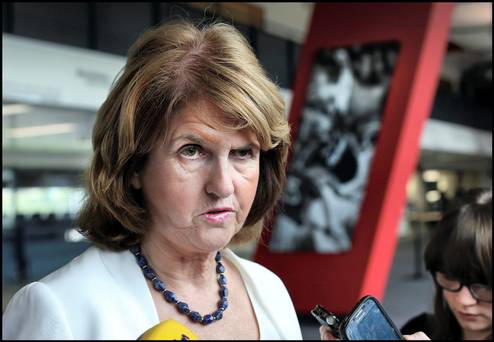

DEAR MINISTER

Dear Minister for Social Protection, Joan Burton,

Joan Burton, Labour Party TD, Minister for Social Protection in Fine Gael/ Labour coalition Irish Government.

I thought I should write to you to express my appreciation of your standing up to that bully Joan Collins and that baying mob of reds and general hooligans that is always howling for the blood of those few, like yourself, who are willing to stand up and tell a few home truths.

You were quite right to point out that videos hostile to the Gardaí were being posted on the Internet by people who had access to expensive mobile phones and Ipads. Some of these are obviously professional red agitators (in the old days, we could be sure that they were receiving funding from Soviet Russia but it’s harder to say where they get their money from these days).

Other people filming and posting are bound to be ne’erdowells who’d rather spend their money on these Ipads and things rather than pay their water bills like good citizens. They probably have expensive television sets on which they’re watching the news too, not only RTÉ but “alternative” media, such as that muck-raking “Democracy Now!”. To be honest, I’ve wondered sometimes whether it was wise to educate the working classes but now, sure one doesn’t have to be able to read to watch videos and news reports, does one?

And attacking the poor Gardaí, who are only doing their job! Their critics say that they don’t deal effectively with crime in working class areas but turn out in big numbers to police protests.  That is clearly nonsense.  Why, I had a burglar alarm tripped in my Killiney Hill residence the other day and two squad cars were there within four minutes! It was a false alarm, but still ….. Some people say that if the Gardaí weren’t behaving badly, they wouldn’t be giving their critics anything to put on the Internet, but that’s not the point. Sure you can’t deal with the kind of people who live in places like Darndale or Clare Hall without being a little robust – it’s what they understand, what they practice among themselves. It’s only the Gardaí being culturally sensitive, if you like. But who likes doing his job while being videoed (well, film stars maybe … and celebrities … and politicians, maybe)?

Joan Collins TD
Joan Collins, TD (elected Member of Irish Parliament), many years a socialist community activist.

As for your one, that Joan Collins? A postal clerk, I ask you! What can a postal clerk know about what it takes to run a country? Not like yourself, now, having previously worked as a lecturer in accountancy. But getting back to that Collins …. sure looking at her history is like a career in far-left organisations – the Socialist Party, People Before Profit, the United Left Alliance, and now in the United Left, with that other red get, Clare Daly.

The Collins woman has no sense of propriety or occasion. Did she not give Bertie Ahern a tongue-lashing as he was being interviewed on TV on the day of his resignation outside the Dáil! “Shame on you!” she shouted at him; no, shame on her! I know you’ll agree with me here, although the Soldiers of Destiny party has never been one of our closest friends. Poor Bertie had put in years of service as a TD and Taoiseach and was entitled to his pension of €135,000 (and he hadn’t even been condemned by the Mahon Tribunal yet)! I hope he has opened a bank account since, as with rising crime, stuffing money under the mattress is no longer a safe option.

But forgive me, I’m drifting off the point. I just wanted to say “fair play” to you for speaking the truth and standing up to that red rabble-rouser Collins. And if you ever get around to banning the trouble-makers from carrying mobile phones or from putting such provocative videos up on the Internet, you’ll have my full support. Our democracy needs to be protected from people like them.

Respectfully,

Shleevy N. Fawning

Video of exchange between the two Joans in the Dáil in which the Minister makes comments about protesters with “expensive Ipads”: https://www.youtube.com/watch?v=y6RmC9a82P8

Sorry, Your Majesty

Queen Elizabeth II Delivers Annual SpeechYour Most Exalted Majesty, Queen of the United Kingdom of Britain and Northern Ireland, Commander-in-Chief of the UK Armed Forces, Head of the Church of England, Queen of the Commonwealth.

We trust this letter finds your Highness well, as we do also with regard to Your Highness’ large family and of course your trusted corgis.


I am tasked with writing to yourselves in order to make some embarrassing admissions and to ask your Royal forgiveness.


No doubt your family carries the memory of an uprising in Dublin in 1916? Yes, of course one’s family does, as your Highness says. Well …. the embarrassing thing is this ……. it’s so difficult to say but no amount of dressing up is going to make it better so I’d best just come out with it: that was us. Yes, it’s true.


Not just us, of course. There were a load of Reds in green uniforms too, Connolly and Markievicz’s lot. And of course our female auxiliaries, and the youth group. But most of that rebellious band was us, the Irish Volunteers. I can’t adequately express to your Highness how ashamed we are of it all now. Your government of the time was quite right to authorise the courts-martial of hundreds of us and to sentence so many to death. Your magnanimity is truly astounding that only fifteen were shot by firing squads and that Casement fellow hanged.


But were we grateful? Not a bit of it! Does your Highness know that some people still go on about that Red and trade union agitator, James Connolly, being shot in a chair? What would they have your Army do? Shoot him standing up? Sure he had a shattered ankle and gangrene in his leg! One can’t please some people – damned if one does something and damned if one doesn’t. If the Army hadn’t kindly lent him a chair, those same people would be saying that the British wouldn’t even give him a chair to sit on while they shot him.

And how did we repay your Highness’ kindness and magnanimity in only executing sixteen? And in releasing about a thousand after only a year on dieting rations? By campaigning for independence almost immediately afterwards and starting a guerrilla war just three years after that Rising! A guerrilla war that went on for no less than three years. Your Majesty, we burn with shame just thinking of it now!

Our boys chased your loyal police force out of the countryside, shot down your intelligence officers in the streets of Dublin, ambushed your soldiers from behind stone walls and bushes ….. but still your Highness did not give up on us. Some people still go on and on about the two groups of RIC Auxiliaries and the things they did, referring to them by the disrespectful nicknames of “Black and Tans” (after a pack of hunting dogs) and “Auxies”. They exaggerate the number of murders, tortures, arson and theft carried out by them. Of course, your Highness, we realise now, though it’s taken a century for us to come to that realisation, that sending us that group of police auxiliaries was a most moderate response by yourself. But we were too blind to see that then and shot at them as well!

And that fellow Barry and his Flying Column of West Cork hooligans, wiped out a whole column of them. Your Highness will no doubt find it hard to believe this, but some troublemaker even went so far as to compose a song in praise of that cowardly ambush! Oh yes, indeed! And some people still sing it today – in fact they sing songs about a lot of regrettable things we did, even going back as far as when we fought against your Royal ancestors Henry and Elizabeth 1st! Truly I don’t know how your Highness keeps her patience.

Then we went on and declared a kind of independence for most of the country but …. some of us weren’t even satisfied with that! It was good of you to have your Army lend Collins a few cannon and armoured cars to deal with those troublemakers.

And then some time later, even after those generous loans, some of us declared a Republic and pulled the country (four fifths of it, at any rate), out of the Commonwealth. Left the great family of nations that your Highness leads! Words fail me ….well almost, but I must carry on, painful though it is to do so. A full confession must be made – nothing less will do. And then, perhaps …. forgiveness.

Of course your government held on to six counties …. You were still caring for us, even after all our ingratitude! It was like hanging on to something left behind by someone who stormed off in an argument – giving them an excuse to come back for it, so there can be a reconciliation. How incredibly generous and far-sighted of your Majesty to leave that door open all that time!

Fifty years after that shameful Rising, it was celebrated here with great pomp and cheering, even going so far as to rename railway stations that had perfectly good British names, giving them the names of rebel leaders instead. Then just a few years later, some of our people up North started making a fuss about civil rights and rose up against your loyal police force, forcing your government to send in your own Army. And was that enough for the trouble-makers? Of course not – didn’t they start a war with your soldiers and police that lasted three decades!


No doubt your Majesty will have noted that some of those troublemakers have changed their ways completely and are in your Northern Ireland government now. They’ve been helping to pass on the necessary austerity measures in your government’s budgets, campaigning for the acceptance of the police force and for no protests against yourself. Indeed, their Martin McGuinness has shaken your hand and rest assured were it not considered highly inappropriate and lacking in decorum, he would have been glad to kiss your cheek, as he did with Hillary Clinton when she visited. Or both cheeks, in your Majesty’s case! Your Majesty can see, I hope, that we can be reformed.


Our crimes are so many, your Highness; and we have been so, so ungrateful. But we were hoping, after you’d heard our confession, our humble apologies, after your Highness had seen how desperately sorry we are, that you’d forgive us. And if it’s not too much to hope for, that you’d take us back into the United Kingdom. Reunite us with those six counties, and so into the Commonwealth. Is there even a tiniest chance? Please tell us what we have to do and we’ll do it, no matter how demeaning. Please?


Your most humble servant,

P. O’Neill Jnr.

LETTER TO MEMBER NY ST. PATRICK’S DAY PARADE COMMITTEE

To: Patrick Brian Boru Murphy                                             From: Cornelius McSclawvey,
NY St. Patrick’s Day Parade Committee                                            Teernagoogh.
New York.                                                                                                  Republic of Ireland.

20th March 2014.

Re. invitation to PSNI to march in NY Parade


Dear Patrick Brian Boru Murphy,

I’m so sorry to hear of all the abuse you had to endure over your Committee’s decision to invite the Police Service of Northern Ireland to participate in the NY City’s Parade this year. To be honest, it was an overdue decision – even Sinn Fein accepted the PSNI years ago!  And of course urged your Committee to stand by the invitation — fair play to them although I’ve never liked them, I have to say.

But just who do these yobbos think they are? Those Irish-Americans who objected are living behind the times. And the gall of them to remind you of Peter King, selected Grand Marshall for the 1985 NY Parade, visiting IRA man Joe Doherty when he was in NY jail fighting extradition back to the UK! And the Philadelphia Parade committee making the same Joe Doherty Grand Marshall of their Parade back in 1989. Sure are we not all permitted a mistake or two in our lives?

Of course it was from the Irish Consulate that the suggestion first came to invite the PSNI. Some people, like that Larry Kirwan (of “Black ’47” musical notoriety), accused the Consulate of catering only for the rich Irish-Americans, the lace-curtain crowd. Yes, he did – he even put it in one of his books! Or so I’ve been told – I wouldn’t waste my time reading any of his rubbish. What’s wrong with lace curtains anyway? They let in light and keep your nosy neighbours’ eyes out – not that any neighbours live on our couple of acres of garden anyway, but still …

The cheek of that Wexford blow-in! And even if it were true, aren’t the successful Irish-Americans the ones who really matter? The likes of the Kennedys, O’Neill and even Republicans like Reagan (I mean the US political party), the ones who made — and keep on making – the USA great! Sure you couldn’t expect a country’s consulate to be looking out for the likes of building workers, bar and hotel staff, nurses and nannies! And even computer programming is pretty run of the mill these days.

Anyway, the Consulate lobbies for more green cards for Irish migrants, allowing them to emigrate to the USA legally, helping to sustain the economy back home through relieving us of paying them social welfare benefits and allowing them to earn money to send back home instead. Of course we know there are not enough green cards and a lot will still be illegal migrants but what can one do? And no doubt that helps keep the wages down … and stops them going on demonstrations and the like ….

Sorry, I’ve been drifting off topic. Your critics have been saying that the PSNI are just the RUC under a different name – that they are the same repressive and sectarian force as always. Well, maybe, but some things we have to just grin and bear, don’t we? And as for repression, sure they’re only persecuting dissidents, people who don’t agree with the Good Friday Agreement. The dissidents say that they’re being persecuted because of their legal political activities and not for breaking any laws. But if you stand against the tide, you must expect a good soaking, I always say.

Anyway, I just wanted to say “well done!” to you and to the rest of the Parade Committee. Hopefully next year you can not only invite the PSNI again but the Ulster Defence Regiment as well! As you know, they were formed from the B-Specials, much as the PSNI were from the RUC. It’s healthy to change the name of organisations every once in a while ….  And maybe the year after that, you can invite the British Parachute Regiment! They will probably never change their name but they are so colourful, with their red berets and wing badges … Fág an Balaugh!

Yours most sincerely,


Cornelius Mc Sclawvey


METAL-DETECTING USING BAKED BEANS

IRISHMAN REVOLUTIONISES METAL DETECTION PROCESS

By our Science Reporter

Can Baked Beans
A new metal-detecting system has been developed which is revolutionising security detection, prospecting and archaeology.  Previous systems have depended on magnetism and have not responded well to non-ferrous metals.  The new system responds to all metals and, strange as it may seem, it functions through using baked beans in tomato sauce.

An Irishman developed the detection system after discovering the principle, like many great discoveries, through accident.  “I often prepare breakfast of baked beans on toast,” said Dublin man Diarmuid Breatnach.  “I noticed when I tipped a tin of baked beans into the pan for heating, that some of them remained stuck inside the can, even after vigorous shaking.  I began to wonder if there might not be an attraction of some sort between them and the metal.”

Metal Detector
The Garrett Ace 150 metal detector, at the lower price range of conventional detectors, sells at €199. The new bbp (baked bean principle) detector however is currently selling at around half the price.

The idea kept going around in Breatnach’s head until he decided to test it out.  “In a friend’s garage, we ran a series of tests and discovered that yes, indeed, baked beans in tomato sauce are attracted to metal.  And we discovered that they worked with many different kinds of metals – steel, obviously, but also aluminium, copper, zinc, tin, silver and alloys like brass and bronze.  We didn’t have any large enough surfaces of gold and platinum to test – they have to be several millimetres across to work – but we thought it would work for them too.”

The Dublin man then set about designing the machine that would employ this attraction for metal detection.  Using his skills learned in a former trade of fitter-welder, he constructed the first prototype and took out a patent on it.

“I went to a small metal-ware company on the outskirts of Dublin where I knew a guy and made a deal with the owner.  They produced a few models and then we went to security firms and some metal mining companies, the models worked great under test conditions and we got supply contracts.”

Now the factory, Schiessen Ltd, has expanded its workforce four hundred per cent and struggles to keep up with orders.  In addition, baked bean in tomato sauce production has soared, with attendant expansion in the cultivation of haricot beans and tomatoes abroad.

What impact have these developments had on Breatnach’s life?  “When I started, I was in default on my mortgage and the bank was about to seize my flat,” said the Dublin man.  “Those days are gone and I’m comfortable now.  But I never forget how it started and still eat beans on toast in the morning,” he says with a smile.

End item     

INTERVIEWING THE PSNI ABOUT STEPHEN MURNEY — a light-hearted look at a serious situation

“Please take a seat. He’ll be right down to you” says the man behind the desk in the Police Service of Northern Ireland uniform.

Before I have much time to read the public notices, a man comes comes through an inner door and approaches me. Average male height, he’s in blue-striped white shirt and dark trousers, dark blue tie askew. “Are you the sociologist?” he asks. His hair is blond-grey and his eyes are very blue.

“Hello, pleased to meet you,” he continues before I can reply that I’m studying sociology, “I’m Detective- Constable Proctor. Can I get you a cup of tea? Let’s go to the interview room.”

Why not? I think, following him – after all, I am interviewing him. Of course it’s usually the police doing the interviewing in that room.

A woman who seems to be a civilian employee brings each of us a cup of tea.  Thanking her, I sip mine, looking around the room. I’ve heard about police interviews but I don’t see any bloodstains. They probably clean them up afterwards. Or maybe they do those interviews somewhere else, like in the cells. Then they could leave the bloodstains there to terrify the next occupants … to soften them up before interrogation.

Proctor blows on his tea, sips …. “Well, Mr. …. I’m sorry, I’ve forgotten your name.”

“O’Donnell… Owen.”

“Owen O’Donnell? The name seems familiar somehow ….”

“Maybe it’s my cousin – he has the same name. People call him ‘Red’. ‘Red Owen’.”

“Oh?  Like an alias?”

“Well, more like a nickname. Because he is, you see.”

“He’s a Red?”

“No, he’s red-haired. He had quite a successful career for awhile in pest control in Ulster …. with his partner Shane O’Neill.”

“Perhaps I have heard of the firm …..” He looks like he’s searching his memory.  After a moment, looking at his watch: ”Now, Mr. O’Donnell, if we could ….”

“Yes, of course. It’s very kind of you to give me your time.”

“I believe you’re studying Sociology?” looking at me over the rim of his mug.  Aha, so he does know.

I nod vigorously. Sometimes I believe it myself. The University might even believe it when they get to see my assignments.  That would be after I get around to completing them and handing them in, of course.

“And you want to ask me about policing?”

“Yes, for my studies. Policing in general, a bit about the history of the force here … and about a specific case.”

“Well of course, if I can help …. we like to help the public. That’s what we’re here for. But I’m afraid I only have a few minutes.”

“Okayyyyy ….” I say, consulting my notebook. “Originally the PSNI was the RIC –- the Royal Irish Constabulary, right?”

“Yes.”

“The RIC was the police force over the whole island.”

“Yes.”

“The whole of Ireland must have been united then.”

Proctor looks uncomfortable at this. “Aye – under British rule.”

“After the Treaty, in 1921, the RIC disappeared over the rest of Ireland …. but here it became the RUC, the Royal Ulster Constabulary?”

“Aye,” he says, a faraway look in his eyes.

“Have you any theory why it was called that?”

“What?” He looks startled, then puzzled.

“I mean, why ‘Ulster’?”

“Well, this is Ulster, isn’t it?” — looking at me as if I might be a bit simple.

“Well, only six counties of it – there are nine counties in the province of Ulster, aren’t there?”

He jerks a little at the mention of ‘six counties’, frowns. He seems to have heard those words before … perhaps they have unpleasant associations for him.

“Mr. O’Donnell,” he says …. pauses …. “perhaps we could move on to questions about the police force of today?”

“Of course! Of course!” I stammer. “I really am so grateful for your time.” I shuffle my notes. “So the RUC became the PSNI in…” I peer at my notes.

“2000,” says Proctor.

“Yes, that’s it!” I beam at him. “But why?”

“I beg your pardon? Why what?”

“Why the change of name?”

“It was thought more appropriate, I suppose. I really don’t know, Mr.O’Donnell.”

“Well, is the PSNI different from what the RUC was?”

“I suppose …. yes …. we’re more of a community police force now. The wider community.”

“Oh. The RUC didn’t serve the wider community?”

“Of course they did!”

“But how is the PSNI different then?”

“Well, we serve it more than we did before. Even more. Justice for all.”

“I see,” I say, but allowing the puzzled look to remain on my face.

I wonder whether I should ask him why his force has “Northern Ireland” in its name, when every eight-year old who has done basic Irish geography at school would know that Donegal has the northernmost part of Ireland and they don’t have PSNI there …. they have the Gardaí.

I decide not to ask and instead move on to another question. “Do you remember the RUC Reserve, the ‘B-Specials’?”

“Of course,” he replies, a faraway look in his eyes again. “They were …. part of the service.”

“Where did they go?”

“Well, they joined the Ulster Defence ….. I mean, they were disbanded.”

“I think you were going to mention the Ulster Defence Regiment?”

“Well,yes …. it’s just that many of them reputedly joined that Regiment.”

“From police straight into the Army?”

“Aye, it would seem so.”

“Doesn’t that strike you as strange? I mean, police and soldiers …. two very different jobs, wouldn’t you say?”

“Mr.O’Donnell, you are surely aware of the history of this province?”

‘Province’? There are nine counties in the province of Ulster but only six of those in the British colony. But I decide to let that go too as he continues.

“We have had a long battle against terrorist violence here. We … the police force here … had to carry guns. Many gave their lives.”

“Yes,” I say sympathetically. “It must have been so dangerous.”

“Yes, it was. It was a war! So it was a bit like soldiering for us. Then the Army came in when things really started to get out of hand. Mind you, they were doing a lot of police work too. So you might say that there was a fair bit of crossover in our roles.”

Looks at his watch again.

I rustle my notes again. “That’s great. Thanks for that background. Would it be OK to move on to the specific case now?”

“Of course.” He sits back.

“It’s about …..” I consult my notes “…. Stephen Murney.”

“Oh?” — sitting forward again, eyes narrowed.

“Do you know the case?”

“Well… the name does seem familiar ….” He waits for me to go on.

I read from my notes: “He was arrested in November 2012 and is currently in Maghaberry Jail. Can you tell me why he is in prison?” I ask, looking up.

“I understand he was refused bail, Mr.O’Donnell.”

“Ah, of course.” I refer to my notes again. “Yes, of course …that’s right. But why?”

“Why? I’m not a judge and jury, Mr. O’Donnell.”

“No of course not, Detective Constable.”

Aware of the no-jury Diplock courts that try charges under ‘anti-terrorist law’, I add: “He won’t be tried by a jury anyway.”

“No, of course you’re right,” he says, a smile on his lips.

“But why do you think he might have been refused bail?”

“I’d suppose because of the seriousness of the charges. And because of the fear he might abscond before his trial.”

“Yes…. the seriousness of the charges. They’re related to terrorism, aren’t they?”

“Yes, that’s right. We still have a bit of a terrorist problem in Northern Ireland …. though we are getting on top of it.”

“I understand the evidence against him is quite overwhelming.”

“It would seem so,” he says nodding but then stops. “Of course, we must assume he’s innocent until proven guilty.”

“Yes, of course,” I reply, giving him a bit of a crestfallen look.

I consult my notes again. “There was a lot of evidence collected at his home. Lots of photographs of PSNI in action …. even of the RUC going back for forty years.”

“Yes,” Proctor replies, looking grim. “Photographs that could be of use to terrorists.”

“In what way?” I ask, with a puzzled expression.

“Well, they could be used in identifying police officers for assassination. And he put them up on Facebook.”

“Oh dear!”

He sips his tea. I consult my notes.

“Hmmm. But apparently he’s been taking these photos for ages, in full view of your colleagues. And using them to accuse the police of harassment. Why didn’t they arrest him earlier? Before he built up such a collection … and going back forty years!”

“Well, Mr. O’Donnell, it’s not my case, but sometimes we let a suspect run loose for a while, see whether he’ll lead us to other terrorists. Also to lull him into a false sense of security.”

“Yes, I see. I see how that might work. Do you think he was? Lulled into a false sense of security?”

“Perhaps. Perhaps he was,” nodding his head judiciously.

“But according to his lawyers …. at the bail hearing … apparently his car was being stopped and he was being questioned, sometimes having his car searched, nearly every day. Sometimes twice a day. I mean, he wouldn’t be getting lulled into any sense of security under those circumstances, would he?”

Proctor gives me a blue-eyed stare, his face a bit flushed.  “I really can’t say, Mr. O’Donnell,” he says coldly.

I consult my notes again. “Oh yes, there was more evidence, apparently. He had a military-style uniform. And a BB gun.”

Proctor is nodding vigorously. He seems to be saying: “You see?

“BB guns are not illegal, are they? They’re not firearms?”

“No, but they can be used to intimidate people … who might think that they are a firearm. They can also do some damage if fired at close quarters into the face.”

“Oh dear, of course! It’s a wonder they don’t ban them, isn’t it?”

He looks at me searchingly. “Yes ….” Looks at his watch.

“I’m nearly finished, Detective-Constable. It’s so good of you to give my your time … your valuable time. About the military-style uniform ….”

“Yes?

“Apparently Murney claims …. that it was part of a band uniform. A marching fife and drum band. Could it be?”

“Well, it could … but it could also be for a paramilitary organisation. They do like to dress up in uniforms.”

“I see. The uniform was found in his wardrobe, I think?”

“I believe so.”

“Not hidden away …. like under floorboards or anything?”

“No… why do you ask?”

“Well, I mean …. it’s puzzling, isn’t it? A terrorist … sorry, of course we have to assume he’s innocent until found guilty … but anyway … a person keeping a uniform for terrorism in his wardrobe? Not hidden away somewhere?”

“I don’t know …. I really can’t read the minds of terrorists, Mr.O’Donnell. Nor of terrorist suspects. Now, I really need to ….”

“Yes, sorry. About the final piece of evidence …”

“Yes?”

“Stencils for slogans.”

“Yes. Apparently.”

“Could that be something to do with terrorism?”

“No, that’s related to damage to property … the charge is of malicious damage to property.  At a time and place unknown.”

“With stencils?”

“With paint, Mr. O’Donnell. The stencils are used … sorry, could be used …. to spray slogans. The paint is difficult to clean off and often leaves a permanent stain. Or the cleaning agent does when people try to clean the paint off.”

“Oh, of course. I’m sure you’re quite right, Detective-Constable. But that is a relatively minor charge, surely? Compared to charges relating to terrorism?”

“People have a right to have their property protected. And nobody wants to live in an area covered in slogans, do they?”

“No, of course not. But why charge a terrorist – sorry, a suspected terrorist – who is already facing very serious charges …. why charge him with relatively minor charges? Oh! Wait! Could it be like a fall-back? So if the other charges don’t get proven, you can get him on at least something?”

Proctor is giving me a steely look.  “Mr.O’Donnell, as I said, it’s not my case and I really must go now. I have so much paperwork to catch up on.”

Stands up, walks to the door and opens it, the other arm kind of gathering me, herding me towards the door, even though I am still seated. I get up, collect my notes and put them away in my satchel. Then I pick up my coat and start to move towards the door.

“Thank you again, Detective-Constable. You really have been so helpful. Thank you. And ….”

He looks at me, one eyebrow raised.

“You be careful out there,” I say, looking at him sincerely, then walk out the door.

End

NB: The characters in this piece are fictional, except for the arrested person referred to, Stephen Murney, a Newry Republican political activist (member of éirigí). The charges mentioned and the material produced as evidence for the charges are as detailed. The date of his arrest and incarceration is also as related.  He was kept in jail without offer of bail for six months then offered it on condition of not residing in Newry where his family is and other restrictive conditions, including wearing a tag.  Eventually, a few weeks ago, with some charges dropped, he was released on bail to his home, without a tag but under curfew.  Yesterday, 24th February, he was cleared of all charges.  He had been 14 months in prison.