DYSLEXIA – A COUNTRY WHERE SURPRISE IS EXPECTED

Diarmuid Breatnach

(Reading time: 6 mins.)

(The author is known as a traveller to many exotic places, including expeditions in search of mythical lands, most famously “The United Kingdom”, the “Republic”, “Norn Ireland” and “The Mainland.” Here he writes about the land of Dyslexia).

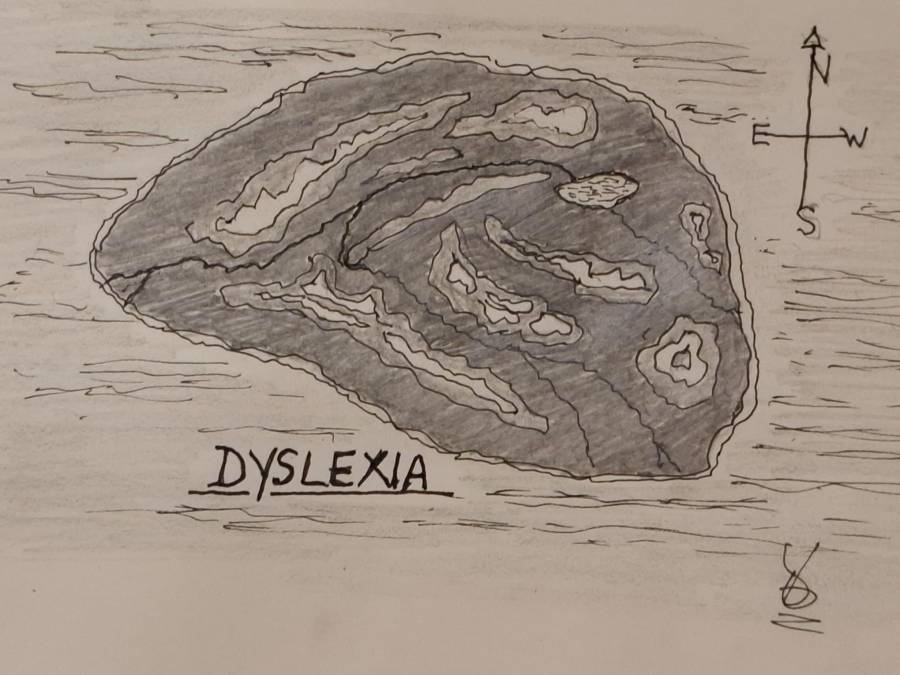
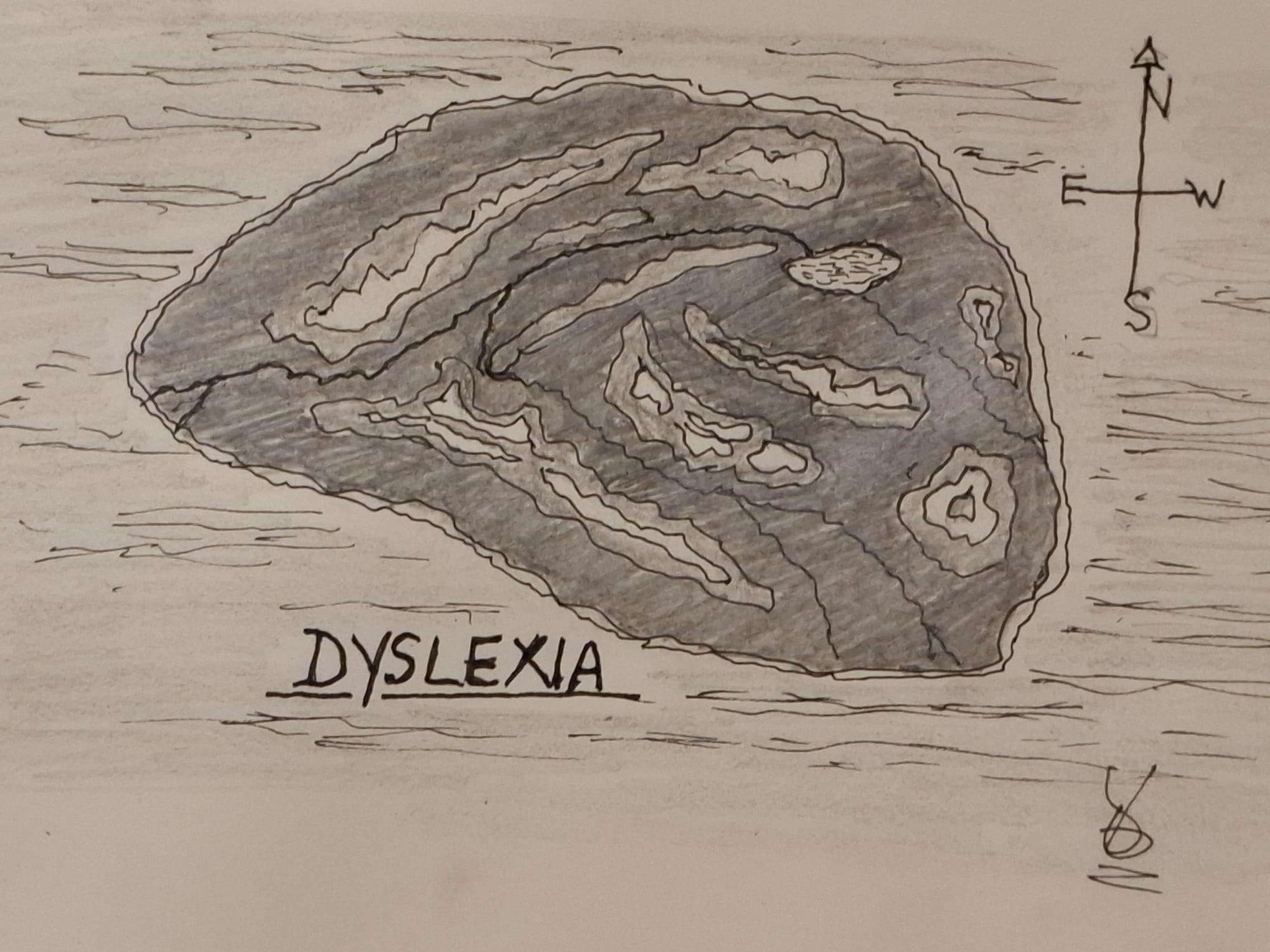
Dyslexia is, as the suffix “-ia” suggests, a country …. think of India, Mongolia, Russia, California [now relegated to a vassal state], Hibernia [also something of a vassal state], Narnia [er .. no, that is an imaginary land in a series of children’s tales].

Strangely the existence of Dyslexia was not even suspected until 1881, when Oslawd Khanber1 claimed to have visited the land. His discovery was widely doubted until confirmed by Ludorf Linber2 in 1887.

The people of this newly-discovered land were distinguished by all having a difficulty to varying degrees in spelling and/or in remembering sequences of numbers.

Khanber and Linber both named this land (and the rest of the world agreed) “Dyslexia”, from the Greek root “dys” meaning “bad/ abnormal/ difficult” and “lex” meaning “word” (although in Latin it means “law”, understood as “written word”).

Dyslexia was, like many other lands and people, not named by the natives themselves, but by people from elsewhere. Such examples abound, for example “Australia”, “America”, “Scotland”, “Eskimo”, “Teddy Boys”, “Pagans”, “Celts”, “Saxons”, “Teagues”, “Gypsies”, “E.T.s” etc.

Attempts to identify what the Dyslexics themselves called their land have so far collapsed in confusion, with different spellings and even pronunciations hotly argued for against others.

In fact, there have been accusations of racism aimed at those who named the land “Dyslexia” and the people “Dyslexics” — it seems particularly cruel to create a word itself so difficult to spell to name a people with a known disability in spelling.

Previously, Dyslexics just called themselves “people” and the land “the land”, while those who came across migrants from there before Dyslexia was actually discovered called them other names: such as “stupid”, “slow”, “thick” or “people with ADD or ADHD”.3

However, most “Dyslexics” today have not only adopted the name and learned to spell it but are wont to proudly declare “I’m Dyslexic” (but rarely “I am a Dyslexic”).

When Dyslexia came to the attention of the rest of the World no-one seemed astonished that it should be discovered long after the North and South Poles, the Mariana Trench, the Matto Grosso Plateau and indeed a great number of planets.

What did astonish the World was that Dyslexia had apparently independently within its borders invented television, radio, Ipads, microwave ovens, central heating and hot showers and of course the internal combustion engine and nuclear power.

This proliferation of technology would have been normally amazing (if anything normal can be said to be amazing, or vice versa) in a previously undiscovered country.

But what was really, really amazing was that everyone in Dyslexia had overcome a disability to climb to such industrial heights. The obstacles must have been tremendous.

Imagine confusing, for example, sodium chloride, a common table salt, with sodium chlorate, which is used as a weedkiller.

Also by the way, as an ingredient in making home-made bombs, a curious fact since nitrogenous fertiliser, with a directly opposite effect to sodium chlorate when spread on weeds, is also sometimes used in making home-made bombs).

Anyway, shake sodium chloride in small quantities on your weeds and they probably won’t like it but most will survive – especially those that actually like a little of it, like relatives of the cabbages and such. Shake a little sodium chlorate on your food, however and ….

well …. no, don’t try it – without urgent and skilled medical attention you will die quickly and painfully.

For another example, imagine confusing “defuse” with “diffuse”: one goes to de-escalate a conflict and ends up spreading it around. Other confusions are possible between the noun or verb “ware”, the (usually) adverb “where” and the past tense verb “were”. And so on.

For physics, knowledge of and accuracy in mathematics is essential – algebra, logarithms, binary codes, sines and co-sines, square roots (these last are mathematical constructs, not mythical regulated-shape carrots as propagated by anti-EU campaigners).

In calculating distances, heights and depths, spaces and circumferences, ability in geometry, trigonometry and ordinary mathematics is required. Somehow, the Dyslexics, the inhabitants of Dyslexia, had overcome their disability or compensated for it in some way.

They had developed as flourishing and environment-poisoning an industrial society as the most developed parts of the world, such as the United States of America (most developed industrially, that is).

Dyslexics are said, despite this disability with letters and numbers, to be of above-average intelligence. They had to be, to develop all those complicated benefits of industrial society despite their handicap.

Strangely, one may think, many Dyslexics have become literary figures famous throughout the world, Hans Christian Andersen, Agatha Christie, F. Scott Fitzgerald and WB Yeats among them. Contrary to popular belief among non-natives, James Joyce was not from Dyslexia.

This prevalence of Dyslexics among so many giants of literature and indeed of virtually every other field of human endeavour has given rise to a group of Dyslexians who call their disability “the gift of Dyslexia”.
The Dyslexics are often garrulous and sociable and this is especially true when in Dyslexia itself. The difficulty in remembering telephone numbers for example makes every telephone call an adventure.

Say a native wished to phone another native called Cathy (also known as Cthy, or Ktay, Thyca etc), and the phone number was 731 1062 (please note, this is an imaginary telephone number by which neither Cathy nor anyone else can be reached).

The Dyslexic might phone 371 1026 – all the correct digits but in a different order (note, this also is an imaginary telephone number by which no-one may be reached).

The conversation, somewhat simplified, might go like this:

“Yes, hello?” (female voice, breathless with anticipation of another adventure).

Our caller: “Hi, is that Cathy?”

Recipient (giggling): “No, it’s not. There isn’t any Cathy here. I’m Wanda.”

Our caller: “Oh, hi Wanda, you sound very nice. How about going on a wanda with me?”

Wanda (with a little giggle but playing cautious): “Maybe …. What’s your name?”

Our caller: “Terry.”

Wanda: “Where were you thinking of wandering with me?” (A moment’s pause while both mentally translate the last part of that into “wandering on me”).

Terry (clearing his throat which has suddenly gone dry): “Well, there’s a nice new Indian restaurant opened up in town. Do you like Indian food, Wanda?”

“Ohhh, Terry, I love it. So spicy!” (Very slight pause as both translate “spicy” as a description for food flavouring into a metaphor instead). “When were you thinking of?”

“Er … tonight too soon?”

“No, I happen to be free tonight.”

“Shall I come and pick you up? Say …. seven pm?”

“That would be lovely, Terry. I live off the Trans City Road, tenth left, first right, eighth left, in Hopeful Street, the seventh house on the left-hand side if you’re coming from town, with a brown and white door and a hydrangea bush in the garden.”

“Got it – off the Trans City Road, tenth left, first right, eighth left, Hopeful Street, seventh house on the left-hand side, brown and white door and a hydrangea bush in the garden. At seven pm. I’m looking forward to meeting you.”

Most Dyslexics are always open to adventure, ‘going with the flow’. One never knows what a simple telephone call may bring or to what an appointment or written address may lead.

But as a result, Dyslexics are also philosophic about missed appointments, forgotten birthdays and so on; they waste little time mourning something lost and instead look forward to something gained.

Terry might or might not make it to Wanda’s but they both know the world is full of other possibilities.

Cathy, for example, who failed to receive a call from Terry to congratulate her on her gaining a dystinction in her dyploma, received later that evening what non-natives would term “a wrong number” call from a Sofia who had meant to call a Geraldine.

Sofia had intended trying to patch up a long-running difficult relationship with Geraldine and instead found herself making the acquaintance of Cathy, who seemed much nicer and more understanding than was Geraldine.

Putting her problems with Geraldine aside, Sofia agreed to Cathy’s suggestion to meet for a late coffee (which they both knew could lead to an early drink and who-knows-what from there). Cathy had by now forgotten that she was hoping Terry would call.

Dyslexia is not just another land, nor even just a strange one – it’s an entirely different way to live.

End.

Note: If you found this article of interest, why not register with Rebel Breeze for free, so that you will be notified by email of subsequent articles. You can de-register any time you wish.

Footnotes:

1Adolph Kussmaul, to non-dyslexics.

2Rudolf Berlin, to non-dyslexics.

3A supposed disability the existence of which is hotly debated but has exonerated many teachers accused of bad teaching methods and states accused of having too large classes in their schools and which has been profitable for some educational psychologists and extremely so for some chemical companies.

HERE, BUT THERE

Diarmuid Breatnach

(Ireland, Palestine)

Here, the leaves are dying,

There, the people are dying;

Here, the leaves are falling,

There, the bombs are falling.

Here it is the turn of season,

There, genocide’s the only reason.

The tree seems as though it died

It is not dead but now asleep;

Retreated to its living roots

Underground stretched down deep.

In the Spring new buds we’ll see;

It is not easy to kill a tree.

Hard to kill a people too

As they rise up to resist anew.

November 2023

Centre: Birch tree, Dublin City North, November 2021 (Photo: D.Breatnach)

THE NEW WAILING WALL

Diarmuid Breatnach

(Reading time: 3 mins.)

There’s a new Wailing Wall …
THERE’S A NEW WAILING WALL;
It’s in Gaza, and here mothers and fathers wail
at the bloody bodies of their children;
children wail at the bloody bodies of parents;
all wail over the bodies of friends and neighbours;
the wailing rises and the tears fall.

At this Wailing Wall …
AT THIS WAILING WALL,
we wail the mendacity of Israel and the West,
we wail the complicity of the media in the West;
while rockets, shells and bombs rained down upon us
the lies fell faster and thicker than rain,
a torrent of lies that never stopped.
To surge in flood over the bodies of our slain.

You come now with your flag of peace …
YOU COME NOW WITH YOUR FLAG OF PEACE
tramping along the bloodstained road
and up the mountain of our bones
and the rubble of our homes
and offer us business as before
or – bombardment once more.

Now that the bombs have stopped …
NOW THAT THE BOMBS HAVE STOPPED
we too stop and look around us:
our schools gutted and bloodstained,
mosques and hospitals in ruins,
so many of our buildings rubble,
or with gaping shell-holes,
in the hell-hole
you have made of Gaza.

We had so little and you destroyed so much.
WE HAD SO LITTLE AND YOU DESTROYED SO MUCH!

In the days to come, more will sicken and die,
of wounds on flesh and wounds on soul,
of lack of medicine, fuel or food
as even in pause you take your toll.

Many are numb, some try to forget …
MANY ARE NUMB, SOME TRY TO FORGET,
some try to live without forgetting,
but there is a begetting,
for in many hearts too,
your phosphorus flakes are snowing,
the embers of hate are glowing,
their machine guns and bombs are mowing
you and your children for generations to come.

Against your Goliath …
AGAINST YOUR GOLIATH,
our slingshots were of no use;
yes, God was with you –
he’s no longer Hebrew or English –
He’s American now;
you shot us down like fish
in the shooting barrel
you made of Gaza.

You wish us to recognise you?
YOU WISH US TO RECOGNISE YOU?
Of course we recognise you –
the imprint of your boots are upon our necks;
we carry them from cradle to the grave.

But we will never agree to accept
or agree that you should keep
what you have stolen and plundered
the land you have sundered
or that you can make us second-class
citizens in our own land.

While we struggle to endure …
WHILE WE STRUGGLE TO ENDURE
and to ensure
that you never defeat us
let it be that we do not learn to treat others
as you now treat us.

What did you learn from your oppressors?
WHAT DID YOU LEARN FROM YOUR OPPRESSORS?
If all you learned was how to also
do so much of what they did,
then truly have the six million died in vain
and you mock their memory by invoking them.

Diarmuid, Feabhra 2009

I began to write this just as the December 2008- January 2009 bombardment of Gaza by Israel was coming to an end and I rounded it off in February.  

That was the one they called “Operation Cast Lead”, which killed over 1,400 Palestinians, mostly non-combatants, including 400 children and injured over 5,300 — again, mostly non-combatants.  

I little thought that so few years later Israel would unleash an even worse bombardment upon the beleaguered Palestinians in Gaza, as it did in July 2014, during which it killed over 2,300, again mostly non-combatants and that time nearly 500 children.  

The damage to infrastructure is colossal and the Israeli-Egyptian blockade makes significant repair impossible.

The commentary above was written in 2014. Apart from killing in raids, there were more massacres to come: March 2018, more than 700 Palestinian refugees killed at the borders of the Israeli state and in 2021, over 260 Palestinians killed after Zionist provocation at the Al Aqsa Mosque, in Jerusalem.

In August 2022, over 30 Palestinians, including women and children, killed in Israeli missile attacks and this year, by August, Israel had killed 172 Palestinians. Now, over October-November 2023, they have killed 133 Palestinians in the West Bank and over 9,000 in Gaza, including 3,760 children.

There is no question that this is genocide: “the deliberate killing of a large number of people from a particular nation or ethnic group with the aim of destroying that nation or group.”

Any of the following acts committed with intent to destroy, in whole or in part, a national, ethnical, racial or religious group, as such:

  1. Killing members of the group;
  2. Causing serious bodily or mental harm to members of the group;
  3. Deliberately inflicting on the group conditions of life calculated to bring about its physical destruction in whole or in part;
  4. Imposing measures intended to prevent births within the group;
  5. Forcibly transferring children of the group to another group.”

(https://www.un.org/en/genocideprevention/genocide.shtml)

Nor did that genocide begin in October this year, nor last year, nor the year before. It began in 1948 with the creation of the state of Israel and has been continuing since.

end.

EXTERMINATION WAR AND ALTERNATE UNIVERSES

Diarmuid Breatnach

(Reading time: 3 mins.)

I am engaged in an extermination war and I’m not winning.

It’s against those tiny brown fruit flies. Apparently they live by consuming bits of fruit and other vegetable stuff. But no matter how much I seal kitchen refuse and fruit into bags, large of small, they still fly around and around, annoying me. Deliberately taunting me.

Since I seal the bags, what do they live on? Just the faintest of smells is enough for the little f…ers, it seems! And I use the term advisedly. They are renowned fast breeders and an adult female fruit fly can lay up to 2,000 eggs on the surface of anything that’s moist and rotting.

Within 30 hours, tiny maggots hatch and start to eat the decayed food. Within 2 days, they’re all grown up and ready to mate, too! Luckily a fruit fly only lives 8 to 15 days – but still.

With such a fast turnaround, they’ve been used for genetic experiments, with even a flightless subspecies developed for the purpose.

Unfortunately, the ones at my place are all fully able to fly. And sometimes not just around me but flying right at me, inches away from my eyes. Do you know how difficult it is to kill something tiny mere centimetres away from your eyes? I really, really hate them.

I could spray them with insecticide, or course but that would mean poisoning my living space environment. I use anti-bacterial surface cleaner spray instead, hopefully less toxic for me. I know it’s less toxic for them also but it does slow them down or stick them to the wall so I get them.

Sometimes.

When they’re at a good distance for me to focus, I reach out really fast and smack my two hands together on them. Success rate? About one in ten. And even then, sometimes, when I open my hands, the little f..ker flies away, apparently unharmed and no doubt fly-sniggering.

But what about all those times I know for certain I caught one, open my hands and … nothing there. It’s not like I missed it because I didn’t see it fly away and it is nowhere to be seen. Except a few seconds later, it reappears – from nowhere.

Of course, it can’t appear from nowhere, not really.

So where did it go? Obviously, into an alternate universe and then back out to laugh at me. You don’t believe in alternate universes? Well a lot of physicists treat the subject with great seriousness and even think they might conform to quantum theory.

Don’t ask me to explain quantum theory but the multiple universes theory has to do with time and space or something. And we do know that time is objective (we’re getting older) but also subjective, as we experience when we sit through an interview or a haranguing from a partner.

Anyway, my war with the fruit flies continues. But what is their alternate universe like and why do they come back into mine? No fruit there? No oxygen? Really clever (but not quite quick enough) spiders?

I’m engrossed by the possibilities. Maybe there’s no cops or other fascists there.

So, I talked to this tech geek I know and he’s working on designing a micro-micro video camera. When he has it developed, we’ll trap some of those irritating flies, attach the micro-camera to one, threaten it until it jumps into the next universe and catch it when it returns.

Then, remove the camera and download the film.

What will we see? Who knows. Wonders, perhaps. But maybe only a giant hand swatting at the camera carrier as the fly dodges and shifts-universes back into this one.

End.

A DANGEROUS DISEASE

Diarmuid Breatnach

(Reading time: One min.)

A deadly disease has struck some people in Ireland, affecting tendons in the legs, control of the tongue and causing partial amnesia. By a strange twist, some of those affected are attracted to the very site of the first outbreak of the disease.

The effect on the tendons in the legs of those affected is dramatic: they can no longer stand up straight and find themselves bending a knee or even collapsing on to both knees, the tongue protruding in bizarre licking motion.

Less visible but in many ways more striking is the amnesia effect. Those affected lose memories of parts of what they learned in school or what they themselves thought and said in the past – even in recent years.

According to Dr. P O’Neill of the Institute of Research and Adjustment, a new symptom was observed recently: “Affected people spent four hours staring vacantly at a film of some anachronistic ritual”.

Dr. T.W.Tone, who has been studying similar outbreaks in the past observed on the affinity of the disease for people of higher social classes: “No-one is guaranteed immunity but it does seem that the lower the social class, the less likely the person is to contract this disease.”

Commenting on the low recovery rate of those who contract the disease, Dr. J.Connolly pointed to the crucial importance of prevention, for which community programs of education can be very effective. “We rely especially on Volunteers,” he said, “men and women who are dedicated to preventing the spread of this disease.”

end.

BESPOKE CAR ALARMS WITH VOICES!

Diarmuid Breatnach

(Reading time: 2 mins.)

Car alarms are mostly of a kind, emitting shrill noise. But why not have them use voice? And why not allow the car-owner to choose from a variety of voice alarms, find one perhaps more suited to their own personality?

Don’t forget, you saw this idea and this selection here first!

SIX CATEGORIES, VARIOUS MODELS

Insistent (2 models)

(in English public school accentnot recommended for certain areas of Ireland, Scotland, Wales or inner-city England)
You are crowding me. Please desist. In other words, stop!

B. (gradually increasing in volume)

This is not your car. You are not an authorised driver. You are performing an illegal act. There are serious consequences. You must stop now.

This is not your car. You are not an authorised driver. You are performing an illegal act. There are serious consequences. You must stop now.

This is not your car. You are not an authorised driver. You are performing an illegal act. There are serious consequences. You must stop now. (etc.)

Threatening selection (6 models)

A. (in northern USA accent) Step away from the car. STEP AWAY FROM THE CAR. DO IT NOW!

B. SMILE. THANK YOU. YOUR PHOTO IS ON ITS WAY TO THE POLICE.

C. God does not like you standing too near me or trying my door handle. He sees everything you do.

D. Stand back. You are about to receive a mega electric shock. Charging …

E. SCRATCH MY CAR AND PREPARE TO DIE. (available in a selection of accents, from Russian mafia to LA Gangsta).

F. That spike you have just received from my door handle has taken a sample of your DNA and carries a powerful sleep drug. You have seconds before you collapse. Find somewhere safe to lie down.

Sinister (1 model)

Yes, come in, come in! Welcome! Welcome! I’ve been waiting for someone like you. Just like you. Never mind the bloodstains. Just an accident. Or two. Come in, come in! (Available in a variety of voices, creaky, sibilant, etc.)

Persuasive selection (2 models)

A. You’d steal a Metro? Seriously?

B. Yes, yes, listen to my voice. Breathe deeply. Lisssten to my voice. You feel com-fort-ably warrrrm and relaxed. Tot-all-y rel-axed. You don’t want to steal a car any more. Certainly not this one. You want to find a cafe and sit in it. Tot-all-y rel-axed. You will leave now.

Attention-attracting with Embarrassment Deterrence selection (5 models)

A. HELP! I AM BEING BROKEN INTO! HELP!

B. BARRRP! (Yes, a loud fart-noise. With sewer smell). BRAAPP! BARRRP!

C. I HAVE DISCHARGED A BAG OF URINE ON YOUR LEG. IT CARRIES A PERMANENT PURPLE DYE TOO.

D. EVERYBODY! THE PERSON STANDING BY THIS CAR IS A CHILD MOLESTER AND TORTURES PUPPIES AND KITTENS!

E. Ooh! Ah, stop. That tickles. No. Ahahahaha! No, please! No! AHAHAHAHAHA! Oh gosh, stop, please stop. Ahahahahaha!

Other

Think about what you’re doing. Do you really want to steal this car? Think about the conseq …

SO SORRY, YOUR MAJESTY

Nearly completely reprint from Rebel Breeze eight years ago

(Reading time: 2 mins.)

Your Most Exalted Majesty, Queen of the United Kingdom of Britain and Northern Ireland, Commander-in-Chief of the UK Armed Forces, Head of the Church of England, Queen of the Commonwealth.

We trust this letter finds your Highness well, as we do also with regard to Your Highness’ large family and of course your trusted corgis.

I am tasked with writing to yourselves in order to make some embarrassing admissions and to ask your Royal forgiveness.

No doubt your family carries the memory of an uprising in Dublin in 1916? Yes, of course one’s family does, as your Highness says.

Well …. the embarrassing thing is this ……. it’s so difficult to say but no amount of dressing up is going to make it better so I’d best just come out with it: that was us. Well, our forebears. Yes, it’s true.

Not just us, of course. There were a load of Reds in green uniforms too, Connolly and Markievicz’s lot. And of course our female auxiliaries, and the youth group.

But most of that rebellious band was us, the Irish Volunteers (that became the IRA). I can’t adequately express to your Highness how ashamed we are of it all now.

Your government of the time was quite right to authorise the courts-martial of hundreds of us and to sentence so many to death. Your magnanimity is truly astounding in that only fifteen were shot by firing squads and that Casement fellow hanged.

But were we grateful? Not a bit of it! Does your Highness know that some people still go on about that Red and trade union agitator, James Connolly, being shot in a chair? What would they have your Army do? Shoot him standing up? Sure he had a shattered ankle and gangrene in his leg!

One can’t please some people – damned if one does something and damned if one doesn’t. If the Army hadn’t kindly lent him a chair, those same people would be saying that the British wouldn’t even give him a chair to sit on while they shot him.

And how did we repay your Highness’ kindness and magnanimity in only executing sixteen? And in releasing about a thousand after only a year on dieting rations?

By campaigning for independence almost immediately afterwards and starting a guerrilla war just three years after that Rising! A guerrilla war that went on for no less than three years. Your Majesty, we burn with shame just thinking of it now!

Our boys chased your loyal police force out of the countryside, shot down your intelligence officers in the streets of Dublin, ambushed your soldiers from behind stone walls and bushes ….. but still your Highness did not give up on us.

Some people still go on and on about the two groups of RIC specials and auxiliaries and the things they did, referring to them by the disrespectful nicknames of “Black and Tans” (after a pack of hunting dogs) and “Auxies”. They exaggerate the number of murders, tortures, arson and theft carried out by them.

Of course, your Highness, we realise now, though it’s taken a century for us to come to that realisation, that sending us that group of police auxiliaries was a most moderate response by yourself. But we were too blind to see that then and shot at them as well!

That fellow Barry and his Flying Column of West Cork hooligans wiped out a whole column of them. Your Highness will no doubt find it hard to believe this, but some troublemaker even went so far as to compose a song in praise of that cowardly ambush! Oh yes, indeed!

And some people still sing it today – in fact they sing songs about a lot of regrettable things we did, even going back as far as when we fought against your Royal ancestors Henry and Elizabeth 1st! Truly I don’t know how your Highness keeps her patience.

Then we went on and declared a kind of independence for most of the country but …. some of us weren’t even satisfied with that! It was good of your Grandfather George V to have your Army lend Collins a few cannon and armoured cars to deal with those troublemakers.

King George V of the UK, who kindly lent Collins some of His Army weapons and transports.

And then some time later, even after those generous loans, some of us declared a Republic and pulled the country (four fifths of it, at any rate), out of the Commonwealth. Left the great family of nations that your Highness leads! Words fail me ….well almost, but I must carry on, painful though it is to do so.

A full confession must be made – nothing less will do. And then, perhaps …. forgiveness.

Of course your government held on to six counties …. You were still caring for us, even after all our ingratitude! It was like hanging on to something left behind by someone who stormed off in an argument – giving them an excuse to come back for it, so there can be a reconciliation.

How incredibly generous and far-sighted of your Majesty to leave that door open all that time!

Fifty years after that shameful Rising, it was celebrated here with great pomp and cheering, even going so far as to rename railway stations that had perfectly good British names, giving them the names of rebel leaders instead.

Then just a few years later, some of our people up North started making a fuss about civil rights and rose up against your loyal police force, forcing your government to send in your own Army. And was that enough for the trouble-makers?

Of course not – didn’t they start a war with your soldiers and police that lasted three decades!

No doubt your Majesty will have noted that some of those troublemakers have changed their ways completely and are in your Northern Ireland government now.

They’ve been helping to pass on the necessary austerity measures in your government’s budgets, campaigning for the acceptance of the police force and for no protests against yourself.

Indeed, their Martin McGuinness has shaken your hand and rest assured were it not considered highly inappropriate and lacking in decorum, he would have been glad to kiss your cheek, as he did with Hillary Clinton when she visited. Or both cheeks, in your Majesty’s case!

Your Majesty can see, I hope, that we can be reformed.

Our crimes are so many, your Highness; and we have been so, so ungrateful. But we were hoping, after you’d heard our confession, our humble apologies, after your Highness had seen how desperately sorry we are, that you’d forgive us.

And if it’s not too much to hope for, that you’d take us back into the United Kingdom. Reunite us with those six counties, and so into the Commonwealth. Is there even a tiniest chance? Please tell us what we have to do and we’ll do it, no matter how demeaning. Please?

Your most humble servant,

P. O’Neill Jnr.

AESOP UPDATED – the Grasshopper and the Ant

Diarmuid Breatnach

(Reading time: 2mins.)

The grasshopper was enjoying the early May sunshine, playing his fiddle a bit, eating succulent new grass a bit, just enjoying life – a lot. Now and again, the grasshopper noticed an ant scurrying by but at first paid it no attention. Eventually though, he began to be a little curious and also, probably, a little irritated by this constant scurrying to and fro.

“Hey, Ant,” the grasshopper called out, the next time the busy insect passed him, “Why are you so busy? Why can’t you just enjoy life?”

The ant stopped and looked around to find out where the voice had come from.

“Ah, Grasshopper …. sorry, what did you say?”

“I asked why be so busy, why not just enjoy life?”

“Because food has to be gathered while it’s growing,” replied the ant, disbelieving anyone could be so stupid as not to know that. “And stored.”

“But Ant,” said the grasshopper indulgently, “there’s plenty of food around. No need to store it at all.”

“Yes, there’s plenty of food now, Grasshopper. But when the winter comes, hardly anything will grow. We gather the food now and store it so we won’t starve come winter.”

“Oh Ant, let winter look after itself. Now is the time to enjoy life.”

How can anyone be so stupid, thought the ant, shaking her head.

“Please yourself”, she said, hurrying on.

“Don’t worry, I will,” replied the grasshopper, striking up a merry tune.

He’ll only learn when it’s too late, thought the ant.

But she was wrong. The grasshopper began to think about the coming winter and absence of food. In between chewing the juicy grass-stems and playing tunes on the fiddle, the grasshopper went about making arrangements.

Summer turned to Autumn and Autumn turned to Winter. Most growing plants either died or went dormant. Cold winds blew through leafless branches.

Underneath the ant-hill, inside the ant-nest, it was warm and there was plenty of food, thanks to the hard work of the ant colony throughout the Summer and Autumn. The ants were enjoying their food, warmth and old stories.

A thunderous knocking announced someone at the main door. When the ants cautiously opened the door, whom should they see but the grasshopper, looking cold and hungry.

“I need some of your food,” he said. “Hunger is making me cold. And when I get cold, I get hungrier.”

“Too bad,” chorused the ants in the doorway.

“You should have listened to me in the Summer,” exclaimed one ant smugly.

“Oh, I did,” replied the grasshopper, even more smugly and let out something like a whistle, whereupon a large and aggressive crowd of blue beetles jumped out of hiding and ran for the door, overcoming the ants there in minutes. Into the the ant-nest they poured and sounds of fighting and injury could be heard within.

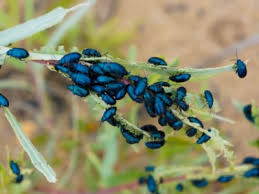
The blue beetles had been hiding but at the Grasshopper’s command, stormed the ant nest.

After a while, an injured but surviving ant at the doorway saw a blue beetle come staggering back out and approach the grasshopper.

“We need reinforcements, Master,” it whined. “The ants are massed and fighting hard defending their food stores. We threatened their young but they’re protecting them too.”

The grasshopper seemed unsurprised, almost as though he could have predicted that. He gave a different kind of whistle and a horde of dark green beetles poured out of hiding and into the nest. The noise of fighting grew louder and then ceased.

When the blue beetles ran into stiff resistance, the Grasshopper sent in the green beetles to finish off the opposition.

Any hope the ant had that the silence meant the elimination of the beetles was destroyed as a steady stream of beetles began to emerge, most of them carrying bundles of food.

“Lazy scum!” cried the surviving ant at the nest’s door. “You’re leaving us to starve!”

“No such thing,” scoffed the grasshopper. “If you all died of starvation, who would gather the food and store it next year? And the year after? You will probably go hungry – but you won’t starve. Not most of you anyway.”

The ant said nothing in reply, just watched the food parcels being carried out of the nest.

When they were all ready to leave, the grasshopper turned to the ant.

“No fighting next year, Ant. You just give us what you gather and we’ll give you back enough to live on and to raise new ants. No need for all that fighting, is there?”

The grasshopper turned away without a backward glance and followed the long lines of his food-carrying beetles in dark green and blue, his personal security platoon of blue beetles around him.

End.

The Grasshopper and Ants (Source image: illustration in book Aesop’s Fables, Library of Congress)

TRUTH AND POWER –THE FIRST LESSON

Diarmuid Breatnach

I remember my first lesson at school. First lesson from a teacher, that is, because you learn other lessons in school as well, from other kids. That particular lesson has remained with me for the rest of my life.

OK, it couldn’t have been the first lesson – it was my second year at school — but it is the first I remember which, in a way, does make it the first. And it wasn’t from any book or written on the blackboard.

Lesson One - Truth to Power

That was in senior infants then, I was five years old and our teacher was Iníon Ní Mhéalóid, Miss Mellet in English. It’s a rare Connemara family name, I know now and that is where she was from. She was handsome, maybe even more than that, I can’t remember now. I never had a crush on any teacher who taught me but if I had, it would not have been on her.

The day of this particular lesson, I must’ve been misbehaving in some way, I suppose. Not paying attention to her and talking or laughing with another kid, probably.

She called me out from my desk, admonished me, told me to stick my hand out and … whacked it with a ruler. Maybe my eyes gave her a message, I’m not sure. They say the eyes are the windows of the soul and right then, at that moment, I guess my soul must’ve been pretty dark.

What are you thinking?” she asked me in Irish.

Now, my Da had brought me and my brother up to tell the truth – always. Years later, my young sister at school would have teachers tell her that though I had often misbehaved, I had always told the truth. I did too, mostly.

When Iníon Ní Mhéalóid asked me that, my training came to the fore but it was more than that – I wanted to tell her what I was thinking.

I think you’re horrible,” I replied, in Irish too, of course.

I thought I heard my classmates suck in their collective breath.

Hold out your hand again!”

I did so, half disbelieving. She’d asked me, hadn’t she?

Whack!

What are you thinking now?”

That …. that …. you’re h-horrible,” I sobbed.

Hold out your hand again!”

Whack!

What are you thinking now?” She had a glint in her eye.

I paused, conflicted, then replied.

Nothing.”

An bhfuil tú cinnte (are you sure)?”

Tá (I am)”.

Go back to your seat then.”

So now you’re thinking things like “physical abuse, abuse of power, bully, traumatic experience” and feeling sorry for me. Right?

You have it wrong.

Iníon Ní Mhéalóid had taught me a very valuable lesson, relating to truth and power. It is this:

You can speak truth to power because you feel like it, through pride, to encourage others or for any other reason. But those in power are not like your equals down below. You don’t owe those in power any truth and it is perfectly acceptable to tell them lies, to protect yourself or others.

You can of course speak the truth out of choice but know that they do not respect it, will probably use it against you and ….. you must be prepared to pay the price.

End.

Drumcondra journey over snow

Diarmuid Breatnach

     The heights around Phibsboro and Glasnevin were reported snowbound so I decided to head down to the Tesco post for my shopping. Bundled up warm and with boots coated in dubbin, I stepped out into snow powder whipped up by the icy wind.  I had to close my eyes to slits when it blew against my face.

Heading towards Drumcondra Tesco station

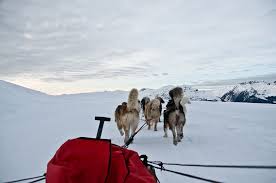
A whistle woke the dogs and they came out of their snow-holes, shaking themselves and trotting over. Handing out small pieces of meat which they wolfed down, I called Buck to follow me over to the sled, where he sat supervising while I put the other dogs in harness. They were eager to go, skittish, whining, tail-wagging, occasionally growling at a perceived trespass by a team-mate. Buck stared down the most fractious but ignored Bríd altogether. Lately she’d been getting at Buck, undermining him. I didn’t know what to do about it. I couldn’t put her in the lead as, apart from that reversing the problem, the team probably wouldn’t follow a bitch. A dog team is like a wolf pack – there can be a dominant male and a dominant female but in almost all cases the male is the lead, the top dog.

Heaving the sled to left and right a couple of times I broke it free of its ice, took the leads and, with my shouted “Mush!” we were off.

A little later, going down towards the frozen Tolka, I had to apply the brakes a little to ensure the sled didn’t run into the hindmost dogs. They all felt the drag and then the jolt as the left brake hit something hard frozen under the snow, canting the sled momentarily to one side. Buck looked back at me reproachfully. You think dogs can’t look reproachful? Many can … and Buck is a master at it.

“Sorry, Buck, couldn’t help it … couldn’t see it.”

But he was already turned away, his shoulder muscles bunched, pulling along, leading. We crossed the Tolka no trouble despite one of the hindmost dogs slipping for a moment, righting himself some what embarrasedly, continuing. The sled runners hissed from the snow, then a grating tooth-gritting high-pitched scraping and then a low hiss across the ice.

Crossing the frozen Tolka

“Up boy, pull away!” I shouted but Buck was already bunching himself for the slope of the far bank, pulling steadily, all dogs in the traces pulling together. As soon as the sled was clear of the ice I jumped off and ran alongside it, one hand on the sled. As it gained the top of the bank, the dogs already over, I jumped back on and mushed them on to the Tesco post, the wind whipping ice powder towards me, sometimes higher than my head but often only at knee height.

There was another sled there, hitched to the rail outside the post, its dogs still in traces, huddled down against the wall. Swinging the team around by pulling on the leads, I got the sled in near the other dogs with my team furthest away. I didn’t want to come out to the aftermath of an argument between that team and mine.

Hitching the sled to the rail, I walked up to the front entrance, scraped the snow off my boot soles on the steel scraper and slapped it off where I could reach on my fleece-lined jacket. Opening the door, I stepped in quickly on to the mat and closed the door behind me.

Arnka Flaherty was on duty at the register and flashed me a smile.

“Fuar go leor duit?” I enquired.

“It is, yes it is cold enough,” she replied, still smiling, the blue eyes and curly hair looking a little out of place on her broad Inuit face. But her smile would light a dance hall.

I saw a few pairs of snowshoes by the door and guessed some customers had hiked it in. Not too bad really at the moment with snow only a foot to two feet deep most places, though in some hollows you might sink up to your waist in drifts.

Bart was there, a big Dutchman from over Santry way, as I already knew. I’d recognised his sled and some of his dogs outside.

“Bart”, I nodded.

“Diarmuid,” he nodded back.

“Looks like getting worse,” I said.

“Yes, says on the Internet.”

“Best get supplies in then, right?”

“Right.”

So saying, we went about our separate business. In that little exchange, we had enquired without the exact words about one another’s mental and physical health, whether we each had enough fuel and food. And said that we cared about one another and would help, were it needed.

Going through the aisles picking up my items I nodded to the other customers, a spry old woman who must have snowshoed in and two young students from the college not far away, a male and a female, perhaps a couple, perhaps not. Their winter clothes looked on the expensive end of the range.

I picked up some tins of fish (though I might catch some fresh later, hole-fishing through the Tolka ice), frozen meat for the dogs, a bag of tatties and a smaller one of rice, a parcel of briquettes, a bag of porridge oats and laid them in front of Arnka. Then I went back for milk powder, beet sugar, frozen butter, olive oil, frozen greens and a butane cylinder.

Arnka raised her eyebrows at the latter. “Where’s the empty?” she queried.

“I forgot and left it at home. I’ll bring it in tomorrow. I promise.”

She said nothing and started to tot up my account. Perhaps she minded, perhaps not. It was hard to tell with Arka. I paid, bid her slán on my second trip outside with the last of my supplies, waving to Bart and to the old lady on the way.

Outside, the wind had died down below but up above the clouds were moving fairly fast, leaving a clear starlit night. Beautiful but cold and soon to get colder. The dogs were already on their feet, shaking themselves, some whining. I loaded up the sled, pulled by scarf across my nose and mouth and we mushed back homeward, the dogs glad of the exercise and knowing they’d be fed soon. We crossed the Tolka ice, now glittering in the starlight or ghostly shining in places and up the opposite bank, the dogs straining, me pushing the heavy sled this time and trying not to slip ….

Then clear and pulling away up the rise into Drumcondra proper and soon to be home. Hot food and warmth for me, defrosted meat for the dogs and their own holes in the snow, curled up inside and soon warm with the snow piling up around them.

End