IT’S NOT A SEA-CHANGE – IT’S A TSUNAMI

Diarmuid Breatnach

(Reading time main text: 10 mins.)

Marching in a Palestine solidarity demonstration or standing in some prominent spot in Ireland amidst Palestinian flags, solidarity banners and placards and listening to the beeping of horns in approval from passing traffic is a great feeling.

Some visitors from other lands are often surprised at the extent of support here for the Palestinians. “It must be because of the Irish history of fighting colonialism and occupation”, they speculate. And some Irish people will nod eagerly in agreement.

But it wasn’t always like this. There was a time when most Irish people sympathised or even empathised with the Israelis. And we need to be aware of that and of the journey the Irish people have made from there to here and how that happened.

Irish solidarity with Palestine rally outside the Israeli Embassy in Dublin, Tuesday 18 May 2021 (Photo: D.Breatnach)

Last night (26 May) the Dáil, the Irish Parliament, declared in unopposed vote that the “illegal”1 Israeli settlements amount to an annexation. The Breaking News.ie report on the vote called Ireland “the first EU member state to do so”, hinting that others may follow.

And some of the northern European states might, indeed, unhappy with their support for Israeli atrocities through toeing the USA line – but someone always has to be first.

The motion, put forward by the Sinn Féin party, passed unopposed, while an amendment by the People Before Profit party calling for the Israeli Ambassador and staff to be expelled2 failed by a comfortable majority of almost two to one.

However, 46 Dáil votes in favour of the expulsion of the Israeli Ambassador would have been unthinkable just a few decades ago.

The vote and previous cross-party support, with the exception of Fine Gael, predicts a very smooth run for the “Occupied Territories” Bill soon to reach its third and final reading in the Dáil3.

An Israeli Ambassador to Ireland some years ago accused the Irish people of being “the most anti-semitic” in Europe.

I think that was around the time of the Israeli Zionist State’s previous war with Gaza in 2014, when the extent of Irish society’s solidarity with the Palestinians was evident and, of course, for a number of decades now the Zionists have been working hard to appropriate Jewry and to daub anyone criticising Israel as being “against Jews”, i.e “anti-semitic”4.

However, Maurice Cohen, Chairperson of the Jewish Representative Council was quoted in an Irish Times article that same year saying that there was no major anti-semitism in Ireland and that Irish people were able to distinguish between people who are Jewish and the Israeli State.5

That attitude, of the Irish sympathy with the oppressed Jews not equating support for the Israeli state, required some change, since for decades the majority view had been supportive of Israel.

Anti-Semitism in modern Ireland

Christianity has often played a part in whipping up anti-Jewish feeling, using the New Testament story of Jews denouncing the Christ figure and their responsibility for his alleged crucifixion by the Romans.

The Catholic and Protestant religions in Ireland played some part in that demonisation. But no notable medieval Irish writer gave us a Jew who would exact a pound of flesh from a human in revengeful debt repayment. Gaelic society had no Jewish ghettoes, no laws against Jews6.

Anti-semitism has existed in Ireland as in all other European countries but not to the extent that it has in some of those countries, for example in England. The 1904 Limerick Boycott or Pogrom is sometimes pointed out to counter such an assessment but the the full story needs to be known.

Fr. John Creagh of the Redemptorist Order was an anti-semitic bigot and liar and did succeed in whipping up anti-Semitism against the few Jewish families settled in Limerick. But the Bishop of Limerick, Dr. O’Dwyer denounced the bigotry, as did the Church of Ireland Bishop, Thomas Bunbury and a man who assaulted a rabbi was jailed.

Nevertheless, the boycott and hostility continued for two years with the support of sections of the media (Limerick Leader, Irish Independent, Munster News)7 and a number of families left Limerick to emigrate from Cork port.

However, passing through the city on their way, they were welcomed by people in Cork and given accommodation; such was the welcome that some decided to stay and David Marcus, a novelist and literary editor of the Irish Press and Louis Marcus, filmmaker, were descendants of those refugees, as was Gerald Goldberg, 1977 Mayor of Cork8.

The period of modern active anti-semitism in Ireland was the 1930s which reflected the rise of fascism and attendant anti-semitism around the world.

The Catholic Church often saw fascism as a bulwark against atheism and communism and sections of the Irish ruling class regarded it as a defence against advances by the working class and socialism, additionally against Irish republicanism.

The Church and ruling class alliance had crushed the Republican resistance in the Civil War but the Republican movement, despite executions, jailing, internment, exile and repression, remained viable and began to reorganise itself.

It did so militarily but also politically and despite the split in Sinn Féin and the formation of Fianna Fáil in 1926, the latter began to pick up electoral support and, by 1932 was in Government, albeit in a minority.9

The previous Government had produced hysterical propaganda against it, even suggesting the party was communist.

The Army Comrades Association, formed to counter Republicans after Fianna Fáil was elected to Government in 1932, went through a number of name changes but has been known as “the Blueshirts” collectively, although they did not adopt the blue shirt as part of their uniform until 1933.

Despite their uniform style and “Roman salute” adopted from the Italian fascists, academics and some political activists have denied that the Blueshirts were a fascist organisation. However some of their leaders, including the former Garda Commissioner O’Duffy and a number of Government Ministers and supporters definitely were fascists and anti-semitic.

Blueshirts at Bluebell Cemetery, Dublin County 1934 (Photo sourced: Internet)

Irish Republicans and socialists fought the Blueshirts on the streets. In 1933 the De Valera Government banned a march on Dublin planned by the Blueshirts and later banned the organisation itself, which led to the formation of a right-wing coalition including the Blueshirts to form the Fine Gael political party10.

Irish Republicans and socialists went to fight against Franco in the Spanish Antifascist War (1936-39) and though outnumbered in the order of ten to one by those recruited by the Blueshirts11 to fight for Franco, it was only the Irish fighting on the Republican side who acquitted themselves well, fighting in many major battles and losing about a quarter of their number in action

In comparison, the Blueshirts gained a reputation for drunkenness, lack of discipline or of general military merit and saw little military action.

Shankill Road Belfast contingent of the antifascist socialist Republican Congress, at the annual Republican Wolfe Tone commemoration at Bodenstown, Co. Kildare, 1934. (Photo sourced: Internet)

During WWII the German Nazis ran a radio station, Irland-Redaktion, aimed at the Irish population and even containing some broadcasts in Irish but I gain the impression (without having reviewed its material) that it concentrated on anti-Allies propaganda, in particular probably anti-British and also on maintaining Irish state neutrality. It did contain broadcasts in the Irish language12.

ISRAEL IN IRISH POLITICS AND SOCIETY

POLITICS AND DIPLOMACY

The 1937 Constitution established under De Valera specifically mentioned Judaism in Article 44.1 and protected it from persecution while De Valera himself had good relations with the first Chief Rabbi of Ireland, Chaim Herzog (mentioned later here in relation to the founding of Israel).

The State under De Valera remained officially neutral through WWII but, despite the IRA, actively friendly towards the Allies. Some anti-Semitism survived and has been picked up and incorporated in attempts to form fascist groups within Ireland which, since the 1930s defeat of the Blueshirts have been tiny and also prevented from having any great influence in society.13

But most of Irish society, especially after the horrors of the Nazi death-camps became common knowledge after WWII, empathised with the Jews. This continued to be the case as waves of Jewish refugees went to Palestine, often battling British soldiers and police who were trying to stop them landing.14

The State of Israel was created by Jewish settlers on Palestinian land in 1948 and was quickly recognised by two world powers – the USA and the USSR but the Irish state, like many others, was reluctant to follow suit, conscious that Palestine had been an Arab colonial possession or “mandate” of the UK, many of whose possessions around the world were being de-colonised.

In Irish eyes the Israeli Air Force attack on Egypt in 195315, two years before the Irish state was admitted to the United Nations, didn’t help Israel’s case.

Israel struck without declaring war in support of the French and British attempt to maintain control of the Suez Canal against an Egyptian government’s intention to nationalise it. And the USA, keen to show that the balance of world powers had changed since WWII, publicly condemned the attack, especially chastising the old colonial powers and previous world masters, the British and French16.

President Nasser of Egypt making a speech (Image sourced: Internet). Nasser led the Egyptian nationalisation of the Suez Canal. (Photo sourced: Internet)

The Irish state of course had friendly relations with the USA but the Zionist State had some important Irish connections too. The Chief Rabbi of Palestine was a Zionist, Yitzhak Herzog – late of Belfast and Dublin, where he had also been Chief Rabbi of Ireland. One of his sons, Chaim Herzog, also a Zionist and though born in Belfast and raised in Dublin, became the 6th President of Israel.
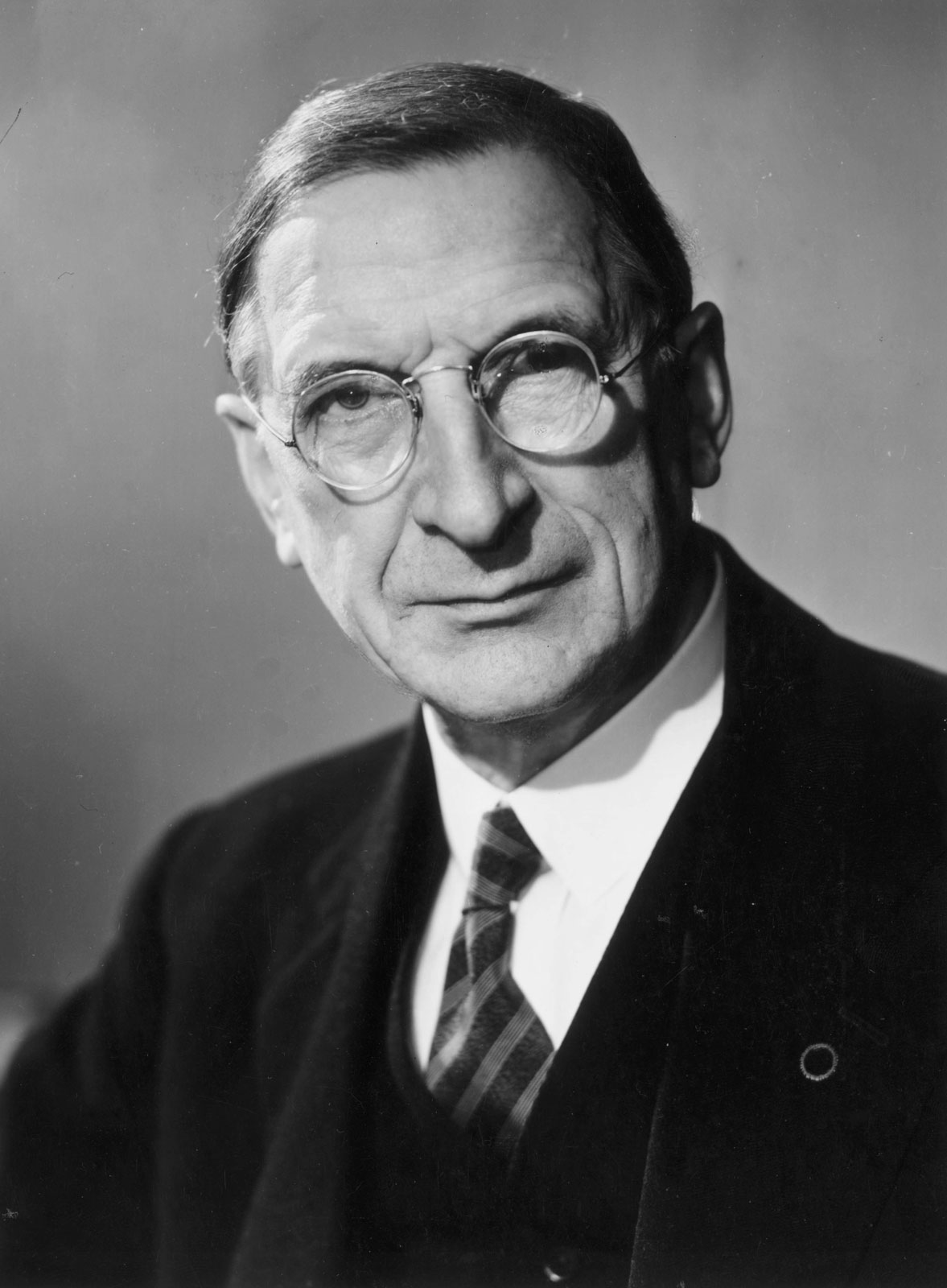
De Valera, former IRA leader, founder of Fianna Fáil, later President of Ireland and friendly with Zionist Chaim Herzog (Photo sourced: Britannica)
Chaim Herzog, Zionist, Chief Rabbi of Ireland and later of Israel, friendly with De Valera. One of his sons was sixth President of Israel (Photo sourced: Internet)

Robert Briscoe (1894-1967), an Irish Republican and Zionist, a former prominent IRA Volunteer and TD (1927-1961 member of the Irish Parliament), twice Lord Mayor of Dublin (1956/’57, 1961/’62)17, not only supported the creation of the Israeli State but was a special adviser to Menachim Begin18 after the Second World War.

He advised Begin in the transformation of the terrorist Irgun organisation into a parliamentary political movement in the form of Herut in the new Israeli state; the party later became Likud. Briscoe had also fund-raised for the Irgun in the USA.

Robert Briscoe, former IRA Volunteer and TD, as Lord Mayor of Dublin meeting USA President John F. Kennedy on the latter’s visit to Ireland in 1963 (shortly before Kennedy’s assassination in Dallas, Texas). (Photo sourced: Internet)

His son, Ben Briscoe (b.1934), also a TD (1965-2002) and Lord Mayor (1988-1989), was a Zionist too. Both Briscoes were members of the Fianna Fáil party, the party most often in government of the Irish state.

Alan Shatter (b.1951), was a Zionist from a Jewish family and TD (1981-2002; 2007-2016) and former member19 of Fine Gael, the party most times in government after Fianna Fáil (and now in coalition with it). Shatter was Minister for Equality and Minister for Defence from 2011 to 2014.

Though controversial even within his own party (and at times, Government) Shatter was influential in Irish politics and a public defender of Israel, during the 2009 Gaza War calling an opposing TD “anti-semitic” and on another occasion clashing with Ilan Pappé, expatriate Israeli, anti-Zionist and Professor of History at University of Exeter, England and refuting his scholarship.

Alan Shatter as Minister for Justice with Garda Commissioner Martin Callinan behind him before both were obliged to resign in 2014 over the Garda McCabe whistleblower case. Shatter is a Zionist and defender of the Israeli State who this week alone had a letter defending the state in the Irish Times newspaper. (Photo credit: Brenda Fitzsimmons, Irish Times)

MEDIA

Pathé newsreel film with narration in English was shown regularly in Irish cinemas before WWII and up to the 1970s, sometimes before the main feature film but more often, when two films were shown, between them. Irish audiences on occasion between the end of the War and the founding of the Israeli state, saw British troops and police struggling with Jewish refugees at ports, or ships crammed with refugees being forbidden to land after the War.

Even without their own long and recent history with the British, Irish sympathies would naturally go to the refugees, many of them survivors of Nazi death-camps.

The Zionist epic film Exodus starring Paul Newman (1960), purporting to depict the events in the creation of the Israeli State has been credited with being enormously influential in swinging USA popular opinion in support of Israel; it had a significant impact on Irish opinion also. It glorified the Zionist terrorist Haganah organisation (which later became the core of the Israeli Army) and was very anti-British and anti-Arab.
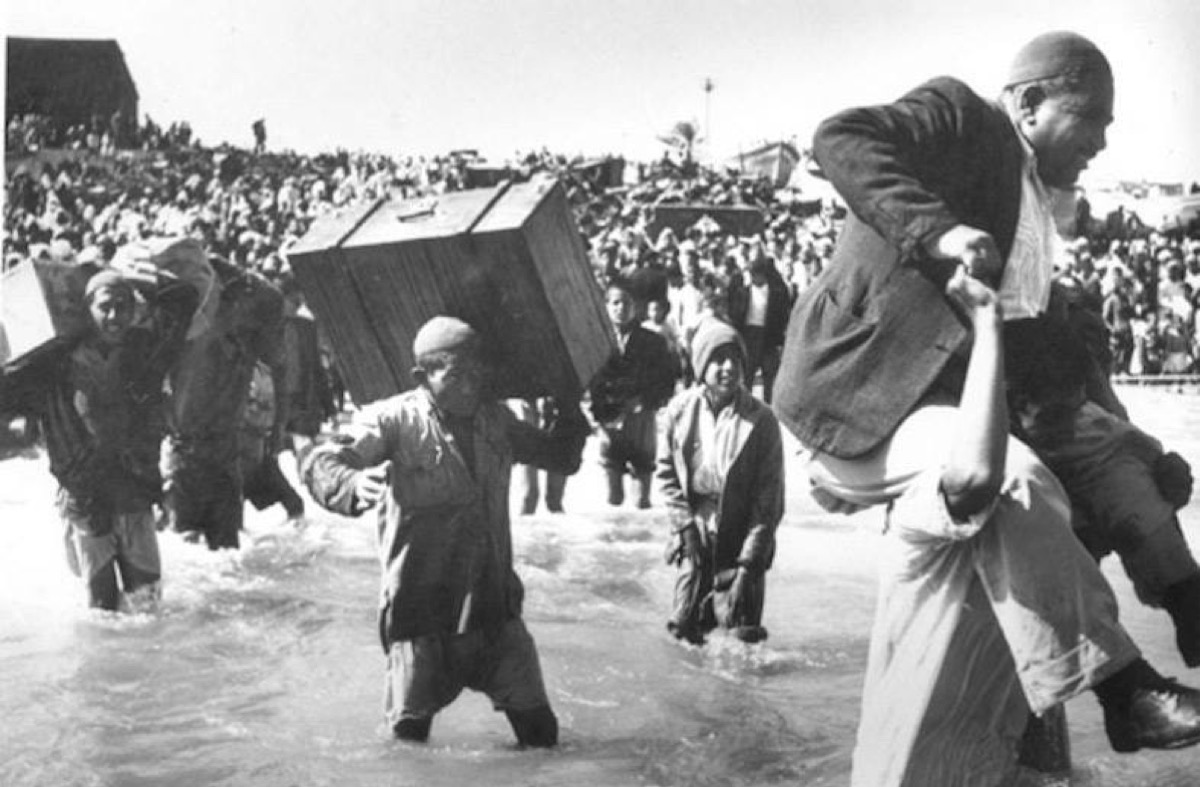
One of the realities of the formation of the Israeli State in 1948, the Nakba (Catastrophe), mass expulsion of Palestinians. (Image sourced: Internet)

Despite whatever concerns might have existed in its upper echelons, the Irish State recognised Israel de jure in 1963.

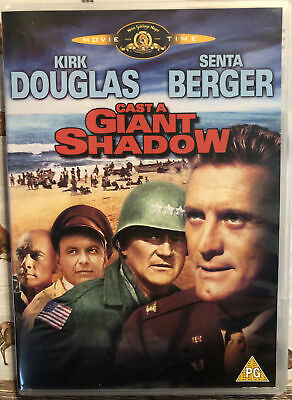
In 1966 the film Cast a Giant Shadow was produced in the USA and was soon showing in Britain and in Ireland. The film took as its human interest base story that of David Daniel “Mickey” Marcus, a true-life USA Zionist and WWII veteran but in its depiction of the formation of the State of Israel was wildly inaccurate, of course showing none of the massacres or evictions of Palestinians20 carried out by the Zionists, in particular their armed gangs.

“Mickey” was a member of one of those terrorist gangs, the Haganah and was played by Kirk Douglas with Senta Berger as the love interest, while even Frank Sinatra, Yul Brynner, John Wayne and Angie Dickinson had cameo roles in the film.

Despite its number of Hollywood stars and the support of the Israeli State and their armed forces, it reputedly flopped in terms of financial return on investment.
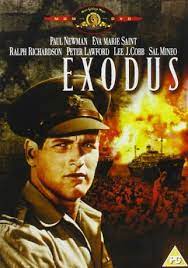
English language poster for the 1960 Exodus film, featuring Paul Newman at a high point in his career. (Image sourced: Internet)
Cover for the 1966 Cast A Giant Shadow film as a DVD (allegedly deleted and rare, according to EBay advertisement). (Image sourced: Internet)

Both films were popular in Ireland (showing Jewish paramilitaries fighting uniformed British troops and police didn’t hurt) and strengthened feeling of sympathy with Israel.

Also in the 1960s a number of socialist-type communities called “kibbutzim” were established on land in Palestine under Israeli rule and many young people, Jewish and Gentile, went to work in them for some months, out of idealism, to experience change, new cultures, comradeship (and possibly get laid, as the Yanks say).

Christian pilgrims to the Holy Land21 went by permission of the Israeli State and had a very narrow and sanitised experience (if at all) of what life was like there for the Palestinians.

In the 1967 June War and the 1973 Yom Kippur War in Palestine, the media reporting represented the inaccurate image of the plucky little Jewish State fighting against and overcoming aggression by combined Arab states. This was more easily done in the case of the 1973 war when Egypt and Syria attacked first, but the fact was that Israel had been the aggressor in the ‘67 war, striking at Egypt, Jordan and Syria and the Zionists were now in occupation of land conquered in that war.22

All those ingredients together helped create a culture of Irish society friendliness towards the Israeli State and no Israeli Ambassador was complaining at that time of the words of Irish Government Ministers, much less of the general attitude of the Irish population.

The friendly attitude was reflected also in much of the Irish nationalist movement. Irish language supporters and campaigners, who wished to make Irish a language spoken throughout Ireland and not only in the Gaeltacht areas, admired the Israeli State for its achievement in restoring Hebrew as a daily spoken language, a language that for centuries had been used only in religion.23

IRISH SOCIETY’S VIEW OF ISRAEL BEGINS TO CHANGE

However, people were beginning to see beyond the pro-Israel narrative. In 1974 the United Nations General Assembly recognised the Palestinian right to self-determination, along with the Palestine Liberation Organisation as the legitimate representative of the Palestinian people, as did the Arab League. The following year the UN General Assembly recognised Zionism as a racist ideology24 (which was not overturned until 1991).

In the Left and Republican movement

By the late 1960s most left-wing organisations around Europe were clear that the Israeli State was a Zionist one, not legitimate and that the Palestinians were oppressed and fighting a liberation struggle. Official Sinn Féin sent a delegate to conferences in Jordan and Kuwait in 1970/‘71; in 1970 too an article in the party’s weekly United Irishman saw Ireland, like Palestine in a national liberation struggle25.

The Official IRA prisoners in Mountjoy Jail supported the Palestinians in their journal An Eochair in 1973 and Palestinians were among the guerrilla groups represented in the second Anti-Imperialist Festival organised by the Officials in July 1976.26

Nevertheless the election manifesto of the Workers’ Party in 1983, successor to Official SF, argued for the recognition of the State of Israel, although that was contrary to party policy and to the involvement of WP members in the Irish Friends of Palestine organisation, which was committed to supporting the PLO.

However, party policy was soon publicly and internally reinstated in solidarity with Palestine.

Around this time, the British & Irish Communist Organisation, a small but influential organisation, had a pro-Israel position which however it reversed in the late 1980s, shortly before the party’s demise.

In the 1970s the Provisional Sinn Féin weekly newspaper An Phoblacht often featured articles sympathetic to the Irish struggle from a USA-based correspondent signing himself as Fred Burns O’Brien.

An Irish anti-imperialist working in London noted, in one of those articles, a favourable reference to the Israeli state and penned a protest letter to the Republican newspaper, pointing out that the Palestinians and not the Israeli Zionists were the natural allies of the Irish people and of anti-imperialists in general.27

The letter was not published and for some time O’Brien’s articles continued to appear in An Phoblacht.

However, once the Provisionals declared themselves to be in favour of socialism, they became pro-Palestinian and in the 1990s the PLO would have representatives attending Provisional Sinn Féin’s Ard Fheiseanna (Annual Congresses).28

Ireland today – the bloody path to being overwhelmingly pro-Palestinian

Large numbers of Irish people were becoming pro-Palestinian and against the Israeli state from the 1970s onwards, a process that accelerated through the decades.

After an air force, naval and ground artillery bombardment in 1972, Israel’s infantry and armoured forces invaded south Lebanon with the support of its right-wing Christian militia ally. That action resulted in between 1,100-2,000 Palestinian and Lebanese Muslims dead and 100,000-250,000 internally displaced.29

In 1982 the Israeli armed forces were back in Lebanon again, allied to right-wing Lebanese Christian militia. Estimates of Palestinian and Lebanese killed during that conflict vary from 1,100 to other sources quoting about 2,000 killed, most of them Palestinian and Lebanese.

From 100,000 to 250,000 people were displaced internally due to the invasion and fighting and that and other events contributed hugely to the ongoing Lebanese Civil War (1975-1990). However on this occasion the Israeli armed forces suffered considerable casualties, often in ground struggle with Hizbollah fighting from tunnels.

Massacres of civilians in refugee camps became part of the war in Lebanon, with both Syrian and Israeli culpability.
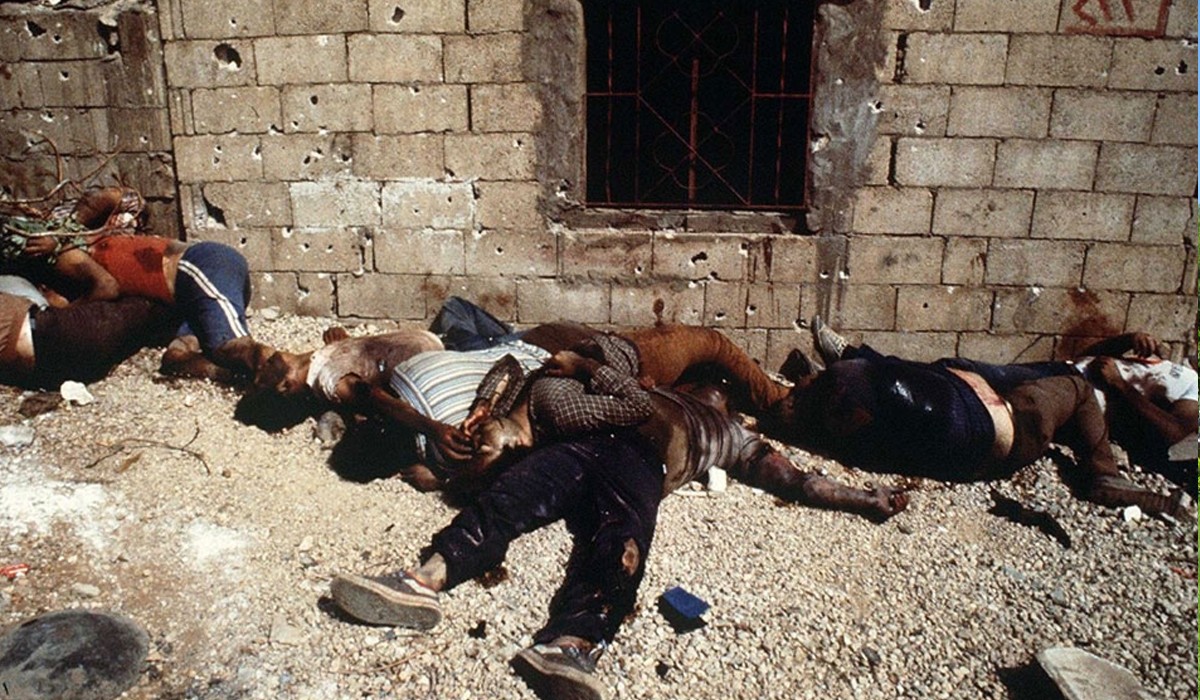
A scene from the aftermath of the Sabra and Shatila Massacre 1982 facilitated by Israel (Image sourced: Internet)

On 12 August 1976, supported by Syria, Christian Maronite forces managed to overwhelm the Palestinian and leftist militias defending the Tel Al Zaatar refugee camp in east Beirut, which had been under siege since January.

The Christian militia massacred 1,000–1,500 civilians, which unleashed heavy criticism against Syria from the Arab World.

Six years later, on 18th September 1982, the right-wing Christian Phalange (also known as Kataeb Party), in the presence and under the protection of the Israeli armed forces, its ally, massacred occupants of the Sabra and Shatila refugee camp in Beirut.

Estimates of the number of massacre victims vary with the highest number at 3,500, mostly Palestinians and Lebanese Shiites.

1987 saw the beginning of the First Intifada of strikes, civil disobedience and riots (which did not end until 1991). That year alone 289 Palestinians in the West Bank and Gaza were killed by Israeli state forces with another 15 by Israeli zionist civilians, while only ten were killed on the Israeli side, six civilians and four of the armed state forces.

In addition, Mossad agents shot the Palestinian cartoonist Naji al-Ali in the head in a London street. Overall during the First Intifada the Israeli army killed more than 1,000 Palestinians whilst 164 Israelis were killed.

The Second Intifada began nine years later and ran from 2000 to 2005 with a death-toll of 3,000 Palestinians and 1,000 Israelis, as well as 64 foreigners.
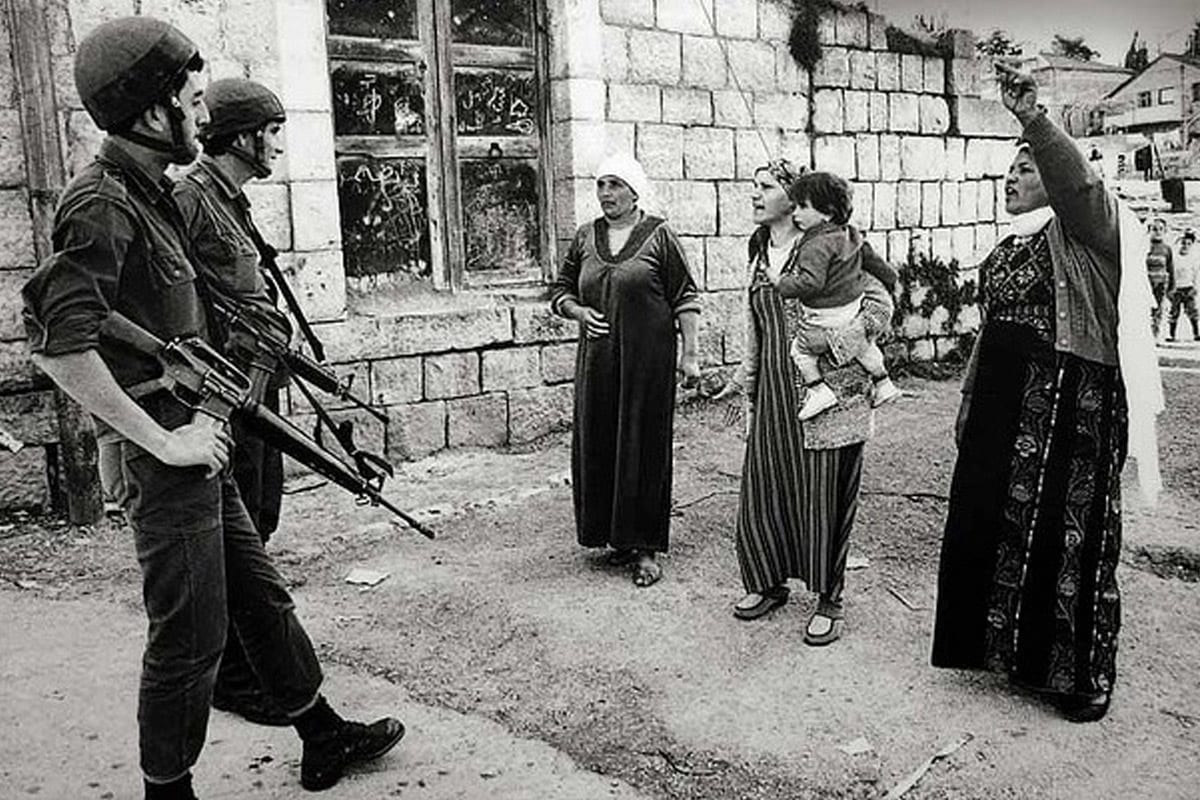
Unarmed Palestinian women confront armed Israeli soldiers in December 1987, during the first Intifada. (Photo credit: Robert Croma, Mary Scully Reports).

After Hamas won their landslide victory in the 2007 elections to the Palestinian Authority, Al Fatah denied them taking administrative power in the West Bank but a similar attempt failed to do so in Gaza.

The Israeli armed forces withdrew from Gaza but kept control of one of its gates, its air space and sea. Minor armed conflicts continued until 2009, when Israel launched an intensive attack on the enclave, dubbing it Operation Cast Lead.

Over the 22 days of the assault, in which Israel used white phosphorous shells against civilian areas (against international law), 1,400 Palestinians had been killed, of which 431 were children.

In 2010 the Israeli Navy intercepted ships, one of which sailed from Ireland, bringing aid to Gaza on the high seas, boarded them under arms, killing ten Palestinian solidarity activists on a Turkish ship and sailed the ships into Israeli port.

In the process they jammed the radar and radio of the ships, confiscated the cargoes (though some were eventually released to Gaza), confiscated the mobile phones and laptops of crew and passengers (the memories of which they inspected, wiping many photos and film), seized the ships, detained the passengers and crew in jail and deported them.

Carlos Latuf cartoon draws on the film Jaws to depict the Israeli Navy’s stalking and attack on the Irish aid-to-Gaza ship, the Rachel Corrie. (Image sourced: Internet)

In November 2013, Palestine was accorded “non-member observer status” in the United Nations and would henceforth be referred to officially as “the State of Palestine”.

When the Israeli Ambassador called Ireland “the most anti-semitic country in Europe was I think, as I said, 2014, during or soon after his state’s assault on Gaza that year.

On the Palestinian side 2,251 were killed during that war, of which 551 were children and 299 women; in addition 11,231 Palestinians were injured, including 3,436 children and 3,540 women. More than 1,500 Palestinian children were orphaned.

18,000 housing units were destroyed in whole or in part and 73 medical facilities and many ambulances were damaged.30 There was widescale damage to electricity generation and supply and to sewage treatment plants, which resulted in heavy sea pollution; factories also were destroyed.

On the Israeli side, the casualties were 67 Israeli soldiers, five Israeli civilians (including one child) and one Thai civilian killed, while 469 IDF soldiers and 261 Israeli civilians were injured. Hardly an Israeli building was damaged despite the approximately 300 rockets fired by Palestinian guerrilla groups.

This was not war of two belligerents and the casualty statistics underlined that; the Israelis had an airforce, the Palestinians have none; the Israelis had a navy, the Palestinians have none.

The Israelis had sophisticated long-range and even remotely-controlled weapons; all the Palestinians have is their home-made rockets, most of which fall short or are destroyed by Israeli defence systems. Of course, the Palestinians have no anti-air attack defence systems whatsoever.

The only effective armed response that Palestinians have is their guerrilla forces which are only effective within firearm reach of the enemy, when they can certainly take their toll, as the Israeli Occupation Forces found when they invaded Gaza and were forced to retreat.

Irish society saw enough of this, on videos, in reporting on TV and in print and drew their conclusions despite the media bias nearly always in favour of the Israelis and against the Palestinians.

The solidarity activist organisations helped educate the Irish people but it was mostly what the latter saw and heard and the process of their own brains that transformed their view.31

In 2017 the Palestinian flag was flown above Dublin’s City Hall by majority vote of Dublin City councillors for one month in solidarity with the Palestinians.

The latest Gaza “War” just concluded was another in a long list and the current truce can only be, as those before it, a temporary one. The Zionist State project requires oppression and repression of Palestinians which in turn can only give rise to continued resistance.

The Zionist State cannot defeat the Palestinian will to resist but nor can the Palestinian resistance defeat the militarily far superior Israeli State with its huge military, economic and political support from the United States of America.

The states of the world that would wish to support the Palestinians or at least end the periodic bloodbaths will need to withdraw their support from the US-led alliance that supports the Zionist State.

THE ATTITUDE OF IRISH SOCIETY TODAY

Altogether, the opinion of most of Irish society today on the Israel-Palestine conflict is vastly different to what it was in the 1950s, 1960s and even 1970s – a sea-change has taken place of which Irish politicians have had to take note.

People today have alternative sources of information to the Irish and British mainstream written and TV media, with major news networks such as Al Jazeera and RT. In addition, some mainstream media has decided to expose Israeli’s actions.

But also video and photographs from smaller organisations and individuals get shared on social media and are seen by hundreds, thousands or even hundreds of thousands.

Part of the Ha’Penny Bridge, Dublin annual New Year’s Day Palestine solidarity demonstration organised by the Ireland Palestine Solidarity Campaign 2020 (Photo: D.Breatnach)

The Palestinian solidarity activities of what has been broadly the largest oppositional movement to the State, the Republican Movement, through its publicity and the activism of its members of course helped develop awareness in Irish society of the justice of the Palestinian cause and, conversely, of the injustice of that of the Zionist State. The small socialist and communist organisations also played a part.

Although all those, including in particular in more recent times solidarity groups and individual activists, have made a huge contribution, the main element responsible for the change has been the visible behaviour of the Zionist State itself, along with its Zionist supporters, both inside and outside Israel.

And the “sea-change” has become now a tsunami.

End.

FOOTNOTES

1Declared illegal by the United Nations, since they are all on land seized in conquest by Israel in 1967. Many Zionists however regard them as the logical extension of the Israeli state, a kind of Zionist “manifest destiny”. On the other hand, many others consider the Israeli state itself to be illegal, a racist, religious state on ground seized from the Palestinians.

2A traditional diplomatic way of expressing extreme displeasure with the state represented by an embassy.

3Sponsored by Irish Senator Frances Black, a singer, social and human rights campaigner, its full title is Control of Economic Activity (Occupied Territories) Bill 2018 and has been proceeding slowly since 2018. The Bill would it make it illegal to import, repackage or sell products from the ‘Occupied Territories’ within the territory of the Irish State, liable on conviction to heft fines. Its passage and implementation would represent another ‘first’ in the EU for Ireland.

4Originally it meant “against the semitic people” and since the Arabs are “semitic people” too, it would mean being hostile to them also — which would make Zionists anti-semitic, in part. But we’ll use the term here to mean “anti-Jewish”, which is how most people understand it these days (except for the Zionists, for which it means “criticising Israel”).

5https://www.irishtimes.com/news/social-affairs/religion-and-beliefs/jewish-population-here-not-experiencing-hostility-says-official-1.1896293

6Shakespeare’s play The Merchant of Venice, written during the reign of Elizabeth I of England, figures the Jewish financier demanding the pound of flesh from the Christian merchant, a terrible portrayal and it is that which remains in the memory and even in the language, while the Jew’s recounting of the insults he has received before that are mostly forgotten. England had anti-semitic laws in terms of settlement, trade and other rights until the 1930s and semi-official tolerance/ encouragement of active anti-semitism right up to WWII.

7And Arthur Griffiths, shortly before he founded the original Sinn Féin party.

8While it is stated in many sources that some families remained in Cork and although I can recall recently reading about the welcome the city gave them, I regret that a number of searches have failed to date to reveal that source.

9Fianna Fáil remained governing in minority until 1938 when it was in majority, was in minority again in 1943, in majority in 1944 until ‘48 when it was in Opposition.

10The party is often to this day called “Blueshirts” by opponents.

11And blessed by many Irish bishops and priests as “crusaders for the Catholic Faith”.

12See link for in SOURCES at end of article for review of Hitler’s Irish Voices: The Story of German Radio’s Wartime Irish Service by David O’Donoghue (Beyond the Pale Publications) in History Ireland.

13The difficulties of capitalism recently, the breakdown of the two-party system and the Covid19 pandemic have provided opportunities for far-Right and outright fascists organising in Ireland and anti-semitism features among them in particular in the three tiny fascist parties. However, they tend not to promote their anti-semitism, preferring instead to concentrate on anti-immigration, homophobia and islamophobia.

14Even though the British had been encouraging Jewish migration to Palestine since at least the Declaration by the British Prime Minister Arthur Balfour in 1917.

15The British had previous control over Egypt, having fought the French and the Egyptians and in fact still had troops there until June 1956. But their days were numbered there from the Arab nationalist coup in the Egyptian Army in 1952, which is what led to the nationalisation of the Suez Canal.

16President Eisenhower threatened to hurt the UK financially and the British Prime Minister, Anthony Eden, was forced to resign.

17The Lord Mayorship of Dublin is a largely ceremonial position but of course not without some influence; the chosen candidate is elected by City councillors at their Annual Meeting in the summer and occupies the position until the election of the successor the following year.

18Leader of the Irgun and sixth President of the Israeli State.

19Shatter resigned his membership in 2018; he was the sitting TD with the largest property portfolio of any member of Ireland’s cabinet while a cabinet minister (2011-2014).

20And even rape before murder, as was acknowledged officially a few years ago.

21Because of its location in much of the Christian Bibles, Palestine is considered the “Holy Land”. However it holds sites revered by Jews and Muslims too.

22It was in that war that Jerusalem and much additional land was occupied by Israel and part of the Zionist project is to make Jerusalem the Jewish-only capital of the Israeli State (hence the recent Zionist civilian harassment of Palestinian families living there).

23Other Jewish languages were used such a Yiddish – mostly German in composition — by the Ashkenazi Jews and Ladino — mostly medieval Spanish-Portuguese but with many other influences — by the Sephardic Jews.

24Resolution 3379.

25The Lost Revolution, Brian Hanley & Scott Millar (2009), pp.213, 215, 221

26Ibid, p.334.

27I wrote the letter and it was not the only one they didn’t publish. My father Deasún Breatnach, who was Editor of the paper for a couple of years, told me that he had been refused permission to publish another letter I had written.

28The PLO at the time was controlled by the Al Fatah organisation and in 1989 signed up to the disastrous Oslo Agreement, which in time led to their losing their place in the leadership of the Palestinian movement and of the Palestinian Authority to Hamas. Both Palestine and South Africa were initially seen in some quarters as great examples of the alleged benefits of “peace processes” and both the PLO and ANC delegates at the Ard-Fheis were employed to help swing the Provisionals’ membership between the Irish version of the “process”.

29Most of the statistics are taken from a Wikipedia source clearly influenced by pro-Israeli contributors: https://en.wikipedia.org/wiki/Timeline_of_the_Israeli%E2%80%93Palestinian_conflict

30https://www.ochaopt.org/content/key-figures-2014-hostilities

31A notable exception to this whole process has been the Unionist section of the British colony in Ireland, the Six Counties. In particular the Loyalists love to hate anything the Republicans support and for that reason profess to hate the Palestinians and to support the Israeli state, despite some connections of theirs with British and Irish fascist groups who are anti-semitic.

SOURCES(in order of use)

Irish Parliament votes to declare Israeli ‘illegal settlements’ and annexation: https://www.breakingnews.ie/ireland/dail-to-vote-on-motion-calling-for-expulsion-of-israeli-ambassador-defeated-1133487.html

“Occupied Territories Bill”: https://www.oireachtas.ie/en/bills/bill/2018/6/

Gaza War 2014 casualties: https://www.ochaopt.org/content/key-figures-2014-hostilities

Anti-Semitism in England: https://en.wikipedia.org/wiki/Antisemitism_in_the_United_Kingdom

Limerick antisemitic Boycott and riots: https://www.historyireland.com/20th-century-contemporary-history/the-limerick-pogrom-1904/

Blueshirts: https://en.wikipedia.org/wiki/Blueshirts

Irish Christian Front: https://en.wikipedia.org/wiki/Irish_Christian_Front

Anti-Semitism in Ireland (in particular during the WWII years): https://www.historyireland.com/20th-century-contemporary-history/jews-in-twentieth-century-ireland-refugees-anti-semitism-the-holocaust-dermot-keogh-cork-university-press-15-99-isbn-1859181503-hitlers-irish-voices-the-story-of-german-radio/

Protection of Judaism in the 1937 Irish Constitution: https://en.wikipedia.org/wiki/Constitution_of_Ireland#Religion

Herzog: https://en.wikipedia.org/wiki/Chaim_Herzog

Robert Briscoe, IRA Volunteer, TD and Zionist: https://en.wikipedia.org/wiki/Robert_Briscoe_(politician)

Ben Briscoe, Jewish, Lord Mayor of Dublin: https://en.wikipedia.org/wiki/Ben_Briscoe

Ben Briscoe Lord Mayor of Dublin and Zionist: https://repository.upenn.edu/cgi/viewcontent.cgi?article=1103&context=phr

Alan Shatter: https://en.wikipedia.org/wiki/Alan_Shatter

Zionist Hollywood films:

(1960): https://www.timeout.com/movies/exodus

(1966): https://en.wikipedia.org/wiki/Cast_a_Giant_Shadow

Massacre and rape by Israeli soldiers in one village: https://en.wikipedia.org/wiki/Safsaf_massacre

June or Six-Day War: https://www.history.com/topics/middle-east/six-day-war#

Timeline and statistics in a Zionist-influenced Wikipedia site: https://en.wikipedia.org/wiki/Timeline_of_the_Israeli%E2%80%93Palestinian_conflict
Irish Republican Richard Behal (Part Two)

Fascinating story in Part II (Part is very interesting too) of a successful IRA attack on an advance British in 1965.

Also an interesting account of an attempt by the Irish Gombeen ruling class to reach closer cooperation with British imperialism in the run-up to the 50th anniversary of the 1916 Rising, combined with a struggle within the IRA between emphasis on military struggle or social and economic struggle.

The work in obtaining these interviews and broadcasting them is a very important contribution to recovering our history.

irishrepublicanmarxisthistoryproject's avataririshrepublicanmarxisthistoryproject

This is part two of the story of Irish Republican Richard Behal who as a young man joined the Irish Republican Army in Kilkenny, he subsequently participated in Operation Harvest . (Otherwise known as the 1956-62 Border Campaign)

In 1965, one years before the 50th anniversary of the 1916 Easter rising,  Richard  was  involved in an operation to attack the British naval boat HMS Brave Border with an anti-tank weapon in Waterford . The attack caused millions of pounds of damage to the boat.

In addition, he was arrested and remanded  to Limerick prison from where he made a daring  escape using a hack-saw to cut through the iron bars of the cell window.

View original post

Sniping from hiding — Eoghan Harris

Diarmuid Breatnach

I despise the man and have done so for most of his career — a manipulator of people and opinion who was given much more than a fair shake by interests in the media and politics here in this neo-colonial part of the country. “Neo-unionist” is an apt enough description, as would be “neo-colonialist”.

But nasty and despicable as all that he was done and said has been, doing so while hiding with others behind a fake social media account is the most despicable of all. So many others on the Right and Far-Right in Ireland are doing so, sometimes in conjunction with the Far-Right of the USA, Trumpists etc.

It is understandable that some political activists may have to use a fake account from time to time, because of political repression or because of unreasonable closing down of their sites by FB without right of appeal (e.g in criticising Israel or in supporting Irish Republicanism). But Harris has no such excuse — quite the contrary, he was promoted by the political-media class.

Eoghan Harris Axed By Sunday Independent Over Fake Twitter Account

“Slightly Shaken” (!)

Two skilled landings by Irish pilots when their single engines failed — but 72 years apart.

Eoin Mac Lochlainn, visual artist's avatarScéalta Ealaíne

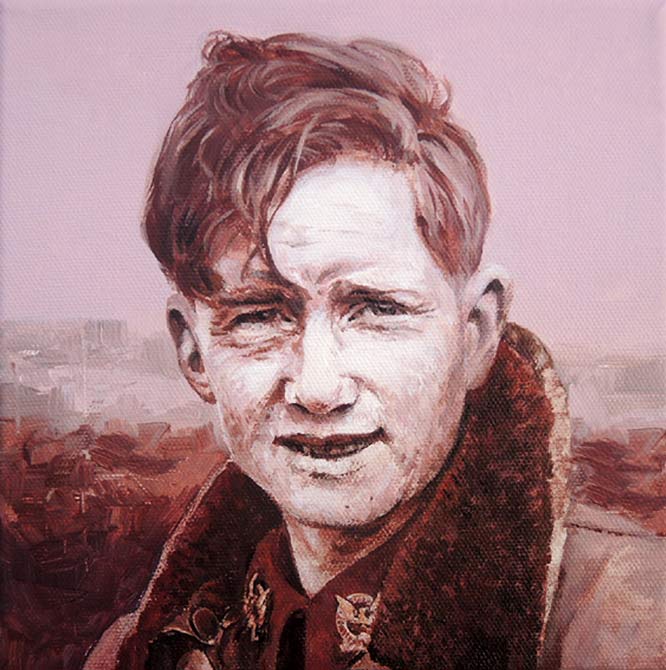
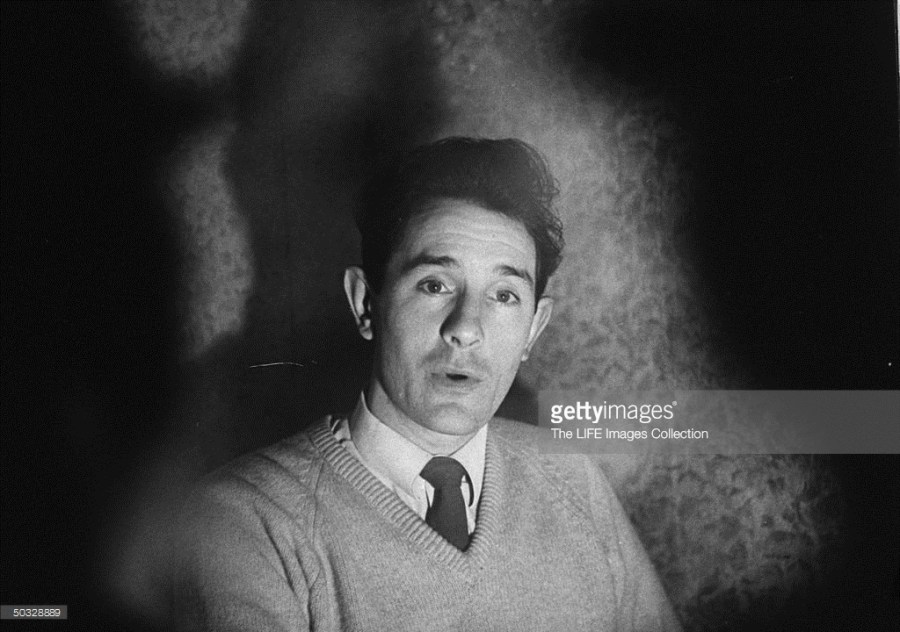
oil painting by Eoin Mac Lochlainn of Pilot Michael McGloughlin A portrait of my uncle, Pilot Michael McGloughlin
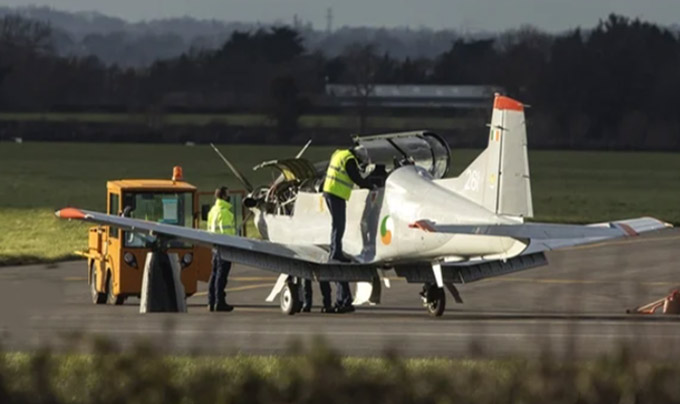
Now, engine failure is one thing if it’s in your lawnmower but another thing entirely if you’re flying a single engined aircraft. You might’ve heard about that incident last week with the Irish Air Corps plane at Baldonnell?

Well, the engine conked out about 30km from the air base but, rather than bailing out, the two pilots managed to manoeuvre the aircraft and glide it all the way back for a safe landing at Casement Aerodrome, Baldonnell in south-west Dublin.

The two-person PC-9 aircraft was conducting a training mission when the problem arose but, according to a military source, the pilots were unharmed aside from being “slightly shaken”.

The Irish Air Corps plane, safely landed at Baldonnell   – photo RTE
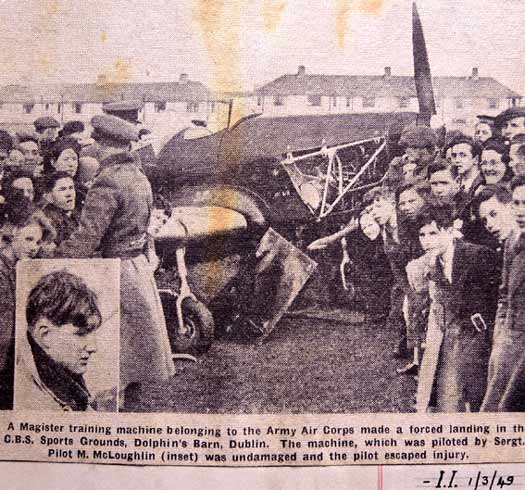
Pilot Michael McGloughlin after a forced landing in Dolphin's Barn, 1949 A paper cutting from The Irish Independent, March 1949

Now, how about this:  I had an uncle who was a pilot. I…

View original post 310 more words

ABSTRACTED IN GREYSTONES

Diarmuid Breatnach

(Reading and viewing time: 3 mins)

On a sunny but windy day in Greystones, lá grianmhar ach gaofar, nature put on an abstract art show. The sunshine brought out intensely the yellow of the lichen on the limestone rocks, while the black lichen encrustation on some rocks contrasted sharply with a neighbouring section of bare grey. Some trick of the camera and light brought out a gorgeous blue in the rock-shadowed sea which had not been visible to the eye.

Yellow lichen incrusts the tops of stones in foreground like paint daubs while in background, a trick of light or camera turns blue the shadow on the sea. the lichens and plants here are extremophiles, living on the front line (or the beachhead). (Photo: D.Breatnach)
(Photo: D.Breatnach)

Lichens are an amazing life form, being an integrated symbiosis of an alga and a fungus. A cross between a frog and a goose would not be more bizarre in concept – fungi are not even plants, while algae are. The fungus provides a relatively strong skeleton while through photosynthesis the alga produces sugars to feed the fungus.

Although not all are easy to distinguish, there are over 1,165 species of lichen in Ireland, varying from the common to the rare. The yellow-orange one, Xanthoria parietina, is one of the common ones in Ireland. The white and often off-white or grey Ochrolechia parella can be mistaken for bird excreta at a distance, or even as the ground-in chewing gum that costs Dublin City Council so much to remove from street surfaces every week. The black one, Verrucaria maura if I am identifying it correctly, covers rocks that are wave-lapped or hit by sea-spray on a daily basis.

Limestone rock covered with black lichen contrasting with bare grey limestone in upper centre of image (Photo: D.Breatnach)

These are all hardy adventurers, extremophiles, living in zones exposed to great variations of temperature, all even in one day, as the sun beats down between rain showers or windy spray. And they are very tolerant of salinity, without at the same time being dependent upon it. Perhaps not these species but their ancestors, or other forms like them, were the early colonisers of the land on our planet. Terraformers too, as they slowly abrade the rock upon which they cling, helping to create soil, while black lichen attracts heat to warm up surfaces and the alga in the symbiotes releases oxygen into the atmosphere.

Lichens can live attached to rock, wood and metal, some species even inside stone and on snow.

Plaque commemorating the public launch of the Votes for Women campaign with Hannah Sheehy-Skeffington and Hilda Webb confronting Chief Secretary for Ireland (for the Crown) Augustine Birrell at Greystones Harbour in 1910. (Photo: D.Breatnach)

No plaque or monument celebrates these hardy adventurers but down on the harbour wall was a plaque to another hardy life-form, celebrating the 1910 confrontation there of Chief Secretary Birrell, one of the Crown’s main representatives in Ireland, by Hannah Sheehy-Skeffington and Hilda Webb. They were kick-starting the militant Votes for Women campaign which was later brought into conflict with the Irish Parliamentary Party too but influenced the 1916 Proclamation’s advanced and stirring address: “Irishmen and Irishwomen ….”. That Rising six years after the Greystones confrontation would shock Birrell and sadly, would see Hannah’s pacifist husband Francis murdered by a British Army officer during that momentous week.

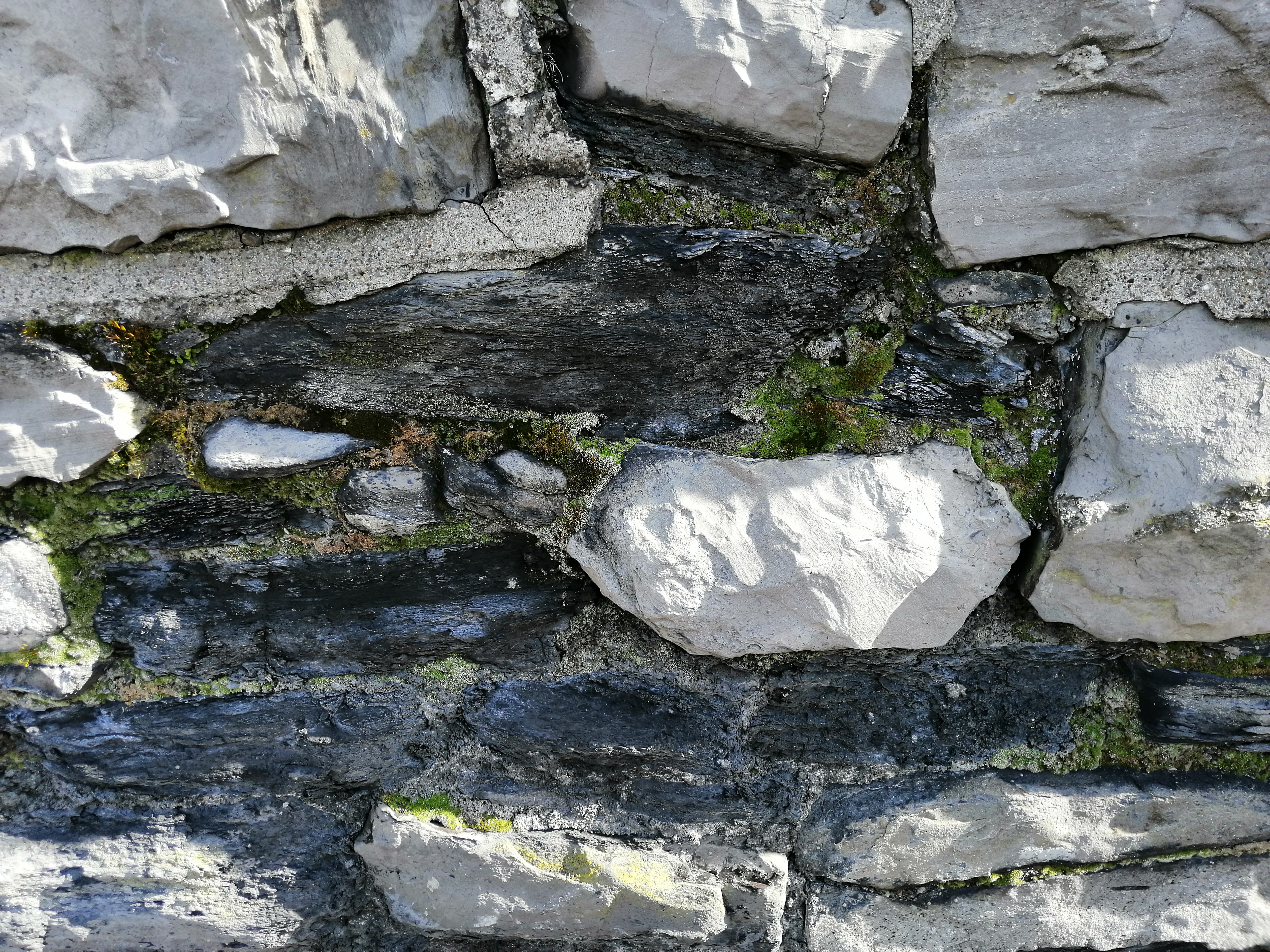
Earlier, in a Dublin train station, I photographed a wall of varied limestone, where algae and moss, also terraformers, had made an abstract art collage.

An abstract collage of shapes and colours: limestone wall with moss and algae, train station, Dublin. (Photo: D.Breatnach)

End.

REFERENCES

https://www.irishlichens.ie/

http://www.biology.ie/species.php?m=lichens-ie&s=2140

KEEPING THE COLONISED AND THEIR OWN PEOPLE IN IGNORANCE

Diarmuid Breatnach

(Reading time: 3 mins.)

I received an on-line invitation to support a protest about the exclusion of Palestinian Studies from the California State high school curriculum on Middle Eastern studies. Aside from the obvious importance and relevance of Palestinian studies in any Middle Eastern syllabus, there is the glaring need for such options in a country that is the biggest supporter of the state of Israel, with which the Palestinians are in conflict. But then it is precisely its relevance that ensures its opposition, nor is it only with regard to Palestine that such exclusion occurs.

“After months of controversy, California has released the final version of a model statewide ethnic studies curriculum for use in high schools. The original draft curriculum rightfully included the histories and narratives of Arab Americans, including Palestinians, written by scholars in the field.

“Due to pressure from anti-Palestinian organizations, the Arab American lesson no longer includes content developed by Arab American ethnic studies educators, and has NO information about Palestine. Palestinian history and narratives should be central to any ethnic studies curriculum, and this attempted erasure is appalling. …..

“We’re not the only ones raising the alarm. All original curriculum drafters have asked for their names to be removed as authors because the revised curriculum no longer represents their work and vision. It no longer highlights contributions and struggles against structural racism and social, political, and economic marginalization. It has become an “All Lives Matter” curriculum.“

Mosaic map of Palestine and detail of Jerusalem. Civilisation of Palestine, 5th Century BC. Jerusalem, Museo Di Israele (History Museum) (Photo by DeAgostini/Getty Images)

AND SO TO IRISH STUDIES ….

Some decades ago in London I was involved with a number of others in organising a course called Irish Aspects at Goldsmiths College1. The course was composed of a series of weekly 2-hour evening meetings at the site, which was in the New Cross area of SE London. The sessions would cover, as its title indicated, different aspects related to Ireland, such as literature, politics, history ….

The course did fairly well but when it came to the following year, the College administration indicated they were considering closing it down. The course attendance, despite minimal advertising, was fair and the expense to the College, apart from the heating and lighting in the room we were using, was a mere two hours per week at tutor rate, with which we paid the speakers we brought in.

In discussion with the Director, he admitted that “The case for Irish studies is unanswerable”, by which I clarified that he meant “cannot be opposed”. Nevertheless, they did close down the course and would not even offer us a room in which to meet weekly without any paid tutor hours.

A few years later I applied to the Irish Studies course at University of North London2 and got in a year later. In fact, only half the BA course was in Irish studies and one had to choose another section of the Humanities prospectus to make up the whole. Over the years of studying and engaging with the subject of Irish Studies, I learned that in the whole of Britain there was not one whole degree course available in that subject and the only thing close was Celtic Studies, at the University of Aberyswyth, in west Wales3. So a BA course based on the history, culture, literature, art and language of a neighbouring country, with which the British State had been politically and militarily engaged for 800 years, from which huge migration to Britain had taken place for centuries, was not thought appropriate to make available in any one of over 130 universities in Britain4.

It was of course the same as with the refusal of the Palestinian course in the state of California, USA – its very relevance and importance was the reason why it could not be provided.

It is well documented by many writers and historians that the colonialists and imperialists do not wish the indigenous of the colonised lands to have a good appreciation of their own culture and history and certainly Ireland under British rule provides an abundance of examples of that negation.

But the lack of such courses in Britain did not only deprive Irish migrants and their children of the opportunity of such study, it also deprived the host community, along with other migrant communities. And that too has its rationale.

In a long struggle with a colonised people it would be disastrous for the ruling class if the host of the ruling class to suppress “the natives”. And the potential with regard to Ireland was serious, since the Irish migrant and diaspora community in Britain was huge and some of it well integrated into sections of British society – particularly the working class and its trade union and political expressions.

Mosaic map of Palestine and detail of Jerusalem. Civilisation of Palestine, 5th Century BC. Jerusalem, Museo Di Israele (History Museum) (Photo by DeAgostini/Getty Images)

In addition, the Irish had much to teach the host population about the real nature of the British ruling class, since they had seen and felt it with fangs and claws bared, a sight of which the workers in Britain in more recent times caught only an occasional glimpse5.

The people who manage the imperialist and colonialist systems occasionally do stupid things but they are not stupid. They control education as an important ideological process and product. Battles can be fought over course funding and available subjects and these are justified. Some will be won for the ruling class needs its moderates, liberals and revisionists to moderate the content and try to control the discourse and therefore the conclusions. Ultimately however workers and communities from oppressed nations and groups need to set up their own courses and rely on their own resources.

End.

FOOTNOTES

1 Now part of the University of London.

2 Now part of London Metropolitan University.

3 I note that Liverpool University now offers a BA (Hons) course in Irish Studies. However, even there, students in Year One are required to take other 30 credits of subjects outside that curriculum.

4 Ireland was invaded by colonisers from Britain in 1169 and the English occupation is counted from that date; currently Britain holds six counties in the north-east of Ireland as a direct colony. The Irish compose by far the largest ethnic group historically migrating to Britain and for most of its history, past and recent, have been the largest ethnic minority community present.

5 It can hardly be pure coincidence that the Irish in Britain supplied the working class there, as well as with many of its activists and prominent figures, two leaders of its first mass movement (the Chartists), its first classic novel (The Ragged-Trousered Philanthropists) and its battle hymn (The Red Flag).

THE WOMEN STARTED IT!

(Reading time: 5 mins)

Diarmuid Breatnach

We celebrate International Women’s Day on March 8th but are we aware that on that day in 1917, women started the Russian revolution?  It was one of the many contributions of women the world over to the struggles of humanity.

BACKGROUND

          There were many causes of discontent with the ruling regime in Russia in 1917: it was monarchic, autocratic, repressive, incompetent. It had put the country into a war with Germany and Austria, which was in its third year. People were very hungry with food shortages for a number of reasons including the trains being used to transport war materials and soldiers rather than to bring food into the city. Nationalities within Russia and Greater Russia were denied self-determination.

Peasants were serfs to the aristocracy, who could beat, imprison and even hang them. Officers, always from the aristocracy or — to a lesser degree — from the professional classes regularly struck ordinary soldiers or had them whipped. The officers were also for the most part grossly incompetent.

The Christian Church (Russian Orthodox) was allied to the regime and corrupt. Free speech was suppressed and the secret police could be anywhere; the regular police were brutal and could not be challenged by ordinary people. Wages were often barely enough to live on.

START OF THE REVOLUTION

          Petrograd was the Imperial capital city of Russia (the name had been changed in 1914 from St. Petersburg, which sounded too German) and in February and March 1917 a number of factories there were on strike for better wages.   In particular, on March 7th (February 22 according to the calendar in use in Russia then), workers in the large Putilov works went on strike. The factory owners sacked the workers but not had not yet replaced them; there were some clashes with police.

The following day, March 8th (by our calendar), International Women’s Day, women in Petrograd organised a number of meetings and rallies. Led by no political party but in an atmosphere of deep discontent throughout the city, the women’s activities became increasingly energetic and militant. Demonstrations began to march, demanding bread and the women went to factories not yet on strike, calling on the workers to down tools and join the demonstrations. As as many as 50,000 did.

Two days later, a general strike had seized Petrograd’s manufacturing industries, much of the city’s services and even some commercial business, bringing clerks, teachers and students to swell the numbers in protests. Everywhere there were street meetings, marches; red flags and banners began to appear among the crowds. Slogans hardly considered before were shouted and became current, including calling for the monarch, the Tsar, to abdicate or to be deposed.

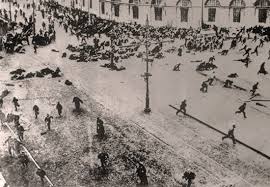
Demonstration during the "February Revolution" 1917. Note the prominence of women in the demonstration.
Demonstration during the “February Revolution” 1917

The Petrograd police were powerless to control the demonstrators who would have turned on them had they intervened. On the 11th, three days after the women’s mobilisation, the Tsar called on the Russian Army to intervene and to shoot demonstrators.

Russia had the largest single army in the world and despite the war, thousands were still in Petrograd. They had been used in the past against the workers and in 1905 had massacred people on a demonstration to petition the Tsar. But now, after three years of war and shortages, they were not keen to do so and particularly reluctant to open fire on women. Soldiers began to mutiny and, when threatened by officers, often shot them instead.

On that day, the Chairman of the Duma, the parliament which the Tsar Nicholas had kept powerless, sent an emergency telegram to the Tsar, who was at the Headquarters of the Russian Army, asking him for urgent action. The Tsar’s reply was dismissive – his wife, the Empress Consort Alexandra, had written to him that the problems in Petrograd were being exaggerated.

A Russian Army barricade during the "February Revolution" -- the soldiers refused the orders of their officers to shoot demonstrators.
A Russian Army barricade during the “February Revolution” — the soldiers refused the orders of their officers to shoot demonstrators.

But the garrison of Petrograd, including elite units, had mutinied by the 12th, four days after the women’s marches and demonstrations. In addition the Cossack troops, usually reliable in shooting and sabring demonstrators and rioters, were disobeying the orders of their officers to attack the people (although they had not joined the mutiny). Officers began to go into hiding as more of them were being shot by soldiers from their own units. Symbols of Tsarist rule were being torn down in public places.

Two days later, on the 14th, the socialist parties and organisations established the Petrograd Soviet, last seen there twelve years previously, in 1905, before it was crushed by the Russian army. The Petrograd bourgeoisie were frightened but were unused to ruling except as permitted to by the Tsar, who himself now seemed unable to control events. Their powerless Duma (parliament), although ordered closed down by the Tsar that morning, set up a temporary committee to restore law and order and later, their Military Commission as part of the Provisional Government they created.

Thus began a period of dual authority in the city – the revolutionary workers, soldiers (and later, sailors) through the Soviet on the one hand and the bourgeoisie through their Military Committee on the other.

The Petrograd Soviet set the tone for what was to come by approving a number of points in Order No.1, effectively the first law drawn up by the Soviet, point 4 of which stated:

“The orders of the Military Commission of the State Duma shall be executed only in such cases as do not conflict with the orders and resolution of the Soviet of Workers’ and Soldiers’ Deputies.”

The Soviet was making sure it could not be overruled by the new unelected body which the bourgeoisie had set up, the Provisional Government, or by its Military Commission.  

Senior Army and political appointees advised the Tsar to do what just over a week previously would have been unthinkable – to abdicate. On the 15th, the Tsar abdicated on his own behalf and of his son, nominating instead his brother, the Grand Duke Alexandrovich, to be Tsar. But he in turn knew he had no support as things stood and refused the “crown”.

July Days Russia 1917
Demonstrating workers shot down by Army units in the Russian “July Days”, 1917

The Russian monarchy of centuries had been overthrown — only seven days after the women’s mobilisation in Petrograd.

Maneouvers by the different sides continued during May and June, including an attempted military coup by senior officers commanding army units away from Petrograd. The fortunes of the revolution swayed back and forth across the country until demonstrations in July supported by the Anarchists and the Bolsheviks were suppressed by army units loyal to the Mensheviks and Socialist Revolutionaries political parties in power.

Workers were being disarmed, soldiers re-submitted to the old discipline and revolutionary leaders were being hunted; the War was also ongoing.

In October, the Bolsheviks seized power, ended Russia’s involvement in the War and began to construct a socialist state.

Two years later the people had to fight to defend it against a right-wing military uprising supported by eight states, including the Allies but were successful in the end.

But it was the women who had started the ball rolling seven months earlier on March 8th, with their rallies and demonstrations and calling the workers out from the factories. Henceforth too, they played their part in government, in building the country and in the armed forces, particularly during the war against fascism and in defence of the USSR from June 1941 to the fall of Berlin and Nazi Germany in 1945.

Nearly 200,000 women were decorated and 89 eventually received the Soviet Union’s highest award, the Hero of the Soviet Union. Some served as pilots, snipers (some of the ace snipers at the famous battle (or siege) of Stalingrad were women), machine gunners, tank crew members and partisans, as well as in auxiliary roles of nursing, construction, administration, factory work and of course food production.

end.

Soviet female combat pilots in WW2. The USSR was the only state to have female combat pilots.
Soviet female combat pilots in WW2. The USSR was the only belligerent state to have female combat pilots during WW2.

“POLAITIÚ” AN GHAEILGE AGUS AN BASCAIS

Curtha le céile ag Diarmuid Breatnach

(Achar ama á léamh: 5 nóim.)

Do b’é an chóilíneacht a rinneadh teanga na nGaeil a “pholatiú”, mar shompla le Reachtanna Chill Coinnigh, le coinníolacha na Plandála, leis na Péin-Dlíthe agus córas na scollaíochta náisiúnta faoi chóilínteacht Shasana. Is beag dul as bhí ag na hÉireannaigh náisiúnacha ach a dteanga dúchais a pholatiú mar chosaint, mar cheist tarrthála.

(Foinse íomhá: an Idirlíon)

Níor aontaigh an Ídeach agus an Phiarsach ar an gceist céanna agus ceaptar gur éirigh Dubhghlas de hÍde as uachtarántacht an eagrais a bhunaigh sé, Connradh na Gaeilge, dá bharr i 1915. Chuir na Sasanaigh Pádraig Mac Piarais chun báis i 1916 agus cé gur cuireadh an Ghaeilge ins an chéad áit go hoifigiúil ins an Saor Stát, agus de hÍde mar Uachtarán 1 1938, is in éag agus ag cúlú atá an Ghaeilge ag dul ó shin i leith (in ainneoin fás mhór scolaíochta lán-Ghaeilge ar leibhéal na bunscoilíochta agus cúpla bua eile thar na blianta, mar shompla bunú TG4 agus Raidió na Gaeltachta).

Pádraig Mac Piarais, Eagarthóir nuachtán Chonradh na Gaeilge, “An Claidheamh Soluis”. Bhí sé den tuairim gur ceist pholaitiúil chomh maith le cultúrtha a bhí sa Ghaeilge faoi chóilínteacht Shasana. Chuir na Sasanaigh chun báis é i 1916 (Foinse grianghraif: an Idirlíon)

Tá an cheist ós ár gcomhair arís agus chun an fhírinne a rá, níor imigh sí ariamh: polaitiú nó gan polaitiú, nó bás don teanga in ionad polaitiú. Deir scríbhneoirí an ailt thíos gur ceist práinneach sin don Bhascais. Is mar an gcéanna againne é maidir leis an Ghaeilge.

Dubhghlas de hÍde, a bhí i gcoinne “polaitiú” na teanga agus a d’éirigh as uachtarántacht Chonradh na Gaeilge i 1915, eagras a bhunaigh sé in 1892. Ceapadh é mar Uachtarán Stát na hÉireann i 1938. (Foinse grianghraif: an Idirlíon)

Aistriú go Gaeilge den alt i Naziogintza ag Cathal Ó Murchú:

CAITHFIMID TÚSÁITE A THABHAIRT DON BHASCAIS

Is ábhar díospóireachta é polaitiú na Bascaise dúinne inár n-eagraíocht NAZIOGINTZA ó a bunaíodh í.  Tá sé pléite againn agus neart scríofa ag tagairt air, agus anois – tríd an alt seo – chinníomar dul i ngleic leis an gceist seo go díreach.

Ar dtús, ní mór dúinn bheith soiléir faoi bhrí an téarma “polaitiú.”  Teastaíonn uainn bheith soiléir go n-úsáidimid an focal polaitiú ar bhonn náisiúnta, agus nach dteastaíonn uainn ar chor ar bith dul i mbun aighneas polaitíochta ar chlé nó ar dheis, nó bheith claonta le grúpa polaitiúil amháin nó eile.  Tá ár n-aighneas sa réimse seo le stáit na Fraince agus na Spáinne, ar mhian leo a dteangacha a bhrú orainn.  Mar gheall ar athchultúrú éigeantach na Spáinnise agus na Fraincise, agus ar theacht le chéile na bhfórsaí polaitiúla le déanaí, tá Tír na mBascach i mbun dhianphróiseas dínáisiúnaithe, a bhfuil cáineadh déanta go minic. Tá creimeadh ar fheasacht náisiúnach na mBascach soiléir agus díscaoileadh gasta ar siúl ar ár náisiún in aigéan ollmhór na féiniúlachta Franca-Spáinní.

I bpróiseas an asamhlaithe seo, tá stáit na Spáinne agus na Fraince tar éis gach uile uirlis is cleas ar fáil dóibh a úsáid.  Os rud é go dtuigeann siad gurb í an teanga crann taca an náisiúin, bhíodh siad de shíor ag iarraidh bunús na teangan Bascaise a bhaint, ach anois ar bhealach níos slítheanta: in ionad coscú iomlán ar theanga na Bascaise, mar atá déanta acu ar feadh na gcianta, anois tá siad ag rá go mba cheart “dípholaitiú” a dhéanamh ar an teanga Bascaise, ag iarraidh aon luach polaitiúil nó siombalach a bhaint ón mBascais, ag iarraidh teanga aimrid a dhéanamh aisti.  Ní hamháin meáin na Spáinnise, ach neart polaiteoirí, tráchtairí, gníomhuithe sóisialta chomh maith inár náisiún féin atá ag athrá na mana céanna: “níor cheart go ndéanfar polaitiú ar theanga na mBascaise.”

Nach ait gurb iad siúd is mó a bhíonn ag polaitiú (agus ag brú orainn) a dteangacha féin (Airteagal a 3 de Bunreacht na Spáinne: ní mór do áitritheoirí stát na Spáinne bheith eolach ar an teanga Spáinnise; mar an gcéanna le hAirteagal a 2 de Bunreacht na Fraince) atá amhlaidh orthu siúd ag maíomh dúinn nár cheart polaitiú a dhéanamh ar ár dteanga.  Nuair atáimid faoi fhulaingt ó aon leatrom teangan, mar shampla, deirtear linn gan cáineadh poiblí a dhéanamh ar seo, mar gheall go mbeimid ag polaitiú ár dteanga.  Is léir go bhfuil aitheasc “dípholaitaithe” na Bascaise sa tóir ar ghéilleadh ár dteangan.

Ach ní hamháin sin atá i gceist.  Iad siúd gur mhian leo luach ídé-eolaíoch na Bascaise a bhaint, tuigeann siad go maith go bhfuil cruinne siombalach bailithe, roinnt ar luachanna cultúrtha, i bhfocal amháin, Pobal i gceist.  Mar gheall go dtugann an teanga Bascaise ár láthair sa saol, agus muide i láthair mar Bhascaigh.  Le bheith cruinn faoi, is cuid an-bhunúsach an “muid” inár bhféiniúlacht náisiúnta, bunchuid a mhaireann thar na cianta, mar a aistrítear í ó ghlúin go glúin.  Iad siúd gur mhian leo an íde-eolaíocht a bhaint ónár dteanga, tuigeann siad go dtugann an Euskera féiniúlacht ar leith agus i gcoitinne dúinn: ar leith sa chaoi gur Euskaldunes (cainteoirí Bascaise) sinne, agus i gcoitinne sa chaoi go ndéanann an teanga Bascaise náisiún dúinn.  Is de dheasca na hEuskera a thugtar ainm agus croí do Thír na mBascach.

Iad siúd gur mhian leo an luach ídé-eolaíocht a bhaint ón mBascais, abraimís go soiléir é, is mian leo ár ndínáisiúnú: is mian leo an ghné is éifeachtaí a bhaint ónár dteanga, is mian leo an déthéarmach “Euskara-Euskal Herria” a scrios agus teanga ár dtíre a aistriú go rud éigin gan dochar nó neodrach ar nós gur Béarla nó Esperanto bheith ann, rud éigin gan anam.  Dar leo siúd, bheith gonta faoi, níor cheart go mbeadh teanga Thír na mBascach ceangailte an iomarca le Tír na mBascach féin.

Ag tabhairt aghaidh ar seo, dearbhaímid go soiléir go mba cheart meá pholaitiúl, fhéiniúlach agus shiombalach a thabhairt don Euskara. Go mba cheart dúinn polaitiú a dhéanamh ar an mBascais, mar sin, os rud é gur cuid bhunúsach mar náisiún é.

Bímis soiléir faoi rud amháin: ní bhaineann an Bhascais le haon pháirtí polaitiúil amháin nó le haon ídé-eolaíocht ar leith.  Ní hea ar chor ar bith.  Ach ní hionann sin agus ceart ar dhípholaitiú ar an mBascais.  Is é sin díreach an aidhm atá ag náisiúnuithe na Fraince agus na Spáinne gur mhian leo náisiúnachas na mBascach a lagú, agus mar aidhm ag Bascaigh áirithe gur mhian leo nach bagairt a bheith ann i gcoincheap na teangan.

Tuigeann aontachtuithe na Spáinne agus na Fraince go maith nuair a labhraímid Bascais go bhfuilimid ag cur ár bhféiniúlacht náisiúnta in iúl.  Tá uisce faoi thalamh i gceist leis an iarratas gan polaitiú a dhéanamh ar an mBascais: ná cur an teanga agus an fhéiniúlacht Bhascach in iúl — tá sé contúirteach.  Mar gheall ar an gcúis seo, ina n-iarrachtaí luach ídé-eolaíoch na hEuskera (nó an Chatalóinis nó an Ghailísis) a bhaint, is minic a deireann Spáinnigh arís is arís eile “go bhfuil teangacha mar bhunuirlisí cumarsáide.”  Ní hionann teangacha neamh-Spáinnise na Leithinse Íbéirí, ar ndóigh.  Mar nuair a labhraíonn siad faoina dteanga féin, deireann Spáinnigh go mbaineann an Spáinnis le hoidhreacht luachmhar na gcainteoirí Spáinnise uile, ceann a chruthaíonn naisc láidre chultúrtha is mhothúchánacha idir an Spáinn agus Méiriceá Theas (tá an lá Féile na Spáinnise ar siúl ag an 12ú Deireadh Fómhair, Lá an “Hispanidad”, is féidir an rud céanna a rá faoin “Francophonie”).  Ach ní hea, tuigimid go maith nach bhfuil teangacha mar uirlisí simplí cumarsáide.  Tá teangacha mar bhunchodanna i gcruthú na bhféiniúlachtaí bailithe, tá siad mar chodanna a chruthaíonn naisc chultúrtha agus mhothúchánacha idir a gcainteoirí.  Mura bhfuil sna teangacha ach uirlisí cumarsáide, bheimís go léir ag labhairt Béarla.

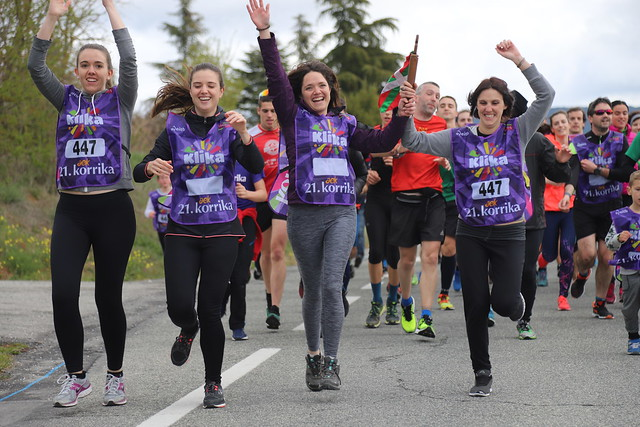
An Korrika (Rith) débhliantúil chun an Bascais a chur chun cinn, eagraithe ag AEK, eagras chun Bascais a mhúineadh do dhaoine fásta. (Foinse grianghraif: an Idirlíon)

Cibé áit a bhfuil teanga, tá féidearthacht ann do náisiún freisin.  Chomh maith le teangacha, is í feasacht i gcoitinne a n-áitritheoirí a chinnteoidh bunú an náisiúin sin. Mar sin, tá comhpháirt pholaitiúil na teangan soiléir — agus iad siúd gur mhian leo uallach pholaitiúil a bhaint ón mBascais, tuigeann siad go maith é seo.

Is oth an port céanna a gcaitear orainn a chloisteáil ó chuid den saol náisiúnach Bhascach: “ní cheart dúinn polaitiú a dhéanamh ar an teanga Bascaise.”  Iad siúd a deir seo, ní labhraíonn siad Bascais go rialta.  Baineann siad feidhm as an mBascais chun chur i gcéill, agus labhraíonn siad Spáinnis agus Fraincis ar a sáimhín só gan aon spéis ar leith.  Ach ba cheart do gach Bascach a bhfuil grá ina c(h)roí do Thír na mBascach tábhacht na teangan i múnlú an náisiúin a thuiscint, agus an difríocht idir Euskal Herria on Spáinn nó ón bhFrainc a aithint, a bpríomhghné, a dteanga, teanga na Bascaise.  An bhfuil orainn an fhianaise chuspóireach a cheilt?

Mar sin, ní féidir luach lárnach simplí a thabhairt don Bhascais, mar atá déanta i roinnt dár scoileanna.  Mar atá tugtha don Bhéarla, mar shampla.  Tá sé ríthábhachtach do mhic léinn i dTír na mBascach a thuiscint go bhfuil an Bhascais mar chrann taca dár bhféiniúlacht i gcoitinne, leis an mbrí iomlán a bhaineann leis.  Sa réimse seo, ní mór dúinn polaitiú a dhéanamh ar theanga na Bascaise, mar atá luaite againn cheana.  Ach labhróimid faoi sin go mion in alt eile maidir lenár samhail oideachasúil.

Gan amhras ar bith, ní mór an Bhascais a pholaitiú.  Ar an lámh amháin, le polasuithe uaillmhianacha teangan a chur i bhfeidhm a gceadaíonn dúinn seasamh débhéascna ár dteangan a shárú.  Agus ar an lámh eile, a shoiléiriú nach uirlis shimplií chumarsáide an Euskera amháin, ach an comhartha is follasaí a léiríonn an éagsúlacht ag Euskal Herria ó náisiúin eile na Cruinne.

A chríoch.

(Foinse grianghraif: an Idirlíon)

(Eagras Bascach neamhspleach ar dhreamanna polaitiúla is ea Naziogintza a bhfuil mar chuspóir aici an Bhascais a chur chun cinn mar chuid lárnach de náisiún Euskal Herria. Déantar staidéar ar chásanna teangachaí náisiún atá faoi láthair gan stát dá gcuid féin)

ANTI-MASKERS AGAINST SOCIAL SOLIDARITY

Diarmuid Breatnach

(Reading time: 7 mins.)

In an opinion piece in Saturday’s Irish Times, Sean Moncrieff describes a journey on public transport in which he and others were subjected to an anti-masking and Far-Right conspiracy harangue by two other passengers who were not wearing masks. This behaviour typifies the arrogant, overbearing attitude of these Far-Right conspiracy theorists and how opposed they are to the prevalent ethos, especially among working people, of social solidarity.

The incident described is far from being a random isolated one. Up and down the country, anti-maskers have insulted people wearing masks, calling them “muzzled”. Irish Yellow Vester Ben Gilroy was videoed following an elderly man around a supermarket, harassing him for wearing a mask. Some of them, like anti-migrant, anti-masker Alan Sweeney, whose home is in Co. Galway, and a couple from Wexford, have travelled far outside their 5 km. restriction zones to enter shops while refusing to wear masks and then filming the resulting altercation as being alleged struggles for their civil rights. Following an anti-masker rally last year, a group of them entered carriages on the LUAS (the Dublin tram system) and mocked and abused people wearing masks (Sweeney was among those that time too). On a supposed celebration of St. Brigid by anti-maskers in Kildare this February, one was allegedly pulling masks off elderly (naturally!) passers-by. A doctor who returned to Ireland to help fight the virus and gave a thumb-down sign to an anti-mask march in Dublin, was menaced by some participants while many shouted at him “Take off your mask”. Dublin QAnon leader Dolores Webster (‘stage’ name Dee Wall) at a rally in Galway last year was videoed unmasked and deliberately coughing at a counter-protester while laughing about it.

They have even picketed hospitals, as reported in Wexford and in London, while health workers in Wales on social media reported being attacked by anti-maskers. More of that behaviour would have forced the State to close them down, which is probably why we have not seen more of it.

One of the many ironies associated with the Far-Right is that they claim wearing masks creates fear and breaks down solidarity among people, making them more easily manipulated. Meanwhile they go about actually undermining genuine social solidarity wherever they find it.

One of the many expressions of social solidarity in a banner on display in the working-class Dublin area of the Liberties in February 2021. (Photo: D.Breatnach)

SOCIAL SOLIDARITY

Social solidarity evolved first among ancient human societies as a way to live to survive in difficult situations. First in the family, then in the tribe, people helped one another in order for the group as a whole to survive. As society developed, even in societies dominated by exploiting classes that had little or no notion of solidarity, aspects of this social solidarity continued: agricultural communities worked in cooperation to get harvests in, to dig and operate irrigation ditches, to maintain various infrastructures. Workers, pitted to compete against one another as individuals or even groups, learned to build common solidarity and developed slogans like “An injury to one is an injury to all!” and “United we stand, divided we fall!” The moral folk tale of the mother (or father) and the sons (or daughters) being likened to sticks, individually vulnerable but unbreakable in a bunch, is known around the world.

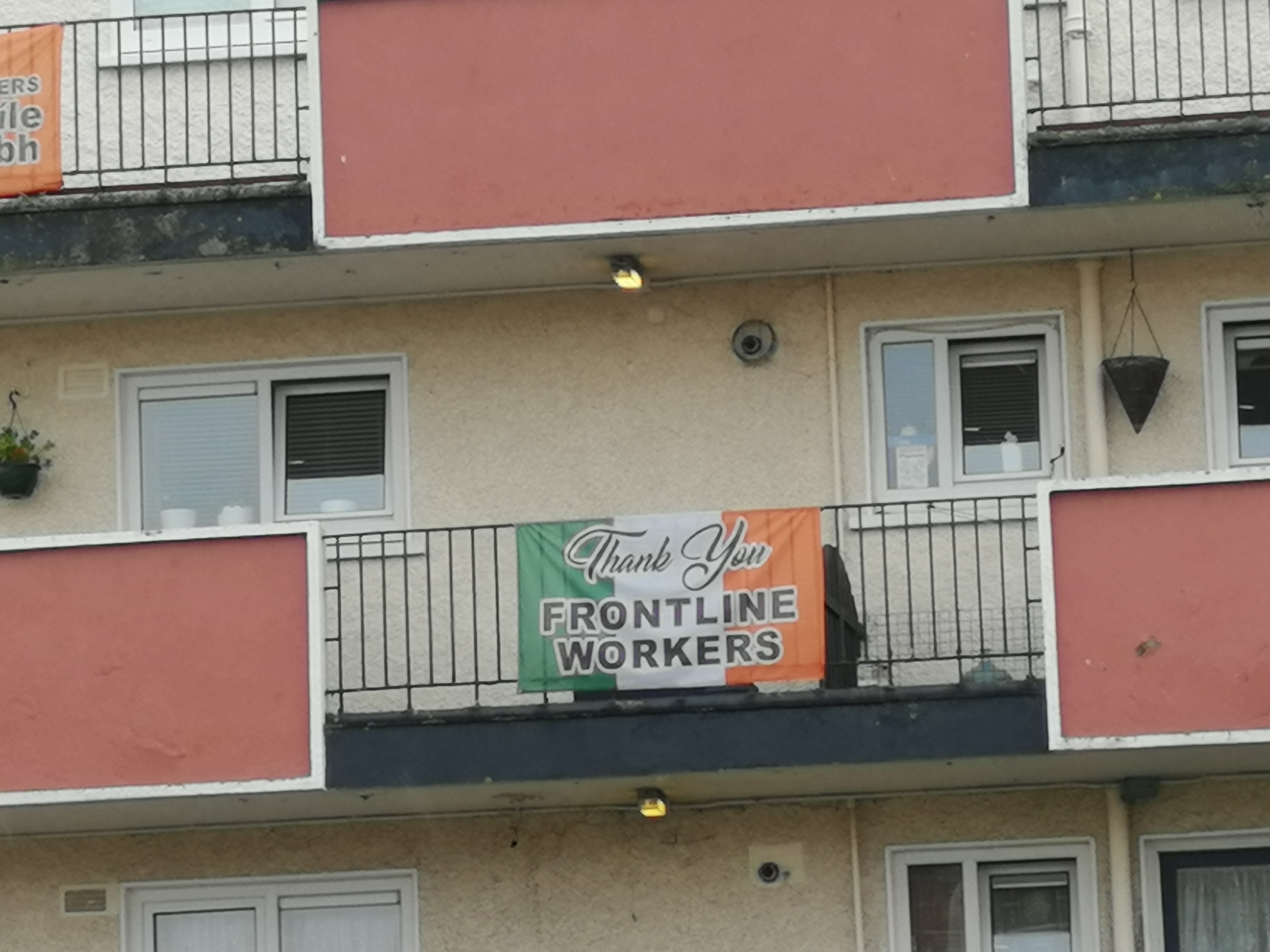
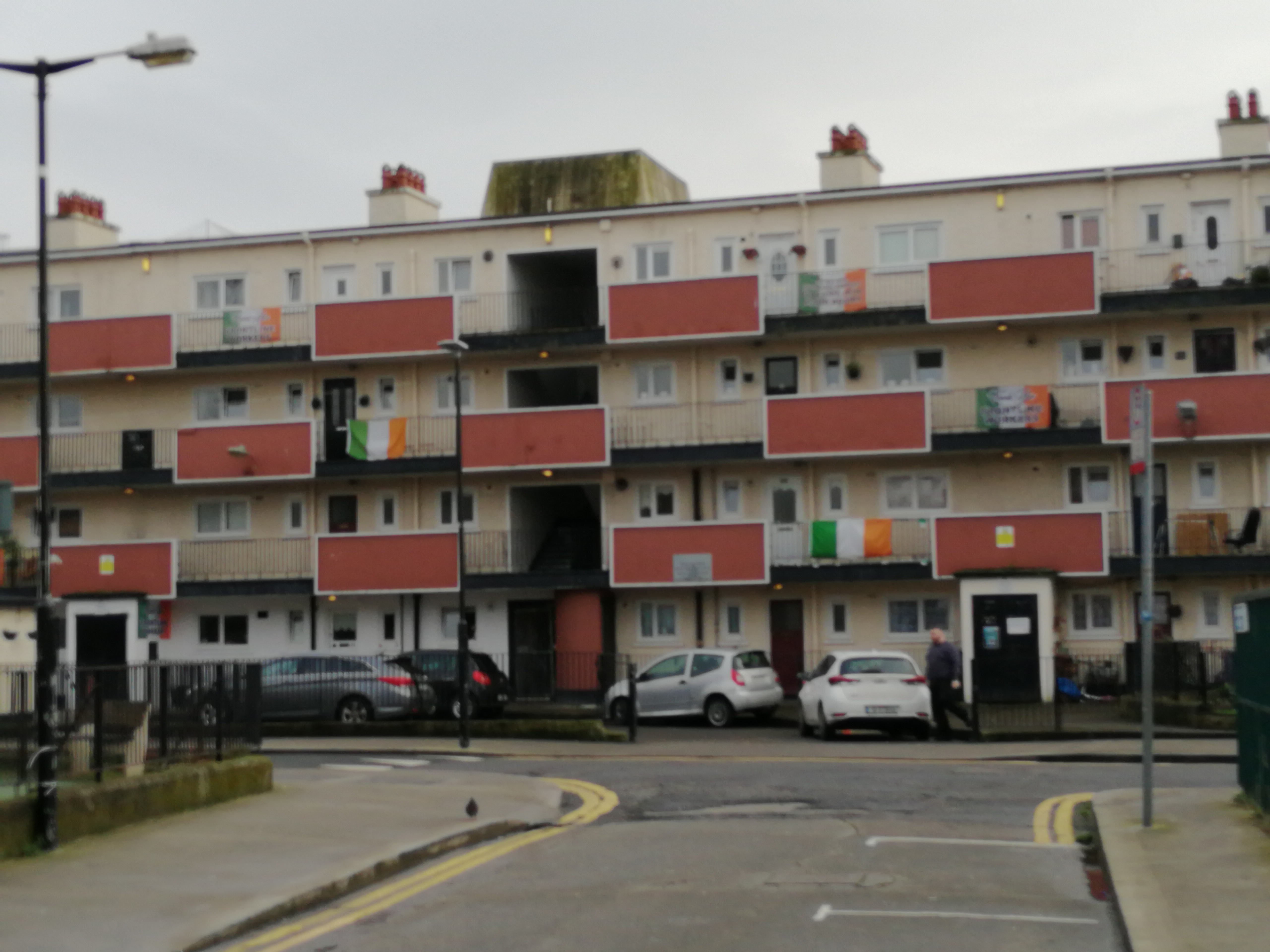
An expression of social solidarity: A block of flats in the Liberties, Dublin, displaying banners thanking front-line workers. (Photo: D.Breatnach)

During this pandemic, social solidarity has been expressed by cooperation to stop the spread of the virus, for example by maintaining social distancing, wearing masks in shops or among crowds. It has also seen expression in demonstrations of solidarity with front-line service workers, in actions like creating solidarity noise, posts on social media, display of placards and banners inside windows and on balconies. People have helped neighbours with their shopping and delivery needs and in some areas, communities have organised a broader service. The anti-maskers and the fascists among them, naturally, have done none of this, despite claims to be raising money “to feed the homeless” or “for mental health services” at events they used to promote their right-wing anti-masker rhetoric (and quite possibly line their own pockets). In fact the genuine feed-the-homeless voluntary services already in operation prior to the pandemic — due to the crisis of homelessness and lack of adequate services in this state – have continued their voluntary work, risking their health and safety. And though they appeal for donations of food, clothing and sleeping bags, they NEVER ASK FOR MONEY.

FASCISTS AT WORK

In recent developments the unity of the Far-Right in Ireland has fragmented. But in earlier days, the organised fascists in the very small parties and groups encouraged the anti-maskers in order to increase their numbers on protests, to recruit members into their own groups and to prepare some of them for street-fighting against the Left. The largest rallies were convened by the Irish Yellow Vests, led by Islamophobe Glen Miller and the self-promoting “anti-eviction activist” (sic) Ben Gilroy. But they were attended and promoted by a wide range of Far-Right conspiracy theorists, anti-maskers, anti-immigrants and Catholic fundamentalists including QAnon, Gemma O’Doherty, the fascist National Party, Síol na hÉireann and Irish Freedom Party.

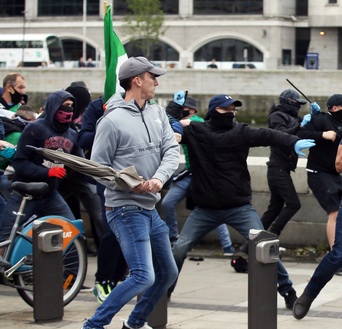
After a rally of theirs at Custom House Quay on 22nd August 2020, a spokesperson for the National Party boasted about having organised the rally’s “security operation”; what he was referring to was an attack by at least 50 men, most of them armed with metal bars and clubs disguised as flags, upon an unarmed smaller group of counter-protesters in which one of the latter was knocked unconscious.

WHY ARE THEY ALLOWED TO BEHAVE LIKE THIS?

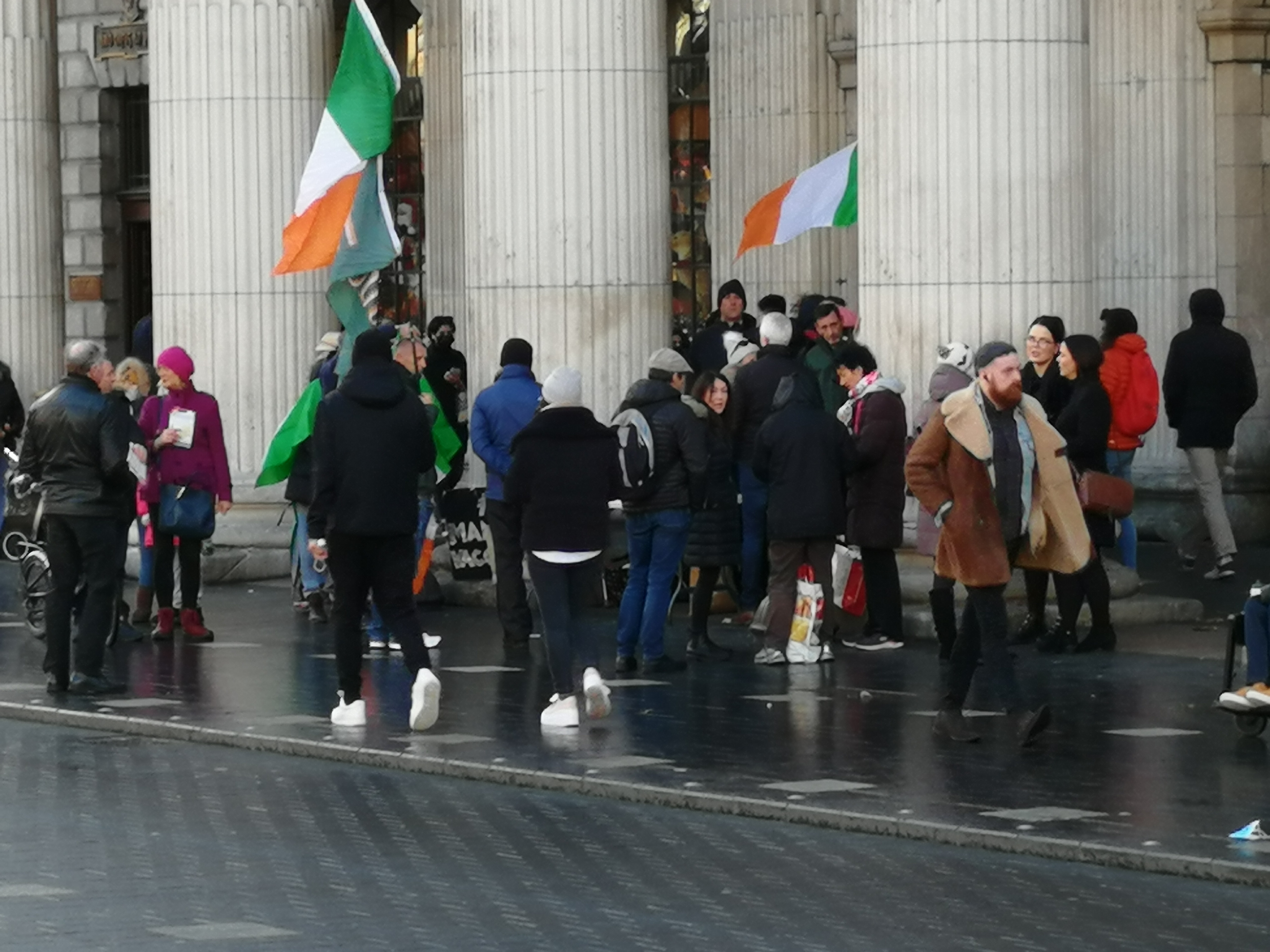
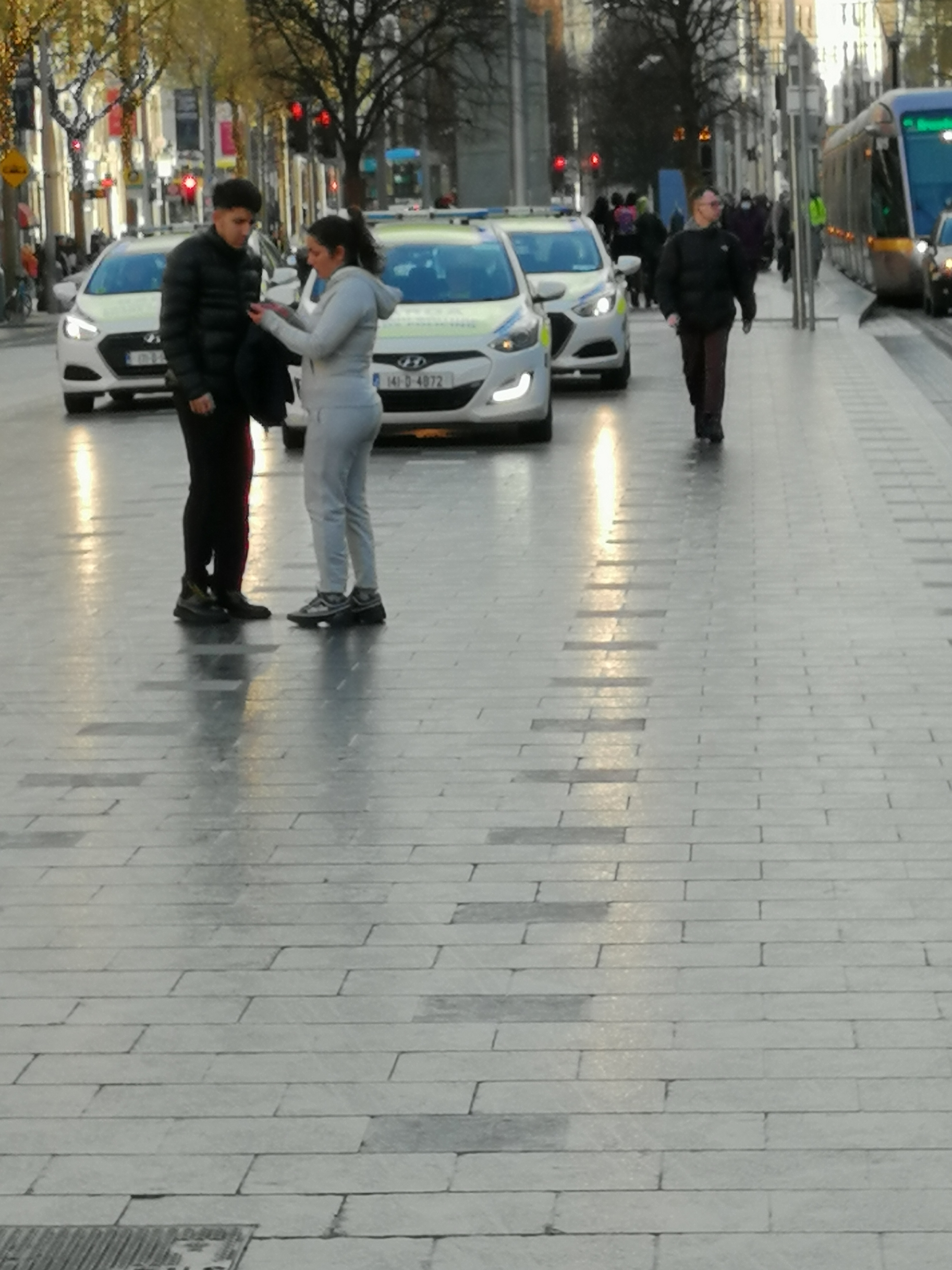
The above is a question many ask themselves. Although recently there have been a few arrests for contravention of pandemic restrictions and public disorder, in general the anti-maskers have enjoyed a freedom to flout the law to a degree difficult to believe. The QAnon group that rallied for months every Saturday outside the GPO in Dublin had a police presence only to protect them, while around the corner the pickets of sacked Debenham workers were harassed by the Gardaí. On a couple of those Saturdays, people in O’Connell Street picketing in solidarity with a Basque hunger-striker, though masked and maintaing social distancing, were harassed by the State’s political police.

QAnon in December at weekly gathering outside the GPO, Dublin against wearing masks, lockdown etc etc. (Photo: D.Breatnach)

Gemma O’Doherty videoed herself up and down the country denouncing all and sundry while violating pandemic restrictions. Sweeney, as mentioned earlier, has done the same, abusing shop workers providing a service while carrying out their duties under pandemic restrictions. Dolores Webster aka Dee Wall has had herself videoed addressing anti-masking rallies in places as far from Dublin as Galway and Belfast. The Irish Yellow Vests were allowed to flout the restrictions on a number of their rallies and marches until they tried to block Grafton Street and were aggressive to the Gardaí who tried to move them on, whereupon the Far-Rightists were shocked to be on the receiving end of police batons, normally only experienced by genuine protesters about social and economic conditions.

Some of the Garda protection for QAnon in O’Connell Street on 20 December 2020. (Photo: D.Breatnach)

The Far-Right have been allowed to breach pandemic restrictions because their protests do not threaten the status quo. Furthermore, they aim at disrupting social solidarity which is no friend of the ruling class and its governments of various political parties. But there is more to it than that. The QAnon and Far-Right demonstrations in the USA were observed to have police support and police officers were observed opening gates for their recent invasion of the Capitol building in Washington DC (although a police officer was also killed in the invasion). In Ireland, the counter-protesters attacked by armed (and masked – at an anti-mask rally!) fascists at the Irish Yellow Vest rally at Custom House Quay on 22nd August 2020 were not only not arrested but the Gardaí attacked the counter-protesters. A few weeks later, an LGBT campaigner of many years was clubbed to the ground in Kildare Street by a supporter of the National Party after which the Gardaí ordered the woman, blood streaming down her head, to leave the area. On each occasion the Gardaí reported no serious incidents had occurred but following widely-disseminated video on social and mass media of the latter incident they were forced to amend their report and eventually to arrest an individual for the assault.

Some of the armed fascists that attacked a counter-protest on Custom House Quay on 22 August 2020, which the National Party boasted on video of having organised. The Gardaí arrested none of these and attacked the counter-protesters instead. Three weeks later an LGBT campaigner was clubbed by a fascist in Kidlare Street and, blood streaming down her head, ordered away by Gardaí. On each occasion the Gardaí said no serious incident had occurred but in the second case had to change their story some hours later due to video sharing and outraged comment. (Source Image: Internet, then cropped)

This is not merely a case of general police and fascist mentality running in parallel — the Gardaí have faced and attacked protesters on the Republican and socialist Left for decades. That is the section of society that is viewed as a potential threat by the ruling class and its State. And when the working people are to be squeezed in future austerity to make them pay for the capitalist crisis, it is those among the Republican and socialist Left that will be mobilising protests in resistance. A fascist and racist movement undermining social solidarity and attacking the genuine opposition must surely be a most welcome phenomenon to the Irish ruling class.

A conspiracy theory? Perhaps – but certainly a more logical one and with a basis in history.

End.

SOURCES & FURTHER READING:

Sean Moncrieff piece in the Irish Times: https://www.irishtimes.com/life-and-style/people/sean-moncrieff-they-re-idiots-leave-it-by-the-time-i-sit-down-again-i-m-speechlessly-angry-1.4471045

Far-Righter Alan Sweeney harassing people wearing masks: https://www.facebook.com/permalink.php?id=1577148655909375&story_fbid=2618273678463529

https://www.98fm.com/podcasts/98fm-39-s-dublin-talks/anti-masker-screams-adrian-luas-protest

and engineering altercations by entering shops without masks: https://www.irishtimes.com/news/ireland/irish-news/anti-maskers-serve-them-and-get-them-out-as-quickly-as-possible-1.4423654

Doctor who returned to Ireland to help fight the virus intimidated: https://www.irishexaminer.com/news/arid-40048547.html

Misreporting of the Irish Yellow Vest rally on Custom House Quay in August 2020: https://www.irishtimes.com/news/ireland/irish-news/four-arrested-in-clashes-at-anti-facemask-protest-in-dublin-1.4336794

A more reality-based account of the August Irish Yellow Vest rally: https://rebelbreeze.com/2020/08/31/there-will-be-another-day/

Commemorating those who have died with Covid 19: https://www.irishtimes.com/covid-19-lives-lost

James Mooney The Irish American “Indian Man”

By Geoff Bell

(Reading time: 3 mins.)

An 1893 article on James Mooney by the Chicago Inter-Ocean newspaper correctly claimed that he knew more about the North American Indian than anyone else in the world. The son of poor Irish immigrants, Mooney never had the chance of higher education, yet amazingly he became not only a champion of Native peoples, but also one of the most influential anthropological fieldworkers of all time. His books written more than a century ago are still considered classics in the field.

Mooney possessed a talent for detailed and disciplined research that one of his colleagues later described as genius and he left several volumes of research. At a time when most Americans considered Native American culture barbaric and primitive, Mooney’s fascination with Irish myth and deep identification with its culture informed his view of Native Americans. Mooney saw Ireland as a spiritually rich, though materially deprived culture, which shaped his sympathetic views of Native Americans.

James Mooney in his 40s or 50s perhaps. (Source photo: Internet)


The Mooney family came to America as famine refugees. His father James Mooney was an itinerant scholar who taught Gaelic and Irish history at a time when it was a crime to do so. Born in Meath about 1832, Mooney’s father left for Liverpool in 1849, but life was hard and prospects limited, so he decided to move to the United States. Arriving in New York City in 1852 aged 30 he Married Ellen Devlin, 12 years his junior. He had known her family in Meath and asked for Ellen’s hand in marriage, but at first she refused the impoverished teacher. In New York they experienced the grim life of the tenements.

Ellen had family in the Midwest and in 1852 they moved to Richmond, Indiana. James Mooney died soon after his son’s birth, leaving the family to contend with poverty. His mother, who made her living as a housekeeper, supplemented her son’s public school education with tales of her native country, stories about the former grandeur of Irish culture, and memories of oppressive British rule. After graduating from high school in 1878, Mooney taught public school for one year and then joined the staff of the Richmond newspaper, but Mooney was a romantic who chafed at the limitations of small town life.

Since childhood, Mooney had a fascination with Native Americans and he longed to study them. Lacking any credentials whatsoever, Mooney applied for a position with the Bureau of American Ethnology, which was run by the famed explorer John Wesley Powell, the first white man to see the Grand Canyon. Amazingly, Mooney talked his way into a non-paying position and eventually became a paid member of the Bureau and one of the first “professional” scholars studying Native Americans.

James Mooney with Native American (Source photo: Internet)

His first field work was studying the few remaining members of the Cherokee Tribe in North Carolina. The Cherokee were victims of the brutal expulsion policy of President Andrew Jackson who sent them west to Oklahoma on the infamous “Trail of Tears.” Mooney lived with the Cherokees, learned their language and soon gained their trust. Mooney believed that the only way to learn their ideas and study their character was to live and work with them. At a time when the general attitude towards Native Americans was dismissive, Mooney saw the Cherokees not as inferiors, but as humans who shared a common humanity with people from more materially advanced civilizations. The more time he spent with Native Americans, the more his writing stressed their humanity. From his Irish roots, Mooney understood that some cultures put great store in charms and prayers and Mooney became a great chronicler of Native incantations and prayers, using them as a focal point to derive a deeper understanding of Native cultures.

Painting depicting winter scene of the expulsions of the Cherokee from Georgia to Oklahoma (1830-1850), “The Trail of Tears”. Permitted no preparation, their homes were looted by whites even as they were hustled away. 4,000 died on the journey. (Source image: Internet)

At a time when the Commissioner of Indian Affairs had told government employees to do everything in their power to curb native ceremonies, Mooney’s detailed research into Native beliefs, rituals, folklore and traditions violated government policy and was nothing short of revolutionary. Mooney published his groundbreaking study of the Cherokee, The Myths of the Cherokee, which added a new dimension to the writing of Indian history by using sources from the Indians themselves. The comprehensive work compiled 126 Cherokee sacred stories, animal myths, legends, wonder stories and historical traditions. His account is tinged with a sadness informed by his awareness that Gaelic and Cherokee culture were both under threat, writing, “the older people still cling to their ancient rites and sacred traditions, but the dance and the ball play wither and the Indian day is nearly spent.”

Cover of 1995 Reprint (Source photo: Internet)

Mooney’s career spanned thirty-six years and several Native American peoples. At a time when many whites wanted to force Native Americans to abandon their culture and assimilate, Mooney became an outspoken critic of assimilation and the boarding schools where forced assimilation occurred, making him an object of scorn for supporters of the practice.

He was also viciously attacked for his defense of two Native traditions: the Ghost Dance and the use of peyote in religious ceremonies. The Ghost Dance was a Native ritual that spread from tribe to tribe. Started by a Native American mystic and visionary, the Ghost Dance promised a physical regeneration of the world and the removal of all whites from Native lands. Fear of the dance led to the tragic massacre of Native Americans at Wounded Knee in 1890. Published in 1896, Mooney’s Ghost Dance Religion and the Sioux Outbreak of 1890 established Mooney’s reputation among anthropologists and historians. It has been called “The classic study of the American Indian revitalization movement.” Its power derived in large part from Mooney’s Irish heritage, which gave him an acute awareness of a people struggling to preserve their culture against economic, political and cultural oppression. Native American scholar Robert Utley said of Mooney, “No scholar since has tried to tell the story of the Ghost Dance in so comprehensive a fashion and that will never be done.”

Cover of a collection of Mooney’s publications on the Cherokee rituals and beliefs in paperback 1992. (Source photo: Internet)

Though his life was dedicated to Native Americans, he never forgot his Irish roots. He learned some Gaelic and sang Gaelic songs to his five children. In 1907, he hosted Douglas Hyde, founder and president of the Gaelic League, at a meeting that laid the groundwork for the Gaelic League of Washington. Mooney became President of the Gaelic Society of Washington and thanks in part to Mooney’s efforts, Hyde won support for the establishment of the first Irish Studies programs at American universities.

Mooney also suffered opprobrium for his defense of the Native American rituals using the Peyote cactus, which has hallucinogenic properties. In 1891, he became the first white man to ever witness a peyote ceremony. Mooney understood that peyote became for Native Americans a bridge to another spiritual dimension. Misunderstood like the Ghost Dance, the peyote religion counseled peace and brotherhood among the Indians and unlike the Ghost dance it did not pledge destruction of the whites. In February 1915, he testified in Congress in defense of the Peyote right, even though it jeopardized his government job.

An older James Mooney (Source photo: Wikipedia)

Mooney died in 1921 believing that despite a lifetime of work, little had changed. He ended his career as he began it: convinced of the inability of one race to understand another. Mooney had committed his life to preserving Indian culture against a White world committed to its eradication. His mission flatly contradicted the Federal policy of assimilation, which assumed that, within a generation, there would be no more Indians, only “Americans.” Today, he is still recog­nized by whites and Indians alike as one of the foremost Native American ethnologists ever and a man who played a massive role in preserving Native American culture.

End.

(Source photo: Internet)

SOURCES

https://en.wikipedia.org/wiki/James_Mooney

Moses, L.G, The Indian Man – A Biography of James Mooney, University of Nebraska Press Lincoln, Nebraska 1984